The aim of this paper is to understand the region of Central Asia through its distinctive relationship with water resources and how states in the region co-operate—or should do so—in order to achieve better management of this valuable resource.
Map of the Aral Sea Basin. source: <http://www.karakalpak.com> and Royal Haskoning DHV.

Article 1(3) of the Charter of the United Nations (UN Charter)Footnote 1 exhorts international co-operation as a general goal of the international community; but it is also a positive duty that sovereign states must comply with when dealing with matters of common concern, in conformity with General Assembly Declaration 2625.Footnote 2 Thus, we believe that the duty to co-operate in good faith, aimed at achieving a sound and reasonable outcome for all, should be borne in mind during international negotiations which tackle the management of national and collective interests in the field of transboundary watercourses.
Section I introduces the general legal context and, after the presentation of factual data, it examines the management of water resources in the region from the viewpoint of the obligation of co-operation established under general international law, including the realization of the right of access to water and sanitation by all citizens. We observe that the lack of sound regional co-operation on water management issues leads to mismanagement of water resources and loopholes in citizens’ access to this basic resource. Subsequently, we analyze how and to what extent current international co-operation tools might contribute to solving existing challenges. To this end, we explore in detail two areas in which regional and supraregional co-operation are providing promising—but yet insufficient—results. These concern both co-operation in the generation and distribution of hydroelectric power in the region, and regional co-operation in the management, conservation, and sustainable development of the inland fisheries of Central Asia. Within the framework of water usage, we have selected cases to illustrate the different degrees of co-operation in order to ascertain the consequences for the region in each of them and to push for improved co-operation in all areas related to water usage.
I. A GENERAL OVERVIEW OF WATER AND CO-OPERATION IN CENTRAL ASIA
In this section, we shall provide some basic data on water availability and use in Central Asia, both in terms of political priorities and its legal framework. This will show the inherent difficulties for the common management of water resources in the region and will lead to an unsatisfactory outcome in terms of the management of water and access to it by individuals.
A. Management of Water Resources: A Priority for the States of Central Asia
The core issue with water in Central Asia is the need to balance its sustainable use between the easternmost upstream area of the region (Kyrgyzstan and Tajikistan), which produces seventy-five percent of these water resources, and the downstream area of the floodplains (Uzbekistan, Turkmenistan, and Kazakhstan), which consumes roughly the same percentage. This situation has compelled the five states to give special attention to the management of water resources in the region's two principal river basins around the Syr Darya and Amu Darya rivers. Today, the stability of these river basins has a direct relationship to the potential escalation of conflict, and it poses a significant concern for the power relations among the states involved in their management.
The five states share the resources of the Syr Darya and Amu Darya river basins. In particular, Kyrgyzstan, Uzbekistan, Tajikistan, and Kazakhstan share the Syr Darya Basin, which has a length of 3,019 kilometres (km), a catchment area of 219,000 square kilometres (km2), and an annual volume of 37.2 cubic kilometres (km3). There are five large reservoirs in the catchment area, and eighty percent of the land is under cultivation by irrigation. The irrigation system covers 300,000 hectares (ha) in Tajikistan (with a projected addition of 500,000 ha, not all within the same watershed), 400,000 ha in Kyrgyzstan (with a projected addition of 230,000 ha), 800,000 ha in Kazakhstan, and 1,900,000 ha in Uzbekistan.Footnote 3 Similarly, the Amu Darya Basin is shared by Tajikistan, Turkmenistan, Uzbekistan, and Kyrgyzstan, as well as by Afghanistan and Iran. The Amu Darya Basin, whose source is in Vakjdjir (Afghanistan), contains over thirty-five man-made reservoirs along its route: two of them are large river seasonal storage reservoirs (Nurek on the Vakhsh River and Tuyamuyun in the lower reaches).Footnote 4 It has a length of 2,540 km with a catchment area of 309,000 km2 and an annual volume of 73.6 km3. The irrigation system covers 22,000 ha in Kyrgyzstan, 469,000 ha in Tajikistan, 1,735,000 ha in Turkmenistan (with a projected addition of 450,000 ha), and 2,321,000 ha in Uzbekistan (with a projected addition of 634,400 ha), as well as 460,000 ha in Afghanistan.Footnote 5
As indicated, Kazakhstan, Uzbekistan, and Turkmenistan are located downstream, while Kyrgyzstan and Tajikistan are upstream. Kazakhstan has a population of fifteen million inhabitants and only ten percent of its gross domestic product (GDP) comes from agricultural activity, while twenty-three percent of the population works in the sector. Because the country is dependent on the water resources of its upstream neighbours, the government of Kazakhstan identifies the transboundary management of waterways as a question of national security, and it seeks to promote a strategy based on co-operation with the countries in the region. This has led the government to take an active part in the development of various initiatives with its neighbours, for example by investing heavily in hydroelectric infrastructure. At the same time, however, Kazakhstan has also pursued specific unilateral measures, such as the construction of the Koksaray Dam to combat the floodwaters that arrive from Kyrgyzstan and Tajikistan, or the construction of a series of dykes and canals to restore the water level and address degradation in the part of Kazakhstan in the vicinity of the Aral Sea.Footnote 6 Uzbekistan is the most populous state in the region, with roughly twenty-seven million inhabitants. Agriculture, primarily the cultivation of cotton, accounts for twenty-five percent of its GDP, while forty-four percent of the population work in the sector. Of the country's territory, sixty percent is desert, making the joint management of transboundary water one of Uzbekistan's chief priorities as well. However, this objective often runs into difficulties arising from the country's complex relations with its neighbours. In Turkmenistan, which has only five million inhabitants, eighty percent of the territory is affected by desertification, although twenty-five percent of the country's GDP comes directly from agriculture and forty-four percent of the population work in the agriculture sector. There are tensions in the Amu Darya Basin, particularly between Turkmenistan and Uzbekistan, stemming from, among other considerations, the Turkmen construction of a man-made lake in the Karakum Desert. Yet, in spite of the need to maintain good relations with Uzbekistan, the Turkmen government puts less emphasis on regional co-operation and focuses principally on its neighbours in the Caucasus and the Middle East.Footnote 7
By contrast, Tajikistan and Kyrgyzstan are located upstream. The mountains of Tajikistan contain the headwaters of the Amu Darya River and the country has roughly seven million inhabitants, with fifty percent living in rural areas and working in agriculture. In the wake of the serious economic crisis that followed the breaking-off of relations with Russia, the state had to devote considerable resources to ensuring food security for its population in one of the poorest countries in the area. This, in turn, has given rise to a need for more efficient management of water resources. Kyrgyzstan, which has a population of 5.2 million inhabitants, is rather poor in natural resources other than water. The mountain ranges of the country contain the headwaters of the Naryn River, which is the main tributary of the Syr Darya and an important source of the country's hydroelectric power. Agriculture accounts for thirty-nine percent of Kyrgyzstan's GDP, and fifty-five percent of the population are employed in the sector. Energy security issues are one of the country's top priorities.Footnote 8
The indiscriminate consumption of water in agricultural activity, and particularly in the monoculture of cotton in Uzbekistan, Turkmenistan, and Tajikistan, to which we will return, required the establishment of large-scale irrigation systems and, in the 1960s, this resulted in the drying-up of the Aral Sea,Footnote 9 one of the elements essential to the maintenance and regulation of the region's natural and climatic balance. This situation, together with the complete lack of crop rotation and the inadequate upkeep of the network of irrigation channels, eventually caused in the Aral Sea Basin what water resource experts call a “disruption in the prevailing water balance”.Footnote 10 By 1990, more than ninety-five percent of the marshlands and wetlands had turned into desert, and more than fifty delta lakes, covering an area of 60,000 ha, had dried up. Since then, the ecological situation of the Aral Sea has been classified as biologically dead, with over 33,000 km2 of its seabed exposed in vast salt flats contaminated by pesticides carried by the wind distances of up to 250 km. At the same time, as a consequence of climate change, there has been a drastic imbalance in the formation areas at the headwaters of the rivers, primarily in the mountain ranges of Pamir, Tian Shan, and Altai, where evidence points to a twenty-five percent loss in glaciers between 1957 and 2000.Footnote 11 In addition, the watersheds of the region's two chief rivers, the Amu Darya and the Syr Darya, are considered especially compromised. The two watersheds have suffered a reduction in water availability of forty percent and thirty percent, respectively, as have the Karakum Canal in Turkmenistan and the Irtysh in Kazakhstan, the reservoirs of Vilef and Sogdiyskaya in Tajikistan, and, broadly, the Ferghana Valley, whose waters and lands are a source of dispute between Kyrgyzstan and Uzbekistan.Footnote 12
B. Obligations of International Co-operation Amongst States Sharing a Water Basin and the Specific Forms of such Obligations in Central Asia
Contemporary international law has developed and codified the obligations of co-operation for states that share international waterways—which is the de facto case of Central Asia and particularly of the Aral Sea Basin. From this standpoint, two general considerations need to be noted: the first regarding the development of international co-operation and its specific forms in recent international legal instruments that are multilateral in nature, specifically in Central Asia, and the second in relation to the very concept of international waterways and their connection to the concept of a water basin, which is more useful when addressing the difficulties of international co-operation and water management in Central Asia, particularly in the Aral Sea Basin.
With respect to the first consideration, it should be remembered that co-operation among states sharing watercourses began in the nineteenth century. The aim was to facilitate the management of common interests, fundamentally international shipping and trade. In some instances, this initial co-operation led to the establishment of permanent institutional mechanisms. In any event, however, more recent economic and social progress has shown the importance of other uses of international waterways, such as energy production, industrial consumption, fisheries, and agricultural irrigation, as well as the problems generated by water pollution and the depletion arising from these uses. In other words, the scope of international concern over international waterways has multiplied to the same extent that the evolution of international law and of international society has led to an appreciation of shared natural resources requiring the co-operation of affected states in order to ensure their management, conservation, and sustainable development.
For present purposes, and leaving aside the many bilateral or multilateral agreements at the regional level, there are currently two main multilateral international tools on international waterways: one is the Convention on the Protection and Use of Transboundary and International Lakes (Helsinki Convention);Footnote 13 the other is the UN Convention on the Law of the Non-Navigational Uses of International Watercourses (1997 UN Convention).Footnote 14
On the one hand, some of the aims of the Helsinki Convention are expressed in Article 2:
a) To prevent, control and reduce pollution of waters causing or likely to cause transboundary impact; b) To ensure that transboundary waters are used with the aim of ecologically sound and rational water management, conservation of water resources and environmental protection; c) To ensure that transboundary waters are used in a reasonable and equitable way.
To this end, the Helsinki Convention establishes obligations of co-operation among the states that are parties to it for the purposes of protecting and using transboundary waters.Footnote 15 Therefore, it is a general environmental convention addressing the negative consequences of pollution from human activity in relation to international waterways. At present, only three of the five states of Central Asia are parties to the Helsinki Convention: Kazakhstan (since 2001), Uzbekistan (since 2007), and Turkmenistan (since 29 August 2012).Footnote 16 On the other hand, the 1997 UN Convention is a general framework convention that seeks to ensure the use, exploitation, conservation, management, and protection of international waterways, as well as the promotion of their optimal and sustainable utilization for current and future generations.Footnote 17 However, in Central Asia, it has only been ratified by Uzbekistan (in 2007).
Specifically, the states in the region have adopted a number of conventions on the joint management of interstate water resources,Footnote 18 and they have established, among other institutional frameworks, the Interstate Commission for Water Coordination (ICWC) in order to promote the rational use, protection, and control of transboundary waters.Footnote 19 However, the legal system surrounding the ICWC poses contradictions: first, it is excessively sector-specific, focusing on terms of exchange in the trade of water for energy;Footnote 20 second, it essentially guarantees the management principles and the exchange structures put in place during the Soviet era, which are structurally unsatisfactory from an environmental viewpoint, but accepted by the region's five states.Footnote 21
With respect to the second consideration, there is some dispute over the very concept of international or transboundary watercourses and its subsumption within the broader concept of the international water basin, which is also geographically and biologically much more clear In other words, the question is whether international watercourses are only rivers that cross borders between two states and rivers whose waters flow through two or more states, or whether they must be understood in relation to an entire water or drainage basin to the extent that these watercourses are located in two or more states, thereby forming an entire coherent hydrological system. The use of either of these concepts also responds to competing interests, with the downstream states typically pushing for the broader concept of a water basin.
In this respect, the Helsinki Convention sets out a more limited definition of “transboundary waters”, stating that they are “any surface or ground waters which mark, cross or are located on boundaries between two or more States” (Article 1.1). By contrast, the 1997 UN Convention establishes a fuller definition, defining “watercourse” as “a system of surface waters and groundwaters constituting by virtue of their physical relationship a unitary whole and normally flowing into a common terminus” (Article 2.a). In other words, these concepts are not similarly defined, especially with the 1997 UN Convention incorporating the idea of a connection between surface waters and groundwaters in a “unitary whole”, from which it is possible to deduce a much broader view of the concept of the international water basin.
These considerations are useful in relation to the Aral Sea Basin, which as noted earlier is basically made up of the river basins of the Syr Darya and the Amu Darya. These river basins, with all of their tributaries, extend over more than 500,000 km2 throughout the five states of the region, although a number of the tributaries within the Amu Darya Basin are located in Afghanistan and Iran. Beyond this last connection, it is clear that, as already indicated, the demise of the Soviet Union has given rise to an international dimension that did not previously exist, thereby creating the need for the new states of Central Asia to give attention also to management and international co-operation relating to water resources and their various uses. In this respect, we hold the view that the principles that have inspired the main existing international rules on international watercourses have a role in exhorting action and co-operation among the states of Central Asia.
C. Access to Water and Sanitation in Central Asia
The United Nations General Assembly (UNGA) proclaimed in 2010 that every person has a human right to water and sanitation. The scope and content of such a right has been developed by the Committee on Economic, Social and Cultural Rights, as well as by the Special Rapporteur on the Right to Water and Sanitation.Footnote 22
In the context of the Asian continent, access to improved water sources has consistently increased in recent years. The percentage of the populace with access to safe drinking water has risen from seventy-two percent to eighty-seven percent in little more than fifteen years.Footnote 23 For the five states of Central Asia, the lack of transparency characterizing their political systemsFootnote 24 is an enormous obstacle to reliable information on their citizens’ ability to gain access to safe drinking water. From secondary sources, we do know that all of the states of Central Asia acknowledge that water is one of the most important factors for their economic and social development and that, as a consequence, they have all adopted legislation and codes that unequivocally establish water as the property of the state.Footnote 25 However, in some cases, this also comes with the view that water should be treated as a commodity with a market price.Footnote 26 Moreover, in nearly all cases, their declarations on the importance of water are exceedingly rhetorical in nature.Footnote 27 In any case, the public ownership of water puts the responsibility for water management squarely on the state in each of these countries, leaving no room for the privatization of the resource—although its management has been given to private hands in some cases.
In addition, all of the states in the region are parties to the International Covenant on Economic, Social and Cultural Rights (ICESCR)Footnote 28 and to other relevant treaties on human rights, which legally oblige states to show respect for the right of their citizens to clean water and sanitation. However, there is no evidence that the provision of this service has been formulated as a “right” in any of the five states, much less the existence of adequate procedural remedies to enforce the provision of such a benefit in cases of non-compliance by the public authorities.Footnote 29 Besides, none of them has ratified the 1999 Protocol to the Helsinki Convention on Water and Health (HCWH)Footnote 30—a step that would be tantamount to the recognition of such a fundamental right.
Indeed, the obligations that the Helsinki Convention imposes on States Parties are not modest, especially in relation to watercourses which are not strictly national. However, the most significant step towards the recognition of the right to water in the Eurasian region is the HCWH that complements the Helsinki Convention. Without explicitly stating a “human right”, the main objective of the HCWH, as expressed in Article 6(1), is to ensure the universal provision of drinking water and sanitation throughout the region in order to strengthen the protection of public health. There is less emphasis on the transboundary character of water than on its human accessibility and quality, regardless of the source, which must be protected. Indeed, the HCWH “provides that States should be guided by several principles relating to human rights, including access to fair and adequate water for all, access to information, public participation and attention toward vulnerable groups”.Footnote 31 The establishment at national level of specific implementation targets, together with its international system of supervision (under Articles 6 to 8), put the HCWH to the forefront of international treaties on environmental law. As mentioned, none of the Central Asian states are found amongst the twenty-six parties to the HCWH.
Instead, with the collapse of the Soviet Union, the new independent states each adopted a national system of planning and management, which reflected the view that these water resources were irreplaceable tools for future economic development.Footnote 32 None seized the opportunity to promote an economic, political, and environmentally sustainable approach to water resource management at a regional level. On the contrary, the unilateral component gained strength, and regional conflicts began to escalate over how to settle the allocation and prioritization of competing water uses.
In practice, the legal framework for these states ensures the ongoing application of the water allocation principles and quotas set under the Soviet model. This model has been reproduced in various regional and bilateral agreements, and it is the criterion that has dominated the creation of specific transboundary institutions addressing this question. Along these lines, the five states expressly endorsed such a water allocation model through the agreement of 18 February 1992,Footnote 33 signed in Almaty, on the joint management of the use and protection of interstate water resources, applicable to all watercourses in the Syr Darya, Amu Darya,Footnote 34 and Aral Sea Basins. The accord also regulated the qualitative and quantitative protection of water resources and the distribution of water for the supply of the population and crop irrigation. Further, in accordance with the agreement, the region's water resources were to be considered a shared and comprehensive resource, with parties having made commitments to undertake joint steps to resolve the problems of the drying-up of the Aral Sea and to annually determine the uptakes of water, an obligation that has been systematically broken.
Consequently, there is a sharp contrast between water availability and usage in Central Asia. The region does not suffer from an overall shortage of water: although the region's downstream countries do not directly “generate” the better part of this resource and are, therefore, theoretically more vulnerable in this respect, “we find a situation in this area in which there are theoretically enough of the existing resources for agriculture and for human consumption”.Footnote 35 More specifically, the average amount available in each of these states, per person and per year, is more than sufficient in terms of availability:Footnote 36 Kazakhstan, 7,368 cubic metres (m3); Kyrgyzstan, 9,293 m3; Tajikistan, 12,706 m3; Turkmenistan, 12,706 m3; and Uzbekistan, 4,527 m3.
The same is not true of the uses to which this resource is put. More than ninety percent of the available water per capita goes to agricultural uses and almost all the rest, which is not much, goes to industrial uses. The exception is Kazakhstan, whose averages are more in line with global averages for current water use and where agriculture “only” represents eighty-one percent of these uses, while industry accounts for seventeen percent. One way or another, the domestic use of water in these states stands at percentages that range from one percent in Turkmenistan to four percent in Uzbekistan. Clearly, with proper management, this should provide a supply of safe drinking water to all inhabitants of these countries.Footnote 37
That said, the states of Central Asia have a ratio of water use per capita that is much less efficient than other countries with the same level of human development, such as the states of North Africa and the Middle East, and even that of higher-income states like Turkey and Mexico. Nearly fifty percent of channelled water is lost throughout the system, although a portion can be recovered when it returns to natural waterways.Footnote 38 According to a number of authors, the supply of water required by one unit of production is at least three times greater than international standards (and in some cases, ten times greater), because of antiquated farming methods, which cause serious losses of water.Footnote 39 Water is also squandered in the industrial and domestic spheres. This waste of water at all levels of usage can be explained not only by the deterioration and technological shortcomings of the supply systems, but also in part by the low cost of water. At first glance, this low cost is a positive datum, because it does not exceed the three percent of household income recommended by the United Nations Development Programme (UNDP). However, it also detracts from the social value of the resource, and most alarming of all, the level of malnutrition in Central Asia, despite the enormous quantities of water poured into agriculture, remains very high.Footnote 40
As a consequence, the actual access to water and sanitation varies from state to state and, more significantly, from urban to rural areas. The water supply systems of Kazakhstan cover an average of seventy-eight percent of the urban population, and eighty percent of the population have water supply for twenty-four hours a day. By contrast, in sixty-eight cities and villages, the supply follows a schedule of specific times or is available only during daylight hours. In Kyrgyzstan, the centralized system of water reaches eighty-one percent of the population, but the supply systems and facilities are in very poor states of repair: 206 supply systems (nearly twenty percent of the total) do not meet minimum safety standards and twenty-four of those lack water treatment facilities. In fifty-nine supply systems, there is no disinfection of water delivered to the population. More than 600,000 people do not have access to treated sources of drinking water and they use water drawn directly from, amongst others, irrigation channels. In Tajikistan, ninety-three percent of the urban population has access to safe drinking water, but such access diminishes to only forty-nine percent of the population in rural areas. This is a relevant datum as Tajikistan is the most rural country in the region, with nearly seventy-five of the population living in rural areas. Of this rural population, eighty percent use sources of water that do not have adequate sanitation and hygiene. In Turkmenistan, only sixty percent of the urban population has access to centralized quality water for twenty-four hours a day. At the other extreme, there are some built-up areas where most of the population has access to water only for two hours a day, twice a week. Lastly, there are provinces in Uzbekistan where the water supply only reaches twenty-five percent of the populace and the water infrastructure is in a deplorable state.Footnote 41
If we link the right to water with the right to health and look at illnesses and deaths caused by the lack of clean water for domestic uses, the nations of the region stand midway between the developed countries and the developing countries, with Kazakhstan closer to the former, Tajikistan and Turkmenistan closer to the latter.Footnote 42 According to the World Bank, the inadequate functioning of water treatment plants across the entire region has made drinking water unsafe in many urban centres, leading to a worrying rise in illnesses such as typhus and diarrhoea.Footnote 43 In addition, water-provisioning services have declined dramatically outside the capitals, and they have practically collapsed in many small cities and rural areas. Further, the capacity to mobilize resources for the sector is severely constrained by shrinking national budgets and low household incomes.Footnote 44 All in all, access to safe drinking water and sanitation facilities is far from being a universal guarantee and it is manifestly poor among the rural population in all countries in the region.
II. COMPETITIVE CO-OPERATION PERFORMANCE: HYDROELECTRIC ENERGY MANAGEMENT IN CENTRAL ASIA
The consolidation of the use of renewable energiesFootnote 45 requires a high degree of intergovernmental co-operation in order to create and manage a solid and stable legal international framework. At a regional level, frameworks of this kind would aid the transition towards an economy based less on traditional sources of energy and more on a sustainable model of energy management, and would also help respond to three primary concerns. The first is economic, since the gap between the world's oil reserves and demand is closing rapidly with the growth of the economies of China and India; the second is environmental, given the severity of the consequences of climate change; and the third is social, reflected, for example, in the fact that at the start of the twenty-first century, more than 1.6 billion people still have no access to electricity.
In the states of Central Asia, the main objective is to promote the reasonable and equitable use of water resources. Under this framework, these states have in recent years begun to take significant steps to develop renewable energy resources. While downstream countries are mainly endowed with fossil energy sources, upstream countries, with abundant hydropower resources, have focused their efforts in promoting and prioritizing renewable water-related projects. These changes have not been without significant reservations.
A. The International Legal Framework for the Promotion of the Use of Renewable Energies
International law has only recently begun to take an interest in the promotion of renewable sources of energy.Footnote 46 In one way or another, several multilateral actions have attempted to bring the question to the attention of the international community.
At the United Nations, the first actions were framed in the context of economic development and co-operation. The starting point was the UN Conference on New and Renewable Sources of Energy, held in Nairobi in December 1981.Footnote 47 The scope of the conference was limited, and the main result was the approval of an Action Programme for the Development and Utilization of Alternative Sources of Energy (Nairobi Programme).Footnote 48 After the approval of the Nairobi Programme, the UNGA set up the Committee on the Development and Utilization of Renewable Sources of Energy, which continued its work under a variety of names until 2001, when its responsibilities were transferred to the Commission on Sustainable Development.Footnote 49 Over the last ten years, however, the growing impression was that the Commission on Sustainable Development had failed in its mission to consolidate the implementation and sustainable use of sources of renewable energy;Footnote 50 even though energy had been under its jurisdiction since 2006, the Commission had not been able to adopt any decisions regarding its development.Footnote 51
Among the few actions currently being implemented is the United Nations Energy initiative,Footnote 52 a mechanism for inter-institutional co-operation in the area of energy, created in 2004. The institution is involved in three areas: first, “Energy access”, led by the United Nations’ Department of Economic and Social Affairs (UNDESA) and the UNDP in co-operation with the World Bank; second, “Renewable energy”, led by the Food and Agriculture Organization (FAO) and the United Nations Environment Programme (UNEP); and third, “Energy efficiency”, run by the United Nations Industrial Development Organization. Essentially, its objective is to support states in their transition towards sustainable energy use and to set in motion a process of co-operation between the various bodies in the United Nations system that have responsibility in this field.
Another important instrument developed under the auspices of the United Nations is a programme called “Sustainable Energy for All”,Footnote 53 an institutional mechanism promoted by the United Nations Secretary-General with the aim of making the programme's title a reality by 2030. It has three aims that must be fulfilled by that date: to guarantee universal access to energy services; to double the global rate of energy efficiency; and to double the quota of renewable energies in the global energy mix. In December 2010, the UNGA adopted Resolution 65/151, which proclaimed 2012 as the International Year for Sustainable Energy, and acknowledged that:
access to modern affordable energy services in developing countries is essential for the achievement of the internationally agreed development goals, including the Millennium Development Goals, and sustainable development, which would help to reduce poverty and to improve the conditions and standard of living for the majority of the world's population.Footnote 54
Also, the growth of renewable energies has spurred the creation of new bodies of international co-operation outside the United Nations—all of them, surprisingly, based in Abu Dhabi—which nonetheless contribute relatively little in substance to pre-existing structures.
The foundation of the International Renewable Energy Agency (IRENA), for example, should have represented an important landmark in the deployment of renewable energies. Created in Bonn on 26 January 2009,Footnote 55 and currently comprising 138 members—including Kazakhstan and Tajikistan, and with Kyrgyzstan and Uzbekistan in the process of becoming membersFootnote 56—it was destined to be a key actor in international energy governance and the driving force for exploiting the potential of sustainable energy worldwide. IRENA has recently launched a programme called REMAP 2030 to accelerate the implementation of renewable energies and to double their presence in the energy mix by 2030. Nonetheless, it has yet to make an impact in the global energy landscape and it remains to be seen what it can achieve alongside the International Energy Agency (IEA).Footnote 57
Two other recently created corporate forums have failed to make their mark in the public management of renewable energy sources. These are the World Future Energy Summit (WFES)Footnote 58 and the International Renewable Energy Conference (IREC).Footnote 59 Since its inception in 2008, the WFES has become the renewable energy sector's most important annual event, but its recent meetings seem to have been little more than opportunities for businesses to sell their products to public and private operators. On the other hand, the IREC, a ministerial conference created on a German initiative in 2004, which led to the publication of the “Renewable Energy Policy Network for the 21st Century” (REN21), has been slightly more active. In 2005, the IREC adopted the Beijing Declaration,Footnote 60 which included some thirty commitments for participating states and organizations. In 2010, the IREC Conference reaffirmed the importance of investment and international co-operation, research, the development of profitable technologies, and planning.Footnote 61 Finally, the IREC Conference, held in 2013 in Abu Dhabi, stressed the need for greater intergovernmental co-operation, and highlighted the important role of the Middle Eastern countries in this sector.Footnote 62
Although they lack an environmental dimension, we should also mention other organizations which, for different reasons, have shown an interest in renewable energies: the IEA (of which none of the five Central Asian states is a member), the World Bank (of which all of the five Central Asian states are members), and the World Trade Organization (WTO) (only Kyrgyzstan and Tajikistan have membership status, while Kazakhstan and Uzbekistan have observer status). In the area of renewable energies, the IEA mainly promotes co-operation in research and technological developments, and encourages states that have developed specific technologies to reach agreements regarding their implementation via multilateral forums. The IEA also plays an important role in the creation of indicators and criteria for the development of public policies. As for the World Bank, it recognizes the potential role of renewable energies in raising the quality of life in developing countries, encourages the participation in this market of private operators, and promotes financial and non-financial instruments to support private investment in renewable energy. Finally, inside the WTO, the promotion of renewable energies raises certain questions regarding the compatibility of some of the measures applied—especially when they include incentives for energy producers—with the General Agreement on Tariffs and Trade, the General Agreement on Trade in Services, and the Agreement on Subsidies and Countervailing Measures.Footnote 63
In such a framework, the European Union (EU) should also be mentioned. EU energy policy is grounded on two main principles: the obligations assumed in the framework of the Kyoto Protocol, and its concern for the security of Member States’ energy supply.Footnote 64 With regard to the first of these two aspects, it should be borne in mind that the EU imports sixty percent of its natural gas and eighty percent of its oil from third-party states, primarily from the Russian Federation. In view of these figures, it seems clear that the success of the EU's energy policy is dependent on the establishment of a sound and credible policy with regard to its relations with large-scale producers and distributors.Footnote 65 The second aspect is particularly linked to the EU's will to promote the use of renewable sources of energy, stressed earlier by the European Commission in its White Paper entitled “Energy for the Future: Renewable Sources of Energy”,Footnote 66 and in the following Directive 2001/77/EC on the promotion of electricity produced from renewable energy sources in the internal electricity market.Footnote 67
Moreover, the fight against climate change has given this approach added impetus, and the actions of the EU are now carried out inside the framework of the Kyoto Protocol. In relation to these objectives, a particularly important instrument was Directive 2009/28/EC, which established a common framework for the promotion of the use of energy from renewable sources.Footnote 68 It sets the following goals for the year 2020: twenty percent of gross final energy consumption in the EU, and ten percent of energy consumption in the transport sector in each Member State, should come from renewable sources. It also establishes specific energy consumption targets for each Member State, which range from fifty percent for Sweden to ten percent for Malta.Footnote 69
However, all these objectives have the year 2020 as their deadline. What will happen after that? The European Commission's “Energy Roadmap 2050” merely stresses that renewable energies should have a central role in the energy mix of the EU. Also, the European Commission's “Renewable Energy: A Major Player in the European Energy Market”Footnote 70 does not offer a clear outline of how this energy option should be reinforced, but presents three possible alternatives: first, trusting in the cap and trade systems included in international instruments for climate change, and establishing more demanding quantified objectives for reducing greenhouse gas emissions; second, working towards the creation of legally binding objectives for renewable energies and greater co-ordination of the actions for their promotion; or third, continuing with the current objectives, standardizing the regimes for promoting the use of renewable energies.
B. The Importance of Energy Change in Central Asian States: The Promotion of Hydroelectric Energy
As a renewable energy asset, hydropower provides low-cost electricity and helps to reduce carbon dioxide emissions. Of course, water has a considerable potential for mitigating the impact of climate change,Footnote 71 but it also requires efficient cross-border management to deal with economic, social, and environmental concerns. This means to create and put into operation effective institutional, legal, financial, and technical international co-operation mechanisms in order to promote the increased development and sustainable use of this renewable resource.
For more than half a century, the production of hydroelectric energy has been a key factor in the relations between the states of Central Asia. The connection between water and energy, however, has never been a simple matter. The reasons for this are straightforward: a balance must be found between the energy needs of the upstream countries—Kyrgyzstan and Tajikistan—and the irrigation needs of the downstream countries—Kazakhstan, Uzbekistan, and to a lesser extent Turkmenistan. The asymmetrical distribution of water resources in the region, and the use of hydropower as a weapon in the relationships between neighbouring countries, has led to an unequal energy supply in the region. Therefore, the main issue has always been how to create a minimum level of trust to allow international co-operation in this area.
From an ecological point of view, the geographical situation of Central Asia is extremely complex. The local hydraulic system is unusual, since most of its rivers end in closed drainage basins, and only the two main rivers, the Amu Darya and the Syr Darya, terminate in the Aral Sea. The Zeravshan and the Murghab rivers disappear in the deserts of Karakum and Kyzylkum, while the Ili drains into Lake Balkhash. From an environmental perspective, the region is highly sensitive to the hydroelectric infrastructures along the Amu Darya and the Syr Darya, mainly located in Kyrgyzstan and Tajikistan. The complex groundwater renewable resources in the Aral Sea Basin also need to be taken into account. There are at least four primary aquifers and about 340 local aquifers, with total reserves of 43.5 km3, highly affected by intensive extraction and salinization.Footnote 72
Other factors of a technical nature have a direct influence on the development of hydroelectric energy. Altitude, rainfall, and the drainage area all affect the potential of this energy source. There are three different kinds of hydroelectric facilities in the region: the installations in high mountain areas, often characterized by small flows and major changes in the elevation of the terrain; installations at medium altitudes, in rivers with abundant flows, with mean differences in level of around a hundred metres; and installations in low-lying areas, mainly along the large rivers, with very high yields and low vertical height.Footnote 73
The hydroelectric energy sector in Central Asia is not yet fully developed, but it is raising high expectations. Currently, the contribution of hydropower to general energy consumption moves in a very wide range, and it may differ from the ninety-eight percent in Tajikistan to the one percent in Turkmenistan.Footnote 74 Due to the economic crisis, the internal electricity demand is currently weak, but electricity exports are growing fast. Hydroelectric energy is expected to provide enough electricity to meet the national energy needs of the upstream Central Asian countries at a lower cost, as well as to help avoid energy shortages in the winter season. In addition, surplus power might be exported to other interested actors, such as China and Russia, India and Pakistan, or Afghanistan and other South Asian countries.
However, although the potential of these water courses is very high, they are under-exploited: at present, only ten percent of the region's economic hydropower potential, estimated at 460,000 gigawatt hours (GWh) per year, is currently being used.Footnote 75 The situation in each of the five states in the region is as follows.
Tajikistan,Footnote 76 with a hydropower potential of almost 317,000 GWh per year, is the second highest producer of hydroelectric energy in the Commonwealth of Independent States, after Russia. In fact, it produces more than half of the hydroelectric resources of Central Asia. In addition to the country's large infrastructures (mainly Rogun, Nurek, and Sangtuda I & II), which provide ninety-eight percent of the energy it uses, small hydroelectric plants could generate up to 100 megawatts per hour (MWh) per year, and around 1,000 small hydroelectric energy stations with a capacity from 10 to 3000 kilowatts per hour (kWh) per year could be constructed. However, at present, Tajikistan's hydroelectric stations produce only 15,800 GWh per year, and the country is obliged to import energy from Uzbekistan. In fact, the stations in operation are working at barely ten percent of their real capacity.
Kyrgyzstan,Footnote 77 which has the fourth largest water supply of the countries of the Commonwealth of Independent States and has an estimated hydropower potential of 99,000 GWh per year, produces only 10,300 GWh per year. Hydroelectric energy represents eighty percent of the country's total energy production, and ninety-one percent of the total energy used. Currently, the development of new hydroelectric stations (mainly Toktogul Kambarata I & II, t-Bashi, Kurpsai, Shmaldysai, Tash-Kumyr, and Uch-Kurgansk) is being promoted in order to resolve the major energy crisis, which has affected the country for years. For example, a pilot project is underway to construct thirteen small hydroelectric stations in remote towns and villages.
The situation is quite different in the countries downstream. KazakhstanFootnote 78 could provide almost 27,000 GWh per year, but at present it generates no more than 8,000 GWh per year. Kazakhstan's three large hydroelectric stations alone produce ten percent of the country's electricity needs. Four hundred small hydroelectric stations have been abandoned, and new, large-capacity stations are currently being built, together with other large-scale projects carried out in co-operation with China.
Hydroelectric energy remains a major resource in Uzbekistan,Footnote 79 with the state's hydroelectric production representing the highest proportion in the region. Nevertheless, it is the country that produces the least hydroelectric energy in absolute terms—10,800 GWh per year—and this does not constitute more than fifteen percent of its overall energy production. Several hydroelectric stations of varying capacities are under construction.
Finally, the data for TurkmenistanFootnote 80 are insufficient to draw conclusions, but the use of renewable energies appears to be practically nothing. The use of hydroelectric energy, with a hydropower potential of 2,000 GWh per year, also appears to be insignificant (3 MWh per year).
Since hydropower is one of the largest renewable sources of energy in the region, then, what are the main problems facing the attempts to increase the use of renewable energies, especially hydroelectric power, in the energy mix of the Central Asian states?
Among the major obstacles are the weaknesses associated with the legal, social, and economic framework for the promotion of renewable energies, and the high level of tension that persists between the states of the region. These tensions were made evident with Uzbekistan's withdrawal from the Central Asian electricity distribution network in 2009—a means of expressing their disagreement with Tajikistan's intention to resume the construction of the Rogun Dam on the Vakhsh River.
On the one hand, the management model of water resources in these states still harks back to the Soviet era. It is asymmetrical and unbalanced, favouring the unilateral priorities of the new states while hindering the establishment of a regional focus for co-ordination. The model fosters an extreme dichotomy between the two competing uses of water in the region—irrigation and the production of hydroelectric energy—and ignores the most urgent needs of the population, such as food security, the availability of safe drinking water, and health issues. In fact, since independence, the lack of understanding between these countries has led to a drastic reduction in electricity generation. Kyrgyzstan and Tajikistan experienced extreme scarcity of energy in the winter season, while Kazakhstan and Uzbekistan began to face periodic interruptions in their supply in the summer season.Footnote 81 The malfunctioning of the exchanges of gas and oil for water aggravated the mistrust among the states in the region.Footnote 82
In order to deal with those issues, the Central Asian states have signed several agreements.Footnote 83 A co-operation agreement was signed in Almaty in 1992 on the shared Use and Protection of Trans-boundary Water Resources in the Aral Sea, as well as two complementary agreements concerning the Statutes for the Basins of Amu Darya and Syr Darya.Footnote 84 In 1993, the Central Asian states reached an agreement to carry out joint actions with respect to the Aral Sea—including environmental rehabilitation and economic and social development in the region of the Aral Sea.Footnote 85 In 1995, the five countries signed the Nukus Declaration on the Sustainable Development of the Aral Sea,Footnote 86 adopting a programme of specific actions to improve the condition of the Aral Sea. In 1998, Kazakhstan, Kyrgyzstan, and Uzbekistan signed a set of co-operation agreements on the Environment and the Rational Use of Nature, on the Joint and Complex Use of Water and Energy Resources of the Naryn and Syr Darya Cascade Reservoirs, and on the Use of Water and Energy Resources of the Syr Darya Basin.Footnote 87 A protocol with some amendments related to hydropower and hydroelectricity in the Syr Daria Basin was also signed in 1999.Footnote 88 In 2000, a new agreement was signed between Kazakhstan and Kyrgyzstan on the Utilization of the Water Facilities of Interstate Use on the Chu and Talas Rivers.Footnote 89 There are also some bilateral agreements, mostly related to the annual operations of water allocations.Footnote 90 Finally, Turkmenistan sponsored a framework convention on the environment for the sustainable development of Central Asia, with the aim of improving the “ecological environment, rational use of natural resources, as well as reduc[ing] and prevent[ing] trans-boundary environmental damage through the harmonization and co-ordination of environmental policies”.Footnote 91 However, this convention was not signed by Turkmenistan, Tajikistan, and Kyrgyzstan until 2006, while Kazakhstan and Uzbekistan continue to consider their participation.
In spite of all these initiatives, the balance of hydropower in the region is still too poor. Unlike what happened in other regions—the Danube, the Rhine, the Mekong, or the Nile basins—the lack of leadership and political will, and the fact that water management is considered a highly sensitive domestic issue, have resulted in poor water governance, which is hardly compatible with a model of the equitable and reasonable use of water resources widely promoted by international agreements.Footnote 92
On the other hand, the promotion and the use of renewable energies have the potential to play an important part in the modernization of these states. But again, the political and institutional capacity, and the leadership required to oversee the changes needed in the collective management of the river basins shared by these states, appear to be non-existent, and the balance of power in the region is relative. Indeed, the traditional option has been to promote unilateral large-scale hydroelectric facilities and infrastructures rather than multilateral co-operation small projects, which could operate on a more equitable basis.
Large hydroelectric facilities are closely related with energy demands through renewable sources. Certainly, these kinds of large facilities might lead to a decreased use of fossil fuels, but this does not automatically mean that they result in environmentally or socially sustainable development. On the contrary, many of these initiatives generate significant negative impacts on local populations, while also generating significant economic benefits for their promoters. For example, large dams usually cause the flooding of arable land, reduce biodiversity, hinder the migration of species, alter river navigation, change the flow of rivers and groundwater level, and provoke the displacement and forced relocation of villages, amongst other things. In the Central Asian region, not only is the preservation of agricultural activity threatened, the total disappearance of the Aral Sea and its physical and human ecosystem is also possible.Footnote 93
One strategy that might aid the process of modernization is the promotion of small-scale community projects for the management of water resources. Small and micro hydroelectric facilities are expected to be more attractive in terms of financial feasibility, local community development, and technical and environmental management. They are usually built in isolated areas and are used for the production of electricity to satisfy the needs of small communities or isolated complexes. This would improve the socioeconomic conditionsFootnote 94 of these states with relatively few resources, and would have a positive effect in reinforcing transborder co-operation in this highly complex and conflictive area. Hydroelectric stations of this kind would permit the electrification of isolated areas—an issue of great importance in a region with so many rural settlements—and at the same time provide the country with additional energy resources when consumption demands are particularly high. Furthermore, given their small sizes and limited capacities,Footnote 95 the activity of these power plants would not significantly affect the flow of water in the states downriver and would not represent a threat to the region's stability. They would not significantly affect the hydrological regimes of the transboundary watercourses to the same degree that large dams usually do.
Finally, the implementation of projects of this kind would allow for a more flexible approach to the management of water resources. They might help to introduce a number of much-needed changes: for example, the adaptation of the hydroelectric stations to multiple uses (combining the production of hydroelectric energy with other applications such as drinking-water supply systems, irrigation canals, flood controls, or waste-water plants); the redevelopment of hydroelectric stations from the Soviet era abandoned during the 1990s, through the creation of recreational areas to generate income for the local economy; the design of joint projects to divert the supply of water to the areas where it is most needed, thus reducing the effects of drought and increasing flood control; and the installation of stations at the base of dams to exploit the water flow more fully, thus generating more power.
Given the nature of the region, the implementation of these changes requires the leadership of international organizations. In Kyrgyzstan, for example, the United Nations took part in the drafting of the Winter Response Plan, which aimed to strengthen the capacity of the government to protect the most vulnerable sectors of the population against increases in the price of energy, food, and water. The Global Environment Facility granted Uzbekistan the sum of US$10 million to finance projects stimulating market approaches in renewable energy. Other international bodies, both governmental and non-governmental, are working together on the development of management projects for hydroelectric energy.Footnote 96 One such project is financed by Central Asia's Eco-Energy Alliance, which, in co-operation with the Carnegie Endowment for International Peace,Footnote 97 is creating small community centres in remote rural areas that are not connected to national electricity networks.
Investment in these projects is likely to have a considerable impact on the socioeconomic development of the population, and will also help to protect the environment. In the long term, it will probably have a beneficial effect on security and political stability as well, since it represents a break from the philosophy that has traditionally done little to balance the need for electricity production with the population's need for food security.Footnote 98
However, these projects do not seem to be a priority for the states in the region, which see the exploitation of these resources as a means of obtaining foreign currency rather than as a way to alleviate local problems. An example is the continuing existence of the Central Asian Power System inherited from the Soviet Union, which remains in charge of the distribution of electricity in these states.Footnote 99 Its gross inefficiency has meant that states with potential for exporting electricity—Tajikistan and Kyrgyzstan—have looked southwards and have preferred to sell to their neighbours in the south and west—Iran, Pakistan, and Turkey—rather than to their immediate neighbours inside the region. At the same time, they have ignored the possibilities offered by the small stations, which operate at lower costs and provide affordable short-term solutions for the local population.
Therefore, this issue concerns not only the five Central Asian states. It also affects Afghanistan, because of the resources that it draws from the Amu Darya Basin, and because of its interest in fostering co-operation to improve its untapped hydropower potential—one of the possible confidence-building measures that can help improve the economic and social recovery of the country.Footnote 100
Other interested actors from outside the region also interact. The scenario is complicated by the involvement of two key regional stakeholders, Russia and China, and the need for the states in the region to strike a balance between the inflow of Western investment and the constant presence of these two major states. Russia, for instance, imports cheap hydroelectric energy from Kyrgyzstan and Kazakhstan to supply areas in Siberia, and at the same time it sells electricity to regions in northern Kazakhstan. In order to strengthen its position, Russia is also working on the development of transmission lines connecting north and south Kazakhstan, and some interconnecting lines between the networks of Tajikistan and Kyrgyzstan.Footnote 101 As for China, its influence in the region is increasing rapidly. The opening of the new gas pipeline linking the gas fields of Kazakhstan, Uzbekistan, and Turkmenistan in 2009 allows approximately two-thirds of the volume that is currently sent to Russia to be sent to China, a move that will have major economic and above all geopolitical consequences.Footnote 102 China has also substantially increased its market quota in Kyrgyzstan and Tajikistan, and is funding many of the main hydroelectric infrastructures in the region.
III. ENCOURAGING CO-OPERATION PERFORMANCE: MANAGEMENT, CONSERVATION, AND SUSTAINABLE DEVELOPMENT OF INLAND FISHERIES IN CENTRAL ASIA
Turning now to a rather innovative area of co-operation—Central Asia's inland fisheries—where we shall examine first, the general international rules on co-operation and the sustainable development of inland fisheries; second, the relative importance of this type of fisheries in the region and the need for co-ordinated management among the various states of Central Asia; and third, the institutional mechanism established in the context of the FAO for international co-operation, including a summary analysis of the Central Asian and Caucasus Regional Fisheries and Aquaculture Commission (CACFish).
A. Management, Conservation, and Sustainable Development of Inland Fisheries Under International Law
Since the mid-twentieth century, marine fisheries have been a major concern on the international agenda.Footnote 103 By examining the most recent developments of such international concern over this question, the aim here is to ascertain how this concern has spread and expanded in relation to freshwater or inland fisheries, particularly in inland waters shared by more than one state, which is of greatest interest in this paper.Footnote 104
In recent decades, international fishing activity has witnessed an ongoing process of increasing limitations from two perspectives: first, limitations on fishing on the high seas, marked by the enlargement of fishing areas under the jurisdiction of states, and second, the introduction of the principle of sustainability when considering fish stocks, which gives rise to a pressing need for states to moderate their fishing activity. The key milestone of this process occurred in 1982, when the United Nations adopted the Convention on the Law of the Sea and recognized exclusive economic zones as well as the unquestionable importance of conservation, management, and sustainable use in the long term of the living marine resources in the world's seas and oceans.
In this context, and specifically with respect to the second dimension, two major international treaties have been adopted: the UN Agreement on the Implementation of the Provisions of the UN Convention on the Law of the Sea, of 10 December 1982, relating to the conservation and management of straddling fish stocks and highly migratory fish stocks, and the FAO Agreement to Promote Compliance with International Conservation and Management Measures by Fishing Vessels on the High Seas, of 24 November 1993. Similarly, a new principle of responsible fisheriesFootnote 105 in international law has been under development within, basically, the framework of the FAO, leading to the creation of an important non-binding instrument: the Code of Conduct for Responsible Fisheries (Code of Conduct), adopted by the FAO Conference of 1995.Footnote 106
Although the main focus of international interest in these legal instruments has been aimed at the needs and problems of marine fisheries,Footnote 107 the guiding principles for management, conservation, and sustainable development of fisheries can also apply to inland waters, particularly in cases involving international waterways. In this context, it is clear that the general principles and objectives of fisheries management established in the Code of Conduct apply to inland fisheries as well. It suffices to spell out a few of these principles, which are indisputably applicable and valid: for example, “the right to fish carries with it the obligation to do so in a responsible manner so as to ensure effective conservation and management of the living aquatic resources” and “fisheries management should promote the maintenance of the quality, diversity, and availability of fishery resources in sufficient quantities for present and future generations in the context of food security, poverty alleviation, and sustainable development”.Footnote 108 These and other general principles of sustainability of fish stocks are, in our understanding, clearly applicable to inland fisheries.
This approach also means that, in cases of international waterways, the affected nations must reach agreements to ensure the sustainable management of fish stocks. An obligation, therefore, follows for states to co-operate on a regional level and, where relevant, to establish organizations to manage fisheries, reach other international agreements, and undertake other suitable arrangements for their conservation and sustainable management, as set out in Article 6.12 of the Code of Conduct. As we shall see, this obligation is fully applicable to the Central Asian region and to the initiative to set up CACFish.Footnote 109 In this same context, the conservation and management measures that can be adopted at a regional level “should be based on the best scientific evidence available and be designed to ensure the long-term sustainability of fishery resources at levels which promote the objective of their optimum utilization and maintain their availability for present and future generations” and they should also be based on application of “the precautionary approach widely to conservation, management, and exploitation of living aquatic resources in order to protect them and preserve the aquatic environment”.Footnote 110 This focus on the obligations of conservation of diversity and sustainability of living aquatic resources can similarly also reside in other international legal frameworks and conventional treaty regimes.Footnote 111
On the basis of the above analysis, we can for now conclude that current international rules and regulations establish obligations for states—both in general and, for our purposes, in the specific cases of states that share water resources—with respect to the sustainable management of aquatic ecosystems, the conservation of the diversity of living aquatic resources, the sustainability of fishing activities, and the equitable distribution of benefits derived from these natural resources. These obligations, as far as we are interested here, can be applied to the Central Asian states and involve international regulation and co-operation in the matter of fisheries. We can also state that the general consideration of fishery issues based on approaches that look fundamentally or basically at marine fisheries make urgent the need to establish other conceptual frameworks specific to inland fisheries—frameworks that are also legal and political in nature.Footnote 112
B. Fishing Activity in the Aral Sea Basin
In relation to fishing activities in the Aral Sea Basin, we must first note that the large-scale harnessing of the two chief rivers in the region, basically for agricultural irrigation and hydropower production, has had a significant negative impact on living aquatic resources and it has brought about a sharp reduction in fish production both in inland capture fisheries and in aquaculture.Footnote 113 As we shall see, the fundamental problem lies in the incompatibility of fish capture and aquaculture programmes with competing demands (basically from energy and agricultural irrigation) for limited water resources.Footnote 114
In the watersheds of the Syr Darya and Amu Darya, there are fifty-five reservoirs, with fishing activities taking place in a number of them. The total surface area of water in the reservoirs of importance to fishing covers 3,310 km2. However, the construction of dams also has a significant impact on fish populations. For example, it causes a decline in the number of autochthonous species of freshwater fish and leads to their replacement naturally or artificially by species acclimatized to standing water.Footnote 115
Major fishery reservoirs in the Aral Sea Basin

source: T. PETR, K. ISMUKHANOV, B. KAMILOV, D. PULATKHON, and P.D. UMAROV, “Irrigation Systems and Their Fisheries in the Aral Sea Basin, Central Asia” in Proceedings of the Second International Symposium on the Management of Large River Fisheries, (Vol. II, Bangkok: FAO, 2004), at 228.
In addition, a large number of natural lakes and man-made lakes created for water storage are also important for fishing.Footnote 116 Specifically, these lakes cover a surface area of 7,000 km2, more than twice the area covered by the reservoirs that are important to fishing.Footnote 117
As for the competing demands on water resources, a few examples serve to illustrate the issue. In Kazakhstan, for instance, seventy percent of water resources go to irrigate more than 3.3 million agricultural hectares by means of a complex network of irrigation and drainage channels, which has been one of the causes of the Aral Sea's drying up, its salinization, and the collapse of its fisheries.Footnote 118 Similarly, in Turkmenistan, the greater part of the water resources are allocated to agricultural irrigation, even more since the demise of the Soviet Union. Both Tajikistan and Kyrgyzstan, for their part, have a wide-ranging system of man-made reservoirs and lakes that are used not only for agricultural irrigation and hydropower production, but also for significant fishing activity, although this has declined dramatically in recent years.Footnote 119 However, the promotion of rural sustainability and food security has prompted these two upstream states to promote and regulate fishing activity and, indeed, they are two of the four states that so far make up the CACFish.
Broadly speaking, the situation of the inland fisheries in Central Asia has suffered the consequences of two deep-seated systemic crises in recent years that have already been discussed in this paper. The first is environmental and stems from the accelerated drying-up of the Aral Sea and the destruction of its major inland fishing grounds; the second is political and concerns the aftermath of the Soviet Union's collapse and the break-up of an effective and centralized management system governing fishing in the region's rivers, lakes, and reservoirs. These two crises have brought with them a decline in fishing activity and in available fish stocks,Footnote 120 as well as a fall in agricultural production. The economic and social consequences of these crises are plain to see. With respect to the issues raised here, they have caused a decline in inland fisheries and fishing communities, along with rising levels of poverty and a growing lack of food security.Footnote 121 Both the deterioration of infrastructure, even in the case of agricultural irrigation, and the lack of official support and financial assistance, have had disastrous economic consequences for the region's states, which have only recently begun to turn the corner.
In effect, the total catch from the inland fisheries of the five states of Central Asia, which was never sizeable, has plummeted since the fall of the Soviet Union.Footnote 122 Nonetheless, the three downstream nations, Kazakhstan, Uzbekistan, and Turkmenistan, still have a strong potential to develop fishing activity and aquaculture. In the Aral Sea Basin, the estimate for the fishing potential of the rivers, lakes, and reservoirs runs as high as 200,000 tonnes of annual fish for market—that is, practically four times higher than current production levels.Footnote 123
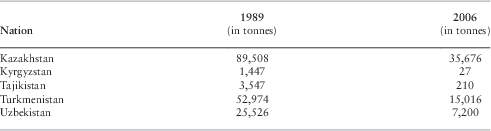
The table below, which compares the total capture in 1989 and 2006, shows that, even though industrial aquaculture procedures have increased everywhere in recent years as a result of technological development, they have not increased in Central Asia, and the region's five states have seen a sharp decline in their total tonnage of fish production: the declines for Kazakhstan, Turkmenistan, and Uzbekistan are roughly 60% to 72%, while the declines for Tajikistan and Kyrgyzstan range from 94% to 98%. Clearly, water-rich countries like Kyrgyzstan and Tajikistan have always had their own biological and geographical constraints in relation to fishing.
Decline in total aquaculture and inland fisheries in Central Asia between 1989 and 2006
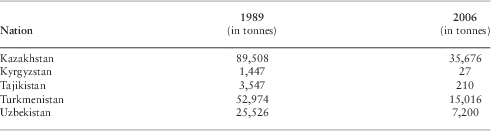
source: A. THORPE and R. VAN ANROOY, Inland Fisheries Livelihoods in Central Asia: Policy Interventions and Opportunities (Rome: FAO Fisheries and Aquaculture Technical Paper 526, 2009) (aquaculture includes inland capture fisheries and marine fisheries in the Caspian Sea, in the cases of Kazakhstan and Turkmenistan).
This phenomenon can be explained from several angles. One, clearly, is the drying-up of the Aral Sea and the deterioration of the Aral Sea Basin, which has led to reduced fishing activity, brought drastic changes to the way of life, and endangered the survival of several villages and communities. Another centres on the growth or persistence of other uses of water resources, particularly water for agricultural irrigation, and this has had consequences on falling water quality and the attendant biological ramifications. Yet another relates to the lack of government initiatives and structures to promote the additional use of irrigation systems for fish production, while a further issue is that this situation has clearly been brought about, to a large extent, by mismanagement of fisheries in the area.
In this last respect, evidence also shows that the international legal and institutional instruments to co-ordinate the joint management of existing water resources in Central Asia have barely taken fishing activities into account specifically. The ICWC has only recently begun to pay attention to the interests of other water users, such as fishermen.Footnote 124 To a large extent, this lack of interest can be attributed to a general problem of undervaluing inland fisheries in water management at the local, region, and basin-wide level. Generally, little account is taken in water management decision-making of the impact that such decisions will have on fishing, fisheries, and the rural population dependent on them. In addition to the component of animal protein in the diet, however, it must also be noted that inland fisheries in developing countries have an even greater economic impact than marine fisheries because of their direct impact on the rural population, on employment for men and women, and to a more limited extent, on the inland fisheries industry.Footnote 125
In this light, one can then appreciate the benefit of a comprehensive, ecosystemic approach to the internationalized co-ordinated management of the waters in the Aral Sea Basin. Such an approach needs to take into account the practices of land use, both for agriculture and forestry, as well as other energy and industrial needs, the needs of urban areas and of fishing activity. This is because all of these issues interactively affect the processes in the basin and the quality and quantity of available water.
C. CACFish
In addition to international rules and regulations on the management, conservation, and sustainable development of inland and marine fisheries and the activity of international organizations, particularly the FAO, numerous and varied regional agreements and organizations have also been created to address fisheries management. These regional fisheries management organizations (RFMOs) have been created as an ideal way to internationalize fisheries management, that is, to pave the way for the adoption of international measures aimed at the conservation and management of fish stocks at regional and subregional levels. RFMOs reflect institutional developments that operate in relation to inland fisheries and waterways, basins, and lakes that are international in different regions of the world. One example within the framework of the FAO is the recent establishment of the CACFish
1. CACFish forerunners and creation
More than forty RFMOs exist. Some fall under the auspices of the FAO, while some have been created by affected states with FAO sponsorship. There are RFMOs with clear institutional dimensions, while others are mere management bodies that have administrative functions and establish fisheries conservation and management measures, while still others are strictly scientific advisory bodies. Lastly, a number of RFMOs have been set up as FAO subsidiary bodies or through an international agreement overseen by the FAO. Whatever the case may be, there is a wide range of RFMOs,Footnote 126 and prior to exploring the objectives and functions of CACFish, we will examine both inland RFMOs and the provisions of the FAO constitution governing their creation.
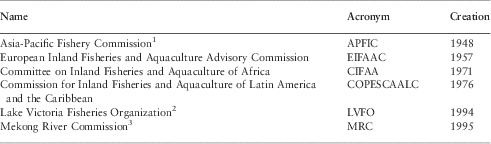
Although most RFMOs address a specific marine region or subregion and specialize in a given species, particularly some of the many species of tuna, CACFish was preceded by six other regional or subregional RFMOs focused specifically on inland fisheries,Footnote 127 with competences over inland waters, rivers, reservoirs, and lakes.
Regional inland fisheries management organizations (RFMOs)
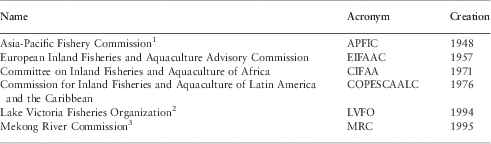
1APFIC has competence on questions of living aquatic resources, marine and inland.
2LVFO was set up by agreement among the affected states, not under FAO sponsorship.
3MRS, which was also created without FAO sponsorship, came out of an international agreement reached by the affected states in 1995, replacing the Committee for Coordination of Investigations of the Lower Mekong Basin (the Mekong Committee), founded in 1957.
Two legal avenues exist within the framework of the FAO constitution to create such an organization: one avenue makes use of Article VI of the FAO Constitution, which enables the Conference or Council to create subsidiary bodies directly dependent on one of these two main bodies of the FAO, while the other avenue makes use of Article XIV, which enables the Conference or Council to adopt international agreements on matters within their competence, including the protection of fish stocks, although the consent of the affected states is required for such agreements and their range of territorial application to come into effect. In both cases, the established mechanism can have the same level of competence, but in the second case a more explicit, legally binding commitment is required from participating states, giving greater legal weight to the recommendations and measures that may be adopted.
In this context, the process to create CACFish began in December 2007 at a workshop held by the FAO subregional office for Central AsiaFootnote 128 for experts from the region's states. At the workshop, the call was to establish a regional co-operation mechanism to promote sustainable fisheries and aquaculture in Central Asia. From the outset, it was clear that the territorial reach of the proposal was broader than the five states of Central Asia. It was also clear that the future regional agreement was intended to be open to all concerned states, given the transboundary nature of the region's waters and fish stocks. By a unanimous vote, the FAO Council passed Resolution 1/137, of 30 September 2009, approving the agreement in accordance with Article XIV of the FAO Constitution.Footnote 129 This Article provides that the Council, by at least a two-thirds vote of its members, may approve and submit to Member Nations “agreements concerning questions relating to food and agriculture which are of particular interest to Member Nations of geographical areas specified in such agreements and are designed to apply only to such areas”, which was the case with this agreement.
Once the agreement received approval from the FAO Council, it was submitted to Member Nations of the geographical region concerned so that they could give their consent and facilitate its entry into force. This entry into force, in accordance with Article XIV of the same agreement, occurred from the date of the reception of the third instrument of acceptance by the FAO Director-General on 3 December 2010. At present, only four of the states are parties to the agreement. Notably, two of the four states that have ratified the agreement are Kyrgyzstan and Tajikistan, the two upstream countries in the Aral Sea Basin and the two that have the lowest total catch from inland fisheries and aquaculture in the area.
States participating in the agreement to establish CACFish
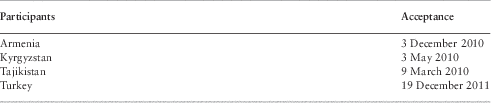
Again, it is important to underscore that an international agreement adopted by the FAO requires the consent of affected states, because this highlights the commitment and co-operation between the FAO and its Member Nations in the affected region. On one hand, this model enables states in the region to benefit from the technical merits and synergies of FAO services. On the other hand, it obliges them to assume financial commitments for the implementation and application of the Commission's work programmes.
In this same vein, for example, Article XII of the agreement envisages the possibility of amendments and provides that such amendments must be submitted to the FAO Council—and even that the amendments can be referred to the FAO Conference—and that these bodies can invalidate them if they consider that they are “incompatible with the objectives and purpose of the Organization”. In spite of the FAO's privileged role, it is clear that, to the extent that this involves an international treaty, any amendment must be formally accepted by two-thirds of the states who are parties to the agreement for the amendment to take effect, and, if such an amendment entails new obligations for these states, it will take effect only for those that have accepted it.
Once the agreement had been adopted, other preparatory intergovernmental meetings took place to implement the new fisheries organization. At these meetings, the future operating rules and the proposal for the Commission's five-year work planFootnote 130 were drafted. Finally, from 19 to 21 December 2011, the inaugural meeting of CACFish took place and the first session of the Commission approved the rules of procedure, the financial regulations, the administrative budget for the initial period, the scheme and scale of contributions to the administrative budget, the five-year work programme (2011 to 2015), the acronym and logo of the Commission, and other scientific and technical advice.Footnote 131
The agreement requires that all participating states will have representation and will take part in the Commission's meetings, at which each Member State will be entitled to one vote and decisions will require a majority of the votes cast, except where the agreement envisages a different majority, such as in the case of adopting recommendations. The agreement calls for regular (annual) meetings of the Commission, whose initial headquarters will be located in the same headquarters as the FAO subregional office for Central Asia in Ankara, and the FAO will also provide the secretariat for the Commission. The agreement also establishes a Technical Advisory Committee and allows for the creation, as needed, of subsidiary bodies, such as temporary, special or standing committees, and working groups.
CACFish organization chart.
2. CACFish objectives and functions
In keeping with the approaches outlined in this paper, the aim of CACFish is to contribute to the conservation, management, and sustainable long-term use of living aquatic resources in inland waters, by means of responsible fisheries and aquaculture achieved through closer regional co-operation. More specifically, Article III of the agreement establishes the specific functions and responsibilities of the Commission in terms of maintaining constant vigilance over the condition of fish stocks and the status of other economic and social dimensions relating to fishing activity; contributing to the generation of knowledge, to its dissemination, and to the general promotion of co-operation in these questions; fostering research and development projects and co-operation projects; and formulating and recommending measures suitable for the conservation and rational management of living resources in the agreement's area of competence and in the application of these recommendations.
In our judgment, the regulatory footing of this last area—formulating recommendations on measures for the management and conservation of fish stocks—constitutes one of the focal points of future CACFish action. As provided in Article III.3 of the agreement, CACFish's regulatory actions relating to conservation and management must apply the criterion of a precautionary and systematic approach, taking into account the best scientific data available. It should be underlined that, while this is about formulating recommendations, the agreement envisages that these recommendations will be binding once they have been approved by two-thirds of the parties present and voting, but only with effect from the date set by the Commission itself and upon completion of a “period of objection”, which is provided for in the agreement. In effect, Article V.3 of the agreement establishes that any party will have a period of 120 days from notification of a recommendation to formulate any objection to it, in which case there will be no obligation to implement the said recommendation. The agreement also provides that any party can, at any time, withdraw its objection and decide to implement a recommendation. In short, recommendations on measures for fisheries development and management are binding, provided that no objection is raised by signatory states, which therefore can, in this sense, not only take part in decision-making and oppose a recommendation, but also reserve the possibility of opting out of the application of adopted recommendations.Footnote 132
With the objectives and function of CACFish established, special consideration must be given to the agreement's area of competence or, in other words, to the states that can become CACFish members. In our view, this represents one of the organization's unique features. It also serves to highlight specific spheres of international influence and, at least for the moment, hampers the complete viability of the Commission. First, as already underscored, Central Asia is conceived as a region not only in a wider sense than the one strictly employed in this paper, but also includes the Caucasus. This approach was partly a response to the original initiative of the FAO's subregional office, but it was also, doubtless, a reflection of geopolitical aspects worthy of examination.
Under Article IV of the agreement, its area of competence includes the inland waters and areas within the territorial boundaries of the states of Central Asia (i.e. Kazakhstan, Kyrgyzstan, Tajikistan, Turkmenistan, and Uzbekistan), as well as the Caucasus (i.e. Armenia, Azerbaijan, Georgia, and Turkey) and, “with respect to inland fisheries, other waters included in the trans-boundary water basins that border the territories of Central Asia and the Caucasus”. This definition, which uses only geographical terms and not political ones, expands the possibility of membership in the Commission and clearly raises the transboundary aspect of watersheds. In the case of the Aral Sea Basin, this approach, as noted earlier, opens up CACFish participation to Afghanistan and Iran (which both share the watershed of the Amu Darya). In both watersheds, however, the number of states that could become parties to the agreement rises among the nations of Central Asia and the Caucasus.Footnote 133
In effect, under Article I.2 of the agreement, any FAO Member Nations can become signatories to the agreement, provided that their territories are wholly or partially located within the area defined in Article IV. In this way, the provisions of the agreement are sufficiently broad so that, in addition to the states specifically listed in Article IV, it can also include other states, such as China, Iran, Russia, Afghanistan, Mongolia, and Ukraine, all of which have been officially invited to become members of the Commission.
As noted earlier, however, only four nations are currently parties to the agreement and sit on the Commission. To reinforce the strength of today's weakened CACFish, it is necessary not only for more states to join, but also to look in broad terms at the provisions of the Code of Conduct examined previously. Specifically, Article 7.1.4 of the code establishes that:
[w]here a sub-regional or regional fisheries management organization or arrangement exists and has the competence to establish conservation and management measures, those States should cooperate by becoming a member of such organization or a participant in such arrangement, and actively participate in its work.
This provision has given rise to appeals voiced at CACFish and FAO meetings for other invited states to become formal participants in the agreement.
Lastly, with regard to the subject of financial operation, it was agreed that CACFish would have an autonomous budget, although the FAO was to provide secretariat and support services, at least during the initial period of establishment. In this respect, the proposal set out a funding methodology that reflects the usual practices of RFMOs. Devised at the meeting of the Steering Committee in Istanbul in February 2010Footnote 134 and later approved at the first meeting of the Commission, the model features three components: a first portion (20%) to be shared equally among all members (the base fee); a second portion (35%) to be paid on the basis of each Member Nation's per capita GDP (the wealth component); and a third portion (45%), which is a percentage of the total tonnage from inland fisheries and aquaculture of each CACFish Member Nation (the production component). To this end, Table 5 provides a useful snapshot of production levels in 2007.
Inland fisheries and aquaculture production in 2007 in the Central Asian and Caucasus region
source: FAO Fisheries and Aquaculture Report SEC/R935 (Bi), p. 6.
The data in the table above, which are used to determine the budgetary allocations and funding of the Commission, clearly show the limited share of total inland capture and aquaculture pertinent to the five nations of Central Asia. More specifically, the shares of Tajikistan and Kyrgyzstan (the two states in the region who are already party to the agreement) are zero percent in relation to total production in Central Asia and the Caucasus. By contrast, the three largest-producing states, both in inland capture and in aquaculture, are the Russian Federation, Iran, and Turkey. These facts and the territorial range of the Commission, or what we have referred to as its area of influence, together lead to the following conclusion: in relation to inland fisheries, there is a certain dilution in the regional character of Central Asia within a broader context in which the influences and interests of major and emerging powers are unavoidable. In fact, Turkey's interests and regional influence are taking the lead and, amid a lack of participation by other major regional powers, are pulling the other nations of Central Asia in Ankara's wake.
IV. FINAL REMARKS
Our paper argues that the asymmetric allocation of water resources in Central Asia should foster deeper co-operation, rather than rivalry, among riparian states; a course of action that produces encouraging outcomes when taken seriously, as the cooperation about inland fisheries shows. The above findings lead us to a number of conclusions in the different fields related to water co-operation in Central Asia that we have discussed.
First and foremost, we believe that an adequate management of water in the region advises all Central Asian states that have not done so to ratify promptly the existing global and regional instruments on water co-operation. This is a step that would facilitate international co-operation and integrated management of their shared water resources, in a context where co-operation can no longer be considered a possibility in contemporary international law, but an actual must. Based on the idea of “basin” that encompasses the two main rivers of the region and their subsidiaries, the states in Central Asia should work towards the establishment of a joint management of its water resources.
Second, the limited capacity of the Central Asian states to manage collectively their fishing resources has led to the FAO's initiative to establish a regional fisheries management organization, CACFish. This implies a certain dilution in the regional character of Central Asia within a broader context in which the influences and interests of major and emerging powers are unavoidable. In spite of the fact that only four states in the wider region have become members of the Commission, we believe that this is the right path for them to take in order to face, in a collective and institutional manner, and with the technical support of the FAO, the challenges of management and conservation of continental fisheries in the region.
Third, the high potential of watercourses in the region for the development of hydraulic energy remains low in most countries. At the same time, the projects that upstream states are currently planning and developing may result in serious negative environmental and social impacts in their territory. Instead of large facilities, the promotion of small-scale community projects for water management would improve the socioeconomic conditions of these states and their populations
The region as a whole endows a significant amount of water resources but it clearly lacks a good national and regional management framework, both from a political and legal perspective. Most of the current issues still revolve around an old problem: how to reconcile and make compatible the unilateral management of the hydropower potential of the poorer upstream states with the irrigation demands of the wealthier downstream states (rather interested in exporting their oil and gas outside the region); or, put in a different way: hydropower versus irrigation.
The existing agreements on concerted and sustainable management of shared water resources in Central Asia have clearly failed. Smooth co-operation is of paramount importance but it requires mutual trust, political will, commitment, and some previously agreed basic principles of understanding. All these conditions are yet to be met in the present situation. Therefore, shared management based on a community of interest and the fair and equitable use of the shared water can only hardly occur.
In order to achieve any progress in this area, it is necessary to strengthen the current institutional mechanisms and to create measures to promote trust among the interested states (“trust building”) in the prevention and resolution of conflicts linked to the shared resource of water.
Finally, this improved national and international water management would in its turn allow these states to use water at home in a more sound way, giving full priority to the achievement of the right to safe water (and sanitation), particularly in rural areas, where it is most needed. The state ownership over water, and the rhetoric importance given to this resource in the national discourse, should be accompanied by national policies and regional co-operation that ensures that every household, school, or workplace has quality running water available at a reasonable price.