The coordination required to deal with climate change will be a challenge for any jurisdiction, sub-national or national, but has received little scholarly attention. (Rabe Reference Rabe2008, 788)
Introduction
The United States (US) Senate rejection of potentially economy-wide federal cap and trade programmes to reduce greenhouse gases (GHGs) suggests an inquiry into alternative solutions. While potentially transformative, a federal cap and trade initiative would have been only one element of a comprehensive national climate plan. Richards and Richards (Reference Richardson and Houston2009) argue that federal actions need to be more comprehensive than technology-based, supply-side regulation. Scientists, business leaders and policymakers are increasingly strident in saying that doing nothing is an unacceptable alternative as well (NRC 2011).
We argue that government authority and intergovernmental conflict between federal, state and local governments should be explicitly considered in selecting, designing and implementing comprehensive climate policies. The climate policies we consider are “complementary” and typically sector-based in contrast to economy-wide actions that would put a price, or emissions, cap on GHGs. We focus on the state-federal relationship, because states have long been considered the central actor in the federal system (Elazar Reference Fisher, Ury and Patton1991). States and/or local governments have primary regulatory authority over energy policy in general, demand-side fuel/electricity management, land use and transportation planning, economic development, and air and water quality (see Woods Reference Woods2006, among others). As described in detail below, states are likely to have primary implementation authority for most economy-wide and sector-level federal climate policies, such as power plant combustion efficiency standards.
While states and local governments are the primary actors in promulgating most energy and land use policies, there are some questions as to why they would implement climate policies that incur local costs in return for global benefits. There are both political and economic explanations for sub-national climate policy development. For instance, climate policies can create local environmental benefits (Krause Reference Layzer2011). Local government officials can also use climate policies for political gain in more environmentally conscious jurisdictions. Carley (2009) claims that higher environmental scores for elected officials predict higher levels of renewable electricity generation. In addition, a primary motivation for state climate plan development has been to cultivate exports for the national and global clean energy economies and the accompanying creation of local jobs and investment (Rabe 2004; Globe Advisors and Center for Climate Strategies 2012; Maggioni et al. Reference Mazmanian, Nelson and Jurewitz2012). In addition to direct economic and political benefits from climate policies, Urpelainen (2009) finds that uncertainty by the federal government about the benefits from national climate policies, which has stifled momentum at that level, also predicts the emergence of state and local climate policies.
Sub-national governments have also been active participants in international climate policies (Rabe 2004) and are increasingly recognised by the United Nations Framework Convention for Climate Change as observers and participants in policy dialogue, now representing the second largest delegation of attendees next to federal representatives. These governments not only lead and innovate in climate policy design (Betsill and Bulkeley Reference Betsill and Bulkeley2004), but have been actively engaging national and sub-national governments in other countries as well. Mazmanian et al. (Reference Mazmanian and Kraft2008) outlined the international aspirations that California had in developing its GHG programme and, subsequently, the authors show how California has been able to link up its GHG emissions trading system with the province of Quebec in Canada (Mazmanian et al. Reference Mazmanian, Jurewitz and Nelson2013). Sub-national governments are increasingly important actors as policy decisions become more decentralised in increasingly fragmented global climate governance networks (Biermann et al. Reference Blom-Hansen2009).
For all the above reasons, states are clearly critical in both national and international climate policy theory and design. However, a large federal role is also essential to attain GHG emission reductions for three reasons. First, new federal authority will be required to enable policy actions and to provide funding for state and local actions to reduce GHGs. State and local governments cannot do it alone. This is evidenced by the fact that the major policy options developed by stakeholders in the state climate action plans, analysed below, require some type of new federal authority that will maximise GHG emission reductions so that they are in line with ambitious national targets. Federal leadership is essential – even if a national cap on GHG emissions or other comprehensive federal policy is not forthcoming anytime soon.
Second, federal actions are necessary because combined state-level actions alone are unlikely to substantially reverse GHG emissions growth. The US Department of Energy (2012) estimates that reference case US GHG emissions will increase from 5.6 billion metric tonnes of carbon dioxide equivalents (BMTCO2e) in 2010 to 5.7 BMTCO2e in 2035. Emissions forecasts have shown a significant decline recently, but further GHG declines are hampered due to a lack of targeted mitigation policies, as exemplified by only nine of 50 states spending more than 2 per cent of electricity sector revenues on demand-side management (DSM) programmes. This is a minimal level of investment to capture all cost-effective DSM opportunities to slow the growth in electricity demand and associated GHG emissions (Molina et al. Reference Nash2010). Federal price instruments (e.g. carbon taxes, cap and trade) and/or minimum performance standards (e.g. national renewable energy portfolios, national clean car standards and national DSM subsidies) are necessary to scale up the activities recommended in state climate action plans to enable meaningful GHG mitigation at the national level. The design and implementation of a comprehensive approach to reducing GHG emissions must be broader and deeper than existing energy and environmental policies.
Finally, federal (nation-state level) actions are necessary to address the collective action and enforcement problems that plague GHG mitigation at the international level. For example, small jurisdictions face the sucker payoff in game theory terms, where they undertake the costs of mitigation while the benefits accrue globally and are temporally distant (Mazmanian et al. Reference Mazmanian and Kraft2008). While Victor et al. (Reference Weaver2005) and Schreurs (Reference Sovacol2008) have argued that there have been steps towards global climate governance, global GHG emissions continue to rise absent a comprehensive international agreement. The relationship between intergovernmental conflict and cooperation with international GHG treaty negotiation is beyond the scope of this paper, but interested readers are referred to Urpelainen (2012). Given the claims for the primacy of state and local authority for energy and environmental policies, as well as the need for federal climate action, explaining and resolving intergovernmental conflict is critical for successful global GHG mitigation.
Our paper is organised as follows. The next section provides a brief review of intergovernmental relations theory and then develops a framework and empirical support for the relationship between the level of conflict and the probability of policy enactment. Using theories of spatial bargaining, we develop the hypothesis that intergovernmental conflict is negatively correlated with policy enactment. The section after next provides a taxonomy of policy cooperation, coordination and conflict. This is followed by an analysis of 23 GHG mitigation policy options using the conflict-cooperation taxonomy. We then estimate the potential macroeconomic impacts of these policies. We find that, by 2020, employment gains represent a possible increase of 1.19 per cent above baseline levels, with over half of the increase attributable to the policies that require intergovernmental bargaining and collaboration – a key indication that collaborative approaches can potentially stimulate macroeconomic gains that otherwise may be unrealised. We conclude with a set of recommendations based on our analysis. We identify a need for a national climate action plan that explicates performance standards, funding and other enabling and cooperative actions at all levels of government to reduce GHG emissions and increase aggregate economic efficiency.
Intergovernmental relations theory
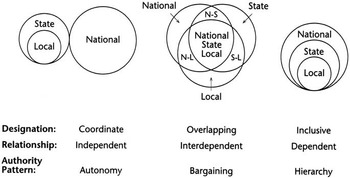
The role of the federal government relative to the states in American society is an enduring “cardinal” question [Wilson (Reference Wood1908) 1961], and preoccupation with it has been described as a “neurosis” (Rubin and Freeley Reference Sabatier and Jenkins-Smith1993). The extent to which the federal government has been the dominant actor in exchanges between levels of government has been the subject of exhaustive debate (see among others, Sovacol Reference Treyz2008). Overlapping authority is the term often used to describe American federalism, and it has moved even more into the vernacular in the wake of the 2008 financial crises (Bary Reference Bary2010). Figure 1 shows the overlapping authority model in contrast to two alternatives (from Wright Reference Wright2001, 75).
Models of intergovernmental relations. Source: Wright (Reference Wright2001, 75).
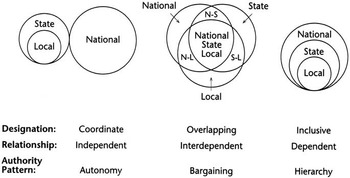
Overlapping authority is based on independent units of government that bargain for authority while engaging in activities. Bargaining entails exchanges in which states typically receive federal funding and authority with the quid pro quo of adequate accounting, reporting and performance. Rabe (Reference Rabe2011) highlights the state-federal bargaining that occurred in the Rose Garden Agreement of 2009 between the Obama Administration, governors and the industry in a new approach to setting automobile fuel efficiency standards. Environmental regulation typifies this type of overlapping authority, which has also been labelled cooperative federalism (Adelman and Engel Reference Adelman and Engel2007).
The 1960s through the 1990s have been described as a period of cooperative federalism, where the federal government adopted the authority to set minimum national performance standards and/or conditions in a policy domain (e.g. the Clean Air Act Amendments of 1970) and then delegated implementation to the states. States promulgated authority at their level to carry out and enforce the federal standards. If states did not participate, or did not secure federal approval of their implementation plans or performance, then execution switched to conjoined national and state authority (Wellborn Reference Wilson1988). Cooperative federalism describes most landmark environmental legislation, such as the Endangered Species Act and the Federal Water Pollution Control Act Amendments of 1972, which were designed to prevent a race to the bottom in regulatory quality.
Scholars have noted a recent shift from cooperative federalism to “coercive” federalism. With the few exceptions noted below the federal government has been the centralising authority for decades during both Democratic and Republican administrations (Posner Reference Rabe2007). Mandates and preemptions are two common federal policy actions with centralising effects. Mandates are statutory direct orders from the federal government imposed on state and local governments. Preemption refers to the authority of Congress under the supremacy clause of the US Constitution to enact statutes that displace or replace state and/or local laws and powers (Advisory Commission on Intergovernmental Relations 1992). Preemption has the effect of limiting state legislative independence and in a consolidation of federal power.
Crossover sanctions are another coercive tool used by the federal government to extend its authority into arenas firmly under state control. Crossover sanctions are financial penalties imposed on federal grants in one issue area for not complying with rules in an unrelated area (Posner Reference Rabe2007), such as withholding federal highway construction funds to coerce states to adopt minimum drinking age limits or a 55 mile/hour speed limit. Richardson and Houston (Reference Riker2009) also show how the federal government has used these fiscal tools to prompt state adoption of traffic safety rules.
The federal government has also limited state climate policy actions that it perceives as going beyond state authority. Rather than establishing a “floor” for state performance, the federal government has used executive, legislative and judicial authority to place a cap, or “ceiling”, on state regulation. For example, the justification for federal preemption of aggressive state policies, like the Pavely Bill in California that increased auto fuel efficiency, was that federal law is required to ensure regulatory consistency in order to reduce the burden on regulated actors. In his 2007 letter to Governor Schwarzenegger rejecting California’s request for a waiver to allow the state to implement its law, US EPA Administrator Johnson claimed to be preventing a “patchwork” of state standards (Johnson Reference Joskow and Schmalensee2007). Heinzerling (Reference Hill and Hupe2008, 928) notes that federal preemption can result in “upending” state action and create a host of uncertainties for firms and regulators. Put another way, federal preemption can be, and has been, justified in preventing both a race to the bottom and a race to the top in state regulation.
Political conflict and the probability of policy enactment
The above discussion on federal mandates and preemption describes conflict or political competition for power between vertical levels of government during the policy design phase (Breton Reference Broder1998; Volden Reference Wei and Rose2005). Our main hypothesis is that the likelihood of successful enactment of public policies decreases with increased intergovernmental conflict, ceteris paribus. If actors (government jurisdictions and their policy coalitions) are too far apart in their policy preferences, bargaining fails and is not an option for conflict resolution. Then, costly mandates or preemption are utilised by the dominant actor to achieve its public policy goals. This stylised negative relationship between political conflict and the enactment of public policies is grounded in theories of spatial bargaining and analytical politics. We follow Butler et al. (Reference Butler, Bellman and Kichiyev2007) who claim that “bargaining is at the heart of all politics” (p. 607) and Meirowitz (2007) who notes that, “the spatial model has become a centerpiece of the literatures on legislative politics, agenda theory, and social choice theory” (p. 252). In other words, conflict resolution, not conflict, is at the heart of successful policy approaches.
Our first assumption is that conflict occurs because actors at all levels of government are seeking power and to protect their own self-interests: sectoral policy goals, macroeconomic control and local autonomy (Blom-Hansen Reference Breton1999). Our second assumption is that, in federalist systems with overlapping authority, conflicts over authority between jurisdictions are typically settled through bargaining (Wright Reference Wright2001) or by fiat from higher hierarchical authority (Stoker 1992).
The bargaining literature provides the theoretical support for our hypothesis, which is not empirically tested in this paper. Although an exhaustive treatment of the literature is beyond the scope of this paper, modern spatial bargaining theories began with Hotelling (1929). Nash’s (Reference Nelson1950) bargaining solution, Down’s (Reference Drummond1957) median voter theorem and Black’s (Reference Black1958) committee decision-making model form the theoretical foundations for the voluminous subsequent work on social choice analysis. For simplicity, we discuss two-player bargaining games, but recognise that multilateral bargaining occurs in most intergovernmental negotiations, which brings about additional problems (Bennett Reference Bennett1997).
In a bargaining game, seller S and buyer B, each have a reservation price, which are s and b, respectively. The reservation price is the minimum price that each party will settle for, and below which is worse than no agreement. In the basic model, each party has a linear utility function and attempts to maximise its utility through bargaining. If S and B can agree on a price x, in the “zone of possible agreement” where b>s, then the seller’s surplus is x−s, and the buyer’s surplus is b−x. However, if the buyer’s reservation price is below the seller’s (b<s), then there is no zone of possible agreement in the distributive bargaining problem (Raiffa Reference Richards and Richards2002). In this case, the parties revert to their best alternative to negotiated agreement (Fisher et al. 1991), which can be a continuation of the status quo. For a more detailed discussion, we recommend reading Banks and Duggan (Reference Banks and Duggan2000), who have analysed the spatial bargaining issues surrounding agenda setting, institutions and the status quo.
A relevant example of the bargaining game is the enactment of a federal renewable portfolio standard (RPS) that requires that a minimum of 15 per cent of electricity sales come from wind, solar or other renewable electricity generation sources by a certain date. The pro-RPS (seller) coalition consists of US legislators, governors and mayors from cities in the West with large supplies of renewable resources. Interest groups representing wind and solar generation companies are also selling the s=15 per cent standard. The anti-RPS (buyer) coalition consists of elected officials from renewable resource poor regions (the Southeast) and the fossil fuel industry, as well as state and local officials. This coalition is resisting the RPS proposal at any level (b=0 per cent) because of its perceived cost, as well as the intrusion of federal authority into a state energy policy domain. In this example, there is no zone of possible agreement because b<s. As detailed below, a national RPS has not been enacted due to these dynamics of political conflict.
Political conflict mechanisms
We now turn to the mechanisms by which political conflict affects policy enactment. We bifurcate four mechanisms into vertical (intergovernmental) and horizontal (intra-governmental) channels. The first vertical mechanism is commonly discussed as “bottom-up policy learning” where the federal government learns from state and local government innovations (Lutsey and Sperling Reference Maggioni, Nelson and Mazmanian2008). It is a truism to hear about states and municipalities as laboratories for democracy. Sub-national policy innovation (and learning by higher level governments) should be conceived of as shared preferences, or reduced conflict, between levels of government.
Second, state, local and special district governments use their direct access to congressmen, staffers and agency specialists highly influential in policy development to transmit their preferences (Weible Reference Wheeler2005). Actors from sub-national governments are critical participants in policy networks responsible for federal policy enactment and implementation (Sabatier and Jenkins-Smith Reference Schreurs1999). The result is that sub-national actors can often block or delay policy enactment using their policy networks and access to policy elites. Sub-national governments have their own effective lobbying resources with which to pursue bargaining that achieves their self-interests at the federal level (Cammissa Reference Carley1995). The National Governors Association (NGA) and National Conference of State Legislatures directly lobby federal officials. Finally, cities and states influence federal policies through the courts to achieve their own self-interests in energy policy, climate change, consumer protection laws, economic development, tobacco regulation and many other issues (Winder and LaPlant Reference Woods2000). Dinan (Reference Downs2008) summarises the effects of state influence on federal activities in 2007–2008 as: “state officials… experienced notable success in persuading federal officials to take account of their concerns” (p. 382).
Third, the RPS bargaining example above shows how horizontal, or intra-governmental, political conflict reduces the likelihood of policy enactment. While not the primary emphasis of this paper, political conflict and spatial bargaining within legislatures and committees have been studied extensively (Shepsle and Weingast Reference Snyder1987; Baron and Ferejohn Reference Baron and Ferejohn1989). What is particularly relevant here is how regional factor endowments can introduce cleavages, or disequilibria according to Riker (1980). State policymakers and interest groups have jointly mobilised on a regional basis to fight federal environmental regulations that put them at a comparative disadvantage with other regions (Joskow and Schmalensee Reference Krause1998). Dozens of bills requiring a minimum level of renewable electricity sales have failed over the last several decades because of alliances between powerful regional utilities and their congressional allies who have argued that this policy would raise costs due to a lack of renewable energy supplies (ESs) (Snyder Reference Stoker2007). State heterogeneity also predicts federal-state conflict in formal models in the assignment of authority at the policy design phase (Volden Reference Wei and Rose2005). Furthermore, our claim that the likelihood of policy enactment is correlated with political conflict is consistent with other political theories, including legislative incentives such as credit claiming and blame avoidance (Weaver Reference Weible1986). While beyond the scope of this analysis, theories of delegation (Bendor et al. Reference Bendor, Glazer and Hammond2001) and implementation (Wood Reference Wright1992; Hill and Hupe Reference Hotelling2002) also support our theoretical claims.
Legal challenges against the federal government by state and local governments are the fourth mechanism by which political conflict affects policy enactment between jurisdictions. Gormley (2006) finds over 350 state and local lawsuits filed between 1980 and 2004 against just three agencies: the Department of Education, Environmental Protection Agency (EPA) and Centers for Medicare and Medicaid Services. In the climate realm, the most significant state lawsuit has been Massachusetts v. EPA, where 12 states successfully sued the EPA to regulate carbon dioxide as a pollutant under the Clean Air Act.
To summarise, there is considerable theoretical and empirical evidence for our core theoretical hypothesis that political conflict is negatively correlated with policy enactment. While the federal government can, and does, impose mandates on the states, these mandates extract a higher political cost than when preferences are more aligned between levels of government. We also hypothesise that collaborative policies that can facilitate mutual goal attainment have a higher probability of enactment.
A taxonomy of policy conflict
Now we turn to developing indicators of policy conflict and cooperation. We build on Gormley (2006, Figure 1, 526) who dichotomises the conflict versus cooperation continuum as money versus mandates. Conflict will most likely occur when the federal government imposes mandates and preemption, while cooperation is more likely with expanding financial largess. We extend Gormley’s typology by including coordination as an intermediate category between conflict (mandates) and cooperation (resource transfers). Coordination includes bargaining between levels of government that enables mutual goal attainment as described in more detail below.
Competitive policies
These are mandates identified by political conflict over authority for the sources and uses of funds, minimum performance standard-setting, monitoring, reporting, and programme evaluation and review. The aforementioned conflict between the US EPA and California over the authority to set automobile fuel efficiency standards under the Pavely Bill (2006) is a classic example of competitive climate policy where California and the US competed for the authority to set minimum performance standards for automobiles. Similarly, a national RPS would imply a federal takeover of renewable energy policy from a realm currently dominated by state authority. A federal carbon pricing or cap and trade programme to correct the market failure of unpriced GHG emissions would also result in an expansion of federal government authority. Federal cap and trade proposals have been resisted by stakeholders, because they were perceived as an intrusion of federal “tax” authority (Broder Reference Butler, Bellman and Kichiyev2010). We expect intergovernmental conflict and bargaining over the location and level of authority over key programme attributes, such as funding disposition, programme implementation, and monitoring and evaluation. We also expect vertical competition to occur, because the US Constitution does not limit sub-national authority and allows joint federal-state actions.
Coordination policies
Coordination reflects recognition of the condition of interdependence in modern policymaking where governmental programmes intend to ameliorate complex social problems. Here, we refer to coordination as the condition when potentially adverse outcomes to actor B are considered when actor A makes a decision (Lindblom Reference Lubell, Leach and Sabatier1965). Federal enabling policies for climate mitigation are typical cases of sequential interdependence (Hall and O’Toole Reference Heinzerling2000), where an output from one actor is needed as part of the input for another. Coordination is more likely when policies that result in benefits from agreement between levels of government facilitate goal attainment in one jurisdiction by enabling policies in another. This type of collaborative policy development between levels of government helps mitigate conflicts by creating mutual benefits not attainable by unilateral actions.
We consider three sub-types of coordination policies in the climate policy domain.
First, enabling policies at all levels of government occur when a level of government in a superior position in the hierarchy undertakes an action (e.g. a law or executive order) that potentially allows lower jurisdictions to maximise the effectiveness and efficiency of their implementation of mitigation policies. For example, improving coal plant generation efficiency could potentially, by itself, reduce US GHG emissions by 2 per cent (Nichols Reference Partridge and Rickman2008). States that wish to pass standards in this area, however, are hampered by ambiguity in the federal EPA New Source Review (NSR) permitting programme. Further, owners of coal generators are reluctant to increase generation efficiency by installing efficient fans, fuel dryers and other equipment modifications if they trigger the expensive and time-consuming NSR permitting process. Without federal enabling legislation that clarifies what activities are acceptable under state coal generation efficiency policies, GHG mitigation from these sources will be greatly attenuated.
The second type of coordination policies are financing mechanisms. These policies redistribute, or recycle, funds from consumers or producers within and across states or municipalities. Financing mechanisms improve access to capital in energy services and other areas (International Energy Agency Reference Johnson2007). This includes programmes that offer collection mechanisms, such as on-bill financing for the incremental costs of energy-efficient equipment, and programmes that can provide a pool of capital to fund costs upfront. A federal collection mechanism for energy DSM programmes, which are firmly under existing state authority, could be an example of a coordinative intergovernmental policy arena. A federal surcharge on electricity generation modelled on the Nuclear Waste Fund could provide considerable funding for state DSM programmes. A pay-as-you-go federal DSM fund redistributed back to states would prevent free riding by states wishing to avoid DSM charges that could cause them to lose energy-intensive industries. Such a DSM programme could provide the lowest-cost resource procurement. In addition, to optimise the implementation of state energy efficiency policies, state administrative capacity would need to be augmented (Nelson Reference Nichols2012). The pay-as-you-go design would minimise concerns about an extension of federal authority into an area dominated by state authority.
The final type of coordinating policies are performance standards that are either required to be implemented by firms or voluntarily implemented by states and municipalities. These standards do not include implementation and enforcement by sub-national governments. For example, minimum performance standards for appliances are primarily established by the federal government and implemented by manufacturing firms. However, states can set their own standards for equipment not included in federal rulemakings, as the federal process is quite slow. Recycling and smart growth standards would allow jurisdictions to opt-in for reducing solid waste and compact urban design, but would not equate to federal mandates.
Cooperative policies
These are resource transfer policies and include redistributive policies that use federal taxation authority to fund expanded activities currently under state authority. As Gormley (2006, 525) notes: “The more money the federal government makes available to the states, the happier the states tend to be”. Cooperative policies provide exogenous sources of funding (or other resources) for states and municipalities from federal income taxes and other general federal sources. The existing federal renewable energy production tax credit is strongly supported at the state level in wind-rich states (Camia Reference Cammissa2012). A federal combined heat and power (CHP) feed-in tariff, green building incentives and a high efficiency vehicle incentive that subsidises clean ES and demand are likely to be cooperative in nature between vertical levels of government.
GHG mitigation policies and authority
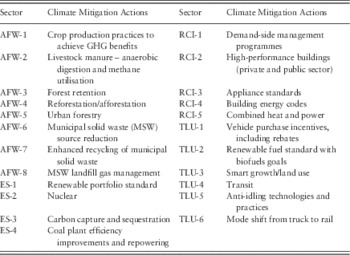
As the above list indicates, a portfolio of actions and implementation tools across all sectors and employing a wide range of policy instruments are needed to achieve GHG emission reductions that meet or exceed national goals. We build on prior work (Peterson et al. Reference Peterson, Wennberg, Rose and Wei2010a) to identify a comprehensive suite of 23 policies, termed “super-options”, because they represent the most important actions in each sector and across all sectors of the economy to significantly reduce GHGs (see Table 1). The super-options were chosen from state climate action plans based on two criteria: (1) they reflect common recommendations for implementation in state climate action plans and (2) they represent the vast majority (~93 per cent) of GHG reductions from the plans. However, they are by no means all-inclusive, as most state climate plans include up to 50 total actions. The super-options represent the most prominent and widely applied actions. We direct those readers interested in the composition of the state-level stakeholder groups and their climate planning outcomes to Maggioni et al. (Reference Mazmanian, Nelson and Jurewitz2012, 240–242).
GHG reduction policies in four sectors

Source: Compiled by the authors.
Note: GHG=greenhouse gas; AFW=agriculture, forestry and waste; ES=energy supply; RCI=residential, commercial and industrial; TLU=transportation and land use.
The microeconomic data, assumptions and methods used in this study are based on the results of formal agreements by over 1,500 stakeholders made through intensive, deliberative processes that used consensus-building, fact-finding and advanced analytical techniques in 16 American states that have developed climate action plans. Although the extent to which these policies have been effective in reducing GHG emissions has been contested (Wheeler Reference Winder and LaPlant2008; Drummond Reference Elazar2010; Nelson et al. Reference Nelson2014) given the lack of federal action, US states and municipalities have taken the lead in developing climate plans and policies (Rabe Reference Rabe2011).
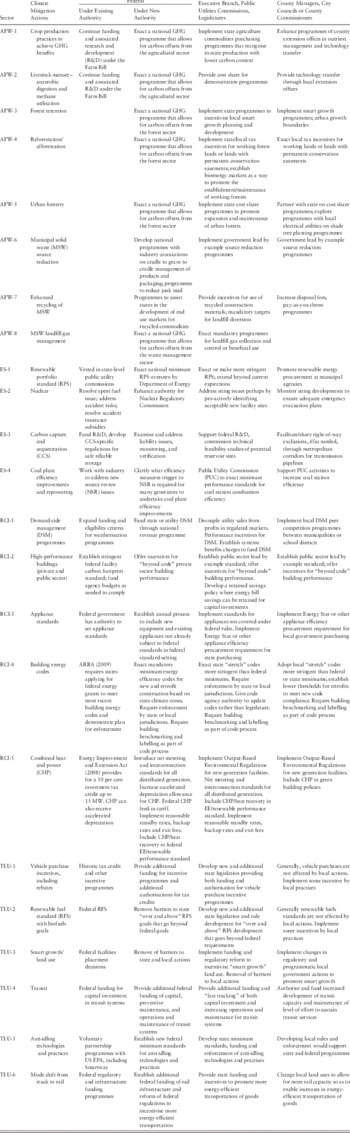
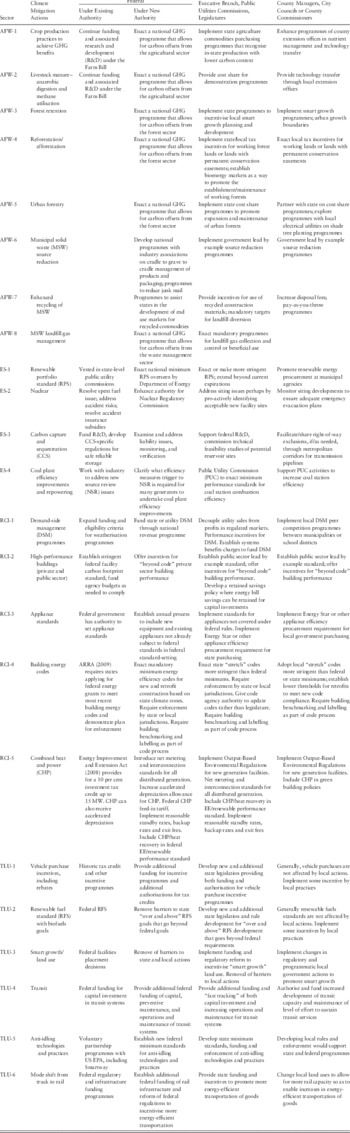
The policy actions in Table 1 provide GHG reductions that are additional to reference (baseline) case actions, but most require some type of federal authority, whether enabling state activity or setting minimum performance standards for the states. These are detailed in the expanded list of policy options in Appendix. The recommendations include a variety of matching policy instruments (including price and non-price approaches) needed for achieving GHG targets and economic and energy benefits. The Appendix is organised by government level. At the federal level, there are two columns, one entitled “Existing Authority” and the other “New Authority”. The existing authority column reflects actions available to the administration and agencies under current law, although new appropriations may be required. The new authority column in bold reflects actions Congress and/or state legislatures would most likely have to authorise.
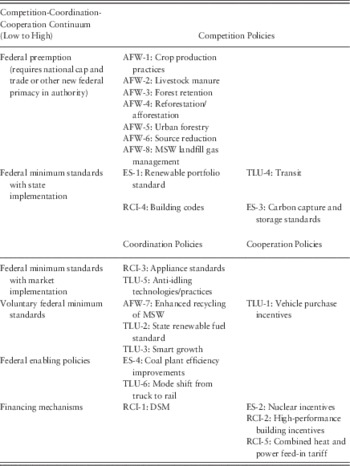
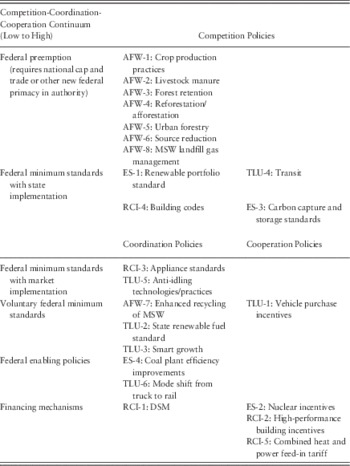
Next, we sort the climate policies according to their hypothesised intergovernmental conflict level. The vertical axis in Table 2 (the first column) presents each of the policies in the Appendix (column 4) categorised according to the competition-coordination-cooperation continuum, which is based on the policy’s position in the bold column headed “under new authority”. This categorisation provides an innovative way to analyse climate policies based on hypothesised intergovernmental conflict and the type of funding required. In the top box are the “competition policies” (where there are no fiscal transfers), which include all of the agriculture, forestry and waste policies (except AFW-7) that require a cap and trade programme to create demand for GHG offset reductions from the sector. Competition policies also include new federal minimum performance standards.
Authority and type of funding for climate policy options
Source: Compiled by the authors.
Note: AFW=agriculture, forestry and waste; MSW=municipal solid waste; ES=energy supply; RCI=residential, commercial and industrial; TLU=transportation and land use; DSM=demand-side management.
The horizontal axis introduces a fiscal transfer variable. The policies vary on the degree to which they result in or require federal fiscal transfers to the relevant economic sector. Coordination policies, such as federal minimum appliance standards, are adopted by firms, and therefore state governments do not incur implementation costs through unfunded federal mandates. Coordination (enabling) policies can provide mutual benefits to multiple levels of governments. A federal DSM charge would help attain federal energy policy goals, such as a reduction in criteria air pollutants, as well as improved energy security. Uniform state and municipal government DSM programmes would foster low-cost resource acquisition without losing energy-intensive industries to other states, as the DSM charge would be incurred in all jurisdictions.
The negative relationship we posit between intergovernmental conflict and policy enactment controls for other factors, such as the perceived compliance costs of the policies. However, in an era of tax cutting and budget deficits, the cooperation policies that require significant federal transfers are perhaps less likely to be enacted.
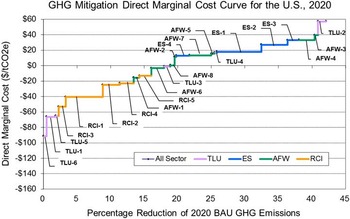
In Figure 2, we present the estimated direct costs of each of the super-options. The y-axis is the cost per tonne of GHG mitigated, and the x-axis is the per cent reduction in GHG emissions below the business-as-usual level in 2020 that each super-option can potentially provide. The potential reduction from the portfolio of super-options is 42 per cent. The data reflect the average cost of each option implemented so as to reach the average level of emissions reduction (policy targets) in the state climate action plans that form the empirical basis for the aggregated options. For example, the cost of $19/tonne for ES-1, the RPS option, assumes avoiding electricity costs and renewable electricity capital costs and capacity factors equal to the weighted average of those variables in the state climate action plans (Peterson et al. Reference Posner2010b).
Super-option direct marginal costs. Source: Developed by the authors.

Macroeconomic impact simulations
The major focus of climate action plan analysis has typically been on the direct, or on-site, microeconomic impacts (such as cost-effectiveness) of individual mitigation options and aggregate portfolios of actions. Typically, the economic costs of GHG emissions stemming from short-term climate variability, such as extreme weather events, and indicators of long-term climate change, such as gradual warming and a rising sea level, are not estimated in state climate action plans. The assessment of indirect effects, including the multiplier effects of increased or decreased output and employment in other sectors of the economy, are often more politically important. For example, energy efficiency reduces the demand for electricity generation from all sources including both fossil energy and renewables. It, therefore, reduces the demand for fuel inputs such as coal and natural gas. At the same time, businesses and households whose electricity bills have decreased have more money to spend on other goods and services. If the households purchase more food or clothing, this stimulates the production of these goods, at least in part, within the state. Food processing and clothing manufacturers in turn purchase more raw materials and hire more employees. Then more raw material suppliers in turn purchase more of the inputs they need, and the additional employees of all these firms in the supply chain purchase more goods and services from their wages and salaries. The sum total of these “indirect” impacts is some multiple of the original direct, on-site impact; hence, this is often referred to as the multiplier effect, a key aspect of macroeconomic impacts. It applies to both increases and decreases in economic activity. The multiplier effect can be further stimulated by price decreases and muted by price increases.
Regional Economic Models, Inc. (REMI) model analysis
The linkages between energy and climate policy, the economy and macroeconomic impacts are extensive and require the use of a sophisticated model that reflects the major structural features of an economy, the workings of its markets and all of the interactions between them. Several modelling approaches can be used to estimate the regional macroeconomic impacts of such policies, including indirect effects. These modelling approaches include: input-output, computable general equilibrium (CGE), mathematical programming and macroeconometric models. Each modelling approach has its own strengths and weaknesses (see, e.g. Rose and Miernyk Reference Rose and Wei1989; Partridge and Rickman Reference Peterson, Wennberg, Rose and Wei2010). After careful consideration of modelling criteria, such as accuracy, transparency, manageability and cost, we chose the REMI Policy Insight Plus (PI+) modelling software (REMI Reference Raiffa2009) to evaluate the macroeconomic impacts to the US from implementing the 23 GHG mitigation super-options across the states. The REMI model have been extensively peer-reviewed and is the most widely used macroeconomic modelling software package in the US, including being used by government agencies in nearly every state (REMI 2012). The REMI model is superior to the other models considered in terms of its forecasting ability. Further, it is comparable to CGE models in terms of analytical power and accuracy. This builds on our methodology developed in the analysis of the macroeconomic impacts of climate action plans in several major states (Rose and Wei Reference Rose and Wei2009, Reference Rose, Wei and Dormady2012; Miller et al. Reference Molina, Neubauer, Sciortino, Nowak, Vaidyanathan, Kaufman and Chittum2010; Rose et al., Reference Rose, Wei and Prager2011, 2012; Wei and Rose Reference Wellborn2011). More details on the REMI model can be found in the online appendix of the Supplementary Material linked to this article.
The REMI model has evolved over the course of 30 years of refinement (see, e.g. Treyz Reference Urpelainen1993). It is a (packaged) programme, but is built with a combination of national and region-specific data. Government agencies in practically every state in the US have used a REMI model for a variety of purposes, primarily evaluating the impact of changes in tax rates, the exit or entry of major businesses in particular or economic programmes in general, and, more recently, the impact of energy and/or environmental policy actions. A macroeconometric forecasting model covers the entire economy, typically in a “top-down” manner, based on macroeconomic aggregate relationships such as consumption and investment. REMI differs somewhat in that it includes some key relationships that factor in such things as imports/exports and production input choice in a “bottom-up” approach. In fact, it makes use of the finely grained sectoring detail of an input-output model, i.e. in the version we used, it divides the economy into 169 sectors, thereby allowing important differentials between them. This is especially important in the context of analysing the impact of GHG mitigation actions where various options are fine-tuned to a given sector or where they directly affect several sectors somewhat differently. The macroeconomic character of the model is able to analyse the interactions between sectors (ordinary multiplier effects) and the responses of producers and consumers to price signals, as well as changes in other market conditions. The REMI PI+ model additionally brings into play features of input substitution, labour and capital markets, as well as trade with other states and countries, including changes in competitiveness. The labour market in the REMI model is very sophisticated, including considerations of input substitution between labour and other factors of production, market supply and demand, wage rate determination and economic geography.
Input data
The quantification analysis of the microeconomic costs/savings undertaken by the state stakeholder processes was limited to the direct effects of implementing the options (see, e.g., FGAT 2008; MCAC 2008). For example, the direct costs of an energy efficiency option include the ratepayers’ payment for the programme and the energy customers’ expenditure on energy efficiency equipment. The direct economic benefits of this option include the savings in energy bills. Before undertaking macroeconomic simulations in the REMI model, the direct costs and savings for each policy option are translated to model inputs that can be utilised in the model. This step involves the selection of appropriate variables and policy levers in the REMI PI+ model to simulate the policy’s changes. For further information, please see previous applications of the model to assess climate policy impacts (Miller et al. Reference Molina, Neubauer, Sciortino, Nowak, Vaidyanathan, Kaufman and Chittum2010; Rose and Wei 2012; Rose et al. Reference Rose, Wei and Prager2011) and the online appendix of the Supplementary Material linked to this article.
The major data sources for this analysis are the scaled-up quantification results of the costs and savings of state-level mitigation policy options. See Peterson et al. (Reference Posner2010b) for the scale-up methodology used to derive the national level data from the state climate action plan analysis results. The stakeholder/portfolio scenario from Peterson et al. (Reference Peterson, Wennberg, Rose and Wei2010a) is an aggressive scenario containing no federal cap and trade or taxing authority and assumes full implementation of the 23 GHG mitigation measures in all 50 states. Because of data and resource limitations, our analysis focused on data collected on macroeconomic linkage variables (only) from seven states (Colorado, Washington, North Carolina, Florida, Iowa, Michigan and Pennsylvania) that are economically and geographically representative of the national economy.
Results
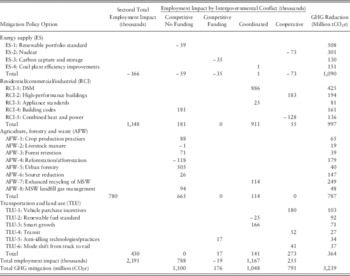
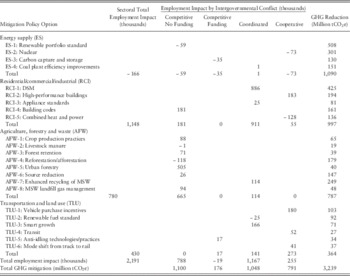
The simulation results indicate that most of the super-options yield positive impacts to the economy. Table 3 presents the impacts in terms of a major macroeconomic indicator – employment – for each super-option for the year 2020. The estimates of GHG reduction potential for the options are also presented. Total GHG emissions for the US in 2020 in the absence of GHG reduction policy implementation is an estimated 7,695 MMtCO2e. As noted above, the percentage reduction potential from the portfolio of super-options is 42 per cent.
Employment and GHG impacts of 23 GHG mitigation policy options in year 2020 (thousands of full-time equivalent jobs)Footnote *
Source: Modelling results by the authors.
Note:
* Totals may not add up due to rounding.
GHG=greenhouse gas; DSM=demand-side management; MSW=municipal solid waste.
The results in Table 3 are presented for both individual options and major sectoral categories, as well as for the three categories of intergovernmental relations (competitive, coordinated and cooperative). By 2020, the employment gains are 2,191 thousand, which represent an increase of 1.19 per cent from the baseline levels. The net present value of the total GDP impacts for the period 2010–2020 is about $356 billion (constant 2007 dollars – not shown). These GHG mitigation options also have the ability to lower the nation’s price index by 0.77 per cent from baseline by the year 2020 (not shown). This price decrease has a positive stimulus on GDP and employment. The macroeconomic impacts of 15 of the 23 options are positive, which means that enacting the portfolio of policy options is expected to bring about a positive stimulus to the nation’s economy by creating more jobs and increasing GDP. Positive stimulus occurs in these options, because they result in cost savings (benefits are greater than costs), and thus lower production costs in their own operation and for their customers. This raises business profits and the purchasing power of consumers in the country, thus stimulating the economy. Those policy options that result in negative macroeconomic impacts do so primarily because, while they do reduce GHGs, the return on investment from a purely economic perspective is negative. Options from the residential, commercial and industrial sectors (RCI) would yield the highest positive impacts on the economy, followed by the options from the agriculture and waste management sectors and the transportation and land use sectors.
-
∙ An analysis of job impact intensity (jobs per billion tonnes of CO2e reductions) for the ES sector indicates that, although higher costs result in job losses, they are relatively small – in the order of <0.1 per cent of the total economy-wide employment. Full implementation of a national RPS could result in job losses at a rate of 123,000/billion tonnes of CO2e reduced. Comparatively, the job loss rate for a nuclear standard is much higher at about 293,000 jobs/billion tonnes CO2e reduced.
Table 3 categorises results according to the three typologies of competition, coordination and cooperation of intergovernmental conflict for the super-options. For competitive policies, we also distinguish those that do not receive federal funding from those with some federal fiscal transfers. These employment impact results highlight several important points:
-
∙ More than half of the employment gains come from coordinated policy options that use enabling or financing mechanisms. Option RCI-1 (DSM) yields the highest positive impacts on the economy – an employment increase of 886,000 jobs by 2020.
-
∙ The competitive policies show mixed economic outcomes. The RPS requires large amounts of capital investment, which will in turn increase energy prices, raise the production costs for businesses and result in considerable dampening effects on the conventional fossil fuel supply sectors. Conversely, the urban forestry policy under a federal regulatory regime would result in job growth due to the large labour component of the policy.
-
∙ The cooperative policies show considerable variation in employment effects, with vehicle purchase and high-performance building incentives showing large job gains, but CHP and carbon capture and storage showing negative effects due to the high capital investment cost.
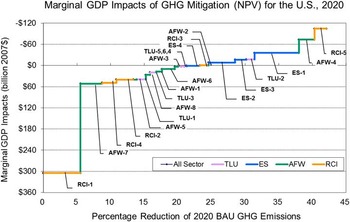
Figure 3 displays the GDP results for each of the super-options in contrast to Figure 2 where we present the estimated direct costs of each of the super-options. The y-axis is the GDP impact for each super-option, but is inverted so that super-options above the $0 axis result in GDP reductions, while those below it result in GDP gains in 2020. Like Figure 2, the x-axis is the per cent GHG emissions reduction that each super-option can potentially attain as compared with the business-as-usual level.
GDP impacts of the super-options. Source: Developed by the authors.

Figure 3 shows that RCI-1, the DSM coordination policy, has the largest positive GDP impact of all the super-options and, from an economic development perspective, should be given the highest priority for federal action. The figure can be used to provide a ranking of the various mitigation options if GDP impacts are the top priority; an analogous ranking can emanate from the employment impacts presented in Table 3. Note that the rankings for GDP and employment will differ slightly when compared to each other, and that both will differ significantly from the direct cost impacts presented in Figure 2. The dramatic difference (e.g. RCI-1 ranks fifth from the top in Figure 2, while it ranks first in Figure 3) is due to the complexity of macroeconomic linkages that only a formal economic model like REMI can ascertain.
Discussion
The macroeconomic results in Table 3 indicate that there is potential demand for the energy and climate policy options that can improve economic and environmental outcomes. However, the current paradigm of cooperative federalism is too contentious to supply these policies given the widely divergent preferences of key stakeholders. In other words, a “zone of possible agreement” is lacking in many climate and energy policy bargaining efforts. Our theoretical framework indicates that, to supply these policies, climate policy enactment processes need to explicitly include the coordination of shared authority between levels of government through informed and open dialogue with stakeholders.
Achieving the economic and environmental benefits of the GHG policies in Table 3 will require a shift from conflict-oriented governance to collaborative governance, where authority over implementation is represented by joint planning and the joint provision of services between levels of government (Mazmanian and Kraft Reference Meirowitz2009). Governments have experienced some success in coordinating authority across different levels including in the case of watershed management (Lubell et al. Reference Lutsey and Sperling2009) and regional land use planning (Layzer Reference Lindblom2006), among others. Dialogue among stakeholders at all levels of government and society are needed to develop shared understandings of what actions are required to optimise US energy and climate policies. These discussions must be formalised into policy proposals to facilitate coordination and cooperation between interdependent units of government. However, the institutions and mechanisms for intergovernmental coordination are under-supplied because the start-up costs for coordination are often high (Bardach Reference Bardach1996).
To provide leadership and reduce start-up costs, we suggest that state climate action planning efforts offer valuable analytical and process templates for a national climate action plan, which would bring together federal, state and local governments with industry and civil society representatives. A national climate action plan, convened by the US government with broad stakeholder participation, would create federal leadership in collaboration and reduce perceptions of its domination of state and local climate policies. A national climate action plan would make policy recommendations on: (1) mandatory, market-based, voluntary performance standards and other cooperative policy mechanisms, (2) funding programmes to reach GHG reduction targets, (3) enabling coordination policies that are necessary for all levels of government to attain their GHG reduction targets, economic development goals and environmental plans, and (4) a comprehensive, stakeholder-based planning process to identify and design the best fitting policies for state, local and federal implementation in each sector – including an updated state implementation plan process under the Clean Air Act to incorporate GHGs through formal collaborative processes like those used in over 20 states. These four elements could be pursued jointly or independently, but should be formulated under a federal framework that supports and integrates sub-national action. Each policy is likely to be complex and unique and will require flexible coordination mechanisms to help fit regulatory authority to the scale of the problem (Freeman and Farber Reference Gormley2005).
A national climate action plan is especially promising because of mutual goal attainment between jurisdictions. States and localities have wanted to set and meet climate planning goals because, in addition to climate benefits, they can improve local economies. States do not view climate action as a necessary tradeoff between climate protection and economic development, but rather as an absolute gain if policies are properly selected and designed. Similarly, the federal government can attain a variety of policy goals including impacts on air quality, water quality, health, resource conservation and energy security by coordinating with state and local jurisdictions. These significant “co-benefits” also include reduced energy and water consumption, as well as improvements to quality of life that occur mainly at the local level. Institutional design that leverages these co-benefits into GHG mitigation policies is likely to be desired by a wide range of stakeholders at all levels of government and society.
The competition-coordination-cooperation taxonomy developed here is just one means to measure intergovernmental conflict, and it can help inform stakeholder coordination efforts. Yet, we believe that this theoretical approach is generalisable to other regulatory domains beyond climate policy for three reasons. First, our theory is an extension of the work of Gormley (2006) who coded intergovernmental conflict in the health, education and environmental policy domains into the money versus mandate categories. Second, we extend Gormley’s approach by applying it not only to regulatory policies, but also to other types of policies that can be qualitatively identified as minimum standards for state implementation, market or voluntary standards, financing, enabling, disclosure, information and education, voluntary agreements, technical assistance or funding policies. Finally, our approach is possible because of the large number of “new” climate policies in the portfolio we analysed. This sample enabled us to categorise the policies on the competition-coordination-cooperation continuum and to relate these with the likelihood of legislative enactment or implementation through expanded use of existing regulatory authority. Each of these policy categories is associated with declining degrees of intergovernmental conflict. However, further research is required to develop empirical estimates of the relationship between intergovernmental conflict and the probability of enactment.
Conclusion
The macroeconomic simulations indicate that implementing the aggregate mitigation policy options recommended in the state climate change action plans at the national level are a win-win portfolio of policies that can provide significant GHG reductions, as well as employment and output gains. The enabling and financing coordination policies are especially strong candidates for concerted policy development, as more than 64 per cent of the job gains stem from coordinated and cooperative policy options – yet they are not likely to happen under the status quo policy process. These policies contribute large economic development benefits; adequate federal funding of DSM alone across the 50 states could result in nearly a million new jobs.
The results indicate that programmes to successfully overcome market barriers and failures in the energy sector are most likely enacted when they minimise intergovernmental conflict. Our analysis suggests that, instead of focusing on national minimum performance standards, energy and environmental efforts should aim to enact coordination policies with positive macroeconomic impacts that may justify states and localities going beyond minimum (floor) federal standards, financing, enabling, market and voluntary performance standards, and other cooperative mechanisms. Because a comprehensive national energy efficiency standard is not likely to be enacted, we should consider that demand reductions from a federal energy surcharge be refunded directly to states for DSM programmes. Although such a surcharge based on energy sales is not as economically efficient as a tax on the carbon content of the fuel, it can still begin to ameliorate energy market failures and barriers and is much more politically feasible.
Our analysis shows that solutions to climate change will not come solely from Washington, DC, nor from state capitals, but rather will be the product of collaboration and mutually beneficial bargaining between key stakeholders who share common understandings and preferences about GHG mitigation. Climate change mitigation policies can help grow the economy if they are properly designed, and need not provoke competition and resistance from either the top-down or bottom-up if they are designed to minimise intergovernmental conflict.
Acknowledgements
The authors wish to thank Dan Mazmanian and the participants of a panel at the 2012 Association for Public Policy Analysis and Management Conference for comments on a previous version of this paper. Special thanks to Lewison Lem, Steve Roe, David von Hippel and Bill Dougherty for assistance on the microeconomic modelling. We also extend our thanks to the editors of the Journal of Public Policy and three anonymous reviewers for their insightful comments. Any remaining errors or omissions are the responsibility of the authors.
Supplementary material
To view supplementary material for this article, please visit http://dx.doi.org/10.1017/S0143814X14000117
Extended list of federal, state and local authority for 23 GHG reduction policies