INTRODUCTION
Exposed beaches are considered poor habitats, where wave action and sediment instability limit the development of biological assemblages, with low productivity compared with other coastal environments (McLachlan, Reference McLachlan, McLachlan and Erasmus1983). Species on sandy beaches are related to both interstitial moisture levels in sand at low tide and tide levels or inundation times (McLachlan, Reference McLachlan1990; Jaramillo et al., Reference Jaramillo, McLachlan and Coetzee1993). In temperate latitudes, supralittoral levels are usually occupied by an assemblage formed by semi-terrestrial amphipods (talitrids), isopods (Oniscidea) and insects (mainly dipterans and coleopterans) that is linked to the food supply from algal wrack and tidal organic material (Jaramillo et al., Reference Jaramillo, McLachlan and Coetzee1993; McLachlan & Jaramillo, Reference McLachlan and Jaramillo1995). Intermediate intertidal levels are usually occupied by marine isopods (cirolanids) and polychaetes (spionids) (Junoy & Viéitez, Reference Junoy and Viéitez1992; Souza & Borzone, Reference Souza and Borzone2000). Lower intertidal levels are occupied by marine amphipods, isopods, cumaceans, polychaetes and molluscs (Jaramillo, Reference Jaramillo1994; McLachlan & Jaramillo, Reference McLachlan and Jaramillo1995).
Oil-spills are considered one of the most significant environmental disasters on intertidal coastal areas and, particularly, the ‘Prestige’ oil-spill off north-west Spain in November 2002 was especially harmful due to its magnitude (Puente et al., Reference Puente, Juanes, Calderón, Echavarri-Erasun, García and García-Castrillo2009). The oil spill motivated many ecological studies on affected intertidal beaches and estuaries, with special emphasis on macroinfaunal assemblages (de la Huz et al., 2005; Junoy et al., Reference Junoy, Castellanos, Viéitez, de la Huz and Lastra2005; Puente et al., Reference Puente, Juanes, García, Álvarez, Revilla and Carranza2008, Reference Puente, Juanes, Calderón, Echavarri-Erasun, García and García-Castrillo2009). Natural variability of exposed beaches depends on different factors, such as slope, tidal ranges, biogeography, latitude and food supply, as well as seasonal cycles that comprise water temperature, storm events, wave exposure and accretion–erosion dynamics (Brazeiro & Defeo, Reference Brazeiro and Defeo1996; Lastra et al., Reference Lastra, de la Huz, Sánchez-Mata, Rodil, Aerts, Beloso and López2006). Medium and long-term studies are suitable to differentiate between the rates of natural and/or anthropogenic disturbances, but these studies are scarce on sandy beaches. To our knowledge, there are no long-term studies on macroinfaunal assemblages from beaches considering natural inter-annual variability and an episodical anthropogenic disturbance (e.g. an oil spill).
The present environmental study was conducted at O Rostro beach, the beach most affected by the ‘Prestige’ oil spill and previously characterized by very low macroinfaunal abundance and diversity (Junoy et al., Reference Junoy, Castellanos, Viéitez, de la Huz and Lastra2005; Lastra et al., Reference Lastra, de la Huz, Sánchez-Mata, Rodil, Aerts, Beloso and López2006). The beach morphodynamic is well known after the monitoring plan and studies developed since the ‘Prestige’ catastrophe (Bernabeu et al., Reference Bernabeu, Nuez de la Fuente, Rey, Rubio, Vilas, Medina and González2006; CEPRECO 2006; González et al., Reference González, Medina, Bernabeu and Novóa2009).
The main aims of the present work were to analyse: (i) the short-term effects of the ‘Prestige’ oil spill on macroinfaunal assemblages; and (ii) to determine the macroinfaunal recovery in the most affected beach in Spain after the oil spill over the medium term (2003–2007).
MATERIALS AND METHODS
Study area and sampling procedure
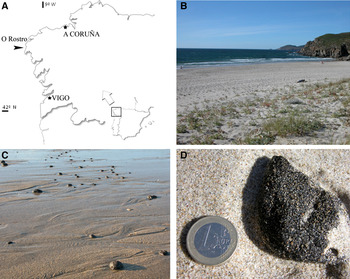
The study was conducted at O Rostro beach (42°58′N, 9°15′W), located on the Galician Costa da Morte (north-west Spain; Figure 1A). The beach is 2000 m long, laterally confined at both sides by cliffs. The intertidal width is up to 150 m for spring tides; the supralittoral comprises a sandbank without vegetation (50 m wide) and a vegetated dune system (100 m wide; Figure 1B). O Rostro beach is exposed to large waves (Bernabeu et al., 2006; CEPRECO, 2006). The tidal range in spring is up to 4.5 m. It is an intermediate beach, with a stable middle-scale transversal bar-horn system (González et al., Reference González, Medina, Bernabeu and Novóa2009). In contrast with other Spanish beaches, it is a non-urbanized beach with few recreational users.
(A) Location of the O Rostro beach; (B) photograph of the north end of the O Rostro beach at high tide on May 2003; (C) tar balls (15–30 cm diameter) observed at the intertidal on first sampling campaign (May 2003); (D) small pellets still present at O Rostro beach at the last sampling campaign (May 2007).

As a result of the sinking of the ‘Prestige’ tanker, oil reached O Rostro beach on 18 November 2002. The beach received a significant amount of oil throughout 2003 and was the beach most polluted by the ‘Prestige; >10,000 t of residual material were removed from the beach (Junoy et al., Reference Junoy, Castellanos, Viéitez, de la Huz and Lastra2005; González et al., Reference González, Medina, Bernabeu and Novóa2009). Buried oil also gradually reappeared and was dragged to the coast because of the beach morphodynamic (Bernabeu et al., Reference Bernabeu, Nuez de la Fuente, Rey, Rubio, Vilas, Medina and González2006; CEPRECO, 2006; González et al., Reference González, Medina, Bernabeu and Novóa2009). Six months after the spill (May 2003), big tar balls (15–30 cm diameter) were obvious in the sediment (Figure 1C) and small pellets (1–2 cm) were collected as late as May 2007 (Figure 1D).
This beach was surveyed throughout five sampling campaigns; six months after the oil spill (May 2003), when cleaning activities were finished and sampling was authorized, and for four years after the oil spill (May 2004, May 2005, May 2006 and May 2007). The campaigns sampled two transects in the middle of the beach which extended from above the drift line (supralittoral) to below the swash line. Beach division was based on Salvat's zonation scheme (Salvat, Reference Salvat1964, Reference Salvat1967) adding an extra supralittoral level (Pollock & Hummon, Reference Pollock and Hummon1971). Hence, five levels were sampled in each transect, two levels at supralittoral zone: (1) 2 m above the drift line; and (2) at the drift line; and three levels in the intertidal zone: (3) retention, tidal level 3–2 m; (4) resurgence, tidal level 2–1 m; and (5) saturation, tidal level 1–0 m. At each level, three 0.05 m2 replicates (1 m apart) were taken with plastic cylinders to a depth of 30 cm and sieved through a 1 mm mesh. The retained residue in the mesh sieve was preserved in 7% formaldehyde; macroinfauna was subsequently sorted from the sediment, identified and counted. The level of replication was based on previous studies (De la Huz, 2005; Junoy et al., Reference Junoy, Castellanos, Viéitez, de la Huz and Lastra2005).
A classical BACI design (Before-After-Control-Impact; Underwood, Reference Underwood1991) was impossible to perform, due to the lack of data before the oil spill and suitable controls, i.e. unaffected beaches with similar environmental characteristics. The only available macroinfaunal data from O Rostro beach were collected on only one sampling occasion (September, 1995) seven years before the spill (Lastra et al., Reference Lastra, de la Huz, Sánchez-Mata, Rodil, Aerts, Beloso and López2006). These data were used as reference for the previous beach state.
The AZTI Marine Biotic Index (AMBI) (www.ambi.azti.es) was designed to establish the ecological quality of European coasts, investigating the response of soft-bottom communities to natural and human-induced changes (Borja et al., Reference Borja, Franco and Pérez2000), being verified successfully in relation to a very large set of environmental impact sources (Borja et al., Reference Borja, Muxika and Franco2003). The AMBI was used exclusively for evaluation of the intertidal zone; supralittoral species were mainly excluded from the species list.
Environmental variables
At each sampling level, one sediment sample was collected for grain size analysis and organic matter content. The sediment was labelled and kept in plastic bags until its arrival at the laboratory, where it was dried in a stove at 60°C for 24 h to constant weight. Particle size analysis was performed by dry sieving (Buchanan, Reference Buchanan, Holme and McIntyre1984). Organic matter content of the sediment was estimated as weight loss of dry samples after combustion (450°C, 24 h). During the 2004 campaign, six sediment samples at each sampling level were used to determine the concentration of hydrocarbons in the sediment with the field kit PetroFlag (Dexsil, Hamden, USA). The oil was buried randomly at the beach and the measurements were highly variable. The method was discarded for the following campaigns.
At each sampling occasion, beach slope (S = 1/R, where R = intertidal width/height of the upper intertidal level) was estimated by the Emery method (Emery, Reference Emery1961); wave height and wave period were estimated to calculate Dean's parameter (Ω) according to Short (Reference Short1999). Furthermore, the beach index (BI) was calculated as follows
 $$\lsqb \hbox{BI}=\log_{10}\lpar \hbox{Mz}\times \hbox{TR}\rpar /S\rsqb$$
where TR is the tidal range, S is the beach slope and Mz is the mean particle size expressed in (φ units + 1), to avoid negative values (McLachlan & Dorvlo, Reference McLachlan and Dorvlo2005). These data were largely completed during morphodynamic beach studies after the oil spill (CEPRECO, 2006; González et al., Reference González, Medina, Bernabeu and Novóa2009).
Statistical analysis
Macroinfaunal assemblages for each time of sampling were analysed using the multivariate package PRIMER v. 6 (Clarke & Gorley, Reference Clarke and Gorley2006). Multivariate data were square root transformed to retain information regarding relative abundances and to reduce differences in scale among the variables (i.e. Clarke & Green, Reference Clarke and Green1988) and Bray–Curtis dissimilarity matrices were calculated between all pairs of samples for ensuing analyses (Bray & Curtis, Reference Bray and Curtis1957). To avoid possible fluctuations due to near-blank samples, a dummy was added to conduct the zero-adjusted Bray–Curtis dissimilarity (Clarke & Gorley, Reference Clarke and Gorley2006). PERMDISP analyses (Anderson, Reference Anderson2005) for testing the homogeneity of multivariate dispersions was previously performed. PERMANOVA analysis was used to study the differences between ‘year’, ‘level’ and the interaction ‘year × level’. An unconstrained ordination, non-metric multidimensional scaling (nMDS) (Kruskal & Wish, Reference Kruskal and Wish1978) and cluster analyses were performed to show multivariate patterns among plots.
Statistical methods available in Systat 12 (SPSS, 1999) were performed to analyse macroinfaunal and sedimentary data as a function of year (2003–2007) and tidal zone (supralittoral vs intertidal). Factor analysis (FA) was used to look for coherent grain size groups of variables that were correlated with one another within groups but largely independent between groups (Tabachnick & Fidell, Reference Tabachnick and Fidell2001). These groups of correlated variables or factors help to interpret the underlying mechanisms that have created the relationship between variables. To facilitate interpretation, varimax rotation was used, since it minimizes the number of variables that load highly on a factor and maximizes the loading variance across factors. To further facilitate the interpretation of correlation, analyses were employed between those granulometric variables loading high in the factors and their associated macroinfaunal species.
RESULTS
Environmental variables
Sedimentary characteristics of the O Rostro beach throughout the study period are given in Table 1. The dominant sedimentary type was medium sands (0.2–0.5 mm diameter) throughout the study period in both zones (supralittoral and intertidal). Gravel and silt–clay were scarce (<1.3%). Organic matter content was characterized by low concentrations (<1.2%) (Table 1). Data from the concentration of the hydrocarbons in the sediment varied from 36.50 ± 17.79 ppm at the upper supralittoral level to 139.18 ± 63.22 ppm at the saturation level.
Sediment variables of the O Rastro beach throughout the study period. So, sorting coefficient; OM, organic matter content.

Beach index (BI) ranged from 2.23 (2004) to 2.61 (2005). Dean's parameter (Ω) estimated at the sampling times ranged from 3.2 (2007) to 3.8 (2004). However, the beach slope (1/x) varied greatly at O Rostro beach, from 21.85 (2004) to 48 (2006).
These observations are in concordance with the data of CEPRECO (2006) and González et al. (Reference González, Medina, Bernabeu and Novóa2009). These authors noted that the modal state of the beach corresponds to the ‘Rhythmic Bar and Beach’; however, the beach exhibits a great temporal distribution of morphodynamic states, from ‘Transversal Bar and Rip’ to ‘Longshore Bar and Trough’.
Macroinfauna assemblage
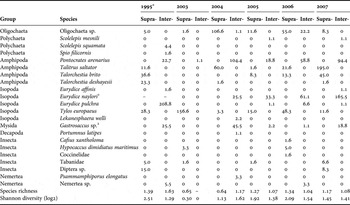
The overall macroinfaunal abundances varied largely throughout the study period, ranging from 49 ind. m2 (2005) to 280 ind. m2 (2007). These differences were mainly due to the variations of crustacean abundances, the dominant taxonomic group (Table 2). Species richness remained constant with slight variations throughout the study period, with the exception of 2003 campaign, six months after the spill, which showed the lowest richness (five taxa) (Table 2).
Density (individuals/m2), species richness and diversity of the macrofauna throughout the study period. *, 1995 data elaborated from original data provided by Dr Lastra (Universidad de Vigo); 1, Eurydice naylori was described in 1997 and is obviously absent from the 1995 data; 2, the specie was Gastrosaccus roscoffensis in the 2003–2007 sampling campaigns.

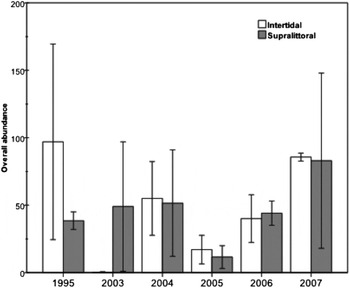
The supralittoral zone was characterized by low macroinfaunal abundance throughout the study period, ranging from 63 ind. m2 (2005) to 276 ind. m2 (2007) (Figure 2). The most abundant species were the talitrid amphipod Talitrus saltator (167 individuals), the isopod Tylos europaeus (141 individuals), the oligochaeta (114 individuals) and the talitrid Talorchestia brito (41 individuals). The remaining species were scarce (<10 individuals) (Table 2).
Overall macrofaunal abundances (±SE) in intertidal and supralittoral stations throughout the study period (oil spill started November 2002).

Abundance of taxa at the intertidal zone varied largely throughout the study period, ranging from only 1 ind. m2 six months after the spill (2003) to a maximum 282 ind. m2 at the end of the study period (2007) (Figure 2). The most abundant species collected after the spill were the isopods Eurydice naylori (257 individuals), and the amphipod Pontocrates arenarius (250 individuals), followed by the mysid Gastrosaccus roscoffensis (61 individuals). As in the supralittoral zone, the remaining species were scarce (<10 individuals).
In 2003 post-oil spill conditions, macroinfaunal assemblages were represented by only one intertidal specimen of the amphipod Pontocrates arenarius and four supralittoral taxa: Oligochaeta, Tabanidae larvae, the coleopteran Hypocaccus dimidiatus maritimus and the isopod Tylos europaeus. Tylos europaeus dominated overwhelmingly (156 ind. m2, 94.94% overall abundance), and together with the oligochaetes and Pontocrates arenarius were collected in all sampling campaigns (1995 and 2003–2007). Supralittoral talitrids Talitrus saltator and Talorchestia brito, and the mysid Gastrosaccus were collected at each sampling occasion, including 1995, except for 2003, six months before the spill.
The most abundant Eurydice species after the spill was E. naylori, an isopod species described in 1997 (Jones & Pierpoint, Reference Jones and Pierpoint1997), and obviously not recorded in the 1995 sampling campaign. Polychaetes, represented by three spionid species, were scarce. Only two specimens of Scolelepis mesnili were collected in 2005 and 2007, whereas in 1995 the species collected were Scolelepis squamata and Spio filicornis.
Analysis results
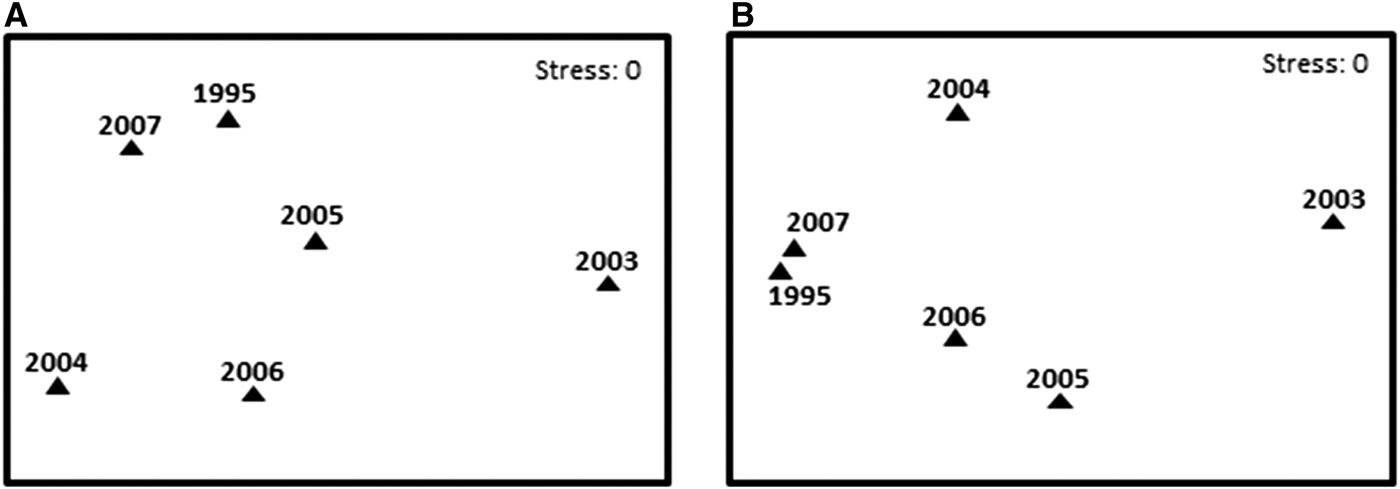
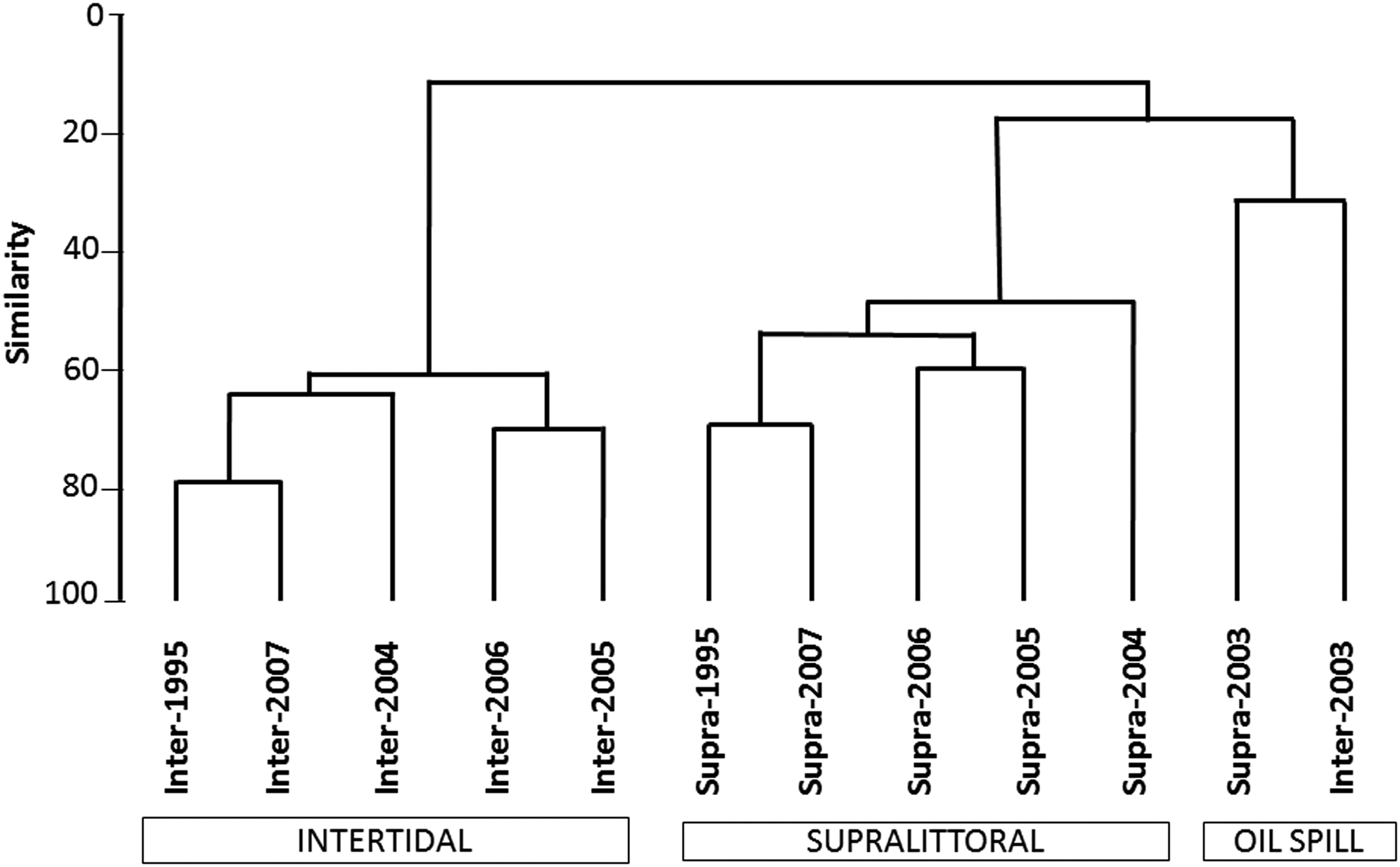
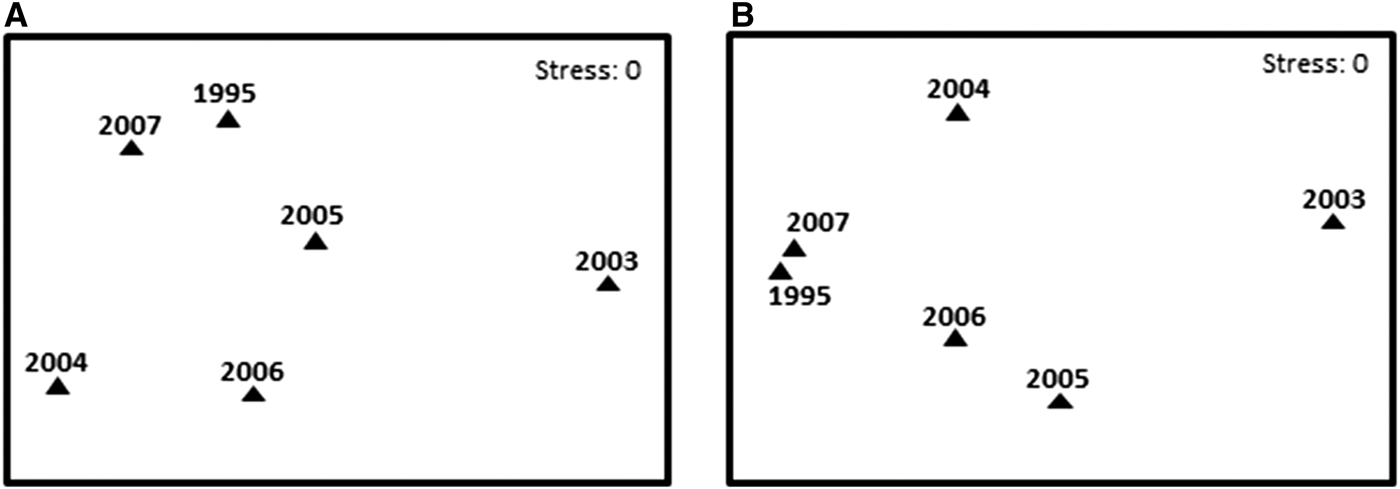
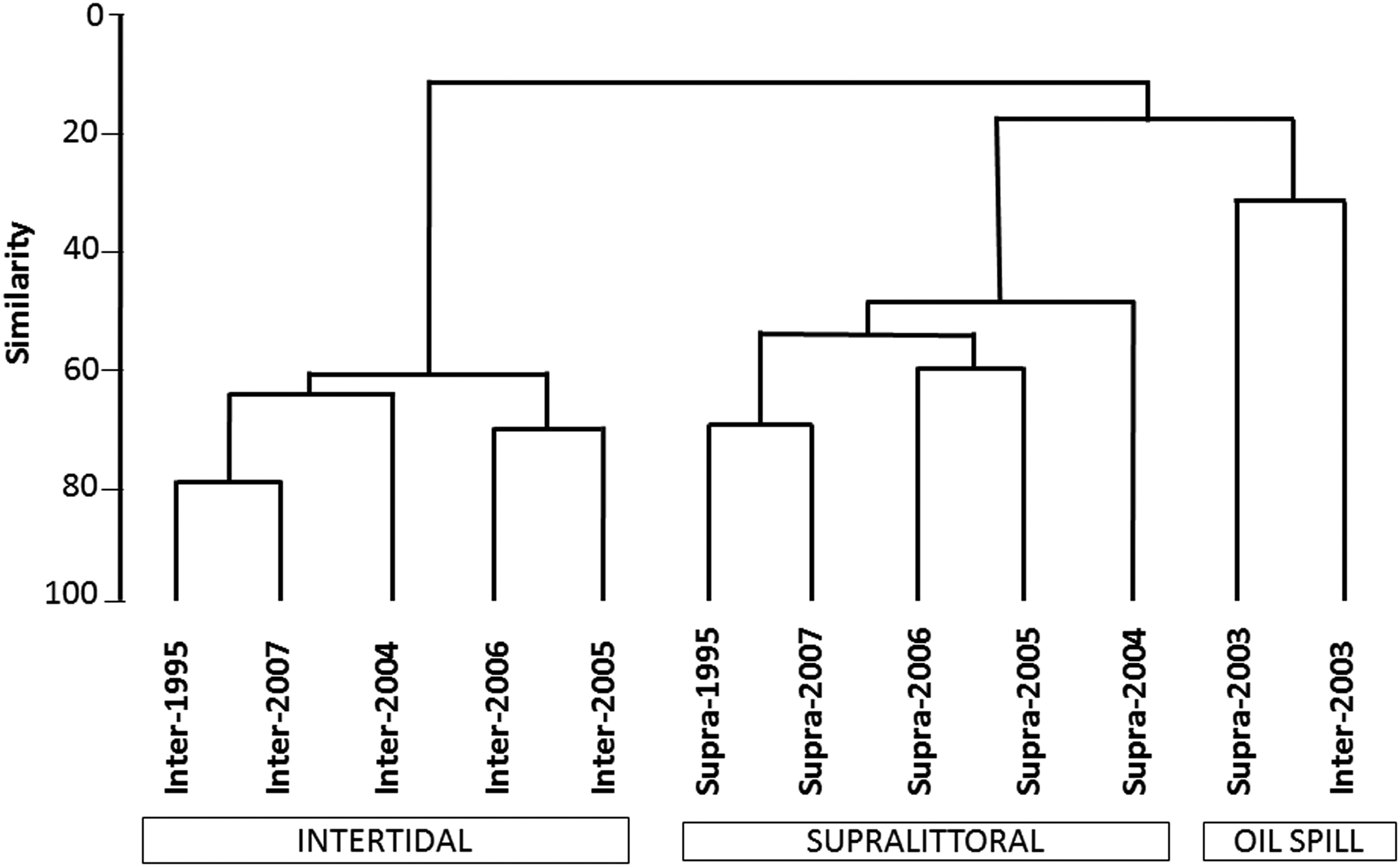
Significant differences were found in the multivariate analyses of variance according to the factors ‘zone’ and ‘year’, with a P-value (perm) <0.0001 for the study period. A significant result was also found for the interaction of ‘zone × year’ (P (Perm) <0.0001) (Table 3). These results were in concordance with a different test on the homogeneity of multivariate dispersion of the samples. The nMDS and cluster analyses of supralittoral and intertidal zones show that 2003 (six months after the spill) is separated from the remaining years (Figures 3 & 4). The cluster analysis shows a close resemblance between 1995 and 2007 at both zones. Macroinfaunal assemblage structure remained almost constant throughout the study period.
Non-metric multidimensional scaling similarity plot computed for: (A) supralittoral; (b) intertidal.
Cluster analysis for the supralittoral and intertidal zones at the different sampling campaigns. First campaign, May 2003, is labelled OIL SPILL.
Results of PERMANOVA testing for diffferences in macrofaunal assemblage structure throughout the study period with Year and Zone as fixed factors.

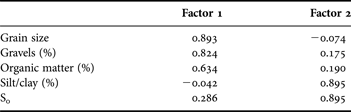
A factor analysis (FA) was used with sediment variables and two factors were identified. Factor 1 comprises grain size, gravels and organic matter and Factor 2 includes silt–clay and a sorting coefficient (S0) (Table 4). The percentage of variance explained for each factor is: 43.30% (axe 1) and 25.08% (axe 2), with a total of 68.38%.
Factor analysis with sedimentary variables.
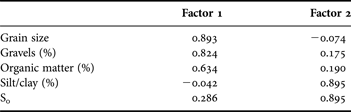
Significant correlations occurred only between factor 2 (silt–clay and the sorting coefficient (S0)) and the amphipod Pontocrates arenarius (Pearson correlation R = 0.26; P = 0.043).
The temporal variation in the AMBI also shows the beach recovery after the impact. In 2003 the beach is classified as highly disturbed (AMBI = 5.671), only slightly disturbed in the following year, 2004 (AMBI = 2.887) and undisturbed in 2005, 2006 and 2007 (AMBI = 1.105, 0.900 and 0.603, respectively). The beach was also considered undisturbed in 1995 (AMBI = 0.950).
DISCUSSION
The main problem for the assessment of the ecological effects of the ‘Prestige’ oil spill is the lack of baseline studies in many of the ecosystems affected, as has been highlighted in other studies (Gelin et al., 2003; Puente et al., Reference Puente, Juanes, Calderón, Echavarri-Erasun, García and García-Castrillo2009). Previous data (1995) from Galician beaches made possible comparisons before and after the 2003 oil spill. In this context, a wide spatial analysis, with many beaches sampled, has proved to be useful in detecting the general impact in short term before–after analyses (De la Huz et al., Reference De la Huz, Lastra, Junoy, Castellanos and Viéitez2005; Junoy et al., Reference Junoy, Castellanos, Viéitez, de la Huz and Lastra2005). A reduction of macroinfaunal abundance and species richness was encountered six months after the spill. These shifts were particularly accentuated in scarce species, represented by low abundance at the studied beaches, which were eliminated from oiled beaches (De la Huz et al., Reference De la Huz, Lastra, Junoy, Castellanos and Viéitez2005; Junoy et al., Reference Junoy, Castellanos, Viéitez, de la Huz and Lastra2005). In the supralittoral, macroinfaunal variations consisted of the disappearance of insects, and in some cases, a sharp increase of oligochaetes. This increase was related to the oil deposit at upper beach level. Talitrid amphipods and the isopod Tylos europaeus showed a clear reduction in abundance. In the intertidal zone, a marked decrease of polychaetes and isopods abundance (Scolelepis spp., Eurydice spp.) and the increase of abundance of the amphipod Pontocrates arenarius was observed.
Talitrids and Eurydice spp. were absent in the samples six months after the spill (2003). The increase of Pontocrates arenarius abundance observed in 2003 at Galician beaches (Junoy et al., Reference Junoy, Castellanos, Viéitez, de la Huz and Lastra2005) was also evident in 2004 at O Rostro beach. Junoy et al. (Reference Junoy, Castellanos, Viéitez, de la Huz and Lastra2005) noted that with the available data it was difficult to assess whether P. arenarius is an opportunistic species favoured by the ‘Prestige’ spill, but it is noteworthy that in the most severely affected beach the increase was delayed. Scolelepis species were always rare at O Rostro due to the sedimentary characteristics of the beach; both S. squamata and S. mesnili prefer finer sediments (Laborda, Reference Laborda1987; Junoy & Viéitez, Reference Junoy and Viéitez1992).
The ‘Prestige’ oil spill did not markedly affect macroinfaunal diversity and richness (De la Huz et al., Reference De la Huz, Lastra, Junoy, Castellanos and Viéitez2005; Serrano et al., Reference Serrano, Sánchez, Preciado, Parra and Frutos2006; Puente et al., Reference Puente, Juanes, Calderón, Echavarri-Erasun, García and García-Castrillo2009), which was observed in other oil spills (Kingston et al., Reference Kingston, Dixon, Hamilton and Moore1995; Feder & Blanchard, Reference Feder and Blanchard1998; Fukuyama et al., Reference Fukuyama, Shigenaka and VanBlaricom1998). A significant effect observed in other spills (Pielou, Reference Pielou1975; Gómez-Gesteira et al., Reference Gómez-Gesteira, Dauvin and Salvande-Fraga2003) was an enhanced abundance of opportunistic species, mainly polychaetes, accompanied by a sharp decrease of sensitive species, mainly amphipods (Gómez-Gesteira & Dauvin, Reference Gómez-Gesteira and Dauvin2000, Reference Gómez-Gesteira and Dauvin2005; Peterson, Reference Peterson2001). This smaller effect of the ‘Prestige’ oil spill could be explained by the physico-chemical characteristics of the oil, the season of the spill (winter), rough seas, sea temperature and quick removal of oil from most of the beaches (De la Huz et al., Reference De la Huz, Lastra, Junoy, Castellanos and Viéitez2005; Junoy et al., Reference Junoy, Castellanos, Viéitez, de la Huz and Lastra2005).
Six months after the spill, O Rostro beach suffered a severe reduction in macroinfaunal abundance and species number (1995 vs 2003). However, interannual variations throughout the period 2004–2007 did not show strong differences in macroinfauna assemblage structure. The beach recovery has also been detected with the AMBI.
The ‘Prestige’ oil spill affected the beach macroinfauna for the first 17–18 months. Ecological studies on interannual variations are scarce on Spanish coasts, and are crucial to determine variations of macroinfaunal assemblages. Moreover, ecological responses to climate change, such as shifts in physiology, phenology, distribution, assemblage structure and species interaction, are still uncertain, but apparently are increasing on sandy beaches throughout the last decades (Brown & McLachlan, Reference Brown and McLachlan2002; Jones et al., Reference Jones, Gladston and Hacking2007).
Natural disturbances have possibly hindered the identification of the generalized effects of oil-related activities on macrofauna assemblages in the northern Gulf of Mexico (Green & Montagna, Reference Green and Montagna1996). Thus, the responses of opportunists to natural and anthropogenic disturbances are not easily distinguishable (Clark, Reference Clark1982; Spies, Reference Spies, Boesch and Rabalais1987; Hernández-Arana et al., Reference Hernández-Arana, Warwick, Attrill, Rowden and Gold-Bouchot2005).
ACKNOWLEDGEMENTS
We are grateful to Dr Mariano Lastra (Universidad de Vigo, Spain) who kindly provided data from 1995. The authors wish to thank the Benthos Team from Universidad de Alcalá (‘The Cribians’) for field assistance.
FINANCIAL SUPPORT
This research was supported by Project VEM2004-08544, Spanish Ministerio de Educación y Ciencia and the Project ‘Biodiversidad marina en el Atlántico’, Instituto Frankin Universidad de Alcalá.