


Introduction
Social Anxiety Disorder (SAD; also known as Social Phobia) is one of the most common anxiety disorders, with a 12-month prevalence rate of approximately 6.8% (Kessler, Chiu, Demler and Walters, Reference Kessler, Chiu, Demler and Walters2005). Although most people occasionally experience some degree of social discomfort or shyness, individuals with SAD fear humiliating or embarrassing themselves in social situations so intensely that they either avoid such situations entirely or suffer through them, often with the use of “safety behaviors” (e.g. excessive rehearsal) in an attempt to control the anxiety or limit the likelihood of feared outcomes. Moreover, individuals with SAD often believe that they are incapable of behaving in a socially skilled manner and will face rejection or loss of status as a result of their own deficiencies (Clark and Wells, Reference Clark, Wells, Heimberg, Liebowitz, Hope and Schneier1995). For most individuals, SAD symptoms emerge in adolescence and are more likely than other anxiety disorder symptoms to remain unrecognized and/or untreated (Magee, Eaton, Wittchen, McGonagle and Kessler, Reference Magee, Eaton, Wittchen, McGonagle and Kessler1996).
Various theoretical models provide a framework for understanding the development and maintenance of social anxiety (Clark and Wells, Reference Clark, Wells, Heimberg, Liebowitz, Hope and Schneier1995). The most widely researched models stem from Beck's (Reference Beck1976) cognitive specificity theory, which states that emotional problems in general arise from specific dysfunctional beliefs and cognitions about social situations. For example, depression is thought to emerge from a triad of overly negative “core beliefs” about the self, world, and future (Beck, Rush, Shaw and Emery, Reference Beck, Rush, Shaw and Emery1979), and panic disorder, from catastrophic beliefs about the dangerousness of naturally occurring physiological sensations (Clark, Reference Clark1986). With respect to social anxiety, dysfunctional cognitions about one's own social inadequacy (e.g. “I can't keep a conversation going”), the inherently critical nature of others (e.g. “Everyone is looking for reasons to criticize me”), the presence of one's own anxiety symptoms (e.g. “People notice how anxious I become and think I'm strange”), and the fundamental importance of being positively evaluated by others (e.g. “It would be awful if someone didn't like me”) are thought to play a pivotal role in the fear and avoidance of social interactions (Clark and Wells, Reference Clark, Wells, Heimberg, Liebowitz, Hope and Schneier1995; Rapee and Heimberg, Reference Rapee and Heimberg1997).
These dysfunctional cognitions about social situations are specifically thought to lead to anxiety and fear when anticipating or engaging in social interactions, even in the absence of overt threat cues. Further, such cognitions prompt hypervigilance for any possible sign of social threat (McNally, Reference McNally and Hope1996). This hypervigilance activates a set of attentional biases towards internal (e.g. physiological symptoms of anxiety) and external (e.g. frowns, yawning or signs of boredom) threat cues. The detection of these perceived threat cues in turn triggers a further shift in attention away from the social interaction and to one's own negative thoughts and predictions about the situation. This shift in attention subsequently hinders the individual's social performance further. Ultimately, this may elicit actual signs of negative social evaluation from others, confirming the individual's maladaptive beliefs. Additionally, excessive efforts to avoid, control, or escape from social situations (i.e. safety behaviors) aid in the maintenance of social anxiety by preventing the disconfirmation of dysfunctional cognitions (e.g. one cannot learn that giving a speech is not truly dangerous if one avoids public speaking; Clark, Reference Clark1999).
A large body of empirical research with clinical and nonclinical individuals provides support for this theoretical model of social anxiety. For example, several studies indicate that individuals with social anxiety engage in more negative self-evaluation than non-anxious individuals and perceive themselves negatively in social situations (e.g. Amir, Foa and Coles, Reference Amir, Foa and Coles1998a, Reference Amir, Foa and Colesb; Stopa and Clark, Reference Stopa and Clark2000). Further, research on attentional biases provides evidence that socially anxious individuals have specific attentional biases toward social threat cues such as frowning or angry faces (e.g. Asmundson and Stein, Reference Asmundson and Stein1994; Hope, Rapee, Heimberg and Dombeck, Reference Hope, Rapee, Heimberg and Dombeck1990; Lee and Telch, Reference Lee and Telch2008). Evidence from these studies also suggests that these processes naturally occur and elicit anxiety along a continuum in both clinical and subclinical (i.e. anxious but non-treatment seeking) populations. Treatment studies examining the efficacy of cognitive-behavioral therapy (CBT) for treating social anxiety provided further support for the validity of models that highlight the role of dysfunctional cognitions. Specifically, research suggests that CBT, which focuses on helping patients change their dysfunctional cognitions, confront feared situations (exposure therapy), and eliminate safety behaviors, is an effective treatment for social anxiety (Mattick, Peters and Clarke, Reference Mattick, Peters and Clarke1989; see Heimberg, Reference Heimberg2002 for a review). Additionally, data from treatment studies support the conclusion that reductions in cognitive distortions (e.g. overestimations of the probability and cost of negative social events) are closely associated with the degree of improvement in social anxiety symptoms (McManus, Clark and Hackmann, Reference McManus, Clark and Hackmann2000).
Although the available literature supports the theoretical model described above, dysfunctional cognitions do not account for all of the variability in social anxiety symptoms (Fergus, Valentiner, Kim and Stevenson, Reference Fergus, Valentiner, Kim and Stephenson2009). Moreover, the somewhat limited data presently available suggest that the combination of cognitive strategies with exposure may not be significantly superior to exposure alone (e.g. Rodebaugh, Holaway and Heimberg, Reference Rodebaugh, Holaway and Heimberg2008; Hope, Heimburg and Bruch, Reference Hope, Heimberg and Bruch1995; Chambless, Tran and Glass, Reference Chambless, Tran and Glass1997; Scholing, and Emmelkamp, Reference Scholing and Emmelkamp1999; Gould, Buckminster, Pollack, Otto and Yap, Reference Gould, Buckminster, Pollack, Otto and Yap2006). Accordingly, it is important to examine alternate theoretical mechanisms that may help us to more completely predict, explain, and treat social anxiety. It is also important to use existing theoretical mechanisms as benchmarks to evaluate the ability of novel mechanisms to improve upon our understanding of the phenomenon underlying social anxiety symptoms.
Relational Frame Theory (RFT; Hayes, Luoma, Bond, Masuda and Lillis, Reference Hayes, Luoma, Bond, Masuda and Lillis2006) is one such model that provides additional mechanisms worth evaluation. Similar to CBT models, RFT posits that cognitions exert their effects based not only on their form or frequency, but also based on the context in which they occur (Hayes et al., Reference Hayes, Luoma, Bond, Masuda and Lillis2006). Unlike CBT models, however, RFT views contexts that encourage the control of private experiences such as thoughts and emotions as problematic. Further this model, which forms the basis for Acceptance and Commitment Therapy (ACT), proposes that many psychological problems arise from experiential avoidance (EA; Hayes and Gifford, Reference Hayes and Gifford1997). EA is defined as efforts to control or avoid unpleasant private events such as negative thoughts and emotions, for example anxiety (Hayes, Wilson, Gifford, Follette and Stroahl, Reference Hayes, Wilson, Gifford, Follette and Stroahl1996; Orsillo and Roemer, Reference Orsillo and Roemer2005). From this perspective, social anxiety is thought to arise from efforts to control or eliminate the emotional and physiological experiences associated with anxiety, as well as thoughts and fears of embarrassment and negative evaluation. Thus, the RFT model of anxiety disorders departs from the cognitive model in that EA is focused not on one's specific dysfunctional beliefs and interpretations (i.e. dysfunctional cognitions) about events or surroundings, but rather how emotional flexible individuals are and how they tolerate anxious affect in the presence of fear cues. ACT seeks to ameliorate EA by helping socially anxious patients to accept and endure the negative experiences described above (i.e. develop greater “psychological flexibility”), rather than resort to avoidance and escape strategies (Eifert and Forsyth, Reference Eifert and Forsyth2005).
Several studies have shown that ACT is effective for the treatment of anxiety disorders (for a review see Powers, Zum Vorde Sive Vording and Emmelkamp, Reference Powers, Zum Vorde Sive Vording and Emmelkamp2009), lending initial support to the validity of EA as a model for conceptualizing the psychopathology and treatment of anxiety. Only one unpublished study has directly examined the relationship between EA and social anxiety symptoms (Berrocal, Bernini and Cosci, Reference Berrocal, Bernini and Cosci2010). This investigation found that, consistent with RFT, non-clinical participants with greater levels of social anxiety evidenced more EA than did those with less social anxiety. On the other hand, support of the ability of EA to predict the symptoms of other anxiety disorders over and above cognitive distortions has been mixed. For example, in a series of studies the coauthors of the present investigation found that EA did not predict additional variability in OCD, or health anxiety symptoms over and above disorder-specific cognitive distortions (Abramowitz, Lacky and Wheaton, Reference Abramowitz, Lackey and Wheaton2009; Wheaton, Berman and Abramowitz, Reference Wheaton, Berman and Abramowitz2010). The results of a third study, however, showed that EA predicted certain symptom domains of hoarding above and beyond disorder specific cognitions (Wheaton, Abramowitz, Franklin, Berman and Fabricant, Reference Wheaton, Abramowitz, Franklin, Berman and Fabricant2010). To date, no research has examined the relative contributions of EA and disorder specific cognitive distortions in the prediction of social anxiety symptoms.
In summary, both the traditional cognitive and RFT models can account for social anxiety symptoms, at least to some extent. These approaches also both provide a theoretically consistent basis for intervention. Nevertheless, important questions remain: What is the relationship between social anxiety related dysfunctional cognitions and EA? What are the relative contributions of these constructs in the prediction of social anxiety symptoms? Can these constructs together predict social anxiety symptoms better than either construct alone? The present study was designed to address these questions, which have implications for generating accurate models of, and improving treatments for, social anxiety. In this study, we administered measures of social anxiety symptoms, social anxiety cognitions, EA, and general distress, and used regression analyses to examine models predicting social anxiety symptoms. We hypothesized, on the basis of previous research and the conceptual approaches discussed above, that dysfunctional social anxiety cognitions and EA would each be associated with social anxiety symptoms as well as with each other. We also predicted that both EA and dysfunctional cognitions would emerge as independent predictors of social anxiety symptoms after controlling for each other and for general distress. As in previous studies of social anxiety, we elected to test our hypotheses using a sample of individuals who scored above an empirically derived cut-point on a measure of social anxiety symptoms (Stein, Torgrud and Walker, Reference Stein, Torgrud and Walker2000).
Method
Participants
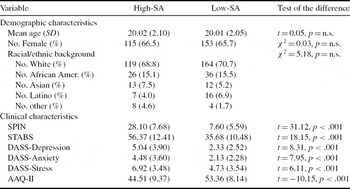
Four hundred and six self-selected undergraduate students (66.3% female; mean age = 20.01 years; SD = 2.06) enrolled in Introductory Psychology courses at a large university in the southeastern United States completed a computer-administered online questionnaire battery. In order to investigate our hypotheses among individuals experiencing significant social anxiety symptoms we divided the sample on the basis of their score on the Social Phobia Inventory (SPIN; Connor et al., Reference Connor, Davidson, Churchill, Sherwood, Foa and Weisler2000) using the empirically derived cut score of 19, which reliably identifies clinically significant levels of social anxiety (Connor et al., Reference Connor, Davidson, Churchill, Sherwood, Foa and Weisler2000). The 19-point cut score was derived via receiver operating characteristic curves, which balance sensitivity and specificity and was found to have high diagnostic accuracy (79%; Connor et al., Reference Connor, Davidson, Churchill, Sherwood, Foa and Weisler2000). This yielded two groups, the first consisting of individuals high in social anxiety [High-SA], n = 173, and the second consisting of individuals low in social anxiety [Low-SA], n = 233. Demographic characteristics of the two groups are presented in Table 1. As can be seen, there were no differences in age or sex composition. Although the two groups were fairly ethnically diverse, there were no significant differences in the frequencies of any particular group.
Demographic and clinical characteristics for the High-SA (n = 173) and Low-SA (n = 233) groups

Note: High-SA = high social anxiety; Low-SA = low social anxiety; SPIN = Social Phobia Inventory; STABS = Social Thoughts and Beliefs Scale; DASS = Depression Anxiety Stress Scales; AAQ-II = Acceptance and Action Questionnaire II
An important issue concerns whether the study of analogue samples is relevant to understanding social anxiety per se. Empirical research indicates that social anxiety exists on a continuum, and commonly occurs in undergraduate samples (e.g. Connor et al., Reference Connor, Davidson, Churchill, Sherwood, Foa and Weisler2000; Stein et al., Reference Stein, Torgrud and Walker2000). Given this, undergraduate samples are frequently used in the study of social anxiety symptoms (e.g. Ashburg, Anthony, McCabe, Schmidt and Swinson, 2005; Mellings and Alden, Reference Mellings and Alden2000). In addition, the clinical cut-off score on the SPIN reliably identifies individuals meeting full DSM-IV criteria for social anxiety and has previously been used in research to identify individuals with significant social anxiety (Connor et al., Reference Connor, Davidson, Churchill, Sherwood, Foa and Weisler2000). The 19-point cutscore on the SPIN should not be interpreted as indicating a bona fide diagnosis of social anxiety disorder in and of itself. However, this score has been found to accurately identify individuals experiencing social phobia and subclinical social phobia symptoms (Ranta, Kaltiala-Heino, Ranteen, Tuomisto and Marttunen, Reference Ranta, Kaltiala-Heino, Ranteen, Tuomisto and Marttunen2007). As such, it has satisfactory diagnostic efficiency to be used as a screening tool for identifying those with significant social anxiety (Ranta et al., Reference Ranta, Kaltiala-Heino, Ranteen, Tuomisto and Marttunen2007).
Procedure
Participation in this study was available to all undergraduate students enrolled in Introductory Psychology classes at the study site. These classes include a research participation requirement (which students can opt out of by completing alternative assignments) and all participants received course credit for their participation in the study. The study was reviewed and approved by the university's institutional review board (IRB).
After signing up for the experiment via an Internet-based software program, participants provided consent to participate and were directed to a secure project website where they completed the study measures. All data were collected using Qualtrics, an online web survey development tool. The design of the Internet versions of the study questionnaires was based on empirically-derived suggestions for how to develop computer questionnaires (e.g. Hewson, Yule, Laurent and Vogel's, Reference Hewson, Yule, Laurent and Vogel2003). Results from a number of studies indicate that the administration of anxiety-related assessment measures using Internet-based and paper-and-pencil formats yield highly comparable results (e.g. Coles, Cook and Blake, Reference Coles, Cook and Blake2006).
Upon accessing the secure project website, participants were presented with a set of instructions for completing the self-report instruments. Participants were informed that all responses were confidential and that no personal identifying information would be included in the computer-generated dataset other than the date and time they completed the study. At the end of the last questionnaire, a debriefing statement was presented.
Measures
The Social Phobia Inventory (SPIN; Connor et al., Reference Connor, Davidson, Churchill, Sherwood, Foa and Weisler2000). The SPIN is a 17-item self-report measure of the severity of social anxiety symptoms. The SPIN has demonstrated good internal consistency, test-retest reliability, construct validity and sensitivity to the effects of treatment (Connor et al., Reference Connor, Davidson, Churchill, Sherwood, Foa and Weisler2000). A score of 19 effectively distinguishes clinically significant cases of social anxiety from nonclinical cases (Connor et al., Reference Connor, Davidson, Churchill, Sherwood, Foa and Weisler2000). Good internal consistency was observed in the present sample (α = .93).
Acceptance and Action Questionnaire-II (AAQ-II; Bond et al., Reference Bond, Hayes, Baer, Carpenter, Orcutt and Waltz2008). The AAQ-II is a 10-item revision of the original 9-item AAQ (Hayes et al., Reference Hayes, Strosahl, Wilson, Bissett, Pistorello and Toarmino2004). Whereas the original AAQ was scored so that higher scores indicate higher experiential avoidance, items on the AAQ-II are reverse coded such that lower scores indicate experiential avoidance while higher scores reflect psychological flexibility. Psychological flexibility refers to the ability to observe one's own internal experiences (e.g. thoughts, feelings, images, physiological sensations) on a moment-to-moment basis, in an open and non-judgmental manner, even when they are unpleasant or upsetting, and is thus considered to be the inverse of experiential avoidance (Hayes et al., Reference Hayes, Luoma, Bond, Masuda and Lillis2006). Scores on the AAQ-II are highly correlated with those on the original AAQ, and have good test-retest reliability and internal consistency (Bond et al., Reference Bond, Hayes, Baer, Carpenter, Orcutt and Waltz2008). Internal consistency in the present sample was acceptable (α = .85).
Social Thoughts and Beliefs Scale (STABS; Turner, Johnson, Beidel, Heiser and Lydiard, Reference Turner, Johnson, Beidel, Heiser and Lydiard2003). The STABS is a 21-item self-report measure that assesses the broad domain of cognitions associated with social anxiety. The measure prompts respondents to rate thoughts that they typically have when encountering social situations on a 5-point Likert-type scale from “Never characteristic” to “Always characteristic”. Two domains of specific cognitions are measured: Social comparison (e.g. “Other people are more comfortable in social situations than I am”) and Social ineptness (e.g. “Other people are bored when they are around me”). Turner et al. (Reference Turner, Johnson, Beidel, Heiser and Lydiard2003) found that both the STABS total score and each of the two factor scores significantly differentiated individuals with social phobia from those without. Further, the total score and both scale scores were found to have adequate test-retest reliability and internal consistency. In the present study, only the total score was used as it has been shown to have better reliability and the two subscales have been found to be highly correlated (r = .85, Turner et al., Reference Turner, Johnson, Beidel, Heiser and Lydiard2003). The STABS total score has demonstrated good convergent validity, test-retest reliability and internal consistency in both clinical and nonclinical populations (Fergus et al., Reference Fergus, Valentiner, Kim and Stephenson2009; Turner et al., Reference Turner, Johnson, Beidel, Heiser and Lydiard2003). Internal consistency in the present sample was excellent (α = .95).
Depression Anxiety Stress Scales 21 (DASS-21; Antony et al., Reference Antony, Bieling, Cox, Enns and Swinson1998). The DASS-21 is a short form of the original 42-item DASS (Lovibond and Lovibond, Reference Lovibond and Lovibond1995). The scale is comprised of three separate subscales, measuring self-reported depression, anxiety, and stress. The DASS-21 subscales have been found to have good reliability and construct validity in both clinical (Page, Hooke and Morrison, Reference Page, Hooke and Morrison2007) and non-clinical samples (Henry and Crawford, Reference Henry and Crawford2005) and are commonly used in research studies. Internal consistency for each DASS subscale was acceptable in the present sample (range in α = .77 to .86).
Data analytic strategy
We first conducted between-group comparisons to examine differences between the High-SA and Low-SA groups’ mean scores on the study measures. Second, using only the High-SA group's data, we computed correlation coefficients to examine zero-order relationships among anxiety, depression and stress (DASS subscales), social anxiety-related beliefs (STABS), EA (AAQ-II), and social anxiety (SPIN). Third, we computed partial correlations to examine whether social anxiety-related beliefs and EA predict social anxiety after controlling for each other. Fourth, two hierarchical multiple regression analyses were performed with the SPIN as the dependent variable. In both regressions, the DASS subscales were entered in the first step to control the overlap between anxiety, depression, and stress, social anxiety symptoms, and the predictor variables. In Step 2 of the first regression, the STABS was entered to control for social anxiety-related beliefs. The AAQ-II was then entered in Step 3. In the second regression analysis, Steps 2 and 3 were reversed so that the AAQ-II was entered in Step 2 to control for psychological flexibility (EA), and the STABS was entered in Step 3.
Results
Group comparisons
The bottom portion of Table 1 displays the group mean scores on each of the study measures. As expected, between-group t-tests revealed that the High-SA group had higher scores than the Low-SA group on the STABS and lower scores on the AAQ-II. The High-SA group also showed significantly higher DASS subscale scores relative to the Low-SA group. A subsequent analysis of covariance revealed that the group differences in STABS and AAQ-II scores remained significant after controlling for differences in general depression, anxiety, and stress (DASS subscale scores; all ps < .001).
Zero-order correlations
All of the remaining analyses we report were conducted using only data from the High-SA group. First, the STABS was moderately correlated with the AAQ-II, r = −.36, p <.001. Note that the inverse correlations involving the AAQ-II are due to the fact that higher scores on this instrument correspond to a higher degree of psychological flexibility. On the other hand, higher scores on other measures indicate a higher degree of psychopathology.
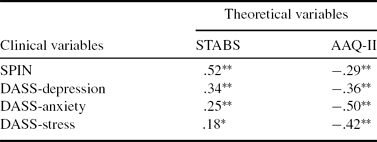
Correlations between the theoretical variables (i.e. AAQ-II and STABS) and symptom measures (i.e. SPIN and DASS subscales) are displayed in Table 2. As can be seen, the SPIN was strongly associated with the STABS and moderately associated with the AAQ-II. All three of the DASS subscales were also significantly correlated with the AAQ-II and the STABS, with magnitudes ranging from weak to moderate.
Zero-order correlations between theoretical variables and symptom variables for the High-SA group (N = 173)
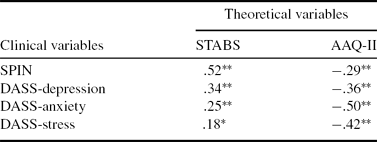
Note: High-SA = high social anxiety; SPIN = Social Phobia Inventory; DASS = Depression Anxiety Stress Scales; STABS = Social Thoughts and Beliefs Scale; AAQ-II = Acceptance and Action Questionnaire I. *p <.05; **p < .001
Partial correlations
To examine independence of relationships between the predictor variables and social anxiety symptoms we computed a set of partial correlations in which the STABS was used to predict SPIN scores while controlling for AAQ-II scores, and the AAQ-II was used to predict SPIN scores while controlling for the STABS. Table 3 displays the results of these analyses, which indicate that after controlling for the AAQ-II, the STABS remained a significant predictor of SPIN scores; with the magnitude of this partial correlation (r = .46) being slightly weaker than the zero-order correlation between the STABS and the SPIN (r = .52). On the other hand, after controlling for the STABS, the AAQ-II did not remain a significant predictor of SPIN scores; the magnitude of this partial correlation being markedly weaker than the zero-order correlation between the AAQ-II and the SPIN (−.29 vs. −.13).
Partial correlations between theoretical variables and social anxiety

Note: STABS = Social Thoughts and Beliefs Scale; SPIN = Social Phobia Inventory; AAQ-II = Acceptance and Action Questionnaire II. *p < .01
Regression analyses
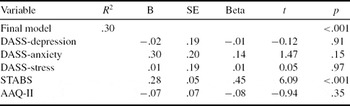
The results of our regression analyses are described here, and the summary statistics for each variable in the final step of each regression equation are presented in Table 4.
Summary statistics for the final step of regression equations predicting social anxiety SPIN scores

Note: SPIN = Social Phobia Inventory; DASS = Depression Anxiety Stress Scales; STABS = Social Thoughts and Beliefs Scale; AAQ-II = Acceptance and Action Questionnaire II
Equation 1: STABS in Step 2 preceding AAQ-II in Step 3. In Step 1, the DASS subscales explained a small, yet significant portion of the variance (10%) in SPIN scores (R 2 = .10, F(3, 156) = 5.79, p < .01). In Step 2, adding the STABS explained an additional 19% of the variance (R 2 change = .19, F(1, 155) = 42.29, p < .001). In Step 3, however, adding the AAQ-II did not account for any significant additional variance (R 2 change = .01, F(1, 154) = 0.89, p > .05).
Equation 2: AAQ-II in Step 2 preceding STABS in Step 3. As in equation1, the DASS was entered in Step 1 and predicted 10% of the variance in SPIN scores. In Step 2, the AAQ-II explained significant additional variance (3%) over and above the DASS subscales (R 2 change = .03, F(1, 155) = 4.90, p < .05). In Step 3, addition of the STABS explained an additional 17% of the variance (R 2 change = .17, F(1, 154) = 37.12, p < .001).
The final model. The final model explained 30% of the variance in SPIN scores and was statistically significant (R 2 = .30, F(5, 154) = 13.02, p < .001). As Table 4 shows, in the final models, the STABS emerged as the sole significant predictor of SPIN scores.
Discussion
In the present study we aimed to investigate relationships between social anxiety related dysfunctional cognitions, EA, and social anxiety symptoms. Further, we examined the independent and relative contributions of these dysfunctional cognitions and EA in predicting social anxiety symptoms. Empirical findings consistently show that the dysfunctional cognitions examined in the present study are associated with social anxiety symptoms (Turner et al., Reference Turner, Johnson, Beidel, Heiser and Lydiard2003). These cognitions, however, do not completely predict social anxiety symptoms; thus it is important to evaluate other conceptual approaches that might add to explanatory models. An important advantage of the present study was that it used an empirically established theoretical mechanism as a benchmark from which to evaluate the predictive utility of RFT in social anxiety.
Several recent studies have also found that EA is a predictor of social anxiety, and that ACT-based interventions are effective treatments for social anxiety and related problems (Ossman, Wilson, Storaasli and McNeil, Reference Ossman, Wilson, Storaasli and McNeil2006; Forman, Herbert, Moitra, Yeomans and Geller, Reference Forman, Herbert, Moitra, Yeomans and Geller2007). The present study, however, is the first empirical effort to examine the relationship between social anxiety related cognitions and EA, as well as the relative and additive contributions of these constructs in predicting social anxiety.
As we had hypothesized, the High-SA group endorsed higher levels of dysfunctional cognitions and EA relative to the Low-SA group; and between group differences could not be accounted for by general levels of psychological distress. Moreover, dysfunctional cognitions and EA were both correlated with social anxiety symptoms. Thus, elevated levels of dysfunctional cognitions and EA appear to be generally related to social anxiety symptoms. These findings are consistent with previous research indicating the specificity of social anxiety related cognitions to social anxiety symptoms (e.g. Turner et al., Reference Turner, Johnson, Beidel, Heiser and Lydiard2003), as opposed to being characteristic of anxiety in general. These findings are also consistent with the results of a previous study (Berrocal et al., Reference Berrocal, Bernini and Cosci2010), which found that social anxiety is associated with reduced psychological flexibility and the tendency to try to escape or avoid unpleasant psychological experiences (i.e. higher levels of EA).
As predicted, zero-order correlations indicated that EA and dysfunctional cognitions were moderately correlated with one another. This is not surprising given that that both constructs relate to negative experiences associated with social anxiety. Specifically, from the cognitive-behavioral perspective, maladaptive cognitions underlie overly negative predictions related to social or evaluative situations, leading to the fear of criticism and negative evaluation by others. Similarly, from the RFT perspective, EA reflects attempts to avoid or suppress unpleasant emotions, thoughts, and other private experiences, such as those encountered when anticipating or entering social or evaluative settings.
Results of the partial correlation and regression analyses provided mixed support for our prediction that both EA and dysfunctional cognitions would independently predict social anxiety symptoms. That is, while dysfunctional cognitions predicted social anxiety symptoms even after controlling for EA, the converse did not apply: EA failed to significantly predict social anxiety after controlling for dysfunctional cognitions. Similarly, in our regression analyses we found that both EA and dysfunctional cognitions each predicted social anxiety symptoms after accounting for general distress (Step 2), yet the results from Step 3 of the regression models indicated that dysfunctional cognitions, but not EA, were a significant predictor of social anxiety. That is, EA did not account for significant additional variance above and beyond that explained by dysfunctional cognitions; yet adding dysfunctional cognitions to the model that included EA and general distress did result in significant additional variance explained. These findings suggest overlap between EA and dysfunctional social anxiety-related cognitions. Specifically, the cognitions and EA both tap into concerns about emotionally uncomfortable inner experiences (i.e. anxiety in social situations). The primary distinction being that in RTF, the problem is thought to lie in the avoidance of emotional discomfort whereas in cognitive theory, it is the distortions themselves that are viewed as problematic. In fact, many of the social anxiety-related cognitive distortions incorporate the concept of EA (i.e. “Other people are more comfortable in social situations than I am”). Given this relatedness, it is not surprising that EA failed to enhance our ability to predict social anxiety symptoms above and beyond cognitive distortions.
The moderately strong relationship we found between EA and social anxiety is consistent with the assertion by Hayes et al. (Reference Hayes, Wilson, Gifford, Follette and Stroahl1996) that various forms of psychopathology, including clinical anxiety, can be conceptualized as “unhealthy methods of experiential avoidance” (p. 1154). The results of our partial correlation and regression analyses, however, support the argument that the variance in social anxiety symptoms that is accounted for by EA is already captured within the construct of dysfunctional social anxiety cognitions. Thus the addition of treatment techniques aimed at reducing EA, as with the addition of techniques intended to reduce dysfunctional cognitions (i.e. cognitive restructuring), will likely fail to provide a means of significantly enhancing the outcome of exposure-based therapies (e.g. Hope et al., Reference Hope, Heimberg and Bruch1995).
Some limitations of the present research should be noted. First, these data were collected from a sample of non treatment-seeking individuals. Although high social anxiety individuals were examined, they may differ in fundamental ways from treatment seeking socially anxious individuals. This limitation, however, does not preclude interpretation of our data with respect to clinical populations. Indeed, previous research demonstrates that results obtained from highly anxious unscreened samples are generalizable to clinical individuals (Stopa and Clark, Reference Stopa and Clark2001). Second, our data are correlational in nature, and therefore preclude conclusions about cause and effect relationships. Although our results are consistent with the hypothesis that dysfunctional cognitions and EA foster the development of social anxiety symptoms, it is also possible that the converse is true. That is, social anxiety symptoms might lead to maladaptive social anxiety cognitions and EA. Additionally, there might be unexamined “third variables” that account for the relationships we found. Third, it should be recognized that EA is a fairly broad construct when compared to the dysfunctional cognitions examined in this study. Future research might examine whether there is a more specific variant or dimension of EA that is unique to social anxiety and thus better able to uniquely predict its symptoms. Further, it is possible that EA may be more relevant for a specific sub-group of individuals with social anxiety. For example, it may be that those suffering from generalized social anxiety, as compared with individuals with specific social fears, are more vulnerable to problems with EA. Therefore future research should examine the ability of EA to predict social anxiety symptoms within specific subgroups of individuals with social anxiety problems. If EA proves to be more relevant to the prediction of certain subtypes of social anxiety problems, this could have important implications for improving patient-treatment match.




Comments
No Comments have been published for this article.