Introduction
A recent review by Rashid (Reference Rashid, Muir and Westcott2003a) emphasized that flax diseases are mostly caused by fungal pathogens. Hence, integrating disease resistances into new linseed and fibre flax (Linum usitatissimum L. subsp. usitatissimum) cultivars has been an important component in most breeding programmes (Kutuzova, Reference Kutuzova1994, Reference Kutuzova, Dragavcev and Fadeeva1998; Rashid, Reference Rashid, Muir and Westcott2003a). The potentially most damaging disease in flax is probably flax rust [Melamspora lini (Ehrenb.) Desmaz.]. More than 30 alleles of different resistance genes to flax rust have been reported in the review by Kutuzova (Reference Kutuzova, Dragavcev and Fadeeva1998). Resistance to rust is effective in controlling this disease and is mandatory in linseed cultivars released in Canada as well as in fibre flax cultivars released in Russia (Krylova, Reference Krylova1994; Kenaschuk and Rowland, Reference Kenaschuk, Rowland, Slinkard and Knott1995). The genetic resistances to rust have proven to be very stable (Rashid, Reference Rashid, Muir and Westcott2003a), demonstrating, how successful resistance breeding can be.
For other flax diseases, progress could still be made, and this study focuses on three of them, in which breeding could benefit from screening diverse germplasm for promising genetic resistance. Fusarium wilt [Fusarium oxysporum Schlechtend.: Fr. f. sp. lini (Bolley) W.C. Snyder & H.N. Hans.] is a problem in fibre flax and linseed production all over the world, in particular, if the crop is grown frequently in the same fields (Rashid, Reference Rashid, Muir and Westcott2003a). Seed treatments with fungicides could not eliminate the disease (Rashid, Reference Rashid, Muir and Westcott2003a). Genes for resistance to fusarium wilt have been found. However, differences exist among various reports on inheritance of fusarium wilt resistance and the number of genes involved (Kutuzova, Reference Kutuzova, Dragavcev and Fadeeva1998; Zhuchenko and Rozhmina, Reference Zhuchenko and Rozhmina2000). Kroes et al. (Reference Kroes, Rashid, Hammond, Lange and Flax Institute1998, Reference Kroes, Löffler, Parlevliet and Keizer1999) did not find differential cultivars when testing various isolates of fusarium wilt from Europe and North America. However, nine resistance genes to fusarium wilt have been described elsewhere, and seven of these were found to be effective under the environmental conditions of Russia (Rozhmina, Reference Rozhmina2004). Anthracnose [Colletotrichum lini (Westerdijk) Tochinai] and pasmo [Septoria linicola (Speg.) Garassini, synonym: Mycosphaerella linicola Naumov] have received less attention by flax researchers than fusarium wilt and rust, and complete resistance against either of these diseases has not yet been found (Kudrjavceva, Reference Kudrjavceva1994; Kutuzova, Reference Kutuzova, Dragavcev and Fadeeva1998; Zhuchenko and Rozhmina, Reference Zhuchenko and Rozhmina2000). Reduced fibre quality and yield has been attributed to infection with anthracnose during early growing stages of the flax plant (Kudrjavceva, Reference Kudrjavceva1994; Bačelis and Gruzdevienė, Reference Bačelis and Gruzdevienė2001), while infection with pasmo occurs towards the end of the growing season and causes more damage to linseed (Rashid, Reference Rashid, Muir and Westcott2003a, Reference Rashid, Bailey, Gossen, Gugel and Morrallb; Grant et al., Reference Grant, Rashid, Lamari and Flax Institute2004).
Germplasm collections in genebanks are important sources of disease resistance in plant breeding and results of flax germplasm evaluations have been published (Zhuchenko and Rozhmina, Reference Zhuchenko and Rozhmina2000; Brutch, Reference Brutch, Maggioni, Pavelek, van Soest and Lipman2002). Such information is useful to accelerate breeding progress, and to facilitate diversification in agriculture and sustainable crop production. Methodologies for routine screening of fibre flax breeding lines for disease resistance have been developed and applied by the All-Russian Flax Research Institute (VNIIL) at Torzhok, Russia, for several years. The VNIIL has focused on fibre flax breeding and it seemed interesting to apply the existing techniques for disease resistance screening to flax germplasm including linseed accessions, which have been of importance in North American breeding programmes. The objective of this study was to detect useful germplasm for disease resistance breeding and to describe patterns of variation for resistance against the flax diseases fusarium wilt, anthracnose and pasmo in germplasm from the flax collection at Plant Gene Resources of Canada (PGRC).
Material and methods
Experimental location and climatic conditions
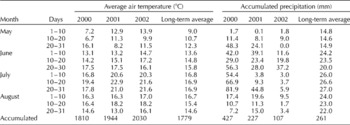
The accessions were evaluated for reaction to the three diseases at the VNIIL at Torzhok, Russia (57°03′N, 34°58′E, 160 m above sea level). Torzhok is located in north-western Russia, an area with extensive production of fibre flax. The soil at Torzhok is a medium-podsolic soil of loamy texture and slight acidity (pH of 4.4–5.0). The climate is temperate–continental with cool winters. The disease resistance screening of all three diseases and of all accessions was repeated in the three growing seasons of the years 2000–2002. In order to optimize temperature conditions for infection with the diseases, seeding in the field and greenhouse were conducted in the last 10 days of May; that is, 3 weeks later than the seeding date for regular flax production, which is at the beginning of May. The average temperatures during the last 10 days of May were 16.1°C in 2000, 8.2°C in 2001 and 11.5°C in 2002. The summarized climatic conditions during the experimental years compared to long-term averages at Torzhok are presented in Table 1. In 2000, the temperatures were slightly higher than normal. Heavy rainfall occurred during the flowering period of the flax plots. The conditions facilitated field infection with anthracnose and pasmo. In 2001, the temperatures during June and July were considerably higher than the long-term average and rainfall was reduced during the second half of the vegetation period. The growing conditions were favourable for linseed and fibre flax. The conditions facilitated field infection with anthracnose and pasmo. In 2002, temperatures during June to August were much higher than in average years and precipitation was very low. Severe drought occurred at Torzhok and plant maturation was accelerated. Infections with pasmo did not occur under these conditions and a rating for pasmo infection was impossible, whereas a rating for anthracnose infection could be conducted.
Climatic conditions at the experimental location Torzhok, Tver' district, Russia, during the growing seasons of the three experimental years

Plant material
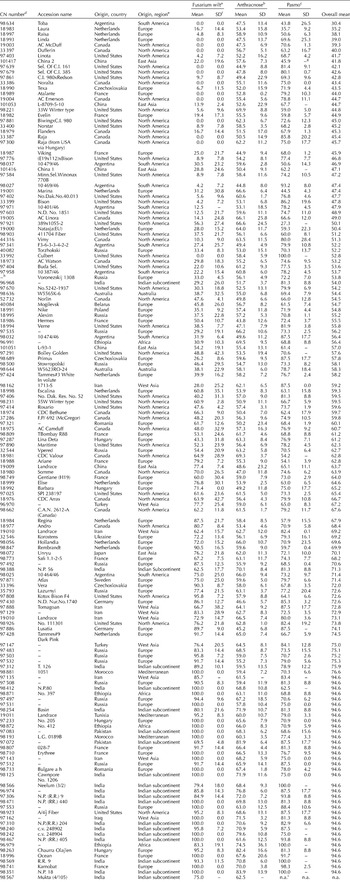
A subset of 153 flax accessions was selected from the PGRC collection based on diversity for agrobotanic characters (plant height, stem branching, seed size, seed colour), oil content and fatty acid profiles observed by PGRC at Saskatoon in 1998 (Diederichsen et al., Reference Diederichsen, Raney, Fu, Richards and Flax Institute2002). The selected accessions originated from 24 countries of the following regions (according to Zhukovskij, Reference Zhukovskij1968): 55 from Europe, 46 from North America, 19 from the Indian subcontinent, 10 from West Asia, 8 from South America, 6 from East Asia, 4 from Africa, 3 from the Mediterranean area and 2 from Australia (Table 2). Seventeen linseed cultivars from Canada and 8 from the United States were included in the 46 accessions originating form North America. The 55 European accessions were dominated by fibre flax cultivars. Thus, the screened accessions consisted mostly of genetically stabilized breeding lines or cultivars released by breeding programmes.
Mean disease severity indices (%) for fusarium wilt, anthracnose and pasmo in 153 flax genebank accessions. Accessions are sorted in ascending order by the overall mean of disease severity index of the three diseases

a,bFusarium and anthracnose ratings from 3 years.
cPasmo ratings from 2 years.
dAccession number in Canadian genebank, Plant Gene Resources of Canada.
eCountries assigned to regions according to Zhukovskij (1968).
fStandard deviation.
gA dash indicates that a standard deviation could not be calculated due to missing values.
hThe cultivar Voroneshskij is available from the VNIIL, Torzhok, catalogue number k-3052.
iNot applicable, because rating for pasmo is missing.
Pathogen material, inoculation and disease resistance ratings
Artificial inoculations with the pathogens and the ratings for disease severity were conducted according to the protocols developed for flax germplasm evaluation by the VNIIL. The exact methodological guidelines applied for disease evaluations have been published (Lokashova et al., Reference Lokashova, Krylova and Kudrjavceva2000; Kudrjavceva, Reference Kudrjavceva2002). Mixtures of virulent strains of the respective pathogens collected within the territory of the former Soviet Union were used for inoculation (Lokashova and Kudrjavceva, Reference Lokashova, Kudrjavceva and VIR1998). All the pathogen material used is maintained at the VNIIL as part of the collection of 816 pathogen lines of flax rust, fusarium wilt, anthracnose and pasmo. The pathogen material is accessible for other users within the framework of co-operative agreements. An outline of the methods applied is given here; the references describing the disease evaluation guidelines in detail are published in Russian.
Fusarium wilt screening was conducted in a greenhouse to optimize the environmental conditions for disease infection. The greenhouse was not heated and there was no artificial light. Therefore, the temperatures were close to the outside temperatures reported in Table 1 and the light regime was dictated by the geographical latitude of the experimental location at Torzhok. Sowing at the end of May ensured temperatures high enough for development of fusarium wilt. Wooden containers measuring 50 × 85 cm and 20 cm in depth were used for planting. After filling two-thirds of the container volume with field soil, 350 g of fungal culture were spread on the soil surface and then covered with the remaining soil. The soil was not treated and was taken from a field that had not been grown with flax for at least 6 years, which has proven to be enough time to free it from soil-borne flax pathogens. The fungal culture contained micro- and macrospores of 15–16 strains of Fusarium oxysporum, half of which were highly aggressive and half moderately aggressive strains. The aggressiveness of the strains contained in the applied mixture was tested separately for each strain. Inoculation of the containers was conducted 10–12 days prior to sowing. Sixteen seeds of each accession were planted in the containers at a spacing of 2.5 cm and a depth of 1 cm. The susceptible flax cultivar ‘Slavnyj 82’ and the resistant line I-7 were planted in each container in three replicates, with 16 seeds each for controlling the disease inoculum. A first single-plant rating for emergence and disease was conducted shortly after emergence to determine losses due to lack of germination or any diseases. The rate of germination (emergence) of the flax seeds was between 95% and 100%. The disease severity rating for fusarium wilt was conducted at early seed maturity on each single plant and this rating was used to calculate a disease severity index, as described below.
Anthracnose and pasmo screenings were conducted during the 2000–2002 growing seasons by simultaneously inoculating a field nursery with both diseases, following the method developed by Kudrjavceva (Reference Kudrjavceva1993). The late seeding in the field supported infection with pasmo by delaying maturation until the usually warm and humid conditions of August. Prior to sowing, ground, dry flax straw heavily infected with pasmo (Septoria linicola) and cut into pieces of 1–1.5 cm length was placed at a depth of 6–7 cm at a rate of 6–8 g m− 1 in each row to be seeded and covered with a thin layer of soil. The infected straw was a mixture of pasmo-infected straw received from different locations in Russia. The viability of the pathogen organism on the straw was tested in a growth chamber prior to infecting the plots. Then, a mixture of cultures containing conidia of anthracnose (Colletotrichum lini) was spread in each row at a rate of 7–8 g m− 1. The mixed strains of C. lini were increased on sterilized oat grains at a temperature of 22–24°C for a period of 3 weeks. The inoculum consisted of a mixture of 20–25 strains of C. lini, of which 50% were highly aggressive, 25% moderately aggressive and 25% mildly aggressive in separately conducted tests. Rows were 20 cm apart and 50 cm long, and 50 seeds of each accession were planted in each single row. Three replicates were planted for each accession. The area seeded with plots was narrow and had a width of 1 m, which resulted in long margins. Along the margins surrounding the evaluation plots the flax cultivar ‘Slavnyj 82’ susceptible to pasmo was seeded and the soil in this planting was covered with pasmo-infected straw at a rate of 1.5–2 kg/m2 to increase the infection pressure from the marginal area on the plots planted with the accessions to be evaluated. The disease ratings for anthracnose and pasmo were conducted at the 4–6 leaf stage and at early seed maturity, respectively. Each single plant in the plots was rated and one disease severity index was calculated from the three plots of each accession, as described below. The field emergence rate was between 85% and 100%.
The rating scale for all diseases was as follows: 0 = healthy plant; 1 = slightly diseased, 2 = intermediately diseased, 3 = heavily diseased, and 4 = very heavily diseased. The disease severity index was calculated as percentage of diseased material, according to equation (1). A disease severity index of 0% indicated high resistance while a value of 100% indicated high susceptibility of the respective accession.

where a i is the number of plants with disease rating b i; b i is the disease rating value; n is the number of rated plants; and b max is the highest rating value on the scale applied.
Data analysis
Only summarizing statistics were applied to describe the variation of disease severity in the investigated plant material because the selection of the plant material from the whole germplasm collection preserved by PGRC was not random. The disease severity indices from 3 years (fusarium wilt and anthracnose) or 2 years (pasmo) were used to calculate a mean value for each accession and a standard deviation between the years to characterize the variation among the observations in different years. The overall mean of the three mean values for each disease was calculated and may be considered as a quantifier for combined overall disease severity for all three diseases in each accession. Such an overall mean may be useful in index selection in flax breeding. For one accession, CN 98 567, the overall mean could not be calculated, because no value for pasmo resistance was obtained. Single observations were missing in 50 cases, which made their mean values less informative, and, due to such missing values, in 12 cases it was not possible to calculate a standard deviation for the respective disease severity rating.
Results
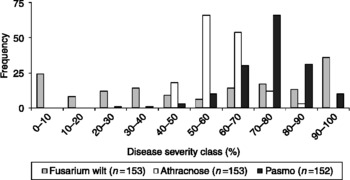
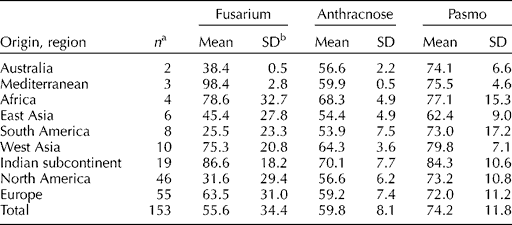
The average disease severity indices for all 153 accessions are reported in Table 2. The mean disease severity index ranged from 0 to 100% for fusarium wilt, 43.8–83.9% for anthracnose and 27.3–100.0% for pasmo. The average disease severity indices of all tested accessions in the 3 years for fusarium wilt and anthracnose and 2 years for pasmo observations were relatively similar (Table 3). This indicates that the environmental conditions in the different years did not affect the overall infestation with the diseases. Averaged over all years and accessions, the disease severity indices for the three diseases ranked in the following order: fusarium wilt (55.6 ± 34.4%), anthracnose (59.8 ± 8.1%) and pasmo (74.2 ± 11.8%). The variation observed for each accession among years was highest in fusarium wilt (comparison of standard deviations in Table 2). The frequency of the different disease severity classes was relatively similar over the whole range for fusarium wilt, and 14 accessions had a consistent disease severity index of 0.0% in all experimental years (Table 2, Fig. 1). Higher disease severity indices were more frequent for pasmo (most frequent class 70 to ≤ 80%) and anthracnose (most frequent class 50–60%). The six accessions from East Asia showed above-average resistance (low disease severity index) to all three diseases, but the small number can probably not fully represent this region. The 19 accessions from the Indian subcontinent had low resistance to all diseases (Table 4). Accessions from North America displayed above-average resistance to fusarium wilt, while European accessions showed lower than average resistance to this disease. The few accessions from South America had resistances comparable to those from North America, but the number was too small for good representation.
Summarized overview of disease severity indices (%) of 153 flax accessions by experimental years

a Standard deviation.
Histograms for frequency of disease severity classes in flax accessions, based on mean values from 3 years (fusarium wilt and anthracnose) or 2 years (pasmo).

Average disease severity indices (%) of 153 flax accessions by regions of origin of the accessions for fusarium wilt, anthracnose and pasmo
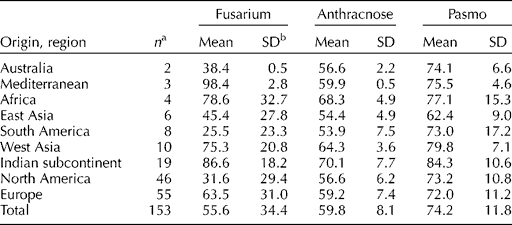
a Number of accessions.
b Standard deviation.
Discussion
Complete disease resistance (a disease severity index of 0.0%) was only found to fusarium wilt, while none of the accessions showed complete resistance to anthracnose or pasmo. This result confirms earlier reports (Zhuchenko and Rozhmina, Reference Zhuchenko and Rozhmina2000). Since breeding lines and cultivars dominated the investigated accessions, it seems that higher resistance levels have been achieved to fusarium wilt compared with those to anthracnose and pasmo. High fusarium wilt resistance occurred in accessions from North America and South America, the latter all from Argentina. In another screening of 96 out of the same 153 accessions for adaptation to growth under drought conditions in Russia and Canada, linseed cultivars from Canada and the USA also showed stable and high seed weights and seed yields, which reflects breeding progress in these traits as well (Diederichsen et al., Reference Diederichsen, Rozhmina, Zhuchenko and Richards2006). Hence, North American flax germplasm often combined resistance to drought with disease resistance. Such a combination of desirable traits in genetic blocks has been described as the foundation for adaptability in cultivated plants (Zhuchenko, Reference Zhuchenko1988).
In the present study, accessions from India and Pakistan were relatively susceptible to the diseases investigated. Vavilov (Reference Vavilov, Zhukovskij and Bachteev1964) noted eco-geographical differentiation in flax regarding disease resistance, and reported flax from India as being susceptible to the important flax diseases. Since anthracnose and pasmo are not of major importance in this region, there has been no selection pressure to acquire resistance. Fusarium wilt, however, is a common disease in the Indian subcontinent, but the pathogen populations in this region are likely to be genetically different from those used in our screening. Consequently, accessions with resistance in the present study may not be resistant in India. In another investigation, resistance to fusarium wilt found in the flax accession ‘Punjab 53’ from India by Knowles et al. (Reference Knowles, Houston and McOnie1956) was not confirmed when exposing the accession to a Russian pathogen population (Rozhmina, Reference Rozhmina2004). This indicates geographic variation in pathogen populations and virulence. Differences among fusarium wilt populations within Canada have also been found (Mpofu and Rashid, Reference Mpofu, Rashid and Flax Institute2000). It would be useful to compare the results of this study with screenings of the same accessions in North America in order to detect differences in pathogen populations between North America and Russia.
The three flax accessions ‘Toba’ (CN 98 634) from Argentina, ‘Laura’ (CN 18983) and ‘Raisa’ (CN 18 997) from The Netherlands showed the highest overall resistance to all three diseases, and may be useful in flax breeding programmes. In general, the Canadian cultivars performed well regarding overall disease resistance ratings, reflecting the progress made due to the joint efforts of plant pathologists and flax breeders. European fibre flax cultivars tended to be more susceptible to all diseases investigated, but several fibre flax cultivars also showed high overall disease resistance.
Acknowledgements
Funding for this project was received from the Saskatchewan Flax Development Commission and the Matching Investment Initiative of Agriculture and Agri-Food Canada. We thank several technicians at the VNIIL for technical assistance in field and laboratory work, and Mr D. Kessler, Saskatoon, for preparing the seed samples. The authors thank Drs L. Buchwaldt, K. Rashid and J.Q. Liu for helpful comments on the manuscript.