A growing number of colleges and universities have incorporated responses to climate change into their physical infrastructures, curricula, community outreach and research priorities, often under the heading of ‘sustainability’ (Henderson, Bieler, & McKenzie, Reference Henderson, Bieler and McKenzie2017; Vaughter, Wright, McKenzie, & Lindstone, Reference Vaughter, Wright, McKenzie and Lidstone2013). Some have created entire sustainability offices, policies and plans, and signed national and international declarations that pledge to ‘work toward implementing sustainability within their institutions’ (Vaughter, Wright, & Herbert, Reference Vaughter, Wright and Herbert2015, p. 83). Students have also started to demand a more robust response from their institutions; for instance, through fossil-fuel divestment campaigns that target endowments (Grady-Benson & Sarathy, Reference Grady-Benson and Sarathy2016). However, within mainstream scholarship and practice about climate change, the horizon of hope is for institutions (of higher education and otherwise) to become more sustainable while maintaining business as usual — or, as Baskin (Reference Baskin, Biermann and Lovbrand2019) describes it, ‘business as usual, but greener’ (p. 165). By initiating a conversation at the intersections of decolonial studies, sustainability studies and higher education studies, in this article I consider the ethical and ecological limits of maintaining sustainability as an orienting horizon.
In starting this conversation, I work from the premise that ‘[w]e don’t just have a knowledge problem — we have a habit-of-being problem’ (Shotwell, Reference Shotwell2016, p. 38).Footnote 1 Specifically, the currently dominant (modern-colonial) habit-of-being is ethically harmful and ecologically unsustainable, given that it is premised on the denial of our entanglement and the ceaseless racialised exploitation and expropriation of labour, land and ‘natural resources’. Further, because modern higher education institutions developed alongside and through colonialism, and remain structurally dependent upon colonialism for their continued existence (Boggs & Mitchell, Reference Boggs and Mitchell2018; Stein, Reference Stein2017; Wilder, Reference Wilder2013), these institutions and those of us who work and study within them have reached an impasse. That is, even as ‘we find ourselves already in the midst of everyday social and ecological catastrophes, existential risks and uncertain futures’ (Rousell, Reference Rousell2016, p. 138), we remain invested in the continuity of a modern-colonial system that is both modern higher education’s condition of possibility and the root cause of climate change. As long as we remain invested in this continuity, we will continue to deny the racial and ecological violence that has been inflicted by this system, the inherent unsustainability of the system, and the fact that climate change will likely spell an end to this system.
As Davis and Todd (Reference Davis and Todd2017) argue, ‘The story we tell ourselves about environmental crises, the story of humanity’s place on the earth and its presence within geological time determines how we understand how we got here, where we might like to be headed, and what we need to do’ (pp. 763–764). While in this article I offer no solutions to the impasse I describe, I nonetheless invite readers to rethink ‘the stories we tell ourselves’ about climate change, higher education and our horizons of hope. I begin by offering a summary of decolonial critiques, and then reviewing their diagnosis of colonialism as the primary cause of climate change. Next, I consider the implications of this diagnosis for higher education, specifically in settler colonial contexts. Then, without assuming that existing colleges and universities can or should be made ‘sustainable’, I offer a framework for approaching higher education as a space for learning how to disinvest from a harmful habit-of-being. Finally, in the conclusion, I offer a tool for analysing the extent to which responses to climate change in higher education address three orienting denials that characterise this habit-of-being: denial of colonial violence, denial of ecological unsustainability, and denial of our condition of entanglement.
Decolonial Critiques of Modernity
There is no single definition or lineage of decolonial thought, but it can be traced to several distinct but overlapping genealogies of postcolonial, anticolonial, Indigenous, Black, and abolitionist studies and social movements. Decolonial critiques understand coloniality as modernity’s constitutive underside, and thus identify the initiation of Black enslavement and Indigenous colonisation in the 15th century as modernity’s epistemological and ontological genesis. Colonialism has taken the form of external colonialism (in which colonists come to extract resources and labour and export it back to the metropole), and settler colonialism (in which colonists come not only to extract resources and labour, but also to stay; Tuck, McKenzie, & McCoy, Reference Tuck, McKenzie and McCoy2014). However, as Lowe (Reference Lowe2015) suggests, coloniality is not an event or even an era, but rather a set of categorical divisions, extractive relations and ontological configurations that together ‘governs and calibrates being and society in an ongoing way’ (pp. 92–93). Thus, although its specific formations have been contested and shifted over time and place, a colonial ordering of the world endures and remains the price of modern existence.
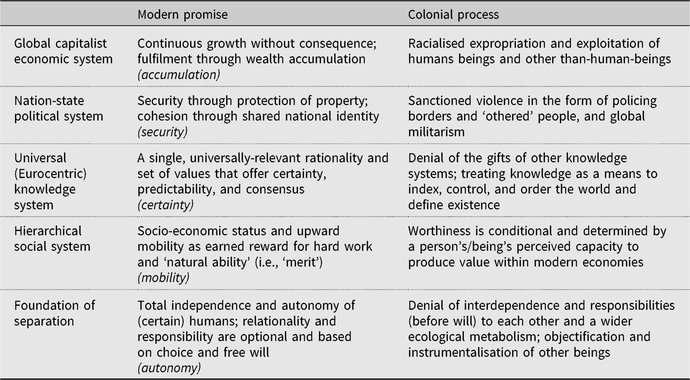
Here, I synthesise critiques that identify the various architectures of being that are naturalised within modernity (Stein, Hunt, Suša, & de Oliveria Andreotti, Reference Stein, Hunt, Suša and de Oliveria Andreotti2017). The modern-colonial habit-of-being rests first and foremost on a foundational separation of humans from each other and the rest of nature (other-than-human beings), and holds out the promise of unrestricted autonomy and independence (Alexander, Reference Alexander2005; McVittie, Datta, Kayira, & Anderson, Reference McVittie, Datta, Kayira and Anderson2019; Silva, Reference Silva2014). In this configuration of being, responsibility to and relationality with other beings are purely matters of choice and rational calculations of utility-maximisation. Separation also lays the groundwork for various modern-colonial systems that are characterised by racialised and anthropocentric hierarchies. This includes a knowledge system that is organised by universal reason and which offers the promise of epistemic authority, certainty and predictability — that is, the idea that to know the world is to have the ability and the right to control it (Ahenakew, Reference Ahenakew2016; Santos, Reference Santos2007). It also includes a political system organised by nation-states, which offer the promise of order, security, private property and shared identity (Arvin, Tuck, & Morril, Reference Arvin, Tuck and Morrill2013; Byrd, Reference Byrd2011). There is also an economic system organised by global capitalism that promises endless economic growth and accumulation without consequence (Coulthard, Reference Coulthard2014). And finally, there is a hierarchical social system that promises socio-economic status as a reward for hard work (Donald, Reference Donald2019).
From a decolonial perspective, these modern promises are largely enabled by disavowed colonial processes that are externalised, invisibilised, and denied by those who are deeply invested in the modern habit-of-being. I summarise the relationship between different modern promises and the related colonial processes in Table 1.
Modern Promises and the Colonial Processes That Subsidise Them

Three Primary Denials and Four Levels of Denial

According to this analysis, modern promises can only be fulfilled within a colonial ordering of the world that is premised on separation and hierarchy, through which the dominance of a particular subset of humanity is secured at the expense of all other humans and the environment itself. In other words, modernity’s emergence and maintenance is subsidised through ongoing genocide and ecocide. The implication of all this for climate change is that the modern-colonial habit-of-being is not only inherently harmful, but also inherently unsustainable. This, in turn, makes the premise of sustainability both a practical impossibility and an ethically compromised horizon of hope. However, because it is so difficult to interrupt investments in this habit-of-being, the limits of mainstream sustainability efforts are generally unacknowledged.
Decolonial Critiques of Climate Change
Decolonial analyses are marginalised within mainstream conversations on climate change and barely register within climate change education, as is the case with critical and transformative perspectives more broadly (Busch, Henderson, & Stevenson, Reference Busch, Henderson and Stevenson2018; Tuck et al., Reference Tuck, McKenzie and McCoy2014). However, there is a growing body of scholarship that provincialises mainstream, Eurocentric narratives about climate change, and makes visible differently distributed vulnerabilities to it (e.g., Baskin, Reference Baskin, Biermann and Lovbrand2019; Davis & Todd, Reference Davis and Todd2017; Gomez-Barris, Reference Gomez-Barris2019; Karera, Reference Karera2019; Singh, Reference Singh2019; Whyte, Reference Whyte2017, Reference Whyte2018). While these engagements vary depending on their context and intention, broadly speaking they frame the modern-colonial system itself as the underlying root cause of climate change. Thus, within these analyses, as Whyte (Reference Whyte2018) argues, ‘It is not a given that today’s social-ecological systems are ones that are important to conserve’ (p. 299). In other words, from a decolonial perspective, the very idea of sustainability is suspect, and it therefore becomes necessary to ask: What are we trying to sustain, and why?
Davis and Todd (Reference Davis and Todd2017) argue that colonialism amounts to ‘a severing of relations between humans and the soil, between plants and animals, between minerals and our bones’ (p. 770). It is because of these severed relations that decolonial critiques emphasise coloniality as the underlying cause of climate change. The foundational modern colonial separation of human beings from ‘nature’/‘the environment’, and the presumed superiority and authority of the former over the latter is what allowed for the objectification of the latter into property (i.e., land and ‘resources’), and the subsequent extraction and appropriation of that ‘property’ for profit. Identifying non-European people with the denigrated category of ‘nature’, in part because they did not generally treat ‘nature’ in this extractive way, provided further rationalisation for the colonial-capitalist exploitation and expropriation of people and the earth itself (Silva, Reference Silva2014). This premise of separability amounted not only to a denial of responsibility to other beings, but also a denial of humans’ metabolic entanglement with the earth itself.
In order to make the colonial roots of climate change more visible, critical scholars challenge dominant discourses, such as descriptions of the present era as ‘the Anthropocene’. This term was coined to describe the current geological epoch in which ‘humanity’ has been the primary force of global environmental change (Lewis & Maslin, Reference Lewis and Maslin2015; Rousell, Reference Rousell2016). The concept has spread across disciplines and even into popular culture. However, it has also come under critique for suggesting ‘humanity’ as a whole has caused the climate to change (Davis & Todd, Reference Davis and Todd2017; Di Chiro, Reference Di Chiro2014; Karera, Reference Karera2019). These critiques argue that in fact, climate change was largely caused by a specific, largely White and wealthy subset of humanity that externalised the costs of its particular way life and development onto other humans and other-than-human beings. As Gomez-Barris (Reference Gomez-Barris2019) notes: ‘Humanity is not is not universally implicated in the demise of our planet’s non-renewable resources, the diminishing of its biodiversity, or the history of capitalism’s destruction of communal interdependence.’ The irony here is that while the colonial West has long excluded racialised and Indigenous people from the category of ‘the human’ (Wynter & McKittrick, Reference Wynter and McKittrick2015), within the mainstream framing of the Anthropocene, it mobilises a universal figure of humanity in order to erase differential responsibility for ecological crisis. Thus, it is crucial to name ‘the problem of colonialism as responsible for contemporary environmental crisis’ (Davis & Todd, Reference Davis and Todd2017, p. 763).
In a complementary intervention, Whyte (Reference Whyte2017) notes that ‘Indigenous climate change studies’ diagnose the origins of today’s climate crisis thusly: ‘The colonial invasion that began centuries ago caused anthropogenic environmental changes that rapidly disrupted many Indigenous peoples, including deforestation, pollution, modification of hydrological cycles, and the amplification of soil-use and terraforming for particular types of farming, grazing, transportation, and residential, commercial and government infrastructure’ (p. 154). In other words, ‘vulnerability to climate change [is] an intensification [of] colonialism’ (p. 156), rather than a new development.
Meanwhile, the fact ‘[t]hat colonizers today… are concerned about climate change, suggests that they are now being affected by the seismic waves of massive ecosystem transformation that began over 500 years ago’ (Whyte, Reference Whyte2017, p. 159). Indeed, it is increasingly difficult to externalise the true costs of modernity’s promises. These costs are made evident not only through intensifying climate disasters, but also increasing economic insecurity and political instability. In this context, those who have gained the most — at least materially — from the colonial processes that both enabled the emergence of modern existence and initiated climate change itself can no long sequester themselves from the effects of these processes, even as they generally remain the least or last directly affected.Footnote 2 Yet, because the colonial processes that have subsidised these promises have been largely disavowed, current instabilities appear to be the result of external causes. Thus, many people look to existing systems and institutions for solutions: market-based solutions from global capital (e.g., carbon trading); policy solutions from the nation-state (e.g., The Green New Deal; or alternatively, demands made upon the nation-state by groups such as Extinction Rebellion); and scientific and technological solutions from the ‘universal’ Enlightenment knowledge tradition (e.g., carbon sequestration).
While some of these efforts might mitigate or slow the impact of climate change, ultimately it is unlikely that the system that produced climate change has the necessary tools to halt or reverse it. Further, this new sense of urgency can lead to more harm if driven by a desire to sustain the status quo — it might simply repeat previous patterns through which colonial violence has been justified and rationalised under the banners of progress and benevolence. Whyte (Reference Whyte2018) therefore concludes that until colonial violence is addressed as the underlying cause of climate change, any effort to halt or mitigate climate change will also tend to reproduce colonial processes and relations.
Several implications follow from these analyses: (1) Populations that have been subject to European colonial rule, enslavement, and indirect forms of subjugation — that is, those on whose lands and backs modernity was built — have been experiencing the effects of ‘climate change’ since the 15th century, and those same populations are the most vulnerable to new climate crises; (2) Those socialised into a modern-colonial habit-of-being generally deny coloniality as the root cause of climate change, given that to address these root causes would require questioning the conditions that enable their way of life — something few are willing to do; (3) It is only a matter of time before climate change catches up with those inhabiting the modern-colonial habit-of-being, even as they have the greatest buffer from it; and (4) If we continue to use the same tools, strategies, analyses, and relationships that created this habit-of-being to address the crises that it created, this will likely lead to further colonial (racial and ecological) violence.
In sum, as Gomez-Barris (Reference Gomez-Barris2019) argues, ‘shifting how we imagine the root cause of climate change matters for how we narrate impending planetary crisis’. By diagnosing the interrelated colonial structures of genocide and ecocide as the root causes of climate change, decolonial critiques offer a serious challenge not only to outright climate change deniers, or to those who admit that climate change exists but seek to address it solely through reforms focused on technological fixes and improved efficiencies (Baskin, Reference Baskin, Biermann and Lovbrand2019), but also even some more radical advocates who seek systemic change but nonetheless fail to reckon with coloniality and their complicity in it (Brulle & Norgaard, Reference Brulle and Norgaard2019). These insights also suggest that most of us are highly unprepared to face a potential future in which we will have no choice but to learn to know, be, and relate otherwise.
In the next section, I consider what this might mean for higher education, and why it is so difficult for many of us within institutions of higher education to consider the possible end of the only way of life that we have ever known.
The Coloniality of Modern Higher Education
While it is commonly believed that higher education institutions are crucial sites of response to climate change (Henderson et al. Reference Henderson, Bieler and McKenzie2017; Jurdi-Hage, Hage, & Chow, Reference Jurdi-Hage, Hage and Chow2019), what generally goes unasked is how these institutions might have helped to create climate change in the first place and the implications that follow from this, which is what I address in this section. Colleges and universities are central actors in the reproduction of society, and while most seek a relative degree of autonomy, all are deeply embedded in their political and economic contexts. Particularly in settler colonial countries such as the United States, Canada and Australia, institutions of higher education have served as primary sites through which modern promises are both cultivated and fulfilled. Thus, these institutions have both benefitted from and contributed to the reproduction of the colonial processes that decolonial analyses identify as the primary causes of climate change. This severely limits their ability to serve as sites for learning to disinvest from modern promises.
As Stanley (Reference Stanley and Steinberg2009) notes, colleges in the early settler colonial context of Canada ‘remade the cultural landscape of the territory [on which they sit], imposing their disciplinary practices and ways of knowing on the territory and its inhabitants, effectively steamrollering the systems of cultural representations and the meanings already in place’ (pp. 143–144), not to mention the political and economic systems that were rooted in those places. This included, of course, the attempted eradication of Indigenous forms of (higher) education that had existed on now colonised lands for thousands of years (Stein, Reference Stein2019; Stonechild, Reference Stonechild2006). Beyond the immediate lands they occupy, the education and research that higher education institutions in settler colonial contexts contribute to the reproduction of these systems on a wider scale, socialising citizens for the political system of the colonial nation-state, preparing labourers and investors for the capitalist economic system, disseminating a largely Eurocentric knowledge system, and naturalising the notion of human supremacy and authority over other living beings, and White supremacy over Indigenous, Black, and other racialised peoples (Ahenakew, Reference Ahenakew2016; Daigle, Reference Daigle2019; Grande, Reference Grande, Tuck and Yang2018; Hampton, Reference Hampton2016; Marker, Reference Marker2017; Smith, Reference Smith1999; Stein, Reference Stein2017, Reference Stein2018). If we overlook the role of higher education in not only preparing people to be engaged and invested in the social, political and economic reproduction of the modern-colonial habit-of-being, but also as a primary site in which its promises are fulfilled, we will severely underestimate the difficulty, if not the impossibility, of transforming these institutions into sites for addressing climate change.
Addressing the colonial foundations of higher education, and thus addressing the roots of climate change as they relate to higher education, is particularly difficult in an era in which higher education is perceived to be in crisis and thus in a vulnerable position requiring defence. After all, higher education is largely viewed as a site in which modern promises (in particular, social mobility) can be fairly and efficiently distributed — a role that paradoxically becomes more cemented in a context in which available opportunities are increasingly scarce (Wyly & Dhillon, Reference Wyly and Dhillon2018). This move to valorise the university can forestall deeper critique as it ‘repeats the forgetting of the dispossession at the university’s origins while simultaneously drumming up a sense of crisis regarding the potential consequences of its downfall’ (Boggs & Mitchell, Reference Boggs and Mitchell2018, p. 441).
Many people feel disillusioned as promises that were previously more accessible are increasingly uncertain and difficult to fulfil, and there is more competition for fewer secure socioeconomic positions. In this context, some cling even more tightly to these promises, and to the institutions that pledge to fulfil them. This includes higher education, given that, as Boggs and Mitchell (Reference Boggs and Mitchell2018) note, ‘the university increasingly assumes the social function of embodying, enabling, and managing social insecurities of various forms’ (p. 440). This can make challenging the benevolence of those institutions, and their ability to adequately address these crises all the more difficult. If, as Brown (Reference Brown2015) suggests, we are living in an epoch characterised by ‘civilizational despair’ (p. 222), then many (Brown included) will seek to counter this despair by reclaiming their ‘conviction about the human capacity to craft and steer its existence or even to secure its future’ (p. 221). Higher education, through both its promises of ‘infinite opportunity and upward mobility’ (Wyly & Dhillon, Reference Wyly and Dhillon2018, p. 135), as well as its promise that the knowledge produced within its walls will enable us to solve these crises, becomes a prime site at which the ability to craft a future in alignment with existing desires is asserted.
Higher education’s function as a site in which colonial hope is rearticulated and reanimated includes its role as a site for social and technological innovations that are meant to ensure the continuity of the modern-colonial habit-of-being. Even when there is tacit acknowledgement of the role of modern (especially technological) knowledge in creating climate change, this knowledge is nonetheless framed as offering the most viable solution for solving climate change (Baskin, Reference Baskin, Biermann and Lovbrand2019). Indeed, prevailing approaches to social change in higher education risk reproducing instrumental and ethnocentric imaginaries of justice, responsibility, and change (Whyte, Reference Whyte2018; Wynter & McKittrick, Reference Wynter and McKittrick2015). These imaginaries tend to: maintain the uneven distribution of social power and limit the available possibilities for ethical relationships (Donald, Reference Donald, Ng-A-Fook and Rottmann2012); deny marginalised communities the resources and opportunities to create and lead their own visions social development and transformation (Spivak, Reference Spivak2004); and reproduce existing knowledge hierarchies that favour Western science and technology (Ahenakew, Reference Ahenakew2016; Santos, Reference Santos2007; Smith, Reference Smith1999). The collective result of these patterns is to diminish the value of other knowledge traditions, social capabilities and ecologies, and to overlook the unevenly shared benefits and harms of existing systems and transformations.
However, a story that funnels this sense of ‘civilisational despair’ back into desires for the same modern promises (of autonomy, accumulation, security, certainty and hierarchy) is not the only story we can tell about climate change and the role of higher education in it. If we instead approach climate change and other interrelated crises from the perspective of decolonial critiques, we get a very different story. If we, as Karera (Reference Karera2019) suggests, allow ‘the afterlives of slavery and colonialism on the rise to inform us on how to face the Anthropocene’ (p. 52), then rather than frame modern promises as broken but viable and fixable, we might consider that they were always false and harmful: they could never be fulfilled for most people, and to the extent that they could be, it came at significant cost to other people and other-than-human beings. These costs have thus far been largely externalised to those deemed not to matter, and have only recently started to sharply impact those who they previously benefitted. In other words, we can come to see these as promises as ultimately unfixable. From this perspective, perhaps the growing sense of ‘civilisational despair’ is not something to be suppressed or appeased, but rather something to be faced head on, and even cautiously welcomed.
If we seek to address the full extent of the climate and other challenges we face, we may need to invite people to move from a sense of disillusionment with the promises offered by modern institutions (including of higher education), toward disenchantment with those promises, and ultimately, disinvestment from them. In this rendering, disinvesting is not the same as divesting (Agathangelou, Olwan, Spira, & Turcotte, Reference Agathangelou, Olwan, Spira and Turcotte2016); it does not entail removing oneself from a situation by searching for some place that is not compromised, but rather facing the fact that complexity and complicity is the ‘constitutive situation of our lives’ (Shotwell, Reference Shotwell2016, p. 8), and asking how this came to be. It would mean recognising that those of us who invested in and benefitted from modern promises, and thus from the colonial violences that made them possible, have incurred a debt that we can likely never repay, and produced harms that we can likely never heal — while also recognising that we have no choice but to try anyway. This work cannot begin, however, if we remain invested in these promises, or if we are motivated by the search for redemption rather than by a sense of responsibility, wellbeing and interdependence.
Disinvesting also does not mean that we should not work to make life more livable in existing institutions, and in the larger system, for as long as they stand. However, it means not continuing to invest our hopes in their futurity, and learning from their mistakes so that we might not repeat them as we look toward new possibilities. Finally, if we are to remain conscious of ‘the scenes of violence that characterize the underbelly of normative projects’ (Karera, Reference Karera2019, p. 49), then this work will require that we develop the stamina, maturity and humility to sit with the collective mess we are facing, without turning our backs on it and looking for an easy exit or prefabricated alternative in the midst of uncertainty. There is likely no effective or ethical way to compel people to do this work within existing institutions. However, if we do not commit to this work (and perhaps even if we do), we may continue to naively expect that the same habit-of-being that created the problems we now face will be able to solve them.
Higher Education for the End of the World as We Know It
Some decolonial critiques frame decolonisation as entailing nothing less than ‘the end of the world as we know it’ (Silva, Reference Silva2014), that is, the end of the modern-colonial habit-of-being, given that it was precisely by forcibly ending other worlds that this world was made possible. Interestingly, this framing is also mobilised by the Dark Mountain Project, a cultural movement about climate collapse: ‘The end of the world as we know it is not the end of the world, full stop. Together, we will find the hope beyond hope, the paths which lead to the unknown world ahead of us’ (as cited in Hine, Reference Hine2018, emphasis added). On the one hand, these statements come from distinct and incommensurable genealogies of critique. After all, it is quite different for those for whom ‘the world’ was made to welcome its end than for those on whose backs and lands the world was made to do so. However, the echoes in these statements suggest both the generative potential of bringing together conversations about decolonisation and climate change, as well as the importance of doing so without flattening the histories that have brought us here.
For those who have been socialised within a modern-colonial habit-of-being, the promises that animated the past no longer seem to apply to the present, while the future also appears deeply uncertain. This often provokes anxiety, because there is no clear picture of what will ultimately emerge in place of the old, nor any guarantee that it will be better than what we currently have. Yet the present also offers an important if ambivalent opportunity for learning and unlearning. In this section, I consider how those of us currently inhabiting higher education institutions might support the work of ‘hospicing’ a habit-of-being and our attachments to it, and develop the stamina that will be required in order to welcome a radically uncertain future.
Inspired by Bauman’s (Reference Bauman2001) suggestion that we think of higher education in the post-modern era as ‘preparation for life’, I briefly outline educational engagements with intellectual, affective and relational dimensions of change as a gesture toward a much larger and longer conversation about how higher education might serve as a space in which we prepare for the end of the world as we know it, which incidentally would also be the end of higher education as we know it (Stein, Reference Stein2019). While it is unlikely that these kinds of engagements could ever become central to the mainstream orientation of any existing higher education institution, they might find a place within the cracks and among those who have already become disillusioned with its promises. Indeed, ironically, the present era of economic rationalisation, in which the traditional purposes of higher education have come under attack, may provide a dubious opportunity for treating the institution as a transitional site in which to prepare for an uncertain future (Rousell, Reference Rousell2016).
Intellectual Dimension
To face the potential end of a habit-of-being requires a dimension of intellectual engagement. In many ways, this is precisely what institutions of higher education are charged to do. However, rather than only rely on mainstream approaches to diagnosing and solving problems within various disciplines, it is important to also consider how these very strategies have also contributed to our current challenges — and how they might therefore be limited in resolving them (Wynter & McKittrick, Reference Wynter and McKittrick2015). If we fail to do so, then we will fail to learn the lessons that modernity has to teach, and we risk reproducing more of the same, even if we want to make something different. This means learning from modernity’s mistakes, as well as its gifts, by asking ourselves what we should we take with us, and what should be left behind (Bendell, Reference Bendell2018).
Another element of intellectual preparation is learning to identify the limits of modernity’s universalising impulses. As Shiva (Reference Shiva1993) notes: ‘Dominant scientific knowledge thus breeds a monoculture of the mind by making space for local alternatives disappear, very much like monocultures of introduced plant varieties leading to the displacement and destruction of local diversity’ (p. 4). Within this monoculture of thought, non-Western knowledges are generally not legible and may even be deemed non-existent; conversely, efforts to make them legible often involve removing them from their context in order to import them into Western frames of reference (Ahenakew, Reference Ahenakew2016). In contrast, we might consider the necessity (while also acknowledging the difficulty) of Santos’s (Reference Santos2007) proposal for an ‘ecology of knowledges’ in which all knowledges are recognised as both insufficient and indispensible. Rather than either universal relevance or absolute relativism, the idea is to learn to appreciate contextual relevance, as well as to understand limitations. The notion of contextual relevance also challenges the modern epistemic desire to create a singular catalogue of the world and determine the causality of all things in order to predict and control them (Silva, Reference Silva2014). This desire has led to dividing the world into that which is known or not-yet-unknown, resulting in an accumulative approach to knowledge. This denies the complexity of ourselves and the world in order to fit things into neat boxes, and then denies what does not ‘fit’; it also leads to a search for simple solutions, and a refusal to consider that some things are simply unknowable. This may partially explain some of the anxiety people feel when facing a deeply uncertain future. Thus, in the current context, what is needed is not just acquiring more knowledge or skills, but also developing learners’ negative capabilities.
Negative capabilities are conceptualised in relation to positive capabilities (skills, knowledge, competencies). Although both are important, French, Simpson, and Harvey (Reference French, Simpson, Harvey, Sievers, Brunning, De Gooijer and Gould2009) suggest negative capabilities prepare one to ‘be oriented towards the unknown, creative insight of the moment and hence towards ‘the edges’ of their ignorance’ (p. 202). This may create important opportunities to face the limits of our individual and collective imaginaries, and to confront the difficulty of imagining otherwise without projecting onto the future and thus reproducing more of the same. Negative capabilities could also engender a sense of humility that might enable experiments with alternatives that are conscious of the potential for mistakes and failure, and the opportunity to learn from them. In this sense, the intellectual work that is needed is not to produce predetermined, universal solutions that will provide guaranteed outcomes, but rather partial, provisional responses that will enable certain possibilities, and foreclose others, even as they will not necessarily ‘resolve’ the overarching challenges we face.
Finally, negative capabilities might prepare learners to engage with different ways of knowing and being without reproducing patterns of relationship premised on hierarchies of epistemic value and consumption of difference (Ahenakew, Reference Ahenakew2016). From here, encountering difference would not be viewed as an accumulative opportunity for extraction but rather as a generative opportunity to situate our own perspective as just one of many that are possible, discern the contextual relevance and limitations of all knowledge systems, and foster new possibilities through relationships at the interfaces of these systems without enacting new hierarchies or sacrificing the internal integrity of each system (Santos, Reference Santos2007). I address this further in the relational dimension.
Relational Dimension
Learning to live differently will require learning to relate not only to knowledge but also to people and other living beings very differently. The modern-colonial habit-of-being requires a deep denial of our interdependence, relationality and responsibility to all beings (Donald, Reference Donald, Ng-A-Fook and Rottmann2012; McVittie et al., Reference McVittie, Datta, Kayira and Anderson2019). Try as we might to isolate ourselves from what we call ‘nature’, all of us remain entangled with, dependent on, and indeed a part of it. This means that the violence we have done to nature, we have also done to ourselves. As well, what we have done to other humans we have also done to ourselves. To unlearn this separation requires disinvesting from forms of knowing and being that have been engendered by modernity and convinced us that shared interests, ideas or identities are the basis of relationships. Instead, we might create engagements where people can sense that our responsibilities to one another exist before will (Spivak, Reference Spivak2004), as a product of our shared existence with and on a finite planet. Un-numbing people to a sense of entanglement might in turn mobilise a sense of intrinsic worth, rather than the kinds of conditional and comparative worth that modern promises offer, which are premised on being not only separate from, but also superior to, other humans and other-than-human beings (Silva, Reference Silva2014).
Some who have been subjugated by modernity have held onto other modes of existence, despite colonial efforts to repress or even eradicate them. Many of these ways of knowing and being hold important lessons about how to survive without relying on modern institutions, and how to relate in a very different way to the earth itself. Yet it is difficult if not impossible for those invested in modern promises to see these gifts, and to engage them in a way that is not immediately instrumentalised back into the maintenance of the modern-colonial habit-of-being. That is, engagements with difference often selectively extract from other epistemologies and ontologies in search of ways to hold on to modern securities, certainties and supremacies, without giving anything up (Ahenakew, Reference Ahenakew2016; Simpson, Reference Simpson2004; Whyte, Reference Whyte2017). To avoid these patterns of engagement, we will need to denaturalise colonial patterns of relationship that have been premised on consumption in order to see the problems with these patterns, to understand why some are reluctant to share these gifts, and to understand why we should not feel entitled to access them. The imperative is to learn how to think and be alongside other ways of knowing and being without seeking to master, consume, or claim ownership over them.
Rethinking our learned approaches to relationality is not only about relearning to relate to other people differently, but also to the earth itself. Doing so is also a tricky task. People may seek to engage only in a contained way — for instance, through a neatly manicured garden. This can erase the complexity of life, and reduce nature to pleasurable moments of leisure, rather than experiencing it as a living system that contains both joy and pain, both colourful flowers and the compost from organic waste that feeds them. Conversely, efforts to engage with ‘the wilderness’ risks reproducing colonial ideas of ‘lands that are mythically untouched by humans’ (Whyte, Reference Whyte2018, p. 285); this erases longstanding interdependent Indigenous relationships to place, and reproduces colonial entitlements that in turn naturalise and disavow the violence that has been enacted to secure non-Indigenous access to those places (Tuck et al., Reference Tuck, McKenzie and McCoy2014).
Those socialised into the modern-colonial habit-of-being will have to figure out how to honour our interdependence with and responsibility to all living beings in ways that do not repeat these harmful patterns — including patterns of extractively consuming others’ labours and knowledges for one’s own agenda and enjoyment. Further, interdependence with and a sense of connectedness to all things means feeling both the good and the bad, and seeing clearly our part in both. Indeed, no genuine relational shifts will be possible without taking responsibility for complicity in the violence done to other humans and other-than-human beings in the name of profit and progress. If these shifts are oriented by a desire for redemption (Shotwell, Reference Shotwell2016), or a presumed entitlement to organise relationships on our own terms and secure continued access to ‘natural resources’, it will only reproduce harmful patterns (La Paperson, Reference Paperson2014).
Affective Dimension
It is in the affective dimension that perhaps the most work is needed in order to address denial of the full extent of our complicity and the challenges we face, and yet it is rarely addressed in formal institutions of higher education. As noted earlier, in many cases people have access to all of the information that would be required to consider the distinct possibility that both the modern-colonial habit-of-being and the institutions that uphold it are not, cannot, and should not be sustainable. However, they remain in denial about the full implications (Bendell, Reference Bendell2018; Brulle & Norgaard, Reference Brulle and Norgaard2019; Foster, Reference Foster2014; Spratt & Dunlop, Reference Spratt and Dunlop2018). This is, in part, because we are not only dealing with investments in a material economy, but an affective economy as well. In particular, the affective economy operates through the mobilisation of desires for the fulfilment of modern promises, which are made possible because of colonial processes. These promises include: autonomy (through separability), certainty (through universal knowledge), security (through nation-states), accumulation (through capitalism) and mobility (through social hierarchy).
These promises are not easily given up, and fragilities may be activated when these promises are perceived to be under threat (DiAngelo, Reference DiAngelo2011). Even without consideration of our complicity in violence, facing the inherent unsustainability of our modern-colonial institutions and habit-of-being can be emotionally overwhelming (Clayton et al., Reference Clayton, Manning, Krygsman and Speiser2017), particularly when there are no ready-made alternatives. As a result, people may calibrate their responses to climate challenges in ways that maintain hope that those promises can be restored and fulfilled, even if intellectually they have concluded otherwise (Foster, Reference Foster2014). It is difficult to disinvest from the modern-colonial habit-of-being and its attendant promises, particularly given that for many people it is the only way of life we have ever known. Furthermore, many are wary of feeling hopeless in a moment already characterised by uncertainty, insecurity, and instability.
Instead of seeking to appease or resolve these feelings, or fulfil desires for hope in the continuity of modern existence, we can consider the generative potential of despair. In this way, Brown’s (Reference Brown2015) lament that the ‘loss of conviction about the human capacity to craft and steer its existence or even to secure its future is the most profound and devastating sense in which modernity is “over”’ (p. 221) might be rather precise. Instead of concluding that this ‘loss of conviction’ is something to be avoided, we might consider how colonial violence has itself been rationalised by the imperative to ‘master’ or order human existence (Silva, Reference Silva2014; Wynter & McKittrick, Reference Wynter and McKittrick2015). This, in turn, suggests the need for spaces in which we can mourn the loss of this conviction and face modernity’s decline so that something new might emerge from its refuse. This is affective labour because it demands of us that we work through often unconscious or disavowed desires and investments, rather than only shifting conscious intellectual commitments.
In other words, what is needed in response to the strong affective pull for hope in the continuity of our existing system is not to ask or demand that learners ‘put their emotions aside’ in order to ‘focus on the facts’, but quite the opposite: to invite them to be honest about what those emotions are and where they are coming from (Taylor, Reference Taylor2013). This work requires critical empathy for ourselves and others, so that we can face the full spectrum of humanity’s capacity for horrible and amazing things, instead of searching for an unattainable promise of perfection, progress, or purity (Shotwell, Reference Shotwell2016; Todd Reference Todd2015). This includes admitting to the satisfactions and pleasures that have been derived from modern promises — and thus, from colonial violences. If we cannot be honest about our enduring investments in a harmful and unsustainable habit-of-being, and about the difficulty of disinvesting from it, then we may continue to assert that we want a different future while our actual desires remain unchanged. Instances where our intellectual agreement with the need for substantive change is superseded by our affective resistance to change makes evident that shifting habits of thinking does not necessarily lead to shifting habits-of-being. Attending to our affective responses in moments of crisis can help to clarify where our investments actually lie. It remains to be seen whether, as we reach the limits of the planet, people will be more willing to face the hard truths about the colonial conditions of our existence and our investments in it, or cling ever tighter to the false modern promise that we can transcend those limits without giving anything up.
Conclusion: Beyond Sustainability
In contrast to higher education responses to climate change that are premised on sustaining modern-colonial existence, in this article I asked: What kind of higher education could prepare learners for the possibility of its end? It is challenging for people to consider that their way of life is not only the primary cause of impending crises, but that it has also been the cause of many preceding crises. The difficulty of addressing the colonial conditions of our existence extends to higher education institutions, even as they purport to be open to divergent perspectives. Yet if we consider that higher education is not only a product of the modern-colonial system, but also dependent on it for its reproduction, then the scope and scale of the challenges ahead become clear.
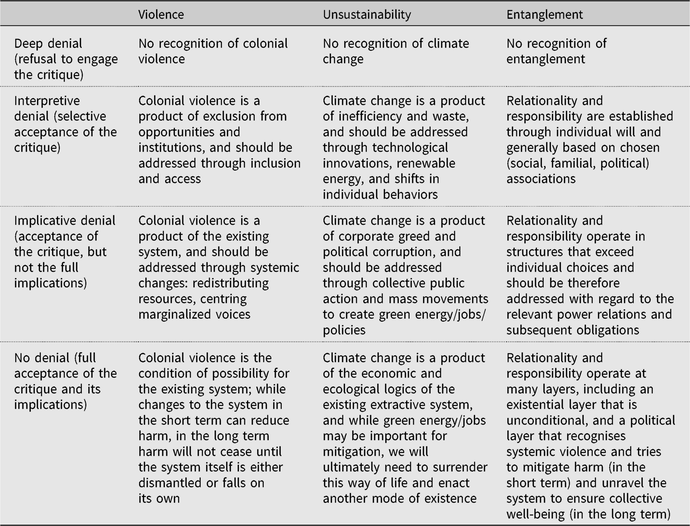
Thus, rather than offer a neat or prescriptive ending, I conclude by offering a tool for analysing different responses to climate change in higher education (and beyond) in Table 2. This tool can help clarify the extent to which a response is addressing the denials that keep the modern-colonial habit-of-being in place, which can be summarised as: (1) denial of the systemic colonial violence that underwrites the maintenance of the dominant system (which is premised on racialised exploitation and expropriation); (2) denial of the inherent ecological unsustainability of the dominant system (which is premised on unending growth and consumption that ignores the limits of the planet); and (3) denial of the condition of our entanglement (which is premised on framing relationality as a willed choice rather than a fact of our collective existence on a finite planet)
Because there are also different degrees of denial, I include four different levels of denial that are inspired by Foster (Reference Foster2014), but which emphasise the extent to which a response takes seriously decolonial critiques of each of the three denials. This tool is not intended to be a means to dismiss efforts if they do not challenge all three denials at the fullest layer, especially given that it is practically impossible to deeply address all denials the same time and remain legible (i.e., have one’s proposal understood as possible or desirable). Rather, it is meant to make visible what is often invisibilised, so that we can interrupt these denials when they are reproduced (in ourselves and others), and be more cognisant of the contributions and limitations of any climate change intervention.
Acknowledgements
Many of the ideas in this text are informed by my collaborative work as part of the Gesturing Towards Decolonial Futures Collective (https://decolonialfutures.net).
Sharon Stein is an Assistant Professor in the Department of Educational Studies at the University of British Columbia. Her scholarship addresses the role of higher education in society, especially as this relates to internationalisation, decolonisation, and climate change. Her work emphasises the educational challenges of addressing the interrelated ecological, cognitive, affective, relational, and economic dimensions of justice, responsibility, and change.