The guitarfish, ascribed to the genus Rhinobatos Linck, 1790, are cosmopolitan in warm temperate and tropical seas, and demersal on continental shelves and uppermost slopes on sand bottoms. This genus has thirty-five valid species plus one dubious species and at least five undescribed species (Compagno, Reference Compagno and Hamlett2005). On the Colombian Pacific coast, three species of the genus Rhinobatos are present (R. planiceps Garman, 1880, R. leucorhynchus Günther, 1867 and R. prahli Acero & Franke, Reference Acero and Franke1995) and one species (R. glauostygma Jordan & Gilbert, 1883) is not yet confirmed for this area (Mejía-Falla et al., Reference Mejía-Falla, Navia, Mejía-Ladino, Acero and Rubio2007).
Rhinobatos prahli has a body intermediate between shark-like and skate-like with two equal-sized dorsal fins, asymmetrical tail without lower lobe; disc triangular with pectoral fins adhered to head; long pointed snout, with two central cartilaginous ridges that widen at the front to form a spatula like tip; rear border of large spiracle with two folds, inner one not well developed; front nasal flaps extending in the centre only to inner level of nostrils; approximately 70–80 small denticles from nape to origin of first dorsal fin; several small denticles on each shoulder; a few poorly developed tubercles on snout and small denticles on front edges of eyes. The species presents a particular coloration pattern: dorsum brown with white spots (sometimes ringed with dark brown) on disc and tail; pale area on each side of the rostral cartilages; underside either plain white or yellowish with dark markings on edges of disc, and black blotches at tip and sides of snout (Acero & Franke, Reference Acero and Franke1995; Robertson & Allen, Reference Robertson and Allen2008). This species has few specimens documented and very little is known about its habitat and depth-range. Its distribution is not well defined, but it has been recorded from north-western Costa Rica, Panama (Golfo de Chiriquí), Colombia (Isla de Gorgona), Ecuador (Santa Rosa and Puerto López) and northern Peru (Puerto Pizarro) (Acero & Franke, Reference Acero and Franke1995; Béarez, Reference Béarez2000 and personal communications; Jiménez-Prado & Béarez, Reference Jimenez-Prado and Béarez2004; Kyne, Reference Kyne2008; Robertson & Allen, Reference Robertson and Allen2008). Although in Colombia the holotype was registered in the Gorgona National Natural Park (Acero & Franke, Reference Acero and Franke1995), this is the only one available record of this species for this country. This paper documents three new records of R. prahli, two of them in unknown localities for the species.
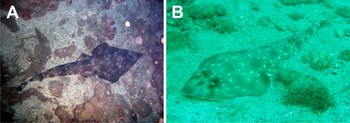
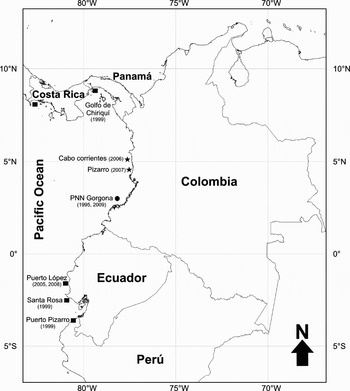
Based on the Sharks, Rays and Skates Sighting National Programme (PNAT) that the SQUALUS Foundation has been developing in Colombia since 2003 with the collaboration of divers, two photographic records of R. prahli were obtained. One photograph was taken in January 2006 (Figure 1A), in a place known as Amargal (05°34′47.7″N 77°30′50.4″W) near to Cabo Corrientes (Figure 2). This zone presents rocky and sand bottom with abundant soft coral (personal observations). In this sighting two individuals were observed swimming, one near to the other, in an approximate depth of 24 m (M. Múnera, personal communication). Several other photographs of individuals of R. prahli were taken in January 2009 (Figure 1B) in the Parguera (03°14′39″N 78°09′58″W) diving zone of Gorgona Island (Figure 2). This zone is characterized by presenting sandy bottoms with a few rocks. One of the authors, who did the sighting, observed seven individuals at 18 m depth resting in the sandy bottom; the largest were close to 90 cm total length (TL) and the smallest 50 cm TL.
Photographs of Gorgona guitarfish (Rhinobatos prahli) from (A) Amargal, Cabo Corrientes, Colombia (24 m depth) and (B) Gorgona Island, Colombia (18 m depth).

Records of localities and years of Rhinobatos prahli specimens in the tropical eastern Pacific, including the holotype (circle), known capture localities (squares) and new records of this study (stars).

In addition to the photographic records, one female Gorgona guitarfish 58.5 cm TL was captured in August 2007 by a shrimp trawler, near to Pizarro, Chocó, Colombian Pacific coast (04°58′42″N 77°24′7.8″W) (Figure 2).
The photographic records of R. prahli were taken in sand and rocky environments near to coral reefs, at 18 and 24 m depth. These direct sightings of specimens in these sites are according to the only existing record at this date for Colombia (the holotype; Acero & Franke, Reference Acero and Franke1995); however, the new visual records were obtained in not very deep waters, while the holotype was obtained at 70 m depth. The new capture record comes from a shrimp vessel fishing in shallow waters, commonly less than 25 m depth (Mejía-Falla & Navia, Reference Mejía-Falla and Navia2008).
Jiménez-Prado & Béarez (Reference Jimenez-Prado and Béarez2004) describe R. prahli as a benthonic species of shallow waters that lives over soft bottoms, and is incidentally and not very frequently captured with trawl nets in Ecuadorian waters. In Colombia, this species has not been registered as an incidental capture in any fishery, however, it is possible that it would have been captured but not registered due to bad identification. Its strong similarity in shape and size with R. leucorhynchus leads it to be catalogued as ‘guitarrilla’ (common name in Colombia for guitarfish) in fish landings, and be assumed as that species. This is what happened with the specimens given to us as ‘guitarrillas’ but once analysed they appeared to be R. prahli. Additionally, in pursuit of eventual landings in ports and in more than 100 drags undertaken by shrimp vessels between 2001 and 2008, this species had not been registered (Mejía-Falla & Navia, Reference Mejía-Falla and Navia2008).
The absence of records of Gorgona guitarfish in Colombia since its original description more than a decade ago, and the low frequency of records in other countries, makes R. prahli an uncommon species in Colombia and in the tropical eastern Pacific (Figure 2). According to the IUCN (2008) this species shows an unknown population behaviour and very uncertain data, and for these reasons it was included in the Deficient Data category. This gives validity to this note, and remarks on the importance to produce information about the species, with the objective to attain biological and population aspects in the halfway or long term, which is necessary to understand its dynamics and real conservation status. Finally, we conclude that R. prahli lives on soft and sandy bottoms and in rocky bottoms near to coral reefs, from shallow waters to depths close to 70 m, and may reach 90 cm in total length. Its distribution is not well defined, but it has been recorded from localities in Costa Rica, Panama, Colombia, Ecuador and northern Peru (Robertson & Allen, Reference Robertson and Allen2008); however, it is uncertain whether its occurrence is continuous across this range or is in paths.
ACKNOWLEDGEMENTS
We thank P. Béarez who gave literature and information on the species and for his comments to improve the manuscript; H. López who collaborated in the fieldwork and diver M. Múnera who donated the photograph.