Introduction
Exploring the Galaxy by the use of interstellar space probes is the only way to perform detailed investigations of extrasolar planets believed to harbour life.
Also the Fermi paradox
If there are extraterrestrial civilizations out there then where are they? Why haven’t we seen any traces of intelligent extraterrestrial life, such as probes, spacecraft or transmissions?
can be investigated if we know how long a time it takes to explore the Galaxy with space probes.
Here exploration of the Galaxy is simulated with space probes using a numerical model of the Galaxy. However, before going into detail with the model, the initial parameters needed to build a model of the Milky Way are described.
In Section 1 the initial parameters for the simulation are derived. Section 2 presents a model for exploring 40 000 stars in a box covering a distance of 300 pc above and below the Galactic plane as a function of Galactic radius. Section 3 models the whole Galaxy based on these results and presents the final results and discussion.
Initial parameters
There are roughly 100 billion stars in the Milky Way (Allan Reference Allan1973). The fraction of these stars that have planets suitable for harbouring life is estimated to be ≃10%, all located in the so-called Galactic Habitable Zone (GHZ), which spans the area 3–11 kpc from the Galactic Centre (GC; Lineweaver et al. Reference Lineweaver, Fenner and Gibson2004). This GHZ is comparable with the one found by Peña-Cabrera & Durand-Manterola (Reference Peña-Cabrera and Durand-Manterola2004), which extents from 4 to 17.5 kpc. In the following calculations, the GHZ of Lineweaver et al. is used.
There are roughly 820 F, G, K and M stars per 104 pc3 in the Solar neighbourhood, equal to a square box of 21.543 pc3 (Allan Reference Allan1973). This corresponds to 0.0615 stars per pc3 if it is assumed that ∼50% of the stars are in binaries and a binary is counted as one star. O and B stars are disregarded as these have too short a lifetime to harbour planets where life has time to evolve. Spectral class A stars are included as it is argued by Peña-Cabrera & Durand-Manterola (Reference Peña-Cabrera and Durand-Manterola2004) that these have a long enough lifetime to allow at least simple life to evolve. Binary systems consisting of two low-mass stars are not disregarded as simulations have shown that these can harbour terrestrial-like planets (Lissauer et al. Reference Lissauer, Quintana, Chambers, Duncan and Adams2004).
The stellar number density of the Milky Way disc is assumed to decline exponentially with distance from the GC. Measurements of the scale length give results in the range 2.5–3.5 kpc (see Sackett (Reference Sackett1997) for a review). Star counts from the Two-Micron All-Sky Survey (2MASS) yield a result of 3.3 kpc (Lpez-Corredoira et al. Reference Lpez-Corredoira, Cabrera-Lavers, Garzn and Hammersley2002) whereas direct measurements of M stars with the Hubble Space Telescope by Zheng et al. (Reference Zheng, Flynn, Gould, Bahcall and Salim2001) give 2.75 kpc. In the following a scale length of 3 kpc is used.
The area to be explored is defined as the area between 3 and 11 kpc from the GC and 300 pc above and below the Milky Way’s thin disc, as this last figure is the scale height of the Galactic thin disc (Gilmore & Reid Reference Gilmore and Reid1983).
To find the number of stars in this area the stellar number density profile is simply integrated over this interval, with binaries counted as one star. With z denoting the height respectively above and below the Galactic plane, r denoting the radial distance from the GC and σGC denoting the stellar number density at 3 kpc radial distance from the GC, the number of habitable stars, N hab, is

which is equal to 1.17×10¹⁰. The factor of two is caused by the equality between −z and z.
These 1.17×10¹⁰ habitable stars are an overwhelmingly large amount, and too many to include in a simulation. The approach here will therefore be to examine how long a time it takes a number of probes to explore a small number of stars, and to see how this exploration time scales as a function of the stellar number density, i.e. the Galactic radius. How the exploration time scales as a function of the number of probes used is also investigated. These results are then later used when simulating exploration of the entire Galaxy.
Exploring 40 000 stars
In this simulation, how long it will take to explore a volume containing 40 000 stars was investigated. In the following ‘stars’ designates stars that can possibly sustain life. Thus, as already mentioned, O and B stars are excluded in the models.
The model
In the first part of the simulation three-dimensional (3D) box systems are modelled, each containing 40 000 stars, but located at different Galactic radii. The already mentioned exponential decline of the stellar density with Galactic radius means that there will be fewer stars per cubic parsec further away from the GC, and each box will thus become larger in order to contain the 40 000 stars. All the boxes go from −300 to 300 pc in the z-direction. With regards to the exponential decline of the stellar density any spiral structure that the Galaxy might have is disregarded, as it is assumed that the density of low-mass stars does not increase strongly in the spiral arms.
Exploration algorithm
The 40 000 stars are explored by sending out one host probe which travels to some faraway star referred to as the ‘destination star’. Once the probe arrives, it dispatches a number (four or eight) of smaller probes that in total investigate the 40 000 nearest stars. They do this by always moving to the star nearest to their current location that has not been explored already. The distance and position of this star can easily be determined from its parallax. After all the 40 000 stars have been explored the probes return to the destination star, where they dock with the host probe for maintenance and prepare to travel to a new destination star.
The time it takes to travel back to the host probe from the last star explored, once all 40 000 stars are covered, is a tiny fraction of the time it takes to explore the 40 000 stars, and thus this return time has no impact on the total exploration time.
Once all the 40 000 stars have been explored and the probes have returned to the host probe, this moves to a new destination star some distance away where the smaller probes are released again to explore the 40 000 nearest stars and so on. In this way, the whole Galaxy can be covered in a finite amount of time.
For all probes a speed of 0.1c is assumed. This velocity is low enough so that effects due to general relativity can be ignored, yet high enough that the travel time between stars are of the order of years. The smaller probes only carry out fly-by investigations of the stars since the time and energy required to first brake and then reaccelerate the probe would slow the exploration time considerably. The time required to brake the spacecraft, examine all the planets in the given system in detail and reaccelerate the spacecraft will be at least of the same order of magnitude as the travel time between two stars, thus reducing the number of stars visited in a given amount of time by at least a factor of two. Therefore, fly-by investigation is assumed.
The purpose of the fly-by space probes is to detect whether there are any possible habited planets in the system. If this is the case then a new probe can be launched from the mother planet to carry out detailed investigation. It should be relatively easy to detect life on the surface of planets even from a fly-by space probe. To use our own civilization as an example, light pollution and heavy radio-broadcasted communication would reveal our presence on the Earth easily to any fly-by probe entering the Solar System, even if it were only equipped with technological equipment available today, such as a telescope equal to the Hubble Space Telescope and a radio receiver.
To prevent the small probes from visiting the same stars twice, each probe is limited to only investigate stars at a given height from the disc plane. Thus, the first probe will, for example, only explore stars in the range z=0–50 pc and so on. In reality this could be achieved by making the probes calculate their distance from the disc plane based on parallax to a number of known disc-plane stars. This approach effectively prevents probes from exploring the same stars.
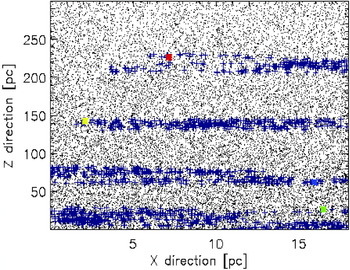
The exploration pattern of such a set-up can be seen in Fig. 1.
The x–z plane of a box containing 20 000 stars from 0 to 300 pc in the z-direction and at 3000 pc from the GC. Four probes, each marked by their own colour at their present location, are used to explore the stars. Unexplored stars are marked with a black dot and stars that have been visited are marked by a purple cross. At the time of this snapshot 1300 stars have been explored. Notice how the probes are confined to certain – intervals.

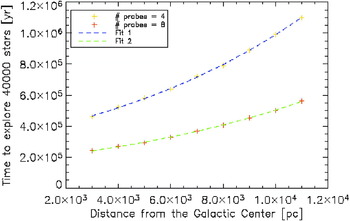
The time it takes a given number of probes to fully explore a 3D box containing 40 000 stars as a function of Galactic radius is given in Fig. 2. The fitted functions are both exponential functions of the form a e b·r. For four probes a=334 636 yr and b=1.07732×10⁻⁴ pc−1, and for eight probes a=172 734 yr and b=1.05971×10⁻⁴ pc−1. It thus takes of the order of 105 years to explore 40 000 stars, covering z from −300 to 300 pc.
Exploration time of 40 000 stars from −300 to 300 pc in the z-direction as a function of Galactic radius. The fitted functions are both of the form a e b·r.

Having found out how long time it takes to explore 40 000 stars, as a function of Galactic radius, this result is used to simulate exploration of the entire Galaxy.
Modelling the whole Galaxy
The problem with modelling the whole Galaxy is that even with a model consisting of systems each with 40 000 stars, there are still ∼260 000 such systems in the Galaxy. This is just too many to be handled in a reasonable amount of time, so the focus here is only on the time needed to explore our quadrant of the Galaxy. Thus, only an area one-quarter the size of the total circumference of the Galaxy, centred on the Solar System, is explored. This reduces the number of systems that need to be explored by a factor of four. In this quadrant of the Milky Way there will thus be ∼65 000 systems each consisting of 40 000 stars, which clearly illustrates just how enormous the Galaxy is.
In the following ‘stars’ mean systems of 40 000 stars. The model of the Galaxy is build so that the stellar density declines exponentially with Galactic radius as already explained in Section 1.
Each host probe always moves to the star located nearest to its present location that has not yet been explored.
This means that not all stars in the vicinity of the home planet will be covered, but it maximizes the number of stars explored as a function of time.
To prevent the host probes from exploring the same stars each host probe is assigned an angle in the disc plane as seen from the mother planet if looking towards the GC, which it has to stay inside. For example, if there are four probes, then the first could be assigned an angle from 0 to π/2 and so on. This can easily be accomplished in reality by telling the probe to fix its orientation by means of distant galaxies. In the simulations the angle is chosen such that the number of stars are the same in each angle. This gives a larger angle to the probes exploring the outer regions of the Galaxy compared to the probes in the inner part of the Galaxy.
Results
Now the entire Galaxy from 3 to 11 kpc is simulated and one-quarter of it explored. Four or eight host probes are sent out. Each star in the Galaxy now represents 40 000 stars and each time a probe has explored one star, the results from Fig. 2 are used to add the time needed to explore the 40 000 stars at this point.
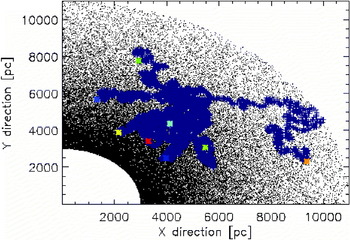
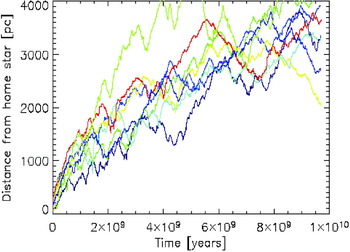
For four probes, each with four subprobes, the time required to explore 10 000 systems, each containing 40 000 stars, is 1.16×10⁹ years, which is around 10% of the age of the Universe according to observational data of the microwave background radiation (Spergel et al. Reference Spergel2007). As this is a completely unrealistic time for any civilization to wait, the simulation was also run for eight probes, each with eight subprobes. The Galaxy from this simulation is shown in Fig. 3. Here the time is 2.92×10⁸ years, again an immense time. However, as seen in Fig. 4, the probes manage to traverse distances of almost 4 kpc during that time, bringing them to the inner and outer edges of the Galaxy in the quadrant where they started.
A quadrant of the Galaxy, being explored by eight probes (each with eight subprobes). The probes, each marked by their own colour, start from a distance of 8000 pc from the GC, and at an angle of 45° from the x-axis. The units on both axes are in parsecs. Explored stars are marked by a purple cross. Note that more probes are dispatched in the direction of the GC, as the number of stars is greater here, and the angle in which the individual probes must stay is thus smaller. Stars inside 3 kpc and outside 11 kpc are not shown, as these are not explored.

The distance from the home star, as a function of time, for the individual host probes. Each probe is marked by its own colour. The probes each manage to travel a distance of almost 4 kpc.

Discussion
The scope of the simulation becomes clear when one realizes that the above-mentioned times are only for exploring 10 000 of the 260 000 systems of 40 000 stars each. Thus it takes 2% of the age of the Universe to explore 1/26∼3.85% of the Galaxy, using eight probes with eight subprobes. To explore the entire Galaxy with probes like this is virtually impossible.
One could argue that using only eight probes with eight subprobes each is totally inadequate for exploring a whole galaxy. This is a good argument, but it must be remembered that these probes are by no means similar to the small interplanetary probes that are known today. They will be much larger and much more expensive to produce then any space probe previously built since they have to last for ∼109 yr and be able to repair themselves. The economic feasibility of building such probes will not be discussed here.
However, in order to accommodate this criticism, a simulation of the exploration of the Galaxy, using 200 host probes, each with eight subprobes was run. The result is that, in this case, it will take 1.52×10⁷ yr to explore the 10 000 nearest systems of 40 000 stars each.
There are other problems with a simulation of the above type. First, it is assumed that the probes never fail or are destroyed. It seems very unlikely that a probe would even function for the ∼105 years it takes to explore the 40 000 stars from −300 to 300 pc in the z-direction. All though here a relatively high probe velocity of 0.1c has been used, it is a possibility that even faster probes could be invented, thus decreasing the exploration time significantly.
One could also contemplate the idea of launching self-replicating probes, i.e. probes that are able to build copies of themselves by harvesting materials from each stellar system they pass.
The construction of such probes is technologically as difficult as producing the conventional probes proposed to be used to explore the Galaxy, as these conventional probes must operate for millions, if not billions, of years. Therefore, one can argue that self-replicating probes should instead be used to explore the Galaxy, as using such probes will lead to much faster exploration times, as the number of probes increase as time goes by.
In fact if self-replicating probes, or von Neumann probes as they are also termed, were used to explore the Galaxy it has been shown that a search of the entire Galaxy will take 4×10⁶–3×10⁸ years, dependent on the speed of the probes (Tipler Reference Tipler1980). This is much faster than using the non-replicative probes proposed in this paper.
However, one should note that there could be complications with using self-replicating probes. Tipler (Reference Tipler1980) himself points out that the program controlling the self-replicating probes would have to have so high an intelligence that it might ‘go into business for itself’ and become out of control of the humans who designed it, resulting in unforeseeable consequences. Since the machines use the same resources as humans, a self-replicating machine might regard humans as competitors and try to exterminate them. Chyba and Hand (Reference Chyba and Hand2005) also points out that self-replicating probes might evolve to prey on each other, creating a sort of machine food-chain. This would, of course, drastically reduce their exploration rate.
Therefore, the conclusion is that if perfect self-replicating probes could be built, these could explore the Galaxy much faster than the probes suggested here. However, building less-then-perfect self-replicating probes could, in the worst-case scenario, have fatal consequences for the human race.
There is also the problem that, on the long timescales used for modelling the whole Galaxy, the differential rotation of the Galaxy will have an influence on the exploration time as will the probes’ distance from the home planet, and this effect has been neglected.
Finally there is the important consideration that the search techniques proposed in this paper are basically a blind search.
Each stellar system is searched individually, even though it may not host any planets at all. Of cause it would be much faster only to search the stars around which planets were known to exist. If the likelihood of planets existing around a star as a function of stellar type were known, one could implement this in a simulation to find the reduction in time by searching only stars with planets. Unfortunately, we do not know this function and can thus only guess at the reduction in time. A reasonable assumption would that if only half the stars have planets, the search time will be reduced by roughly a factor of two. Note that the search should probably not be limited to systems with Earth-like planets. We do not know what form an extraterrestrial lifeform might assume, and thus we cannot exclude any planetary systems from our search.
In this regard it is worth mentioning the DARWIN space telescope, currently in development by the European Space Agency. DARWIN, which is scheduled for launch around 2015, will be able to obtain spectra of planetary atmospheres of any terrestrial-like planets orbiting one of the nearest 1000 stars. This mission, together with other missions such as ‘COROT’ or the ‘Terrestrial Planet Finder’, both of which will be able to detect terrestrial-like planets around the closest stars, will in the near future provide us with candidate planets to be searched for life. Thus there is a reasonable possibility that in the near future the first human-made interstellar probes will begin to search the Galaxy for life. Thus it is important to develop search strategies that will maximize the exploration potential.
Returning now to the results obtained in this paper, based on the results from the simulations, it can be concluded that exploring the Galaxy by sending out probes to visit other stars is horribly slow. However, unless travel methods are invented which give access to faster-than-light-travel, there seems to be no alternative way to proceed other than with this proposed process. This could offer a possible explanation to the Fermi paradox. We have not yet been contacted by any extraterrestrial civilizations simple because they have not yet had the time to find us. Searching the Galaxy for life is a painstakingly slow process.