There's no other place on the planet where so many greats played for so many years, and that's one of those statements that seems like hyperbole, but it's not. … It's really the only quote unquote holy place left in jazz—period.
—Loren Schoenberg, artistic director of the National Jazz Museum in HarlemFootnote 1When pianist Fred Hersch walks on stage for what have become regular residencies at the Village Vanguard, he passes his own portrait on the wall, quietly communicating an expectation of both excellence and authenticity for the performance about to take place. February 2018 marked the eighty-fourth year since the Vanguard first opened its doors, a venue that began on the fringes of the jazz world and now, for many, stands at its sacred center. Having long held the title of New York City's oldest nightclub, the small, triangular basement on Seventh Avenue South in Greenwich Village must appear quite unassuming to those unaware of the club's rich history. It holds just 123 closely packed seats amidst a display of black and white photos and an old tuba. Yet to today's jazz musicians, the Vanguard is, as pianist Jason Moran put it, “the place where Moses and Mohammed and Jesus walked!”Footnote 2 Everything from the red awning out front to the cozy stage at the point of the triangle to the multitude of recordings whose covers proclaim them recorded “live at the Village Vanguard” comes together to evoke memories of great artists whose faces stare down from the pictures on the club's walls. Hersch's portrait appears alongside Thelonious Monk, Sonny Rollins, Bill Evans, Charles Mingus, and many more.
Commentators often note the consistencies the Vanguard has maintained over the course of the many years it has been open. As Matthew Kassel wrote in a piece for The Observer on the venue's eightieth birthday, “not much has changed about the Vanguard, its distinct red awning jutting out into the sidewalk like a beacon of stability in a neighborhood that often feels like a palimpsest of itself.”Footnote 3 Yet the very stability of the club and its unbroken links with its own past have begun to drastically set it apart from other venues on the current New York City jazz scene. While the Vanguard itself has remained remarkably consistent, still offering, for example, comfortably used banquette benches along the walls like those longtime owner Lorraine Gordon remembered sitting on as a teenager when she first visited the space in the 1940s, the cultural meanings surrounding it have fundamentally changed over time, and these changes have ultimately altered the functioning of the club itself. During the past eight decades, the Village Vanguard moved from the periphery of the city's jazz culture to its heart as it came increasingly to represent not so much an artistic vanguard of musical experimentation as a symbol of a historically sanctified jazz mainstream. An examination of the way space and history interact with music in Hersch's work makes plain the growing role of heritage in defining today's Village Vanguard and its characteristic showcasing of a tradition of small group improvisation with ties, both sonic and philosophical, to bebop and its related subgenres.
The place in which a sound originates shapes our experience of it in a number of ways, both acoustically and culturally, and musicians and audiences have spoken highly of the Vanguard in both regards. In her introduction to the volume Music, Sound and Space, Georgina Born identifies three main lineages of thought in the analysis of sound and space, including metaphorical conceptions of musical space drawn from musical notation, the type of physical spatialization of sound associated with, for example, multichannel recording, and a broad third entry point for study that conceptualizes space “not in terms of the internal operations of musical form, nor in terms of the perception of evolving musical or sound objects, but as multiple and constellatory.”Footnote 4 To consider the sounds of the Village Vanguard as multiple and constellatory helps to identify the various meanings that the music of this ostensibly consistent place traverses through ever-shifting contexts of space and time. Rather than functioning as a fixed point in a shifting sea of jazz history, the Vanguard itself also “moves” with currents that shift over time. Drawing on recent work in geography by Nigel Thrift, Born writes that “rather than think of space as static, unitary and unconnected to time, it should be interpreted as inherently mobile and in motion.”Footnote 5 To search for what the Village Vanguard means to jazz is to search for a moving target, as musical, cultural, temporal, and geographic forces are always shifting the way in which the space is experienced. As Born argues,
Taking account of all the elements in these multiplicities—music and sound, space and time, subjectivity and sociality—all are immanent in the experience of music and sound, and all are continually involved in the mediation of the other terms. Abstractly, the six elements can be conceived as composing a dynamic matrix in which each term potentially mediates all the others, together forming a constellation of multidirectional, virtual transformations. But this tidy image pins down what is more aptly portrayed as a decentered, mobile and unruly flux of mediations.Footnote 6
The various tensions Born describes as shaping the experience of music, sound, and space occur at the Village Vanguard not only for listeners taking in sound, but also for musicians creating those sounds through improvisation on stage. The venue is in a dynamic, ever-changing relationship with musicians, listeners, its local geography, and its broader influence that plays out in part through the musical choices of players as they create the Vanguard's present sound in real time.
The present Vanguard, however, is always in dialog with the past. While jazz notoriously evades precise definition, it is often discussed as a “tradition” assumed to be understood and shared by its practitioners and audiences. While it is impossible to name any one musical element that unites this vast body of music, it is almost equally difficult to avoid hearing the words “heritage” or “tradition” in all varieties of discourse on jazz. They show up in scholarly and popular books, magazines, documentaries, liner and program notes, blogs, and even 1987 House Concurrent Resolution 57, the document in which the US Congress declares this music, whatever it may be, a “rare and valuable national treasure” that “is important for the youth of America to recognize and understand … as a significant part of their cultural and intellectual heritage.”Footnote 7 Barbara Kirshenblatt-Gimblett's theorization of the concept of heritage production, originally formulated in the context of museums and tourism, offers a useful way of understanding how past and present now interact in the Village Vanguard as a historic venue featuring a musical style often discussed in terms of its relationship to a nebulous but highly valued tradition. She emphasizes that while heritage production bases itself in the past, “the heritage industry is a new mode of cultural production and it produces something new. There is no turning back.”Footnote 8 Though rooted in the past, the role now filled by the Vanguard in its present jazz scene is ultimately new and quite separate from the place it held in the mid-twentieth century. Significantly, much of this newness is tied up in the display of the old, both through live performances that maintain an awareness of heritage and through recordings made in the Vanguard that allow the past to repeat and proliferate. Kirshenblatt-Gimblett writes that, “Heritage is created through a process of exhibition (as knowledge, as performance, as museum display). Exhibition endows heritage thus conceived with a second life.”Footnote 9 The musicians who now play at the Village Vanguard perform the line between Kirshenblatt-Gimblett's first and second lives, relying on heritage for relevance and authenticity, but facing the additional challenge that the heritage in question traditionally values individuality, countercultural cache, and the placement of pressure on established norms. Music that manages this elaborate balancing act both supports and is supported by the venue itself as the Vanguard plays its own set of complex local and global changes to hold onto its literal and cultural real estate. Through my analysis of both Hersch's recordings and live performances at the Vanguard and elsewhere, I argue that this space, made famous by the music performed and recorded there, has valorized a heritage that now exerts control over what is played on its stage and, by extension, what is widely considered to be today's most respected subgenre of jazz. The network of people involved with this space—including musicians, listeners in person and through records and the management of the business both past and present—together create both a unique local identity for the Vanguard and a construction of what jazz is and has been that resonates outward beyond the physical limits of its famous red doors.
Attempting to define jazz as a genre has been a fraught and largely futile exercise since the term's origins in the early decades of the twentieth century. A word that has at times been applied with derogatory intent and in other moments bestowed as affirmation, sometimes rejected by figures who today are held up as its most celebrated artists including Miles Davis and Duke Ellington, it is impossible to concretely and accurately draw lines around the music that constitutes this genre. There is no single set of musical criteria that can be used to explain the work of Jelly Roll Morton, Ornette Coleman, and Kenny G, but all fall under the jazz umbrella in certain communities and discourses that lay claim to this contested term. Yet, contemporary discussions of jazz often invoke a “mainstream” as a jumping off point for situating diverse jazz styles, audiences, and cultures with regard to each other. For example, in Blowin’ the Blues Away: Performance and Meaning on the New York Jazz Scene, Travis Jackson demarcates the mainstream in 1990s New York as generally entailing styles that “are played primarily on acoustic instruments by small groups of three to seven musicians; make frequent use of thirty-two-bar song forms, twelve-bar blues, and ‘modal’ frameworks, as well as various modifications of them; and are historically rooted in the practices of paradigmatic jazz musicians in general and African American jazz musicians in particular.”Footnote 10 Jackson differentiates this mainstream from other contemporaneous musics also considered jazz, though sometimes by different groups of participants than those most involved with the mainstream, such as “contemporary,” “smooth,” or “experimental” jazz that might make greater use of electronic instruments and sounds, engage more closely with popular music, or stray further from the structural conventions of the mainstream. While it would be an oversimplification to claim that there is a single jazz community that holds a firm consensus on what constitutes mainstream jazz, I use the term here as a means of positioning the Village Vanguard as it is often seen and described by the musicians and listeners that engage with it. Furthermore, given the centrality of New York City in many widely held conceptions of jazz geography and the Vanguard's highly esteemed place within the New York scene, this venue and the network of people who shape it are uniquely positioned to lay claim to a secure position in the jazz mainstream.Footnote 11 Live performances at the Vanguard offer one way in which the borders of jazz are regularly redefined and asserted, and widely distributed recordings of those performances extend the reach and influence of those definitions and assertions beyond the club itself. Because of its relationship to jazz history and capacity for heritage production, the Vanguard, while by no means the only arbiter of mainstream jazz, stands as a particularly powerful one. Especially as tourism has grown in importance in the area surrounding the venue, its role in presenting not just jazz but also jazz heritage has added weight to what happens on the Vanguard's stage. The site simultaneously enacts its specific local nature, shown in the rhetoric about its consistency, and turns that local specificity into a commodity with a broader reach in its more recently acquired status as a tourist destination and recording space, traits that lead it to function in part as what Kirshenblatt-Gimblett calls the “heritage industry … in creating the sense of ‘hereness’ necessary to convert a location into a destination.”Footnote 12 The delicate balance between sameness and change, local and distributed, that characterize today's Village Vanguard, a place that simultaneously operates as the jazz club it has always been and a sort of shrine to both its own past and the numerous other spaces from the heyday of jazz nightclubs that it outlived, partakes in a kind of tourism that Kirshenblatt-Gimblett describes as “escalating the process by which a way of life becomes heritage.”Footnote 13 As Kirshenblatt-Gimblett argues, “While it looks old, heritage is actually something new. Heritage is a mode of cultural production in the present that has recourse to the past.”Footnote 14 The Village Vanguard looks much like it always has, but that very reality means that it operates in ways that are unique to the present day.
From Experiment to Landmark
In an article celebrating the seventieth anniversary of the Vanguard, jazz writer Ashley Kahn begins by suggesting that the very words “Village Vanguard” sound like jazz.
Try repeating it out loud: VIL-lage VAN-guard, VIL-lage VAN-guard.
For 70 years, that alliterative name has swung in 4/4 time, marking the center of the known jazz universe to an international circle of musicians and music fans.Footnote 15
While Kahn could refer to the club as “the center of the known jazz universe” in 2005, when Max Gordon first opened his doors in 1935, the place was anything but. In the thirties, the Vanguard was not much of a jazz club at all, but a space for a wide variety of yet-to-be-established performers. At first, liberal young poets at home in the Bohemian atmosphere of Greenwich Village, led by master of ceremonies Eli Siegel, provided the bulk of the entertainment at the fledgling establishment. According to Gordon, “In addition to poetry, there was music and dance.”Footnote 16 These musical performances were indeed additions, however, not central acts by major stars but brief and often humorous numbers by members of the audience or service staff.Footnote 17 It was not until 1939 that Gordon, seeking to discourage some of the more raucous patrons who had found their way to the Vanguard, began to book more organized nightclub acts, and even these were not typically jazz oriented. The first was a comedy troupe called the Revuers that performed satirical musical numbers and skits featuring a young Judy Holliday in her first forays onto the stage. In the Revuers’ place came blues singers Huddie “Lead Belly” Ledbetter and Josh White, followed by Richard Dyer-Bennet, a lutenist and performer of English ballads from the seventeenth and eighteenth centuries, comedians Carol Channing and Lenny Bruce, singer Harry Belafonte, and many others.
This array of performers does share common ground, although jazz has little to do with their work at the Vanguard. First of all, they held appeal for the bohemian audiences of the left-leaning club that explored anything and everything with an air of counterculture. Whether they were hearing Lead Belly, a blues singer recently released from prison, or Lenny Bruce, a comic who would soon end up there on obscenity charges for the nature of his performance material, Vanguard audiences came out to see artists who pushed against the establishment. In addition, none of the performers booked there in the club's early decades were well-known mainstream artists when they came to the Vanguard. They were generally closer to the beginning of their careers than the end, and their Vanguard appearances would eventually pale in significance when compared to their other achievements as performers, which included Academy Awards and Carnegie Hall performances. The Village Vanguard of the thirties and forties was not a point of arrival for performers, but a point of departure.
The Village Vanguard is no longer the place to go to catch an act by a young unknown whose experimental work from any corner of the art world may or may not prove to break interesting artistic ground. The venue has transformed itself into a space that promises prospective audience members that, on any given night, they can walk in expecting to hear world-class jazz performances. And, as Hersch describes, many people do.
I think the Vanguard is one of those places … on everybody's consciousness … if you come to New York and you love jazz … almost like Statue of Liberty, Museum of Modern Art, Village Vanguard. It[’s] … the authentic New York jazz experience.Footnote 18
Since Gordon refocused the club as a jazz-specific venue in 1957, many of the world's most prominent jazz performers have played and recorded in this famous room.
Only musicians appear at the Vanguard now, and they are among the biggest stars in jazz. Though their work still plays a role in expanding the borders of their musical genre to embrace current techniques and ideas, the contemporary artists who play there have typically earned the right to do so by proving themselves to be extremely capable performers within a recognizable mainstream idiom. Coined by critic Stanley Dance, around the same time the Vanguard cemented its role as a jazz club, the term “mainstream jazz” originally referred to the persistence of swing music after the advent of bebop. Over time, however, the meaning of the word shifted in reference to the ever-expanding outer reaches of jazz. Its current definition in Grove as penned by James Lincoln Collier suggests that the mainstream encompasses “any jazz improvised on chord sequences in the essentially solo style,” typically excluding “free or aleatory jazz of the avant garde, rock-based jazz, and dixieland and other traditional forms.”Footnote 19 I use this term not to pigeonhole music at the Vanguard as bland or passé in comparison to some more real or vibrant current style, but to take advantage of some of the tension native to its historical and contemporary definitions that mirrors the musical process currently playing out at the Vanguard: the mainstream is neither too traditional nor too experimental, and borders are constantly in flux along with the rest of the musics under the broad jazz umbrella. It is recognizable as relevant jazz, indeed as the current core of the genre to many jazz players and listeners, because it partakes of the music's past without taking on the role of direct recreation or revival of older music. The Vanguard holds onto a central place in jazz through live performances and recordings that embody both the heritage and the individual creativity and spontaneity widely considered to be essential ingredients in this genre.
Redefinition and Repetition
Recording played a key part in the Vanguard's transition from the margins of New York City nightlife to a center for a significant contingent of jazz culture. By the end of the 1950s, the Vanguard's role as a major jazz venue was taking shape, in large part due to the influence and jazz connections of Max Gordon's wife and the venue's longtime owner, Lorraine Gordon, who maintained the club from Max's death in 1989 until she passed away at the age of ninety-five in 2018. 1957, the year Max Gordon “began reinventing the Village Vanguard as a jazz club exclusively,” was also the year that the first in a very long line of “live at the Village Vanguard” records was made, this one by saxophonist Sonny Rollins.Footnote 20 Blue Note Records, a company for which Lorraine Gordon had worked with Alfred Lion, her former spouse and the owner, released Rollins's A Night at the Village Vanguard in 1958. Since then, over a hundred recordings made at the club have been released as commercial records or compact discs. A myriad of artists, including John Coltrane, Betty Carter, and Wynton Marsalis, and a variety of labels from Impulse! to Columbia to Winter & Winter, have joined forces with the club to create recordings that carry the Vanguard name and sound. In effect, the Vanguard simultaneously became a place to hear jazz and a point of origin from which it was disseminated to a widespread audience via records.
One of the earliest recording sessions at the Vanguard has proven to be one of the most enduring and well respected. The material recorded Sunday June 25, 1961 by pianist Bill Evans, bassist Scott LaFaro, and drummer Paul Motian is often cited as monumental in the history of the jazz piano trio, an ensemble type that has served as a Vanguard staple for decades. As David Ake argues, “It would not be a stretch to suggest that since the late 1950s Evans has exerted a stronger influence on jazz pianists than any other keyboardist,” and the trio recordings of this era, including those drawn from sets at the Vanguard, “are offered as evidence of the musician's genius.”Footnote 21 The material was initially released by Riverside Records as two albums that met with favorable reviews early on and have only grown in their significance to the jazz canon over time: Sunday at the Village Vanguard and Waltz for Debby. Yet the live aspect of Waltz for Debby held little charm for Down Beat reviewer Leonard Feather in 1962.
The set was recorded, like one of Evans's best previous albums, at the Village Vanguard. I don't know what that meant to Evans—possibly he is one of those artists who needs the stimulation of a club crowd—but to me it only means that somebody who had an irritating cough that day should have stayed home.Footnote 22
C. Michael Bailey's review of the re-release of the same material in 2005 as The Complete Village Vanguard Recordings, 1961 reflects a very different perspective on the audible liveness of the now-canonized Evans recordings from the now-canonized Village Vanguard. In the twenty-first century, with both Evans and the Vanguard now holding honored places in the jazz pantheon, “tinkling glasses and audience patter,” reveal the capital-T, “true Truth of the recordings.”Footnote 23 While Feather's view of background noise was not universally shared in the 1960s, indeed, the growth and persistence of live recording in jazz prove otherwise, the idea of a reviewer criticizing an artist's choice to record at the Vanguard today seems almost unimaginable—after all those are Village Vanguard glasses heard on the recording, not just any background noise, but audible traces of the specific physical space in which the record originated. The discrepancy between Feather and Bailey's perspectives on the soundscape and function of live Evans recordings from the Vanguard mirrors what Darren Mueller demonstrates with regard to releases of Duke Ellington's famous Newport Jazz Festival performance in 1956 on both a 1956 LP and a 1999 CD, with a radically different approach to audio production: jazz audiences at the turn of the twenty-first century embrace sonic evidence of what is conceived of as the “original” or “real” performance context as markers of authenticity, even if that sonic evidence might interfere with the clarity or legibility of the recording on a strictly musical level.Footnote 24 In the case of the Evans recordings, the sound of a clinking bar glass is now a treasure because it is a “real,” “live,” Village Vanguard bar glass, and anything “live at the Village Vanguard” has developed a certain cultural currency.
Much of the Village Vanguard's present fame stems from the recordings that have been made there. That both Max and Lorraine Gordon's autobiographies are titled with plays on the phrase “live at the Village Vanguard” hints at how often “liveness” is coupled with the idea of this space. Yet, specifying that a performance is live is of course only necessary if it in fact no longer is: performers that appear in person before audiences at the club do not need to be advertised as live, only the recordings they produce there do. As Philip Auslander suggests in his study of live performance since the advent of mass media, “historically, the live is actually an effect of mediatization, not the other way around.”Footnote 25 Live Village Vanguard recordings are not simply a means of preserving events that occurred at the club, they are unique new products that themselves play a major role in how the venue is understood. Indeed, as Jackson observed, the production of live albums at the Vanguard can involve not just the inconspicuous recording of sounds that would occur anyway, but careful and conscious preparation and manipulation to transform a typical set of live music into a viable recording project:
When artists like Joshua Redman and Joe Lovano made their live recordings at the Village Vanguard in the 1990s, it was likely as apparent to other audience members as it was to me that these were not typical performances. Intricate networks of wires and cables ran from the stage to other areas of the club and up the stairs to large mobile recording unites parked in front of the club on both occasions. If that weren't evidence enough, the musicians took care to inform us in each case that the evening's performance was being recorded for commercial release. Moreover, as is standard with studio recordings, some recorded material, such as the intervals between songs or “extraneous” audience noise, didn't appear on the final releases. Finally audience applause was recorded on separate microphones to be mixed in later, and the individual tunes chosen for inclusion on the final recordings were sequenced in a manner that didn't replicate their order on the evening(s) of performance.Footnote 26
Pointing out the liveness of recorded material from the Village Vanguard on the surface appears to tie it to the ordinary day-to-day business of the venue's pre-1957 existence, but it in fact marks a significant shift in the history, geography, and sonic possibilities of the space. From the very beginning, the origin of these recordings has been regarded as a significant part of their identity. Of the one-hundred-plus recordings made at the Vanguard in the past sixty years, the vast majority offer some suggestion of their creation in ephemeral, live experiences, public events now recalled as history in the making. From Rollins's A Night at the Village Vanguard and Evans's Sunday at the Village Vanguard, to a plethora of fill-in-the-blank name plus “Live at the Village Vanguard” combinations by McCoy Tyner, Earl Hines, Dizzy Gillespie, and at least a few dozen others, the authority of records is based in the memory of the music's spontaneous performance in front of the Vanguard audience. As they are repeated, these albums function not only as musical sound, but as objects defining a both a heritage and a space.
It is no coincidence that the Vanguard's rebirth as a jazz club and its debut as a recording space occurred at the same time. Max Gordon was losing many of his most successful nightclub acts from his larger midtown venue, the Blue Angel, to television as the funds available through door receipts from a small live audience could no longer compete within the developing mass media economy. The new Village Vanguard that emerged in the late fifties and early sixties proved well designed to appeal to a niche market with which television would not so directly compete, and the club's transformation during this period also engaged with the increasing presence of mass media that was changing the entertainment landscape. While Gordon continued to maintain a live performance space, he, Lorraine, and the network of musicians and recording companies with whom they collaborated also turned that very “liveness” into something that could be distributed on a larger scale. As Auslander has argued, the relationship between live performance and mass media is much closer than generally acknowledged, and mediatized forms primarily dictate the terms of that relationship.
Whereas the traditional view … sees … the live performance arts generally as belonging to a cultural system separate from that of the mass media, live forms have become mediatized … they have been forced by economic reality to acknowledge their status as media within a mediatic system that includes the mass media and information technologies.Footnote 27
Making records at the Village Vanguard allowed the club to become a recognizable institution to jazz audiences regardless of location. Suddenly, John Coltrane fans from the Midwest and Bill Evans listeners in Europe had reason to know about the Vanguard. The club was no longer selling itself to just a neighborhood or a city, but to an international audience, and it was no longer just a small basement room where a small group of listeners sat at crowded tables, but also an imagined space with growing prestige in the minds of record audiences. As Georgina Born argues, the distribution of recordings plays a key role in our current understandings of musical spaces:
The proliferation of audio media … results in a situation in which acoustic environments are increasingly multiple, recursive and topologically malleable. This in turn depends on the potential of music and sound media both to demarcate and reinforce social and psychological boundaries through the creation of sonic autonomy and segregation, and to overcome such boundaries through sound's omnidirectional, mobile and enveloping materiality, as well as through the mediated weaving of translocal sonic connections.Footnote 28
The mediatized Vanguard distributed and heard on recordings impacts the way audiences and performers perceive the space, expanding its reach through both space and time, a change that adds weight to the performances that now take place there through the extensive network of existing material, much of it highly acclaimed, to which they are connected. The “liveness” of the Vanguard began to be experienced by only a small proportion of the music's total audience, a change that served to make that liveness more highly desirable. While live performance at the Vanguard might have struggled on its own during the decline of nightclub culture, the sale of its mediatized replacement reinstated its value by selling its absence and the events of its past, transforming the space into one that could “play” in a wide geographical and temporal landscape.
While the geography of the Vanguard's audience was expanding, its demographics were changing in other ways as well. In Gordon's earlier decades as a nightclub owner, jazz had been one of many forms of popular entertainment that could appeal to his target audience. In the fifties and sixties, however, the place of jazz in American culture was shifting at the same time that mainstream nightclub acts were moving to television. Sociologist Paul Lopes refers to the 1950s and ’60s as a “modern jazz renaissance” in which jazz was “firmly secured … as a major American art tradition.”Footnote 29 By examining the language used to describe jazz from the music's origins through the late twentieth century in trade magazines and eventually broader forms of media, Lopes identifies the late fifties as the historical moment in which the idea of “a progressive jazz tradition from folk art, to popular art, to modernist high art” came to dominate the discourse.Footnote 30 As rock and roll took the spotlight as the new standard form of commercial music, jazz began to be aligned with art music rather than popular culture.
In redefining the booking practices of the Vanguard as a jazz club in 1957, the Gordons were effectively getting out of the popular entertainment business and into the art world, and the Vanguard's location in Greenwich Village and historical relationship with left-leaning bohemian culture made it an ideal venue in which to present the newest and most controversial of art musics. Lorraine Gordon described the transition as follows:
In 1957 … Max was finding it increasingly difficult to book the comics and the nightclub performers who had carried the Vanguard. Television was consuming them all. … Max steered the Vanguard more toward jazz. Only in retrospect does this seem brilliant. But it was. … You think I understood what Coltrane was doing when I heard him in the Vanguard in the sixties? I should say not. I didn't know what the hell I was listening to. … The litany of jazz names Max brought in during this period established the Vanguard's peerless jazz identity for all time: Carmen McCrae; Charles Mingus; Thelonious Monk; Stan Getz; Ben Webster; Mose Allison; Anita O'Day; Teddy Wilson; Miles Davis; Horace Silver; Chris Connor; Dizzy Gillespie; George Shearing; Jonny Griffin; Lambert, Hendricks & Ross; Zoot Sims; Max Roach; Red Garland; Ahmad Jamal; Dinah Washington.Footnote 31
This impressive list of performers that characterized the Vanguard of the late fifties and sixties included both established jazz artists and the avant-garde characterized by Coltrane's increasing turn to free jazz during that period, music Lorraine Gordon described as so foreign to her at the time. While controversial during its emergence, Lopes points out that free jazz was fairly quickly incorporated “within the general modernist paradigm of innovation and exploration” that characterized the renaissance and shift to an artistic rather than entertainment-based understanding of jazz in which critics and historians ultimately “canonized John Coltrane as a jazz visionary.”Footnote 32 Looking back, Lorraine wrote that, “Max booked a lot of acts I couldn't or wouldn't today.”Footnote 33 As jazz heritage accumulated around the Village Vanguard and the live jazz scene surrounding it both locally and globally continued to change over the next six decades, the nature of booking practices at the venue gradually shifted as well, trending generally toward mainstream jazz performed by established artists as the most frequently performed music of the space today.
Fred Hersch and Today's Village Vanguard
The artists who appear frequently at the Village Vanguard now are almost all highly accomplished and familiar figures in the jazz world, and pianist Fred Hersch certainly earned his place in the venue's roster of regulars through his decades of performing at the highest levels of the New York scene, first as a sideman for Vanguard staple players of the 1980s and eventually as a leader of his own ensembles. Hersch, who celebrated his sixtieth birthday while playing a week at the Vanguard in October of 2015, is part of a generation of musicians who grew up in a world in which the Village Vanguard was already a noteworthy jazz destination. In fact, playing at the Vanguard with his own group was a longstanding goal for Hersch. A documentary about his life and music includes a photograph of Hersch smiling as he stands outside the door next to a sign that, for the first time, features his own name. Reflecting on the occasion while sitting in the club ten years later, Hersch said, “I'd been wanting this for fifteen years. That was certainly a big night. … It's a privilege to play here.”Footnote 34 His attitude toward the Vanguard is representative of many of the players who perform there today: they came of age as musicians as playing the Village Vanguard increasingly meant reaching a status of respectability in the New York jazz scene, a scene that in turn is often regarded as representing jazz performance at its highest level. A close listen to how Hersch plays there through the analysis of recordings made both inside and outside the club demonstrates the ways in which this venue now influences the music that is made there. Just as memories of past artists are palpable in the way the Vanguard is now perceived, the venue itself leaves audible marks on the music of the present.
Hersch began playing jazz in the 1970s and witnessed vast changes in the live performance scene as his career was taking shape. When he moved to New York, he first began working in an environment in which “everything took place in clubs.” This type of scene extended outside his home city.
There used to be circuit around the country where you could go. … There were certain bands … who worked forty-some weeks a year. And so, if you got a gig with them, that was your job … you could … make a living. Now that doesn't happen anymore. I mean, with very rare exceptions, you know, nobody works that much.Footnote 35
Hersch points out that today, not only are there fewer clubs for musicians to play in, but also those that do exist are of a different nature. “Especially in the smaller clubs that I used to play in New York, there was more of a connection between performer and audience.” More recently, in addition to the fact that “clubs have become more expensive,” he says, “there are not that many clubs around the country that are like the old clubs … they're slick, they're too big.”Footnote 36 The experience of playing and listening in an intimate space has become increasingly rare, thus heightening its value for today's performers and audiences. This opinion of the Vanguard's increasing value as places like it become more and more rare, held by Hersch and so many other musicians and listeners, resonates with the values Kirshenblatt-Gimblett argues are central to heritage production: “pastness, exhibition, difference, and, where possible, indigeneity.”Footnote 37 By continuing to present music in much the same way it has since the late 1950s, the Vanguard now serves as both the club it has always been and a monument to all the others that were once like it but have since disappeared.Footnote 38
In the contemporary club scene, Hersch feels that “the Vanguard is still the most soulful one.” To him, “what's going to be exciting to people about jazz, and what's going to keep them supporting it and coming back to hear it is … more than likely at a place like the Vanguard,” and less likely in larger settings like concert halls and festivals.Footnote 39 Hersch now plays at the Vanguard regularly, the result of a relationship with the club that he cultivated for a number of years starting with appearances there as a sideman in the eighties. It took until the late nineties for him to convince club owner Lorraine Gordon, who straightforwardly acknowledged sticking with music that she knew, to allow him an opportunity to perform as the leader of his own group.
There was a gap between the end of my sideman time and the time that [Lorraine Gordon] … was convinced to give me a chance as a leader. It was about a six-, seven-year gap. When she was finally persuaded to give me a week, it was, frankly, kind of quite an event—sell-out, everybody showed up—and I think she was kind of surprised. Then, of course I made a live album there, a few times later, and … kind of solidified my relationship as somebody who's always in the mix over there.Footnote 40
Hersch has since distinguished himself as the first pianist ever to play a full week of solo performances at the club. He was also one of the artists featured during the club's eightieth-anniversary celebration and has been added to the gallery of portraits on the Vanguard's walls.
I was very honored. … Lorraine Gordon put my picture on the wall. … That's a big thing. It was great … just that my relationship with the club has been acknowledged.Footnote 41
On Hersch's end, that relationship involved a sense of loyalty to the Vanguard, and he was conscious of not playing at other venues that represented conflicting interests. For example, he said in 2009, “I know it would be very painful for Lorraine if I were to work at, say, Dizzy's Club Coca-Cola,” the smaller club venue that is a part of Jazz at Lincoln Center. “Because they're quote ‘non-profit’ … they get all kinds of free advertising and a board of directors and very deep pockets,” factors that can make it difficult for the Vanguard to remain competitive as a business.Footnote 42 Hersch's respect for Lorraine Gordon and the space she maintained directed his own choices about where to appear as a performer.Footnote 43
Vanguards and Standards
Despite Hersch's close relationship to the Vanguard, however, he acknowledges that, as a venue, it is better suited to some of his musical projects than it is to others. In particular, though he has appeared there as both a soloist and part of a quintet, he recognized that Gordon was happiest to book his trio, the group that, of the ones he leads, tends to stick to the most easily recognizable jazz style and repertoire. Hersch described a Vanguard performance by his quintet at which Gordon told him that she was “really looking forward to the trio.” As a result of Gordon's preferences, he often chose alternative spaces when pursuing more experimental interests, like other clubs, art museums, and concert halls. While his loyalty to the Vanguard discouraged him from playing some venues, he said, “I do play at the Jazz Standard [another New York club], but the kinds of things I'll do at the Jazz Standard are not things that would interest Lorraine.”Footnote 44 In 2009, Hersch saw it as unlikely that his quartet called the Pocket Orchestra would end up playing at the Vanguard because of their more experimental sound. Indeed, Hersch has continued to present his less bebop-oriented new music at a variety of other venues while maintaining a consistent presence at the Vanguard with solo and trio jazz.
Like some of Hersch's other projects, the Pocket Orchestra falls somewhat outside musically or culturally derived definitions of what might best be described as the “jazz mainstream,” the current incarnation of bebop, postbop, and related styles that make up the music most prominently featured on the Vanguard stage. As Scott DeVeaux puts it, “Bebop is a music that has been kept alive by having been absorbed into the present; in a sense, it constitutes the present. It is part of the experience of all aspiring jazz musicians, each of whom learns bebop as the embodiment of the techniques, the aesthetic sensibilities, and ultimately the professional attitudes that define the discipline.”Footnote 45 While, as we will see through his Vanguard performances, Hersch is highly accomplished in the contemporary version of bebop DeVeaux describes, his broad interests in a wide variety of musical styles as well as visual arts, literature, and dance have led to compositions that are not necessarily grounded primarily in established jazz styles like bop, swing, or the blues. For instance, he has composed such diverse pieces as a set of variations on a Bach chorale, a tune inspired by ballerina Suzanne Farrell, a setting of selections from Walt Whitman's Leaves of Grass, and a musical theater piece called My Coma Dreams, based on his experience of a two-month-long AIDS-related coma in 2008. The Pocket Orchestra is another of Hersch's artistic pursuits that has more to do with his individual experiences, interests, and dedication to exploration than it does with the traditional jazz canon. An atypical combination of piano, voice, trumpet and percussion with no bass player and a repertoire made up almost entirely of Hersch's original compositions, this project definitely strikes out in a more experimental direction than the trio, which sticks to standard jazz instrumentation and performs a very normative and equally divided repertoire of original tunes, jazz compositions by other artists, and standards from the American songbook.
The Pocket Orchestra's performance of Hersch's piece “Light Years” wanders farthest from the typical jazz path with its use of recited poetry and percussion that is more coloristic than metric. With trumpeter Ralph Alessi sitting out this tune, Hersch is left with an enormous amount of melodic and harmonic freedom as the only provider of pitched material through substantial stretches of music. The rubato approach to tempo throughout creates a very open-ended atmosphere in which all members of the ensemble interact freely. The piece's beginning provides an example of the kind of flexible musical backdrops to spoken poetry that recur throughout the work. Small chimes and rattles create the initial texture into which other musical layers will be added, an approach to percussion that draws listeners outside of a typical jazz sound world both in its use of non-standard instruments and its lack of a consistent meter or groove. Hersch joins with freely improvised, light, pointillistic playing, creating melodic material that is neither abrasively striking nor easily grasped. Into this context comes Jo Lawry's spoken rather than sung entrance. One minute into the piece, Lawry moves from speech to song, and Hersch moves to a harmonized piano part and a temporarily perceptible, though still flexible, pulse. This gradual, collectively improvised movement from sound to song is repeated in a variety of forms throughout the piece, providing ample opportunity for the kind of spontaneous creation and interactive risk-taking that Hersch values. As he puts it, “I like frameworks … that are specific but not specific. It has an intent, but if it goes somewhere else, I'm not going to control it.”Footnote 46 While “Light Years” may not have the kinds of sonic or cultural characteristics that some audiences deem essential to jazz, it offers the kinds of creative challenges that Hersch finds engaging.
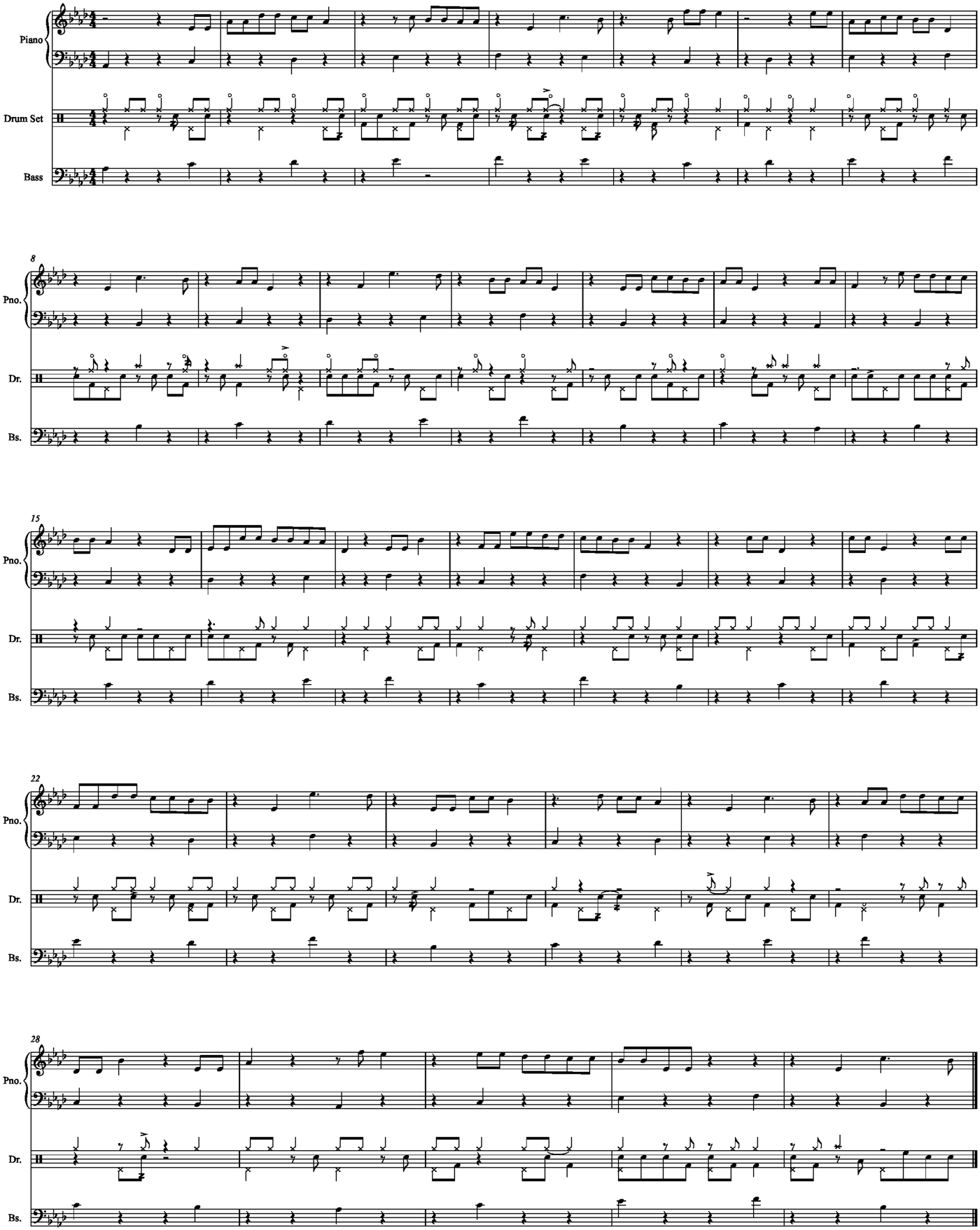
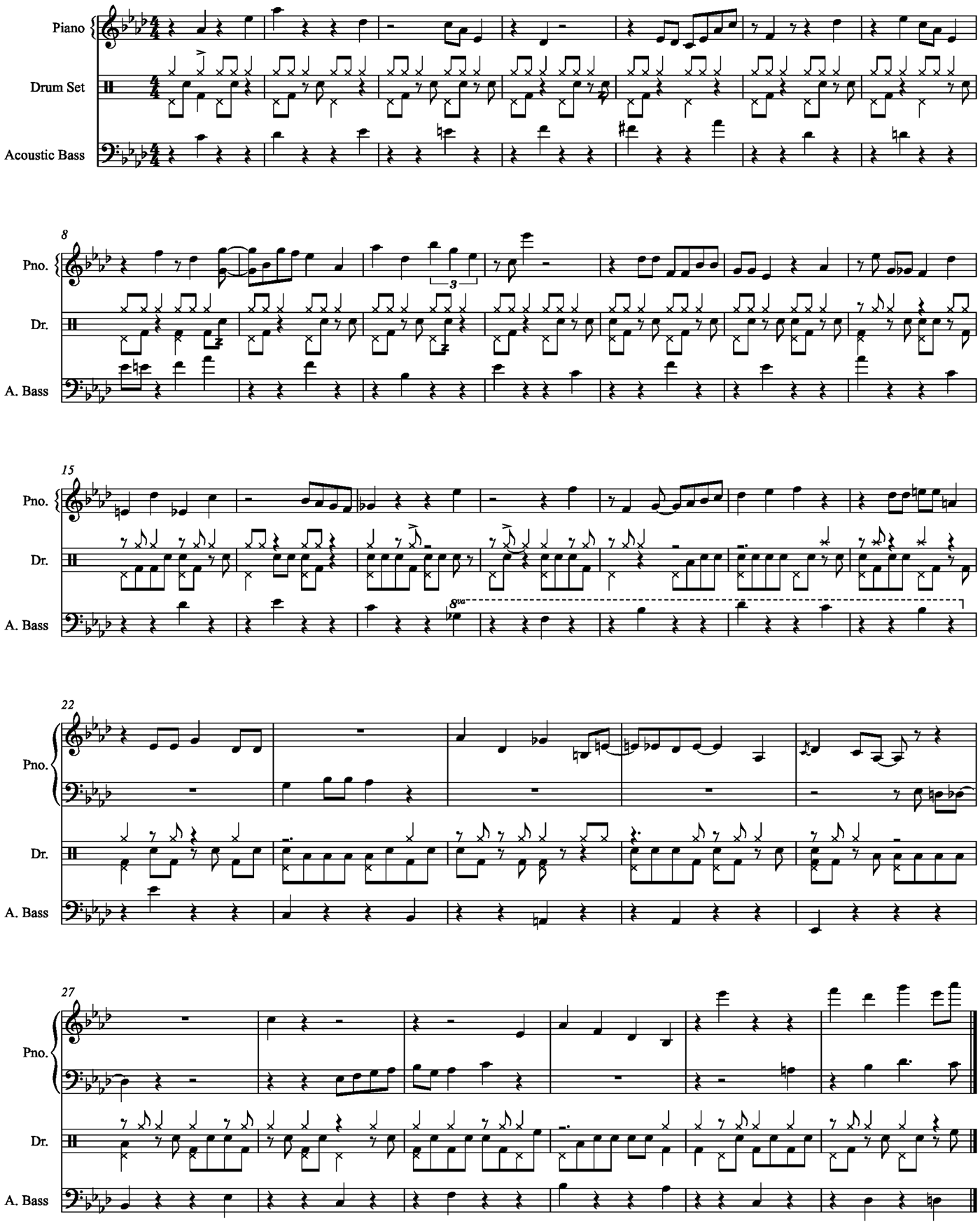
In contrast to “Light Years,” one of the tunes in the Pocket Orchestra's repertoire that is most closely aligned with mainstream jazz is also played by Hersch's trio at the Village Vanguard, offering an excellent opportunity to compare his work at the Jazz Standard to what he performs at the more conservative Vanguard. In the trio rendition, “Stuttering” (see Example 1) comes across as a more or less straight-ahead jazz tune with a few fun and memorable twists, whereas the Pocket Orchestra plays up the tune's oddities to a greater extent. “Stuttering” has a much more normative time feel than Hersch's most adventurous Pocket Orchestra repertoire, with its constant tempo and swing groove; it also features thirty-two-bar repeating choruses that relate it clearly to the most common of jazz formal structures.Footnote 47 As the title implies, however, the piece is still quirky: “Stuttering's” bass line lilts along in a steady triple meter that is at odds with the standard four-four jazz ride cymbal pattern painted over the top, making it, metrically speaking, one of the most unusual tunes in a typical trio set. Its meandering, stop-start melody does not commit fully to either of the work's two metrical camps, and a lack of repeating phrases makes it difficult for listeners to pinpoint any landmarks in the form.
“Stuttering” by Fred Hersch, performance of melody as recorded by the Fred Hersch Trio, Live at the Village Vanguard (Palmetto Records PM2088, Reference Hersch2002). Piano and bass transcriptions by the author, drum transcription by Chris Teal.

In the trio's performance at the Vanguard (see Example 1), Hersch, bassist Drew Gress, and drummer Nasheet Waits play within historically established instrumental roles to create a collaborative three-part texture in which the drums keep time, the bass plays a walking line that defines the harmonic structure, and the piano presents the melodic material. As shown in Example 2, Hersch maintains this texture beyond the initial statement of the head by continuing with it into the first chorus of his improvisation. He chooses to use the piano as a melodic rather than harmonic voice even in his solo, generally avoiding comping in favor of a single treble line.Footnote 48 This textural choice creates continuity between the opening and closing presentations of the melody and the improvised material that falls in between, and Hersch's largely diatonic note choices lead to an equal continuity in terms of pitch. The metric stratification continues to add novelty and interest to the performance, especially as Waits displaces his 4/4 pattern by one beat moving into the first chorus of the solo; but, in general, the conflict between the various voices is downplayed by the normative and continuous texture. In the end, the performance comes across as one in which the musicians casually and effortlessly play in different meters at the same time without ever really highlighting challenges to expected jazz norms.
“Stuttering” by Fred Hersch, first chorus of piano solo as recorded by the Fred Hersch Trio, Live at the Village Vanguard (Palmetto Records PM2088, Reference Hersch2002). Piano and bass transcriptions by the author, drum transcription by Chris Teal.

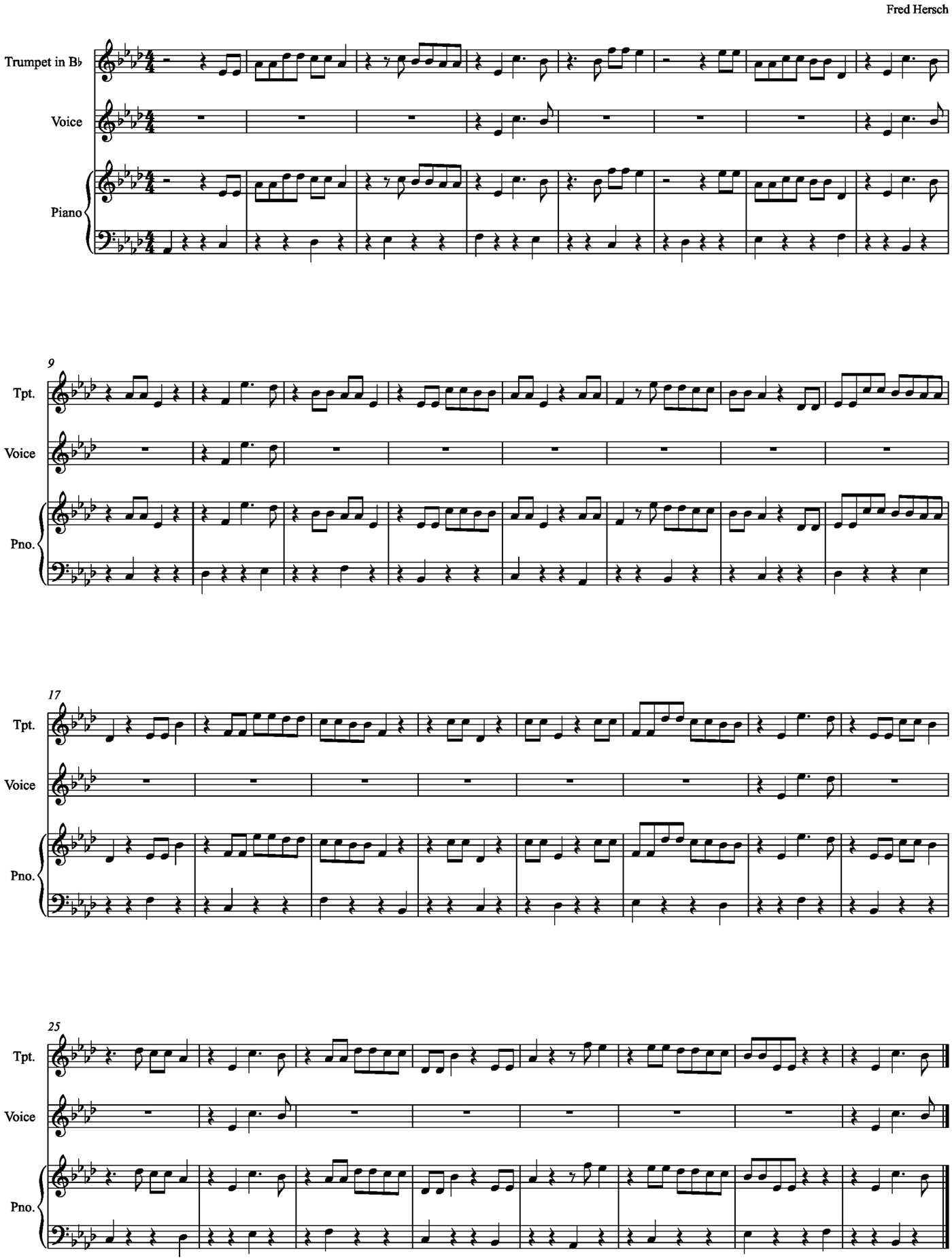
The Pocket Orchestra version of this tune from the Jazz Standard emphasizes the strangeness and incompatibility of “Stuttering's” layers to a greater extent. Beginning with the orchestration of the melody (see Example 3), the sense of uncertainty created by the lack of balanced phrases is played up by the addition of voice to selected moments in the melody. The piano and muted trumpet play the eighth-note figures in unison in a casual manner reminiscent of the trio performance, but they are joined by voice on the irregularly spaced dotted-quarter-note figures, which now stand out more strongly, bringing their odd temporal distribution into focus.
“Stuttering” by Fred Hersch, performance of melody as recorded by the Pocket Orchestra, Live at the Jazz Standard (Sunnyside Communications 1222, 2009). Drums: brushes on snare drum in 4/4.

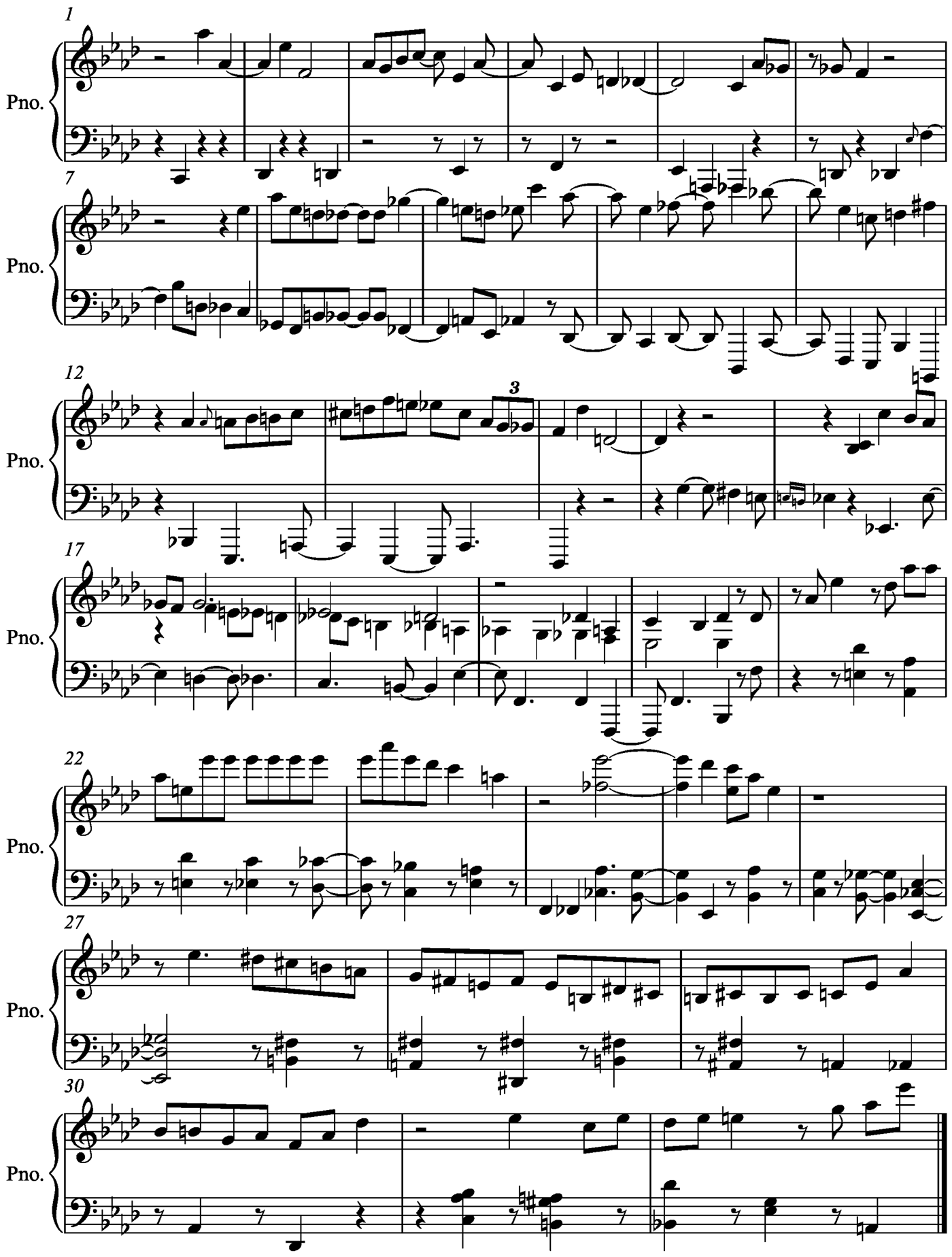
Hersch's piano solo with the Pocket Orchestra is also more disorienting than its Village Vanguard counterpart. While trio bassist Drew Gress maintained the triple-meter bass line that accompanied the head throughout the first chorus of the piano solo, allowing the strange metric mix to gradually become more predictable through repetition, Hersch, in providing his own accompaniment with the bassless Pocket Orchestra very quickly departs from the steady triple bass pattern. As shown in Example 4, by the third measure of his solo, Hersch's bass line has already slipped out of a clear three-four without moving to a clear four-four, leaving listeners without any metric underpinning to ground an understanding of the progression through the form. Hersch also departs from the tune's initial sparse texture, creating a wide variety of constantly changing ones instead. Rather than maintain the walking bass and single melodic line seen in Example 2, he also incorporates contrapuntal textures like the three-voice passage in mm. 15–20 of Example 4 and portions of clear melody with harmonic accompaniment as seen in mm. 21–32 of the same excerpt. Additionally, Hersch's melodic and harmonic choices in this solo stray much further from the diatonic A-flat major world of the melody than the solo in the trio recording. The result is a more jagged and unpredictable version of this piece than was performed at the Village Vanguard in which Hersch draws greater attention to the departures from jazz norms that he has taken with this composition.
“Stuttering” by Fred Hersch, first chorus of piano solo as recorded by the Pocket Orchestra, Live at the Jazz Standard (Sunnyside Communications 1222, 2009). Drums: brushes on snare drum in 4/4.

Comparing Hersch's variations in approach to his own material between performances with the trio at the Vanguard and the Pocket Orchestra at the Jazz Standard already points to the differences between how these two venues situate themselves with regard to mainstream and experimental music. When one considers the full range of repertoire covered by the trio, these differences become even more apparent, suggesting that the specific choices made by the ensembles in the two renderings of “Stuttering” do indeed relate to variations in the contexts of their performance. While the Pocket Orchestra plays all original material, the trio divides its sets among what Hersch refers to as his three “food groups”: standards from the American Songbook, jazz compositions by other artists, and original material. Three sets from the group's July 2009 Vanguard residence show that this division between standards, jazz compositions, and originals is reasonably even and consistent.Footnote 49 In making roughly two-thirds of each set from material already familiar to jazz-educated audiences, the trio provides a much more easily recognizable mainstream jazz product than the Pocket Orchestra, giving listeners aware of the jazz canon but not acquainted with Hersch's work an easy way to relate to a set, even if it stretches somewhat outside of boundaries with which they are familiar. This aesthetic is well suited to the Vanguard of today, as it offers easily recognizable surface features of the mainstream, maintaining aspects of the type of acoustic, post-bop playing that have now characterized the space for decades, while also enacting the venue's avant-garde heritage with unusual and experimental details at a more micro-analytic level.
Moving on and Holding on
Conceptualizing the Vanguard as a stronghold of the mainstream does not equate to thinking of it as antithetical to creativity. It may seem that playing in a context like the Vanguard, which defines jazz more conservatively than some other settings, would not appeal to a player who values ingenuity and risk. Yet, for Hersch, these characteristics do not need to be removed from his essential approach to playing when performing standard repertoire—they are rather relocated. In performing standards, navigating the divide between respecting historically engrained norms and expressing individuality creates a whole different set of challenges than playing originals. Accommodating the Vanguard's reverence for heritage actually creates opportunities for novelty and personal expression by encouraging artists to refer to history without repeating its material, an intellectually and artistically demanding task. As José Bowen points out in his work on convention and improvisation, “a tension exists between standing out from the tradition just far enough to be unique and yet still retaining the identity of the musical work.”Footnote 50 He clearly shows the wide variety of ways in which this tension manifests itself with his analysis of two arrangements of Thelonious Monk's “Round Midnight” in which both are recognizable as versions of the tune without actually containing any common elements with one another. Playing standards and jazz compositions is an important facet of what Hersch does as a musician, and he approaches pre-composed material as an opportunity for a similar type of creative engagement to that found in performances of his original music. He emphasizes the similarities rather than the differences he sees between playing his own pieces and those by others.
Well, I think any tune you have to learn well and spend time with it. Standards, you know, for me, it's partially knowing the words. Then deciding … the key, where it wants to live tempo-wise, then being familiar with it enough that I can just be free with it. With my own tunes, even though I wrote them, I still have to go through the same process.Footnote 51
A performance of Harry Warren's “I Wish I Knew” (1945), a standard Hersch used to open several of his sets during his week at the Vanguard in July 2009, offers a glimpse at what it means to “be free with” a tune.Footnote 52 Compositionally, “I Wish I Knew” falls squarely in the middle of the mainstream jazz repertoire. It is a thirty-two-measure popular song in 4/4 time and ABAC form that he performs at a medium swing tempo—just about as standard as standards come. The trio's performance playfully engages with the normative aspects of this work, maintaining the predictable tempo and form that make it easily recognizable as a jazz tune, while adding new elements that make it more challenging for both players and listeners. Specifically, this performance with bassist John Hébert and drummer Eric McPherson employed two tactics that expanded “I Wish I Knew” beyond its usual boundaries. The first of these is beginning the performance without clearly stating the melody, a technique Hersch has discussed with regard to another composition.
Sometimes this week we were playing “Played Twice,” a Monk tune, and we would just start improvising and then play the melody at the end. And that's fun, because, you know, everybody's … very attentive at first. … Then gradually it [the melody] kind of reveals itself. And I like doing that kind of stuff too. It puts me in a different spot.Footnote 53
The motivation for this formal modification as Hersch describes is both to engage the audience more fully and to lead the performers to different choices by interrupting usual habits. In the Vanguard performance of “I Wish I Knew,” Hersch began an improvised solo right away, only briefly hinting at a few of the primary pitches of the tune's opening A section in the first chorus. A clear statement of the melody did not appear until the final chorus of the performance.
A second alteration technique applied to this rendition of “I Wish I Knew” is a gradual modulation—the performance begins in G major and ends in A-flat. As with the casual approach to metric dissonance in the Vanguard performance of “Stuttering,” what could be a rather jarring move to a distantly related key is smoothed over by slowly building toward the key change over the course of four choruses, allowing listeners expecting a typical jazz performance to remain undisturbed while still playfully engaging those that hope to hear something personalized and imaginative in the presentation of a familiar tune. Like beginning with improvisation, changing keys is a method Hersch uses at times to add interest to pieces well known to him or to his audience. “Sometimes,” he confessed, “just playing a standard, say, in two different keys … a chorus in one key, a chorus in another key, doing that—just something simple, is fun. It just kind of makes it sound intentional.”Footnote 54 As with his description of the first alteration technique, Hersch again points out the value of reworking standards for both players and listeners. He expresses his concern that performances sound “intentional”—that the musician's efforts to engage personally with a particular tune come across in performance.
Often I'll have a student come in here, and I'll feel like they're obligatorily playing “Stella by Starlight” or “In Your Own Sweet Way” or “Alone Together,” but it's like, do you know anything about this tune? Why are you playing this tune? What does it mean to you? Why did you pick it? I hate going to a show and just feeling like there's no intent behind the piece. And I also really dislike feeling like people are not really, really improvising. … To me that's anti-jazz.Footnote 55
For Hersch, simply playing a tune that is drawn from the traditional repertoire of jazz standards does not necessarily mean performing traditional jazz. From this perspective, a standard without evidence of concepts that for Hersch are essential to jazz like creativity and improvisation is no more “real jazz” than a less traditional work like “Light Years.” The challenge in playing a standard becomes making it just as personal as an original tune, and just as relevant to the present historical moment.
It is the tradition heard in performances like Hersch's versions of standards, his searching for an individual voice within an already defined genre, that is best suited to the musical programming presented at today's Village Vanguard. While the venue continues to feature new artists, performers who each add their own new contributions to the music, freshness is balanced with a proportional interest in maintaining existing values. Hersch says, “I give Lorraine a lot of credit for keeping it as it has been, and also expanding to include new artists, which she has.” In examining Gordon's own statements on the matter, continuities between the twentieth- and twenty-first-century incarnations of the Vanguard are easy to spot. In fact, the very expansions that Hersch describes were, for Gordon, continuations. She was quite frank in descriptions of her own hiring practices:
How do I choose whom I hire? Basically, I just start with what I know. I like what I like, so that's what I hire … I also read everything about jazz that's available; I try to keep up with the jazz world.Footnote 56
The fact that Gordon had an interest in “keeping up” as a club owner in the twenty-first century should come as no surprise when her earlier career is considered. Collaborating with her first husband Alfred Lion on projects for Blue Note records over seventy years ago, Gordon remembered being “entirely into older jazz,” but still “going to clubs like the Royal Roost and Birdland, on Broadway near 52nd Street, because that's where all the new young guys were playing this new music called bebop.”Footnote 57 Gordon's extensive career took place in a jazz world characterized by constant stylistic changes, and continuing her own typical practices into her eighties and nineties meant, “always hav[ing her] ears open for the new man, the next phase of jazz history.”Footnote 58 As she described her perspective in a 2013 interview with Will Friedweld,
Everything changes. Look at me, look at you. Of course it changes—it's a growing art form. Anything that's artistic and pure will change. Otherwise it's a static thing that you don't care about. What's new is the name of the game; if it comes out of the musical ability of artists who play and compose, then it's a valid art form.
But Ms. Gordon does insist on some traditional values.
I encourage everyone who plays here to include at least one standard or ballad in every set—I say, no one's going out the door humming that original you wrote 10 minutes ago.Footnote 59
Striking a balance between heritage and change is at the core of what the Vanguard has come to represent.
Lorraine Gordon made her own mark on the jazz history she so lauded when she was named a National Endowment for the Arts Jazz Master in 2013. At the age of ninety, however, she had by that time passed much of the day-to-day operations of the club to her daughter Deborah Gordon, who has since taken ownership of the club, and longtime employee Jed Eisenman. This passing of the torch has so far unfolded as another of the Vanguard's subtle shifts, blending past and present values as the new leadership works with a deep respect for past practices. On one side is a continued need for musical change, and Eisenman echoes Lorraine Gordon's notion that “everything changes,” saying, “The music changes. … If you want to look for what is valid and exciting and real in jazz, you can't just keep hashing out the same stuff.”Footnote 60 Simultaneously, he and Deborah Gordon both stress the importance of continuity. In the following passage, Deborah highlights both sides of the tension:
“I certainly value the history,” said Gordon, who works with her ninety-two-year-old mother Lorraine to keep the Vanguard alive in its ageless state. “Part of what I do is to guard that in a city that changes constantly. But we're not a museum, and we don't want to be. It's a real living place that responds and tries to keep up the name ‘Vanguard.’”Footnote 61
Deborah Gordon and Eisenman continue to book music at the club that can successfully occupy the border between past and present.
Deborah Gordon's comments above highlight another significant tension in the contemporary Vanguard's relation to its world, the constantly changing city. Eisenman is more specific in defining the change Deborah alludes to as related to the drastic changes in property values around the club over the course of its long life.
The things that are great for the real estate industry in New York have hurt the art scene and the culture scene and the night scene and the jazz scene. … I think the fact that New York is more homogeneous now is a little bit of a letdown to those of us who remember the city when it was a little bit more rough and tumble.Footnote 62
The homogenization that Eisenman refers to here can be interpreted as a late stage of gentrification, a term that marked its fiftieth anniversary around the same time the Vanguard turned eighty. Coined in reference to certain London neighborhoods in the 1960s by Ruth Glass, gentrification is a process through which a neighborhood is dramatically changed by an introduction of wealthier inhabitants that eventually leads to the replacement of the previous and less affluent community forced out by rising property values. The neighborhood surrounding the Vanguard, Greenwich Village, was one of the earlier Manhattan neighborhoods to undergo gentrification; sociologist Sharon Zukin describes “an early form of gentrification” in the neighborhood inspiring some artistic residents to relocate to Brooklyn as early as the 1920s.Footnote 63 The poets that the Vanguard catered to in the 1930s were a part of the bohemian culture that continued to thrive in the neighborhood through the majority of the twentieth century, however, as the neighborhood famously played home to folk singers, beat poets, and other countercultural artists. It was around the same time that the Vanguard became a dedicated jazz space that the more marked gentrification of the area picked up steam, beginning in the 1950s and sixties.Footnote 64 As Jackson argues with regard to the New York jazz scene, “The development of jazz … was not simply a function of developments in musical style; it was also a function of developments in the use of urban space.”Footnote 65 The Vanguard did not move, but much of the New York club scene that originated in Harlem shifted gradually from uptown to downtown as more lucrative gigs supported by affluent audiences drew jazz performers to more expensive neighborhoods, culminating in a situation in which “venues came to be more concentrated in and on the fringes of Greenwich Village.”Footnote 66
At this point, the Village Vanguard's immediate neighborhood is number thirty-one on the Forbes list of America's fifty most expensive zip codes with a median home price of $3.6 million.Footnote 67 Maintaining a small business there is surely no easy feat, and indeed, many family-owned businesses have long since been replaced by upscale chain retailers. In a 2005 lament on the loss of the neighborhood's “heart” written for The Guardian, Paul Harris wrote,
Many … once-famous cafes, bars and theatres have closed their doors. Tiny family-run stores are on the retreat before a wave of big name brands. On the main thoroughfare of Bleecker Street there are no fewer than three Marc Jacobs stores. Another Village block has three Ralph Lauren outlets.Footnote 68
Although New York City in general and Greenwich Village have continued to serve as a major jazz hub with numerous venues in close proximity, other individual venues have not had the staying power of the Vanguard. For example, during the mid-1990s, although interest in jazz was described as on the rise by critics Larry Blumenfeld and Peter Watrous, Jackson observed frequent turnover in spaces that catered to jazz listeners, writing,
Perhaps most revealing with regard to the volatility of the jazz club business are newspaper and magazine articles heralding the ‘jazz renaissance(s)’ of recent years. Many of these articles focus on the openings of new clubs catering to jazz audiences. Of the six new clubs cited in articles in 1994, only two were still in business and booking jazz performers at the end of 1995.Footnote 69
How has the Village Vanguard survived in this environment, holding strong as “the greatest mom and pop store in history” while jazz clubs and small businesses of all types in its neighborhood have closed their doors?Footnote 70 Its unique combination of historical continuity as a bohemian nightclub and reinvention as a jazz recording space for the musicians at the very top of their field has allowed it to become both the small, locally specific business that offers up an artistic Greenwich Village experience now more valuable than ever due to its rarity and a widely known brand referenced on albums in the hands of jazz listeners far beyond the city in which they were recorded.
While the cast of musicians appearing at the Village Vanguard has changed over time, the basic premise behind what they are there to do has instead gradually solidified. In a contemporary market in which jazz clubs in a mid-twentieth-century model have become scarce—now competing with concert halls, repertory movements, and festivals—holding on to this particular manner of doing jazz business has become a hallmark of the Vanguard's twenty-first-century identity. In many ways, the culture surrounding the Village Vanguard positions itself in opposition to the forces of institutionalization—it is a place in which creativity, improvisation, and artistic change are held in high regard and a place that openly celebrates the countercultural credentials of its origins and early history. Yet there is no denying that it has become an institution in its own right. Maintaining the integrity of the Vanguard has become a careful balancing act. It is no longer just a nightclub that can present the moment's most novel and promising entertainment. Sixty years’ worth of records have piled up as a very tangible reminder of the direction the space has gone, records that simultaneously serve as reminders of the past and guidelines for the present and the future as they copy and repeat history verbatim in their mediatized form and demand consciously inexact reference through carefully constructed live performances that are both the same as and different from what has come before.
Performances like Hersch's creatively quirky standards and standard-adjacent interpretations of originals serve to keep the Vanguard in its tenuous space between past and present as well as its neighborhood and broader marketplaces. Now that the Vanguard has become an iconic jazz landmark, its recognizable identity is linked to its ability to hold on to what it already is and what it was. These remain two different things, however. The Vanguard of the past, preserved in so many photographs, stories, collective memories, and, above all, treasured records, is an essential part of the Vanguard of the present, a part that forces a more complicated, careful way of carrying on now. With the esteem brought by a stage so many have used before, the respectability now prearranged for new acts at the Vanguard, comes a certain trust that the past will be built upon rather than shattered, a gesture that presents this place as one in which jazz heritage, though always contested and in flux, is audible.