INTRODUCTION
The language development of internationally adopted (IA) children is of both theoretical and clinical interest because their language learning experiences are unique. Specifically, they experience truncated first language (L1) exposure and delayed acquisition of the second or adoption language. Exposure to the adoption language has many of the qualities of L1 acquisition insofar as IA children begin to acquire it during infancy and it is the only language that most IA children are exposed to and learn post-adoption; indeed, acquisition of the adoption language has been referred to as second first-language acquisition (DeGeer, Reference DeGeer1992). IA children from China are of particular interest with respect to language development because, owing to China's one-child policy, and unlike children adopted from some other countries, they are adopted relatively young and they experience relatively favorable pre-adoption environments. As a result, they exhibit limited and usually only short-term general developmental consequences, which, in turn, are likely to have only short-term and limited impact on their language development. Indeed, studies report that most IA children from China have relatively good health at the time of adoption and they exhibit good general development post-adoption (e.g., Gauthier & Genesee, Reference Gauthier and Genesee2011; Pomerleau et al., Reference Pomerleau, Malcuit, Chicoine, Séguin, Belhumeur, Germain, Amyot and Jéliu2005). Studies have shown more specifically that the cognitive abilities and the socio-emotional adjustment of most IA children from China are within age-appropriate levels or are similar to those of non-adopted children within one to two years of adoption (Cohen, Lojkasek, Zadeh, Pugliese & Kiefer, Reference Cohen, Lojkasek, Zadeh, Pugliese and Kiefer2008; Delcenserie, Genesee & Gauthier, Reference Delcenserie, Genesee and Gauthier2013; Gauthier & Genesee, Reference Gauthier and Genesee2011). Issues remain, however, concerning the effects of delayed exposure to the adoption language and attrition of the L1 on their language development post-adoption.
Research that has assessed the language development of IA children using standardized tests and/or parent reports has found that they often score within the typical range on such measures within 12 to 24 months post-adoption (Glennen, Reference Glennen2007; Roberts, Pollock, Krakow, Price, Fulmer & Wang, Reference Roberts, Pollock, Krakow, Price, Fulmer and Wang2005). At the same time, however, there is evidence of language difficulties and lags in comparison to non-adopted children. More specifically, there appears to be a larger than expected group of IA children who perform below average when compared to non-adopted monolingual children and/or who require the services of language specialists (e.g., Delcenserie et al., Reference Delcenserie, Genesee and Gauthier2013; Scott, Roberts & Krakow, Reference Scott, Roberts and Krakow2008). Gaps in language development in IA children have been reported in research conducted during both the preschool and early school years (see Scott, Reference Scott2009, for a review of research on school-age children).
Lags in language development in IA children have also been reported in research that has compared IA children's performance on a variety of language tests directly to that of non-adopted children matched on variables such as age, gender, and socioeconomic status (SES) that are often associated with language acquisition (Cohen et al., Reference Cohen, Lojkasek, Zadeh, Pugliese and Kiefer2008; Delcenserie et al., Reference Delcenserie, Genesee and Gauthier2013; Gauthier & Genesee, Reference Gauthier and Genesee2011; Hoff, Reference Hoff2006). In particular, Gauthier and Genesee (Reference Gauthier and Genesee2011) compared the language test scores of IA children from China at two to three and again at four to five years of age who were living in French-speaking families to those of non-adopted children matched on age, gender, and SES. They found that, despite normal non-verbal cognitive abilities and socio-emotional adjustment, the IA children had statistically significantly lower scores than non-adopted control children on expressive vocabulary, receptive language, and sentence recall at both ages. In a follow-up assessment, when the children were between seven and eight years of age, Delcenserie et al. (Reference Delcenserie, Genesee and Gauthier2013) found that the IA children continued to score significantly lower than matched control children on tests of expressive vocabulary and sentence recall as well as on tests of receptive grammar and word definitions. Of particular relevance to the present study, and in contrast to their language test results, which generally fell within age-appropriate levels on test norms, the IA children scored significantly lower than the controls and also more than one standard deviation below age-norms on a test of sentence recall. Additional analyses revealed further that performance on sentence recall was a significant predictor of the adoptees' performance on all measures of language ability and that statistically significant between-group differences on the language tests disappeared when sentence recall scores were used as a covariate. Taken together, these results suggest that lags in language development exhibited by young IA children are not short term, but rather persist into the early school years and, furthermore, that verbal memory may also be a vulnerable domain of development for these children. Delcenserie and colleagues hypothesized that, in fact, it was weaknesses in verbal memory that underlay the IA children's lags in language development.
However, Delcenserie et al.'s hypothesis was based on IA children's performance on tests of sentence recall. It is unclear at present what tests of sentence recall actually assess. They could be measures of general language ability or verbal memory (e.g., Moll, Hulme, Nag & Snowling, Reference Moll, Hulme, Nag and Snowling2013). On the one hand, to the extent that tests of sentence recall assess general language ability, as argued by Moll et al., then IA children's performance on this test would simply be a reflection of their lags on other tests of language ability. On the other hand, to the extent that tests of sentence recall assess verbal memory, as argued by some (e.g., Alloway & Gathercole, Reference Alloway and Gathercole2005; Potter & Lombardi, Reference Potter and Lombardi1998), then IA children's relatively poor performance on this test might implicate lags in verbal memory in addition to language development per se. That the IA children's language results might be linked to their verbal memory abilities is not unreasonable insofar as it has been reported that differences in language learning outcomes (both first and second) in different types of learners (e.g., typically developed and children with specific language impairment (SLI)) are associated with differences in verbal memory, including verbal short-term memory (STM) and verbal working memory (WM).
Verbal STM, which is involved in the temporary storage of verbal information and in the long-term learning of the phonological structure of language (Baddeley, Gathercole & Papagno, Reference Baddeley, Gathercole and Papagno1998), has been found to be particularly important for the acquisition of vocabulary and grammar, although significant relationships have also been reported between verbal STM and other language abilities, such as reading (Dufva, Niemi & Voeten, Reference Dufva, Niemi and Voeten2001). With respect to vocabulary development, research has shown that typically developing L1 learners as well as second-language (L2) learners with relatively strong verbal STM abilities demonstrate greater vocabulary knowledge than children with relatively weak STM abilities (Gathercole, Willis, Emslie & Baddeley, Reference Gathercole, Willis, Emslie and Baddeley1991; Masoura & Gathercole, Reference Masoura and Gathercole2005). In a study of typically developing English-L1 learners, Gathercole and Adams (Reference Gathercole and Adams1993) found significant relationships between performance on tests of non-word repetition, a measure of verbal STM, and vocabulary knowledge at two and three years of age, even after partialling out the effects of age and non-verbal abilities. A link between verbal STM and word learning has also been found in special populations, such as individuals with SLI (Bishop, Bishop, Bright, James, Delaney & Tallal, Reference Bishop, Bishop, Bright, James, Delaney and Tallal1999). Similarly, significant relationships have been found between verbal STM and the acquisition of grammar, in both L1 and L2 learners (Baddeley et al., Reference Baddeley, Gathercole and Papagno1998; French & O'Brien, Reference French and O'Brien2008). It has been found, for example, that L1 learners with relatively good verbal STM abilities produced sentences that were of higher grammatical complexity, contained more information, were longer, and contained a greater variety of syntactic constructions than children with relatively poor STM abilities. Verbal STM abilities at two to three years of age have also been found to be significant predictors of morphosyntactic abilities at four to five years of age (Adams & Gathercole, Reference Adams and Gathercole1995, Reference Adams and Gathercole1996; Chiat & Roy, Reference Chiat and Roy2008).
Although not as extensively studied as verbal STM, verbal working memory also appears to be important for language development. While verbal STM is involved in tasks that require the short-term storage of verbal information, verbal WM is involved in tasks that involve the simultaneous storage and processing of verbal material. Verbal WM abilities have been found to correlate with a variety of language-related abilities, such as the conceptual component of vocabulary acquisition (Daneman & Green, Reference Daneman and Green1986), language comprehension (Daneman & Carpenter, Reference Daneman and Carpenter1980), reading (Gathercole, Alloway, Willis & Adams, Reference Gathercole, Alloway, Willis and Adams2006), and academic achievement (Gathercole, Brown & Pickering, Reference Gathercole, Brown and Pickering2003; St Clair-Thompson & Gathercole, Reference Clair-Thompson and Gathercole2006). Children with poor WM have been found to be slower to learn the associations between sound and print, which in turn impairs the ability to read and spell (e.g., Gathercole et al., Reference Gathercole, Alloway, Willis and Adams2006). Verbal WM has also been found to be important for L2 learners, both adults (Harrington & Sawyer, Reference Harrington and Sawyer1992) and children (Gutiérrez-Clellen, Calderon & Weismer, Reference Gutiérrez-Clellen, Calderon and Weismer2004; Masoura & Gathercole, Reference Masoura and Gathercole1999), as well as for children with SLI. For example, Archibald and Gathercole (Reference Archibald and Gathercole2006) found that children with SLI between seven and eleven years of age had deficits in both verbal STM and WM (e.g., Weismer & Thordardottir, Reference Weismer, Thordardottir, Accardo, Capute and Rogers2002).
Of particular relevance to the present study, relatively low levels of verbal STM and WM ability are associated with delays in language acquisition or other interruptions in language input. With respect to the latter, there is evidence that children who suffer from otitis media during the first year of life and who, thus, have had interrupted language input at a time during which children's ability to distinguish the phonemic contrasts in their native language is becoming fine-tuned, have verbal STM deficits (e.g., Moody, Schwartz, Gravel & Ruben, Reference Moody, Schwartz, Gravel and Ruben1999). Research also shows that age of acquisition affects verbal WM abilities in L2 learners. Vejnovic, Milin, and Zdravkovic (Reference Vejnovic, Milin and Zdravkovic2010) found that Hungarian undergraduate students who acquired Serbian as an L2 at the age of four had significantly better verbal WM abilities than students who acquired the same L2 at age nine, even when the effect of verbal WM abilities in the L1 was controlled for.
By implication, and taken together, the results of these diverse studies lend support to Delcenserie et al.'s hypothesis that IA children, who experience both interrupted L1 acquisition and delayed acquisition of their new language, might experience verbal STM and WM difficulties in comparison to native speakers of the adoption language. However, Delcenserie et al. did not examine verbal memory ability directly, and thus evidence for lags in verbal memory in IA children is only indirect, at present. The goal of the present study was to examine the verbal memory abilities of IA children from China directly and, moreover, to examine which components of verbal memory might be affected, and the extent to which any lags in verbal memory among IA children are domain-general, thus affecting both verbal and non-verbal memory abilities, or are specific to language. In order to examine which components of verbal memory might be implicated, we included tests of verbal STM, verbal WM, and verbal LTM (long-term memory). To investigate if memory lags were specific to verbal material, we included tests of non-verbal STM and WM. We also included tests of non-verbal cognitive abilities, socio-emotional adjustment, and attention, in order to rule out the possibility that lags in verbal memory, if any, were related to other developmental lags. Since the children who participated in the present study were between nine and twelve years of age, almost 10 years post-adoption, on average, we were also able to investigate the long-term language outcomes of IA children from China. While a number of studies have examined IA children's language development (e.g., Glennen, Reference Glennen2007; Glennen & Bright, Reference Glennen and Bright2005), very few have documented their language abilities so long after adoption (e.g., Delcenserie et al., Reference Delcenserie, Genesee and Gauthier2013; Eigsti, Weitzman, Schuh, De Marchena & Casey, Reference Eigsti, Weitzman, Schuh, De Marchena and Casey2011; Scott et al., Reference Scott, Roberts and Krakow2008).
METHOD
Participants
The participants were thirty IA children from China, eighteen of whom had been tested by Gauthier and Genesee at two to three and four to five years of age and twenty who had been previously tested by Delcenserie et al. at seven to eight years of age. Four new IA children were included in our sample, of which three were siblings of children who had been tested at younger ages. The attrition of participants was relatively minor and the reason cited by all parents who had participated in the Gauthier and Genesee study but not in the present study was lack of time. To ensure that the children who continued to participate in the present study did not differ from those who did not in significant ways, we compared the performance of these two groups using data from Gauthier and Genesee (Reference Gauthier and Genesee2011). We found no statistically significant differences between children who participated in the present study and those who discontinued on the Expressive One-Word Picture Vocabulary test (expressive vocabulary), the Échelle de Vocabulaire en Images Peabody (receptive vocabulary), the Vineland Socio-Emotional Early Childhood Scales, the Leiter International Performance scale (non-verbal cognitive abilities), the Preschool Language Scales (expressive and receptive language skills), and the Clinical Evaluation of Language Fundamentals, including the Recalling Sentences subtest.
All the IA children were girls, and thus the present results might not generalize to samples of IA boys from China. They had been adopted between ages 0;6 and 2;0 (M = 1;8 months, SD = 0;4). As a group, they were between 9;0 and 12;4 at the time of testing (M = 10;8) and had had a mean length of exposure to French of 9;7 (7;5 to 11;7).
The IA children were compared to a group of thirty non-adopted monolingual French-speaking children matched for age, gender, parental level of education, and family income. The control children (CTL) were between 9;2 and 12;2 at the time of testing (M = 10;7) and were at the same grade levels as the IA children. Exclusionary criteria for the CTL children included the presence of psychiatric or neurological antecedents, a history of intellectual deficiency and language problems, premature birth (except for twins), serious health, motor, or behavior problems, first language other than French, and more than 35% exposure to a second language; this information had been collected from parents in response to the Language Exposure Questionnaire, described in the next section.
The present study was approved by McGill University Research Ethics Board.
Questionnaires
A Developmental Questionnaire similar to the one used by Gauthier and Genesee was given to parents to collect information about each child's health, general development, behavior, socio-emotional adjustment, language development, and general abilities in school. The questionnaire also included questions about parents' age, level of education, and family income. The Child Behavior Checklist (CBCL; Achenbach, Reference Achenbach1991) was also completed by the parents. This is a parent report that evaluates children's behavior and social competence at home, and is appropriate for children and adolescents between 6;0 and 18;0.
A Language Exposure Questionnaire was also completed by parents in order to ascertain the children's language exposure and how this may have changed from birth to the time of testing. Because the participants were all in the upper levels of elementary school, and thus had had at least partial exposure to English as a second language, the extent of their exposure to English was also determined in the questionnaire.
Assessment materials
All the measures of language and verbal memory abilities included norms for French-speaking children, with the exception of the Non-word Repetition test, the Competing Language Processing Task, and the Expressive One-Word Picture Vocabulary Test, for which English norms were used. To ensure standardization of procedures, a native French speaker recorded all the stimuli for the tests of verbal STM, verbal WM, and verbal LTM using a digital tape recorder (Sony IC-Recorder ICD-UX71). The stimuli were presented to the participants using iTunes on a laptop computer (Sony VAIO VPC EB31FD). When necessary, the recording was stopped to allow the participants to repeat the stimuli at their own pace.
Language
A French adaptation of the Expressive One-Word Picture Vocabulary Test (EOWPVT; Brownell, Reference Brownell2000) was used to assess expressive vocabulary. This test is a French adaptation of the original English version and was developed by the Speech and Language Pathology Department of the Montreal Children's Hospital. It evaluates children's abilities to make word−picture associations. The experimenter showed a series of pictures to each participant who was asked to name them. This test has been used in our previous studies of these children (see Delcenserie et al., Reference Delcenserie, Genesee and Gauthier2013; Gauthier & Genesee, Reference Gauthier and Genesee2011).
Receptive vocabulary was assessed using the Échelle de Vocabulaire en Images Peabody (EVIP; Dunn, Theriault-Whalen & Dunn, Reference Dunn, Theriault-Whalen and Dunn1993), a French version of the Peabody Picture Vocabulary Test that is normed on French-speaking Canadians. In this test, the participants had to point to the image, among a set of four, that best represented a word spoken by the experimenter. Although norms for French-speaking children exist for this test, they end at 9;11. Nonetheless, the internal validity of the EVIP, as measured by the Claparède Indice (Gauthier & Genesee, Reference Gauthier and Genesee2011), indicates that this test is sensitive for children as old as thrteen years of age.
The Concepts et Exécutions de Directives subtest (a French version of the Concepts and Following Directions subtest) of the Clinical Evaluation of Language Fundamentals – Version for French Speaking Canadians (CELF-CDN-F; Semel, Wiig & Secord, Reference Semel, Wiig and Secord2009) was used to evaluate participants' ability to listen to, interpret, recall, and execute oral commands that increase in length and syntactic complexity (Semel et al., Reference Semel, Wiig and Secord2009). The experimenter read oral commands such as Montre moi la deuxième balle blanche ‘Show me the second white ball’ to the participants, who in turn had to point to the corresponding images in the testing booklet. A score of one was given for each correct response.
The Épreuve de Compréhension Syntaxico-Sémantique (ÉCOSSE; Lecocq, Reference Lecocq1996) is the French version of the Test of Reception for Grammar (Bishop, Reference Bishop1983). This test assesses children's receptive language abilities and, more specifically, their comprehension of syntax. It focuses on features such as pronouns, adjectives, negative phrases, and word order. The experimenter read a sentence to the participants who had to choose which image, among a set of four, illustrates that sentence correctly.
The Association de Mots subtest (a French version of the Word Associations subtest) of the CELF-CDN-F was used to assess the children's ability to categorize words into semantic categories, to form word associations and semantic relationships, and to name elements of the same semantic categories orally in a fast and precise manner (Semel et al., Reference Semel, Wiig and Secord2009). The experimenter asked the participants to name as many words as they could within one minute in each of three semantic categories: animals, food, and professions.
Sentence recall
The Répétition de Phrases subtest (a French version of the Recalling Sentences subtest) of the CELF-4 (Semel, Wiig & Secord, Reference Semel, Wiig and Secord2003), which had been administered by Gauthier and Genesee and by Delcenserie et al., was administered to the children in the present study in order to examine the replicability of their previous findings. This test, which is comprised of thirty-two sentences, assesses children's ability to repeat sentences that increase in length and syntactic complexity. The administration of the test is interrupted after a participant is awarded five consecutive scores of zero. A score of three was given for each sentence correctly repeated; a score of two was awarded if only one error was made; a score of one was awarded if two to three errors were made; and a score of zero was awarded if four or more errors were made during the repetition.
Short-term memory
Verbal STM was assessed using a French Non-word Repetition test designed by Grant, Karmiloff-Smith, Berthoud, and Christophe (Reference Grant, Karmiloff-Smith, Berthoud and Christophe1996) and used by Thorn and Gathercole (Reference Thorn and Gathercole1999). This test includes forty non-words composed of two to five syllables, with ten non-words at each syllable length; the phonotactic rules and dominant stress patterns of French were used to create the pseudo-words (Thorn & Gathercole, Reference Thorn and Gathercole1999). As per Thorn and Gathercole's procedure, the children were told that they would hear funny made-up words and that they should repeat each as accurately as possible. Participants' answers were recorded and scored after the testing session. A score of one was given to successful repetitions and a score of zero was given to repetitions containing one or more errors.
Verbal STM was also assessed using the Répétition de Nombres (directe) subtest (a French version of the Forward Digit Recall subtest) of the CELF-CDN-F. The items in this test are comprised of sequences of digits (1 to 9) that increase in length from two to nine. The children were asked to repeat each sequence of numbers in the same order that they were heard. Testing started at a sequence length of two digits and increased up to nine digits; there were two trials at each sequence length. The sequence was increased by one digit when at least one trial was performed successfully, and testing was discontinued when the child failed both trials at a given sequence length.
The Mémoire Spatiale (directe) subtest (Spatial Span Forward subtest) of the Wechsler Non-Verbal IQ Test (Wechsler & Naglieri, Reference Wechsler and Naglieri2006) was used to assess non-verbal STM. The children were asked to tap a series of blocks according to the sequence demonstrated by the examiner. The blocks were tapped by the experimenter at a rate of one per second. Prior to administering the test items, the experimenter showed the children pictorial directions to illustrate how to perform the test. Participants were awarded a score of one when they correctly reproduced the sequence of blocks presented by the experimenter and a score of zero when they made one or more errors.
Working memory
A French adaptation of the Competing Language Processing Task (CLPT) of the Working Memory Test Battery for Children (Pickering & Gathercole, Reference Pickering and Gathercole2001) was used to assess verbal WM. This test required participants to listen to a prerecorded series of sentences and make truth-value judgments immediately after hearing each sentence. After hearing and judging all the sentences in a set, the children were asked to recall as many of the last words of each sentence as possible. The test was comprised of six sets (or spans) with six trials per set. For example, span 1 included six one-sentence trials and participants were required to make one truth-value judgment per trial and to recall only one word; span 2 included six two-sentence trials and participants had to make two truth-value judgments and to recall two words per trial; and so on. A score of one was awarded when all the final words for a trial were recalled correctly, and a score of zero was awarded when at least one error was made. Testing was discontinued when the children had a score of zero on four of the six trials in a span.
The Répétition de Nombres (inverse) subtest (a French version of the Backward Digit Recall subtest) of the CELF-CDN-F was also used to assess verbal WM. The characteristics of the stimuli of this subtest were similar to those of the Forward Digit Recall, the only difference being that the participants were asked to repeat the sequence of numbers in the reverse order. The test was discontinued when a participant failed on both trials at a given sequence length.
The Mémoire Spatiale (inverse) subtest (Spatial Span Backward subtest) was used to assess non-verbal (i.e., spatial) WM abilities. This subtest used the same procedure described for the Spatial Span subtest except that the participants were asked to tap the blocks in the reverse order. The blocks were tapped by the experimenter at a rate of one per second.
Long-term memory
Long-term memory was assessed using the Liste de Mots subtest of the Échelle de Mémoire pour Enfants (Cohen, Reference Cohen2001; French version of the Word Lists Test of the Children's Memory Scale). This test evaluates LTM using four subtests, two of which were included in the present study. The first subtest evaluated participants' abilities to learn new verbal material (Apprentissage ‘Learning’). In this subtest, the participants were presented with a list of fourteen simple words, such as bague ‘ring’, four times. After each presentation, the participants were asked to remember as many words as they could. The second subtest assessed participants' delayed recall of the words presented in the first subtest after a delay of 30 minutes (Rappel Différé ‘Delayed Recall’). On each subtest, one point was given for each word correctly recalled.
Non-verbal cognitive abilities and attention deficit hyperactivity disorder (ADHD)
Most of the studies that have found differences in cognitive abilities between adopted and non-adopted children used tests of cognitive abilities that include a verbal component, such as the Stanford Binet (Hostinar, Stellern, Schaefer, Carlson & Gunnar, Reference Hostinar, Stellern, Schaefer, Carlson and Gunnar2012). In contrast, studies that do not report such differences in cognitive abilities have used non-verbal measures, such as the Leiter International Performance Scale (Gauthier & Genesee, Reference Gauthier and Genesee2011) or the Differential Ability Scale (Scott et al., Reference Scott, Roberts and Krakow2008). It is thus possible that, when evaluating their cognitive abilities, IA children's language difficulties might bias the evaluation of their cognitive abilities. Accordingly, we opted for a test of non-verbal cognitive abilities, the Wechsler Non-Verbal IQ test (French version; Wechsler & Naglieri, Reference Wechsler and Naglieri2006).
The Matrices and Coding subtests of the Wechsler Non-Verbal IQ Test were used to assess non-verbal fluid reasoning and speed of processing, respectively. As in any subtest of the Wechsler Non-Verbal IQ Test, the test started with the experimenter showing the participants pictorial directions to help them understand the test requirements. In the Matrices subtest, the children were asked to select the missing portion of a matrix from among a set of five options. In the Coding subtest, the children were asked to copy symbols that corresponded to a given number; e.g., a triangle with the number 2, a circle with the number 5, and so on. Participants had to copy as many symbols as possible in two minutes. For both subtests, each child's score was the number of correct responses. In accordance with the procedures detailed in the manual of the Wechsler Non-Verbal IQ Test, the participants' non-verbal IQ was calculated using their scores on the Matrices subtest as well as their total score on the Spatial Span Forward and Spatial Span Backward subtests (described in the sections on short-term and working memory, respectively). The Coding subtest was also administered to determine if the groups differed on speed of processing.
Inattention and hyperactivity were evaluated using the Continuous Performance Test – II (CPT-II; Conners, Reference Conners2001). This test was administered via computer and required the participants to press the space bar of a laptop computer (Sony VAIO VPC EB31FD) whenever any letter appeared on the computer screen, except the letter X. There were four sets of test items with inter-stimulus intervals (ISI) of 1, 2, and 4 seconds and a display time of 250 ms. A report of participants' results was automatically generated after the test, which included a measure of participants' reaction times, an evaluation of children's profile (i.e., their classification into clinical and non-clinical profiles), and a confidence interval for this classification (i.e., percentage).
Procedure
Before testing began, the experimenter explained the study to the participants and their parents, presented the questionnaires, and answered questions. Parents were then asked to sign the consent form. Parents who consented to participate were then asked to complete the Developmental and Language Exposure Questionnaires as well as the CBCL.
Each participant was tested individually in a separate room at the university or in their home. When the participant allowed the parents to stay in the testing room, the parent was asked to remain as quiet as possible and to refrain from providing help. Testing was done in a single testing session of two hours. The order of the tests was counterbalanced to avoid biases due to order effects. However, in order to avoid putting too much burden on participants' verbal memory, the delay of 30 minutes necessary before the administration of the Delayed Recall subtest of the Word Lists Test of the Children's Memory Scale was filled by the non-verbal tests, including the CPT-II and the Self-Evaluation Questionnaire.
RESULTS
Demographic information
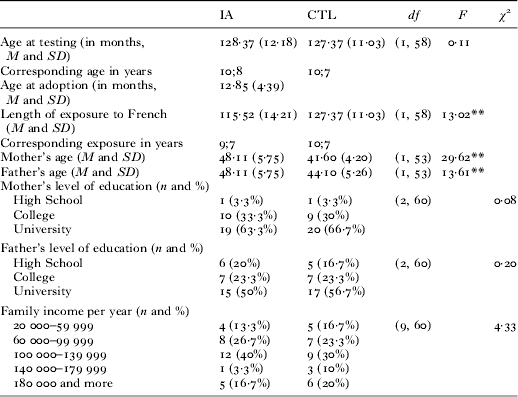
One-way independent groups analyses of variance (ANOVAs; α = .05) were carried out to compare the IA and the CTL children on age at the time of testing, mother's age, and father's age. Results in Table 1 indicate that the groups did not differ significantly in terms of their age at the time of testing and that the adoptive parents were significantly older than the parents of the non-adopted children. Chi-square tests (α = .05) performed to compare the groups on parental level of education and family income (see Table 1) revealed no significant differences on any of these variables, indicating that the groups were well matched.
Demographic data of the internationally adopted (IA) and monolingual French-speaking children (CTL)

notes: IA = internationally adopted children; CTL = non-adopted monolingual French-speaking children; ** p < .01.
General health and socio-emotional development
Parents were asked to provide information about their children's health status in the past as well as at the time of testing. The IA parents reported more health and/or developmental issues than the CTL parents for both time-points. It is, however, important to note that none of the participants were reported to have suffered from severe health or developmental issues at any time. At the time of testing, vision problems were the most commonly reported problems for both groups, even more so for the IA children (IA children: n = 11, CTL children: n = 5). Vision problems, such as myopia, had all been corrected by the time of testing. The IA children's higher incidence of vision problems corroborates results from Kleinstein et al. (Reference Kleinstein, Jones, Hullett, Kwon, Lee, Friedman, Manny, Mutti, Yu and Zadnik2003), who report that children of Asian descent have more vision difficulties than Caucasian children. Contrary to previous reports of relatively high rates of ADHD for IA children (Glennen & Bright, Reference Glennen and Bright2005; Lindblad, Ringbäck Weitoft & Hjern, Reference Lindblad, Ringbäck Weitoft and Hjern2010), only two IA children in the present study were diagnosed with ADHD, which falls in the normal range for children of this age (Glennen & Bright, Reference Glennen and Bright2005). Only one IA child was receiving treatment from a speech–language pathologist at the time of testing.
In terms of socio-emotional development, ANOVAs (α = .05) were performed to compare the groups on the internalizing and externalizing subscales of the CBCL as well as on their total scores. No significant differences were found on any of these scores (internalizing: F(1, 40) = 2·00, p = .17; externalizing: F(1, 40) = 2·35, p = .13; total: F(1, 40) = .62, p = .44). These results are in agreement with previous studies that have found that IA children from China are generally well adjusted and score within the normal range on standardized assessments of socio-emotional abilities (e.g., Delcenserie et al., Reference Delcenserie, Genesee and Gauthier2013; Tan & Marfo, Reference Tan and Marfo2006).
The children's performance on the CPT-II, a measure of ADHD, was compared using an ANOVA (α = .05). Results showed that there was no significant difference between the groups in terms of number of children presenting with a clinical profile of ADHD (F(1, 57) = 0·46, p = .50).
Assumptions
Because multiple statistical comparisons were carried out on the measures of non-verbal cognitive, language, and memory abilities, an alpha level of .01 was selected for all ANOVAs. The Levene test for homogeneity of variance revealed homogeneity of variance for all the variables (p > .05) while the Kolmogorov−Smirnov test of normality revealed normality for both groups on all variables (p > .05).
Non-verbal cognitive abilities
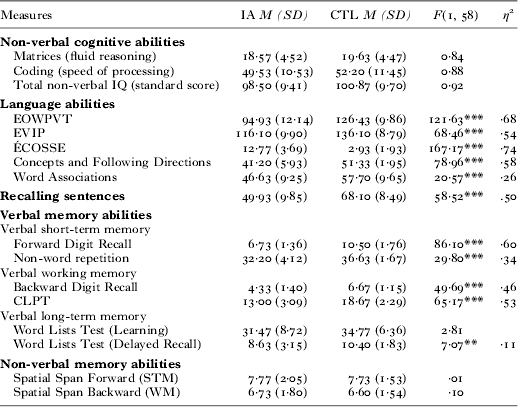
Comparisons between the IA and CTL children's performance on the Wechsler Non-Verbal IQ test revealed no significant differences between the groups on total non-verbal IQ score or on either of the subtests of the Wechsler Non-Verbal IQ test (see Table 2).
Test results (raw scores)
notes: IA = internationally adopted children; CTL = non-adopted monolingual French-speaking children; CLPT = Competing Language Processing Task; ÉCOSSE = Épreuve de Compréhension Syntaxico-Sémantique; EOWPVT = Expressive One-Word Picture Vocabulary Test; EVIP = Échelle de Vocabulaire en Images Peabody; STM = Short-Term Memory; WM = Working Memory; the raw scores for the ÉCOSSE represent the number of errors; ** = p < .01, *** = p < ·001.
Language development
The IA and CTL children's language abilities were compared using independent groups ANOVAs (α = ·01). Similar to previous findings reported by Gauthier and Genesee and by Delcenserie et al., the performance of the IA children on the EOWPVT, the EVIP, and the ÉCOSSE was significantly lower than that of the CTL children. The IA children also performed significantly lower than the CTL children on the Word Associations and the Concepts and Following Directions subtests. These results suggest not only that the IA children's lags in language found in our previous studies persist into the school years, but also that the differences between the two groups are still relatively large, as shown by the moderate and large effect sizes (see Table 2).
Memory abilities
Verbal memory
Statistical comparisons (ANOVAs; α = ·01) between the groups revealed that, as in past evaluations, the IA group scored significantly lower than the CTL group on the Recalling Sentences subtest. Also, the IA children scored significantly lower than the CTL group on both measures of verbal STM − Non-word Repetition and Forward Digit Recall. The IA children also scored significantly lower than the CTL children on the CLPT and the Backward Digit Recall subtest, two measures of verbal WM. Statistical comparison of the children's performance on the Learning subtest of the Word Lists Test indicated that the groups did not differ in terms of their ability to learn verbal material. However, the IA children's performance on the Delayed Recall subtest was significantly lower than that of the CTL children, suggesting that the IA children's memory difficulties extend beyond verbal STM and verbal WM to include verbal LTM (see Table 2).
Non-verbal memory
In contrast to their verbal STM abilities, IA children's performance on the Spatial Span Forward subtest did not differ significantly from that of the CTL children (see Table 2). Nor did the IA children differ from the CTL children on the measure of non-verbal WM (i.e., Spatial Span Backward subtest), suggesting that IA children's lags in memory are language-specific and not general in nature.
Comparisons with test norms
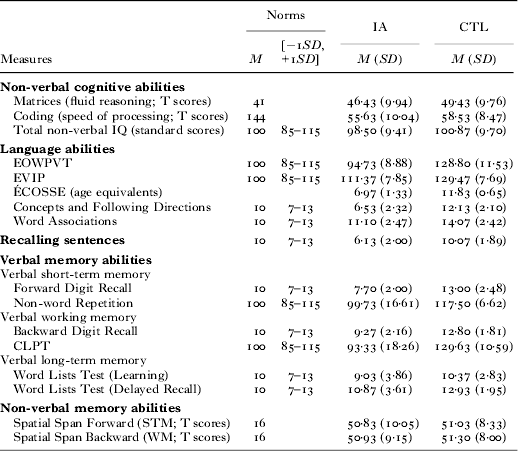
Table 3 summarizes the children's performance on each test of language and memory ability compared to test norms. Although standard scores were available for all the tests of language and verbal memory, this was not the case for the Wechsler Non-Verbal IQ subtests (Matrices, Coding, and Spatial span). The Wechsler Non-Verbal IQ test provides T scores which are included in Table 3. The results indicate that the IA children generally performed within age-appropriate levels on all measures, except on the Recalling Sentences and the Concepts and Following Directions subtest.
Average scores of IA and CTL children relative to language and non-verbal cognitive test norms
notes: ÉCOSSE = Épreuve de Compréhension Syntaxico-Sémantique; EOWPVT = Expressive One-Word Picture Vocabulary Test; EVIP = Échelle de Vocabulaire en Images Peabody; CLPT = Competing Language Processing Task; LTM = Long-term memory. All scores except where indicated otherwise are standard scores.
Distribution of IA children's language and memory test scores
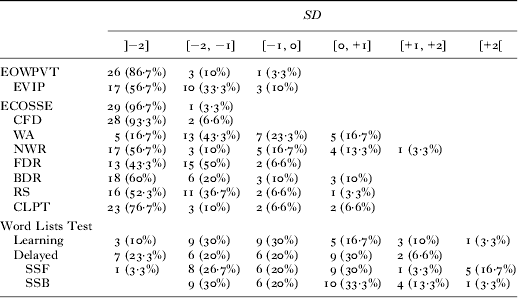
In order to better understand the IA children's results, the number of IA children who scored above and below the average of the CTL group in terms of standard deviations was calculated for each language and memory test. These analyses indicate that IA children's scores were substantially lower than those of the CTL children on most measures of language and verbal memory, and also that a substantial number of IA children performed more than 2 SDs below the mean of the CTLs (see Table 4).
Number and percentage (%) of IA children who scored above and below the mean of the CTL children on tests of language and memory abilities
notes: ÉCOSSE = Épreuve de Compréhension Syntaxico-Sémantique; EOWPVT = Expressive One-Word Picture Vocabulary Test; EVIP = Échelle de Vocabulaire en Images Peabody; CFD = Concepts and Following Directions subtest; WA = Word Associations subtest; NWR = Non-word Repetition; FDR = Forward Digit Recall; BDR = Backward Digit Recall; RS = Recalling Sentences subtest; CLPT = Competing Language Processing Task; SSF = Spatial Span Forward; SSB = Spatial Span Backward.
Comparisons of language and verbal memory abilities
In order to compare the IA children's performance on the memory and language tests, memory-adjusted scores of their language test results were calculated following the procedure used by Archibald and Gathercole (Reference Archibald and Gathercole2006). To do this, memory ages were calculated for each child using their raw scores on the Forward Digit Recall and Backward Digit Recall subtests separately (see Table 5). These two memory tests were used because they were the only tests for which norms for French-speaking Canadian children are available. Using the test manuals, we found the age equivalents corresponding to the children's scores on the Forward and Backward Digit Recall subtests; this was done for each child individually. These ages, instead of children's chronological ages at the time of testing, were then used to calculate the corresponding standard scores on the measures of language ability (referred to as ‘memory-adjusted standard scores’). Memory-adjusted standard scores were not calculated for the ÉCOSSE because this test offers age equivalents and not standard scores. Memory-adjusted standard scores were calculated for the EOWPVT using the norms available, which were based on English-speaking children, and thus caution is called for when interpreting these results.
Memory-adjusted standard scores on measures of language ability

notes: EOWPVT = Expressive One-Word Picture Vocabulary Test; EVIP = Échelle de Vocabulaire en Images Peabody; STM = Short-Term Memory; WM = Working Memory.
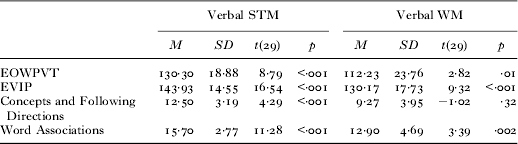
Memory-adjusted standard scores of 100 on the EOWPVT and the EVIP correspond to levels commensurate with verbal memory abilities; memory-adjusted standard scores below 100 indicate that language abilities are lower than memory abilities, and conversely for language scores above 100. Because the CELF-CDN-F uses different values as standard scores, the Concepts and Following Directions and the Word Associations subtests were compared to a mean standard score value of 10 instead of 100. For these subtests, memory-adjusted standard scores of 10 correspond to levels of language ability commensurate with verbal memory abilities, whereas memory-adjusted standard scores below 10 indicate that language abilities are lower than memory abilities.
The mean age corresponding to the IA children's performance on the Forward Digit Recall was 6;9, whereas their performance on the Backward Digit Recall was equivalent to 9;2, indicating that their verbal STM abilities were poorer their verbal WM abilities. The mean memory-adjusted language scores of the IA children are summarized in Table 5. To ensure clarity, in the remainder of this section we will refer to the Forward Digit Recall as a measure of verbal STM and to Backward Digit Recall as a measure of verbal WM.
The results suggest that the IA children's language scores were higher than their verbal STM and verbal WM scores or, alternatively, that their memory abilities were lower than their language abilities (see Table 5). One-sample t-tests were performed on the averaged memory-adjusted standard scores of each child for the EOWVPT, the EVIP, the Concepts and Following Directions, and the Word Association subtests against the expected value of 100 or 10, depending on the test. IA children's language abilities were all significantly higher than their verbal STM abilities, and also higher than their verbal WM abilities. The only exception was their performance on the Concepts and Following Directions subtest. The IA children's performance on this subtest was significantly above their verbal STM abilities, but not significantly different from their verbal WM abilities. This result is not surprising, given that IA children's performance on this subtest was particularly low, even below age norms, and the averaged age equivalent of their performance on verbal WM was relatively high.
Links between memory and language
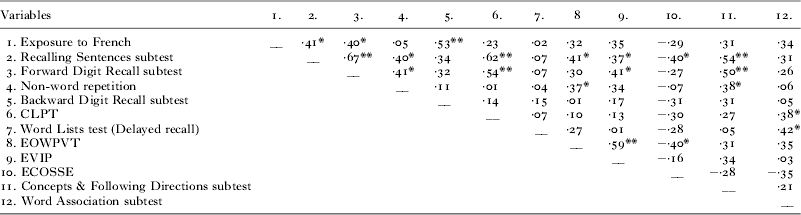
Bivariate correlations between measures of language and verbal memory abilities are presented in Table 6. Age at the time of adoption and non-verbal cognitive and memory abilities are not included in this matrix because they were not correlated with any of the measures of language and verbal memory. Age at the time of adoption was only significantly correlated with length of exposure to French (r = 0·58, p < .001). It is interesting to note that, similar to Delcenserie et al.'s results, the IA children's performance on the Recalling Sentences subtest was correlated with virtually all measures of language and verbal memory.
Correlation matrix
notes: ÉCOSSE = Épreuve de Compréhension Syntaxico-Sémantique; EOWPVT = Expressive One-Word Picture Vocabulary Test; EVIP = Échelle de Vocabulaire en Images Peabody; CLPT = Competing Language Processing Task; ** = p < .01, *** = p < .001.
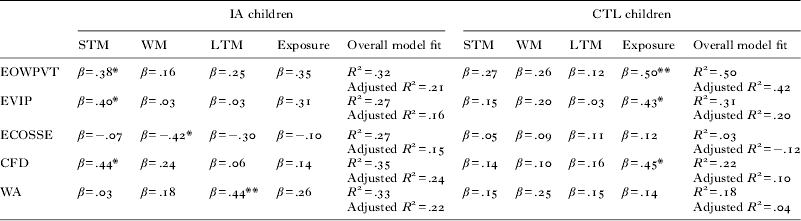
In addition, in order to examine possible links between the children's performance on the language and verbal memory tests, multiple regression analyses were performed using scores on the memory tests – verbal STM, verbal WM, and verbal LTM; see Table 7 for a summary of these analyses. In order to reduce the number of predictor variables in the analyses, composite predictor scores were created for verbal STM and verbal WM separately. To do this, scores on the tests of verbal STM and verbal WM were converted to z-scores, and then two composite scores were created, one composed of the average of the Non-Word Repetition test and the Forward Digit Recall subtest (verbal STM composite), and the other composed of the average of the CLPT and on Backward Digit Recall subtest z-scores (verbal WM composite). In the case of LTM, the predictor score was created by converting the scores the children obtained on the Word Lists Test into z-scores. Length of exposure to French was also included as a predictor, instead of age at the time of testing, because both variables were highly correlated (r = 0·96, p < .01), and also because length of exposure correlated significantly with language outcomes for IA children in our previous studies (Gauthier & Genesee, Reference Gauthier and Genesee2011). Of course, length of exposure to French is equivalent to the age of the CTL children at testing. Assumptions underlying the regression analyses were verified by looking at multicollinearity. Multicollinearity was examined by looking at tolerance values and variance inflation factors (VIF), which provide an estimate of the severity of multicollinearity. None of the tolerance values or VIFs approached levels indicating problems. Indeed, all tolerance values were above 0·724 (VIF = 1·38). Results presented in Table 7 indicate that the IA children's performance on the language measures was better predicted by their memory abilities, and their verbal STM abilities in particular, while the CTL children's performance on the same tests were more often predicted by their length of exposure to French, which, in their case, represents their age at the time of testing.
Results of the multiple regression analyses
notes: ÉCOSSE = Épreuve de Compréhension Syntaxico-Sémantique; EOWPVT = Expressive One-Word Picture Vocabulary Test; EVIP = Échelle de Vocabulaire en Images Peabody; CFD = Concepts and Following Directions subtest; WA = Word Association subtest; ** = p < .01, *** = p < .001.
DISCUSSION
The primary goal of the present study was to examine if IA children from China exhibit significant lags in verbal memory in comparison to non-adopted children, in addition to lags in language ability. To do this, we administered tests of verbal STM, verbal WM, and verbal LTM, along with tests of spatial STM and WM, to groups of matched IA and CTL children. A secondary goal was to ascertain whether language lags exhibited by IA children in the preschool and early school years persist into the middle grades of school.
As reported previously, the IA children in the present study scored significantly lower on most of the language tests than did the CTL children; including tests of expressive and receptive vocabulary, receptive grammar, concepts and following directions, and word associations. In contrast, the IA children did not differ from the CTL children with respect to general non-verbal cognitive ability and on a measure of socio-emotional adjustment. Thus, overall, the lags exhibited by the IA children appear to be language-specific. The present results corroborate the findings of previous studies indicating that IA children from China do not suffer from serious health or general developmental difficulties (Delcenserie et al., Reference Delcenserie, Genesee and Gauthier2013; Johnson, Banghan & Liyao, Reference Johnson, Banghan and Liyao1998).
The present study extends previous findings to show that the IA children also exhibited significantly poorer verbal memory abilities in comparison to matched non-adopted children. In fact, the IA children performed significantly lower than the CTL children on all measures of verbal memory: STM, WM, and LTM. In the case of STM and WM, the differences between the IA and CTL children were evident on two tests of each, indicating that their lags are not test-specific. There were no differences between the groups on the tests of spatial STM and WM, indicating that the IA children's lags in memory are language-specific and not domain-general. The present study is, to our knowledge, the first investigation to find this.
The present results are similar to those from a recent study by Eigsti et al. (Reference Eigsti, Weitzman, Schuh, De Marchena and Casey2011) on the language and cognitive abilities of IA children from Europe and Asia who were adopted by families in the US between age 0;2 and 7;0; the children had had, on average, six years of exposure to English. Similar to the present study, that study found between-group differences in language and memory abilities between the IA and non-adopted control children, and also that their memory and language scores were highly correlated. The present study extends Eigsti et al.'s results by showing that IA children have even longer-term lags in language. Moreover, in contrast to Eigsti et al., who used only a test of word recall to assess short- and long-term memory abilities, we conducted a more detailed evaluation of IA children's memory abilities. Eigsti et al. also found that the adoptees experienced cognitive control difficulties in comparison to the control children, and that their language and memory scores were correlated with age at the time of adoption. They argued that the association between age at the time of adoption and performance on these measures was related to the effects of stress related to institutionalization on brain development. In the present study, we did not find correlations between age at the time of adoption and either memory or language scores; nor did we find significant non-verbal cognitive differences between the IA and CTL children. In any case, arguably, the discrepancy in these two studies' results can be attributed to the relatively narrow range of age of adoption, and thus the relatively short length of institutionalization of the IA children in the present study in contrast to that of Eigsti et al.'s participants.
More detailed analyses of the children's performance on the tests of verbal memory and language indicated that their performance was well below that of the CTL children. In fact, a substantial percentage of IA children performed more than 2 SDs below the mean of the CTL group, specifically on measures of expressive and receptive vocabulary, receptive grammar, concepts and following directions, verbal STM, and verbal WM. That the IA children's results were so low probably reflects not only significantly lower performance by the IA children in comparison to the CTL children, but also the relatively high performance of the CTL children who were from families with relatively high SES. These results indicate that, despite performance that is generally age-appropriate, the IA children did not perform at the level that would be expected from children who benefited from exclusive exposure to French for almost ten years, and who were being raised in families with higher than average SES. It is important to note before proceeding that when IA children's scores on the language tests in the present study are compared to test norms, in general they fall within the normal range. This was true for all the tests except the Recalling Sentences and the Concepts and Following Directions subtests of the CELF-CDN-F. Caution is called for when using these results since the norms for some of these tests (i.e., Expressive One-Word Picture Vocabulary Test, Competing Language Processing Task, and Non-word Repetition test) were not based on the performance of French-speaking children, but rather English-speaking children. Nevertheless, these results are important because they indicate that the lags in language and memory exhibited by the IA children are probably not indicative of clinically significant differences.
Further detailed examination of the IA children's results indicated that their verbal memory abilities were lower than their language abilities. If, as we conjecture, their language abilities are dependent on their verbal memory abilities, one might have expected their language and verbal memory results to be on par. While we have no definitive explanation for the discrepancy in these results, it could be that the IA children have compensated for memory difficulties using compensatory language-learning strategies. We also found that, in contrast to the CTL children, the IA children's verbal memory scores, and their verbal STM scores in particular, were better predictors of their language scores than was length of exposure to French. Length of exposure has often been found to be a significant correlate of IA children's language development, at least at younger ages (e.g., Gauthier & Genesee, Reference Gauthier and Genesee2011). It is important to note that, in the present study, length of exposure to French and age at adoption are probably confounded. Our findings with respect to STM are particularly interesting in light of previous research indicating that the influence of verbal STM on language abilities decreases with age. More specifically, Gathercole et al. (Reference Gathercole, Willis, Emslie and Baddeley1991) found that while verbal STM is a significant predictor of typically developing children's vocabulary acquisition until four to five years of age, a shift is subsequently observed such that vocabulary knowledge becomes a better predictor of verbal STM. Moreover, after eight years of age, no significant association between these variables is usually found (Gathercole et al., Reference Gathercole, Willis, Emslie and Baddeley1991). This contrasts with the present findings, where the IA children's verbal STM abilities, even between ages nine and twelve, still predicted their language abilities, including their lexical and general language development. Although it might be inferred that IA children's language difficulties arise because of sentence memory difficulties, as could be the case for the ÉCOSSE and the Concepts and Following Directions tests, this does not explain why they also scored lower on tests that assessed word-related language skills, such as the EOWPVT, the EVIP, and the Word Association subtest.
That the IA children may have particular difficulties with verbal STM is compatible with the tenets of Baddeley's multi-component model of working memory (Baddeley, Reference Baddeley2000). In this model, verbal STM is thought to be involved specifically in the short-term storage of verbal material, whereas the central executive, a domain-general component that is involved in higher-level mental processes, is thought to work in combination with verbal STM during the performance of tasks that involve the simultaneous storage and manipulation of verbal material. Thus, tasks that assess verbal WM involve verbal STM for short-term storage of information, and the central executive for mental processing. Similarly to verbal WM, tasks that assess non-verbal WM are thought to involve both non-verbal STM (also called visuo-spatial sketchpad, a component equivalent to verbal STM that is involved in the short-term storage of non-verbal material) as well as the central executive. That the IA children's performance on Backward Spatial Span, a test of non-verbal WM, was similar to that of the CTL children would suggest that they do not have difficulty with the ‘executive’ component of WM but rather with the STM component. Thus, the lags in verbal WM exhibited by the IA children in comparison to the CTL children in the present study arguably reflect difficulties with verbal STM. The present results are not unlike those of Rescorla (Reference Rescorla2002), who found that children who had been identified as late talkers at the age of 2;0 to 2;7 had reading and language difficulties at the age of nine as well as weaknesses in areas that subserve language, such as word retrieval and verbal working memory.
Taken together, these findings raise the possibility that the lags in language ability exhibited by the IA children, and their negatively skewed distribution relative to the CTL children, implicate lags in verbal memory, a possibility put forward by Delcenserie et al. While admittedly speculative, this explanation, if valid, raises the question of why the IA children have difficulties with verbal STM. Adverse effects associated with their pre-adoptive environments seem unlikely insofar as their non-verbal cognitive abilities, their attention, and their socio-emotional development are on par with those of the non-adopted controls. This possibility cannot be ruled out completely, however, as very little is known about IA children's pre-natal and pre-adoption living conditions; but, the present results are in line with those of previous studies that have found that, in general, IA children from China do not suffer from general health or developmental difficulties post-adoption (Johnson et al., Reference Johnson, Banghan and Liyao1998; Pomerleau et al., Reference Pomerleau, Malcuit, Chicoine, Séguin, Belhumeur, Germain, Amyot and Jéliu2005). Amount of exposure to French also seems an unlikely explanation, insofar as, at the time of the present testing, the IA children had had more than 9·5 years of exposure to French, sufficient for them to achieve levels of language and verbal memory abilities that were, in general, within age-expected levels.
Alternative explanations of the IA children's verbal STM results may be linked to termination of the birth language and/or delayed onset of exposure to the adoption language. With respect to L1 termination, it has been found that infants begin to tune into, retain, and learn phonological distinctions in the L1 within the first year of life (Kuhl, Reference Kuhl2000; Werker & Tees, Reference Werker and Tees1999), and that these early developments have consequences for later language and cognitive development (Fernald, Perfors & Marchman, Reference Fernald, Perfors and Marchman2006; Marchman & Fernald, Reference Marchman and Fernald2008). In fact, it would appear that it is development of phonological representations of the birth language that facilitates or underpins the development of verbal STM and language development in general in L1 learners (Kuhl, Reference Kuhl2000). With respect to the present results, arguably, termination of the birth language stunts or delays the development of phonological representations and verbal STM of the birth language and, in turn, subsequent language learning. Thus, termination of L1 acquisition may explain the relatively poor verbal STM abilities exhibited by the IA children in the present study post-adoption.
Delayed exposure to the adoption language might also play a role in explaining the present results insofar as there is evidence, reviewed earlier, that STM abilities are sensitive to age of L2 acquisition (e.g., French & O'Brien, Reference French and O'Brien2008; Masoura & Gathercole, Reference Masoura and Gathercole2005). To repeat, Vejnovic et al. (Reference Vejnovic, Milin and Zdravkovic2010) found that Hungarian students who acquired Serbian as an L2 at the age of four had significantly better verbal WM abilities than students who acquired the same L2 at age nine, even when the effect of verbal WM abilities in the L1 was controlled for.
While these explanations are consistent with our findings that IA children exhibit lags in both verbal memory and language ability relative to matched control children, they remain speculative and require additional evidence for corroboration. Moreover, termination of the birth language and delayed exposure to the adoption language are confounded in the present study so that it is impossible to tease apart the relative role of each. It is possible to disentangle these two factors by studying infants who begin to acquire an L2 at the same ages as the IA children but retain their L1. This study is currently in progress in our laboratory. This study could also shed light on the impact of L2 acquisition in typical L2 learners who do not lose their L1 on their verbal memory abilities, raising the possibility that any lag in exposure to an additional language incurs lags in verbal memory relative to monolingual native speakers.