INTRODUCTION
Crop seedbeds in many areas of the world are prepared without the inversion of the top layer of soil by mould board plough (Allmaras & Dowdy Reference Allmaras and Dowdy1985; Cannell Reference Cannell1985; Hobbs Reference Hobbs2007). The main benefits and advantages of this minimum tillage (MT) system of cultivation have been referred to by Kennedy et al. (Reference Kennedy, McDonald, Connery and Purvis2010). Interest in MT in Europe is due in part to recent smaller financial returns for tillage crops (Davies & Finney Reference Davies and Finney2002). In Ireland, the higher work rates and lower costs associated with MT are among the reasons for its adoption by growers (Fortune et al. Reference Fortune, Kennedy, Mitchell, Dunne, Murphy, Connery and Grace2005). Because MT crops need to be sown and established in good conditions, their sowing date in autumn needs to be much earlier than conventionally tilled (CT) crops. However, the earlier cereal seeds are sown in autumn, the greater is the risk of infection with barley yellow dwarf virus (BYDV). This worldwide disease, which can only be transmitted by the feeding activity of aphids (Rochow Reference Rochow1960; Plumb Reference Plumb, Plumb and Tresh1983; Henry et al. Reference Henry, George, Arnold, Dedryver, Kendall, Robert and Smith1993; Power & Gray Reference Power, Gray, D'Arcy and Burnett1995), can cause major reductions in grain yields. Yield reductions in excess of 2 tonnes (t)/ha for wheat and oats and up to 5 t/ha for winter barley have been reported due to naturally occurring BYDV infection, mainly comprising PAV and RPV strains (Plumb Reference Plumb1977; Barrett et al. Reference Barrett, Northwood and Horellou1981; Kendall & Smith Reference Kendall and Smith1981; Bayon & Ayrault Reference Bayon, Ayrault and Burnett1990; Miles et al. Reference Miles, Bluett, Mann and Biddle2001; McKirdy et al. Reference McKirdy, Jones and Nutter2002). BYDV in Ireland is almost exclusively the MAV strain and is predominantly vectored by the grain aphid Sitobion avenae (F.); it has been shown to reduce grain yields of winter barley by up to 3·4 t/ha (Kennedy & Connery Reference Kennedy and Connery2001).
Control of BYDV depends on prevention of infection by viruliferous aphids which, to date, is mainly achieved by means of foliar insecticide sprays applied post crop emergence. Investigations by Kennedy & Connery (Reference Kennedy and Connery2001) showed that cereals sown in early September required an insecticide spray at Zadoks plant growth stage (GS) 22 (Zadoks et al. Reference Zadoks, Chang and Konzak1974) and again at GS 25 (Tottman et al. Reference Tottman, Makepeace and Broad1979). Early investigations into the use of imidacloprid as a seed-applied insecticide by the developer (Bayer plc) indicated that the product was highly effective in controlling BYDV in winter barley (Bluett & Birch Reference Bluett and Birch1992; Knaust & Poehling Reference Knaust and Poehling1992). Further investigations by the developer (Miles et al. Reference Miles, Bluett, Mann and Biddle2001) indicated that, in the case of early autumn-sown crops, the seed treatment was as effective in controlling BYDV as a pyrethroid-type foliar spray applied at GS 22–23. The availability of an insecticide seed treatment giving similar control of BYDV to that of a spray treatment in early sown crops offered advantages to growers including MT practitioners. Principally it eliminates the time input required to apply a foliar spray, thus enabling growers to continue with other tasks such as the sowing and harvesting of crops, including the sugar beet crop which was grown in Ireland until 2006. A further attraction to growers was the cost of the seed treatment. In the case of winter barley, the cost was considerably less than that for applying a spray treatment (hire price for spraying plus cost of insecticide), while in the case of winter wheat it was marginally less. The objective of the present investigation was to test the hypothesis that a nitroguanidine-type seed-applied insecticide would give similar control of BYDV and its aphid vectors to that provided by a pyrethroid-type foliar spray applied post-crop emergence. Investigations into the use of seed applied insecticide for the control of BYDV in MT systems of cultivation have not been reported. Confirmation of the hypothesis would provide empirical data to growers to enable them decide on their strategy for controlling BYDV.
MATERIALS AND METHODS
Experimental design
A split plot experimental design was used. MT and CT strips, each 24×92 m (main plots), were sown with winter barley from 2001 to 2003 and with winter wheat from 2004 to 2006. Strips of each system of cultivation were randomized within each of the four adjacent blocks. Strips were split such that one-half (12×92 m), randomly selected, was sown with insecticide-treated seed while the remaining half was sown with untreated seed. Strips were divided transversely so that each strip comprised three plots, each 12×30 m. A fallow border 0·5 m wide surrounded each plot. Plots of barley were randomly selected within each strip so that one treatment comprised an insecticide spray at GS 22–23 (Tottman et al. Reference Tottman, Makepeace and Broad1979) (last week of September to first week of October) and again at GS 25–26 (first week of November). A second treatment received a single insecticide spray at GS 25–26, while the third was untreated. MT and CT wheat grown from seed not treated with insecticide received the same insecticide spray treatments as MT and CT barley. In the case of MT and CT wheat grown from insecticide-treated seed, the three treatments compared were: (i) a single spray at GS 22, (ii) a single spray at GS 25 and (iii) an unsprayed control. The effect of method of cultivation, seed and spray treatments on autumn aphid infestation and incidence of BYDV in spring were measured. The effects of treatments on tiller density of wheat, prior to harvesting, were also measured.
Insecticides
The seed treatment used on winter barley was Raxil-Secur, applied at 150 ml per 100 kg of seed. Raxil is a fungicide combination of tebuconazole (20 g a.i./l) and triazoxide (20 g a.i./l); Secur is the insecticide imidacloprid (233 g a.i./l). The seed treatment on winter wheat in 2004/05 and 2005/06 was Sibutol–Secur, applied at 150 ml/100 kg of seed; however, in 2006/07, this treatment was withdrawn by the manufacturers and replaced with Redigo–Deter, which was applied at 200 ml/100 kg of seed. Sibutol contained the fungicides bitertanol (140 g a.i./l) and fuberidazole (8·6 g a.i./l), while Secur is the insecticide imidacloprid (87·5 g/l). Redigo–Deter contains the fungicide prothioconazole (Redigo) (50 g a.i./l) and the insecticide clothianidin (Deter) (250 g a.i./l). Each season, the seed not treated with insecticide had the same fungicide combination as that for the insecticide treated seed. The insecticide spray used throughout was the contact pyrethroid Sumi-alpha (esfenvalerate 25 g a.i./l), applied at 165 ml/ha.
Site and soil
Trials were conducted in the ‘Road Field’ at Oak Park, Carlow (52°51′N, 6°55′W, 56 m a.s.l.; 30-year average annual rainfall 790 mm). The trial site soil type is described as Baggotstown–Carlow Complex. This is a moderately deep, free-draining brown earth derived from limestone gravels with sandy loam texture and low moisture-holding capacity being prone to drought in dry periods (Conry & Ryan Reference Conry and Ryan1967). The preceding crops on the site were three spring barleys, prior to which was winter barley, which was preceded by a grass ley.
Cultivations
MT comprised two passes with shallow tine cultivation without soil inversion within one week of harvesting the preceding crop. A trailed Horsch FG 7·5 m cultivator with wide sweep shares was used in 2001. Subsequently, a similar type mounted Horsch Terrano 3 FX 3 m cultivator was used. Cultivation depth was c. 75 mm. Cultivation was followed by rolling (one pass) with a Cambridge-type roller (Vaderstad Rollex 620, 2500 kg and 6·2 m). CT comprised ploughing, 200–250 mm deep, with a Kverneland ES 80 4-furrow reversible plough. Soil was cultivated (one pass) with a rotary-powered harrow and crumbler roller (Lely Roterra 2·5 m) immediately prior to sowing. Cultivation depth was 100–120 mm. Plots were sown with a trailed Vaderstad Rapid 300 S disc cultivator drill, 3 m wide with drill spacing of 125 mm. Sowing depth was 40 mm. Plots were again rolled (one pass) after sowing.
Husbandry
The herbicide Sting (4 litres/ha; glyphosate 120 g a.i./l) was applied to vegetation in the days prior to cultivation. Barley was sown on 12 September 2001 and 10 September 2002 and 2003. The barley cultivar sown in 2001 and 2002 was Regina; however, this was not available in 2003 and was replaced by the cvar Pearl. Wheat was sown on 17, 6 and 15 September in 2004, 2005 and 2006, respectively; the cultivar Claire was used in 2004 and 2005 but, being unobtainable in 2006, was replaced by cvar Einstein. The two barley and two wheat cultivars were considered not to differ, within species, either in their impact on aphid infestation or subsequent virus infection. This was based on unpublished work (T. F. Kennedy & J. Connery) which showed that, unlike the cultivars used here, only those cultivars that differed in their vegetative growth habit differed in aphid infestation levels and virus incidence. The herbicides Trump, 5·5 litres/ha (isoproturon 236 g a.i./l+pendimethalin 236 g a.i./l) and Cougar 2 litres/ha (diflufenican 100 g a.i./l+isoproturon 500 g a.i./l) were applied post-crop emergence in the autumn. Standard fertilizer and fungicide treatments were applied to crops as detailed by Kennedy et al. (Reference Kennedy, McDonald, Connery and Purvis2010).
Aphid sampling and identification
Aphid sampling was carried out in the autumn (post-GS 25) using a vacuum insect net (D-vac; Dietrick Reference Dietrick1961), fitted with a 0·0929 m2 sampling cone. Samples consisted of 10 sub-samples per plot, taken at random, each of 15 s duration. Monitoring of vegetation for aphids either before or following desiccation with herbicide, preceding cultivation, was not undertaken. Aphids on wheat heads were recorded in early July by examining 10 randomly selected heads, in situ, per plot. The keys of Stroyan (Reference Stroyan1952), Prior (Reference Prior1975) and Taylor et al. (Reference Taylor, Palmer, Dupuch, Cole, Taylor and Taylor1981) were used to identify aphids.
BYDV
Cereal leaves (10–15) were collected for virus testing at five separate locations per plot, for each treatment and replicate, at GS 41–43 to determine the strain of virus present. Sampling locations were at intervals of 5 m on the longitudinal axis 3 m from the plot's edge (southern side). Sap was extracted from 1 g of leaf sample and tested for MAV and a 50∶50 mixture of PAV and RPV-type viruses using TAS-ELISA (Neogen® Europe Ltd). Samples were considered positive when their spectrophotometer reading (405 nm) was 3-fold greater than the mean value of negative controls. The proportion of BYDV in each cereal plot was determined by counting tillers with and without symptoms in each of four quadrats per plot. Symptoms were recorded using quadrats of 0·25 m2 at equidistant positions on the longitudinal axis of plots at GS 43–49 for barley and GS 55–59 for wheat.
Harvesting
Harvesting was by means of a modified Deutz-Fahr 3370 combine harvester (Modifications by Trials Equipment Ltd, Essex, UK). A strip 2·3×30 m was harvested in each plot when grain dry matter (DM) content reached 800 g/kg fresh weight (FW), and yields recorded. Grain moisture was measured in a hot-air oven at 90°C for 16 h. Yields were adjusted to 850 g DM/kg FW for analysis.
Data analysis
Data were analysed using Analysis of Variance for a split–split–plot design in blocks (PROC MIXED) (SAS 2004). The model had terms for cultivation method, seed treatment and spray treatment and all interactions of these terms (two-way and three-way). Blocks were included as a fixed effect, while block×cultivation method and block×cultivation method×seed treatment were incorporated as random effects to provide the correct error terms for tests of the main and sub-plot factors. Pre-specified hypotheses were tested at P⩽0·05. Subsequently, all pair-wise comparisons were made and these were considered significant where Tukey–Kramer adjusted P values were less than 0·05. Aphid numbers were log transformed and virus incidence arcsin transformed for data analysis. Residual checks showed that the assumptions of the analysis were not violated.
RESULTS
Aphids
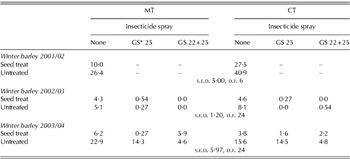
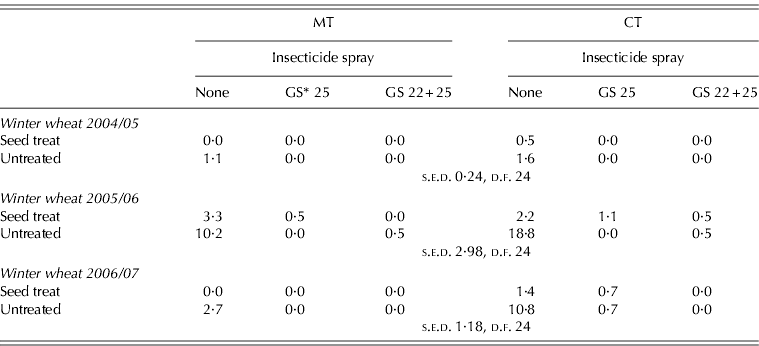
The aphid density/m2 on insecticide-untreated conventionally drilled cereals in autumn (post-GS 25) in the period 2001–2006, respectively, were 41, 8, 16, 2, 19 and 11. The mean weekly aphid density/m2 recorded at nearby observation plots during October for a period of 22 seasons (1989–2010) was 25. The mean autumn aphid species composition on winter barley in the three seasons showed that Rhopalosiphum padi comprised 0·63 of the total aphids found, Sitobion avenae 0·25, Metopolophium dirhodum 0·05 and unidentified 0·07. By late April the species composition was S. avenae 0·71, M. dirhodum 0·24, R. padi 0·04 and unidentified 0·01. The aphids on winter wheat in autumn 2004–06 were S. avenae 0·68, M. dirhodum 0·10, R. padi 0·09 and unidentified 0·13. Averaged over the six seasons, 0·76 of aphids on crops between GS 22 and 25 were wingless (range 0·5–1); post-GS 25 at least 0·95 were wingless. Aphid numbers for the various treatments are shown in Tables 1 and 2. Numbers of aphids, as measured in untreated control plots, were lower in MT compared with CT crops in five of the six seasons, but the reductions were significant only for barley in 2001 (P<0·05) and wheat in 2006 (P<0·01).
The number of aphids/m2 in D-vac samples, on insecticide sprayed and unsprayed winter barley sampled post GS 25, autumn 2001, 2002 and 2003

* GS, plant GS.
The number of aphids/m2 in D-vac samples, on insecticide sprayed and unsprayed winter wheat sampled post GS 25, autumn 2004, 2005 and 2006
* GS, plant GS.
Note: Crops from treated seed received a single insecticide spray only at GS 22.
Autumn aphid infestations in foliar sprayed plots were not measured in 2001. A single foliar spray at GS 25 significantly (P<0·001) reduced aphid numbers in both MT and CT crops when compared with untreated controls for MT and CT barley in 2002, MT and CT wheat in 2005 and CT wheat in 2006. There were no significant differences in aphid numbers between single and double sprays in either barley or wheat.
Insecticide seed treatment significantly reduced aphid numbers in MT and CT barley and wheat compared with the untreated controls only for MT barley in 2001 (P<0·05) and CT wheat in 2005 (P<0·001) and 2006 (P<0·01).
In 2002, the single foliar spray at GS 25 significantly reduced the number of aphids on MT (P<0·01) and CT (P<0·001) barley compared with the insecticide seed treatment. However, in 2003, when aphid numbers were higher, there was no significant difference in aphid numbers between the seed treatment and the single spray. The seed and the single foliar spray treatments did not differ significantly with regard to the control of aphids in MT and CT wheat. However, aphid numbers were either low or absent in many of these treatments.
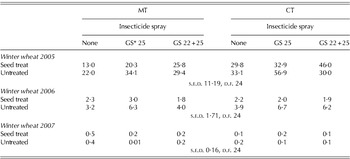
The numbers of aphids (Sitobion avenae (F.)) on wheat heads in early July 2005–2007 are given in Table 3. In 2005, when aphids were plentiful, MT wheat had 0·33 fewer aphids than CT wheat. Cultivation method, seed and spray insecticide treatments did not significantly reduce aphid numbers. Similar results were recorded in July 2006.
The number of aphids per wheat head in early July, 2005–2007

* GS, plant growth stage.
Note: Crops from treated seed received a single insecticide spray only at GS 22.
BYDV
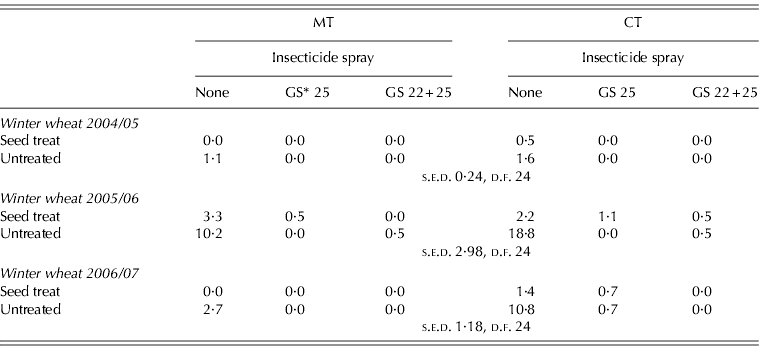
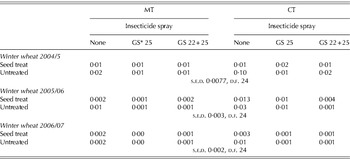
BYDV occurrence, measured at GS 43–49, was widespread in 2002, moderate in 2003–05 and was low in 2006 and 2007. The proportions of tillers with BYDV symptoms for the various treatments are shown in Tables 4 and 5. Similar to aphid numbers, the incidence of BYDV, as measured in untreated controls, was lower for MT compared with CT in five of the six seasons. The differences were significant in 2002 (P<0·001) and 2005 (P<0·01). The greatest difference in BYDV incidence between the two methods of cultivation was recorded in 2002, the season in which the most severe outbreak of the disease occurred. In 2002, the proportion of MT barley tillers having virus symptoms was 0·14, while that for the CT crop was 0·44.
The proportion of BYDV, at GS 43–49, in winter barley 2001–2003

* GS, plant growth stage.
Note: Crops from treated seed received a single insecticide spray only at GS 22.
The proportion of BYDV, at GS 43–49, in winter wheat 2004–2006

* GS, plant growth stage.
Note: Crops from treated seed received a single insecticide spray only at GS 22.
A single foliar spray significantly reduced the incidence of BYDV in both MT and CT crops compared with untreated controls for MT and CT barley in 2002 and 2004 (P<0·001), CT barley in 2003 (P<0·001) and CT wheat in 2005 (P<0·001) and 2006 (P<0·05). There was no significant difference in BYDV disease levels between MT and CT barley sprayed with a single foliar insecticide and crops receiving two sprays. The incidence of BYDV was too low in MT wheat to make valid comparisons either between single sprays and untreated controls or between single and double spray treatments.
The insecticide seed treatment reduced the incidence of BYDV in five of the six seasons for MT crops and in all six seasons for CT crops. These reductions were significant for MT barley in all three seasons (P<0·001, 2002 and 2004; P<0·05, 2003), for CT barley in 2002 (P<0·001) and for CT wheat in 2005 (P<0·001). In the season when BYDV was widespread (2002), the proportions of tillers with the disease were 0·44 for insecticide-untreated CT barley but only 0·03 for CT barley grown from insecticide-treated seed. In general, the insecticide seed treatment reduced the incidence of BYDV in CT barley by 32–93% when compared with untreated barley, and by 55–94% for MT barley.
The single insecticide spray resulted in significantly (P<0·001) lower incidence of BYDV when compared with the seed treatment in MT barley in 2004 and in CT barley in 2003 and 2004. In other seasons, there were no significant differences between these treatments.
The serological examination of leaf-tissue samples (240 samples/season) for BYDV showed 0·36 tested positive for MAV and less than 0·001 positive for a mixture of PAV and RPV strains of virus. As might be expected, the prevalence of samples positive for virus in the various treatments paralleled that recorded for virus symptoms in quadrat measurements (r=0·814, d.f.=11, P=0·001).
Wheat tiller density in each of the three seasons did not differ significantly between insecticide-untreated plots and those receiving either a seed or spray treatment. However, seed treated MT and CT wheat had 9% and 5% fewer tillers, respectively, when compared with untreated seed.
Grain yield
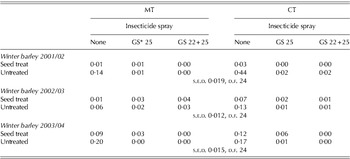
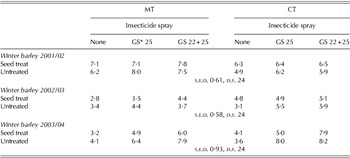
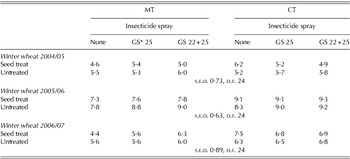
The grain yields for the various treatments are given in Tables 6 and 7. The grain yields for insecticide untreated MT barley and wheat did not differ significantly from that for CT crops in any season. However, in 2002, when BYDV was significantly greater in CT barley than in MT barley, the grain yield for MT barley was 25% greater than that for CT barley.
Grain yields, t/ha, Winter barley, 2002–2004

* GS, plant growth stage.
Note: Crops from treated seed received a single insecticide spray only at GS 22.
Grain yields, t/ha, Winter wheat, 2005–2007

* GS, plant growth stage.
Note: Crops from treated seed received a single insecticide spray only at GS 22.
The single spray at GS 25 significantly (P<0·01) increased grain yield in CT barley in 2003 and 2004. The increases in yield for sprayed barley over unsprayed were 26, 81 and 123%, respectively, for 2002, 2003 and 2004. The corresponding values for MT barley were 30, 32 and 55%. In wheat, the single spray did not significantly improve grain yield relative to untreated wheat in the three seasons of the study for CT and MT crops. The grain yields for both MT and CT barley and MT and CT wheat treated with either one or two sprays did not differ significantly.
The seed treatment did not significantly improve grain yield, relative to that for untreated seed, for either barley or wheat cultivated by MT or CT systems of cultivation even though grain yields were 12–56% higher for CT barley and 10–19% higher for CT wheat. Seed-treated MT crops had a lower grain yield than untreated crops in five of the six seasons of the study.
The single insecticide spray resulted in significantly greater grain yields for MT barley compared with yields for seed treated crops in barley in 2004 (P<0·05). The single insecticide spray also gave significantly (P<0·01) greater grain yields for CT barley in 2004, relative to that for the seed treatment. Again in 2004, MT and CT barley treated with two insecticide sprays had significantly (P<0·001 and P<0·01, respectively) greater grain yields relative to seed treated barley.
DISCUSSION
Aphids
In general, aphids on insecticide-untreated barley and wheat in autumn were fewer on the MT than the CT crops and were significantly so in 2001 and 2006. The finding of fewer aphids on MT relative to CT cereal crops is in accordance with the findings of Kennedy et al. (Reference Kennedy, McDonald, Connery and Purvis2010), who recorded significant differences in aphid infestations between these two methods of cultivation with fewest aphids on MT crops. Kendall et al. (Reference Kendall, Chinn, Glenn, Wiltshire, Winstone, Tidboald, Glenn, Greaves and Anderson1995) also recorded fewer aphids on non-ploughed winter cereal plots relative to those on CT. Among the earlier workers to record an effect of method of cultivation on aphid infestation of cereals were Burton & Krenzer (Reference Burton and Krenzer1985). These found the aphid Schizaphis graminium (R.) was less abundant in plots of winter wheat of reduced/conservation tillage with surface residues when compared with conventionally cultivated plots where residues were low. In contrast with the above results, Sempruch et al. (Reference Sempruch, Starczewski and Tkaczuk2007) found greater densities of S. avenae and R. padi on triticale grown on reduced tillage systems in Poland, relative to CT. In the USA, Quisenberry et al. (Reference Quisenberry, Schrotzko, Lamb and Young2000) found that tillage method had only limited impact on aphids in winter wheat and spring barley. In the case of spring wheat and barley, Hesler & Berg (Reference Hesler and Berg2003) found R. padi more abundant in plots with no pre-sowing tillage than in plots receiving pre-sowing tillage, in south Dakota, and attribute this to increased surface residues providing a favourable microclimate for this aphid which is known to prefer to feed on the lower leaves and stems of cereals (Dean Reference Dean1973, Reference Dean1974; Plumb Reference Plumb, D'Arcy and Burnett1995; Gianoli Reference Gianoli2000; Qureshi & Michaud Reference Qureshi and Michaud2005). Based on the immigration of winged aphids into small-scale plots receiving different amounts of straw to the soil surface (McDonald Reference McDonald2007), Kennedy et al. (Reference Kennedy, McDonald, Connery and Purvis2010) concluded that differences in aphid infestation levels between CT and MT crops was mainly due to immigration of winged aphids, which in turn was influenced by differences in the visual cues between the two crops. Stubble trash associated with MT was considered less inviting to flying aphids than CT crops exhibiting green foliage against a darker soil background. The normal pattern of aphid occurrence in cereals in autumn in Ireland is that winged immigrants give rise to wingless progeny, which comprise at least 0·95 of the population by GS 25. The spread of BYDV (MAV-type) depends on the multiplication and dispersal, principally, of S. avenae aphids. The extent to which beneficial predators reduce aphid numbers and the impact of cultivation systems on predators is not fully known. Separate investigations by the authors suggest that while the numbers of larger species of carabid beetles, e.g. Pterostichus melanarius, are reduced by CT relative to MT, smaller species, e.g. Bembidion species, are unaffected. Bembidion obtusum, which is active and plentiful in Irish cereal fields throughout the winter, is known to prey on cereal aphids (Kennedy Reference Kennedy1994). Of the carabids (adults and larvae) captured in adjoining plots between October 2004 and April 2005, 0·15 tested positive for aphid DNA (McDonald, personal communications); however, the extent of predation on aphids in each system of cultivation was not measured.
MT and CT barley sprayed with insecticide at GS 22 and again at GS 25, in 2003, had a mean autumn infestation of 4·7 aphids/m2 compared with 14·4 aphids/m2 on MT and CT barley sprayed only at GS 25. While this difference was not statistically significant, it nevertheless indicates that most of the aphid control in this season was provided by the spray at GS 22. Kennedy & Connery (Reference Kennedy and Connery2001) also found that in some seasons of high aphid occurrence there was a significant advantage for applying two insecticide sprays, one at GS 22 and another at GS 25, to conventionally cultivated barley sown in early September. However, as stated earlier, Kennedy et al. (Reference Kennedy, McDonald, Connery and Purvis2010) found aphids were significantly fewer in early-September sown MT crops when compared with CT crops. The likelihood of lower aphid populations in MT cereals and the efficacy of a single insecticide spray at GS 25 in controlling aphids indicate this treatment is sufficient to control these pests in MT cereals.
While the imidacloprid insecticide seed treatment reduced autumn aphid infestations of wingless aphids by substantial amounts relative to that for untreated seed differences were significant for only three of the 12 comparisons. Those recording significantly fewer aphids for the seed treatment were MT barley in 2001 and CT wheat in 2005 and 2006. The general low occurrence of aphids in five of the six seasons militated against greater differences in aphid numbers being recorded between seed treated and untreated cereals. MT and CT barley plots sprayed with insecticide in 2002 had significantly fewer aphids relative to untreated plots, while the difference in aphid numbers between seed treated MT and CT barley and untreated barley was not significant. Similar comparisons in the remaining seasons did not differ by a significant amount. In winter wheat and spring oats, Gray et al. (Reference Gray, Bergstrom, Vaughan, Smith and Kalb1996) recorded significant reductions in aphid populations due to seed treated with imidacloprid relative to untreated seed. These workers recorded significant reductions in the longevity of aphids on treated relative to untreated plants and also noted that aphids on treated plants failed to produce viable progeny. Imidacloprid does not bring about a rapid decrease of cereal aphids, according to Knaust & Poehling (Reference Knaust and Poehling1992), but continues to reduce numbers over a prolonged period of several weeks. However, Bluett & Birch (Reference Bluett and Birch1992) considered imidacloprid as highly effective in controlling aphid vectors of BYDV and Royer et al. (Reference Royer, Giles, Nyamanzi, Hunger, Krenzer, Elliott, Kindler and Payton2005) also reported its effectiveness in controlling aphids. Overall, aphid control by the insecticide seed treatment, while substantial, was nevertheless insufficient; in the case of both MT and CT barley in 2002 it was significantly less effective than an insecticide spray at GS 25. Thus, the results do not support the hypothesis that treating cereal seed with a nitroguanidine insecticide would be as effective as a foliar insecticide spray in controlling aphids in autumn, particularly on MT crops.
BYDV
The finding of significantly lower incidence of BYDV in insecticide untreated MT barley and wheat, relative to CT crops reinforces the findings of Kendall et al. (Reference Kendall, Chinn, Smith, Tidboald, Winstone and Western1991, Reference Kendall, Chinn, Glenn, Wiltshire, Winstone, Tidboald, Glenn, Greaves and Anderson1995) and Kennedy et al. (Reference Kennedy, McDonald, Connery and Purvis2010). The latter authors, while confirming a positive relationship between aphid abundance on crops in autumn and the prevalence of BYDV subsequently in these crops, attributed the lower incidence of disease in MT relative to CT crops to differences in the immigration of winged aphids due to the reasons outlined earlier. The findings of higher incidence of BYDV in winter wheat sown in non-ploughed plots having maize residues, relative to those where residues were removed, by Cowger et al. (Reference Cowger, Weisz, Anderson and Horton2010), conflict with the above findings. While Cowger et al. (Reference Cowger, Weisz, Anderson and Horton2010) did not record the aphid infestation on plants they concluded, on the basis of virus serotype that S. avenae was the most likely aphid transmitting the disease and hypothesized that aphids were attracted to plots covered in maize residue in autumn by the yellow colour of the debris. Virus serotypes that are transmitted by R. padi were also found by Cowger et al. (Reference Cowger, Weisz, Anderson and Horton2010) and perhaps this aphid may have had a considerable role in the introduction and spread of the disease. This possibility is supported by the findings of Hesler & Berg (Reference Hesler and Berg2003), who recorded a greater abundance of R. padi on plots of spring wheat and barley that did not receive pre-plant tillage when compared with those tilled prior to planting, and attribute these differences to surface residues providing a favourable microclimate for this aphid. The single insecticide spray at GS 25 gave good control of BYDV relative to that for control plots. Because BYDV was more prevalent in CT crops relative to MT crops, greater control of the disease by insecticide at GS 25 was obtained in CT crops with significant reductions recorded for the three seasons in which barley was grown and in two of the three seasons in which wheat was grown. Again, with CT crops the higher the incidence of infection, the greater the control provided by the single spray. In 2002, when infection in CT barley was greatest, the single insecticide spray at GS 25 had 0·016 of tillers with virus symptoms, as had barley sprayed at GS 22 and 25, compared with 0·44 in control plots. Similarly, neither MT nor CT barley in 2003 and 2004 had lower incidence of BYDV when sprayed at GS 22 and again at GS 25 when compared with crops sprayed at GS 25 only. This indicates the application of insecticide at GS 22 for the control of BYDV symptoms in MT crops is unwarranted but should be made at GS 25. Investigations by Kennedy & Connery (Reference Kennedy and Connery2001) showed a small benefit in grain yield (0·5 t/ha) in some seasons for applying an insecticide at GS 22 to early September-sown (CT) barley. However, prevention of greatest yield loss due to BYDV (>3 t/ha) was obtained by applying insecticide at GS 25 with no further yield benefit for applying insecticides throughout the winter and early spring.
In the case of wheat, which did not have high incidence of BYDV, there was no difference in the control of the disease obtained by spraying insecticide at GS 22 or 25. Earlier investigations on controlling BYDV in CT cereals in Ireland (Kennedy & Connery Reference Kennedy and Connery2001) showed that best control of the disease (in terms of grain yield) was obtained by applying a single contact insecticide foliar spray during the first week of November to crops ranging from GS 22 to 25 by this date. In the south west of England, Kendall & Smith (Reference Kendall and Smith1981) found a single insecticide spray applied in late October or early November was the most effective treatment in reducing BYDV vectored by R. padi. Similar findings were made in northern England by McGrath & Bale (Reference McGrath and Bale1989, Reference McGrath and Bale1990), where the disease was vectored by S. avenae. The insecticide seed treatment gave significant control of BYDV symptoms, relative to controls, in one of the three seasons in which CT barley and wheat were grown. The seed treatment also significantly reduced virus symptoms in each of the three MT barley crops. In the season of greatest BYDV occurrence, 2002, the seed treatment reduced virus symptoms by almost 94% relative to controls in CT and MT barley. In the two following seasons, the seed treatment reduced symptoms, relative to controls, by 50 and 32% in CT barley and 77 and 55% in MT barley. The seed treatment reduced symptoms in CT wheat by between 48 and 92% while in MT wheat the reduction was 73% in 2005 when a moderate level of infection was recorded. These results show, particularly in the case of CT barley, that insecticide seed treatment alone will not give sufficient control of BYDV symptoms but would need to be supplemented with an insecticide foliar spray treatment, preferably at GS 25.
Comparing the control of BYDV symptoms by the seed treatment and that for the single and double insecticide sprays showed sprays had significantly fewer virus symptoms in CT barley in 2003 and 2004 and in MT barley in 2004. Overall, the seed-treated CT barley had on average 6-fold more BYDV infected tillers than that for the single spray at GS 25, while the unsprayed plots had 22-fold more infected tillers than the single spray. In the case of MT barley, the seed treatment had 3-fold more infected tillers than the spray treatment, while control plots had 10-fold more infected tillers than the spray. The low occurrence of BYDV in wheat prevented meaningful similar comparisons between seed and spray treatments. The hypothesis that an insecticide seed treatment could be as effective as an autumn applied foliar insecticide spray in controlling BYDV was not supported. The single spray at GS 25 gave effective control of BYDV symptoms and hence is considered the appropriate treatment to control this disease, particularly in MT cereals which are less prone to infection than CT crops. While the occurrence of BYDV, in Ireland, is sporadic the likelihood of higher autumn temperatures as a consequence of possible climate change would greatly favour thermophile insects (Kocmánková et al. Reference Kocmánková, Trnka, Eitzinger, Dubrovský, Štěpánek, Semerádová, Balek, Skalák, Farda, Jurock and Žulud2011) such as aphids and result in greater incidence of BYDV. For the foreseeable future, it is likely that agrochemical spray solutions for pests and diseases will be required; however, current and future advances in molecular science, genomics and bioinformatics can be expected to provide better control of pests and diseases (Lucas Reference Lucas2011) including aphid–BYDV complexes.
The strain of BYDV encountered in these trials was almost exclusively MAV, which is mainly vectored by S. avenae (Rochow Reference Rochow1969, Reference Rochow1970; Plumb Reference Plumb1974; Gildow & Rochow Reference Gildow and Rochow1983). MAV and its principle vector, S. avenae, continue to be the main components in the epidemiology of BYDV in Ireland (Kennedy & Connery Reference Kennedy and Connery2001, Reference Kennedy and Connery2005).
Grain yield
In 2002, when BYDV occurrence was high, insecticide-untreated MT barley had a similar yield to CT barley. However, the yield advantage of 25% in the MT crop corresponded with 0·35 fewer virus symptoms in the MT crop, which in turn was a consequence of fewer aphids (virus vectors) in MT relative to CT barley. While the improvement in grain yield in MT relative to CT barley was not significant in the present study, Kennedy et al. (Reference Kennedy, McDonald, Connery and Purvis2010) recorded significantly greater yield increases in MT relative to CT barley resulting from less incidence of the virus due to fewer aphids in MT when compared with CT crops. The findings of the present study confirm that MT crops are less prone to BYDV than CT crops. Applying insecticide to CT barley at GS 25 significantly improved grain yields in two of the three seasons of the study (2003 and 2004). While insecticide spray at this GS showed no significant improvement in the grain yield of MT barley relative to untreated barley, the results suggest a greater requirement for the insecticide spraying of CT relative to MT crops for the control of yield reductions due to BYDV. The grain yield for MT and CT barley sprayed with insecticide at GS 22 and again at GS 25 was similar to that for these crops sprayed at GS 25 alone. In the case of wheat there was no difference in yields from plots sprayed with insecticide at either GS 22 or GS 25. Earlier studies (Kennedy & Connery Reference Kennedy and Connery2001) showed the best control of BYDV in autumn sown cereals provided by a single spray treatment was for that applied during the first week in November which for many crops corresponds with GS 25.
Treating seed with imidacloprid did not significantly improve grain yield in either MT or CT barley or wheat relative to yields from untreated seed. In CT barley, imidacloprid improved grain yield by 0·5–1·7 t/ha over the three seasons of the study, while for wheat the range was 0·8–1·1 t/ha. Imidacloprid only had a positive effect on the grain yield of MT crops when BYDV was widespread in 2002. The yield of seed treated CT barley was improved by 28%, relative to untreated seed, while that for MT barley was 16%. In the two remaining seasons in which MT barley was grown and in each of the three seasons of MT wheat, imidacloprid had a negative effect on grain yield. While this negative impact on yield in MT crops was not statistically significant in either barley or wheat, nevertheless, it ranged from 0·6 to 0·9 t/ha in barley and from 0·5 to 1·2 t/ha in wheat. These results suggest that while imidacloprid seed treatment has a positive effect in reducing aphid infestation, virus incidence and preventing yield loss due to virus in CT crops, it is not a suitable treatment for this purpose in MT crops. This apparent yield-inhibiting effect of imidacloprid, and possibly newer generation nitroguanidine type insecticides, applied to seed grown in the MT system of cultivation requires more thorough investigation. In glasshouse and field trials investigating pest control in sugar beet by treating seed with imidacloprid, Kennedy & Connery (Reference Kennedy and Connery2006) found that imidacloprid and propamocarb (fungicide) combinations were phytotoxic, while imidacloprid in combination with the fungicide hymexazol was not phytotoxic. Kennedy & Connery (Reference Kennedy and Connery2006) also noted that imidacloprid-treated seedlings were slower to emerge than untreated seed, but within a number of weeks differences were no longer detectable. In the present study, no significant differences in tiller numbers were seen between MT and CT seed treated wheat. Since imidacloprid had a positive effect on yield in CT crops and a negative effect on MT crops, the mechanism(s) involved in retarding yield is (are) a soil environment–imidacloprid interaction but this was not investigated in the present paper. Studies on the use of imidacloprid as a seed treatment on winter wheat grown in a CT system of cultivation in the U.S. was found by Royer et al. (Reference Royer, Giles, Nyamanzi, Hunger, Krenzer, Elliott, Kindler and Payton2005) to give positive economic returns in some of their studies relative to untreated seed where PAV- and RPV-type BYDV occurred. In other studies which they conducted, the level of BYDV control provided by imidacloprid seed treatment did not give positive economic returns. Imidacloprid was also found to give significant control of BYDV and to increase grain yield relative to untreated seed in wheat and oats inoculated with PAV-type BYDV in Illinois, USA by Gourmet et al. (Reference Gourmet, Kolb, Smyth and Pedersen1996). The latter two studies, however, did not evaluate the efficacy of imidacloprid in controlling BYDV against insecticide sprays post-crop emergence. MT barley sprayed with insecticide at GS 25 had significantly greater yield than that for the seed treatment in MT and CT barley in 2004. Again, CT barley receiving two sprays had significantly greater yield than seed treated barley supplemented with insecticide spray at GS 25.
In general, CT barley receiving a single insecticide spray at GS 25 had a 70% greater grain yield than untreated barley, while that for the seed treatment was 30% greater. In the case of MT barley the insecticide spray at GS 25 improved yield by 38%, while that for the seed treatment was 4% lower than that for untreated control plots. No significant improvement in yield was obtained for either the spray or seed insecticide treatments for CT and MT wheat. Applying insecticide spray at GS 25 to CT wheat improved yield by 7% and MT wheat by 4% relative to controls. The respective values for the seed treatment were 15% for CT wheat and a reduction of 13% for MT wheat.
The efficacy of imidacloprid seed treatment relative to that of crop spraying with pyrethroid type insecticide was compared by McKirdy & Jones (Reference McKirdy and Jones1996) in trials where PAV-type BYDV predominated. They found significantly less BYDV and greater grain yield in wheat and oats sprayed with pyrethroid type insecticide 6 and 12 weeks post-sowing when compared with that for imidacloprid treated seed, and concluded that while imidacloprid gave some control of BYDV in wheat and oats (where R. padi was the only cereal aphid encountered) it was not effective for long enough or to be used alone and so needed to be supplemented with a foliar insecticide spray c. 6 weeks post-crop emergence. The rate of imidacloprid applied to seed by McKirdy & Jones (Reference McKirdy and Jones1996) was 70 g a.i./ha. The commercial rate for applying imidacloprid to cereal seed in NW Europe and used in the present study was 35 g a.i./ha. The latter rate could reasonably be expected to be less effective than the 70 g a.i./ha in controlling BYDV and preventing yield loss. It is concluded that: (i) BYDV in MT and CT cereals is better controlled by a pyrethroid-type insecticide spray in autumn than by treating the seed with a nitroguanidine-type insecticide, (ii) a single insecticide spray between GS 23 and 25 to MT cereals will give effective control of MAV-type BYDV.
The authors acknowledge the assistance of Dr J. Grant with statistical analysis.