Introduction
Diplotriaenoid nematodes of the genus Serratospiculum include nine species parasitizing birds. Of these, at least eight are parasites of birds of prey, mainly of the genus Falco. Serratospiculum tendo, described as Filaria tendo Nitzsch 1857 from Falco communis (syn. Falco tinnunculus) in Russia, and later included in Serratospiculum by Skrjabin (Reference Skrjabin1916), is the main species in the genus found in European birds of prey (Furmaga, Reference Furmaga1957; Krone, Reference Krone, Lumeij, Remple, Redig, Lierz and Cooper2000, Reference Krone and Rockenbauch2002; Santoro et al., Reference Santoro, Kinsella, Galiero, Degli Uberti and Aznar2012a, Reference Santoro, Mattiucci, Nascetti, Kinsella, Di Prisco, Troisi, D'Alessio, Veneziano and Aznarb; Natural History Museum, 2014).
The life cycle of S. tendo has only been studied under laboratory conditions. Specimens of Geotrupes sylvaticus (Coleoptera), Locusta migratoria (Orthoptera) and Periplaneta americana (Blattodea) were infected experimentally by feeding S. tendo eggs obtained from peregrine falcons (Falco peregrinus). Larvae were found only in G. sylvaticus and L. migratoria 6, 12 and 48 days post-infection (Bain & Vassiliades, Reference Bain and Vassiliades1969). In Serratospiculum seurati, a common species infecting captive falcons from the Middle East, at least six species of beetles and one isopod serve as intermediate hosts (Samour & Naldo, Reference Samour and Naldo2001). Adult worms deposit their eggs within air sacs, then embryonated eggs are coughed up and swallowed, and find their way out with faeces or in regurgitated pellets. When the eggs are ingested by insects, larvae hatch and develop to the third infective stages, which are encapsulated in the body fat. Captive falcons are infected by feeding on insects present inside their paddock (Bain & Vassiliades, Reference Bain and Vassiliades1969; Samour & Naldo, Reference Samour and Naldo2001), but the parasite life cycle in free-ranging falcons is speculative and, to date, remains unelucidated.
Reports on occurrence and pathological changes associated with S. tendo in Europe are scarce; however, they indicate a high prevalence of infection and pathogenicity (Furmaga, Reference Furmaga1957; Krone, Reference Krone, Lumeij, Remple, Redig, Lierz and Cooper2000, Reference Krone and Rockenbauch2002; Kalisinska et al., Reference Kalisinska, Lisowski, Czernomysy-Furowicz and Kavetska2008; Santoro et al., Reference Santoro, Tripepi, Kinsella, Panebianco and Mattiucci2010, Reference Santoro, Kinsella, Galiero, Degli Uberti and Aznar2012a, Reference Santoro, Mattiucci, Nascetti, Kinsella, Di Prisco, Troisi, D'Alessio, Veneziano and Aznarb). Here we performed a survey on a large sample of birds of prey from southern Italy, including 11 species of Accipitriformes and six of Falconiforms to investigate features of S. tendo infection, including host specificity and pathological changes.
Materials and methods
A total of 652 free-ranging birds of prey, belonging to 11 species of Accipitriformes and six of Falconiforms that died between January 1998 and August 2014 in Wildlife Rescue Centres (WRC) from the Calabria and Campania Regions of southern Italy, were examined for nematodes of the respiratory tract. The studied birds included 3 Accipiter gentilis, 55 A. nisus, 358 Buteo buteo, 18 Circus aeruginosus, 1 C. cyaneus, 1 C. macrourus, 1 C. pygargus, 1 Hieraaetus pennatus, 4 Milvus milvus, 3 M. migrans, 30 Pernis apivorous, 1 Falco columbarius, 6 F. naumanni, 33 F. peregrinus, 6 F. subbuteo, 127 F. tinnunculus and 4 F. vespertinus. During necropsy, the trachea, bronchi, lungs and air sacs were examined carefully under a dissecting microscope and nematodes were collected, counted and fixed in 70% ethanol. Worms were cleared in lactophenol on a glass slide for identification and then returned to the preservative. Voucher specimens from A. gentilis and F. peregrinus were deposited in the Natural History Museum, London, UK (accession number: NHMUK 2015.1.15.1) and the US National Parasite Collection, Smithsonian Institution, Washington, DC (accession number: USNPC 104802), respectively. In peregrine falcons, differences in prevalence between age classes and gender were assessed by the two-sided chi-squared test. A P value < 0.05 was regarded as statistically significant. Impression smears from the respiratory tract of all studied birds were examined microscopically for S. tendo eggs. Tissue samples from infected birds were fixed in 10% neutral buffered formalin, embedded in paraffin, sectioned at 3 μm, and stained with haematoxylin and eosin. All birds included in the present study died within 7 days after admission to rescue centres (Krone, Reference Krone, Lumeij, Remple, Redig, Lierz and Cooper2000; Santoro et al., Reference Santoro, Tripepi, Kinsella, Panebianco and Mattiucci2010, Reference Santoro, Kinsella, Galiero, Degli Uberti and Aznar2012a, Reference Santoro, Mattiucci, Nascetti, Kinsella, Di Prisco, Troisi, D'Alessio, Veneziano and Aznarb).
Results
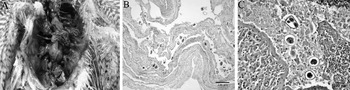
Serratospiculum tendo was found in the thoracic and abdominal air sacs of 25 of the 31 (80.6%) peregrine falcons from the Calabria Region. In three cases, adult nematodes were also found in the lungs. No significant differences were found between age classes and/or gender groups. The mean intensity of infection was 8.7, ranging from 1 to 35. The male to female ratio for Serratospiculum specimens was 1.2:1. A single northern goshawk from the Campania Region was infected with 17 specimens of S. tendo in its thoracic air sacs (fig. 1A). The northern goshawk and 18 of 25 infected peregrine falcons showed cachexia, and all infected birds had bone fractures. At gross examination, air sacculitis and pneumonia were the most common lesions. The northern goshawk also showed a detachment of the dextral lung, showing several necrotic foci. Microscopically, impression smears from the respiratory tract of infected birds were all positive for embryonated eggs. Histologically, the air-sac walls of infected birds showed a thickening of the smooth muscle cells, resulting in a papillary appearance. There was hyperplasia of the mesothelium and epithelium, with foci of plasma cell infiltration and macrophages associated with several embryonated eggs (fig. 1B) and adult parasites. In the northern goshawk, the lungs showed extensive areas of inflammation characterized by lymphocytes, macrophages and fibroblasts surrounding necrotic foci associated with embryonated eggs, and the pulmonary interstitium appeared thickened. The liver capsule had several embryonated eggs surrounded by fibrinous exudates with many macrophages and lymphocytes (fig. 1C). In this latter case the death of the bird was directly linked to S. tendo infection.
(A) Serratospiculum tendo from the air sacs of Accipiter gentilis. (B) Section of a lung of A. gentilis, showing many embryonated eggs of S. tendo. (C) Section of the liver of A. gentilis, showing embryonated eggs of S. tendo surrounded by fibrinous exudates and lymphocytes on the outer surface.

Discussion
Birds of prey from southern Italy were studied for helminths by Santoro et al. (Reference Santoro, Kinsella, Galiero, Degli Uberti and Aznar2012a, Reference Santoro, Mattiucci, Nascetti, Kinsella, Di Prisco, Troisi, D'Alessio, Veneziano and Aznarb). Diplotriaenoid nematodes were assigned to the genus Serratospiculum based on the genus-specific features described by Anderson et al. (Reference Anderson, Chabaud and Willmott2009), and species-specific features of the male spicules described by Bain & Vassiliades (Reference Bain and Vassiliades1969) and Bain & Mawson (Reference Bain and Mawson1981). In Europe, three Serratospiculum spp. have been reported, including S. guttatum and S. chungi, both from Spain, and S. tendo from Britain, France, Germany, Italy, Poland, Russia, Spain and Tadzhikistan (Furmaga, Reference Furmaga1957; Bain & Vassiliades, Reference Bain and Vassiliades1969; Illescas-Gomez et al., Reference Illescas-Gomez, Rodríguez and Aranda1993; Krone, Reference Krone, Lumeij, Remple, Redig, Lierz and Cooper2000, Reference Krone and Rockenbauch2002; Kalisinska et al., Reference Kalisinska, Lisowski, Czernomysy-Furowicz and Kavetska2008; Santoro et al., Reference Santoro, Kinsella, Galiero, Degli Uberti and Aznar2012a, Reference Santoro, Mattiucci, Nascetti, Kinsella, Di Prisco, Troisi, D'Alessio, Veneziano and Aznarb; Natural History Museum, 2014). In addition the latter species has also been reported in F. peregrinus from Australia (Bain & Mawson, Reference Bain and Mawson1981) and Peru (Gomez-Puerta et al., Reference Gomez-Puerta, Ospina, Ramirez and Cribillero2014). Serratospiculum tendo may be distinguished easily from S. chungi and S. guttatum, mainly by the longer length of the spicules (Bain & Vassiliades, Reference Bain and Vassiliades1969; Bain & Mawson, Reference Bain and Mawson1981). Recently, Königová et al. (Reference Königová, Molnár, Hrčková and Várady2013) reported Serratospiculum amaculata in the great tit (Parus major) from Slovakia; however, this species is currently not considered a member of Serratospiculum but of Serratospiculoides (Sterner & Cole, Reference Sterner, Cole, Atkinson, Thomas and Hunter2008; Anderson et al., Reference Anderson, Chabaud and Willmott2009).
Recorded hosts for S. tendo include F. peregrinus, F. cherrug, F. tinnunculus, F. biarmicus, F. mexicanus, F. cyaneus, F. zithofalco (Falconiformes); Milvus korschun (syn. M. migrans) (Accipitriformes); and Corvus frugilegus and Thamnophilus stagurus (Passeriformes) (Skrjabin, Reference Skrjabin1916; Furmaga, Reference Furmaga1957; Krone, Reference Krone, Lumeij, Remple, Redig, Lierz and Cooper2000, Reference Krone and Rockenbauch2002; Santoro et al., Reference Santoro, Tripepi, Kinsella, Panebianco and Mattiucci2010, Reference Santoro, Kinsella, Galiero, Degli Uberti and Aznar2012b; Natural History Museum, 2014). Therefore, the northern goshawk represents a new host record for S. tendo.
Of the 17 birds of prey studied, 25 of 31 (80.6%) peregrine falcons from Calabria Region and a northern goshawk from Campania Region were infected by S. tendo. The small sample of northern goshawks examined from Calabria (n= 1) and Campania (n= 1) is insufficient to draw definitive conclusions for this host in southern Italy. In contrast, the high prevalence of infection in the peregrine falcon suggests a strong host specificity for this parasite. Similarly, Krone (Reference Krone, Lumeij, Remple, Redig, Lierz and Cooper2000) identified S. tendo in 16 of 19 peregrine falcons in Germany. Since the free-ranging peregrine falcon is a specialized predator in open spaces, feeding almost exclusively on living birds of small to medium size, according to local availability (Ratcliffe, Reference Ratcliffe2000), a different source of infection should be expected for S. tendo in free-ranging falcons, with respect to that reported for S. seurati in captive individuals (hosted in paddocks) feeding on insects. The present results from the free-ranging peregrine falcons strengthen the hypothesis proposed by Bain & Vassiliades (Reference Bain and Vassiliades1969) and Krone & Cooper (Reference Krone, Cooper and Cooper2002) regarding the possible existence of avian transport hosts for S. tendo larvae. On the other hand, the main prey items of the northern goshawk are small birds and mammals found in forest habitats. An examination of a larger sample of northern goshawks is required to establish whether or not the S. tendo infection in this host is an isolated case.
Most of the morbidity and mortality by diplotraenoid nematodes has been described for S. seurati in captive birds of prey in the Middle East (Samour & Naldo, Reference Samour and Naldo2001; Tarello, Reference Tarello2006), and Serratospiculoides amaculata in free-ranging individuals in North America (Bigland et al., Reference Bigland, Lui and Perry1964; Kocan & Gordon, Reference Kocan and Gordon1976; Sterner & Espinosa, Reference Sterner and Espinosa1998; Sterner & Cole, Reference Sterner, Cole, Atkinson, Thomas and Hunter2008). Clinical signs included dyspnoea, reduced flight performance, weight loss, anorexia, lethargy, vomiting, closed eyes, pain and tremors. The most common pathological changes were thickening of air-sac membranes compromising air exchange, congestion, focal haemorrhages and focal necrosis of lungs, and bronchial oedema with secondary bacterial and mycotic infections causing death (Bigland et al., Reference Bigland, Lui and Perry1964; Kocan & Gordon, Reference Kocan and Gordon1976; Sterner & Espinosa, Reference Sterner and Espinosa1998; Samour & Naldo, Reference Samour and Naldo2001; Tarello, Reference Tarello2006; Sterner & Cole, Reference Sterner, Cole, Atkinson, Thomas and Hunter2008). Kalisinska et al. (Reference Kalisinska, Lisowski, Czernomysy-Furowicz and Kavetska2008) reported intestinal helminths such as digeneans and a cestode, an epidermal mycosis and a pulmonary bacterial infection in an emaciated peregrine falcon from Poland with an infection of S. tendo in the air sacs, but the death of the falcon was not linked to a specific cause. Unfortunately, in the present study, living birds of prey at the time of admission to the rescue centres showed no clinical signs of infection, but lesions recorded at post-mortem, together with the observed pathological changes, suggested that S. tendo may have caused disease.
In addition to direct effects induced by nematodes on tissues of their hosts, such infections may affect host body condition, and, in turn, flight performance and predatory effectiveness, together with a predisposition to secondary trauma (Bigland et al., Reference Bigland, Lui and Perry1964; Kocan & Gordon, Reference Kocan and Gordon1976; Samour & Naldo, Reference Samour and Naldo2001; Tarello, Reference Tarello2006; Sterner & Cole, Reference Sterner, Cole, Atkinson, Thomas and Hunter2008; Santoro et al., Reference Santoro, Tripepi, Kinsella, Panebianco and Mattiucci2010). For example, peregrine falcons catch their avian prey during spectacular flight performances (Ratcliffe, Reference Ratcliffe2000) and non-optimal health condition may cause flying imbalance and accidental impacts. In this study, all Serratospiculum-infected birds of prey showed traumatic injuries, but whether S. tendo contributed to debilitation, and consequently secondary trauma, in these hosts is unknown.
Financial support
This study was funded by the Ministry of Health of Italy (IZS ME 06/10 RC).
Conflict of interest
None.