During the course of language acquisition, both children acquiring their first language (L1) as well as second language (L2) learners make systematic errors, which are part of the natural developmental process. It is well known that L1 and L2 learners exhibit variability in their use of verbal and nominal inflectional morphology. Nominal morphology related to number, gender, and case agreement and verbal morphology encoding tense, aspect, and mood are sometimes present and sometimes absent (i.e., omission errors) in spontaneous production data in contexts in which native speakers would not produce such errors. For example, optional omission of tense and agreement morphology is common in children learning English, French, and Dutch (Hyams, Reference Hyams and Clahsen1996). Errors of commission, or the use of the wrong affix rather than no affix, are very prevalent in adult SLA. This is illustrated in the two excerpts of spontaneous production in (1) and (2) from two adult L2 learners of Spanish discussed in the current study (words with commission errors appear in bold and Ø stands for omission of obligatory morphology).
(1) Context: Talking about her ideal job
Tal vez ser… será… sería una profesor de español o matemáticas… Necesito tener una apartamento pero yo creo que vas a vivir con mi mamá.
“Maybe I will be a professor of Spanish or math. I need to have an apartment but I think I will live with my mom.”
(2) Context: Retelling the story of Little Red Riding Hood
Y algún día fue su cumpleaños de su abuela y la Ø Caperucita Roja le encantó su abuela mucha y siempre le visitó porque se diverten cuando están juntos. Entonces la Caperucita Roja salió Ø su casa y fue a visitar Ø su abuela visitar.
“And one day was the birthday of her grandmother and Little Red Riding Hood liked her grandmother very much and would always visit her because they had fun when they were together. So, Little Red Riding Hood left her home and went to visit her grandmother.”
A main difference between normally developing children and adult L2 learners is that whereas children eventually overcome developmental errors and reach nativelike attainment in their L1, many of the errors made by L2 learners persist and fossilize, leading to nontargetlike ultimate attainment (Lardiere, Reference Lardiere2007).
From a linguistic perspective, the study of errors is crucial for understanding the systematic nature of the underlying grammatical representation in the mind of individuals. In monolingual adult psycholinguistics, occasional speech errors or slips of the tongue (e.g., *singing sewer machine for Singer sewing machine) are actually seen as windows into the organization of grammar and its units of analysis during planning, production, or comprehension (Bock, Reference Bock, Miller and Eimas1995; Dell, Reference Dell, Gleitman and Lieberman1995). However, whereas speech errors in monolingual adults are quite few (e.g., less than 3% for verbal agreement errors) and can be taken as a performance, execution, or processing problem during online production, most errors in developing and fossilized grammars are actually ambiguous: It is difficult to determine whether they reflect a deficit in grammatical knowledge, a temporary breakdown in processing during computation, or both.
Theoretical proposals subsumed under the representational deficit account of SLA, such as Hawkins and Chan’s (Reference Hawkins and Chan1997) failed functional features hypothesis (FFFH), take morphological errors to reflect lack of the relevant grammatical knowledge. If L2 learners do not produce gender agreement morphology correctly, it is because they lack the functional category or abstract feature values for gender agreement. Alternatively, according to the missing surface inflection hypothesis (MSIH; Prévost & White, Reference Prévost, White, Friedman and Rizzi1999, Reference Prévost and White2000), L2 learners have intact functional projections or feature values, but morphological errors stem from problems at the morphology-syntax interface during production only (a mapping or processing problem).
This article presents empirical evidence that shows that the same problem areas identified for SLA, such as inflectional morphology, are also problem areas for heritage language speakers. Heritage speakers are bilinguals who grew up in immigrant families learning an ethnolinguistically minority language (Kondo-Brown, Reference Kondo-Brown2006; Silva-Corvalán, Reference Silva-Corvalán1994). Due to many complex sociolinguistic, cultural, educational, and affective circumstances leading to reduced input conditions, the outcome of heritage speakers’ acquisition of the home language is not uniformly nativelike as in normally developing children raised in a monolingual environment (see Montrul, Reference Montrul2008; Polinsky, Reference Polinsky2007; Rothman, Reference Rothman2007; and the introduction to this issue). Like child L1 learners and adult L2 learners, heritage language speakers also make developmental errors during the early stages of bilingual acquisition, and, similar to L2 learners, many heritage speakers also display persistent systematic errors in their ultimate attainment (Montrul; Polinsky). In fact, the range of linguistic proficiency in the heritage language is quite large, and heritage speakers cannot be treated as a homogeneous group. At one extreme, and depending on the language, there are adult speakers (in the context of the United States) who merely understand the spoken family language and exhibit full native ability in English, whereas at the other extreme, there may be quite advanced speakers of the heritage language, who are also literate in the language with similarly advanced or even nativelike ability in English. There are also many speakers with an intermediate command of the heritage language, who show basic communication skills in informal settings and some degree of literacy. The spontaneous production excerpts in (3) and (4) from two of the participants reported on in the current study show that morphological variability is also characteristic of adult heritage speakers.
(3) Context: Talking about her ideal job
Amigo, yo sé que tienes una problema de alcohol. Te aconsejo que necesitias a ver Ø alguien. Es necesario que vas, que vas a alguien. Hasta que vas a la hospital con su problema no quiero hablar contigo.
“My friend, I know that you have an alcohol problem. I advise you that you need to see somebody. It is necessary that you see somebody. I won’t talk to you until you go to a hospital.”
(4) Context: Retelling the story of Little Red Riding Hood
La niña está camina y ve Ø una perro que quiere comer Ø la niña pero lo hombre con la ax mata Ø el perro.
“The girl is walking and sees a dog who wants to eat the girl but the man with the ax kills the dog.”
Given that the vast majority of heritage speakers fail to acquire full competence in their home language, an increasing trend in the United States among many of these speakers when they reach college is to attempt to reacquire their language in an instructed environment, like most L2 learners. If one of the aims of instruction is to help learners overcome grammatical errors and become more proficient, this raises the theoretical question of whether morphological variability in the L2 learner and the heritage language learner is similar. To address this question, the present study compares knowledge of nominal and verbal morphology in Spanish L2 learners and heritage speakers and examines whether existing theoretical accounts like the FFFH (a representational deficit account) and the MSIH, which have been advanced to describe vulnerable areas in SLA, can be extended to explain the patterns of morphological variability observed in many heritage language learners. The results suggest that although the MSIH correctly characterizes the performance patterns observed in SLA, this theory does not correctly describe the performance of the heritage language learners tested in the current study. Metalinguistic competence, literacy, and experience are discussed as possible explanations for the task effects observed.
THEORETICAL ACCOUNTS OF MORPHOLOGICAL VARIABILITY IN SLA
Within generative linguistic theory, acquiring morphology implies much more than correctly producing morphemes. For example, tense is an abstract formal feature, manifested as –s, –ed, or Ø with English verbs to mark present, past, and future, respectively, but as –o, –s, Ø, –mos, –is, and –n for present, é, –ste, –ó, –mos, –steis, and –ron for preterit, and –ré, –rás, –rá, –remos, –réis, and –rán for future with –ar verbs in Spanish. Knowing tense means having the abstract feature [+ tense] represented in the grammar and producing the right morphological ending on tensed verbs. However, these two aspects of morphological knowledge can be dissociated: It is possible to have knowledge of the abstract feature tense and to use tense in correct syntactic and semantic contexts or with appropriate adverbials but to use the wrong morpheme on the verb, as many L2 learners do (Lardiere, Reference Lardiere2007; Prévost & White, Reference Prévost, White, Friedman and Rizzi1999). The assumed relationship between abstract formal features and their morphological manifestation distinguish two competing views of SLA.
Representational Deficits
Several researchers within and outside the generative framework subscribe to a general view that argues for fundamental differences between native and nonnative speakers or between L1 acquisition by children and SLA by adults (Bley-Vroman, Reference Bley-Vroman, Gass and Schachter1989, Reference Bley-Vroman2009; Clahsen & Muysken, Reference Clahsen and Muysken1986; DeKeyser, Reference DeKeyser2000; Long, Reference Long2007; Meisel, Reference Meisel1997; Paradis, Reference Paradis2009; Schachter, Reference Schachter1990; Tsimpli & Dimitrakopoulou, Reference Tsimpli and Dimitrakopoulou2007; Ullman, Reference Ullman2001). The main assumption of the representational deficit position is that there are some sort of maturational constraints on SLA. The language learning mechanisms deployed in early L1 acquisition atrophy or shut down past puberty, thus making the acquisition of a L2 later in life a very different process from that of L1 acquisition and with clearly distinct outcomes.
An example of a representational deficit account is Hawkins and Chan’s (Reference Hawkins and Chan1997) FFFH, advanced to account for persistent selective difficulty with the morphosyntactic properties of L2 grammars. The FFFH claims that there is a critical period for the selection of parameterized formal features from Universal Grammar (UG). Parameterized formal features like [± tense], [± gender], and [± wh] determine differences among languages and have syntactic consequences, such as the presence or absence of null subjects, gender agreement, and wh-movement. If the options allowed by such features are not selected as part of language acquisition in the early years of life, they will not be available to enter syntactic derivations later in life, but if the features are selected, then they will be available later. The FFFH thus predicts L1 influence in SLA. The observable behavior would be errors at the advanced and near-native level, some of which are due to the L1.
The main empirical evidence in support of the FFFH in morphosyntax comes from Hawkins and Liszka’s (Reference Hawkins, Liszka, van Hout, Hulk, Kuiken and Towell2003) study of the oral and written production of past tense morphology in L2 English by L1 speakers of Chinese, Japanese, and German. This study found that when compared to L2 learners whose L1s have tense, Chinese-speaking learners of English had serious difficulty with tense morphology. Additionally, Hawkins (Reference Hawkins2001) examined gender agreement in French by English-speaking L2 learners, whereas two studies looked at gender in Spanish: Franceschina’s (Reference Franceschina2001) case study of an end-state Spanish L2 speaker whose gender agreement performance in spoken Spanish did not come close to the 95–100% accuracy mark typical of native speakers and Franceschina’s (Reference Franceschina2005) L2 study of Spanish gender agreement by learners of languages with and without gender. These studies found that English-speaking L2 learners of French and of Spanish had difficulty with gender in these two languages. Hawkins and Liszka and Franceschina (Reference Franceschina2005) concluded that the failure of adult learners to consistently supply overt tense morphology and gender agreement in noun phrases is a consequence of the absence of the corresponding formal feature in the L1 grammar.
The MSIH
The MSIH (Prévost & White, Reference Prévost, White, Friedman and Rizzi1999, Reference Prévost and White2000) is another account of morphological variability in SLA. Unlike the FFFH, the MSIH belongs to the family of full-access accounts (Epstein, Flynn, & Martohardjono, Reference Epstein, Flynn and Martohardjono1996; Schwartz & Sprouse, Reference Schwartz and Sprouse1996), which hold that there are no linguistic deficits due to maturational effects and that L2 learners can eventually acquire the same type of abstract linguistic knowledge as L1 learners. Errors with morphology at advanced and near-native levels of L2 proficiency are not representational (at the level of abstract features) but rather due to deficits elsewhere.
The MSIH was originally proposed to account for the morphological and syntactic distribution of finite and nonfinite verb forms in the spontaneous oral production of four children and four adults in the process of learning French and German as L2s. Prévost and White (Reference Prévost, White, Friedman and Rizzi1999) found that both L2 children and adults showed morphological variability but that the nature and syntactic distribution of errors differed in the child and the adult data. Whereas finite and nonfinite forms occurred in different syntactic environments in the child data, the adults used significantly more nonfinite than inflected forms in syntactic contexts requiring finite forms. Prévost and White concluded that knowledge of morphology and syntax are related in child acquisition but that these two components are dissociated in adult SLA.
A specific claim of the MSIH is that linguistic performance underestimates linguistic competence (Prévost & White, Reference Prévost and White2000). Abstract linguistic knowledge of the L2, like the type of knowledge acquired in L1 acquisition, is present but not always behaviorally accessible; that is, the problem is not in the abstract grammatical representations per se but rather in the mechanisms that access grammatical representations, especially during oral production. The MSIH assumes a model of grammatical organization in which the syntactic computational system generates phrase markers with terminal nodes whose syntactic features are fully specified and into which lexical items are inserted. In mature native speakers, lexical insertion matches fully specified syntactic forms with fully specified lexical forms. For nonnative speakers, however, the lexical items (morphological forms) may only be partially, not fully, specified. It is not uncommon to observe less specified or default forms (such as infinitives or masculine gender) in contexts that require a more morphologically specified form (e.g., inflected verbs and feminine gender). In Prévost and White’s words,
We speculate that this might be due to processing reasons or to communication pressure, in which case one might expect the problem to affect different kinds of language use differentially. For example, L2 learners might be expected to perform more accurately on an untimed grammaticality judgment task (where they have time to access the relevant representation) than in spontaneous production or timed tasks. (p. 129)
Bruhn de Garavito and White (Reference Bruhn de Garavito, White, Pérez-Leroux and Liceras2003) investigated the SLA of gender in Spanish by French-speaking learners and compared their results with those of Hawkins’s (Reference Hawkins2001) English-speaking learners of L2 French. Because the French-speaking learners of Spanish and the English-speaking learners of French made around 30% gender errors in oral production, Bruhn de Garavito and White reasoned that the absence of gender in the L1 is not the main reason why L2 learners have problems with gender—otherwise, the French-speaking learners of Spanish would have been more accurate than the English-speaking learners of French. Their conclusion was that the L2 learners have the abstract feature gender represented in their grammars but resort to less-specified or default morphological forms during online production.
White, Valenzuela, Kozlowska-Macgregor, and Leung (Reference White, Valenzuela, Kozlowska-Macgregor and Leung2004) developed a comprehension-based experiment to test whether gender features are intact at the level of interpretation. White et al. did not specifically test the predictions of the MSIH but focused instead on the effects of L1 influence. However, better performance in written comprehension than in oral production from the L2 learners would be consistent with the MSIH (as noted by Prévost & White, Reference Prévost and White2000). French and English speakers learning Spanish completed a semispontaneous oral production task in addition to a written comprehension task. The results were similar across the two tasks, showing that the intermediate and advanced groups performed at above 90% accuracy on gender agreement. For White et al., these results are incompatible with the representational deficit view as stated in the FFFH and instead indicate that gender features are acquirable in a L2 irrespective of L1 and age of acquisition. However, McCarthy’s (Reference McCarthy2008) study of Spanish gender, which directly investigated the predictions of the MSIH regarding production versus written tasks, found that default forms were used in both production and comprehension tasks by L2 learners. McCarthy concluded that the problem cannot be limited to production.
MORPHOLOGICAL VARIABILITY IN HERITAGE LANGUAGE SPEAKERS
Despite different language backgrounds, cultures, educational and social classes, and exposure to different varieties and registers of their home language, heritage speakers of immigrant languages share a common characteristic: They have achieved partial command of the family language, short of the native-speaker level of their parents and of age-matched peers raised in their home countries (Montrul, Reference Montrul2008). Recent linguistic, psycholinguistic, sociolinguistic, and pedagogical research has identified several vulnerable areas in heritage language grammars, including lexicon, phonology, syntax, semantics, and pragmatics. Morphosyntax—and inflectional morphology in particular—is perhaps the most noticeably affected area (see also contributions in this issue).
In the nominal domain, many languages mark number, gender, and case. Heritage speakers of languages with overt gender, number, and case marking produce a significant number of errors as compared to native speakers or even their own parents. For example, Russian has a three-way gender system (masculine, feminine, neuter); Swedish has a two-way system (common, neuter) and so does Spanish (masculine, feminine). With the exception of most irregular, less frequent, and marked forms, monolingual Swedish-, Russian-, and Spanish-speaking children control gender marking by age 4 or earlier with almost 100% accuracy. Håkansson (Reference Håkansson1995), Polinsky (Reference Polinsky2008), and Montrul, Foote, and Perpiñán (Reference Montrul, Foote and Perpiñán2008) have independently shown that heritage speakers display very high error rates with gender marking (ranging from 5% to 50%). Håkansson found that Swedish heritage speakers made 57% errors with gender agreement in production and concluded that these bilinguals had difficulty retrieving the right affixes for gender. In Russian, the neuter and feminine genders are the most affected in heritage speakers. Polinsky found that whereas higher proficiency Russian heritage speakers displayed a three-way gender system, lower proficiency speakers had a two-way distinction that consisted of masculine and feminine only, with no neuter.
Case marking is another candidate for erosion and imperfect mastery in heritage language grammars. Russian has a six-way distinction in nouns (nominative, accusative, dative, instrumental, oblique, and genitive), but this case system is severely reduced in heritage speakers (Polinsky, Reference Polinsky2007, Reference Polinsky2008): The dative case is replaced by the accusative and the accusative is replaced by the nominative in many constructions with subjects and direct and indirect objects. Whereas native speakers of Russian use the six case markings, heritage speakers tend to use just two—namely, nominative and accusative. Case omission has also been reported in Korean by Song, O’Grady, Cho, and Lee (Reference Song, O’Grady, Cho, Lee and Kim1997). Although nominative and accusative case markers are typically dropped in Korean, monolingual children and adults nevertheless gain full control of the case system, including the discourse-pragmatic conditions under which case markers can be omitted. Song et al. found that whereas 5- to 8-year-old monolingual Korean children were 86% accurate at comprehending Korean object-verb-subject (OVS) sentences with nominative and accusative case markers, 5- to 8-year-old Korean heritage speakers performed at less than 34% accuracy: They tended to interpret OVS sentences as SOV sentences, ignoring the case markers. Finally, Montrul and Bowles (Reference Montrul and Bowles2009) showed that adult Spanish heritage speakers omit the preposition a of dative experiencers with gustar-type verbs (*Juan le gusta la música “Juan likes music”) as well as with animate direct objects (*Juan vio María “Juan saw Maria”). These errors suggest that heritage speakers are either missing a strong feature for case in their grammar or that they just forget to produce the marker.
The verbal domain presents similar challenges to heritage language speakers, particularly subject-verb agreement and tense paradigms. Heritage speakers of Spanish and Russian seem to control regular forms of the present and past tenses but confuse aspectual distinctions between perfective and imperfective forms (Montrul, Reference Montrul2002; Polinsky, Reference Polinsky2007; Silva-Corvalán, Reference Silva-Corvalán1994). The subjunctive mood (in both present and past) is poorly controlled by Spanish heritage speakers in production and in comprehension (Montrul, Reference Montrul, Potowski and Cameron2007; Potowski, Jegerski, & Morgan-Short, Reference Potowski, Jegerski and Morgan-Short2009; Silva-Corvalán), as is the conditional (Silva-Corvalán). Rothman (Reference Rothman2007) also found that Brazilian Portuguese heritage speakers do not develop knowledge of inflected infinitives, a feature learned at school by exposure to written registers. These types of errors are rare in speakers who have full control of their L1.
To summarize, under reduced input conditions and limited opportunities to use the language, heritage speakers’ grammatical systems show a marked tendency toward simplification and overregularization of complex morphological patterns (and restricted word order). It is possible that the observed simplification could be exacerbated by transfer from English (the dominant language in most of the empirical studies conducted to date), but this possibility remains an open question. After all, English has SVO order and poor agreement, with no overt case markers, subjunctive morphology, or grammatical gender. Studies of the same heritage language with different contact languages should be undertaken to investigate the extent to which transfer from the dominant language influences the degree of incomplete acquisition found in heritage language grammars (see Kim, Reference Kim2007, for an example).
Given that both L2 learners and heritage speakers have problems with inflectional morphology, the questions pursued in the current study are (a) whether morphological variability is similar in L2 learners and heritage speakers and (b) whether existing theoretical accounts of morphological variability in SLA can be extended to heritage language acquisition. These questions are examined in a group of L2 Spanish learners and a group of Spanish heritage speakers, matched for proficiency level, who completed a series of oral production, written comprehension, and recognition tasks. According to the FFFH, morphological errors in SLA result from a representational deficit rooted in maturational constraints. L2 learners should make errors with inflectional morphology in production and comprehension, in both oral and written modalities. The MSIH predicts that L2 learners will make more errors in oral production than in written tasks—their problem is mainly producing under pressure and retrieving the correct, fully specified morphological form online.
If L2 learners and heritage speakers show similar patterns of performance in oral and written tasks, this outcome will suggest that acquiring a language early in childhood or later in adolescence plays a minor role in the eventual grammatical representation. The pedagogical implication of this finding is that the same teaching methods may be used to address morphological gaps in these two types of learners. By contrast, if differences between L2 and heritage language learners of similar proficiency are found, this outcome would suggest that linguistic experience and age of acquisition play a significant role in language development. Different pedagogical techniques may then be required to help these two types of learners develop their grammatical knowledge in the classroom.
THE STUDY
The empirical data come from a large-scale research project conducted with 72 L2 learners of Spanish and 70 Spanish heritage speakers. The study investigated the overall linguistic competence of L2 learners and heritage speakers in a variety of grammatical areas, including phonology, lexical knowledge, gender agreement, object clitics and object marking, wh-movement, and tense-aspect and mood. It was not the main objective of this large-scale project to evaluate the MSIH or the FFFH specifically, but because the study tested knowledge of Spanish nominal and verbal morphology using both oral and untimed written measures, the findings are relevant to debates about the nature of morphological variability manifested in different types of language use. The current study discusses overall findings in three representative areas: gender agreement, differential object marking (DOM), and tense-aspect and mood morphology. Full details of the gender study are reported in Montrul et al. (Reference Montrul, Foote and Perpiñán2008), and the results of experiments on clitics and object expression (including DOM) are reported in full in Montrul (Reference Montrul2010). The interested reader is referred to these studies for more details about all other tasks and the statistical analyses. Only a summary is reported in this article.
Participants
All of the Spanish L2 learners and the Spanish heritage speakers completed a linguistic background questionnaire and a short written Spanish proficiency test. The L2 learner group consisted of native speakers of English who used this language exclusively at home as children and who had started acquiring Spanish as a foreign language around puberty (between the ages of 12 and 20). At the time of the data collection, they were enrolled in Spanish language classes at the University of Illinois. The mean age for this group was 22.7 (range: 18–31). The study also included a group of 24 native speakers monolingually raised in Spain, Argentina, and Mexico (mean age: 29.82; range: 21–57). This group was administered all of the tasks first, to make sure the experimental measures developed for the study accurately reflected normative use of the structures tested. Half of the native speakers were tested abroad in their countries of origin, whereas the rest were recent arrivals in the United States (length of residence ranged from 1 to 3 years). Speakers of these varieties were tested because these dialects are representative of the Spanish spoken by the instructors who teach many of the Spanish courses at the University of Illinois. Both L2 learners and heritage speakers are exposed to these varieties in the classroom. Potential dialectal differences with the gender of nouns, for example, were avoided in the construction of all the tasks.
All participants completed 13 short tasks (in addition to consent forms, a written proficiency test, and a questionnaire about their knowledge and use of Spanish and English). They were tested individually by four trained research assistants in two sessions of an hour each (scheduled on different days). To reduce variability in the heritage speaker group, all of the heritage speakers tested were of Mexican descent, which is the largest Spanish-speaking group represented in the area where the study took place. All of the heritage speakers were born and schooled in the United States and were exposed to English before the age of 5 (i.e., in preschool). As the L2 learners, all heritage speakers were graduate and undergraduate students at the same university and were either taking or had taken the same intermediate to advanced Spanish language classes as the L2 learners.
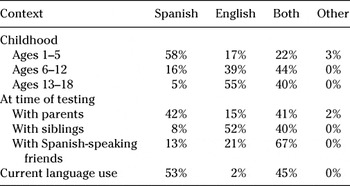
According to the results of the background questionnaire, 88% of the heritage speakers reported that both parents were from Mexico; for the other 12%, one parent was from Mexico and the other was born in the United States. All of the heritage speakers had siblings (from one to nine) and 14 of them (20%) lived with a Spanish-speaking grandparent. Table 1 summarizes the patterns of language use of both Spanish and English during childhood and at the time of testing. Most of the heritage speakers (58%) spoke Spanish during childhood (ages 1–5) but by high school age, the majority was using predominantly English (55%). The highest amount of Spanish in childhood and at the time of testing was spoken with parents only, whereas English or both languages (codeswitching) were used with siblings and friends.
Estimated frequency of Spanish and English language use by heritage speakers (n = 70)

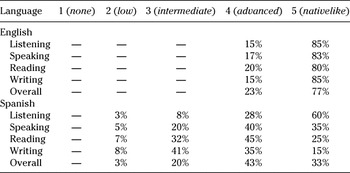
Table 2 summarizes the heritage speakers’ self-assessed proficiency in English and Spanish. When asked to identify their mother tongue, 50% of the heritage speakers listed Spanish, 35% listed English, and the remaining 15% listed both languages. Although all heritage speakers continued to speak Spanish into adulthood, they rated their Spanish abilities between 2 and 5 (mean 3.9) on a self-rating scale with maximum 5 (native-speaker command), whereas they rated their English between 4 and 5 (mean 4.88). As can be seen from Table 2, proficiency in Spanish ranges from low to nativelike. Of the 70 heritage speakers, 34 (48%) felt that they still knew Spanish as a native language, and 36 (52%) considered Spanish to be a L2. All of them wanted to improve their ability in Spanish for personal and professional reasons, by learning aspects of grammar, vocabulary, and spelling they felt they had never learned.
Self-perceived proficiency ratings of heritage speakers (n = 70)

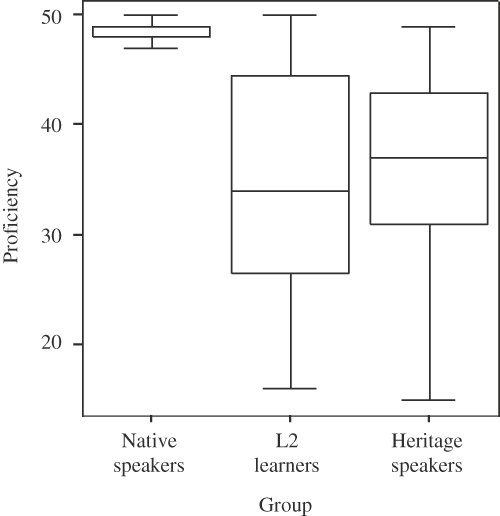
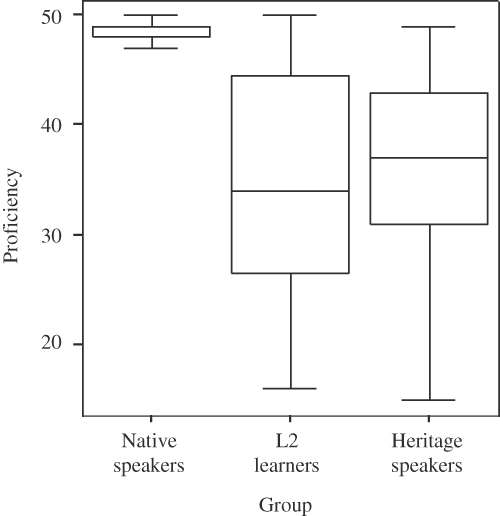
To properly compare L2 learners and heritage speakers and because there is inherent variability in these two groups, all participants were asked to complete a written test of Spanish proficiency—the same used in several other studies of L2 learners (McCarthy, Reference McCarthy2008; White et al., Reference White, Valenzuela, Kozlowska-Macgregor and Leung2004). The maximum number of points on this test was 50. As Figure 1 shows, all of the native speakers scored above 90% (M = 48.5; SD = 1; range: 45–50), whereas the experimental groups scored around 70% (L2 learners: M = 35.34; SD = 9.24; range: 16–50; heritage speakers: M = 36.88; SD = 8.17; range: 15–48). Cronbach’s alpha was computed for reliability, and the coefficient was high (r = .84) for both the heritage speakers and the L2 learners. In fact, the proficiency test was highly correlated with all of the written tasks used in the study; for the L2 learners, r = .65, p < .0001 and for the heritage speakers, r = .86, p < .0001. The scores on the proficiency test for the L2 learners and the heritage speakers were compared with an independent samples t test, and the two groups did not differ from each other, t(139) = –1.339, p = .183.
Proficiency scores by group.
Gender Agreement
Spanish exhibits gender agreement in the noun phrase (la casa “the-fem house-fem,” el libro “the-masc book-masc”). According to some theoretical accounts, gender is a parameterized uninterpretable feature represented in a functional category within the determiner phrase (DP), where the lexical and functional categories of the noun phrase reside. Languages that do not grammaticalize gender are assumed to not instantiate this feature (Franceschina, Reference Franceschina2005).
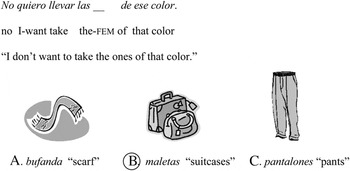
Knowledge of gender was assessed through a written picture identification task (based on the methodology used by White et al., Reference White, Valenzuela, Kozlowska-Macgregor and Leung2004), a written elicited recognition task, and an oral picture description task. In the written picture identification task, participants matched a sentence with a determiner inflected for gender and number (and a null nominal) and one of three pictures, as shown in Figure 2. The task included 8 canonical-ending masculine nouns (–o), 8 canonical-ending feminine nouns (–a), and 16 noncanonical-ending nouns (8 masculine and 8 feminine) ending in –e or a consonant.
Sample test item from the written picture identification task.

In the written recognition task, participants read a paragraph and selected the correct masculine or feminine form of the missing determiner or adjective. The task included 20 determiner and 20 adjective gaps—10 masculine and 10 feminine in each condition. An excerpt of the task is presented in (5).
(5) Los/Las llaves de la puerta, los televisores de 625 líneas y las ruidosas lavadoras se quedarán obsoletos/obsoletas en la próxima década, cuando el 60 por ciento de el/la población de los/las países desarrollados/desarrolladas dependa de las/los telecomunicaciones.
“(The) door keys, 625 line TV sets and noisy dishwashers will be obsolete in the next decade when 60 percent of (the) population of (the) developing countries will depend on (the) telecommunications.”
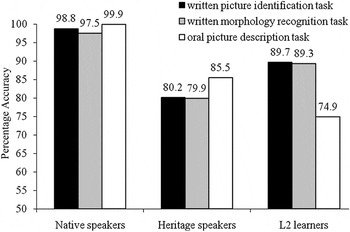
For the oral picture description task, participants were presented with photographs of objects, animals, and people organized in a PowerPoint presentation. They were asked to describe each photograph verbally using the phrase Veo un/una/el/la NOUN ADJECTIVE “I see a/the NOUN ADJECTIVE.” The oral production task was the most difficult of the three tasks because it included 50 high- and low-frequency nouns: 25 masculine and 25 feminine in five subconditions: canonical animate, canonical inanimate, irregular, –e-final, and consonant-final. Because the two written tasks were untimed, whereas the oral task required spontaneous production, this combination of measures allows for the evaluation of learning outcomes against the MSIH and the FFFH. Overall accuracy on the three tasks is displayed in Figure 3. These results show that the L2 learners and the heritage speakers made gender agreement errors in the oral and written tasks, whereas the native speakers hardly made any. There were more errors with feminine than with masculine gender, as masculine agreement (default) was overgeneralized to feminine contexts. There were also more errors with adjectives than with determiners in the written recognition task and in the oral production task, and there were more errors with noncanonical than with canonical ending nouns in the three tasks.
Gender agreement: accuracy on oral production and written tasks.

A repeated-measures ANOVA comparing the overall scores of the three tasks revealed a main effect for task, F(2, 153) = 3.331, p < .05, for group, F(2, 153) = 24.967, p < .0001, and a Task × Group interaction, F(2, 153) = 13.956, p < .0001. Pairwise comparisons showed that the L2 learners were more accurate in the two written tasks than in the oral task, whereas the heritage speakers were more accurate in the oral task than in the two written tasks. There were also significant differences between the two experimental groups: In the two written tasks, the L2 learners were more accurate than the heritage speakers: picture identification task, F(1, 138) = 10.489, p < .002, gender recognition task, F(1, 138) = 28.745, p < .0001. In the oral task, the heritage speakers were more accurate than the L2 learners, F(1, 83) = 55.807, p < .0001.
Because the L2 learners were more accurate with gender agreement in the two written tasks than in the oral production task, their results are consistent with the MSIH: L2 learners have acquired the abstract gender feature, as evident from their accuracy on the written tasks (according to predictions made by Prévost & White, Reference Prévost and White2000) but have significant difficulty in realizing gender morphology in production, a processing or performance problem. This explanation does not work for the heritage speakers, however. Because the heritage speakers showed exactly the opposite pattern—that is, higher accuracy in oral production than in the written tasks—the MSIH cannot account for their morphological variability.
DOM
In Spanish, animate and specific direct objects are obligatorily marked with the preposition a, as in (6a). Other objects are unmarked, as in (7a). A marking with direct objects is a specific case of DOM, a common feature of many languages. According to Torrego (Reference Torrego1998), Spanish DOM is a marked accusative case represented in an additional functional projection where marked objects raise and check strong accusative features.
(6) a. El lobo comió a Caperucita Roja.
the wolf ate dom little-hood red
b. *El lobo comió Caperucita Roja.
the wolf ate little-hood red
“The wolf ate Little Red Riding Hood.”
(7) a. El cazador tenía una escopeta.
the hunter had a rifle
b. *El cazador tenía a una escopeta.
the hunter had dom a rifle
“The hunter had a rifle.”
Montrul (Reference Montrul2004) and Montrul and Bowles (Reference Montrul and Bowles2009) found that Spanish heritage speakers omit a marking in obligatory contexts in oral production. Studies of L2 learners have found similar difficulties with a marking in written tasks, especially grammaticality judgment and elicited production tasks (Bowles & Montrul, Reference Bowles, Montrul, Leow, Campos and Lardiere2009; Guijarro-Fuentes & Marinis, Reference Guijarro-Fuentes, Marinis, Roberts, Gürel, Tatar and Martı2007).
Montrul (Reference Montrul2010) compared the results of the heritage speakers and the L2 learners in their knowledge of object clitic pronouns, clitic left dislocations, and DOM. The participants completed the same oral production task used in Montrul (Reference Montrul2004) and an untimed written acceptability judgment task. Participants were instructed to describe, with as much detail as possible, the story of Little Red Riding Hood in the past tense. All narratives were recorded, transcribed, and coded. Animate and inanimate direct objects were analyzed for the presence or absence of DOM.
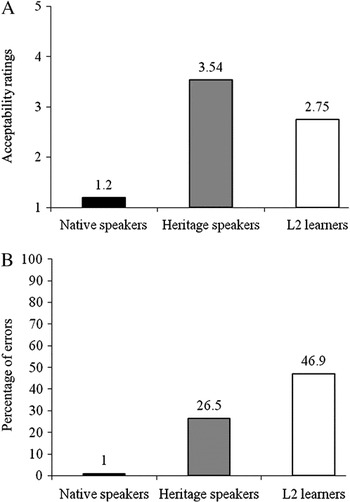
The written acceptability judgment task included 90 grammatical and ungrammatical sentences, which participants were asked to judge on a scale of 1 (completely ungrammatical) to 5 (perfectly grammatical). Among the ungrammatical sentences were 10 sentences with missing a marking. Figure 4 shows overall accuracy on DOM in the two tasks.
DOM: (a) Mean ratings on untimed written acceptability judgment task and (b) percentage errors on oral production narrative task.

Figure 4a displaying the acceptability task shows the mean ratings for ungrammatical sentences; Figure 4b displaying the oral production narrative task shows percentage errors per group. In the written task, the native speakers rated these sentences very low, but the L2 learners and the heritage speakers rated them significantly higher. This means that the two experimental groups incorrectly accepted ungrammatical sentences without a marking. However, the L2 learners, whose ratings were lower, were more accurate at rejecting these sentences than the heritage speakers, F(2, 174) = 28.9, p < .01. By contrast, in the oral narrative task, the L2 learners made significantly more errors than the heritage speakers, F(1, 142) = 14.6, p < .001.
Although the two tasks cannot be compared directly because they involve different scales, the pattern of results is similar to that revealed by the gender tasks: Whereas the L2 learners made more errors than the heritage speakers in the oral task, the heritage speakers were less accurate in the written task. The results of the L2 learners are consistent with the MSIH; the results of the heritage speakers are not. The MSIH cannot account for the heritage speakers’ performance.
Tense-Aspect and Mood
Aspect encodes different ways of seeing a situation and is marked with inflectional morphology on the verb (grammatical aspect) and also by the meaning of verbs and predicates (lexical aspect). Grammatical aspect distinguishes between perfective and imperfective, which in Spanish correspond to preterit and imperfect past morphology on the verb, respectively. Perfective means that the event is conceived as bounded or completed. Imperfective denotes uncompleted or progressive events and is unbounded. Spanish contrasts the preterit (perfective) and the imperfect (imperfective) in the past, signaled with inflectional past tense morphology on the verb. Simplifying significantly, the choice of preterit or imperfect depends on discourse context: The preterit is used to emphasize the end point of an event, as in (8); the imperfect typically emphasizes the beginning of an event or state, taking a variety of other meanings, as illustrated in (9)–(12).
(8) Completed event (preterit)
El año pasado visité Europa.
The year past I-visited Europe.
“Last year I visited Europe.”
(9) Intention (imperfect)
Juan vendía la casa pero la sacó del mercado.
Juan sold the house but it took off-the market
“Juan was selling the house but he took it off the market.”
(10) Progressive (imperfect)
Marisa caminaba por el pasillo cuando saludó a Marcos.
Marisa walked in the hallway when she-said-hi to Marcos
“Marisa was walking in the hallway when she said hi to Marcos.”
(11) Habitual (imperfect)
Cuando era niña me gustaba jugar con muñecas.
When I-was little-girl I-liked to play with dolls
“When I was a little girl I liked to play with dolls.”
(12) Generic (imperfect)
Los dinosaurios ponían huevos.
The dinosaurs laid eggs
“Dinosaurs laid eggs.”
Spanish also expresses modality by means of mood morphology (indicative, subjunctive, and imperative). Subjunctive morphology most often appears in embedded sentences (nominal, adjectival, and adverbial clauses). A problem for the acquisition of mood morphology and the meanings that this grammatical category entails is that these meanings cannot be easily accessed by just observing simple contrasts between utterances and the world. Rather, many uses of mood morphology rest on presupposition, and the possible meanings must be constructed from complex pragmatic inferences. As a result, the acquisition of mood morphology (and its semantic and pragmatic implications) represents a formidable challenge for language learners in general, including L1-acquiring children, L2 adults, and, not surprisingly, heritage speakers.
A traditional approach relates mood choice to the realis-irrealis opposition (Marques, Reference Marques, Hogeweg, de Hoop and Malchukov2009): The indicative is used when the proposition is true of the actual world (realis), whereas the subjunctive is selected when the proposition is not true of the actual world (irrealis). There are obligatory and so-called optional uses of the subjunctive. There are verbs and expressions that lexically select subjunctive complements, rendering the subjunctive obligatory, as in (13)–(15). Note that some verbs, such as querer “to want” in (13), select subjunctive (SUBJ) complements but others, such as creer “to believe” in (15), select indicative (INDIC) complements:
(13) Quiero que vengas / *vienes.
I-want that you-come-subj / you-come-indic
“I want you to come.”
(14) Es importante que tengas / *tienes cuidado
It-is important that you-have-subj / you-have-indic care
“It is important that you be careful.”
(15) Creo que *sea / es verdad.
I-believe that it-is-subj / it-is-indic true
“I believe it is true.”
In other cases, subjunctive morphology is apparently optional but actually determined by pragmatic principles, such as negation (cf. no creo que sea verdad “I don’t believe it is true”) or presupposition, as in the relative clauses in (16). In these cases, indicative mood implies that the speaker knows the outcome of the assertion. The subjunctive, in contrast, does not assert the outcome and assumes that the person might not exist.
(16) Busco un estudiante que habla / hable japonés.
I- look-for a student that speak-indic / speak-subj Japanese
“I am looking for a student that speaks Japanese.”
In generative analyses, functional categories such as tense phrase (TP), aspect phrase (AspP), and mood phrase (MoodP; Giorgi & Pianesi, Reference Giorgi and Pianesi1997; Poletto, Reference Poletto2000) are represented high in the syntactic tree, above the lexical verb. Then the lexical verb (forming a unit with tense-aspect and mood morphology) moves up to these categories to check the syntactic and semantic formal features of each category through overt inflectional morphology.
Several studies have shown that full acquisition of tense-aspect and mood morphology takes a while and is prone to developmental delay, loss, and even fossilization in both L2 learners and heritage speakers (Collentine, Reference Collentine1995; Montrul, Reference Montrul2002, Reference Montrul, Potowski and Cameron2007; Potowski et al., Reference Potowski, Jegerski and Morgan-Short2009; Silva-Corvalán, Reference Silva-Corvalán1994; Terrell, Barcroft, & Perrone, Reference Terrell, Baycroft, Perrone, VanPatten, Dvorak and Lee1987). However, few are the studies that have directly compared these two groups of learners on similar measures to determine whether their developmental paths and ultimate attainment are similar in this domain.
The present study included two oral tasks (one for tense-aspect and one for mood) and two written morphology recognition tasks (one for tense-aspect and one for mood) to compare the same L2 learners and heritage speakers on their knowledge of tense-aspect and mood morphology. For the oral production task eliciting preterit and imperfect, all participants were shown pictures of the children’s story of Little Red Riding Hood and were asked to retell the story in the past, with as much detail as possible (this was the same task used to test DOM). The subjunctive task consisted of broad questions designed to elicit opinions in extended discourse and use of subjunctive forms (e.g., What are your plans after graduation and what is your ideal job? What advice would you give to a friend of yours who is an alcoholic? What would you recommend he/she do?). All participants were encouraged to think about their responses first and were instructed to use verbs and expressions like busco “I’m looking for,” tal vez “maybe,” es necesario que “it is necessary that,” es importante que “it is important that,” creo que “I believe that,” prefiero que “I prefer that,” dudo que “I doubt that,” and so on, some of which require obligatory use of the indicative and others the subjunctive.
The written morphology recognition task testing tense-aspect was a short passage narrating a story in the past. Participants had to choose the correct form of the verb, from two options (preterit or imperfect), based on the context of the story. The passage had 30 blanks that exemplified obligatory contexts for each past tense form (15 for the preterit and 15 for the imperfect); only one tense was correct in each blank. An excerpt is provided in (17).
(17) El jefe le daba/dio el dinero a la empleada para depositarlo en el banco. La empleada trabajó/trabajaba para la compañía pero no estuvo/estaba contenta con su trabajo y quiso/quería otro trabajo. La mujer necesitó/necesitaba salir del pueblo.
“The boss gave the money to the employee to have it deposited in the bank. The employee worked for the company but was not happy with her job and wanted another job. The woman needed to leave the town.”
The other written recognition task was a one-page letter from a patient to his doctor, also discussing advice and opinions. The passage contained 30 blanks: 15 for subjunctive and 15 for indicative forms. All uses of the subjunctive in this task were obligatory and grammatical; that is, the subjunctive and the indicative were subcategorized by the verb or subordinating expression. An excerpt is given in (18).
(18) Cuando me levanto por las mañanas, yo toso/tosa sin parar durante una hora. Es posible que tengo/tenga tos porque por las mañanas siempre hace más frío?Mi segundo síntoma: cuando subo/suba las escaleras de mi casa, me agito/me agite muchísimo. Es posible que yo me canso/me canse simplemente porque ya soy viejo? En tercer lugar, últimamente no tengo/tenga mucho hambre.
“When I wake up in the morning, I cough constantly for an hour. Is it possible that I have a cough in the morning because it is colder? My second symptom: When I go up the stairs at home I feel very agitated. Is it possible that I get tired because I am simply old? In the third place, I have not been very hungry recently.”
The two oral tasks were successful at eliciting preterit and imperfect and subjunctive forms from the two experimental groups and the native speakers. In the oral narrative task, the transcribed speech for each participant was analyzed for frequency of verbal forms and errors in obligatory contexts (i.e., percentage of correct and incorrect forms in the preterit or imperfect). The native speakers, the heritage speakers, and the L2 learners produced an average of 60% of verbs in the preterit and 26% of verbs in the imperfect. According to a factorial ANOVA, the frequency distribution of preterit forms was not significant among the three groups, F(2, 164) = 0.89, p = .41, whereas the distribution of imperfect forms approached significance, F(2, 164) = 2.77, p = .06. Participants produced a few other forms in the present, progressive, imperfect progressive, pluperfect, and subjunctive. In the opinion elicitation task, the native speakers produced 58% subjunctive, whereas the heritage speakers produced 40% and the L2 learners produced 36%. The native speakers produced significantly more subjunctive forms, F(1, 183) = 5.77, p < .005, than the two experimental groups, which did not differ from each other according to post hoc tests, p = .58. The L2 learners and the heritage speakers produced significantly more infinitive forms (16.3% and 16.5%, respectively) than the native speakers (6.6%), F(1, 183) = 3.15, p < .05, as well as more present indicative forms (38.5% and 27.3% vs. 12.4%), F(2, 183) = 9.85, p < .001. This task also elicited some future and conditional verbal forms.
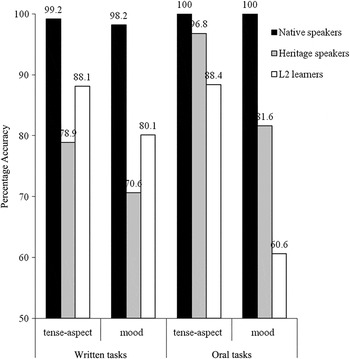
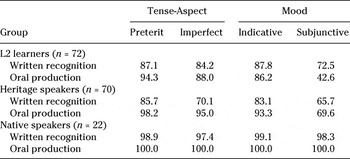
Figure 5 shows the overall accuracy results of the four tasks and Table 3 shows the results by aspect (preterit, imperfect) and mood (indicative, subjunctive) morphology. Factorial ANOVAs comparing the two experimental groups in each task yielded significant effects of tense (preterit vs. imperfect), mood (indicative vs. subjunctive), group, and Tense × Group and Mood × Group interactions (as with the gender results, native speakers are excluded from the statistical analysis because they made few errors). In the tense-aspect task, L2 learners and heritage speakers had more difficulty with imperfect than with preterit in both oral production, F(1, 142) = 4.332, p = .42, and written recognition, F(1, 142) = 15.03, p = .001, whereas in the mood task, L2 learners and heritage speakers had more difficulty with subjunctive than with indicative: oral production, F(1, 142) = 33.72, p < .001; written recognition, F(1, 142) = 36.53, p < .0001. Errors involved using preterit for imperfect or vice versa, infinitive or indicative for subjunctive, and subjunctive for indicative.
Tense-aspect and mood: accuracy on written morphological recognition task and in oral production.

Percentage accuracy on tense-aspect and mood morphology in the written recognition and oral production tasks

Figure 5 also shows that in the two written tasks, the L2 learners were significantly more accurate overall than the heritage speakers: tense-aspect, t(142) = 2.33, p < .05, and mood, t(142) = 2.54, p < .05, whereas in the oral tasks, the accuracy advantage was reversed: The heritage speakers made fewer morphological errors than the L2 learners in the narrative testing tense-aspect, t(142) = 3.50, p < .001, and in the opinion elicitation task that tested mood, t(142) = 4.47, p < .0001. The results of the L2 learners are consistent with the MSIH, but the results of the heritage speakers are not, given that in this grammatical area as well, the heritage speakers showed better morphological accuracy in oral production than in written tasks.
DISCUSSION
The current study has shown that L2 learners of Spanish and Spanish heritage speakers differ from fully fluent native speakers in the percentage rates of morphological errors with gender agreement, DOM, and tense-aspect and mood morphology in oral production and in untimed written tasks. Because inflectional morphology is (apparently) equally problematic in the two groups, the current study asked whether existing theories of morphological variability in SLA can easily be extended to heritage language acquisition. For the FFFH on the one hand, morphological variability may be symptomatic of underlying syntactic deficits: L2 learners make errors because they lack the relevant abstract morphosyntactic knowledge at the level of linguistic representations. A specific prediction of this position formulated by Prévost and White (Reference Prévost and White2000) is that L2 learners should have the same problems with inflectional morphology in oral production and untimed written tasks. On the other hand, according to the MSIH, L2 learners have the relevant abstract morphosyntactic knowledge, but given that problems arise mainly in oral production, the deficit lies in the overt manifestation of surface morphological forms. Morphological variability is a performance, not a competence, problem restricted to oral production under communicative pressure.
Although the study reported here was not originally conceived to tease apart these two competing hypotheses, the combination of tasks used made it possible to address their predictions, at least indirectly. The results of the L2 learners on all grammatical areas tested are very consistent with the predictions of the MSIH: The L2 learners exhibited higher error rates with gender, DOM, and tense-aspect and mood morphology in oral production than in the written recognition and judgment tasks. Errors typically involved the use of defaults or less specified forms in contexts in which the more morphologically specified form is required: Masculine was more often substituted for feminine than the reverse; unmarked objects surfaced in contexts requiring a-marked objects; there were more errors with imperfect than with preterit; and there were more indicative forms (or infinitive forms in oral production) used in subjunctive contexts than the reverse. Because errors of defaults used in contexts requiring the more specified form were found in the two types of tasks, our results are consistent with McCarthy’s (Reference McCarthy2008) findings and her conclusions that “morphological variability is, at least in part, a representational problem as well, and does not derive strictly from production-based limitations” (p. 483). Although proponents of the MSIH maintain that written untimed paper-and-pencil tasks are more representative of L2 learners’ true competence than oral tasks, this claim is problematic. Because these tasks are very metalinguistic, they may not be revealing of the type of abstract linguistic knowledge that should be referred to in acquisition research. If linguistic theories of acquisition are about implicit, intuitive knowledge rather than explicit, metalinguistic knowledge, the issue of how task modality may tap more or less implicit or metalinguistic knowledge needs to be addressed in generative research. Taking this distinction seriously, it may be argued that the L2 learners’ apparent access to abstract representations as evidenced from the written tasks may arise from something else. Before this point is elaborated, the other important finding of this study needs to be considered.
The heritage speakers made the same types of errors: producing and selecting default forms in contexts that required more morphologically specified forms. However, the task effect was the opposite pattern exhibited by the L2 learners and predicted by the MSIH: The heritage speakers made more errors in written recognition and untimed acceptability judgment than in oral production. If the deficit is strictly in production under pressure, clearly the MSIH does not explain morphological variability in heritage speakers. However, the results of the heritage speakers are not compatible with the predictions of the FFFH either, for at least two main reasons. The first reason is that the FFFH predicts equal performance on oral production and written tasks, but the heritage speakers had better performance on all of the oral tasks than in the written tasks. The other reason is that, for the FFFH and similar views, representational deficits in L2 learners are primarily due to maturational effects: Past puberty, L2 learners no longer have access to principles, parameters, features, or learning mechanisms available in child L1 acquisition. Because heritage speakers acquired their language in childhood, they presumably selected the relevant features for the functional categories of gender, aspect, mood, and marked objects early on. Although it cannot be denied that heritage speakers may have some sort of representational deficit as well, the source of the deficit must lie elsewhere—most likely attrition—but not in age or lack of access to UG.
It is undeniable that successful language acquisition must start in childhood when the child is exposed to rich input (in quantity and quality) and has opportunities to use the language in a variety of meaningful situations. If one of these factors is less than optimal, linguistic deficits are very likely to appear throughout development and into adulthood. This is what happens to L2 learners and to heritage speakers. Postpuberty learners start acquiring their L2 late, whereas heritage speakers are exposed to much less input than their monolingual peers throughout late childhood. Both groups usually have fewer opportunities than monolingual children to use the language in a variety of socially and educationally meaningful contexts. It could be argued that, essentially, representational deficits may be due to maturational effects, perhaps in the L2 learners, but may also be due to exposure to reduced input and limited use of the language, which are also very likely in the heritage speakers and in the L2 learners. However, the reason why the task effects are the reverse—namely, that L2 learners are better in written than in oral tasks and that heritage speakers are better in oral than in written tasks—is related to an obvious factor: language learning experience and practice.
Second language learners primarily learn the language in an instructed setting, and the learners of the current study were no exception. In a classroom context, meaningful oral production is quite limited due to class time and perhaps the type of instruction. L2 learners typically receive written input early on and engage in many reading and writing activities. Because their main experience with the language is through reading and writing, L2 learners are very literate in the L2 and also have highly developed metalinguistic skills that allow them to learn about grammar. According to Sharwood Smith (Reference Sharwood Smith2004), metalinguistic knowledge is “the type of knowledge to which we all have access to a certain extent and which we can make more sophisticated by consciously studying the intricacies of language in a more or less academic, analytic fashion” (p. 269). In fact, L2 learners are very good with tasks that rely on highly analyzed and controlled metalinguistic knowledge, such as written untimed fill-in-the-blank tasks requiring them to provide the correct form of the verb, article, and so on. If L2 learners have access to abstract representations in untimed written tasks, it is most likely that these are abstract metagrammatical representations, which lie outside the language structure module itself (according to Sharwood Smith) but which somehow interface with it. Metalinguistic knowledge is a module within the conceptual system constructed via experience. Its “resulting modular nature is necessary for fast and efficient processing. Such processors, though modular in that they run autonomously, are not encapsulated in the way the visual or core language systems are.” (Sharwood Smith, p. 269)
Heritage speakers, on the other hand, learned the heritage language in childhood, in a naturalistic setting and through interactions with family members. Because most heritage speakers in the United States have been schooled in English, they have much less developed literacy in the heritage language than in English and they also have less developed metalinguistic awareness in the heritage language. Colombi (Reference Colombi, Colombi and Alarcón1997), for example, found that many Spanish heritage speakers have the literacy skills of unschooled writers. They may use the preterit and imperfect to narrate a story in the past without much conscious reflection, but when asked to complete a phrase or a written text with the preterit or imperfect form of the verb, they usually find themselves at a loss—they do not know the grammatical labels. Heritage speakers are better in oral than in written tasks because they learned the language aurally and used it orally. They are simply better at what they have done the most. Reading and writing are typically their weaker skills.
In sum, the observed task effects in the two groups possibly arise from enhanced metalinguistic competence for the L2 learners and weaker literacy skills in the heritage speakers. The specific written tasks used in the current study overestimate the morphological competence of the L2 learners while underestimating the morphological competence of the heritage speakers. If the oral tasks, which rely less on time and conscious awareness, are more representative of automatic linguistic competence than the written untimed tasks, then it can be safely assumed that heritage speakers have superior morphological skills than the L2 learners, and a maturational account would hold in this case. In a follow-up study of gender, this issue is being investigated further by using speech perception and oral production tasks.
In conclusion, it is impossible to study abstract linguistic knowledge directly. It is only possible to study linguistic knowledge as manifested in types of language use. The comprehension and production systems, which must access the grammatical representation, are the only indirect access to those representations. What this study has shown is that there seems to be a direct relationship among mode of acquisition, type of task, and task modality. The L2 learners are morphologically more accurate in written tasks and tasks that are more explicit and metalinguistic, whereas the heritage language speakers are better at oral tasks that minimize metalinguistic knowledge and tap implicit, automatic linguistic knowledge (DeKeyser, Reference DeKeyser, Doughty and Long2003; Paradis, Reference Paradis2009). The extent of the errors in one skill or the other depends on their experience with their language and probably on how that knowledge is stored in memory and accessed (implicitly or explicitly).
The question remains of how to theoretically capture the relationship among implicit grammatical knowledge, explicitly acquired knowledge, and use of linguistic knowledge in these two types of learners, regardless of how this knowledge comes to be acquired. How can the written comprehension and oral production dissociations be explained as a function of linguistic experience in these two types of learners? Linguistic theory does not seem to recognize the distinction between linguistic and metalinguistic knowledge, which many tests used in SLA research seem to tap more directly. In contrast, theoretical approaches that recognize the two types of knowledge (De Keyser, Reference DeKeyser, Doughty and Long2003; Ellis, Reference Ellis2005; Paradis, Reference Paradis2004, Reference Paradis2009; Ullman, Reference Ullman2001) do not assume a modular theory of language, and so it is difficult to see under these accounts how the two types of knowledge are organized or how they interface with each other, if at all. A possible solution is the integration of a UG-type theory with a processing and usage-based-type theory and a processing model (comprehension and production), both of which are already available for L1 and L2 acquisition. The model proposed by Sharwood Smith (Reference Sharwood Smith2004) attempts to incorporate all of these components. It assumes a language module like UG, consisting of discrete submodules and interfaces embedded within a general cognitive system that includes a metagrammatical module. Each module (grammatical and metagrammatical) has its own processing mechanisms. Although the model is still sketchy and lacks predictive power, it is promising (see also Truscott & Sharwood Smith, Reference Truscott and Sharwood Smith2004, and commentaries).
Regardless of the right theory, some useful pedagogical implications can still be derived. Both L2 and heritage language learners will benefit from form-focused instruction in the classroom to achieve better grammatical accuracy. L2 learners should be given more opportunities to use the language in oral production; heritage language learners should continue to engage more in written activities, so that they can make a connection between how the language is used in oral production and in written texts.