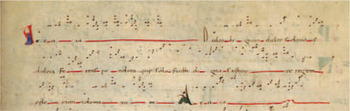
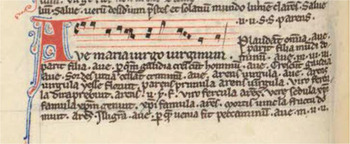
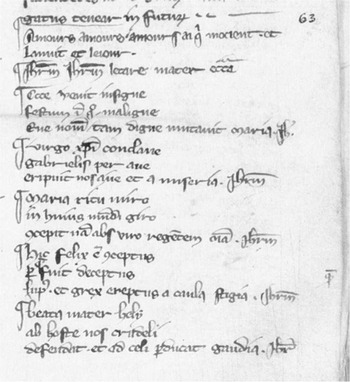
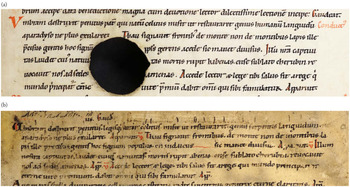
Signs in scores such as  ,
 and
 elicit a common response from musicians: repeat. Modern notation provides a number of symbols to signal repetition, whether of bars, sections or entire movements. When accompanied by lyrics, symbols morph into lexical directions, with terms such as ‘chorus’ or ‘refrain’ informing singers that already-heard material returns. Despite our ease with such symbols and directions, repeat signs of all kinds are relatively recent phenomena, more recent than other conventions of common-practice-era notation and more rarely commented upon.Footnote 1 Prior to the eighteenth century, methods for indicating repeating segments of music, poetry or both were as diverse as musical genres themselves. Ranging from explicit written-out commands to implicit or assumed instructions, repetition was at once pivotal to the creation of form and genre and yet frequently ambiguous in its visual inscription.Footnote 2
While a broader history of the signs and symbols of repetition is long overdue, one moment in the Middle Ages calls attention to an increased demand for explicit methods of cueing the return of music and text. New genres in part or wholly dependent on repetition for form, including the vernacular formes fixes, chansons à refrain, caroles and selected Latin conducti and cantilenae with refrains, flourished beginning in the twelfth century, leading to a notational dilemma for scribes: short of writing out passages again in full, how do you indicate repetition of both poetry and music?Footnote 3 The ordinatio of manuscript sources, especially of poetry, provides a broader context for this concern, with the layout or mise en page functioning as a visual guide for readers, performers and copyists of the content, form, genre and even aesthetic.Footnote 4 As song in the twelfth and thirteenth centuries embraced its visual as well as its aural identity, layout became an increasingly pressing concern.Footnote 5 The varying forms, metres and rhythmical structures of medieval song in Latin and the vernacular required techniques that both extended and added to previous approaches to writing and layout.Footnote 6 Although earlier poetic and liturgical sources featured various levels of textual and musical repetition, scribal challenges are heightened when repetition defines form and genre to the extent that it does in, for example, the early vernacular formes fixes. Since scribes lacked shared conventions for treating layout in an array of new genres, the signalling of repetition in particular varied among sources, the resulting inconsistencies furnishing, as Ardis Butterfield suggests, ‘glimpses of scribal thinking’.Footnote 7
Nowhere is this more evident than in approaches to notating the Latin refrain, a structural element in a range of interconnected genres, most especially the conductus, and an inexact parallel to, and contemporary of, the French refrain.Footnote 8 Unlike the French refrain, which could appear without a surrounding song context (lending it significance as an independent, or intertextual, genre as well as a structural component), the Latin refrain occurs within the confines of larger song forms. In other words, the Latin refrain serves a structural role, while the French refrain was not so confined. The cueing of the Latin refrain also differs from the French refrain in its close relationship to liturgical sources in terms of language, manuscript contexts and, frequently, devotional focus. Throughout the late twelfth and thirteenth centuries, the marking out of the Latin refrain showcases scribal experimentation with layout in musical and poetic sources. Simultaneously, the processes reveal indebtedness to established practices in liturgical and didactic realms and involvement in newer techniques of layout developed in the twelfth century and explored more fully in the thirteenth. I argue, moreover, that the graphic treatment of refrains in sources of Latin conducti exposes assumptions made by scribes and performers about form, genre and the realization of song in performance.Footnote 9 Attending to the visual cueing of refrains clarifies the textual and musical ambiguities arising from the simultaneously oral, written and performative milieu within which medieval song as a whole was cultivated and disseminated.
I begin here by surveying refrain-laden genres in the high Middle Ages, detailing the broader context for the signalling of refrains across linguistic and musical boundaries. The goal is to demonstrate the variety of repetition cueing found in song and the scribal challenges brought about by the emergence of new genres. While shared practices come to the fore across repertories and languages, a narrowed gaze on the Latin conductus invites consideration of a different set of visual constants and oddities in the disposition of refrains and markers of repeats. Specifically, I consider the range of ways in which the Latin refrain is indicated, initially by comparison with the contemporary French refrain, and then by means of the relationship between theoretical discussions of refrains and the material evidence of Latin refrain songs themselves. Building on the special links between many of the conventions found in Latin song sources and those in liturgical and devotional sources – particularly conventions typically not found in vernacular contexts – I delve into the intimate relationship between Latin refrain cueing and practices of cueing and abbreviation utilized in ritual and chant books. Finally, ambiguous refrain cues scattered throughout conducti preserved in two fourteenth-century liturgical sources from the university library in Graz (A-Gu 258 and 409) place the visible in conversation with the invisible. An exploration of the unusual, incomplete and absent cueing of refrains in these two related sources affords unique insights into an array of signalling techniques, as well as the ways in which the Latin refrain itself lived a richer and more complicated life than previously understood.
The refrain
By the thirteenth century, song – and by association the refrain – is virtually always set apart on the manuscript page from non-musical material, whether cued by text or rubric in a narrative or distinguished by staves and musical notation. Within each lyrical instance, a hierarchy organizes the layout of the intertwined components of text, music and form. Repetition requires an additional level of organization, allowing repeated sections such as refrains to be set apart from the remainder of the song. Broadly, lyrical moments are visually demarcated by means of a change of script, such as the use of litterae notabiliores, capital letters, a change in the ruling of the page (frequently, but not always, to accommodate notation), illustrations and rubrics.Footnote 10 Likewise, moments of repetition command their own visual cues, many identical to those used for song writ large. No single scribal protocol dictates the signalling of song and its constituent parts; at times, indications are absent, requiring the reader and/or performer to make decisions as to where and when music begins and ends, and how and what to repeat and for how long.Footnote 11 Despite intensive efforts visually to highlight moments of song and repetition therein, inconsistencies occur often, with resulting demands on the performer to decipher and realize the musico-poetic form of a given song through performance.
While I am ultimately concerned with refrains in the Latin conductus, contemporary vernacular contexts serve as a point of comparison for the Latinate realm in terms of how scribes dealt with layout and the marking off of repeated refrains in song. More importantly, no discussion of refrains and medieval song in and around the thirteenth century can justifiably avoid reference to the highly itinerant, widely disseminated and often ambiguous French refrain, whether it appears in isolation as an interpolation or is attached structurally to a song, such as a chanson à refrain, a chanson avec des refrains, a rondeau, a virelai or a ballette.Footnote 12
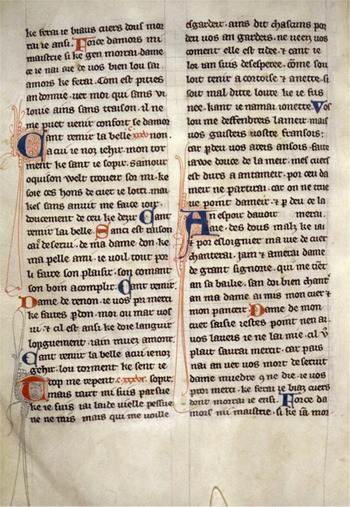
In particular, some vernacular sources provide insight into scribal negotiations around the refrain and its cueing, including moments of inconsistency that appear despite what may seem to be clear expectations of genre. Numerous instances of such idiosyncrasies litter the folios of the chansonnier GB-Ob Douce 308, an unnotated collection of Old French lyrics, many featuring refrains. A ballette whose text plays on familiar tropes of fin amour demonstrates clear signalling of its refrain (beginning ‘Cant remir la belle’) at the start of the song and at the end of each strophe; here, capital letters in alternating red and blue ink mark the incipit of each strophe and the repetition of the refrain respectively (see Figure 1).Footnote 13 Fairly unambiguous, the scribal strategy here relies on the ability of the performer to recall the entirety of the refrain (text and also, presumably, music – which, however, is lacking here) previously sung, since the cues after strophes 1 and 2 provide only ‘Cant remir lai [sic] belle’ and ‘Cant remir’ respectively. A second example is slightly more ambiguous and idiosyncratic, namely the cueing of the refrain for Dame il n'est dolors en terre (GB-Ob Douce 308, fols. 228v–229r), another ballette. In this instance, the refrain lacks any clear signal before being written out in full after the final strophe.Footnote 14 Consequently, unless a singer is already familiar with the work, they would have to know to locate the repeated portion at the end of the song, in addition to then looking to the top of the next folio for the refrain's final word.Footnote 15 Although familiarity with the conventions of the ballette form could explain away such a moment of irregularity, as could the demands of layout, these sorts of ambiguities require resolution in performance, which in turn places the onus on the manuscript's user to find and interpret cues correctly for repetition, a situation that will find a parallel in the refrain cueing of the Graz sources, discussed below.Footnote 16
GB-Ob Douce 308, fol. 229v, ‘Cant remir la belle’. Reproduced by kind permission of the Bodleian Library, Oxford.

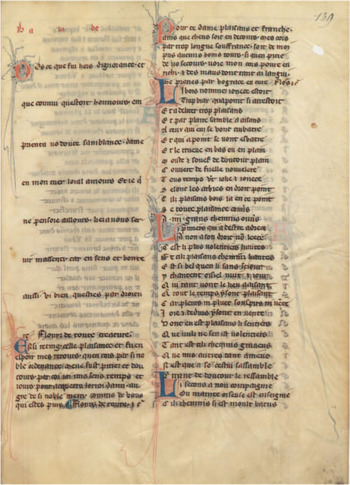
Another common strategy found predominantly in French contexts involves the Latin phrase ‘et cetera’ and its abbreviation. This method is found in the unnotated rondeaux and ballades in La prise amoureuse (F-Pn fonds fr. 24391) and serves to clarify the repetition of the refrain in its entirety (see Figure 2). In this ballade, the refrain ‘Flourz de toute creature’ appears once with empty space above for a musical stave at the end of the initial strophe (following typical ballade form); two further instances then occur following strophes 2 and 3 (for which no space was left for music). Each occurrence of the refrain is abbreviated differently: the first return after strophe 2 in the first column picks out the refrain using a blue paraph or pilcrow and ‘flours de toute et c-’ (‘et cetera’), while the second return after the third strophe lacks a paraph, but further abbreviates the refrain to ‘Flōs et c-’.Footnote 17 Despite deciding on strategies (the abbreviated ‘et cetera’ and a paraph), the scribe varies cues throughout the ballade, resulting in micro-inconsistencies.
F-Pn fonds fr. 24391, fol. 139r, Dés que je fui hors d'ignorance. Reproduced by kind permission of the Bibliothèque Nationale de France, Paris.

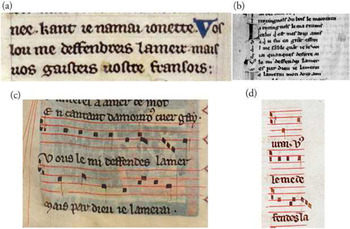
In the few vernacular examples so far, cueing marks off structural refrains. In other words, these are not the aphoristic and intertextual refrains that embody a far more independent existence and whose repetition occurs across manuscripts and genres, including chansons, motets and narrative texts. The cueing practices around the more mobile refrain respond not to a structural function, but instead to their generic identity as lyrical and intertextual insertions.Footnote 18 Consequently, the cueing of such refrains has more in common with scribal approaches to vernacular lyric more broadly, including the use of capital letters, musical notation and symbols. The family of citations for the refrain ‘Vous le me defendés l'amer, més, par Dieu, je l'amerai’ illustrates the plurality of ways in which the refrain both is and is not clearly signalled in diverse settings, including GB-Ob Douce 308 (see Figure 3).Footnote 19 In the case of the two unnotated occurrences of the refrain, punctuation in the form of a period and a blue capital in GB-Ob Douce 308 (Figure 3a) and a paraph in F-Pn fonds fr. 837 (Figure 3b) visually distinguish the refrain from its surrounding song and narrative context respectively. While an indication to sing (‘En cantant d'amourous cuer gay’) precedes the refrain in F-Pn fonds fr. 25566 (Figure 3c), musical notation serves as the clearest visual sign of its lyrical presence within the narrative, in addition to melodically linking to external iterations of the refrain.Footnote 20 In the tenor line of the motet Qui amour – Li douls pensers – Cis a cui, the refrain is virtually indistinguishable from its surroundings (Figure 3d), making its identification reliant on both its occurrence outside the motet repertory and its textual function within the motet itself.Footnote 21
(a) GB-Ob Douce 308, fol. 229v, grafted refrain, or enté, in the ballette à refrain Trop mi repent, ‘Vos lou me deffendreis l'ameir’. Reproduced by kind permission of the Bodleian Library, Oxford. (b) F-Pn fonds fr. 837, fol. 272v, refrain interpolation in Salut d'amour, ‘Vous le mi deffendez l'amer més par dieu ie l'amerai’. Reproduced by kind permission of the Bibliothèque Nationale de France, Paris. (c) F-Pn fonds fr. 25566, fol. 168r, Renart le nouvel, ‘Vous le mi deffendés l'amer mais par dieu ie l'amerai’. Reproduced by kind permission of the Bibliothèque Nationale de France, Paris. (d) F-MOf H. 196, fol. 317r, Qui amour – Li douls pensers – Cis a cui, ‘Vous le me de[f]fendés l'a-’. Reproduced by kind permission of the Bibliothèque de la Faculté de Médecine, Montpellier.

A widely circulating refrain such as ‘Vous le me’ highlights the question of how repetition and cueing function in cross-contextual ways. Although not all refrains have concordances,Footnote 22 most do appear in multiple contexts, albeit often with a variable appearance, as Figure 3 demonstrates.Footnote 23 The ‘meta’ cueing practices that signal repetition among, rather than within, sources seem to demand different scribal approaches from those utilized for structural refrains as seen in Figures 1 and 2. Yet, by the same token, scribes nevertheless drew on the same fount of strategies for song in general and refrains of all varieties, with resulting similarities in layout and a familiar range of signs, symbols and abbreviations.
In the process of inscribing song to the page, the scribes of these few sources were well aware that certain genres involved melodic and textual repetition within and across contexts, often owing to the presence of refrains. By and large, the signalling of structural repetition was driven by necessity, leading to practical solutions such as the Latin ‘et cetera’ or the compressing of a repeated line to its incipit. More problematically, refrains whose repetition occurs at the intertextual rather than the structural level illustrate an even more varied approach to cueing, while still reflecting many of the tactics used for and within individual songs. The cues used in vernacular settings, many of which echo innovative experiments occurring in other material aspects in the life of French lyric, mirror to some degree the cueing of structural Latin refrains. While the refrain of Latin repertories did not have the same poetic currency and, in most cases, mobility as the French refrain, certain instances do bear witness to a shared lineage and perhaps even a shared audience. As I explore below, some Latin refrains embodied a peripatetic existence that blended the itinerancy of the intertextual French refrain with its structural counterpart; in all cases, the Latin refrain demanded scribal solutions that are both similar to and yet at a remove from contemporary vernacular contexts.
The Latin refrain
Latin refrain forms rose to prominence at the same historical moment as the vernacular refrain, the central difference being that the Latin refrain never appeared to attain the level of independence that the French refrain repertory enjoyed.Footnote 24 Nonetheless, commonalities led some musicologists to posit a lineage for the French formes fixes from Latin to the vernacular, since formal parallels between certain chanson genres and Latin conducti and cantilenae are at times striking, most notably with respect to the rondeau.Footnote 25 In this unsolvable chicken-and-egg scenario, questions of chronological priority do not detract from the richness of the Latin refrain song repertory – works variously labelled in both contemporary and medieval sources as cantio, cantilena, conductus, versus and so on.Footnote 26 Unlike French song forms such as the rondeau, virelai and chanson à refrain, the labels available for Latin song do not explicitly or implicitly convey the presence of a refrain. Only subsections of the conductus and versus repertories, for example, feature refrains, and in neither case is there a terminological distinction between those with and those without refrains. In Grocheio's famed – if problematic – description of music ‘made with the human voice’, he divides song into two broad theoretical categories, cantus and cantilena, the division between which falls precisely at the point of presence or absence of structural repetition.Footnote 27 The cantilena category includes refrain forms, while the cantus category does not.Footnote 28 A useful if ambiguous heuristic, Grocheio's categorization according to the parameter of form and structure is one of the few instances in the period where distinction between songs with and without refrains is clearly acknowledged. Less usefully, Grocheio's examples derive solely from the realm of vernacular song, with no hint of a parallel system of classification for Latin song.
Manuscript sources provide material evidence confirming Grocheio's organization according to the inclusion or exclusion of repetition, suggesting that such a schema may have derived from practice in both vernacular and Latin contexts. Like is grouped with like in many chansonniers, and so it is for a number of sources transmitting Latin conducti. Three of the largest thirteenth-century sources for Latin conducti with refrains illustrate the distribution of song forms along the lines of Grocheio's categories for vernacular song. In the largest of the sources (the famed collection of polyphony and monophony from mid-thirteenth-century Paris I-Fl Plut. 29.1), 60 Latin songs, almost all featuring refrains, are grouped together in one fascicle at the end of the manuscript (fascicle XI).Footnote 29 In a manuscript that uniquely transmits the Jeu d'Adam and a Latin Easter drama, F-TOm 927, once again Latin refrain-form conducti (31 in total) are collected together, sandwiched between plays in both Latin and French, and interrupted only briefly by a polyphonic insert.Footnote 30
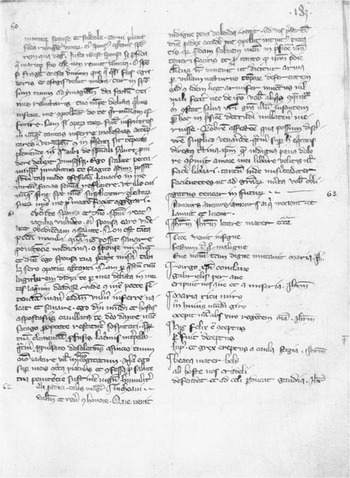
The third source, a text-only miscellany also from Paris, F-Pn fonds lat. 15131 (c.1289), contains a large selection of devotional Latin lyrics not grouped according to form, but instead alternating forms predictably.Footnote 31 Refrain songs punctuate the folios regularly, with paraphs and dividing lines adumbrating their form (see Figure 4). Despite a lack of grouping around formal types, the consistency with which the scribe orders the collection illustrates awareness of the different forms. Since, as seen in Figure 4, the lyrical interjections assert themselves on the page by means of a distinctive mise en page, their regular appearance lends the collection visual as well as lyrical coherence.Footnote 32
F-Pn fonds lat. 15131, fol. 183r. Reproduced by kind permission of the Bibliothèque Nationale de France, Paris.

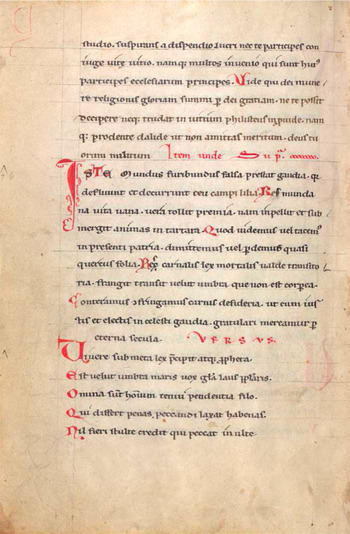
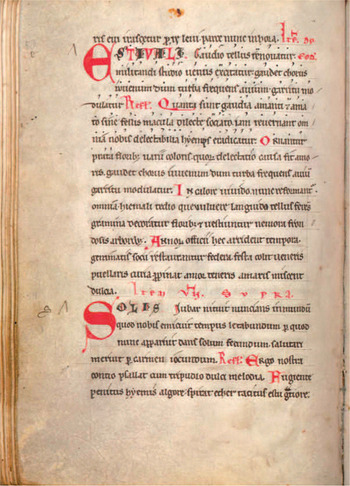
While terminology around Latin song and its refrains may be unclear, manuscript ordering reveals consistent scribal treatment according to underlying structures.Footnote 33 Layouts utilized for Latin song further distinguish between forms in a manner readily apparent to the eye. One of the principal distinctions in both notated and unnotated sources occurs between rhythmical and metrical verse, where rithmi – rhymed, rhythmical versesFootnote 34 – are commonly written as prose, in contrast to metrical verse, for which their stanzaic form is emphasized visually. As Pascale Bourgain argues, this is because rhythmical poetry was so clear aurally in comparison with metrical works, and therefore did not require the same level of attention to layout on the page.Footnote 35 In Figure 5, the scribe of the poetic anthology in the early thirteenth-century D-Mbs clm 4660 (Carmina burana) indicates the alternation between rhythmical poetry (Iste mundus furibundus) and metrical verse (Vivere sub meta lex) in two ways: first through the use of a rubric for the latter (‘versus’) and secondly through layout, organizing the rithmus visually as prose and the versus as stanzaic verses. In both poems, large red initials open the text and smaller red initials emphasize the beginnings of verses or strophes. In an example where lyrical poetry intermingles with epistolary material, the verse structure is emphasized not solely through the layout of the text, but also with the aid of pilcrows or paraphs to organize each strophe (see again Figure 4). The use of both a layout that highlights the poetic form – in this case that of a strophic lyric with refrain – and a visual symbol to clarify the structure further lends the folio a modular and easily navigable appearance. These are but two ways in which Latin lyrics are distinguished from one another as well as from surrounding material; many more strategies are found in both Latin and vernacular sources.Footnote 36
D-Mbs clm 4660, fol. 2v. Reproduced by kind permission of the Bayerische Staatsbibliothek, Munich.

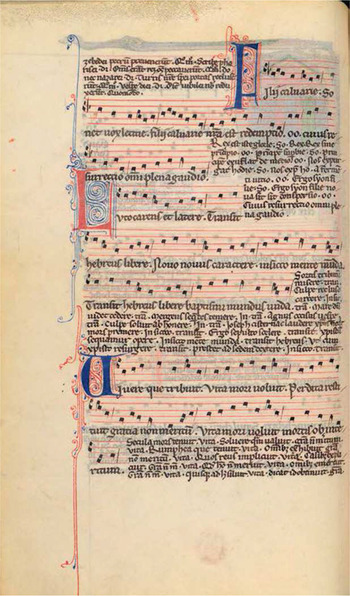
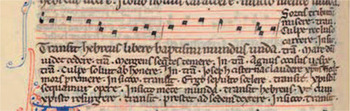
The strophic nature of Latin songs with refrains lends them an appearance on the page comparable to the layout of strophic hymns.Footnote 37 The text of the first strophe along with the music shared by all the following strophes is fully written out; subsequent strophes are written, much like the rithmus of Figure 5, in prose-like fashion directly following and below the notated verse (see Figure 6). Each of the three conducti found on this folio (in order, following the final tail of In hac die dei from fol. 463r: Filie calvarie, Luto carens et latere and Vivere que tribuit) features a refrain of varying length. The refrain is not immediately obvious when scanning the sole system of music and text; only in the following (unnotated) poetic stanzas does the form become obvious. To take Luto carens et latere as an example, the second of the four short lines of text following the final system of music includes a truncated word set apart with interpuncts: •tran• (see Figure 7). Scanning each line of text, interpuncts alert the reader/singer to abbreviated or truncated segments of text, from •In trā• to •transit•. Referring back to the notated initial strophe (Figure 6), the word ‘transit’ occurs twice, first at the end of the first system, in ‘Transit Hebreus libere’, and then at the beginning of the third system, in ‘In sicco mente munda / Transit Hebreus libere / Baptismi mundus unda’. This is, of course, the refrain, whose repetition leads to the following poetic structure (refrain in italics):
I-Fl Plut. 29.1, fol. 463v. On concession of the MiBACT. Further reproduction by any means is forbidden.

I-Fl Plut. 29.1, fol. 463v, detail of Luto carens et latere, strophes 2–7. On concession of the MiBACT. Further reproduction by any means is forbidden.

| Luto carens et latere, | Casting aside bricks and mortar, |
| Transit Hebreus libere, | The Hebrews freely crossed, |
| Novo novus charactere; | Renewed with a new character; |
| In sicco mente munda; | On dry land, with wholesome mind; |
| Transit Hebreus libere, | The Hebrews freely crossed, |
| Baptismi mundus unda. | Cleansed by the waters of baptism. |
The form is the same as the earliest French rondeaux, with the first half of the refrain appearing following the initial line of the verse, and then the entirety of the refrain repeated at the end of each strophe (aAaBAB).Footnote 38 The interpuncts thus signal the interjection of the refrain following the first and third lines of strophes 2–7.
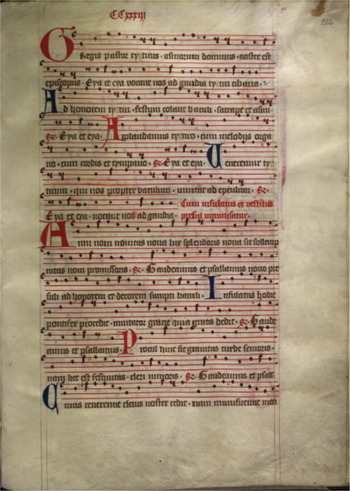
As a counterpoint to the layout of Luto carens et latere, a fourteenth-century gradual from Moosburg (D-Mu Cim. 100) includes over two dozen devotional Latin songs with refrains in a cantionale located near the end of the manuscript. Here, despite the repetition of music for each strophe and the refrain, the entirety of each poem is notated in full, and interpuncts marking off the refrain are accompanied by additional textual directions (see Figure 8). Large capitals alternately red and blue cue the entrance of each new strophe, with smaller capitals highlighted with red furthering the visual hierarchy of the page. Notably, these smaller capital letters are preceded by an entirely red letter, a capital R with a slash, comparable to the monogram used to indicate responses in liturgical sources. Taking the second song on the page as an example, Anni novi novitas, the first slashed red R – bookended by interpuncts – precedes the line ‘Gaudeamus et psallamus / novo presuli / ad honorem et decorum / sumpti baculi’. When the red R returns, the line contracts to ‘Gaudeamus et psallamus’, and then ‘Gaudeamus et psall.’; the music similarly contracts. The abbreviation of the poetry and the regular appearance of the R cue clearly identify this as the refrain; the scribe leaves nothing to the imagination here, preferring instead to signal the song's structure explicitly, including moments of repetition.
D-Mu Cim. 100, fol. 232r. Public domain.

With these few examples, we begin to gain an impression of the spectrum of cueing practices used in notating Latin songs and their refrains. Particularly significant are the differences between the final two Latin song examples, Luto carens et latere and Anni novi novitas, and the cueing of French refrains in the previous examples; while they share some traits, the cueing of repeated text and music even in these few selected instances demonstrates differences in the move from vernacular to Latin. While there may be many reasons for this – distinctively separate scribal cultures and conventions, different audience/performer demands and so on – a key feature of the Latin conductus is its indebtedness to the liturgy and its manuscript conventions. Specifically, scribal practices in liturgical sources, including the use of rubrics and abbreviations, served as either conscious or unconscious models for the signalling of the repetition in Latin song in a way that does not match the cueing of vernacular refrains.
From ritual responses to devotional refrains
When it came to inscribing new genres of poetry and music, scribes permitted themselves a certain flexibility in the mise en page by both developing entirely new approaches to layout and freely assigning new uses to old signs.Footnote 39 Chief among these ‘old’ signs were the various abbreviations and cues strewn throughout liturgical sources to indicate the repeated segments in responsorial genres or to indicate a chant that either was familiar enough that it did not need to be written out or else appeared earlier in the same manuscript. In all these cases, we find conventional methods for communicating repetition to singers. While some of these notational conventions occasionally migrated into vernacular contexts, it is in the Latin song repertory that liturgical cueing practices resonate most strikingly. This is not without reason; in contrast to the way in which French refrains were preserved in chansonniers and narrative sources, Latin song frequently appeared alongside or within liturgical sources, including tropers, graduals and ornamented festive offices.Footnote 40 The proximity of Latin song to the liturgy in terms of physical sources (not to mention language and devotional content) understandably led to shared scribal habits when it came to solving the notational problem presented by refrains.
In the examples of Luto carens et latere and Anni novi novitas above, two main strategies for refrain cueing are highlighted, both dependent on abbreviation. These strategies survive prior to the cultivation of refrain songs in liturgical contexts, underscoring the relationship between the Latin liturgy on the one hand, and Latin song and its associated scribal culture on the other. The first is a traditional kind of abbreviation, where the repeated text is foreshortened in a number of ways (as in, for example, acronyms). The second strategy is the use of a textual cue, typically a capital ‘R’ that could represent a variety of Latin nouns and verbs conveying Repetition or Return; this, too, is a type of abbreviation, albeit of the symbolic kind and based on the addition rather than the subtraction of information (that is, the visual addition of the letter R). Abbreviation and the R cue were the standard methods of notating repeated music and text in liturgical books, and it is these that infiltrate the non-liturgical Latin repertory.Footnote 41
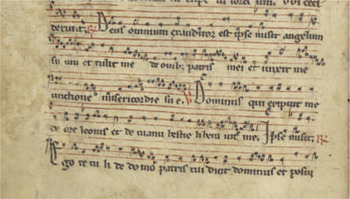
The R cue is the most significant clue in sources of non-liturgical song, since it appears almost entirely within Latin contexts. When the R appears in liturgical books, it typically indicates responsorial performance of antiphons or responsories, genres whose very names are linked etymologically in Greek and Latin, respectively, to repetition and responding.Footnote 42 A page from a Lyons antiphoner dating from the thirteenth century shows the alternation of verses and responses, along with their concomitant abbreviations as slashed ‘V’ and slashed ‘R’ (see Figure 9). In this and related instances, the R is relatively unambiguous, referring to the genre of the chant as well as its structure. The capital letter (depicted here, as in most liturgical books, with a slash on the leg of the letter) aids the singer in navigating a busy page like fol. 145r in US-PHu codex 1590. What the abbreviation in liturgical contexts such as this does not do, however, is indicate repetition; rather, the repetition of the repetendum or response is cued with an incipit (here, with the words ‘Ipse misit’ and its accompanying melodic incipit).Footnote 43 The abbreviation is thus textual, not symbolic. This is not always the case; the R can also signify ‘repetendum’, and therefore a return to a previous segment of the chant.
US-PHu codex 1590, fol. 145r, thirteenth-century French antiphonary (?Lyons), verses (‘V’) with responses (‘R’). Reproduced by kind permission of the Kislak Center for Special Collections, Rare Books and Manuscripts, Philadelphia.

Removed from the context of chant, the use of R as a cue results in terminological ambiguity. Outside liturgical sources, R does not refer to responsories;Footnote 44 at the same time, however, it maintains a link to the responsorial form and repeated repetendum by its positioning in relation to the Latin refrain.Footnote 45 In a sense, it almost does not matter what the letter stands for – in each and every instance, the R cue precedes an identifiable refrain in Latin song repertories. In theoretical terms, given what evidence we have for the etymology of the refrain, the designation ‘refrain’ virtually always involves the Latin prefix ‘re-’, implying in the construction of the word the element of turning back or repeating, much as it does in English (hence return, reiteration, rebirth and so on). Among the few theorists to label the refrain, Grocheio borrows the liturgical ‘re-’ term (‘responsum’) while also introducing the term refractus (from refringere), the latter connoting the idea of ‘breaking’ into a lyric with the refrain.Footnote 46 In an anecdotal rather than a theoretical context, Gerald of Wales likewise struggles to choose between two terms, offering both refectorium and refractorium.Footnote 47 The former denotes the idea of ‘refreshing’ (thus its more familiar use as the name for the refectory or dining area in monasteries), while the latter derives from the same root as Grocheio's refractus, namely refringere, to break open or into. As slippery as the terms used for repetition seem to us now, they were clearly equally ambiguous to medieval writers. Also of note is that these terms largely do not explicitly (except by means of their prefix) convey the sense of repetition that the refrain provides in lyrical settings. This seeming disjunction has resulted in the hypothesis that the refrain and its related vocabulary emerged from its functional role as a structural interruption or rupture in song, rather than its inherent repetitiveness.Footnote 48
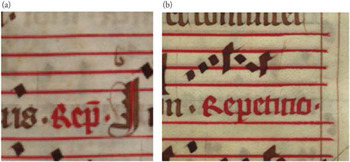
The question of whether the scribes involved in writing Latin song understood the refrain to be a return or a rupture is partly answerable by considering extant examples where R expands into a decipherable word. In other words, the scribes develop their own terminology for the refrain which, albeit limited, differs from that offered by Grocheio, Gerald of Wales and others. The first example has already been seen in Figure 8 above, with the R cue preceding the refrain of the new year's song Anni novi novitas in D-Mu Cim. 100. Although the R is liberally used throughout the cantionale (including on the first folio, where it also appears as ‘Rep.’), it is not until many folios into the lyrical collection that the R expands outwards into ‘Repetitio’, preceding the refrain of Ecce venit de Syon (see Figure 10). Footnote 49 Although three different forms of the same cue are used in the cantionale, ‘R’, ‘Rep’ and ‘Repetitio’, it nevertheless takes several folios and songs for the full word to emerge. Before reaching fol. 233v, the scribe relies on context and familiarity with the R as it functions in a similar manner within the liturgy to allow for an accurate interpretation of repetition in the songs. Significantly, D-Mu Cim. 100 is not the only source for Latin song in which ‘repetitio’ or its abbreviation is found. In A-Gu 258, the strophes of the song Dies ista colitur are each preceded by a V with a macron (an abbreviation more typically used to signal liturgical verses), while ‘repetitio’ precedes the refrain (see Figure 11). Here, however, the refrain line following the cue appears only at the end of the entire poem, rather than being inserted after each strophe (a complexity discussed in detail below). Yet, in both D-Mu Cim. 100 and A-Gu 258, the expanded abbreviation ‘R’ into ‘Repetitio’ leaves little room for interpretation.
Expanded R abbreviations in D-Mu Cim. 100. (a) fol. 231r (Castitatis psallamus); (b) fol. 233v (Ecce venit de Syon). Public domain.

A-Gu 258, fol. 2v, Dies ista colitur with ‘V’ preceding strophes and ‘Repetitio’ preceding final statement of refrain. Reproduced by kind permission of the Universitätsbibliothek Graz.

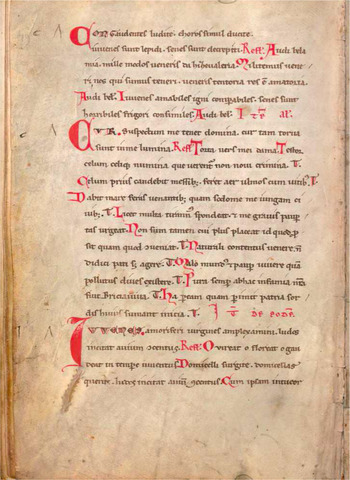
A more ambiguous spelling out of an ‘R’ cue occurs in D-Mbs clm 4660, where throughout the lyrical collection the abbreviation ‘Refl.’ alerts singers to the presence of refrains (see Figure 12). Although never fully spelled out, the abbreviation suggests some form of reflecto, reflectere, to turn back or turn around.Footnote 50 Adding further ambiguity, neither ‘Refl.’ nor the refrain text appears again within individual poems, making its performance after each strophe assumed but not explicit. Resolving such ambiguities, however, are examples like those found on fol. 49v, where three refrain lyrics are inscribed one after the other: Congaudentes ludite, Cur suspectum me tenet domina and Juvenes amoriferi (see Figure 13). In each case, the refrain is treated slightly differently, although all three lyrics utilize ‘Refl.’ before the first statement of the refrain. In Congaudentes ludite, the bilingual refrain beginning ‘Audi bela’ is initially cued with ‘Refl.’ and written out in its entirety. Each of the two subsequent strophes are followed only by the two-word incipit ‘Audi bela’. The second song, the similarly bilingual Cur suspectum me tenet domina, likewise includes ‘Refl.’ before the written-out French refrain ‘Torta vers mei dama’, but indicates subsequent statements of the refrain only with ‘T.’ Finally, the third song, Juvenes amoriferi, indicates the refrain only once with ‘Refl.’ and thereafter follows the example of Figure 12 by omitting any further cues. The sheer variety and inconsistency in cueing that manifest on a single folio point to the continual labour on the part of the scribe to determine the best way of notating refrains.
D-Mbs clm 4660, fol. 34v, Estivali gaudio tellus renovatur and Solis iubar intuit. Reproduced by kind permission of the Bayerische Staatsbibliothek, Munich.

D-Mbs clm 4660, fol. 49v, Congaudentes ludite, Cur suspectum me tenet domina and Juvenes amoriferi. Reproduced by kind permission of the Bayerische Staatsbibliothek, Munich.

The refrains in D-Mbs clm 4660 as well as D-Mu Cim. 100 combine two forms of cueing – the use of textual clues such as ‘R’ and ‘Refl.’ and the suspension or contraction of the refrain itself. The latter method of cueing is common throughout vernacular and Latin sources, and finds ample precedent in liturgical books. Suspension generally refers to the use of the first letter of a word or words, and contraction refers to abbreviation down to a few chosen letters.Footnote 51 The most plentiful example of the latter is the contraction of the sacred refrain ‘Alleluia’ down to its constituent vowels, ‘AEUIA’, paralleling the similar contraction of the lesser doxology ‘Euouae’ (from the closing ‘saeculorum Amen’).Footnote 52 Instances abound in liturgical books in the pages around Easter when the Alleluia (bid farewell at the beginning of LentFootnote 53) is welcomed back into the church. One way of orientating oneself in a liturgical book calendrically is, in fact, to leaf through until abbreviated Alleluias catch the eye. An example from F-Pn fonds lat. 780 demonstrates that even when a scribe has the space to spell out ‘Alleluia’ fully, the abbreviated form is still preferred (see Figure 14). While a novice to medieval manuscripts may be perplexed by the incessant use of ‘AEUIA’, for the medieval reader or singer it was utterly commonplace – a musical and textual reflection of a practice that any student would have been familiar with from memorizing the psalter during the initial years of a religious education. The psalms were frequently signalled with abbreviations in the form of suspensions and contractions: Psalm 1, ‘Beatus vir qui non abiit in consilio impiorum’, for example, would appear as solely the incipit ‘Beatus vir’ or ‘Beatus vir &c’, as well as fully abbreviated to ‘b.u.q.n.a.’Footnote 54
F-Pn fonds lat. 780, fol. 74r. Reproduced by kind permission of the Bibliothèque Nationale de France, Paris.

This same procedure of suspension and contraction is used to differing effects in notated and unnotated Latin lyrics. In a song such as Ave Maria virgo virginum (in I-Fl Plut. 29.1, fol. 469v), the two discrete refrains that comprise the repeated portions of the song are presented in similarly abbreviated forms: •Ave• and •ave•m•u•u• for ‘Ave Maria virgo virginum’, the first refrain, and •arens•, •arēs• and •arens•u•y•f• for ‘Arens virgula Yesse floruit’, the second refrain (Figure 15). What makes this example unusual is not solely the presence of two refrains (one of only a handful of Latin songs with variable refrains), but also the variety of ways in which the scribe abbreviates the two texts. Although this example survives with notation, the refrain cues never occur alongside notation, thus resembling the cueing of unnotated sources such as F-Pn fonds lat. 15131. Throughout the lyrical collection of F-Pn fonds lat. 15131, refrain abbreviations are arranged along the right side of the lyric, further underscored by paraphs along the left side, which are used to organize the underlying strophic structure (see Figure 16).Footnote 55 The abbreviation of the first word of the refrain to the right of the strophes – from ‘Jherusalem’ to ‘Jhrm’ – reveals unmistakably the repetitive form of the lyric. Unlike Ave Maria virgo virginum, here the scribe contracts the refrain consistently, echoing the regular treatment of refrain lyrics throughout the collection.
I-Fl Plut. 29.1, fol. 469v, Ave Maria virgo virginum. On concession of the MiBACT. Any further reproduction by any means is prohibited.

F-Pn fonds lat. 15131, fol. 183r, Jerusalem, Jerusalem, letare mater ecclesia. Reproduced by kind permission of the Bibliothèque Nationale de France, Paris.

Whether through abbreviated cue words or through abbreviation of the refrain itself, the layout of Latin song owes a debt to cueing practices in liturgical sources. In liturgical and extraliturgical contexts, abbreviations stem from at least two interrelated impulses, the first a practical impulse to value space and labour, and the second, more abstractly, a desire to articulate underlying formal structures visually. In both cases, refrain abbreviation demonstrates reliance on both short- and long-term memory and an expectation of form. In the absence of fully written-out repeats of the refrain, signs, symbols and abbreviations are left to remind a singer what to perform, creating an implicit reliance on previous familiarity with a given text, melody and underlying form. In deluxe manuscripts such as I-Fl Plut. 29.1, where clarity of presentation was highly valued, refrains and their position in individual songs are virtually always indicated clearly. Yet it is not always true that refrains are consistently and unambiguously cued, and this presents problems for both scholars and performers.Footnote 56 So what are the implications for performance – and for the status of the Latin refrain more generally – when cueing practices in song alternate between absence and ambiguity?
Unmoored refrains
Two fourteenth-century manuscripts from the Benedictine abbey of St Lambrecht in Austria, now in the University Library of Graz, preserve traces of earlier Notre Dame repertory, specifically conducti: A-Gu 258 and 409.Footnote 57 In each of the sources, together containing a miscellaneous combination of practical and liturgical materials, a collection of partly notated Latin conducti with refrains is embedded within a larger collection of 54 conducti and other poetic texts.Footnote 58 In A-Gu 258, 8 out of 12 conducti include refrains of varying forms and lengths, and in A-Gu 409 those numbers expand to 32 out of 39. Within this combined total of 40 refrain songs, only six are concordant between the two sources. At least 22 of the refrain-form conducti have concordances outside the Graz sources, although not all concordances have the same, or even any, refrain (see Appendix 2). The strophic lyrics in A-Gu 258 and 409 are clearly unusual: not only do they include a remarkably high ratio of conducti with refrains compared with those without, but also the form and cueing of the songs throughout a mere handful of folios in each source represent some of the most ambiguous within contemporaneous Latin repertories. The haphazard cueing in the conducti of A-Gu 258 and 409, however, shines light on practices around the Latin refrain, pointing to both the importance of examining the scribal habits around refrain notation and its implications for performance practice and interpretation.
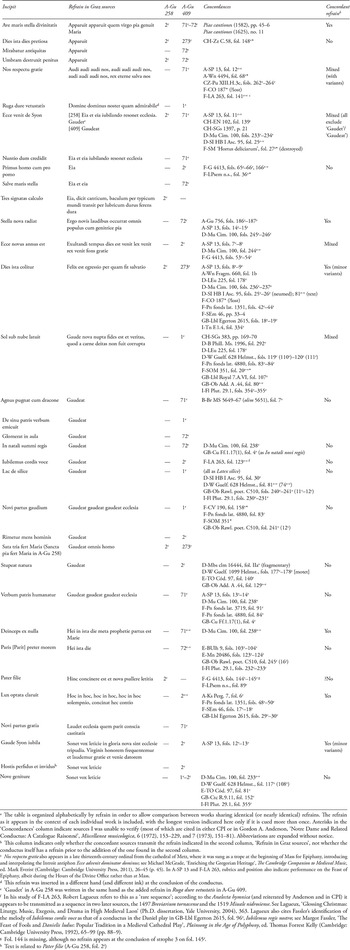
The lion's share of the refrain-form conducti utilizes only six distinctive refrain incipits, with the majority reusing a mere four refrain incipits (see Table 1).Footnote 59 The picture conveyed by this table is far more familiar in the context of the French refrain, where concordances and reuse within and among sources are readily anticipated.Footnote 60 In Latinate contexts, the sharing of refrains among several works is rare enough to remain virtually unnoticed. Yet in these two ‘marginal’ sources, refrains freely roam from lyric to lyric, occasionally evolving in length or word order, but always retaining an identical incipit or cue word.
| Refrain incipit | Occurrences in mss | Totals | |
|---|---|---|---|
| 258 | 409 | ||
| Gaudeat | 1 | 12 | 13 |
| Apparuit | 3 | 4 | 7 |
| Eia | 2 | 4 | 6 |
| Sonet | 0 | 3 | 3 |
| Felix | 1 | 1 | 2 |
| Hei [in] ista die | 0 | 2 | 2 |
In perusing the collections of conducti, their generic identity is unambiguous, with red rubrics clearly proclaiming (at least in A-Gu 409) the lyrics to be conductus. Refrains are less immediately obvious to the eye in the absence of interpuncts and symbols, and abbreviations are utilized throughout the lyrics, and not solely in refrains, furthering the visual complexity of the layout. Similarly, capital letters highlighted with red begin all strophes, as well as refrains and references to the Virgin Mary, making visual distinctions based on colour and letter-case challenging. Further complicating the situation in A-Gu 409 is the fact that refrains are normally cued only once, each time following the ultimate strophe of the conductus; there are only three exceptions where the refrain copied at the end is complemented by internal, typically short, refrains.Footnote 61 Essentially, without recourse to concordant sources, the conducti in A-Gu 409 superficially seem to lack refrains. In A-Gu 258, conversely, refrain cues in half of the conducti appear following each strophe, while in the other half the refrain is appended solely at the end, as in A-Gu 409. Likewise, the scribe in A-Gu 258 utilizes the cue word ‘repetitio’ preceding the refrain of one conductus, Dies ista colitur – the only clear reference in either manuscript to repetition; yet here, too, the refrain and its accompanying ‘repetitio’ cue occur only at the end of the poem (see Figure 11 on p. 297).
Far more frequently in the Graz sources, refrains lack explicit signalling. How, then, are refrains recognized as such? Most of the time, what I label ‘refrains’ are actually ‘tags’ ranging from one to several words attached solely to the end of poems (see Figure 17a below). Given this unusual layout, one approach to discerning poetic form is to attend to the disjuncture that the appended refrain creates with the preceding rhymed, rhythmical and symmetrical strophes (see Table 2). As the scansion of Ave maris stella divinitatis illustrates, the strophes follow an identical pattern with respect to syllable count, rhyme scheme and accent, and only in the final lines is this interrupted by a move to eight-syllable and three-syllable lines and a proparoxytonic stress. As a whole, the lyrical appendages interrupt the scansion of the poem in some way, demonstrating a break (to echo the theoretical emphasis on refringere, ‘to break’, as the etymology of the refrain) from the preceding context and suggesting instead more independent roles as refrains.
| Lyric | Syllables | Rhyme | Accent Footnote a |
|---|---|---|---|
| 1. Ave maris stella, | 6 | a | p |
| Divinitatis cella, | 7 | a | p |
| Virgo castitatis, | 6 | b | p |
| Radix sanctitatis, | 6 | b | p |
| Genitrix eterne claritatis. | 10 | b | p |
| [strophes 2–4] | |||
| 5. Virgo singularis, | 6 | a | p |
| Maria stella maris, | 7 | A | p |
| Salus in procella, | 6 | b | p |
| Regalis puella, | 6 | b | p |
| Dominum pro nobis interpella. | 10 | B | p |
| refrain | |||
| Apparuit, apparuit, | 8 | a | pp |
| Quem virgo pia genuit | 8 | a | pp |
| Maria. | 3 | b | p |
a ‘p’ = paroxytonic stress; ‘pp’ = proparoxytonic stress
Evidence of refrains far less reliant on the interpretation of lyrical breaks can be found in concordances between and beyond the two Graz sources. Taking a conductus unique to the Graz sources as an example, Umbram destruxit penitus, the relative absence of cueing in A-Gu 409 finds clarity in the consistent cueing of A-Gu 258 (see Figure 17). In A-Gu 409, periods punctuate the continuous lines comprising the four strophes, followed after the final strophe by ‘Apparuit’ with a capital ‘A’ (capital letters usually indicate the beginning of a new strophe) and a period. Conversely, in A-Gu 258, the first two strophes are followed by ‘Apparuit’ (both with a capital ‘A’ and a period after the word), and the second two strophes by the abbreviation ‘App.’ With the version in A-Gu 258 as an intertext, the appended ‘Apparuit’ in A-Gu 409 emerges more clearly as a refrain that, in performance, would be inserted after each strophe. In both manuscripts, however, only the word ‘Apparuit’ (‘He appeared’) is included, suggesting a one-word refrain. Yet Table 1 includes seven instances between the two sources of the ‘Apparuit’ refrain, and among these, five include only this one-word incipit or, even more troubling, its abbreviation as ‘App.’ Only once in each source does the refrain expand outwards, becoming the lengthier ‘Apparuit, apparuit quem virgo pia genuit Maria’ (‘He appeared, he appeared, he who was brought forth from the holy Virgin Mary’), in both cases appended to Ave maris stella divinitatis. The single word ‘Apparuit’ seems to function as a cue not only for the refrain within an individual lyric, but also for the longer version of the refrain found elsewhere in each source. Such is the situation, too, for the other shared incipits, although the ‘Gaudeat’ and ‘Eia’ refrains vary, making it difficult at times to discern the fully expanded form of the refrain.
(a) A-Gu 409, fol. 72r; (b) A-Gu 258, fol. 2r. Umbram destruxit penitus. Reproduced by kind permission of the Universitätsbibliothek Graz.

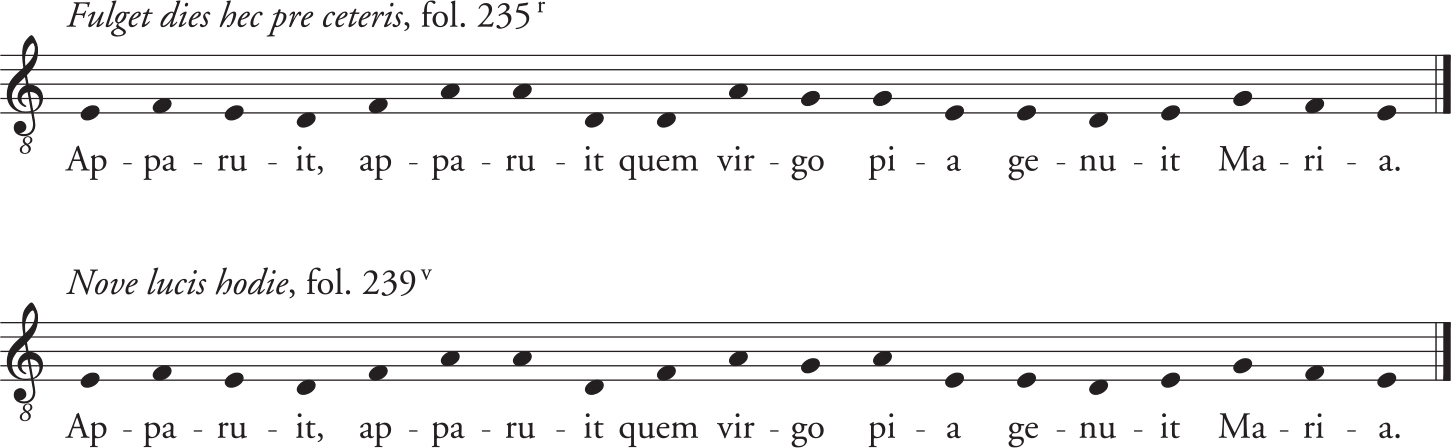
In the case of more variable refrains, as well as the ‘Apparuit’ complex, external concordances shed light on the situation in the Graz sources. The ‘Apparuit’ refrain belongs to a complex of Christmas songs known by its Latin incipit Resonet in laudibus, with origins in Nativity dialogues.Footnote 62 In the Graz sources, ‘Apparuit’ is unmoored from its place in any dramatic scene and instead is linked to a series of strophic conducti celebrating Christ's Nativity. This parallels the role of the refrain in D-Mu Cim. 100, where it appears notated in two songs, Fulget dies hec pre ceteris (fol. 235r, for Christmas) and Nove lucis hodie (fol. 239v, for the Virgin Mary). This source also offers a glimpse into the possible music for the refrain in the Graz sources, where it survives without notation (see Example 1).Footnote 63 In D-Mu Cim. 100, unlike in the Graz sources, the ‘Apparuit’ refrain is clearly cued after each strophe. In Fulget dies, the cue ‘repetitio’ and its abbreviation ‘R’ precede the refrain, while Nove lucis hodie has only the latter abbreviation; in both songs the refrain appears written out fully after the first strophe and thereafter is contracted to a two-word incipit ‘Apparuit, apparuit’. The identities of other single-word refrains in the Graz sources are confirmed by similar concordances, although in some cases the concordances either do not have a refrain at all or have a different refrain (for example, In natali summi regis in A-Gu 409, fol. 72r, is also transmitted in D-Mu Cim. 100 with a variable refrain and in GB-Cu Ff.1.17(1), fol. 4r without a refrain at all). In other words, the Graz sources at times add refrains to songs, elaborating works by ‘troping’ them with repeated segments of text and music. This is especially striking with respect to conducti such as Nove geniture, Ecce venit de Syon and Verbum patris humanatur, which survive with refrains in other sources; the addition of refrains in the Graz sources represents the doubling of repetitive and structural elements in each conductus.
‘Apparuit’ refrains in D-Mu Cim. 100 from Fulget dies hec pre ceteris (fol. 235r) and Nove lucis hodie (fol. 239v)

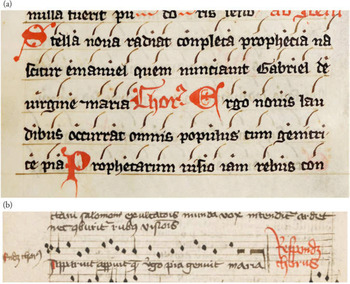
One possible hypothesis is that the Graz sources reflect a practice of adding, in performance, familiar and communal responses, refrains that the community of singers knew from other songs and could freely tack on to other works. That the refrains in the Graz sources could have been sung chorally is attested in at least two other concordant sources, A-Gu 756 and CH-SGs 392 (see Figure 18).Footnote 64 The refrains of both Stella nova radiat and Nove lucis hodie survive in the Graz sources (although the latter conductus poem does not) with the refrains beginning, respectively, ‘Ergo novis’ and ‘Apparuit’. However, the use of the rubric ‘chorus’ preceding the refrains in A-Gu 756 and CH-SGs 392 marks these as noteworthy witnesses of performance practice. More descriptive than terms such as repetitio and reflectio, these choral rubrics emphasize responsorial performance initiated by the entrance of the refrain. Particularly in CH-SGs 392, the monophonic refrain interrupts three-part polyphonic strophes, highlighting the literal and figurative coming together of voices in the response. Considering that concordances for these performative refrains exist in the Graz collections, it is tempting to posit a similarly choral performance practice, one in which a curated collection of responses could serve a range of lyrical settings. Moreover, the ambiguity of refrain cueing in Graz may not be symptomatic of a haphazard scribal approach, but instead an implicit signal of a performance practice involving the interpolation of well-known choral refrains in devotional songs.
(a) A-Gu 756, fol. 186r, Stella nova radiat; (b) CH-SGs 392, p. 89, Nove lucis hodie. Reproduced by kind permission of the Universitätsbibliothek Graz and the Stiftsbibliothek St Gall.

Above and beyond hypothetical performance implications, the cueing of refrains in A-Gu 258 and 409 alerts us to new insights into the Latin refrain. Rather than being a static structural feature, the Latin refrain had a more active and itinerant role in song, perhaps bringing it closer in spirit to the intertextual French refrain. Although complicated by inconsistent and absent cueing, the movement of refrains between and among songs and sources illustrates the vibrant life of Latin song and highlights the possibility that the Latin refrain was far more pervasive in performance than previously understood. Much of this revised perspective on the refrain derives from the cueing practices in A-Gu 258 and 409, which illustrate a flexible approach to the interpolation of refrains in song and a kind of itinerancy not usually associated with Latin song repertories. Seemingly inconsistent and even insufficient, the cueing of the Graz refrains may also reflect the needs of the manuscript's users; as Malcolm Parkes observes: ‘The way in which a text was presented on the page had to be appropriate not only to the needs of these readers but also to the content of the text.’Footnote 65 To put it another way, approaches to cueing repetition convey something about the performers and their understanding of song.Footnote 66 Layout, including the use of signs, symbols and abbreviations to indicate the return of text and music, ‘predispose[s] the reader to react to the text in a particular fashion’.Footnote 67 The cueing of refrains initiates a reaction by prompting the memory and by creating an expectation of form.
Sing it again
The cueing of Latin refrains is embedded in a specific cultural and material moment when innovations in the layout of the manuscript book were rapidly proliferating.Footnote 68 As increased attention was paid to the visual presentation of texts (musical and otherwise), scribes necessarily sought ways of inscribing song and its constituent parts which reflected form, genre and even performance. As the examples in this article witness, no single system for notating repetition dominated. Instead, borrowing methods from liturgical manuscripts and building on conventions of abbreviation, the scribes of medieval song, and especially the conductus, experimented with ways of cueing refrains and marking out repeats by means of signs, symbols and abbreviations. One of the distinguishing factors is not so much genre as language – cueing practices in Latin songs were more deeply indebted to and linked with the conventions found in liturgical books. Yet the distinction between refrain signalling in Latin and that in vernacular contexts is far from sharp; in addition to telling us about shared authorship and a porous scribal culture, the notation of refrains in both linguistic realms tells us something about the songs and their performers. Moreover, by considering the marking off of repetition on the page, we gain a fuller understanding of the lives of refrains beyond their structural function. This is particularly significant in consideration of the Graz sources, where the static nature of the Latin refrain is upended and a revised vision of Latin refrains as moveable, circulating and evolving modules of text and music emerges.Footnote 69
Ultimately, the performance of these refrains – both then and now – is at stake. As Bent writes: ‘There is obviously a special relationship between the work and its physical presentation both in sound and in notation. The appearance of the notation affects the way one reads the music.’Footnote 70 Although Bent may not have been envisioning here the twelfth- and thirteenth-century flourishing of songs with refrains, her emphasis on the link between appearance and performance is vitally important. The physical layout of songs and refrains, and perhaps most importantly the variability of that layout, sheds light on questions of genre and form, scribal habits and influences, and performance. Specifically, the mise en page of song reveals assumptions about what a refrain is and what it does in song, assumptions that we have little access to without close reading of the manuscript page. With the Graz sources as a particularly striking intervention in the historiography of the Latin refrain, an unknown performance practice reveals itself through cueing, a practice in which Latin refrains break free from individual works and circulate among songs, all while maintaining their role as structural responses. Since critical engagement with Latin song and its layout is still in its infancy, with hundreds of Latin songs still in need of close analysis, a wealth of information undoubtedly remains to be unveiled which will amplify our understanding of medieval song, its transmission and its performance.
Appendix 1
Cited Sources
| Siglum | Manuscript | Digital link (where available) |
|---|---|---|
| A-Gu 258 | Graz, Universitätsbibliothek, 258 | http://143.50.26.142/digbib/handschriften/Ms.0200-0399/Ms.0258/index.html |
| A-Gu 409 | Graz, Universitätsbibliothek, 409 | http://143.50.26.142/digbib/handschriften/Ms.0400-0599/Ms.0409/index.html |
| A-Gu 756 | Graz, Universitätsbibliothek, 756 (Seckauer Cantionarium) | http://143.50.26.142/digbib/handschriften/Ms.0600-0799/Ms.0756/index.html |
| A-Ks Perg. 7 | Klagenfurt, Studienbibliothek, Perg. 7 | |
| A-SP 13 | St Pölten, Diözesanarchiv, HS 13 | http://v2.manuscriptorium.com/apps/main/en/index.php?request=show_tei_digidoc&docId=set20100208_76_7&client= |
| A-Wn 4494 | Vienna, Österreichische Nationalbibliothek, Musiksammlung, 4494 | |
| A-Wn Fragm. 660 | Vienna, Österreichische Nationalbibliothek, Fragm. 660 | |
| B-Br MS 5649–67 (olim 5651) | Brussels, Bibliothèque Royale de Belgique, MS 5649–67 ( olim 5651) | http://uurl.kbr.be/1559694 |
| CH-EN 102 | Engelberg, Stiftsbibliothek, Cod. 102 | http://www.e-codices.unifr.ch/en/list/one/bke/0102 |
| CH-SGs 383 | St Gall, Stiftsbibliothek, Cod. Sang. 383 | http://www.e-codices.unifr.ch/en/list/one/csg/0383 |
| CH-SGs 392 | St Gall, Stiftsbibliothek, Cod. Sang. 392 | http://www.e-codices.unifr.ch/en/searchresult/list/one/csg/0392 |
| CH-SGs 1397 | St Gall, Stiftsbibliothek, Cod. Sang. 1397 | |
| CH-Zz C.58 | Zurich, Zentralbibliothek, Musikabteilung, C.58 | |
| CZ-Pu XIII.H.3c | Prague, Národní Knihovna České Republiky, XIII.H.3c | http://v2.manuscriptorium.com/apps/main/en/index.php?request=show_tei_digidoc&docId=rec1327315339_48&client= |
| D-B Phill. Ms. 1996 | Berlin, Deutsche Staatsbibliothek, Phill. Ms. 1996 | |
| D-LEu 225 | Leipzig, Universitätsbibliothek, 225 | http://www.manuscripta-mediaevalia.de/dokumente/html/obj31561625 |
| D-Mbs clm 4660 | Munich, Bayerische Staatsbibliothek, clm 4660 (Codex buranus; Carmina burana) | http://daten.digitale-sammlungen.de/~db/0008/bsb00085130/images/ |
| D-Mbs clm 16444 | Munich, Bayerische Staatsbibliothek, clm 16444 | http://nbn-resolving.de/urn/resolver.pl?urn=urn:nbn:de:bvb:12-bsb00069136-0 |
| D-Mu Cim. 100 | Munich, Universitätsbibliothek, Cim. 100 (Moosburger Graduale) | https://epub.ub.uni-muenchen.de/11079/ |
| D-SI HB I Asc. 95 | Stuttgart, Württembergische Landesbibliothek, HB I Asc. 95 (Stuttg) | http://digital.wlb-stuttgart.de/sammlungen/sammlungsliste/werksansicht/?no_cache=1&tx_dlf[id]=96&tx_dlf[page]=1&tx_dlf[pointer]=0&tx_dlf[double]=0&cHash=4cd64b0a5825bae37411b8591721d24c |
| D-W Guelf. 628 Helmst. | Wolfenbüttel, Herzog August Bibliothek, Guelf. 628 Helmst. (W1) | http://diglib.hab.de/mss/628-helmst/start.htm |
| D-W Guelf. 1099 Helmst. | Wolfenbüttel, Herzog August Bibliothek, Guelf. 1099 Helmst. (W2) | http://diglib.hab.de/wdb.php?dir=mss/1099-helmst |
| E-BUlh 9 | Burgos, Monasterio de Santa María la Real de las Huelgas, 9 (Hu) | |
| E-L 8 | León, Archivo Capitular de la Catedral, 8 (León Antiphoner) | http://bvpb.mcu.es/es/catalogo_imagenes/grupo.cmd?path=26408 |
| E-Mn 20486 | Madrid, Biblioteca Nacional, 20486 (Ma) | http://bdh.bne.es/bnesearch/detalle/bdh0000005661 |
| E-TO Cód. 97 | Tortosa, Biblioteca de la Catedral, Cód. 97 (Tort) | |
| F-CO 187 (?lost) | Colmar, Bibliothèque Municipale, 187 | |
| F-CV 190 | Charleville, Bibliothèque Municipale, 190 | |
| F-G 4413 | Grenoble, Bibliothèque Municipale, 4413 (Bozolari; Le Puy A) | |
| F-LA 263 | Laon, Bibliothèque Municipale, 263 | http://manuscrit.ville-laon.fr/_app/visualisation.php?cote=Ms263&vue=1 |
| F-LPsem n.s. | Le Puy, Bibliothèque du Grand Seminaire, n.s. (olim A V 7 009) (Le Puy B) | |
| F-MOf H. 196 | Montpellier, Université Montpellier 1, Bibliothèque de la Faculté de Médecine, H. 196 (Mo; The Montpellier Codex) | https://manuscrits.biu-montpellier.fr/vignettem.php?GENRE%5B%5D=MP&ETG=OR&ETT=OR&ETM=OR&BASE=manuf |
| F-Pn fonds fr. 146 | Paris, Bibliothèque Nationale, fonds français 146 | http://gallica.bnf.fr/ark:/12148/btv1b8454675g.r=roman%20de%20fauvel%20146?rk=64378;0 |
| F-Pn fonds fr. 837 | Paris, Bibliothèque Nationale, fonds français 837 | http://gallica.bnf.fr/ark:/12148/btv1b9009629n.r=francais%20837?rk=21459;2 |
| F-Pn fonds fr. 19152 | Paris, Bibliothèque Nationale, fonds français 19152 | http://gallica.bnf.fr/ark:/12148/btv1b9062193k.r=francais%2019152?rk=64378;0 |
| F-Pn fonds fr. 24391 | Paris, Bibliothèque Nationale, fonds français 24391 | http://gallica.bnf.fr/ark:/12148/btv1b60003637.r=francais%2024391?rk=21459;2 |
| F-Pn fonds fr. 25566 | Paris, Bibliothèque Nationale, fonds français 25566 (Chansonnier of Adam de la Halle; Trouvère MS W) | http://gallica.bnf.fr/ark:/12148/btv1b54002413d.r=25566?rk=21459;2 |
| F-Pn fonds lat. 780 | Paris, Bibliothèque Nationale, fonds latin 780 (Graduale Narbonense) | http://gallica.bnf.fr/ark:/12148/btv1b6000736q.r=Graduale%20Narbonense?rk=21459;2 |
| F-Pn fonds lat. 1139 | Paris, Bibliothèque Nationale, fonds latin 1139 (St-M A) | http://gallica.bnf.fr/ark:/12148/btv1b6000946s.r=latin%201139?rk=107296;4 |
| F-Pn fonds lat. 1154 | Paris, Bibliothèque Nationale, fonds latin 1154 | http://gallica.bnf.fr/ark:/12148/btv1b84324798.r=latin%201154?rk=85837;2 |
| F-Pn fonds lat. 1351 | Paris, Bibliothèque Nationale, fonds latin 1351 | |
| F-Pn fonds lat. 3719 | Paris, Bibliothèque Nationale, fonds latin 3719 (St-M C) | http://gallica.bnf.fr/ark:/12148/btv1b52502489w.r=3719?rk=107296;4 |
| F-Pn fonds lat. 4880 | Paris, Bibliothèque Nationale, fonds latin 4880 | |
| F-Pn fonds lat. 15131 | Paris, Bibliothèque Nationale, fonds latin 15131 (St Victor Miscellany) | http://gallica.bnf.fr/ark:/12148/btv1b90679007.r=latin%2015131?rk=21459;2 |
| F-Pn n.a.f. 1050 | Paris, Bibliothèque Nationale, nouvelles acquisitions françaises 1050 (Chansonnier de Clairambault; Trouvère MS X) | http://gallica.bnf.fr/ark:/12148/btv1b530003205.r=1050%20chansonnier?rk=21459;2 |
| F-Pn n.a.f. 13521 | Paris, Bibliothèque Nationale, nouvelles acquisitions françaises 13521 (La Clayette Manuscript) | http://gallica.bnf.fr/ark:/12148/btv1b530121530.r=13521?rk=21459;2 |
| F-SEm 46 | Sens, Bibliothèque Municipale, 46 | |
| F-SM ‘Hortus deliciarum’ (destroyed) | Strasbourg, Bibliothèque Municipale (Hortus deliciarum) | |
| F-SOM 351 | Saint Omer, Bibliothèque Municipale, 351 | |
| F-TOm 927 | Tours, Bibliothèque Municipale, 927 | |
| GB-Ctc R.9.11 | Cambridge, Trinity College Library, R.9.11 | http://trin-sites-pub.trin.cam.ac.uk/james/viewpage.php?index=1661 |
| GB-Cu Ff.1.17(1) | Cambridge, University Library, Ff.1.17(1) (Later Cambridge Songs) | https://cudl.lib.cam.ac.uk/view/MS-FF-00001-00017-00001/1 |
| GB-Lbl Egerton 2615 | London, British Library, Egerton 2615 | http://www.bl.uk/manuscripts/FullDisplay.aspx?ref=Egerton_MS_2615 |
| GB-Lbl Royal 7.A.VI | London, British Library, Royal 7.A.VI | |
| GB-Ob Add. A .44 | Oxford, Bodleian Library, Additional A.44 (Bekynton Anthology) | |
| GB-Ob Douce 308 | Oxford, Bodleian Library, Douce 308 (Trouvère MS I) | http://digital.bodleian.ox.ac.uk/inquire/p/637930c2-4d46-4616-8980-6c16717d5268 |
| GB-Ob Rawl. poet. C510 | Oxford, Bodleian Library, Rawl. poet. C510 (ORawl) | |
| I-AO C3 | Aosta, Seminario Maggiore, Biblioteca, C3 (olim 9-E-17) | |
| I-AO D16 | Aosta, Seminario Maggiore, Biblioteca, D16 (olim 4; 9-E-19) | |
| I-Fl Plut. 29.1 | Florence, Biblioteca Medicea Laurenziana, Pluteo 29.1 (F) | |
| IRL-KEp n.s. | Dublin, Representative Church Body, Library, n.s. (Red Book of Ossory) | https://issuu.com/churchofireland/docs/redbookossory |
| I-Tn F.1.4 | Turin, Biblioteca Nazionale Universitaria, F.1.4 (Bobbio) | |
| Piae cantiones (1582) | Piae cantiones: A Collection of Church and School Song, chiefly Ancient Swedish, originally published in A.D. 1582 by Theodoric Petru of Nyland, ed. George Ratcliffe Woodward (London: Plainsong and Medieval Music Society, 1910) | |
| Piae cantiones (1625) | Cantiones piae et antiquae: veterum episcoporum & pastorum in inclyto regno Sveciae, praesertim in Magno Ducatu Finlandiae usurpatae, & primum operâ viri nobilis Theodorici Petri Rwtha, anno 1582, typis commissae (Rostock, 1625) | |
| US-PHu codex 1590 | Philadelphia, University of Pennsylvania, Kislak Center for Special Collections, Rare Books and Manuscripts, MS codex 1590 | http://hdl.library.upenn.edu/1017/d/medren/4961311 |
Appendix 2
Concordances for Conducti With Refrains in A-GU 258 and 409Footnote a
| Incipit | Refrain in Graz sources | A-Gu 258 | A-Gu 409 | Concordances | Concordant refrain Footnote b |
|---|---|---|---|---|---|
| Ave maris stella divinitatis | Apparuit apparuit quem virgo pia genuit Maria | 2r | 71v–72r | Piae cantiones (1582), pp. 45–6Piae cantiones (1625), no. 11 | Yes |
| Dies ista dies pretiosa | Apparuit | 2r | 273r | CH-Zz C.58, fol. 148v* | No |
| Mirabatur antiquitas | Apparuit | — | 72r | ||
| Umbram destruxit penitus | Apparuit | 2r | 72r | ||
| Nos respectu gratie | Audi audi audi nos, audi audi audi nos, audi audi audi nos, rex eterne salva nos | — | 71v | A-SP 13, fol. 12r–vA-Wn 4494, fol. 68r*CZ-Pu XIII.H.3c, fols. 262v–264vF-CO 187* (?lost)F-LA 263, fol. 141r–vFootnote c | Mixed (with variants) |
| Ruga dure vetustatis | Domine dominus noster quam admirabileFootnote d | — | 1r | ||
| Ecce venit de Syon | [258] Eia et eia iubilando resonet ecclesia. GaudetFootnote e[409] Gaudeat | 2v | 71v | A-SP 13, fol. 11r–vCH-EN 102, fol. 139rCH-SGs 1397, p. 21D-Mu Cim. 100, fols. 233v–234rD-SI HB I Asc. 95, fol. 25r–vF-SM ‘Hortus deliciarum’, fol. 27r* (destroyed) | Mixed (all exclude ‘Gaudet’/‘Gaudeat’) |
| Nuntio dum credidit | Eia et eia iubilando resonet ecclesia | — | 71r | ||
| Primus homo cum pro pomo | Eia | — | 2r | F-G 4413, fols. 65r–66r, 166r–vF-LPsem n.s., fol. 36v* | No |
| Salve maris stella | Eia et eia | — | 72v | ||
| Tres signatas calculo | Eia, dicit canticum, baculum per typicum mundi transit per lubricum durus ferens dura | 2v | — | ||
| Stella nova radiat | Ergo novis laudibus occurrat omnis populus cum genitrice pia | — | 72r | A-Gu 756, fols. 186r–187rA-SP 13, fols. 14r–15rD-Mu Cim. 100, fols. 245r–246r | Yes |
| Ecce novus annus est | Exultandi tempus dies est venit lex venit rex venit fons gratie | — | 2v | A-SP 13, fols. 7v–8rD-Mu Cim. 100, fol. 244r–vF-G 4413, fols. 53r–54r | Mixed |
| Dies ista colitur | Felix est egressio per quam fit salvatio | 2v | 273r | A-SP 13, fols. 8r–9rA-Wn Fragm. 660, fol. 1bD-LEu 225, fol. 178vD-Mu Cim. 100, fols. 236v–237rD-SI HB I Asc. 95, fols. 25v–26r (neumed); 81r–v (text)F-CO 187* (?lost)F-Pn fonds lat. 1351, fols. 42r–44rF-SEm 46, pp. 33–4GB-Lbl Egerton 2615, fols. 18r–19vI-Tn F.1.4, fol. 334v | Yes (minor variants) |
| Sol sub nube latuit | Gaude nova nupta fides est et veritas, quod a carne deitas non fuit corrupta | — | 1r | CH-SGs 383, pp. 169–70D-B Phill. Ms. 1996, fol. 292vD-LEu 225, fol. 178vD-W Guelf. 628 Helmst., fols. 119v (110v)–120r (111r)F-Pn fonds lat. 4880, fols. 83v–84rF-SOM 351, fol. 20r–v*GB-Lbl Royal 7.A.VI, fol. 107vGB-Ob Add. A .44, fol. 80r–vI-Fl Plut. 29.1, fols. 354v–355r | Mixed |
| Agnus pugnat cum dracone | Gaudeat | — | 71v | B-Br MS 5649–67 (olim 5651), fol. 7v | No |
| De sinu patris verbum emicuit | Gaudeat | — | 1v | ||
| Glomerat in aula | Gaudeat | — | 72v | ||
| In natali summi regis | Gaudeat | — | 72r | D-Mu Cim. 100, fol. 238vGB-Cu Ff.1.17(1), fol. 4r (as In natali novi regis) | No |
| Iubilemus cordis voce | Gaudeat | — | 2r | F-LA 263, fol. 123r–vFootnote f | No |
| Lac de silice | Gaudeat | — | 1v | (all as Latex silice)D-SI HB I Asc. 95, fol. 30vD-W Guelf. 628 Helmst., fol. 81r–v (74r–v)GB-Ob Rawl. poet. C510, fols. 240v–241r (11v–12r)I-Fl Plut. 29.1, fols. 230v–231v | No |
| Novi partus gaudium | Gaudeat gaudeat gaudeat ecclesia | — | 1r | F-CV 190, fol. 158v*F-Pn fonds lat. 4880, fol. 83rF-SOM 351*GB-Ob Rawl. poet. C510, fol. 241v (12v) | No |
| Rimetur mens hominis | Gaudeat | — | 2v | ||
| Sata tria fert Maria (Sancta pia fert Maria in A-Gu 258) | Gaudeat omnis homo | 2r | 273r | ||
| Stupeat natura | Gaudeat | — | 2r | D-Mbs clm 16444, fol. IIav (fragmentary)D-W Guelf. 1099 Helmst., fols. 177v–178r [motet]E-TO Cód. 97, fol. 140rGB-Ob Add. A .44, fol. 129r–v | No |
| Verbum patris humanatur | Gaudeat gaudeat gaudeat ecclesia | — | 71r | A-SP 13, fols. 13v–14rD-Mu Cim. 100, fol. 238vF-Pn fonds lat. 3719, fol. 91rF-Pn fonds lat. 4880, fol. 84vGB-Cu Ff.1.17(1), fol. 4r | No |
| Deinceps ex nulla | Hei in ista die meta prophetie partus est Marie | — | 71r–v | D-Mu Cim. 100, fol. 238r–v | Yes |
| Paris [Parit] preter morem | Hei ista die | — | 72r–v | E-BUlh 9, fols. 103v–104vE-Mn 20486, fols. 123r–124rGB-Ob Rawl. poet. C510, fol. 245r (16r)I-Fl Plut. 29.1, fols. 232r–233r | No |
| Pater filie | Hinc concinere est et nova psallere letitia | 2r | — | F-G 4413, fols. 144v–145r Footnote gF-LPsem n.s., fol. 89r | No |
| Lux optata claruit | Hoc in hoc, hoc in hoc, hoc in hoc solempnio, concinat hec contio | — | 2r–v | A-Ks Perg. 7, fol. 6rF-Pn fonds lat. 1351, fols. 48r–50rF-SEm 46, fols. 17v–18rGB-Lbl Egerton 2615, fols. 29v–30v | Yes |
| Novi partus gratia | Laudet ecclesia quem parit conscia castitatis | — | 71r | ||
| Gaude Syon iubila | Sonet vox leticie in gloria nova sint ecclesie tripudia. Virginis honorem frequentemur et laudemur gratie et venie datorem | — | 2v | A-SP 13, fols. 12v–13v | Yes (minor variants) |
| Hostis perfidus et invidusFootnote h | Sonet vox leticie | — | 2v | ||
| Nove geniture | Sonet vox leticie | — | 1v–2r | D-Mu Cim. 100, fol. 233r–vD-W Guelf. 628 Helmst., fol. 117v (108v)E-TO Cód. 97, fol. 81vGB-Ctc R.9.11, fol. 152vI-Fl Plut. 29.1, fol. 355r | No |
a The table is organized alphabetically by refrain in order to allow comparison between works sharing identical (or nearly identical) refrains. The refrain as it appears in the context of each individual work is included, with the longest version indicated here only if it is cued more than once. Asterisks in the ‘Concordances’ column indicate sources I was unable to verify (most of which are cited in either CPI or in Gordon A. Anderson, ‘Notre Dame and Related Conductus: A Catalogue Raisonné’, Miscellanea musicologica, 6 (1972), 153–229, and 7 (1973), 151–81). Abbreviations are expanded without notice.
b This column indicates only whether the concordant sources transmit the refrain indicated in the second column, ‘Refrain in Graz sources’, not whether the conductus itself has a refrain prior to the addition of the one found in the second column.
c Nos respectu gratie also appears in a late thirteenth-century ordinal from the cathedral of Metz, where it was sung as a trope at the beginning of Mass for Epiphany, introducing and interpolating the Introit antiphon Ecce advenit dominator dominus; see Michael McGrade, ‘Enriching the Gregorian Heritage’, The Cambridge Companion to Medieval Music, ed. Mark Everist (Cambridge: Cambridge University Press, 2011), 26–45 (p. 45). In A-SP 13 and F-LA 263, rubrics and position also indicate performance on the Feast of Epiphany, albeit during the Hours of the Divine Office rather than at Mass.
d This refrain was inserted in a different hand (and different ink) at the conclusion of the conductus.
e ‘Gaudet’ in A-Gu 258 was written in the same hand as the added refrain in Ruga dure vetustatis in A-Gu 409.
f In his study of F-LA 263, Robert Lagueux refers to this as a ‘rare sequence’; according to the Analecta hymnica (and reiterated by Anderson and in CPI) it appears to be transmitted as a sequence in two later sources, the 1497 Breviarium tornacense and the 1519 Missale nidrosiense. See Lagueux, ‘Glossing Christmas: Liturgy, Music, Exegesis, and Drama in High Medieval Laon’ (Ph.D. dissertation, Yale University, 2004), 363. Lagueux also cites Fassler's identification of the melody of Iubilemus cordis voce as that of a conductus in the Daniel play in GB-Lbl Egerton 2615, fol. 96v, Iubilemus regis nostro; see Margot Fassler, ‘The Feast of Fools and Danielis ludus: Popular Tradition in a Medieval Cathedral Play’, Plainsong in the Age of Polyphony, ed. Thomas Forrest Kelly (Cambridge: Cambridge University Press, 1992), 65–99 (pp. 88–9).
g Fol. 144 is missing, although no refrain appears at the conclusion of strophe 3 on fol. 145r.
h Text is related to Pater filie (A-Gu 258, fol. 2r)
 , which may mean either ‘denuo’, ‘duplex’ or ‘dupliciter’, used in E-L 8; see Robert Stevenson, Spanish Music in the Age of Columbus (The Hague: Martinus Nijhoff, 1960), 17, who references Louis Brou, ‘L'Alleluia dans la liturgie mozarabe: Étude liturgico-musicale d'après les manuscrits de chant’, Anuario musical, 6 (1951), 49–52. Rebecca Maloy most recently identifies the symbol as ‘dupliciter’ in ‘Old Hispanic Chant and the Early History of Plainsong’, Journal of the American Musicological Society, 67 (2014), 1–76 (p. 17 and n. 42). On a related repeat sign in the same repertory which closely resembles a modern ‘repeat bar’ sign (the second of the symbols on p. 273 above), see Emma Hornby and Rebecca Maloy, Music and Meaning in Old Hispanic Lenten Chants: Psalmi, Threni and the Easter Vigil Canticles (Woodbridge: Boydell Press, 2013), 114, 206 and 253.