1. Introduction
In the last few decades, there has been a surge of interest and discussion about China’s property tax reform and its potential impact on stabilizing the housing market. As a pillar industry of China’s national economy, real estate not only drives economic growth but also constitutes the bulk of national wealth, serving as a store of value. In 2019, housing assets accounted for approximately 70% of total urban household assets in China.Footnote 1 Compared to other countries, China’s real estate has exhibited typical characteristics. Firstly, real estate plays an important role as a store of value. Developed countries, with their more developed financial sectors and high levels of securitization, have relatively enough supply of safe debt instruments, making them the primary form for storing value (Gorton, Reference Gorton, Li and Song2017; Caballero, Farhi, abd Gourinchas, Reference Caballero and Farhi2017; Caballero and Farhi, Reference Caballero and Farhi2017). However, in developing countries with a relatively underdeveloped financial sector, agents take physical assets as stores of value. Specifically, limited by the underdeveloped financial sector, households face a shortage of safe financial assets in China. Moreover, China implements strict regulations on the financial account, restricting domestic households from holding foreign assets, which intensifies the safe asset shortage. In this context, agents invest in real estate as a store of value in China Dong et al. (Reference Dong, Liu, Xu and Zhao2021). Secondly, unlike other countries with more mature real estate markets, China has not yet implemented formal and universal taxation on housing ownership. Therefore, discussions on the effects of such a property taxation policy are crucial for China’s comprehensive reform of property taxes.
Given the crucial role of housing assets in preserving households’ wealth, a universal property tax could increase the cost of holding housing assets and reduce asset returns. This may undermine households’ shared belief in the stability of housing assets, causing them to restructure their wealth portfolios and encouraging their flight to other stores of value with lower holding costs and more stable values. As a result, the real estate market could suffer severe demand shocks, which in turn would have a significant negative impact on household wealth, property tax capacity, and other important macroeconomic variables. Moreover, as an alternative financing source for local government revenue, the use of property tax revenue for various purposes can have a significant impact on the policy effects of property tax (Li and Lin, Reference Li and Lin2023; Zhu and Dale-Johnson, Reference Zhu and Dale-Johnson2020). However, previous studies have generally ignored the role of housing assets as a store of value and paid little attention to their impacts on the effects of property tax policy. This paper investigates housing as a store of value in China and explores the impact of a property tax shock on the shared belief in stable housing values. We examine the effects of the use of property tax revenues for various purposes and draw implications for implementing nationwide property tax reform. It is worth noting that although the discussion in this paper is primarily centered on China’s real estate market and property tax policies, our findings can be generalized to accommodate other countries where real estate exhibits similar safe asset attributes and where taxes on housing ownership have not been implemented.
Under a relatively scarce supply of safe assets in the financial sector, a large number of Chinese households consider housing assets as a stable investment that can protect their wealth from economic risks and devaluation. Consequently, housing assets have become the primary store of value for households in China (Dong et al. Reference Dong, Liu, Xu and Zhao2021; Luo and Mei, Reference Luo and Mei2023). To explore the effects of property taxes in this context, we extend Caballero and Farhi (Reference Caballero and Farhi2017) equilibrium model of stores of value to account for the characteristics of China’s housing market. In this model, the financial sector faces a constraint on the supply of safe assets, and housing assets serve as a store of value. We introduce property tax into the model to examine its policy effects. Specifically, we investigate the impact of property tax on households’ shared belief in the housing market and their optimal store-of-value choices. We further explore the effect of property tax under different households’ expectations and examine its potential purposes, such as expanding government expenditure, increasing economic output, and financing the issuance of government bonds. Our results indicate that if the implementation of property tax does not change households’ belief in the stability of housing values, households will continue to use housing assets as a store of value. Property tax can then effectively reduce housing prices while generating sustainable and stable tax revenue for local governments. However, if the implementation of property tax changes households’ belief in stable housing values, households may no longer choose housing assets as a store of value. This could cause a dramatic decrease in demand for housing assets, leading to a collapse in both the housing market and the revenue capacity of property tax. Moreover, the shortage of safe assets in the financial sector may prevent households from preserving the full value of their wealth through investment in safe financial assets, which in turn could lead to a decline in consumption and ultimately a decline in real output. Hence, the damaged belief in housing assets could cause the macroeconomy to fall into a safety trap, where asset markets clear through a recession.Footnote 2
Exploration of the purposes of property tax shows that if the implementation of property tax has little effect on households’ belief in stable housing values, then the use of property tax revenue for expanding government expenditure, increasing economic output, or financing the issuance of government bonds can effectively reduce housing prices compared to the reference case without a property tax on housing assets. However, the dampening effect of property tax on housing prices is weakened by the expenditure channels of the first two tax revenue purposes, which stimulate the net demand for housing assets as a store of value. In contrast, the expenditure channel of financing government bond issuance reduces the demand for housing assets as a store of value, exacerbating the dampening effect of property tax on housing prices. However, if the property tax is implemented in a way that changes households’ belief in stable housing values, then using tax revenue for all three purposes can ameliorate the decline in real output in a safety trap, compared to the reference case without a property tax. Nonetheless, the expenditure channels of the first two tax revenue purposes worsen the scarcity of stores of value, resulting in a weaker increase in real output than the property tax channel alone. In contrast, financing government bond issuance alleviates the shortage of safe financial assets, which contributes to increasing real output.
This paper contributes to the literature on China’s property tax policy and its effects on housing prices, fiscal revenues, and macroeconomics. On the impact of property taxes on housing prices in China, most researchers study the property tax pilot experience in Chongqing and Shanghai. These empirical studies find that property tax can have a significant impact on housing prices, but different property tax schemes can have varying effects (Bai et al. Reference Bai, Li and Ouyang2014; Du and Zhang, Reference Du and Zhang2015). Bai et al. (Reference Bai, Li and Ouyang2014) find that the Shanghai trial tax scheme reduced housing prices by 11%–15%, while the Chongqing trial tax scheme had a spillover effect on housing prices from high-end to low-end properties, leading to a 10%–12% increase in Chongqing’s housing prices. Du and Zhang (Reference Du and Zhang2015) conduct a counterfactual analysis of housing price growth in Beijing, Shanghai, and Chongqing and show that the purchase restriction policy plays a dominant role in dampening housing prices compared to the property tax policy. They also suggest that between the two trial property tax schemes in Chongqing and Shanghai, the Chongqing scheme, which had a higher tax rate, had a stronger effect on reducing the annual growth rate of housing prices. However, China’s real estate market is characterized by regional differences, as the level of economic development varies considerably from one region to another. The development of the local real estate market and the role of housing assets also exhibit significant differences across regions, thereby highlighting the local characteristics of property tax (Cao and Hu, Reference Cao and Hu2016; Zhang and Hou, Reference Zhang and Hou2016). These studies have mainly been restricted to empirical research on property tax pilot cities, which have a limited level of representativeness for other cities. To examine the policy effects of property tax in a more comprehensive way, this paper proposes a general equilibrium model that can help to specify systematically the theoretical mechanisms and understand the local characteristics of property tax. This is particularly important in China, where the real estate market is drastically unbalanced across regions.
Other researchers argue that although property tax has limited effects on controlling housing prices in China, it can effectively serve as a supplement to local fiscal revenue, increase local fiscal revenues, and alleviate the chronic accumulation of local government debt (Cho and Choi, Reference Cho and Choi2014; Li and Song, Reference Li and Song2008; Song et al. Reference Song, Chu and Cao1999; Wu et al. Reference Wu, Mo and Peng2017; Zhu and Dale-Johnson, Reference Zhu and Dale-Johnson2020). Song et al. (Reference Song, Chu and Cao1999) and Li and Song (Reference Li and Song2008) examine China’s property tax system and propose reducing the taxes on construction and transactions and introducing a property tax on the holding period for housing, which could significantly reduce speculative demand for housing assets and provide local governments a more sustainable and stable source of fiscal revenues. Cho and Choi (Reference Cho and Choi2014) argue that China’s current land management system, which is mainly based on selling land use rights for lump sum grants, is unsustainable and results in macroeconomic distortions. They find that property tax would be better at relieving local fiscal pressure and ameliorating the distortions caused by lump sum grants. In addition, Liu and Zeeng (Reference Liu and Zeeng2018) empirically evaluate the impact of property tax policy on industrial transfers, based on the pilot programs on property tax reform. They find that property tax can have a significant industrial transfer effect under low housing prices, but not under high housing prices. Dong et al. (Reference Dong, Guo, Peng and Xu2022) develop a macro-economic theory with firm-level portfolio decision to study the investment-driven housing boom in China. They find that a capital subsidization policy, which directly increases the relative return on physical capital is more effective than a housing taxation policy in stabilizing the housing market and the real economy. Most of these studies consider the depressing effect of property tax on the speculative demand for housing assets. However, they have not yet systematically explored the important role of housing assets as a store of value, thus ignoring the mechanism by which introducing a property tax can change households’ belief in stable housing values and, accordingly, their store-of-value portfolio. Furthermore, the roles of the various property tax purposes in the effects of policy remain largely unexamined. This paper highlights the importance of the role of housing as a store of value and examines the impacts of the various property tax purposes on policy effects. By doing so, the paper aims to provide insights for effective nationwide implementation of property tax reform in China.
The rest of the paper is organized as follows. Section 2 describes the model framework and solves for the model equilibrium under different levels of scarcity of safe financial assets. Section 3 explores the policy effects of property tax and shows that households’ belief in stable housing values and use of housing as a store of value play a significant role in determining the policy effects. Section 3 also discusses the use of property tax revenue for various purposes. Section 4 discusses the implications of the results and concludes.
2. Modeling framework
Based on Caballero and Farhi (Reference Caballero and Farhi2017), we introduce the use of housing assets as a store of value into a stochastic perpetual youth overlapping generation model with risk-neutral and infinitely risk-averse agents. In this economy, output is exogenously constant unless a negative Poisson shock takes place. Agents receive an endowment at birth and then invest it all in assets until they consume their accumulated wealth at death. The two types of agents are identical except for their different risk preferences and optimal asset holdings. Risk-neutral agents prefer risky assets with higher returns, while risk-averse agents only hold assets with stable values. Agents consume two kinds of goods: a general good
 $X$
and a housing good
 $Z$
. The general good is conventionally nonstorable, whereas the housing good is storable and plays a dual role as both a consumption good and an investment good. In addition, agents have a belief in the future stability of housing assets and expect that housing values will remain stable after a negative output shock. Therefore, housing assets can serve as an alternative store of value for agents. When the supply of safe assets in the financial sector is constrained and relatively scarce, agents can hold housing assets to store their wealth. The government levies a tax on housing consumption to finance government expenditures. The details of the model are as follows.
2.1 Basic Setup
The horizon is infinite, and time evolves continuously. Agents are born and die at the same rate
 $\theta$
per unit of time, and thus the population is constant and can be normalized to 1. The agents save all their income when they are alive and consume it only at the end of life. The aggregate wealth accumulated in the economy is denoted
 $W_t$
at date
 $t$
, and aggregate consumption is a constant fraction of accumulated wealth:
 \begin{equation} \begin{aligned}{C_t} = \theta{W_t} \end{aligned} \end{equation}
Households’ consumption consists of a general good
 $X$
and a housing good
 $Z$
. The general good
 $X$
is unstorable and only for consumption, while the housing good
 $Z$
is storable and can be both consumed and stored as assets.Footnote 3 Households’ preferences over the two goods satisfy:
 \begin{equation} \begin{aligned}{c_t} ={({c_{X,t}})^\sigma }{({c_{Z,t}})^{(1 - \sigma )}} \end{aligned} \end{equation}
The prices of the general good and the housing good are denoted by
 $P_t$
and
 $P_{Z,t}$
, respectively.Footnote 4 Between times
 $t$
and
 $t + dt$
, households’ aggregate demands for the two goods satisfy:
 \begin{equation} \begin{aligned}{C_{X,t}}dt = \frac{{\sigma \theta{W_t}dt}}{{{P_t}}} \quad and \quad{C_{Z,t}}dt = \frac{{(1 - \sigma )\theta{W_t}dt}}{{{P_{Z,t}}}} \end{aligned} \end{equation}
There are some endowments in this economy: differentiated varieties
 $i \in [0,1]$
of non-traded inputs and housing goods. Each differentiated variety of input
 $i$
can be transformed by a monopolistic firm
 $i$
owned by households into a variety
 $i$
of intermediate good
 $x_i$
, which is imperfectly substitutable, using a one-to-one linear production technology. Then the intermediate goods can be aggregated to the general good
 $X$
according to the standard Dixit-Stiglitz aggregator:
 \begin{equation} \begin{aligned}{X_t}dt ={(\,\int _0^1{x_{i,t}^{\frac{{\sigma - 1}}{\sigma }}di} \,)^{\frac{\sigma }{{\sigma - 1}}}}\,dt \end{aligned} \end{equation}
where
 $X_t$
denotes the output of the general good
 $X$
. Between
 $t$
and
 $t + dt$
, the endowment of each variety of non-traded inputs is
 $Xdt$
, unless a Poisson shock takes place, in which case the endowment drops to
 $\mu Xdt \lt Xdt$
forever.Footnote 5 Therefore, there is an aggregate uncertainty before the Poisson shock takes place. The endowment of non-traded inputs indexed by
 $i \in [\delta, 1]$
is distributed to the newborn agents in each period, while the rest
 $i \in [0,\delta )$
is distributed to the holders of financial assets as dividends. Then the fraction
 $\delta$
of output is allocated to the owners of financial assets, which can be considered as the capitalizable share, and the rest is allocated to the newborn agents as endowment income. The endowment of the housing good contains both housing consumption and housing assets.Footnote 6 Specifically, the endowment of housing consumption exactly accommodates the consumption demand for the housing good
 ${C_{Z,t}}dt$
in every period, whereas the endowment of housing assets is a constant stock
 $Z$
given at the beginning of the period (
 $t = 0$
).Footnote 7 The endowment of housing assets is distributed to the newborn agents at date
 $t = 0$
. From equation (3), the total value of the housing consumption endowment between
 $t$
and
 $t + dt$
is (1 -
 $\sigma )\theta{W_t}dt$
, which is distributed to the government. Households’ consumption of the housing good is also taxed at the rate of
 $\tau ^c$
, and then the government’s total revenue is
 $(1 +{\tau ^c})(1 - \sigma )\theta{W_t}dt$
to finance its consumption of the general good
 ${G_t}dt$
.Footnote 8 Therefore, the government’s budget constraint satisfies:
 \begin{equation} \begin{aligned} G_t dt=(1+\tau ^c)(1-\sigma )\theta W_t dt \end{aligned} \end{equation}
where the left-side term refers to the government expenditure, and the right-side term refers to total government revenue.Footnote 9
From equation (4), the demand for a variety
 $i$
of the intermediate good satisfies:
 \begin{equation} \begin{aligned}{x_{i,t}}dt ={(\frac{{{p_{i,t}}}}{{{P_t}}})^{ - \sigma }}{X_t}dt \end{aligned} \end{equation}
where
 $p_{i,t}$
is the price posted by the monopolistic firm
 $i$
for intermediate goods
 $x_i$
and is associated with
 ${P_t} ={(\int _0^1{{p_{i,t}}^{1 - \sigma }di} )^{\frac{1}{{1 - \sigma }}}}$
. We assume that the monopolistic firms’ posted prices are entirely rigid. Under the symmetry of monopolistic firms, the prices of different varieties of intermediate goods are equal to each other
 ${p_{i,t}} ={P_t}$
and firms accommodate demand at the fixed posted prices. Without loss of generality, we take the general good
 $X$
as the numeraire (
 ${P_t} = 1$
). From equation (6) the demands for all varieties of intermediate goods and the general good are the same. Actual output
 $X_t$
is demand-determined as follows:
 \begin{equation} \begin{aligned}{X_t}dt = ({C_{X,t}} +{G_t})dt = [1 +{\tau ^c}(1 - \sigma )]\theta{W_t}dt \end{aligned} \end{equation}
It is also constrained by the endowment of non-traded inputs
 ${X_t} \le X$
before the negative Poisson shock. Therefore, actual output
 $X_t$
is associated with households’ wealth accumulation and a distinction can be made between actual output and its potential level. If the equilibrium level of households’ wealth is at the potential level, then there is no gap between actual output and its potential level. However, if the equilibrium level of wealth is below the potential level, then there is a reduction in demand resulting in lower actual output than the potential level. Households’ wealth accumulation is determined by the demand and supply of assets.Footnote 10
On the asset supply side, there are financial assets
 $V_t$
and housing assets
 $P_{Z,t}Z$
. The dividend of financial assets is
 $\delta X_t$
. The financial sector can tranche a fraction
 $\rho$
of these financial assets to split the risky and riskless components of the revenue through the securitization process. The parameter
 $\rho$
indicates the ability of the financial sector to create safe assets. Let
 $V_t^s$
and
 $V_t^r$
denote the supply of safe financial assets and risky assets, respectively. The value of safe financial assets remains unchanged at
 $V_t^s = V_{t,b}^{s} = V_{t,a}^{s}$
when the Poisson shock occurs, with its riskless rate of return and dividend equal to
 $i_t^f$
and
 $\rho \delta \mu Xdt$
, respectively.Footnote 11 The remaining component of financial assets is risky assets. For these, the rate of return and dividend are
 $i_t$
and
 $\delta (X_t - \rho \mu X)dt$
, respectively. A monetary authority sets the riskless rate and is constrained by the lower bound
 $\underline{i}^f (i_t^f\gt \underline{i}^f )$
. Households have a belief in the future stability of housing values and the value of housing assets remains constant when a negative shock happens, at
 $P_{Z,t,b} = P_{Z,t,a} = P_{Z,t}$
. However, there is a storage cost
 $\zeta$
of holding housing assets per unit and per time. The no-arbitrage condition requiresFootnote 12
 \begin{equation} \begin{aligned}{\dot P_{Z,t}}/{P_{Z,t}} \le i_t^f + \zeta \end{aligned} \end{equation}
On the asset demand side, there are two types of agents in the economy: infinitely risk-averse and risk-neutral agents. Risk-averse agents invest in assets with stable values and riskless rate
 $i_t^f$
, accounting for the fraction
 $\alpha$
of the total population. The rest of the population is the risk-neural agents, who prefer assets with higher risk returns
 $i_t$
(
 ${i_t} \ge i_t^f$
). We denote the aggregate wealth of risk-averse and risk-neutral agents by
 $W_t^K$
and
 $W_t^N$
, respectively. Before the negative Poisson shock, the respective wealth accumulations of risk-averse and risk-neutral agents satisfies:Footnote 13
 \begin{equation} \begin{aligned} \dot W_t^K &= - \theta W_t^K + \alpha (1 - \delta )\xi X + i_t^fW_t^K -{\tau ^c}{P_{Z,t}}C_{Z,t}^K \\[5pt] \dot W_t^N &= - \theta W_t^N + (1 - \alpha )(1 - \delta )\xi X +{i_t}W_t^N -{\tau ^c}{P_{Z,t}}C_{Z,t}^N \end{aligned} \end{equation}
where the first and last terms on the right-hand side of both equations correspond to households’ expenditure on consumption and taxes, respectively. The second terms represent the endowment income received by the newborn agents at time
 $t$
, with a proportion
 $\alpha$
distributed to risk-averse agents and the remaining proportion
 $1-\alpha$
distributed to risk-neutral agents.
The third term denotes the revenue of investment assets. The term
 $\xi X$
is actual output before the negative shock, and
 $\xi \le 1$
denotes the gap between actual output and its potential level. The wealth accumulation of risk-averse agents is constrained by the supply of stores of value. When there is a shortage of stores of value, risk-averse agents cannot store their entire wealth, which leads to a reduction in aggregate wealth and in turn a decrease in demand-determined actual output (
 $\xi \lt 1$
). Once the negative Poisson shock takes place, the aggregate risk disappears, and risk-averse agents can store the value of all their income. Therefore, aggregate demand for the general good can accommodate its potential output and actual output is . There is no output gap after the shock.
2.2 Equilibrium
For the analysis, we focus on a period with an aggregate risk and fear of a negative shock conditional on the Poisson shock not occurring.Footnote 14 The following equations apply to the equilibrium before the shock takes place. Combined with equation (7), the goods market clearing condition gives the equilibrium level of aggregate wealth before the shock and satisfies
 \begin{equation} \begin{aligned}{W_t} = \frac{{\xi X}}{{[1 +{\tau ^c}(1 - \sigma )]\theta }} \end{aligned} \end{equation}
The wealth accumulation of both agents can also be rewritten as
 \begin{equation} \begin{aligned} \dot W_t^K &= - \theta [1 +{\tau ^c}(1 - \sigma )]W_t^K + \alpha (1 - \delta )\xi X + i_t^fW_t^K \\[5pt] \dot W_t^N &= - \theta [1 +{\tau ^c}(1 - \sigma )]W_t^N + (1 - \alpha )(1 - \delta )\xi X +{i_t}W_t^N \end{aligned} \end{equation}
Then given the asset market clearing condition
 ${W_t} ={V_t} +{P_{Z,t}}Z$
, the total value of financial assets is
 \begin{equation} \begin{aligned}{V_t} = \frac{{\xi X}}{{[1 +{\tau ^c}(1 - \sigma )]\theta }} -{P_{Z,t}}Z \end{aligned} \end{equation}
Similarly, the total value of financial assets after the shock is
 \begin{equation} \begin{aligned} V_{t,a} = \frac{{\mu X}}{{[1 +{\tau ^c}(1 - \sigma )]\theta }} -{P_{Z,t}}Z \end{aligned} \end{equation}
A fraction
 $\rho$
of financial assets are safe, for which the value remains constant after the shock. Thus, we can solve backward for the values of safe financial assets and risky assets:
 \begin{equation} \begin{aligned} V_t^s &= V_{t,b}^{s } = V_{t,a}^{s } = \rho V_{t,a} = \rho (\frac{{\mu X}}{{[1 +{\tau ^c}(1 - \sigma )]\theta }} -{P_{Z,t}}Z) \\[5pt] V_t^r &={V_t} - V_t^s = \frac{{(\xi - \rho \mu )X}}{{[1 +{\tau ^c}(1 - \sigma )]\theta }} - (1 - \rho ){P_{Z,t}}Z \end{aligned} \end{equation}
In the equilibrium, risk-averse agents invest in assets whose value remains stable under the negative shock, while risk-neutral agents invest in the rest of the assets. Then the equilibrium is characterized by the following equations:
 \begin{equation} \begin{aligned} \dot W_t^K = - \theta [1 +{\tau ^c}(1 - \sigma )]W_t^K + \alpha (1 - \delta )\xi X + i_t^fW_t^K \\[5pt] \dot W_t^N = - \theta [1 +{\tau ^c}(1 - \sigma )]W_t^N + (1 - \alpha )(1 - \delta )\xi X +{i_t}W_t^N \\[5pt] V_t^s = \rho (\frac{{\mu X}}{{[1 +{\tau ^c}(1 - \sigma )]\theta }} -{P_{Z,t}}Z)\,,\, V_t^r = \frac{{(\xi - \rho \mu )X}}{{[1 +{\tau ^c}(1 - \sigma )]\theta }} - (1 - \rho ){P_{Z,t}}Z \\[5pt] W_t^K + W_t^N = V_t^s + V_t^r +{P_{Z,t}}Z \\[5pt] {i_t}^f \ge \underline{i}^f, P_{Z,t}Z\ge 0, ({i_t} - \underline{i}^f)P_{Z,t}Z= 0 \\[5pt] {i_t} \ge i_t^f, W_t^K \le V_t^s +{P_{Z,t}}Z, ({i_t} - i_t^f)(W_t^K - V_t^s -{P_{Z,t}}Z) = 0 \\[5pt] \end{aligned} \end{equation}
where the relationships in the penultimate row indicate that when the supply of safe financial assets is sufficient (
 $i_t^f\gt \underline{i}^f$
), the monetary authority rebalances the aggregate supply and demand for stores of value by setting the risk-free rate to its equilibrium level.Footnote 15 Thus, actual output is at potential,
 $\xi = 1$
, and there is no demand for housing assets. Since there is a storage cost of investing in housing assets, risk-averse agents prefer safe financial assets to housing assets. In contrast, when the supply of safe financial assets is scarce (
 $i_t^f=\underline{i}^f$
), risk-averse agents must hold housing assets as a store of value. Otherwise, risk-averse agents would not be able to store all the value of their savings and would suffer a loss of wealth because of the shortage of safe financial assets. The relationships in the last row of equations (15) indicate that when the risk premium is strictly positive (
 $i_t \gt i_t^f$
), it captures the environment of a shortage of safe assets, in which risk-neutral agents invest in risky assets with higher returns and risk-averse agents acquire all the safe financial assets. When there is no risk premium (
 $i_t = i_t^f$
), risk-neutral agents are the marginal investors in safe financial assets.
Figure 1 shows the sufficient supply of safe financial assets. It indicates that when the equilibrium interest rate
 $i^{f*}$
clearing the safe financial asset market is higher than the interest rate lower bound
 $\underline{i}^f$
, the central bank can adjust the risk-free interest rate
 $i_t^f=i^{f*}$
to ensure that the supply of safe financial assets exactly meets the store-of-value demand of risk-averse agents. Furthermore, when the risk interest rate is higher than the risk-free interest rate level (
 $i^{\prime }\gt i^{f*}$
), risk-neutral agents do not hold safe financial assets, indicating that the supply of safe financial assets in the economy is relatively sufficient. However, when the risky rate is lower than the risk-free interest rate level (
 $i^{\prime \prime }\lt i^{f*}$
), risk-neutral agents have an incentive to hold safe financial assets, shifting the demand curve to the right until the risky rate equals the risk-free interest rate level (
 $i_t=i_t^f$
). At this point, safe financial assets face a new demand curve
 $D^{\prime }$
. In this case, risk-neutral agents are the marginal investors of safe financial assets at this time, indicating that the total supply of safe financial assets exceeds the total store-of-value demand of risk-averse agents, we consider this case as a sufficient supply of safe financial assets.
Sufficient supply of safe financial assets.

In contrast, when the supply of safe financial assets is scarce (
 $i_t^f=\underline{i}^f$
), risk-averse agents must hold housing assets as a store of value. Otherwise, in the shortage of safe financial assets, risk-averse agents cannot store all the value of their savings and will suffer the loss of wealth. Specifically, figure 2 shows the shortage of safe financial assets. It indicates that when the equilibrium interest rate
 $i^{f*}$
clearing the safe financial asset market is lower than the interest rate lower bound
 $\underline{i}^f$
, the central bank fails to adjust the risk-free interest rate lower than the interest rate lower bound and sets the interest rate at the lower bound (
 $i_t^f=\underline{i}^f$
). In this case, the total store-of-value demand of risk-averse agents exceeds the supply of safe financial assets. We consider this case as a shortage of safe financial assets.
Shortage of safe financial assets.

Therefore, there are three cases of equilibrium, depending on whether the supply of safe financial assets is sufficient (
 $i_t=i_t^f\gt \underline{i}^f$
), relatively sufficient (
 $i_t\gt i_t^f\gt \underline{i}^f$
), or scarce (
 $i_t\gt i_t^f=\underline{i}^f$
).Footnote 16
Case 1 (sufficient supply of safe financial assets)
In this case, the economy is away from the zero lower bound without a risk premium (
 $i_t=i_t^f\gt \underline{i}^f$
). Risk-neutral agents invest in both risky assets
 $V_t^r$
and safe financial assets
 $V_t^s$
, while risk-averse agents invest in safe financial assets. There is no demand for housing assets as a store of value and housing prices converge to 0. Therefore, the clearing condition for asset markets becomes
 \begin{equation} \begin{aligned} W_t^K + W_t^N = V_t^s + V_t^r \end{aligned} \end{equation}
As risk-averse agents’ demand for stores of value is accommodated by the supply of financial assets, aggregate wealth is at potential and there is no output gap (
 $\xi = 1$
). Adding the wealth accumulation across both agents, the equilibrium system (15) gives the equilibrium interest rate satisfying
 \begin{equation} \begin{aligned} i ={i^f} = [1 +{\tau ^c}(1 - \sigma )]\delta \theta \end{aligned} \end{equation}
Case 2 (relatively sufficient supply of safe financial assets)
In this case, the economy is away from the zero lower bound but with a strictly positive risk premium (
 $i_t\gt i_t^f\gt \underline{i}^f$
). Risk-neutral agents invest in risky assets
 $V_t^r$
, while risk-averse agents invest in safe financial assets
 $V_t^s$
and housing prices go to 0. As in the case of a sufficient supply of safe financial assets, actual output is at potential (
 $\xi = 1$
). Therefore, the equilibrium equations become
 \begin{equation} \begin{aligned} \dot W_t^K = - \theta [1 +{\tau ^c}(1 - \sigma )]W_t^K + \alpha (1 - \delta )X + i_t^fW_t^K \\[5pt] \dot W_t^N = - \theta [1 +{\tau ^c}(1 - \sigma )]W_t^N + (1 - \alpha )(1 - \delta )X +{i_t}W_t^N \\[5pt] V_t^s = \frac{{\rho \mu X}}{{[1 +{\tau ^c}(1 - \sigma )]\theta }}\,,\, V_t^r = \frac{{(1 - \rho \mu )X}}{{[1 +{\tau ^c}(1 - \sigma )]\theta }} \\[5pt] W_t^K = V_t^s, W_t^N = V_t^r,{i_t} \gt i_t^f \gt 0 \\[5pt] \end{aligned} \end{equation}
Solving for the equilibrium interest rates gives
 \begin{equation} \begin{aligned} i = [1 +{\tau ^c}(1 - \sigma )]\theta \frac{{[1 - \rho \mu - (1 - \alpha )(1 - \delta )]}}{{1 - \rho \mu }} \\[5pt] {i^f} = [1 +{\tau ^c}(1 - \sigma )]\theta \frac{{[\rho \mu - \alpha (1 - \delta )]}}{{\rho \mu }} \end{aligned} \end{equation}
Then the risk premium satisfies
 \begin{equation} \begin{aligned} i -{i^f} = (1 - \delta )[1 +{\tau ^c}(1 - \sigma )]\theta \frac{{(\alpha - \rho \mu )}}{{\rho \mu (1 - \rho \mu )}} \end{aligned} \end{equation}
This implies that the risk premium is strictly positive as long as
 $\alpha \gt \rho \mu$
and the economy is away from the zero lower bound as long as
 $\rho \mu \gt \alpha (1 - \delta )$
. The supply of safe financial assets is determined by the combination of the severity of the Poisson shock (
 $\mu$
) and the securitization level of the financial sector to create safe financial assets (
 $\rho$
). The demand for stores of value of risk-averse agents relative to risk-neutral agents is represented by the fraction of risk-averse agents (
 $\alpha$
), whereas risk-averse agents’ aggregate demand for stores of value is determined by the level of endowment income (
 $\alpha (1-\delta )$
). If the relative demand is greater than the supply of safe financial assets, the risk-averse agents run out of safe financial assets and desire to have more, which results in a strictly positive risk premium. Furthermore, in this case, the risk-free rate decreases with the lower supply of safe financial assets to rebalance the supply and demand for stores of value, until the supply fails to accommodate aggregate demand for stores of value (
 $\alpha (1 - \delta ) \ge \rho \mu$
) and the risk-free rate hits the zero lower bound.
Case 3 (shortage of safe financial assets)
In the case of a shortage of safe financial assets, the economy is at the zero lower bound. In this case, housing assets serve as a store of value and risk-averse agents invest in both safe financial assets
 $V_t^s$
and housing assets
 ${P_{Z,t}}Z$
, whereas risk-neutral agents invest in risky assets
 $V_t^r$
. As the risk-free rate is at the zero lower bound, housing prices
 $P_{Z,t}$
are the key equilibrium variable, which adjusts to accommodate risk-averse agents’ demand for stores of value. Thus, there is no output gap (
 $\xi = 1$
) and the equilibrium is determined by the following system:
 \begin{equation} \begin{aligned} \dot W_t^K = - \theta [1 +{\tau ^c}(1 - \sigma )]W_t^K + \alpha (1 - \delta )X \\[5pt] \dot W_t^N = - \theta [1 +{\tau ^c}(1 - \sigma )]W_t^N + (1 - \alpha )(1 - \delta )X +{i_t}W_t^N \\[5pt] V_t^s = \rho (\frac{{\mu X}}{{[1 +{\tau ^c}(1 - \sigma )]\theta }} -{P_{Z,t}}Z)\,,\, V_t^r = \frac{{(1 - \rho \mu )X}}{{[1 +{\tau ^c}(1 - \sigma )]\theta }} - (1 - \rho ){P_{Z,t}}Z \\[5pt] {i_t} \gt i_t^f = 0, W_t^K = V_t^s +{P_{Z,t}}Z, W_t^N = V_t^r \end{aligned} \end{equation}
This implies that the equilibrium housing price and risky rate are given by the clearing conditions for stores of value and risky assets, respectively:
 \begin{equation} \begin{aligned} \frac{{\alpha (1 - \delta )X}}{{[1 +{\tau ^c}(1 - \sigma )]\theta }} = \frac{{\rho \mu X}}{{[1 +{\tau ^c}(1 - \sigma )]\theta }} + (1 - \rho ){P_{Z,t}}Z \\[5pt] \frac{{(1 - \alpha )(1 - \delta )X}}{{[1 +{\tau ^c}(1 - \sigma )]\theta -{i_t}}} = \frac{{(1 - \rho \mu )X}}{{[1 +{\tau ^c}(1 - \sigma )]\theta }} - (1 - \rho ){P_{Z,t}}Z \end{aligned} \end{equation}
where the left-hand side of both equations denotes aggregate demand for stores of value and risky assets, respectively, while the right-hand side of both equations denotes the corresponding aggregate supply. It follows that the rise in housing prices does not affect the supply of total assets, but influences the share of stores of value and risky assets, resulting in more stores of value and fewer risky assets. Solving the equations yields:
 \begin{equation} \begin{aligned} {P_Z} &= \frac{{[\alpha (1 - \delta ) - \rho \mu ]}}{{\theta (1 - \rho )[1 +{\tau ^c}(1 - \sigma )]}}\frac{X}{Z} \\[5pt] i &= \frac{{[1 +{\tau ^c}(1 - \sigma )]\theta \delta }}{{1 - \alpha (1 - \delta )}} \end{aligned} \end{equation}
Both a greater demand for stores of value (a higher
 $\alpha (1 - \delta )$
) and a more constrained supply of safe financial assets (a lower
 $\rho \mu$
) imply a relatively greater demand for housing assets as a store of value and, in turn, a higher housing price.
Proposition 1.
The sufficient statistics of the supply of safe financial assets (
 $\rho \mu$
) and the demand for stores of value (
 $\alpha$
and
 $(1 - \delta )$
) determine whether the economy is away from the zero lower bound or at the zero lower bound and whether there is a risk premium:
-
a. Under the condition
 $\rho \mu \ge \alpha$
, the supply of safe financial assets is sufficient (
${i_t} = i_t^f \gt 0$
). Risk-neutral agents are the marginal investors in safe financial assets, and there is no demand for housing assets as a store of value.
-
b. Under the condition
$\alpha \gt \rho \mu \gt \alpha (1 - \delta )$
, the supply of safe financial assets is relatively sufficient (
${i_t} \gt i_t^f \gt 0$
). Risk-averse agents own all the safe financial assets, while risk-neutral agents invest in risky assets.
-
c. Under the condition
$\alpha (1 - \delta ) \ge \rho \mu$
, there is a shortage of supply of safe financial assets which fails to accommodate all the demand for stores of value. Housing assets serve as an alternative store of value to safe financial assets for risk-averse agents, and risk-neutral agents invest in risky assets.


In China, the financial sector is relatively underdeveloped and the capital account is under strict control, which together restrict households from investing in safe financial assets to store the value of their wealth.Footnote 17 Combined with the stylized fact that housing assets constitute the largest part of national wealth, we assume henceforth that the condition
 $\rho \mu \lt \alpha (1 - \delta )$
holds henceforth. In the next section, we examine the effects of a property tax conditional on the shortage of safe financial assets.
3. Property tax
We further consider that the government imposes a property tax of
 $\tau ^A$
on the housing assets held by households.Footnote 18 Between
 $t$
and
 $t + dt$
, government revenue increases by
 ${\tau ^A}{P_{Z,t}}Zdt$
. As the property tax increases households’ cost of holding housing assets, it may lead to a change in their belief in the stability of future housing values, and in turn, alter their choice of stores of value. This section examines the policy effect of a property tax with various purposes in the contexts of a resulting collapsed belief in housing assets and an unchanged belief in housing assets.
3.1 Unchanged Belief in Housing Assets
This subsection considers the introduction of a new property tax that does not change households’ belief in the stability of future housing values. Under the parameter restriction
 $\rho \mu \lt \alpha (1 - \delta ) \lt \mu$
, housing assets serve as a store of value for risk-averse agents, and risk-neutral agents invest in risky assets. Thus, the wealth accumulation of risk-neutral agents remains unchanged with the introduction of the property tax, while the wealth accumulation of risk-averse agents changes to:
 \begin{equation} \begin{aligned} \dot W_t^K = - [1 +{\tau ^c}(1 - \sigma )]\theta W_t^K + \alpha (1 - \delta )X -{\tau ^A}{P_{Z,t}}Z \end{aligned} \end{equation}
We further discuss the different uses of the existing property tax revenues and explore the specific policy effects when such revenues are used for funding government consumption, increasing economic output, and issuing government bonds. Then the government should satisfy both the budget constraint (5) and a new budget constrain:
 \begin{equation} \begin{aligned} G_t^E dt=\tau ^A P_{Z,t}Z dt \end{aligned} \end{equation}
where the right-side term is the increased tax revenue from taxation on housing assets, and the left-side term represents the government’s new expenditures
To clarify the different mechanisms and effects of the uses of property tax revenue on housing prices in the following text, we first consider the policy effects when property tax revenues are not used for any purpose. We use this as the reference case, denoted by superscript
 $ref$
for the relevant equilibrium variables.Footnote 19 Thus, in the reference case, except for equation (24), all other equilibrium conditions are consistent with system (21). The equilibrium levels of the housing price and risky rate are determined by the market clearing conditions for stores of value and risky assets, respectively:
 \begin{equation} \begin{aligned} \frac{{\alpha (1 - \delta )X -{\tau ^A}{P_{Z,t}}Z}}{{[1 +{\tau ^c}(1 - \sigma )]\theta }} &= \rho (\frac{{\mu X}}{{[1 +{\tau ^c}(1 - \sigma )]\theta }} -{P_{Z,t}}Z) +{P_{Z,t}}Z \\[5pt] \frac{{(1 - \alpha )(1 - \delta )X}}{{[1 +{\tau ^c}(1 - \sigma )]\theta -{i_t}}} &= \frac{{(1 - \rho \mu )X}}{{[1 +{\tau ^c}(1 - \sigma )]\theta }} - (1 - \rho ){P_{Z,t}}Z \end{aligned} \end{equation}
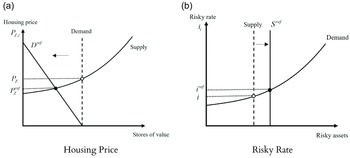
Equation (26) indicate that the levy of property taxes reduces the wealth of risk-averse agents, thereby alleviating the scarcity of safe financial assets and the demand for housing assets as a store of value. Figure 3 illustrates the equilibrium in the reference case. The property tax tilts the demand for stores of value to the left side, while the new equilibrium housing price shifts the supply of risky assets to the right.
The reference case.
The long-dashed lines represent the case before the levy of property taxes, while the hollow point represent the corresponding equilibrium.
 $D^{ref}$
and
 $S^{ref}$
, respectively, represent the demand for housing assets as a store of value and the supply of risky assets in the reference case.

Solving equation (26) shows that the equilibrium values of the housing price and risky rate after the levy of property taxes are, respectively:Footnote 20
 \begin{equation} \begin{aligned} P_Z^{ref} &= \frac{{[\alpha (1 - \delta ) - \rho \mu ]}}{{{\tau ^A} + \theta (1 - \rho )[1 +{\tau ^c}(1 - \sigma )]}}\frac{X}{Z} = \frac{{\theta (1 - \rho )[1 +{\tau ^c}(1 - \sigma )]}}{{{\tau ^A} + \theta (1 - \rho )[1 +{\tau ^c}(1 - \sigma )]}}{P_Z} \\[5pt] {i^{ref}} &= [1 +{\tau ^c}(1 - \sigma )]\theta \frac{{\delta +{\tau ^A}\frac{{1 - \rho \mu - (1 - \alpha )(1 - \delta )}}{{\theta (1 - \rho )[1 +{\tau ^c}(1 - \sigma )]}}}}{{1 - \alpha (1 - \delta ) +{\tau ^A}\frac{{1 - \rho \mu }}{{\theta (1 - \rho )[1 +{\tau ^c}(1 - \sigma )]}}}} \end{aligned} \end{equation}
Therefore, without considering the use of new property tax revenues, imposing property taxes on housing assets can effectively reduce housing prices (
 $P_Z^{ref} \lt{P_Z}$
), but it increases the risky rate (
 ${i^{ref}} \gt i$
). The intuition is that the imposition of a new property tax can effectively diminish the demand for housing assets as a store of value, which leads to a decline in housing prices. Although it does not affect the total supply of assets, it alters the proportions of different assets, resulting in a decrease in the supply of stores of value and an increase in the supply of risky assets. Thus, relative to risk-neutral agents’ unchanged demand for risky assets, the increased supply of risky assets elevates the equilibrium risky rate. Furthermore, as the property tax rate (
 $\tau ^A$
) increases, the housing price decreases while the risky rate increases.
Proposition 2 (Unchanged Belief in Housing Assets). When households’ belief in stable housing values remains unchanged with the imposition of property taxes and households still hold housing assets as a store of value, the property tax can effectively reduce housing prices relative to the case without the property tax. When considering the different purposes of the proeprty tax revenue, expanding government expenditure and improving economic output increase the store-of-value demand for housing assets, while financing government bonds increases the supply of financial safe assets. Therefore, the first two revenue purposes weaken the overall effect of property taxes on constraining housing prices, but the latter one strengthening the policy effect.
3.1.1 Expanding government expenditure
If the government uses the property tax revenue to expand government expenditure, then the government expenditure on consumption equals
 \begin{equation} \begin{aligned}{G_t}dt = [{\tau ^A}{P_{Z,t}}Z + (1 +{\tau ^c}){P_{Z,t}}{C_{Z,t}}]dt \end{aligned} \end{equation}
Combined with the clearing conditions for the general goods and asset markets, we can derive the clearing conditions for stores of value and risky assets are as follows:Footnote 21
 \begin{equation} \begin{aligned} \frac{{\alpha (1 - \delta )X -{\tau ^A}{P_{Z,t}}Z}}{{[1 +{\tau ^c}(1 - \sigma )]\theta }} &= \rho [\frac{{\mu X}}{{[1 +{\tau ^c}(1 - \sigma )]\theta }} - (1 + \frac{{{\tau ^A}}}{{[1 +{\tau ^c}(1 - \sigma )]\theta }}){P_{Z,t}}Z] +{P_{Z,t}}Z \\[5pt] \frac{{(1 - \alpha )(1 - \delta )X}}{{[1 +{\tau ^c}(1 - \sigma )]\theta -{i_t}}} &= \frac{{(1 - \rho \mu )X}}{{[1 +{\tau ^c}(1 - \sigma )]\theta }} - (1 - \rho )(1 + \frac{{{\tau ^A}}}{{[1 +{\tau ^c}(1 - \sigma )]\theta }}){P_{Z,t}}Z \end{aligned} \end{equation}
The equations imply that levying a new property tax on housing assets and using the tax revenue to expand government expenditure reduces risk-averse agents’ demand for stores of value, while also reducing the supply of safe financial assets and risky assets. Figure 4 illustrates the equilibrium in the case of expanding government expenditure. Using the property tax revenue to expand government expenditure shifts the supply of stores of value.
The case of expanding government expenditure.
The long-dashed lines represent the case before the levy of property taxes, while the hollow point represent the corresponding equilibrium.
 $D^{\prime }$
and
 $S^{\prime }$
, respectively, represent the demand and supply for housing assets as a store of value in the case of expanding government expenditure. Additionally, it is worth to note that although expanding government expenditure reduces the supply of risky assets, the change in equilibrium housing price offsets the effect. Therefore, the supply of risky assets remains unchanged.

Solving equation (29), we obtain the following equilibrium housing price and risky rate:
 \begin{equation} \begin{aligned}{P_Z}^\prime &= \frac{{[\alpha (1 - \delta ) - \rho \mu ]}}{{{\tau ^A}(1 - \rho ) + \theta (1 - \rho )[1 +{\tau ^c}(1 - \sigma )]}}\frac{X}{Z} \\[5pt] i^{\prime }&= \frac{{[1 +{\tau ^c}(1 - \sigma )]\theta \delta }}{{1 - \alpha (1 - \delta )}} \end{aligned} \end{equation}
Equation (30) show that introducing a property tax on housing assets to expand government expenditure plays a role in reducing housing prices (
 ${P_Z}^\prime \lt{P_Z}$
), but it has no effect on the risky rate (
 $i' = i$
). In addition, both the housing price and risky rate are lower than in the reference case (
 $P_Z^{ref} \lt{P_Z}^\prime$
,
 $i' \lt{i^{ref}}$
).
The policy has two channels: the collection channel and the expenditure channel. The collection channel works similarly to the reference case, as it reduces the demand for housing as a store of value among risk-averse agents, resulting in a decrease in housing prices. It also increases the supply of risky assets through the decrease in housing prices, which drives up the risky rate. In the expenditure channel, using property tax revenue to expand government expenditure has a crowding-out effect on the supply of both safe financial assets and risky assets, causing increases in the relative demand for housing assets as a store of value and risky assets. Thus, the expenditure channel has a positive effect on housing prices and an opposite effect on the risky rate.
Overall, the suppressive effect of the collection channel is stronger than the stimulating effect of the expenditure channel on housing prices. However, the expenditure channel weakens the effect of housing price regulation, resulting in a relative decrease in housing prices compared to before the policy implementation, but housing prices are still higher than in the reference case. The effects of the two channels offset each other, resulting in no change in the risky rate relative to its previous level before the imposition of property taxes, but it is lower than in the reference case.
3.1.2 Increasing economic output
If the government uses the property tax revenue to increase economic output, it will lead to an increase of
 $m{\tau ^A}{P_{Z,t}}Zdt$
(
 $0 \lt m \lt 1$
) in output. Between
 $t$
and
 $dt$
, total output before the negative Poisson shock increases to
 $(X + m{\tau ^A}{P_{Z,t}}Z)dt$
, while total output after the negative Poisson shock increases to
 $\mu (X + m{\tau ^A}{P_{Z,t}}Z)dt$
.
Introducing a property tax on housing assets to increase economic output reduces the demand for stores of value and facilitates the accumulation of total assets before and after the negative Poisson shock, which increases the supply of safe financial assets. This can alleviate risk-averse agents’ demand for housing assets as a store of value. In addition, the policy increases the endowment income of risk-neutral agents, causing a greater demand for risky assets, while increasing the supply of risky assets as well. Figure 5 illustrates the equilibrium in the case of increasing economic output. Using the property tax revenue to increase economic output tilts the demand for stores of value to the right side (relative to the reference case) and shifts the supply curve to the right.
The case of increasing economic output.
 $D^{\prime }$
and
 $S^{\prime }$
, respectively, represent the demand and supply for housing assets as a store of value (risky assets) in the case of increasing economic output.

Solving for the equations derives the equilibrium housing price and risky rate as:Footnote 22
 \begin{equation} \begin{aligned}{P_Z}^\prime &= \frac{{[\alpha (1 - \delta ) - \rho \mu ]}}{{{\tau ^A}[1 - (\alpha (1 - \delta ) - \rho \mu )m] + \theta (1 - \rho )[1 +{\tau ^c}(1 - \sigma )]}}\frac{X}{Z} \\[5pt] i' &= [1 +{\tau ^c}(1 - \sigma )]\theta \frac{{\delta +{\tau ^A}\frac{{1 - \rho \mu - (1 - \alpha )(1 - \delta )}}{{\theta (1 - \rho )[1 +{\tau ^c}(1 - \sigma )]}}}}{{1 - \alpha (1 - \delta ) +{\tau ^A}\frac{{1 - \rho \mu }}{{\theta (1 - \rho )[1 +{\tau ^c}(1 - \sigma )]}}}} \end{aligned} \end{equation}
Equations (31) imply that introducing a property tax on housing assets to increase economic output can reduce housing prices (
 ${P_Z}^\prime \lt{P_Z}$
) but increase risky rates (
 $i' \gt i$
). However, the decline in housing prices is less pronounced than in the reference case, and the level of the risk premium rate remains stable. The collection channel of property tax on housing assets works similarly to the reference case. In terms of the expenditure channel, the increase in economic output increases the supply of safe financial assets and risky assets, leading to a decrease in the demand for housing assets. However, it also increases agents’ endowment income, leading to an increase in demand for stores of value and risky assets. For housing assets, there is a relative increase in demand from the expenditure channel, as demand for stores of value increases relative to the supply of safe financial assets in the expenditure channel. However, the stimulating effect of the expenditure channel is weaker than the suppressive effect of the collection channel on housing prices. This leads to a relative decrease in housing prices compared to the previous level before the policy implementation, but an increase compared to the reference case. For risky assets, the increases in demand and supply from the expenditure channel offset each other, resulting in an overall stimulus effect. Therefore, the risky rate increases relative to its previous level before the policy implementation, but it remains constant relative to the reference case.
3.1.3 Financing government bonds
The government issues a fixed amount of risk-free bonds
 $D_t$
with a risk-free rate
 $i_t^f$
, and uses property tax revenue to finance the interest payments. Government bonds are a typical safe asset, for which the value remains constant after the Poisson shock. Hence, government bonds are a substitute for safe financial assets and act in this model like tranches, improving the ability of the financial sector to create safe assets.
First, consider that the government issues risk-free bonds
 $D_t$
and provides lump sum rebates of the proceeds from selling the bonds to agents at date 0. Then there are three kinds of stores of value: safe financial assets
 $V_t^s$
, government bonds
 $D_t$
, and housing assets
 ${P_{Z,t}}Z$
. The returns to government bonds and safe financial assets are
 ${\tau ^A}{P_{Z,t}}Zdt$
and
 $\rho \delta \mu Xdt$
, respectively. Solving backward from this derives the values of government bonds and safe financial assets as:
 \begin{equation} \begin{aligned}{D_t} = \frac{{{\tau ^A}{P_{Z,t}}Z}}{{{\tau ^A}{P_{Z,t}}Z + \delta \mu X}}(\frac{{\mu X}}{{[1 +{\tau ^c}(1 - \sigma )]\theta }} -{P_{Z,t}}Z) \\[5pt] \,V_t^s = \frac{{\rho \delta \mu X}}{{{\tau ^A}{P_{Z,t}}Z + \delta \mu X}}(\frac{{\mu X}}{{[1 +{\tau ^c}(1 - \sigma )]\theta }} -{P_{Z,t}}Z) \end{aligned} \end{equation}
Combined with the clearing condition for stores of value
 $W_t^K ={D_t} + V_t^s +{P_{Z,t}}Z$
, we have the following equilibrium conditions:
 \begin{equation} \begin{aligned} \frac{{\alpha (1 - \delta )X -{\tau ^A}{P_{Z,t}}Z}}{{[1 +{\tau ^c}(1 - \sigma )]\theta }} &= \rho ({\tau ^A})(\frac{{\mu X}}{{[1 +{\tau ^c}(1 - \sigma )]\theta }} -{P_{Z,t}}Z) +{P_{Z,t}}Z \\[5pt] \frac{{(1 - \alpha )(1 - \delta )X}}{{[1 +{\tau ^c}(1 - \sigma )]\theta -{i_t}}} &= \frac{{(1 - \rho ({\tau ^A})\mu )X}}{{[1 +{\tau ^c}(1 - \sigma )]\theta }} - (1 - \rho ({\tau ^A})){P_{Z,t}}Z \end{aligned} \end{equation}
where
 $\rho ({\tau ^A}) \equiv \frac{{{\tau ^A}{P_{Z,t}}Z + \rho \delta \mu X}}{{{\tau ^A}{P_{Z,t}}Z + \delta \mu X}} \gt \rho$
indicates the ability of the financial sector to create safe assets. Equations (33) imply that the issuance of government bonds increases the supply of safe assets in the financial sector, thereby alleviating risk-averse agents’ demand for housing assets as a store of value. Hence the supply of safe assets increases relative to the reference case through the expenditure channel, which reduces the demand for housing assets as a store of value and further lowers the equilibrium housing price (
 ${P_Z}^\prime \lt{P_Z}^{ref} \lt{P_Z}$
). In turn, the lower housing price is associated with less property tax revenue, which results in greater equilibrium demand and supply for stores of value than in the reference case. Given that the aggregate supply of assets remains constant after introducing the property tax for the issuance of government bonds, the equilibrium supply of risky assets decreases relative to the reference case. Consequently, the expenditure channel of the property tax policy leads to a further decline in risky rates (
 $i' \lt{i^{ref}}$
). However, compared to the previous level before the policy implementation, the equilibrium demand and supply for stores of value decrease while the equilibrium supply of risky assets increases, increasing the equilibrium risky rate (
 $i' \gt i$
).
Next, consider that the government further uses the proceeds from issuing government bonds to enhance its ability to deal with the negative Poisson shock and increase future economic output, such that output after the Poisson shock increases from
 $\mu X$
to
 $\mu X'$
, instead of providing lump sum rebates of the revenue to agents at date 0. This increases the value of total assets after the shock occurs, while the supply of assets remains constant before the shock. Therefore, the supply of safe assets increases. Solving for the equilibrium conditions derives that the financial sector’s ability to create safe assets is further enhanced toFootnote 23
 \begin{equation} \rho '({\tau ^A}) \equiv \frac{{{\tau ^A}{P_{Z,t}}Z + \rho \delta \mu X'}}{{{\tau ^A}{P_{Z,t}}Z + \delta \mu X'}} \gt \rho ({\tau ^A}) \gt \rho \end{equation}
Therefore, compared to providing lump sum rebates of the proceeds from issuing government bonds to agents, using the proceeds to increase future economic output leads to a greater supply of safe assets, a larger reduction in the demand for housing assets as a store of value, and, in turn, a lower housing price. Denoting the new equilibrium variables by superscript, the new equilibrium housing price satisfies the relationship
 ${P_Z}^{\prime \prime } \lt{P_Z}^\prime \lt{P_Z}^{ref} \lt{P_Z}$
. In addition, the supply of risky assets decreases relative to the equilibrium level with the proceeds from issuing government bonds rebated to agents, but it increases relative to the previous level before the policy implementation. Hence, the equilibrium risky rate increases, but to a smaller extent, satisfying the relationship
 $i \lt{i^{\prime \prime }} \lt{i^\prime } \lt{i^{ref}}$
. Figure 6 illustrates the equilibrium in the case of expanding government expenditure.
The case of expanding government expenditure.
The long-dashed lines represent the case before the levy of property taxes, while the hollow point represents the corresponding equilibrium.
 $D^{\prime }$
and
 $S^{\prime }$
, respectively, represent the demand and supply for housing assets as a store of value (risky assets) in the case of financing government bond.

Based on the analysis above, when households’ belief in stable housing value remains unchanged with the imposition of property taxes, the property tax can effectively reduce housing prices but simultaneously undermine the wealth accumulation of risk-averse agents, resulting in their lower consumption level. Therefore, the property tax increases the wealth and consumption inequalities between risk-averse and risk-neutral agents. Furthermore, when considering the different purposes of the property tax revenue, expanding government expenditure exacerbates the damage in risk-averse agents’ wealth accumulation and thus increasing the inequalities. In contrast, both improving economic output and financing the issuance of government bonds can effectively mitigate the wealth losses of risk-averse agents, thus alleviating the inequalities. Additionally, financing the issuance of government bonds simultaneously undermines the wealth accumulation of risk-neutral agents, while increasing economic output promotes their wealth accumulation.
3.2 Damaged Belief in Housing Assets
In this subsection, we consider that the introduction of a new property tax on housing assets damages households’ belief in the future stability of housing values, and changes their preference for housing assets as a store of value. As a result, risk-averse agents store their wealth through investments in safe financial assets and no longer use housing as a store of value. However, as indicated by the parameter condition
 $\rho \mu \lt \alpha (1 - \delta )$
, there is a shortage in the supply of safe financial assets. At this point, risk-averse agents fail to store all the value of their wealth, which results in a reduction in aggregate wealth. This, in turn, causes a decline in both consumption demand and demand-determined actual output.
Proposition 3 (Damaged Belief in Housing Assets). When the imposition of property taxes damages households’ belief in the future stability of housing values and no longer hold housing assets as a store of value, the shortage of safe assets can trigger a safety trap in which actual output is lower than potential output and asset markets clear through a recession. Similarly, when considering the different purposes of the property tax revenue, financing government bond issuance is more effective in alleviating the shortage of safe assets and stimulating actual output, while both expanding government expenditure and increasing economic output exacerbate the shortage of safe assets.
When households’ belief in a stable value of housing is damaged by imposing a new property tax on housing assets, a safety trap emerges at the zero lower bound with the shortage of safe financial assets. In the safety trap, actual output falls below its potential level (
 $\xi \lt 1$
), and asset markets clear through a recession (Caballero and Farhi, Reference Caballero and Farhi2017). In addition, the government loses the revenue from the property tax on housing assets, and total government revenue comes from the tax on housing consumption, which is assumed to finance government expenditure. Consequently, the government’s budget constraint changes from Equation (5) to
 \begin{equation} \begin{aligned} G_t^{E\prime } dt=(1+\tau ^c)(1-\sigma )\theta W_t dt \end{aligned} \end{equation}
where the left-side term
 $G_t^{E\prime } dt$
represents the new level of government’s total expenditures.Footnote 24 The new equilibrium is determined by the following system:
 \begin{equation} \begin{aligned} \dot W_t^K = - [1 +{\tau ^c}(1 - \sigma )]\theta W_t^K + \alpha (1 - \delta )\xi X \\[5pt] \dot W_t^N = - [1 +{\tau ^c}(1 - \sigma )]\theta W_t^N + (1 - \alpha )(1 - \delta )\xi X +{i_t}W_t^N \\[5pt] {V^s} = \frac{{\rho \mu X}}{{[1 +{\tau ^c}(1 - \sigma )]\theta }},{V^r} = \frac{{(\xi - \rho \mu )X}}{{[1 +{\tau ^c}(1 - \sigma )]\theta }} \\[5pt] W_t^N ={V^r} W_t^K ={V^s},\,{i_t} \gt 0 \end{aligned} \end{equation}
Correspondingly, the clearing conditions for stores of value and risky assets are as follows:
 \begin{equation} \begin{aligned} \frac{{\alpha (1 - \delta )\xi X}}{{[1 +{\tau ^c}(1 - \sigma )]\theta }} = \frac{{\rho \mu X}}{{[1 +{\tau ^c}(1 - \sigma )]\theta }} \\[5pt] \frac{{(1 - \alpha )(1 - \delta )\xi X}}{{[1 +{\tau ^c}(1 - \sigma )]\theta -{i_t}}} = \frac{{(\xi - \rho \mu )X}}{{[1 +{\tau ^c}(1 - \sigma )]\theta }} \end{aligned} \end{equation}
Equations (37) show that the output gap
 $\xi$
is the equilibrium variable clearing the store-of-value market in the safety trap, while the housing price
 $P_Z$
clears the store-of-value market outside the safety trap. Similarly, denoting the levels of the equilibrium variables after the implementation of the property tax policy by superscript
 $\prime$
, solving for the clearing conditions of asset markets derives the equilibrium output gap and risky rate as:
 \begin{equation} \begin{aligned} \xi ' = \frac{{\rho \mu }}{{\alpha (1 - \delta )}}\,,\, i' = \frac{{[1 +{\tau ^c}(1 - \sigma )]\theta \delta }}{{1 - \alpha (1 - \delta )}} \end{aligned} \end{equation}
The damaged belief in housing assets caused by the levy of the property tax on housing assets causes a decline in actual output, relative to the previous level before the tax policy implementation, but the risky rate remains constant.
To illustrate the policy effects of property taxes and the mechanisms in the safety trap, we first explore the case without property taxes. From equation (38), we can derive that when households’ belief in stable housing values is damaged by a property tax on housing assets and the government no longer imposes taxes on housing consumption (
 ${\tau ^c} = 0$
), the equilibrium output gap
 $\overline{\xi }$
and risky rate
 $\overline{i}$
satisfy:
 \begin{equation} \begin{aligned} \bar{\xi } = \frac{{\rho \mu }}{{\alpha (1 - \delta )}},\bar{i} = \frac{{\delta \theta }}{{1 - \alpha (1 - \delta )}} \end{aligned} \end{equation}
Next, we consider that the government continues to impose taxes on housing consumption after imposing a new property tax on housing assets. However, before discussing the use of the tax revenue for various purposes, we start by exploring the policy effect of property taxes without considering their purposes and take this case as the reference in this subsection on damaged belief in housing assets. The respective supplies of stores of value and risky assets equal
 \begin{equation} \begin{aligned}{V^s} = \frac{{\rho \mu X}}{\theta },{V^r} = \frac{{(\xi - \rho \mu )X}}{\theta } \end{aligned} \end{equation}
Except for these equations, all other equilibrium conditions are the same as in system (36). In this subsection, we denote the equilibrium levels of the variables in the reference case by the superscript
 $ref,2$
. Then, solving for the equilibrium conditions derives the equilibrium output gap
 $\xi ^{ref,2}$
and risky rate
 $i^{ref,2}$
satisfying the following:
 \begin{equation} \begin{aligned}{\xi ^{ref,2}} = \frac{{\rho \mu [1 +{\tau ^c}(1 - \sigma )]}}{{\alpha (1 - \delta )}}\,,\,{i^{ref,2}} = \frac{{[\delta +{\tau ^c}(1 - \sigma )][1 +{\tau ^c}(1 - \sigma )]\theta }}{{1 - \alpha (1 - \delta ) +{\tau ^c}(1 - \sigma )}} \end{aligned} \end{equation}
Therefore, compared to the case without property taxes on housing consumption, both actual output and the risky rate increase (
 ${\xi ^{ref,2}} \gt \overline{\xi }, \,{i^{ref,2}} \gt \overline{i}$
). Figure 7 illustrates the equilibrium in the case of damaged belief in housing assets. Imposing a property tax on housing consumption reduces aggregate wealth for both agents, thereby causing declines in the demands for stores of value and risky assets. The reduction in demand for stores of value alleviates the shortage of safe assets and the corresponding loss of wealth, which then boosts aggregate consumption demand and demand-determined actual output. Furthermore, the equilibrium level of actual output has no effect on clearing the market for risky assets.
The case of damaged belief in housing assets.
Variables with superscript “
 $ref,2$
” (“
 $\prime$
”) represent the reference case (the case after the implementation of the property tax policy) with damaged belief in housing assets, where variables with “
 $\bar{}$
” represent the case without property taxes.

Substituting the first equation in system (37) into the second equation derives the clearing condition for risky assets as:
 \begin{equation} \begin{aligned} \frac{{(1 - \alpha )(1 - \delta )\xi X}}{{[1 +{\tau ^c}(1 - \sigma )]\theta -{i_t}}} = (1 - \frac{{\alpha (1 - \delta )}}{{[1 +{\tau ^c}(1 - \sigma )]}})\frac{{\xi X}}{\theta } \end{aligned} \end{equation}
Equation (42) shows that an increase in actual output increases the supply and demand for risky assets by the same extent, leaving the clearing condition for risky assets unchanged. In addition, the equation implies that property taxes reduce risk-neutral agents’ demand for risky assets while increasing the supply of risky assets. Overall, property tax has a net negative effect on the relative demand for risky assets, resulting in a higher risky rate.
Combining equations (38), (39), and (41) reveals that when a property tax is imposed to expand government expenditure, both actual output and the risky rate decrease relative to the reference case (
 $\xi ^{'}\lt \xi ^{ref,2}$
,
 $i^{'}\lt i^{ref,2}$
). However, compared to the case without property taxes, actual output remains the same, and the risky rate increases (
 $\xi ^{'}=\bar{\xi }$
,
 $i^{'}\gt \bar{i}$
). Similar to the analysis under unchanged belief in housing values, the property tax has an impact through two channels: the collection channel and the expenditure channel. The collection channel has the same effect as in the reference case (
 $ref,2$
), while the expenditure channel, which results from an increase in government expenditure, crowds out the supply of both safe financial assets and risky assets. Therefore, although a property tax imposed to expand government expenditure increases actual output, it decreases the risky rate relative to the reference case. For safe financial assets, the combined effect of both channels keeps the relative demand unchanged. However, for risky assets, the negative effect of the collection channel on demand is stronger than the negative effect of the expenditure channel on supply, resulting in a relative decrease in demand. Consequently, actual output remains constant, but the risky rate increases relative to the case without property taxes.
In the following subsections, we explore the policy effects and mechanisms of using property tax revenues to increase economic output and finance the issuance of government bonds.
The case of increasing economic output with damaged belief in housing assets.
Variables with superscript “
 $ref,2$
” (“
 $\prime$
”) represent the reference case (the case of increasing economic output) with damaged belief in housing assets, where variables with “
 $\bar{}$
” represent the case without property taxes.

3.2.1 Increasing economic output
Consider using the tax revenue to increase economic output, such that economic output increases by
 $m{\tau ^c}{P_{Z,t}}^\prime{C_{Z,t}}dt$
. Then actual output increases to
 $(\xi X + m{\tau ^c}{P_{Z,t}}^\prime{C_{Z,t}})dt$
and
 $\mu (X + m{\tau ^c}{P_{Z,t}}^\prime{C_{Z,t}})dt$
before and after the Poisson shock takes place, respectively. It increases the supply of both financial assets and risky assets relative to the reference case, and it increases the supply of financial assets but decreases the supply of risky assets relative to the case without property taxes. Besides, compared to the reference case, the increased economic output increases the aggregate wealth of both agents and, in turn, increases the demands for stores of value and risky assets. Figure 8 illustrates the equilibrium in the case of increasing economic output with damaged belief in housing assets. Using the property tax to increase economic output shifts the demand and supply for stores of value to the right (relative to the reference case). Solving for the clearing conditions for assets yields the following:Footnote 25
 \begin{equation} \begin{aligned} \xi ' &= \frac{{\rho \mu [1 +{\tau ^c}(1 - \sigma )][1 - m{\tau ^c}(1 - \sigma )]}}{{\alpha (1 - \delta )[1 - \mu m{\tau ^c}(1 - \sigma )]}} \\[5pt] i' &= \frac{{[\delta +{\tau ^c}(1 - \sigma )][1 +{\tau ^c}(1 - \sigma )]\theta }}{{1 - \alpha (1 - \delta ) +{\tau ^c}(1 - \sigma )}} \end{aligned} \end{equation}
The risky rate remains constant relative to the reference case and increases relative to the case without property taxes (
 $i' ={i^{ref,2}} \gt \bar{i}$
). The demand and supply for risky assets increase by the same extent through the expenditure channel, which leaves the risky rate the same as in the reference case. In addition, total output includes the actual output of the private production sector and the increase in output due to the government’s use of property tax revenue. Total output increases to:
 \begin{equation} \begin{aligned} \xi X + \frac{{m{\tau ^c}(1 - \sigma )}}{{1 - m{\tau ^c}(1 - \sigma )}}\xi X = \frac{{\rho \mu [1 +{\tau ^c}(1 - \sigma )]X}}{{\alpha (1 - \delta )[1 - \mu m{\tau ^c}(1 - \delta )]}} \end{aligned} \end{equation}
Therefore,
 $\xi$
indicates the factor utilization rate of the private production sector, while
 $\frac{{\rho \mu [1 +{\tau ^c}(1 - \sigma )]}}{{\alpha (1 - \delta )[1 - \mu m{\tau ^c}(1 - \delta )]}}$
measures the output gap between actual output and potential output. Combining equations (43) and (44) implies that although using property taxes to increase economic output crowds out the actual output of the private production sector (
 $\xi ' \lt{\xi ^{ref,2}}$
), it increases overall actual output (
 $\frac{{\rho \mu [1 +{\tau ^c}(1 - \sigma )]}}{{\alpha (1 - \delta )[1 - \mu m{\tau ^c}(1 - \delta )]}} \gt{\xi ^{ref,2}} \gt \bar{\xi }$
), and the greater is the government’s ability to increase economic output (the greater
 $m$
), the greater is total economic output.
3.2.2 Financing government bonds
Consider using the property tax revenue to finance the issuance of government bonds
 $D_t$
and pay for the interest expenses. As before, we first consider that the government provides lump sum rebates of the proceeds from issuing bonds to agents at date
 $t=0$
. Similarly, solving backward from the ex-post returns on government bonds and safe financial assets derives that the ability to create safe assets in the financial sector increases toFootnote 26
 \begin{equation} \rho ({\tau ^c}) \equiv \frac{{{\tau ^c}(1 - \sigma ) + \rho \delta }}{{{\tau ^c}(1 - \sigma ) + \delta }} \gt \rho \end{equation}
Solving for the equilibrium conditions derives the following:
 \begin{equation} \begin{aligned} \xi ' &= \frac{{\mu [\rho \delta +{\tau ^c}(1 - \sigma )][1 +{\tau ^c}(1 - \sigma )]}}{{\alpha (1 - \delta )[\delta +{\tau ^c}(1 - \sigma )]}} \\[5pt] i' &= \frac{{[\delta +{\tau ^c}(1 - \sigma )][1 +{\tau ^c}(1 - \sigma )]\theta }}{{1 - \alpha (1 - \delta ) +{\tau ^c}(1 - \sigma )}} \end{aligned} \end{equation}
Actual output increases relative to both the reference case and the case without property taxes (
 $\xi ' \gt{\xi ^{ref,2}} \gt \overline{\xi }$
). The equilibrium risky rate remains constant compared to the reference case, but it increases compared to the case without property taxes (
 $i' ={i^{ref,2}} \gt \bar{i}$
). Figure 9 illustrates the equilibrium in the case of financing the issuance of government bonds with damaged belief in housing assets. By using the property tax revenue to finance the issuance of government bonds, the supply of safe assets further increases through the expenditure channel. This allows risk-averse agents to store greater value, thereby increasing aggregate demand and demand-determined actual output. However, it has no effect on the relative demand for risky assets through the expenditure channel and, as a result, the equilibrium risk premium remains unchanged compared to the reference case.
The case of increasing economic output with damaged belief in housing assets.
Variables with superscript “
 $ref,2$
” (“
 $\prime$
”) represent the reference case (the case of financing government bonds) with damaged belief in housing assets, where variables with “
 $\bar{}$
” represent the case without property taxes.

Furthermore, suppose that the government uses the proceeds from issuing bonds to enhance its ability to deal with the negative Poisson shock and increase future economic output from
 $\mu X$
to
 $\mu X'$
after the Poisson shock takes place. Denoting the new equilibrium levels of the variables by the superscript
 $\prime \prime$
, solving for the equilibrium conditions derives the equilibrium output gap and risky rate as:Footnote 27
 \begin{equation} \begin{aligned} \xi '' &= \frac{{\mu [\rho \delta +{\tau ^c}(1 - \sigma )][1 +{\tau ^c}(1 - \sigma )]X'}}{{\alpha (1 - \delta )[\delta +{\tau ^c}(1 - \sigma )]X}} \\[5pt] i'' &= \frac{{[\delta +{\tau ^c}(1 - \sigma )][1 +{\tau ^c}(1 - \sigma )]\theta }}{{1 - \alpha (1 - \delta ) +{\tau ^c}(1 - \sigma )}} \end{aligned} \end{equation}
Using the proceeds from issuing government bonds to increase future economic output increases the aggregate supply of total assets after the Poisson shock takes place. This further alleviates the shortage of safe assets by increasing their supply, resulting in an increase in actual output. Consequently, equilibrium output increases (
 $\xi '' \gt \xi ' \gt{\xi ^{ref,2}} \gt \overline{\xi }$
) compared to the case in which the government provides lump sum rebates of tax revenue to agents at date
 $t = 0$
. The increased future output not only directly reduces the supply of risky assets, but also indirectly increases both demand and supply through increased equilibrium output. Nevertheless, the relative demand for risky assets remains unchanged through the expenditure channel. Therefore, the risky rate remains the same as in the reference case (
 $i'' = i' ={i^{ref,2}} \gt \bar{i}$
).
Based on the analysis above, when the imposition of property taxes damages households’ belief in the future stability of housing values, actual output falls below potential output, which in turn undermines the wealth accumulation across all agents and leads to lower consumption. Specifically, using property tax revenue to both expand government expenditures and increase economic output further undermine the wealth accumulation of risk-averse agents and depresses their consumption (as compared to the reference case without considering the purpose of tax revenue). Conversely, using property tax revenue to finance the issuance of government bonds can effectively mitigate the loss of wealth for risk-averse agents.
4. Conclusion
This paper constructed an equilibrium model of stores of value in which the financial sector faces a constrained supply of safe assets and housing assets serve as a store of value. We examined the policy effects of property taxes with various purposes under different household beliefs about the housing market. Our results show that if households’ belief in stable housing values remains unchanged with the imposition of property taxes, households will still hold housing assets as a store of value. Then property taxes on housing assets can effectively constrain housing prices and provide a sustainable and stable source of government revenue. However, if property taxes on housing assets change households’ belief in stable housing values, risk-averse agents will no longer use housing assets as a store of value, causing a collapse in property tax revenue. Furthermore, due to the shortage of safe financial assets, households are constrained from investing in safe financial assets and fail to store all their value, resulting in a reduction in aggregate wealth and consumption demand. As a result, the damaged belief in stable housing values can trigger a safety trap in which actual output is lower than potential output and asset markets clear through a recession.
We also found that the policy effects of property taxes differ depending on the government’s use of the tax revenues. Financing government bond issuance is more effective in alleviating the shortage of safe assets, while both expanding government expenditure and increasing economic output exacerbate the shortage of safe assets. Therefore, when households’ belief in the stability of housing values remains unchanged, the latter two revenue purposes weaken the overall effect of property taxes on constraining housing prices. In contrast, when households’ belief is damaged, these revenue purposes weaken the policy effects on increasing actual output.
Acknowledgments
Support from the Major Program of the National Social Science Fund of China grant No. 22&ZD131 is gratefully acknowledged.
Funding statement
This research was funded by the Major Program of the National Social Science Fund of China, “Research on Preventing and Resolving Economic and Financial Risks Caused by Fluctuations in Housing Prices” (Grant No. 22&ZD131) and the Fundamental Research Funds for the Central Universities (2024XSYL09).
Competing interests
None.
Appendix A. A Numerical Example
We calibrate key parameters in the model as follows:
Risk Aversion Share
 $\alpha$
: Based on the survey conducted by the People’s Bank of China on the assets and liabilities of urban households in 2019, the proportion of households holding risk-free financial assets in the total surveyed households was 99.6%, while the proportion of households investing in risky financial assets was 59.6%. It suggests a rough ratio of 5:3 between households investing in risk-free and risky financial assets. Therefore, we set
 $\alpha =0.675$
.
Capitalization Rate
 $\delta$
: Referring to Caballero et al. (Reference Caballero, Farhi and Gourinchas2008), the capitalization rate in the United States is approximately 0.15. Given that the financial sector in China is less developed than that of the United States, we set the capitalization rate
 $\delta$
at 0.05, slightly below half of the US level.
Supply of Safe Financial Asset
 $\rho \mu$
: Referring to the measurement of safe asset share by Gorton (Reference Gorton, Li and Song2017), we assess the total supply of safe financial assets by summing the changes in short-term deposits, the relatively stable and safe bond component of financial assets (including national bonds, local government bonds, bonds issued by government-supported institutions, policy bank bonds, interbank deposit certificates, and central bank bills), and the net amount of safe financial assets held abroad by Chinese investors. The total supply of financial assets is measured by the sum of domestic bond issuance, stock issuance, loan issuance, changes in domestic currency, changes in short-term deposits, and net purchases of foreign financial assets by domestic investors. Calculations indicate that the share of safe financial assets in China’s total financial assets was less than 12% in the third quarter of 2016. Therefore, we set the parameter
 $\rho \mu$
at 0.12. Specifically, we consider the case of
 $\mu \rightarrow 1$
,
 $\rho \rightarrow 0.12$
.
Consumption rate
 $\theta$
: Based on the “China National Balance Sheet 2020,” China’s per capita net wealth in 2019 was 360,000 yuan, with per capita consumption of 22,000 yuan. It indicates a proportion of per capita consumption to net wealth of 6.1%. Since our model focuses only on financial wealth and excludes labor income, the proportion of consumption to wealth in the model should be higher than 6.1%. Referring to Caballero et al. (Reference Caballero, Farhi and Gourinchas2008), where the proportion of consumption to financial wealth in the United States is 0.22, the parameter should be within the range of 0.061 to 0.22. Therefore, we set the consumption rate
 $\theta$
at 0.1.
Tax Rate on Housing Consumption
 $\tau ^c$
: In China, relevant taxes during housing transactions range from 1% to 4%. Here, we set the parameter
 $\tau ^c$
at 4%.
Share of Housing Consumption
 $\sigma$
: According to the National Bureau of Statistics, China’s per capita expenditure on housing consumption in 2023 was 6,095 yuan, accounting for approximately 22.7% of total per capita consumption expenditure. Therefore, we set the parameter
 $\sigma$
at 0.22.
Based on the above calibration of parameters, equation (23) in the baseline model gives
 $P_Z =5.74 X/Z$
. Considering the imposition of the property taxes on housing assets, equation (27) gives that when the belief in housing assets remains unchanged, the housing price in the reference case satisfying:
 \begin{equation} P_Z^{ref}=\frac{0.52}{\tau ^A+0.091}X/Z=\frac{0.091}{\tau ^A+0.091}P_Z\lt P_Z \end{equation}
When the property tax policy changes the belief in housing assets, equation (41) gives the equilibrium output gap in the reference case as
 $\xi ^{ref,2}=0.193\lt 1$
. Therefore, the property tax policy can effectively control the housing price if the belief in housing assets remain unchanged, while it leads to a safety trap with output recession if the belief collapses.
Appendix B. Unchanged Belief in Housing Assets
This section provides the detailed calculations for the discussions in the case of unchanged belief in housing assets.
B.1 Expanding Government Expenditure
When the government uses the property tax revenue to expand expenditure, combined with the clearing condition for the general goods and asset markets, we can derive aggregate wealth before the negative Poisson shock as:
 \begin{equation} \begin{aligned}{V_t} +{P_{Z,t}}Z ={W_t} = \frac{{X -{\tau ^A}{P_{Z,t}}Z}}{{[1 +{\tau ^c}(1 - \sigma )]\theta }} \end{aligned} \end{equation}
From the post-shock returns on safe financial assets and risky assets, we can solve backward and derive the pre-shock total values of both assets as:
 \begin{equation} \begin{aligned} V_t^s &= \rho [\frac{{\mu X}}{{[1 +{\tau ^c}(1 - \sigma )]\theta }} - (1 + \frac{{{\tau ^A}}}{{[1 +{\tau ^c}(1 - \sigma )]\theta }}){P_{Z,t}}Z] \\[5pt] V_t^r &= \frac{{(1 - \rho \mu )X}}{{[1 +{\tau ^c}(1 - \sigma )]\theta }} - (1 - \rho )({{1 + }}\frac{{{\tau ^A}}}{{[1 +{\tau ^c}(1 - \sigma )]\theta }}){P_{Z,t}}Z \end{aligned} \end{equation}
Compared to the reference case without consideration of the purpose of property tax revenue, the levels of supply of safe financial assets and risky assets both decrease in the case with tax revenue used to expand government expenditure. The increase in government expenditure has a crowding-out effect on private consumption, which is not conducive to overall asset accumulation and correspondingly leads to a decline in the supply of safe financial assets and risky assets. The clearing conditions for stores of value and risky assets are as follows:
 \begin{equation} \begin{aligned} \frac{{\alpha (1 - \delta )X -{\tau ^A}{P_{Z,t}}Z}}{{[1 +{\tau ^c}(1 - \sigma )]\theta }} &= \rho [\frac{{\mu X}}{{[1 +{\tau ^c}(1 - \sigma )]\theta }} - (1 + \frac{{{\tau ^A}}}{{[1 +{\tau ^c}(1 - \sigma )]\theta }}){P_{Z,t}}Z] +{P_{Z,t}}Z \\[5pt] \frac{{(1 - \alpha )(1 - \delta )X}}{{[1 +{\tau ^c}(1 - \sigma )]\theta -{i_t}}} &= \frac{{(1 - \rho \mu )X}}{{[1 +{\tau ^c}(1 - \sigma )]\theta }} - (1 - \rho )({{1 + }}\frac{{{\tau ^A}}}{{[1 +{\tau ^c}(1 - \sigma )]\theta }}){P_{Z,t}}Z \end{aligned} \end{equation}
B.2 Increasing Economic Output
When the government uses the property tax revenue to increase economic output, the new equilibrium before the Poisson shock is determined by the following system:
 \begin{equation} \begin{aligned} \dot W_t^K = - \theta [1 +{\tau ^c}(1 - \sigma )]W_t^K + \alpha (1 - \delta )(X + m{\tau ^A}{P_{Z,t}}Z) -{\tau ^A}{P_{Z,t}}Z \\[5pt] \dot W_t^N = - \theta [1 +{\tau ^c}(1 - \sigma )]W_t^N + (1 - \alpha )(1 - \delta )(X + m{\tau ^A}{P_{Z,t}}Z) +{i_t}W_t^N \\[5pt] V_t^s = \rho [\frac{{\mu (X + m{\tau ^A}{P_{Z,t}}Z)}}{{[1 +{\tau ^c}(1 - \sigma )]\theta }} -{P_{Z,t}}Z],{{ }}V_t^r = \frac{{(1 - \rho \mu )(X + m{\tau ^A}{P_{Z,t}}Z)}}{{[1 +{\tau ^c}(1 - \sigma )]\theta }} - (1 - \rho ){P_{Z,t}}Z \\[5pt] W_t^K = V_t^s +{P_{Z,t}}Z,{{ }}W_t^N = V_t^r,{{ }}{i_t} \gt 0 \end{aligned} \end{equation}
Correspondingly, it derives the clearing conditions for the stores of value and risky assets as follows, respectively:
 \begin{equation} \begin{aligned} \frac{{\alpha (1 - \delta )(X + m{\tau ^A}{P_{Z,t}}Z) -{\tau ^A}{P_{Z,t}}Z}}{{[1 +{\tau ^c}(1 - \sigma )]\theta }} &= \rho [\frac{{\mu (X + m{\tau ^A}{P_{Z,t}}Z)}}{{[1 +{\tau ^c}(1 - \sigma )]\theta }} -{P_{Z,t}}Z] +{P_{Z,t}}Z \\[5pt] \frac{{(1 - \alpha )(1 - \delta )(X + m{\tau ^A}{P_{Z,t}}Z)}}{{[1 +{\tau ^c}(1 - \sigma )]\theta -{i_t}}} &= \frac{{(1 - \rho \mu )(X + m{\tau ^A}{P_{Z,t}}Z)}}{{[1 +{\tau ^c}(1 - \sigma )]\theta }} - (1 - \rho ){P_{Z,t}}Z \end{aligned} \end{equation}
B.3 Financing Government Bonds
When the government uses the property tax revenue to finance bonds issuance and further uses the proceeds from bonds to increase economic output, the output after the Poisson shock increases from
 $\mu X$
to
 $\mu X^{\prime }$
. Then, solving backward from the returns to government bonds and safe financial assets after the Poisson shock derives the values of government bonds and safe financial assets as:
 \begin{equation} \begin{aligned}{D_t} = \frac{{{\tau ^A}{P_{Z,t}}Z}}{{{\tau ^A}{P_{Z,t}}Z + \delta \mu X'}}(\frac{{\mu X'}}{{[1 +{\tau ^c}(1 - \sigma )]\theta }} -{P_{Z,t}}Z) \\[5pt] \,V_t^s = \frac{{\rho \delta \mu X'}}{{{\tau ^A}{P_{Z,t}}Z + \delta \mu X'}}(\frac{{\mu X'}}{{[1 +{\tau ^c}(1 - \sigma )]\theta }} -{P_{Z,t}}Z) \end{aligned} \end{equation}
Therefore, the clearing conditions for stores of value and risky assets are as follows:
 \begin{equation} \begin{aligned} \frac{{\alpha (1 - \delta )X -{\tau ^A}{P_{Z,t}}Z}}{\theta } = \rho '({\tau ^A})(\frac{{\mu X'}}{{[1 +{\tau ^c}(1 - \sigma )]\theta }} -{P_{Z,t}}Z) +{P_{Z,t}}Z \\[5pt] \frac{{(1 - \alpha )(1 - \delta )X}}{{[1 +{\tau ^c}(1 - \sigma )]\theta -{i_t}}} = \frac{{(1 - \rho '({\tau ^A})\mu \frac{{X'}}{X})X}}{{[1 +{\tau ^c}(1 - \sigma )]\theta }} - (1 - \rho '({\tau ^A})){P_{Z,t}}Z \end{aligned} \end{equation}
Appendix C. Damaged Belief in Housing Assets
This section provides the detailed calculations for the discussions in the case of damaged belief in housing assets.
C.1 Increasing Economic Output
When the government uses the property tax revenue to increase economic output, combined with the clearing conditions for goods markets and asset markets, we derive the total values of assets before and after the Poisson shock, respectively, as:
 \begin{equation} \begin{aligned} V = W = \frac{{\xi X}}{{[1 - m{\tau ^c}(1 - \sigma )]\theta }}\,,\,{V^ + } ={W^ + } = \frac{{\mu X}}{{[1 - \mu m{\tau ^c}(1 - \sigma )]\theta }} \end{aligned} \end{equation}
Accordingly, the supplies of safe financial assets and risky assets are as follows:
 \begin{equation} \begin{aligned}{V^s} = \frac{{\rho \mu X}}{{[1 - \mu m{\tau ^c}(1 - \sigma )]\theta }}\,,\,{V^r} = \frac{{\xi X}}{{[1 - m{\tau ^c}(1 - \sigma )]\theta }} - \frac{{\rho \mu X}}{{[1 - \mu m{\tau ^c}(1 - \sigma )]\theta }} \end{aligned} \end{equation}
In addition, combined with the relationship
 $m{\tau ^c}{P_{Z,t}}^\prime{C_{Z,t}} = m{\tau ^c}(1 - \sigma )\theta W$
, the accumulation of wealth for both agents evolves to:
 \begin{equation} \begin{aligned} \dot W_t^K = - [1 +{\tau ^c}(1 - \sigma )]\theta W_t^K + \alpha (1 - \delta )[1 + \frac{{m{\tau ^c}(1 - \sigma )}}{{1 - m{\tau ^c}(1 - \sigma )}}]\xi X \\[5pt] \dot W_t^N = - [1 +{\tau ^c}(1 - \sigma )]\theta W_t^N + (1 - \alpha )(1 - \delta )[1 + \frac{{m{\tau ^c}(1 - \sigma )}}{{1 - m{\tau ^c}(1 - \sigma )}}]\xi X \end{aligned} \end{equation}
Therefore, the clearing conditions for stores of value and risky assets are as follows:
 \begin{equation} \begin{aligned} \frac{{\alpha (1 - \delta )[1 + \frac{{m{\tau ^c}(1 - \sigma )}}{{1 - m{\tau ^c}(1 - \sigma )}}]\xi X}}{{[1 +{\tau ^c}(1 - \sigma )]\theta }} = \frac{{\rho \mu X}}{{[1 - \mu m{\tau ^c}(1 - \sigma )]\theta }} \\[5pt] \frac{{(1 - \alpha )(1 - \delta )[1 + \frac{{m{\tau ^c}(1 - \sigma )}}{{1 - m{\tau ^c}(1 - \sigma )}}]\xi X}}{{[1 +{\tau ^c}(1 - \sigma )]\theta }} = \frac{{\xi X}}{{[1 - m{\tau ^c}(1 - \sigma )]\theta }} - \frac{{\rho \mu X}}{{[1 - \mu m{\tau ^c}(1 - \sigma )]\theta }} \end{aligned} \end{equation}
C.2 Financing Government Bonds
When the government uses the property tax revenue to finance government bonds issuance and provides lump sum rebates of the proceeds from bonds to agents at date
 $t=0$
, the returns to government bonds
 $D_t$
and safe financial assets
 $V_t^s$
are
 $\tau ^c(1-\sigma )\mu Xdt$
and
 $\rho \delta \mu Xdt$
, respectively. Solving backward from the returns after the Poisson shock takes place derives the supplies of both assets as:
 \begin{equation} \begin{aligned} D = \frac{{{\tau ^c}(1 - \sigma )}}{{{\tau ^c}(1 - \sigma ) + \delta }}\frac{{\mu X}}{\theta }\,,\,{V^s} = \frac{{\rho \delta }}{{{\tau ^c}(1 - \sigma ) + \delta }}\frac{{\mu X}}{\theta } \end{aligned} \end{equation}
Then the clearing conditions for stores of value and risky assets are as follows:
 \begin{equation} \begin{aligned} \frac{{\alpha (1 - \delta )\xi X}}{{[1 +{\tau ^c}(1 - \sigma )]\theta }} = \rho ({\tau ^c})\frac{{\mu X}}{\theta } \\[5pt] \frac{{(1 - \alpha )(1 - \delta )\xi X}}{{[1 +{\tau ^c}(1 - \sigma )]\theta -{i_t}}} = (\xi - \rho ({\tau ^c})\mu )\frac{X}{\theta } \end{aligned} \end{equation}
where
 \begin{equation*}\rho ({\tau ^c}) \equiv \frac {{{\tau ^c}(1 - \sigma ) + \rho \delta }}{{{\tau ^c}(1 - \sigma ) + \delta }} \gt \rho \end{equation*}
denotes the improved ability to create safe assets in the financial sector through the issuance of government bonds.
Furthermore, when the government uses the proceeds of bonds to increase future economic output, the output after the Poisson shock increases from
 $\mu X$
to
 $\mu X^{\prime }$
. Similar to equation (61), the clearing conditions for stores of value and risky assets are as follows:
 \begin{equation} \begin{aligned} \frac{{\alpha (1 - \delta )\xi X}}{{[1 +{\tau ^c}(1 - \sigma )]\theta }} &= \rho ({\tau ^c})\frac{{\mu X'}}{\theta } \\[5pt] \frac{{(1 - \alpha )(1 - \delta )\xi X}}{{[1 +{\tau ^c}(1 - \sigma )]\theta -{i_t}}} &= (\xi - \rho ({\tau ^c})\mu \frac{{X'}}{X})\frac{X}{\theta } \end{aligned} \end{equation}