Introduction
Avian feathers have many different functions. They provide insulation and capacity for flight among others. The remiges are flight feathers connected to the rear portion of the wing. Those attached to the ulna are termed the secondary remiges. In many birds the attachment points are traceable as more or less marked tuberosities and/or pits organized in linear series (Edgington & Miller Reference Edgington and Miller1942). Such tuberosities are called ‘ulnar quill knobs’ or ‘remigial papillae’, and their morphology appears to be unrelated to flight performance in extant birds (Hieronymus Reference Hieronymus2015). Ulnar quill pits have been found in some non-volant seabirds, such as modern penguins (Sphenisciformes: Spheniscidae) and Cenozoic plotopterids (Pelecaniformes: Plotopteridae) (e.g. Mayr Reference Mayr2004). Procellariiformes, the closest living relatives to penguins, possess papillae not pits (Hieronymus Reference Hieronymus2015, table 1). In the case of Sphenisciformes, birds with a fossil record extending to the Palaeocene (66.0–56.0 Ma) and already very diverse in the Eocene (56.0–33.9 Ma) (Jadwiszczak Reference Jadwiszczak2009), the term remex is rather confusing though. Since at least the latter epoch, penguins have been apparently characterized by the lack of differentiation between greater coverts and remiges (Clarke et al. Reference Clarke, Ksepka, Salas-Gismondi, Altamirano, Shawkey, D’Alba, Vinther, DeVries and Baby2010). Reported here is a penguin ulna from the Late Eocene of Seymour Island (Antarctic Peninsula) showing the only known quill pits of early Sphenisciformes and, hence, indirectly extending our knowledge on the feathering of these birds. It comes from the same time period as the unique fossilized feathers of a giant penguin from Peru described by Clarke et al. (Reference Clarke, Ksepka, Salas-Gismondi, Altamirano, Shawkey, D’Alba, Vinther, DeVries and Baby2010).
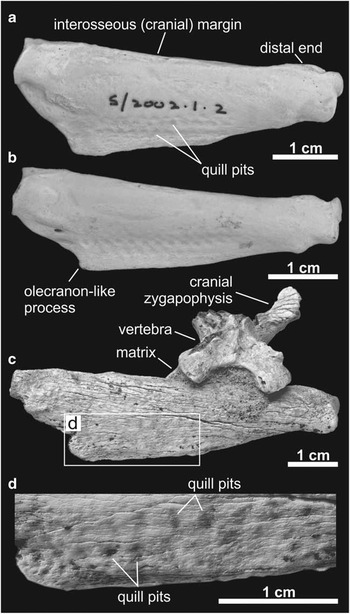
The fossil bone discussed here is an almost complete ulna, partially covered by matrix together with a fragmentary cervical vertebra (Fig. 1c), probably belonging to the same individual, from the Eocene La Meseta Formation (Seymour Island). It was collected in 2012 by TM, in the upper part of the unit Telm7 (or Submeseta Allomember; Late Eocene), within the Swedish locality NRM2, south-east of the Argentine Marambio Base (64°14.778'S, 56°37.169'W). The specimen is permanently deposited in the palaeozoological collections of the Naturhistoriska riksmuseet, Stockholm, Sweden (NRM-PZ). The comparative material comprises ulnae of modern penguins (Fig. 1a & b) housed at the Natural History Museum at Tring, UK (NHMUK).
Right ulnae of penguins in dorsal view: a. extant Spheniscus magellanicus (Forster), NHMUK S/2002.1.2, b. extant Eudyptes chrysocome (Forster), NHMUK S/1956.14.2, c. & d. unassigned Eocene specimen NRM-PZ A.1116 from Seymour Island.

Results
The studied ulna (NRM-PZ A.1116; Fig. 1c) represents the right wing skeleton of a relatively small early penguin. Its olecranon is broken and the whole surface is marked by longitudinal cracks. The bone is 62.5 mm long and 8.4 mm broad proximally (dorsoventral width of the proximal end).
The dorsal surface of the above ulna is characterized by the presence of two parallel rows of pits traceable along a considerable portion of its caudal expansion. They are offset relative to one another and cranial pits appear to be connected with their caudal, slightly more proximal, counterparts by short, shallow and oblique furrows (Fig. 1d). The pits are quite regularly spaced, with their midpoints c. 3.5 mm apart. There are at least 10–11 within each row, but, since the bone is damaged, the actual number may have been larger.
Discussion
The specimen NRM-PZ A.1116 is 9.3% shorter and 9.7% thinner proximally than the ulna belonging in the partial wing skeleton of ?Delphinornis (from the Eocene La Meseta Formation on Seymour Island, Antarctica) reconstructed by Jadwiszczak (Reference Jadwiszczak2010). It is similar in size to its counterparts assignable to the extant gentoo penguin, Pygoscelis papua (Forster). Hence the bird represented by NRM-PZ A.1116 was certainly much smaller than Inkayacu paracasensis Clarke et al., a giant penguin with preserved feathers from the Late Eocene of Peru, and at least five of ten species of penguins from the La Meseta Formation (see Jadwiszczak & Chapman Reference Jadwiszczak and Chapman2011).
The ulnar quill pits can be found in small- and middle-sized present-day penguins, i.e. those from the genera Eudyptes and Eudyptula (Mayr Reference Mayr2004) as well as Pygoscelis and Spheniscus, although their visibility varies between specimens (Jadwiszczak, personal observation). Mayr (Reference Mayr2004, p. 63) mentions a ‘row of pits’, whereas there are often two or more such rows, supposedly only one related to homologues of remiges (Fig. 1a & b). Interestingly, the layout of pits (and connecting furrows) in the fossil specimen differs from that observed in some modern ulnae. For example, while the pattern in NRM-PZ A.1116 can be termed as slightly slash-like (/), that in extant rockhopper penguin, Eudyptes chrysocome (Forster), resembles a row of backslash characters (e.g. Fig. 1b & d).
The location of quill pits in modern penguin ulnae corresponds to that in the fossil bone discussed here. Thus these pits can be reasonably interpreted as attachment markings of the ligaments of the follicles of feathers along the trailing edge of the forearm. The Inkayacu penguin possessed stacked layers of identical feathers originating from the ulna (and carpometacarpus), close to its caudal margin, and one of these layers could be considered to represent remiges (Clarke et al. Reference Clarke, Ksepka, Salas-Gismondi, Altamirano, Shawkey, D’Alba, Vinther, DeVries and Baby2010). It appears to be justifiable to consider two rows of ulnar pits in NRM-PZ A.1116 as attachment sites for undifferentiated ‘remiges’ and a layer of greater coverts respectively. Since the ulna of I. paracasensis is heavily abraded, no attachment markings are decipherable; however, the oblique orientation of fossilized feathers relative to the ulnar main axis (Clarke et al. Reference Clarke, Ksepka, Salas-Gismondi, Altamirano, Shawkey, D’Alba, Vinther, DeVries and Baby2010, fig. 2A) corresponds to that of elements of the pits-and-furrows system in NRM-PZ A.1116 (Fig. 1c). Undoubtedly, the latter specimen constitutes a source of valuable data on the plumage of early penguins, especially their non-giant representatives.
Acknowledgements
We are grateful to an anonymous reviewer for helpful comments. PJ acknowledges financial support through SYNTHESYS funding made available by the European Community – Research Infrastructure Action under the FP7 Structuring the European Research Area Programme; project GB-TAF-4610. TM thanks the Argentine Antarctic Institute (IAA-DNA), the Argentine Air Force and the Swedish Polar Research Secretariat (SPFS) for logistic support for fieldwork on Seymour Island, and the Swedish Research Council (VR grant 2009-4447) for financial support.
Author contribution
PJ developed and led the study, contributed 70% to the research, and prepared the typescript and figure. TM provided the fossil ulna and contributed 30% towards the research.