The practice of pre-operative enteral feeding in term neonates with congenital cardiac disease and prostaglandin-dependent pulmonary or systemic circulation remains controversial. Despite the fact that the physiologic and nutritional benefits of early enteral feeding in term and pre-term neonates are a well-studied subject, the safety and benefits of pre-operative nutrition in infants with prostaglandin-dependent congenital cardiac disease are yet to be defined. However, it is speculated that improved pre-operative nutritional status via enteral nutrition may lead to improved surgical outcomes, reduced peri-operative morbidity, perhaps a shorter length of hospital stay, and superior neurodevelopmental outcomes.
The paucity of data regarding optimal pre-operative nutrition in term prostaglandin-dependent neonates has led to a wide variety of nutritional practices. Very few published studies on pre-operative enteral feeding safety and tolerance in neonates with prostaglandin-dependent congenital cardiac diseaseReference Willis, Thureen, Kaufman, Wymore, Skillman and da Cruz1–Reference Luce, Schwartz and Beauseau4 either support or refute early enteral feeding in this neonatal population. In order to investigate the variability in pre-operative nutritional management of ductal-dependent neonates, we conducted an international survey to elucidate the current nutritional practices. To our knowledge, this is the first study to examine the variety of pre-operative nutritional strategies used in the care of term neonates with prostaglandin-dependent congenital cardiac disease around the world.
Materials and methods
Our survey was designed to describe the pre-operative nutritional practices in infants with prostaglandin-dependent congenital cardiac disease. After receiving the Institutional Review Board's approval, in March, 2008, paediatric practitioners were contacted via e-mail to respond to an Internet-based survey using commercially available software (www.surveymonkey.com). The survey was distributed to attendees of the Eleventh Annual Update on Paediatric Cardiovascular Disease (February, 2008, Scottsdale, Arizona, United States of America), the directors of neonatology fellowship training programmes around the United States, and via the European Society of Paediatric and Neonatal Intensive Care internet website. The survey explored current pre-operative nutritional practices in prostaglandin-dependent neonates including the willingness to enterally feed prostaglandin-dependent neonates, assessments of feeding readiness, medication dosing, use of umbilical catheters, and the observed incidence of feeding intolerance. Each survey had a total of 19 questions requiring either free text or multiple-choice answers. Within each survey, respondents were asked to identify their clinical role and geographical location in the United States or internationally. No attempt was made to correlate reported nutritional management practices with patient outcomes as part of this survey.
Survey results were summarised and are reported as the percentage frequency of given responses. Categorical comparisons of response frequencies were reported.
Statistical analysis
To assess the internal consistency and validity of the online survey used to gather the data for the study, the standardised Cronbach's alpha was calculated using all questions regarding a participant's willingness to enterally feed pre-operative prostaglandin-dependent infants – the primary outcome– under various conditions and for various reasons.
In addition to internal consistency, factorial validity in measuring the construct of willingness to enterally feed these patients was estimated with the varimax rotation method. Initial inspection of screen plots and the use of Wrigley's criterion to include or exclude survey items in the analysis led to a final factor analysis that forced items to load on three factors. Items that loaded most heavily on the primary factor included questions related to overall abstention from feeding, questions related to abstention for some specific reasons such as the presence of umbilical catheters, as well as questions about assessment, nutrition, and feeding means. Items that loaded most heavily on the second factor included only those two items related to the direction of ductal flow. Finally, those items that loaded most heavily on the third factor included miscellaneous items related to feeding decisions. Combined with the fact that all three factors were fairly similar in terms of the types of items that loaded on them, this indicates that a single construct is being measured in a variety of ways and under a variety of conditions by the instrument.
For the primary statistical analysis, a model selection technique was used to determine which predictor variables should be included in the final multivariable analysis. Single-variable logistic regression models were used to model the probability that a respondent reported enterally feeding pre-surgical prostaglandin-dependent neonates separately for each of the five potential predictor variables: country of practice, direction of ductal flow, presence of umbilical artery catheters, presence of umbilical venous catheters, and respondent's speciality/clinical role. Any predictor that yielded a p < 0.05 in a single-variable model was included in the final multivariable model; this included the first four variables but not the last variable.
Results
Demographics of survey respondents
A total of 737 medical caregivers were invited to participate in this survey, and we received 200 (27%) responses, with 80% from within the United States and 20% from outside the Unites States. Survey respondents represented 22 countries, and in the United States reported from 38 different states (Fig 1). Of all survey respondents, physicians represented 71% – including 44% paediatric cardiologists, 45% neonatologists, 10% paediatric intensivists, and 1% paediatricians); nurse practitioners and physician assistants constitute 10%, nurses 12%, and other medical personnel 7%. Within the group of non-United States respondents, physicians represented 73%, nurse practitioners and physician assistants 7%, nurses 15%, and other medical personnel 5%.
Demographics of the survey on enteral feeding in neonates with prostaglandin-dependent congenital cardiac disease.

Enteral feeding practices
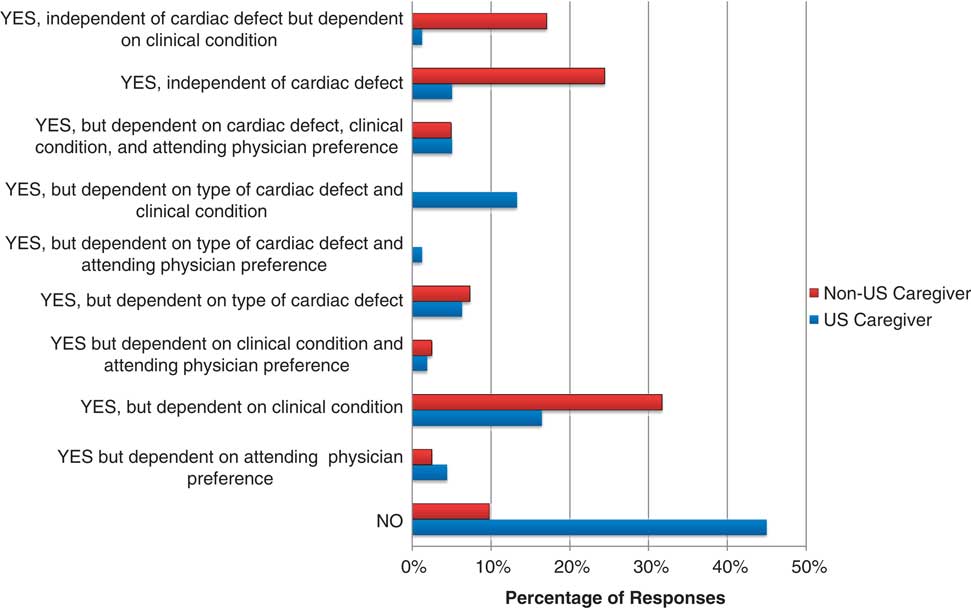
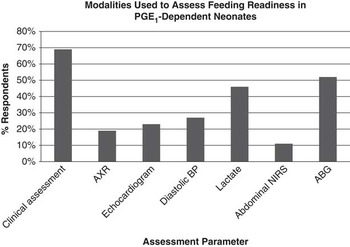
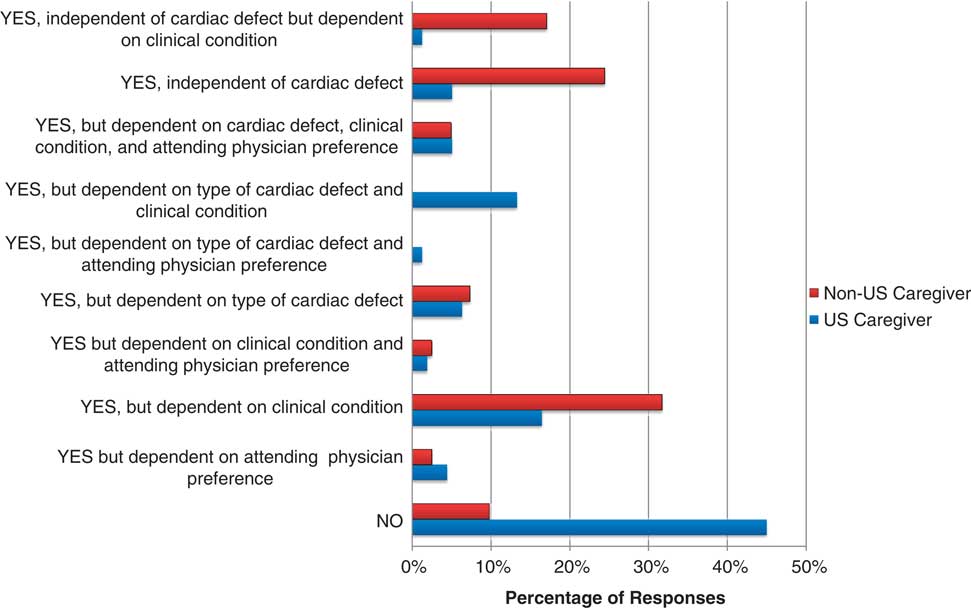
Routine pre-operative enteral feeding in prostaglandin-dependent infants was reported by 56% of United States medical caregivers and 93% of non-United States medical caregivers (Fig 2). The majority of caregivers who practise routine pre-operative feeding offer patients a combination of breast milk and formula nutrition via oral and gavage feeds. A large number of respondents prefer 60 kilocalories per 100 millilitres breast milk or formula; however, 23% of all responders allow these prostaglandin-dependent infants to ingest up to 72 kilocalories per 100 millilitres nutrition. The laboratory and physiological markers commonly used to determine clinical readiness to feed were quite varied and heterogeneous (Fig 3). The most frequently reported monitoring parameters included the clinical assessment, arterial blood gas, diastolic blood pressure, and serum lactate. A small minority of caregivers empirically followed abdominal radiographs while enterally feeding prostaglandin-dependent infants.
Reported enteral feeding practices of prostaglandin E1-dependent neonates.
Heterogeneous criteria routinely used to determine the feeding readiness of prostaglandin E1-dependent neonates.

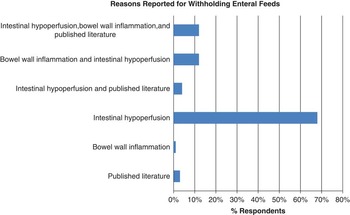
For those caregivers unwilling to feed in the pre-operative period (Fig 4), the major reasons cited for withholding enteral feeding included concern for intestinal hypoperfusion, concern for bowel wall inflammation, and apprehension with regard to feeding in the presence of umbilical catheters.
Reasons for enteral feeding abstinence around the world.

Role of ductal flow direction in feeding decisions
Of those respondents willing to enterally feed prostaglandin-dependent infants, two-thirds of caregivers do not base their enteral feeding decision on the ductal flow direction. Of all respondents whose feeding decisions are affected by the direction of ductal flow, 66% believe that it is safe to feed when flow is predominantly left to right, 24% when flow is predominantly right to left, and 10% when flow is bidirectional. When examined categorically, paediatric cardiologists report that they believe it is safer to feed prostaglandin-dependent infants with predominant left-to-right shunting (85%) in comparison with predominant right-to-left shunting (10%) or bidirectional shunting (5%). Neonatologists report a similar feeding practice, preferring to enterally feed prostaglandin-dependent infants with predominant left-to-right shunting (53%) rather than right-to-left shunting (29%) or bidirectional shunting (18%). Only two paediatric intensivists reported using the ductal flow pattern to make feeding decisions, with one only feeding prostaglandin-dependent infants with left-to-right shunting and the other only feeding infants with right-to-left shunting.
Feeding approaches in patients with umbilical arterial and/or venous catheters
Approximately 55% of United States and 71% of non-United States caregivers are willing to enterally feed prostaglandin-dependent infants with an umbilical arterial catheter in place. Comparing subspecialities, 48% of cardiologists are willing to feed with such a catheter in place in comparison with 73% of neonatologists.
When evaluating willingness to enterally feed with an umbilical venous catheter in place, 77% of United States and 87% of non-United States respondents were willing to feed. There was a similar response between subspecialities, with 78% of cardiologists and 82% of neonatologists being agreeable to feeding with an umbilical venous catheter in place.
Concomitant use of medications
Prostaglandin
The maximum dose of prostaglandin believed to be safe for enterally fed neonates varied significantly. Of those respondents willing to feed on prostaglandin, the majority of United States respondents preferred a maximum dose of 0.025 micrograms per kilogram per minute (42%), whereas non-United States respondents allowed feeding with a higher dose of 0.05 micrograms per kilogram per minute (31%). Notably, a number of respondents commented that feeding safely on prostaglandin is not dose dependent, but is rather based on a patient's clinical picture.
Intravenous haemodynamic support
In all, 81% of the United States survey respondents reported feeling uncomfortable feeding prostaglandin-dependent infants concurrently receiving inotropic or vasoactive support. In contrast, 45% of non-United States respondents reported that they were comfortable to enterally feed such patients.
Statistical interpretation
Instrument consistency and validity
The application of the standardised Cronbach's alpha identified an alpha value of 0.9, which indicates that this instrument had excellent internal consistency. The instrument was judged to have factorial validity in measuring the construct of willingness to enterally feed these patients, by the application of the varimax rotation method.
Primary analysis
A total of 163 respondents were included in the final multivariable logistic regression model. Of those 163 respondents, 101 (62%) reported that it is routine practice in their institutions to enterally feed these neonates. Country of practice, direction of ductal flow, and presence of arterial or venous umbilical catheters were all significant predictors of feeding practice.
Respondents practising outside the United States of America were 7.8 times more likely to feed these patients than respondents within the United States of America (95% confidence interval: 1.9–31.9, p = 0.004). Respondents’ decisions to feed were 3.1 times more likely to be affected by the presence of an umbilical arterial catheter than they were to be unaffected by this factor (95% confidence interval: 1.2–7.5, p = 0.015). Similarly, respondents’ decisions to feed were 13.7 times as likely to be affected by the presence of a venous catheter as they were to be unaffected by this factor (95% confidence interval: 3.6–52.6, p = 0.015). Finally, respondent's decisions to feed were 5.2 times as likely to be affected by the direction of ductile flow as they were to be unaffected by this factor (95% confidence interval: 1.7–16.4, p = 0.005).
Discussion
Despite the fact that the benefits of early enteral feeding in critically ill term and pre-term infants have been widely recognised, a unified pre-operative nutritional strategy for neonates with prostaglandin-dependent congenital cardiac disease is ill-defined. The lack of objective nutritional data has lead to a wide variety of pre-operative nutritional practices in these infants. This report is the first to describe the various pre-operative nutritional strategies in ductal-dependent neonates in practice today.
For neonates with prostaglandin-dependent congenital cardiac disease, the current nutritional strategies used by caregivers around the world are quite variable. United States survey respondents report exercising caution when considering pre-operative enteral feeding in ductal-dependent neonates, whereas non-United States respondents report routine enteral feeding in this prostaglandin-dependent population.
A common reason given for feeding apprehension in these neonates is the theoretical risk for intestinal hypoperfusion, which may lead to necrotising enterocolitis, although the latter has not been demonstrated. Past studies have shown a variable increase in the risk of necrotising enterocolitis in neonates with congenital cardiac disease;Reference Leung, Chau and Hui5–Reference McElhinney, Hedrick and Bush7 however, the mechanism by which this may occur is unclear. More recently, Luce et alReference Luce, Schwartz and Beauseau4 investigated a population of neonates undergoing the Stage I hybrid procedure for palliation of complex congenital cardiac disease and found that the prevalence of necrotising enterocolitis is comparable to that reported for neonates undergoing the Norwood procedure. Interestingly, earlier gestational age was a significant risk factor but no other demographic, perinatal, peri-operative, clinical, or procedural variables, including enteral feeding regimens, were associated with the development of necrotising enterocolitis.
The combined lack of objective data and the hypothetical concern for this complication in this population have prompted many caregivers to refrain from enteral feeding until after surgical repair. With such a discrepancy in pre-operative feeding management between caregivers, ongoing speculation exists to the true incidence of necrotising enterocolitis in this ductal-dependent population.
Ductal patency and flow pattern are often evaluated in prostaglandin-dependent neonates before the initiation of enteral feeds. When creating this survey, we had expected that caregivers might rely on ductal flow direction to determine the safety of pre-operative enteral nutrition. Instead, we discovered that only a minority of caregivers report basing their enteral feeding decisions on the ductal flow direction. It was interesting to find that those respondents relying on the ductal flow pattern felt more confident feeding neonates with a predominantly left-to-right ductal flow pattern. The physiology in those patients relates to the diastolic flow reversal in the descending aorta as blood travels retrograde to fill the pulmonary bed. When compared with infants with a right-to-left ductal flow pattern, arguably these infants should theoretically be at higher risk for mesenteric ischaemia due to reduced systemic perfusion. By analogy, studies in the pre-term population have demonstrated that the presence of a patent ductus arteriosus is associated with retrograde diastolic flow in the descending aorta and that the superior mesenteric artery may impair intestinal perfusion and has been linked to an increased risk of necrotising enterocolitis.Reference McElhinney, Hedrick and Bush7–Reference Martinussen, Brubakk, Vik and Yao10 McElhinney et alReference McElhinney, Hedrick and Bush7 conducted a retrospective review of 643 neonates with congenital cardiac disease in an attempt to identify factors associated with an elevated risk of necrotising enterocolitis. A common feature of many of the cardiac structural defects associated with enterocolitis was the combination of a widened pulse pressure and low diastolic pressure. Both these findings are more likely to be observed in patients with a retrograde diastolic flow pattern in the descending aorta, which may potentially result in mesenteric ischaemia.
The topic of enteral feeding in prostaglandin-dependent neonates in the presence of umbilical catheters also remains quite controversial. The presence of umbilical catheters, particularly in the arterial location, often impacts the caregiver's decision to enterally feed prostaglandin-dependent neonates owing to concerns of compromised intestinal perfusion. In our survey results, we had expected to find significant variation in the acceptance of concomitant umbilical catheter usage and pre-operative enteral feeding. As we anticipated, many caregivers reported scepticism regarding the safety of enteral nutrition in the presence of an umbilical arterial catheter. However, we did not expect to find the majority of respondents feeling comfortable while feeding safely with an umbilical venous catheter present. A prior study by Tiffany et alReference Tiffany, Burke, Collins-Odoms and Oelberg11 sought to evaluate the practice of enterally feeding high-risk newborns in the presence of umbilical catheters. In their survey of 549 North American neonatologists, they found that 92% of respondents reported at least trophic feeds with an umbilical venous catheter in place, whereas only 30% reported routinely feeding with an umbilical arterial catheter. In the neonatal literature, the safety of early enteral feeding in the presence of umbilical catheters has been reported in high-risk pre-term and term infants. Havranek et alReference Havranek, Johanboeke, Madramootoo and Carver12 prospectively examined the blood flow velocity in the superior mesenteric artery before and after small enteral feeds in 19 very low birth weight pre-term infants with umbilical arterial catheters. The authors concluded that there was no significant difference in the superior mesenteric artery blood flow velocity responses to minimal enteral feedings in infants with an umbilical arterial catheter in place when compared with the same infants with the catheter removed. Another study by Davey et alReference Davey, Wagner, Cox and Kendig13 examined the frequency of feeding problems in premature infants receiving enteral feeds in the presence of an umbilical arterial catheter when compared with those who were not fed until after catheter removal. This prospective randomised study included 60 patients and showed no difference in feeding problems among treatment and control groups. Despite the fact that both studies are not sufficiently powered to exclude the possibility of feeding intolerance in enterally fed neonates with umbilical arterial catheters, they do provide evidence suggesting lack of harm.
In many instances in paediatric cardiology, there is a paucity of evidence-based practice. Many clinical decisions are governed by experience and training, instinct, and anecdote, often with little basis in specific studies.Reference Darst, Newburger, Resch, Rathod and Lock14 The decision to feed infants on prostaglandin awaiting intervention is an example of this. A novel systematic approach to overcome such limitations in this discipline is Standardised Clinical Assessment and Management Plans or SCAMPS. This has been proposed as a tool to improve patient care through standardised assessment and reduce variability of management in a diverse patient population.Reference Rathod, Farias and Friedman15 Such an initiative may prove to be useful in a variety of questions of clinical practice.
Clearly, there are limitations to our study. As with any survey, our findings rely upon caregiver self-reporting and thus all results are subject to this bias. The study design has an inherent selection bias, as the majority of individuals identified to participate in this survey were attendees of a national meeting or directors of United States medical training programmes. Lastly, we did not seek to associate pre-operative nutrition with post-operative outcomes in this survey. Nevertheless, this survey provides a flavour of the heterogeneity that characterises current feeding practices in prostaglandin-dependent neonates around the world. This survey provides a strong driving force to advance the study of nutritional safety in critically ill prostaglandin-dependent neonates with congenital cardiac defects.
Conclusion
The results of this survey indicate that there is a lack of consensus in providing enteral nutrition to neonates with congenital cardiac disease and prostaglandin-dependent systemic or pulmonary circulations. Arguments that support or refute the practice of pre-operative enteral feeding in ductal-dependent neonates have little support in the medical literature. Future multicentric, randomised studies should aim to demonstrate the safety and short- and long-term benefits of enteral feeding in this selective population, while evaluating markers of intestinal perfusion. For this purpose, it would be crucial to establish consistent and standardised feeding protocols that may even contribute to reducing the incidence of necrotising enterocolitis.
Acknowledgements
The authors acknowledge Dr Gil Wernovsky, MD, for his assistance in the distribution of this survey.