1. Introduction
English is an official language in Uganda and is said to be in its nativization phase when placed within Schneider's (Reference Schneider2007) model of the trajectorial development of Englishes (Isingoma & Meierkord, Reference Isingoma, Meierkord, Esimaje, Gut and Antia2019). In the present study, we delineate the general features of the Ugandan accent of English (i.e. those that cut across regional or ethnic boundaries) as well as features that evince variability among Ugandans due to regional or ethnic background. The first description of the phonological features of the variety of English spoken in Uganda is included in Fisher's (Reference Fisher2000) seminal paper on this L2 (second language) variety of English. Another description of these features is found in Nassenstein (Reference Nassenstein2016). Both Fisher (Reference Fisher2000) and Nassenstein (Reference Nassenstein2016) provide a short section, outlining the features which are similar to the general features of L2 Englishes, notably the restructuring of the phonemic system, e.g. /a/ replacing /ɜ:, ɑ:, ʌ, ə/ and the free variation of [l] and [r], although the latter occurs regionally (see similar findings on L2 varieties of English in Bailey & Görlach [eds.] Reference Bailey and Görlach1984; Platt, Weber & Ho, Reference Platt, Weber and Ho1984; Schmied, Reference Schmied1991; Simo-Bobda, Reference Simo-Bobda2000; Atechi, Reference Atechi2004; Schneider et al. [eds.], Reference Schneider, Burridge, Kortmann, Mesthrie and Upton2004; Tsilimos, Reference Tsilimos2018; among others). Additionally, Simo-Bobda (Reference Simo-Bobda2001) and Schmied (Reference Schmied, Schneider, Burridge, Kortmann, Mesthrie and Upton2004) describe more or less the same features but in a more detailed way under the label ‘East African English’ (Kenya, Uganda, Tanzania). Schmied (Reference Schmied, Schneider, Burridge, Kortmann, Mesthrie and Upton2004) posits three reasons that underlie the features in question: substrate influence, simplification and spelling pronunciation. To these studies, we add a more focused study on one particular aspect of the Ugandan accent(s) of English, namely by Meierkord (Reference Meierkord, Meierkord, Isingoma and Namyalo2016), who looks at diphthongs and how they are realized by speakers of different L1s. Her findings demonstrate variability but also convergence in the idiomorphic pronunciation of diphthongs by Ugandans.
This study therefore sheds more light on the outlines provided by Fisher (Reference Fisher2000) and Nassenstein (Reference Nassenstein2016), as well as augmenting observations made by Simo–Bobda (Reference Simo-Bobda2000) and Schmied (Reference Schmied, Schneider, Burridge, Kortmann, Mesthrie and Upton2004) as regards the accent of English in Uganda. Remarkably, using features not captured by Meierkord (Reference Meierkord, Meierkord, Isingoma and Namyalo2016), the study provides more evidence for her observation as regards the existence of more than one homogeneous accent of English among Ugandans due to ethnic language substrate influence. In order to achieve this goal, we involved 52 respondents who were L1 speakers of four main Ugandan indigenous languages (i.e. 13 each), namely Acholi, Ateso, Lugbara and Luganda. This was meant to take care of the three main language families found in Uganda, namely Nilotic (Acholi for Western Nilotic and Ateso for Eastern Nilotic), Central Sudanic (Lugbara) and Bantu languages (Luganda).Footnote 1
2. Methodology
We collected our data using recordings: here, we asked the 52 Ugandans (see Section 1), who were all university students, to read key words we provided on a word list (see Section 3 and Appendix 1), as we recorded them (cf. Hung, Reference Hung2000). The key words were meant to capture major peculiar patterns of both vowels and consonants that would allow for generalizations that evince the Ugandan accent(s) of English. Just like Hung (Reference Hung2000), we used words that belong to the category of common words that occur in everyday discourse so as to make the reading as natural as possible and avoid any difficulty that could arise if one encountered a word one had never used or heard before (see Hung, Reference Hung2000 for more information on using word lists).
We then used an auditory analysis of the specific sounds under consideration as produced by our respondents during the reading of the selected words. While we did not use any acoustic analyzer software, we compared the sounds produced by our respondents with the sounds on the interactive IPA chart as well as both the audio and transcribed pronunciations provided by the OED in order to double-check our conversance with RPFootnote 2, which we used as a reference model for comparative purposes. Where there was interspeaker variability, we grouped the speakers based on the variation, which unsurprisingly turned out to stem from regional or ethnic backgrounds.
3. The Ugandan accent(s) of English and Received Pronunciation compared
3.1 Introduction
Way back, Wells (Reference Wells1982) used four parameters to describe differences between accents of English, namely phonetic realization, phonotactic distribution, phonemic system and lexical distribution (see subsections below for details). While Wells’ (Reference Wells1982) taxonomy has been around for close to four decades, it has provided parameters that have been referred to (or at least some aspects of them) in the comparison and analysis of English accents. For example, his lexical sets have widely been used, e.g. in Schneider et al. (eds.) (Reference Schneider, Burridge, Kortmann, Mesthrie and Upton2004). And, as Hodson (Reference Hodson2014: 18) puts it, Wells (Reference Wells1982) ‘remains a useful reference.’ In addition, Brown (Reference Brown2014: 76) observes that Wells’ (Reference Wells1982) parameters are not only relevant to L1 varieties but also to L2 varieties of English. Thus, in the current study, we will use Wells’ (Reference Wells1982) parameters and, where necessary, augment them with current theorizing about L2 Englishes or second language acquisition processes.
3.2 Differences between the Ugandan accent(s) of English and RP
3.2.1 Phonetic realization
Phonetic realization involves corresponding phonemes being realized with different articulations (Wells, Reference Wells1982: 73; Brown, Reference Brown2014: 75). For example, Brown (Reference Brown2014: 75) states that in RP and GA, okay is pronounced with the diphthong /eɪ/ in the second syllable, while it is pronounced with /e:/ in Scottish English and in ‘many foreign’ accents. This is the vowel found in the FACE lexical set proposed by Wells (Reference Wells1982: 142). Relatedly, this RP phoneme, /eɪ/, is realized in the Ugandan accent of English as /eɪ/, /e:/ or /e/, as shown in the following wordsFootnote 3 (Table 1):
Examples of differences in phonetic realization of the FACE vowel

From the examples, we realize that RP /eɪ/ is realized in the Ugandan accent of English as /eɪ/ as in veil, as /e/ as in able and as /e:/ as in café, depending on the spelling of the words (see below). Crucially, since we only relied on auditory perceptions, we only heard the sound /e/ in the pronunciation of words such as able and later. However, Meierkord (Reference Meierkord, Meierkord, Isingoma and Namyalo2016: 142 ff.), using results obtained from Praat-generated acoustic analyses, shows that despite the propensity among Ugandans to monophthongize the vowel in the FACE lexical set, they also diphthongize it mainly as /eə/, but occasionally as /eɪ/. Schmied (Reference Schmied, Schneider, Burridge, Kortmann, Mesthrie and Upton2004: 160) states that the diphthong in the FACE vowel tends to be monophthongized in East African English (and African Englishes in general). Crucially, as we will demonstrate below, this only affects specific words in the Ugandan accent of English. The use of /eɪ/ in L2 varieties has also been documented by Mesthrie (Reference Mesthrie, Schneider, Burridge, Kortmann, Mesthrie and Upton2004: 1102f.), albeit it occurs to a less extent. As Meierkord (Reference Meierkord, Meierkord, Isingoma and Namyalo2016: 130) reports, earlier observations regarding the absence of diphthongs and the consequent realization of the diphthongs as double monophthongs in African varieties of English, e.g. Black South African English, have been proved to be incorrect thanks to e.g. van Rooy's (Reference Van Rooy, Schneider, Burridge, Kortmann, Mesthrie and Upton2004) acoustic analyses. Van Rooy's (Reference Van Rooy, Schneider, Burridge, Kortmann, Mesthrie and Upton2004) findings have now been bolstered by Meierkord's (Reference Meierkord, Meierkord, Isingoma and Namyalo2016) acoustic analyses.
One aspect that should be considered when analyzing the vowel in FACE for an L2 variety like the Ugandan accent of English is the spelling. As is well known (cf. Schmied, Reference Schmied, Schneider, Burridge, Kortmann, Mesthrie and Upton2004: 158; Simo-Bobda, Reference Simo-Bobda, Schneider, Burridge, Kortmann, Mesthrie and Upton2004: 886), spelling plays a very important role in the pronunciation of words in L2 varieties of English. Relevantly, our respondents used the sound /eɪ/ in the words spelled with <ai>, <ei>, <ay> and <ey>, e.g. aim, neighbor, may, and convey. In fact, due to the influence of spelling, our respondents also used this diphthong in words spelled with the above graphemes which are not pronounced in RP using this diphthong, e.g. heifer, says, said Footnote 4, plantain, mountain and neither, which in RP are either monophthongized as /hefə/, /sez/, /sed/, /plantɪn/, /maʊntən/ (here the second syllable) or diphthongized as /aɪ/ in neither. It is highly probable that the few instances of /eɪ/ in Meierkord (Reference Meierkord, Meierkord, Isingoma and Namyalo2016) could have been realized in the pronunciation of the five words out of the 14 in the FACE lexical set in her data spelled with some of the above letters, i.e. daily, laid, plain, waiting and way. For the words spelled with <a>, e.g. later, our respondents used /e/, since the spelling is monographemic. In addition, we are aware that many of the borrowings from French spelled with <e> and which have only partially undergone indigenization in RP are pronounced with /eɪ/. Such words include café, cliché, buffet, beret, etc.In the Ugandan accent of English, these are quintessentially pronounced with /e:/.
3.2.2 Phonotactic distribution
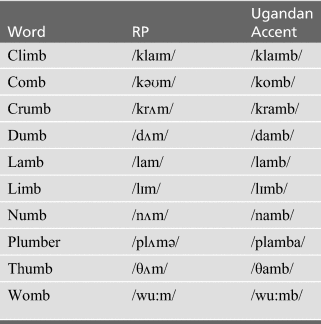
Wells (Reference Wells1982) states that RP and GA have differences as regards how some phonemes may or may not combine in a syllable. A well known example involves the phoneme /j/, which in GA cannot follow an alveolar in a cluster. Consequently, while in RP the word new is pronounced as /nju:/, in GA it is pronounced as /nu:/. This is what Wells (Reference Wells1982: 75) calls phonotactic distribution. RP and the Ugandan accent of English also show differences based on this parameter, as shown in Table 2:

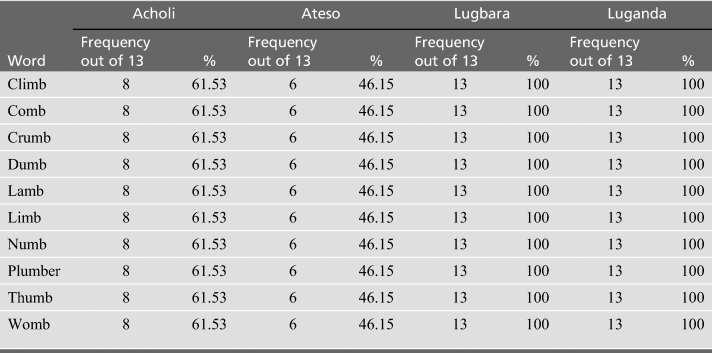
Occurrence of the cluster /mb/ in English among different L1 groups

Observably, while RP does not allow the cluster /mb/ in the same syllable, the Ugandan accent of English allows it. Again what is at work here are the artefacts of spelling pronunciation working synergistically with substrate influence. The contribution of spelling pronunciation is likely as the words are written with the grapheme <mb>. However, this is not sufficient as the words debt and Wednesday, for example, were not pronounced by our respondents as /debt/ and /wednezdeɪ/, despite having the grapheme <bt> and <dn> respectively.Footnote 5 While according to Schmied (Reference Schmied, Schneider, Burridge, Kortmann, Mesthrie and Upton2004: 158), debt is pronounced as [debt] in East African English, our data do not show that. On the other hand, the role of substrate influence in realizing the cluster /mb/ in the Ugandan accent of English is manifest when one considers two of the L1s spoken by our respondents: Luganda and Lugbara, both of which have the cluster /mb/ (cf. Mwita Reference Mwita2007 for the occurrence of /mb/ in Bantu). For example, in Luganda, words such as mbu ‘that’ and katemba ‘comedy’ contain the cluster /mb/, while for Lugbara, words such as mbe ‘to lick’, mba ‘to spy’, mbelembele ‘quickly’ also have it.Footnote 6 Crucially, it is interesting to note that Acholi and Ateso do not have this sequence (cf. Myers-Scotton & Okeju, Reference Myers–Scotton and Okeju1972; Barasa, Reference Barasa2017; Oyaro Reference Oyaro2019). While there are words that orthographically contain the sequence <mb> in the two languages, in pronunciation, the sequence belongs to two different syllables, as is the case in RP (e.g. combine /kəm.baɪn/). For example, according to Barasa (Reference Barasa2017: 61), an Ateso word like emaembet ‘mango’ would syllabify as /e.ma.em.bet/. Similarly, the Acholi word kombedi ‘now’ syllabifies as /kom.be.di/.
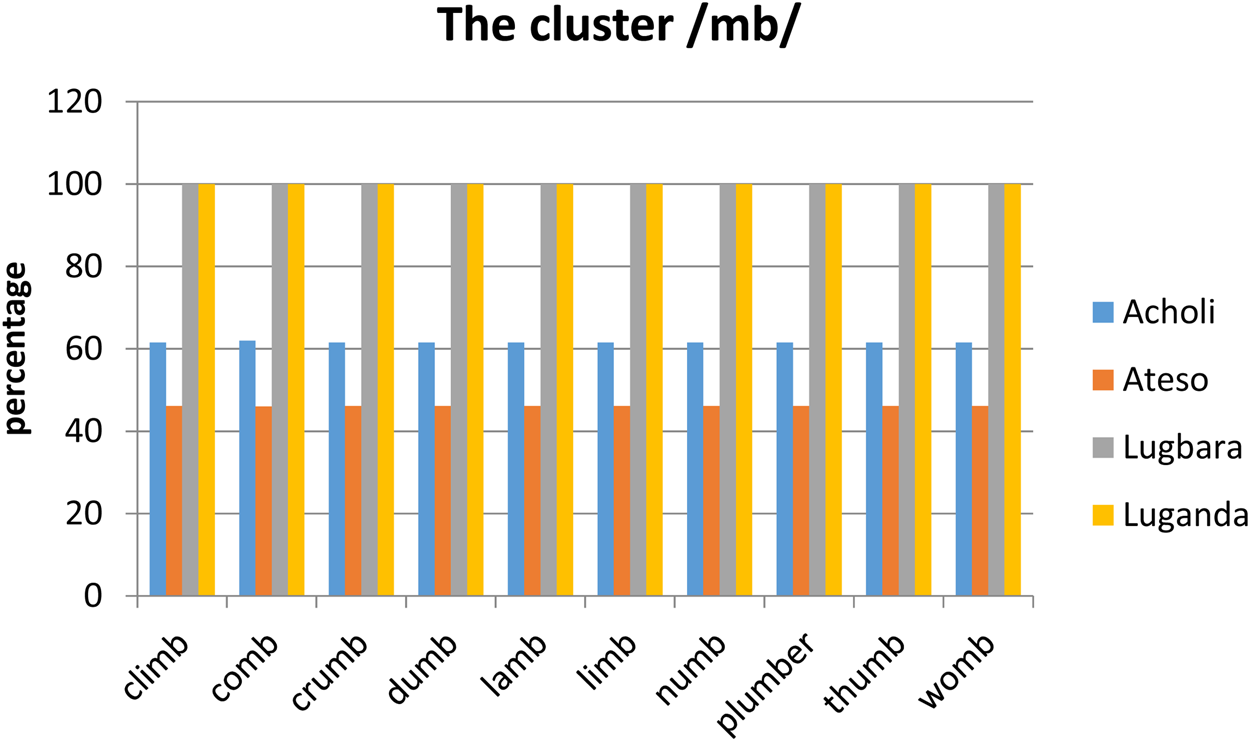
As noted under Table 2, there was interspeaker variability. Specifically, while the majority of the speakers (i.e. 40 out of 52) used the cluster /mb/, there was a small group of speakers (i.e. 12 out of 52) who did not use it. This can be visualized in the following graph (Figure 1; see also Appendix 2):
As can be seen from the graph (and in Appendix 2), all speakers of Luganda and Lugbara pronounced the words with the cluster /mb/, while eight speakers from Acholi (i.e. 61.53%) and six from Ateso (i.e. 46.15%) pronounced the words with /mb/.Footnote 7 This makes a total of 14 speakers, out of the 26 total number from the two languages (i.e. Acholi and Ateso), who pronounced the words with the cluster /mb/ (recall each language had 13 respondents in the study). This means, in total, 12 Acholi and Ateso speakers pronounced the words without the cluster /mb/. This is not surprising, as an earlier study by Orude (Reference Orude2016) also shows that some L1 speakers of Ateso pronounce such words with the cluster /mb/, while others pronounce them without it. Note that one may contend that the 12 Ugandans (among the Acholi and Ateso L1 speakers) who pronounced the above words without /mb/ were able to do so because they had a good level of phonological proficiency in English, thereby enabling them to pronounce the words as they are pronounced in RP. While this may not be discounted completely, there is evidence that in one of the two languages, i.e. Acholi, its L1 speakers often find it difficult to pronounce English words which have coda clusters (cf. Adokorach, Reference Adokorach2018). This is due to the fact that while Acholi, just like English, has closed syllables (in addition to open syllables), the codas must be singleton consonants. The same situation holds for Ateso (Barasa, Reference Barasa2017: 50). Consequently, English syllables with bisegmental or trisegmental coda consonants are generally pronounced by L1 Acholi speakers by omitting the second and third consonants, e.g. box and scripts are pronounced as /bok/ and /skrɪp/ respectively by many Acholi speakers (Adokorach, Reference Adokorach2018). Thus, in this way, the phonotactics of Acholi makes the pronunciation of the words in Table 2 by some L1 speakers of the language look like RP pronunciation, while those who regard themselves as having overcome this mother tongue ‘interference’ end up pronouncing the words the way the majority of Ugandans pronounce them, i.e. with the cluster /mb/. We should note that while the 12 Acholi and Ateso speakers did not use the cluster /mb/, they did not pronounce the word plumber as /plᴧmə/; rather, they pronounced it as /plam.ba/, thereby reflecting a spelling pronunciation of the word but at the same time not allowing the cluster /mb/ as is the case in their L1s.
Following from above, we can surmise that, at the macro level, the cluster /mb/ is a salient feature of the Ugandan accent of English given its predominance, although there is some micro-variation involving some speakers of English in Uganda. Hence, while we may recognize the influence of Bantu languages on the Ugandan accent of English (since they are spoken by 66.4% of the Ugandan population), we still need to underscore the role that other Ugandan languages play in shaping this accent, in line with Meierkord's (Reference Meierkord, Meierkord, Isingoma and Namyalo2016) argument that different L1s influence their speakers in different ways in Ugandan English. For the eight Acholi and six Ateso speakers (61.53% and 46.15% respectively) who pronounced the above words with the cluster /mb/, one could think of factors such as mobility in the country, which exposes them to the majority non-Nilotic Ugandans, who have the cluster /mb/ in their accent (and L1s), thereby making them adopt the pronunciation with this cluster. Alternatively, it could just be a question of spelling pronunciation, although our data shows that this factor is not very salient in the pronunciation of consonant clusters in the Ugandan accent of English; rather, it is more manifest in the pronunciation of vowels.
3.2.3 Phonemic system
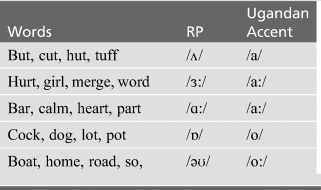
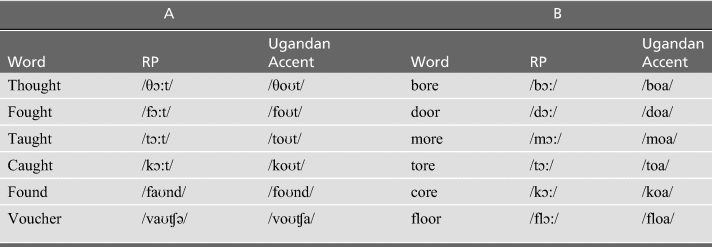
If a given variety of English has particular phonemes which another variety of English does not have, then the differences between the two varieties of English are due to what is known as phonemic system (Wells, Reference Wells1982). As is already evident from many of the transcriptions in the above examples, the Ugandan accent of English lacks the RP phonemes /ɑ:, ʌ, ɜ:, ɒ, əʊ/ (see also Fisher, Reference Fisher2000; Simo–Bobda, Reference Simo-Bobda2001; Schmied, Reference Schmied, Schneider, Burridge, Kortmann, Mesthrie and Upton2004; Nassenstein, Reference Nassenstein2016; Meierkord, Reference Meierkord, Meierkord, Isingoma and Namyalo2016). Meierkord (Reference Meierkord, Meierkord, Isingoma and Namyalo2016: 143), however, shows that while indeed the diphthong /əʊ/ is non-existent in the Ugandan accent of English and to some extent tends towards monophthongization, a variant diphthong is often produced in the Ugandan accent of English, i.e. /ʊə/ or /ɔə/ when pronouncing words in the GOAT lexical set. When this diphthong is monophthongized, the above RP vowels are thus mainly rendered as /a, a:, o, o:/, with the first sound replacing /ʌ/, the second replacing /ɑ:, ɜ:/ and the last two replacing /ɒ, əʊ/ respectively, as shown in the following examples (Table 3):
Examples of differences in phonemic system

As has been stated by Schmied (Reference Schmied, Schneider, Burridge, Kortmann, Mesthrie and Upton2004), this restructuring is due to the fact that Ugandan L1s lack many of the RP vowels and there is often a tendency to simplify the complex English vowel system to a few vowels that exist in the substrate languages. To the above, we need to add the fact that the schwa is realized in several ways in the Ugandan accent of English depending on the spelling (Fisher, Reference Fisher2000: 60), i.e. it is realized as /a/ in a word such as better, /o/ in a word such as stubborn and /e/ in a word such as obstinate.Footnote 8
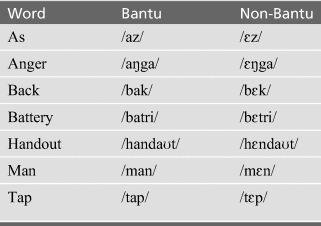
Until recently, RP had the sound /æ/ in its vowel inventory, which was found in the TRAP lexical set. However, we are aware that this sound is now realized as /a/ in contemporary RP (Upton Reference Upton, Schneider, Burridge, Kortmann, Mesthrie and Upton2004: 221, Ježek Reference Ježek2012: 135, OED). The contemporary RP sound is what Bantu speakers of English in Uganda use in words such as back, bank, and hat, while evidence from our recordings show the use of /ɛ/ in lieu of /a/ by some non-Bantu speakers (see details below). Simo–Bobda (Reference Simo-Bobda2001: 273) admits that /a/ is ubiquitous in Uganda, but states that ‘there is a negligible number of cases of /ɛ/ here and there.’ Whereas there is a clear predominance of /a/ in our data (see below for figures), the occurrence of /ɛ/ requires some explanation. In fact, non-Bantu are known in Uganda as people who characteristically use this sound in English and this is one of the most prominent features of what is locally known as the ‘northern accent’ (since non-Bantu languages are found in the northern and north-eastern parts of Uganda). Thus, Bantu speakers and non-Bantu speakers can sometimes be distinguished based on this sound, as shown in the following examples (Table 4):
Examples of pronunciation differences between Bantu and non-Bantu

While Ugandan Bantu languages have the sound /a/ only, Acholi, Ateso and Lugbara have both /a/ and /ɛ/ (cf. Barasa, Reference Barasa2017; Oyaro, Reference Oyaro2019; Crazzolara, Reference Crazzolara1960). One question that arises here is to explicate why not all the L1 speakers of the non-Bantu languages used /ɛ/, since only 18 out of 39 non-Bantu used it (recall that we had in total 13 respondents per L1, which gives us 39 respondents from the three non-Bantu languages, i.e. Acholi, Ateso and Lugbara, while Luganda – a Bantu language – had 13 respondents as well, thereby making the grand total of 52 respondents, as explained in Section 2). One hypothesis that can be used here is that the speakers of non-Bantu languages who used /a/ and not /ɛ/ are influenced by the Bantu accent of Ugandan English. However, the tenability of this premise begs the question as to why this should be the case, yet these non-Bantu languages also have the sound /a/. Thus, the influence could also be said to have come from the non-Bantu languages themselves. In order to try and find out what exactly determines the choice between /a/ and /ɛ/ for non-Bantu, we asked some of the informants involved in the study in a follow-up discussion. Those who used /a/ told us that they simply pronounced the words the way other Ugandans pronounce them. This, to some extent, means they might partly be influenced by the Bantu, and this influence is facilitated by the presence of /a/ in their L1s. The response we obtained from the group that used /ɛ/ was that they pronounced the words the way older speakers of English in their region pronounce such words, and that these older speakers were taught by the British. In other words, to them, they simply pronounce the words like what they perceive as British. Thus, when a British person uses /æ/, for them they hear /ɛ/ (evidently, we are aware that the change from /æ/ to /a/ in RP is recent and that not every British person uses RP).
It is now clear that despite the claim that Bantu languages have a predominant influence on Ugandan English (Isingoma, Reference Isingoma, Meierkord, Isingoma and Namyalo2016), other Ugandan languages also have a role to play (Meierkord, Reference Meierkord, Meierkord, Isingoma and Namyalo2016). Apart from a few borrowings (cf. Isingoma, Reference Isingoma, Meierkord, Isingoma and Namyalo2016; Isingoma & Meierkord, Reference Isingoma, Meierkord, Esimaje, Gut and Antia2019), non-Bantu languages, not least the ones under consideration in this study, have influenced the pronunciation of specifically two words in the Ugandan accent of English across the country, namely cap and pack. These words are typically pronounced with /ɛ/ in the ‘northern accent’ and with /e/ by L1 speakers of Bantu, since the Bantu languages do not have /ɛ/. While the use of /ɛ/ may be regarded as normal for non-Bantu, it is quite surprising to hear Bantu speakers use /e/ in the pronunciation of cap and pack, since here they are supposed to use /a/. However, the surprise has an explanation, with a historical provenance. The Bantu speakers use /e/ as an approximation of the non-Bantu /ɛ/. Traditionally, in Uganda, the words cap ‘head-dress’ and pack ‘backpack’ were associated with the army. Historically (especially during the colonial times and the early years of independence), the Bantu people in Uganda were regarded as weak people and were therefore not generally recruited into the army (Amone, Reference Amone2014). Thus, the army was dominated by non-Bantu and naturally they frequently used the words cap and pack (as borrowings in Ugandan Kiswahili – the language of the Ugandan army), which they pronounced as /kɛp/ and /pɛk/. Since there were a few Bantu in the army (who were only recruited after meeting certain physical requirements), they also used the words with an approximate sound, i.e. /e/. Thus, these words have kept this pronunciation to date.Footnote 9 Hence, even though one may espouse the idea that there is substantial influence of Bantu L1s on the Ugandan accent of English and that this influence arguably affects some non-Bantu speakers as well, what emerges from this study is the fact that non-Bantu languages have also typically influenced some aspects of the Ugandan accent of English beyond their territorial boundaries. Thus, there is no doubt that what we observe here is a case of what Meierkord (Reference Meierkord2012, Reference Meierkord, Meierkord, Isingoma and Namyalo2016) refers to as ‘Interactions across Englishes.'
In contradistinction to some accents in East Africa (e.g. in some accents of Tanzanian English) and West Africa (e.g. Ghana), where RP /ɜ:/ is also replaced by /ɛ/ (or even /ɔ/ in other West African countries) (cf. Simo–Bobda, Reference Simo-Bobda2000, Reference Simo-Bobda2001), this sound does not exist in the Ugandan accent of English, despite the fact that the three non-Bantu languages under consideration in this study (and other Ugandan non-Bantu languages) have the sound /ɛ/ and even /ɔ/. In the Ugandan accent of English, all words with RP /ɜ:/ are prototypically pronounced using /a/ across all L1 groups (see Table 3). While Simo–Bobda (Reference Simo-Bobda2001: 274) states that /ɛ/ is sometimes heard in acrolectal speech in Uganda in place of RP /ɜ:/, our data do not show that and neither do our daily observations attest to that. Moreover, neither Fisher (Reference Fisher2000) nor Nassenstein (Reference Nassenstein2016) makes mention of /ɛ/ as a substitute of RP /ɜ:/ in the Ugandan accent of English.
Crucially, in addition to the reduction of the number of RP vowels in the Ugandan accent of English, there are also cases of vowel addition, triggered by spelling and therefore resulting in what is known as spelling pronunciation. This manifests itself with respect to two diphthongs that do not exist in RP, namely /oʊ/ and /oa/. The two diphthongs are realized in words such as the ones listed in Table 5:
Examples of spelling pronunciation diphthongs

Some varieties of English have diphthongs that do not exist in RP. For example, Wells (Reference Wells1982) reports that New Zealand English has the following diphthongs that are not found in RP: /æe/, ɑe/, /oe/ in FACE, PRICE and CHOICE lexical sets respectively (see also Bauer & Warren, Reference Bauer, Warren, Schneider, Burridge, Kortmann, Mesthrie and Upton2004: 582), while Wilson (Reference Wilson, Schneider, Burridge, Kortmann, Mesthrie and Upton2004: 989) shows that THOUGHT is pronounced by some speakers with /ɔə/ in St. Helena English. While the above diphthongs in the Ugandan accent of English are clearly motivated by spelling, the diphthongization of sounds where RP has a monophthong is also found in some L1 varieties of English. For instance, Melchers (Reference Melchers, Schneider, Burridge, Kortmann, Mesthrie and Upton2004: 43) states that the lexical set THOUGHT has the diphthong /ʌ¨ʊ/ (alternating with the monophthong /ɔ/ in Orkney English (one of ‘the most northerly units of land in the British Isles'). At the same time, the OED shows that in GA, words such as bore may be pronounced with the vowel /ɔə/ as an alternative pronunciation to /ɔr/. In fact, the RP use of /ɔ:/ in words such as bore and door is relatively a recent development, as RP had the diphthong /ɔə/ in such words (Jones, Reference Jones1918: 116; Meierkord, Reference Meierkord, Meierkord, Isingoma and Namyalo2016: 125).
3.2.4 Lexical distribution
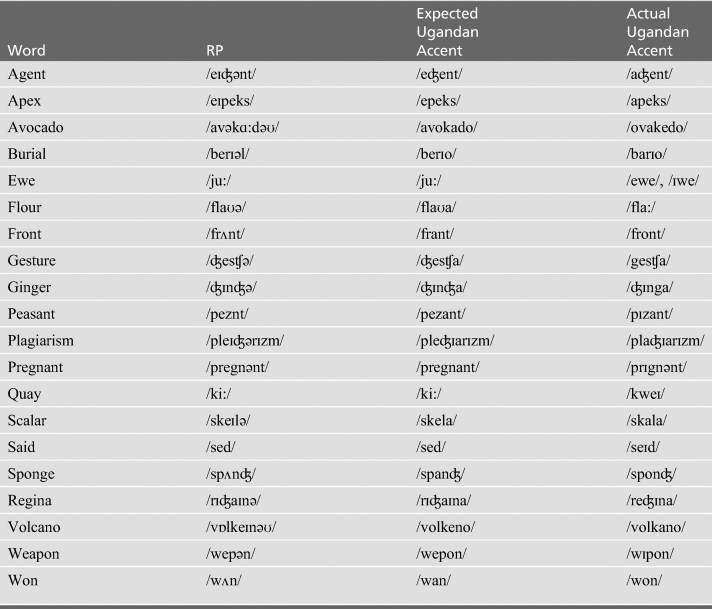
When varieties of English just assign different phonemes to the same word without any systematic phonetic or phonological rule underlying them, Wells (Reference Wells1982) attributes this to what he calls ‘lexical distribution'. Hence, the difference between RP /naɪðə/ and GA /ni:ðər/ (neither) in terms of the nucleus of the first syllable is not systematic, since in words such as height, leitmotif, heist, etc. both varieties realize the grapheme <ei> as /aɪ/, or for words such as beige, neighbor, weight, etc., both varieties realize it as /eɪ/. Thus, the lack of systematicity here means that the difference is just a case of lexical distribution. Our respondents were asked to pronounce the words in Table 6 below. Following the general patterns of pronunciation in the Ugandan accent of English (as demonstrated in the previous sections), the expected pronunciation would be what is presented in the third column. However, this is not the way our respondents pronounced these words. Instead, they pronounced them as shown in the last column, thereby problematizing the systematicity in the pronunciation of English words in the Ugandan accent of English. As can be seen in Table 6 below, all the respondents pronounced the words in the same way, save for the word ewe, which had the variants /ewe/ and /ɪwe/. However, this variation is of little import for the present purpose, as our focus here is simply on the departure of the Ugandan accent of English from RP.
Examples of differences in lexical distribution

The unsystematicity in the pronunciation can clearly be seen, for example, in the words front, sponge, won, which in the Ugandan accent of English are pronounced with /o/ and not the expected /a/, which is the phoneme used to replace RP /ʌ/ elsewhere. One may argue that it is a case of spelling pronunciation. This may be true, but also there is a lack of systematicity here, since words such as son, some, love, dove, glove, etc. are not pronounced in the Ugandan accent of English with /o/; rather, they are pronounced with the typical Ugandan accent of English sound /a/, the equivalent of RP /ʌ/. And one will be clearly justified to ask oneself why Ugandans pronounce /avəkɑ:dəʊ/ (avocado) as /ovakedo/ in lieu of what is expected of them, i.e. /avoka:do/, or /ɛvoka:do/ in the ‘northern accent'. It is clearly not the case that where RP has /a/, the Ugandan accent of English has /o/ and where RP has /ɑ:/, the Ugandan accent of English has /e/. Instead, the canon is that where RP has /a/ and /ɑ:/, the Ugandan accent of English has /a/ and /a:/, or sometimes /ɛ/ in place of RP /a/. The substitution above occurs with respect to the word avocado only. Another word that behaves like avocado is flour. It is the only word pronounced with /a:/ in the Ugandan accent of English among the words that have the triphthong /aʊə/ in RP; that is, words such as flower, hour, sour are all pronounced with /aʊa/ in the Ugandan accent of English and not simply /a:/. This situation reflects the dichotomy /təmeɪtoʊ/ vs. /təmɑ:təʊ/ in GA and RP respectively as regards the vowels in the second syllable: definitely, it is not the case that where RP has /ɑ:/, GA has /eɪ/. Hence, these are cases of lexical distribution.
Relatedly, although we stated in Section 3.2.1 that RP /eɪ/ of the FACE vowel is realized in the Ugandan accent of English as /eɪ/, /e:/ or /e/ (depending on the spelling), there are words where it is realized as /a/ in words spelled with the grapheme <a> (yet prototypically Ugandans pronounce such words with /e/ where RP has /eɪ/). Words pronounced with /a/ in the Ugandan accent include volcano, matrix, Satan, scalar, agent, apex, apolitical and asymmetrical. Here, a constellation of analogization, spelling pronunciation and substrate influence may be behind this pronunciation. For example, the pronunciation of volcano as /volkano/ (i.e. with /a/) may analogically be based on the word canon (i.e. the first vowel, which is /a/), while Satan could be linked to Saturday (i.e. the first vowels). This may be equated to what happens between GA and RP, where one could say that the difference between GA and RP as regards the pronunciation of plait and macron could be attributed to analogization. In RP, the words are pronounced as /plat/ and /makrən/, while in GA, they are pronounced as /pleɪt/ and /meɪkrən/, potentially by analogy with bait /beɪt/ and matron /meɪtrən/, which are pronounced with /eɪ/. Crucially, such differences between RP and GA are treated as cases of lexical distribution, since these seemingly analogy-triggered cases are not systematic, i.e. it is not the case that wherever RP has /a/, GA has /eɪ/. As regards spelling pronunciation (as well as substrate influence), it is possible for the grapheme <a> to lead to the pronunciation /a/ in the Ugandan accent of English as a result of the fact that, in the substrate languages under consideration, words are generally pronounced the way they are written (save for prosody); e.g., the graphemes <a, e, i> are pronounced as /a, e, ɪ/, respectively (cf. Njeru, Reference Njeru2013; Oyaro, Reference Oyaro2019). Despite the role of these L2 acquisition factors in triggering these differences between the Ugandan accent of English and RP, the fact that these differences deviate from the general trend in the Ugandan accent of English realization of the RP sound /eɪ/ in the FACE lexical set (cf. Section 3.2.1) makes them be treated as cases of lexical distribution if we are to follow Wells’ (Reference Wells1982) taxonomy. Although the realization of the RP sound /eɪ/ in the FACE vowel as /a/ in the Ugandan accent of English involves fairly many words, this is quite unpredictable, as the grapheme <a> in the FACE lexical set typically gives rise to the pronunciation /e/ in this variety of English. Moreover, having fairly many words still falls within the confines of lexical distribution, as Brown (Reference Brown2014: 75) states that ‘sometimes, the group [of the words, bi] is large, and sometimes it is small – perhaps only a single word.’ As is well known, the case of lexical distribution involving RP /ɑ:/ and GA /æ/, as in half, involves more than 150 words (Dimitrova–Vulchanova et al., Reference Dimitrova–Vulchanova, Græsli, Hauge and Midtgård2005: 30).
We are now aware that many of the Ugandan pronunciations may be attributed to spelling pronunciation, e.g. pregnant, ginger. But also the irregularity in British English vis-à-vis its orthography vs. pronunciation has a role to play, leading to analogization among Ugandan speakers of English. For example, the notorious pronunciation of quay as /ki:/ in RP is even queried by the OED (s.v. quay), which states that ‘the usual modern pronunciation with /i:/ is surprising, since /eɪ/ is the expected modern development for a word with Middle English ai or ei.’ To this, we can add said and burial, which are pronounced in RP as /sed/ and /berɪəl/ respectively. We are aware that the provenance of these pronunciations is diachronic in nature (Ganske, Reference Ganske2008), but the anomalousness they present in contemporary English leads to leveling by L2 speakers, where, for instance, said is pronounced by analogy with paid, quay with way and burial with burrow. Notwithstanding the anomalousness and its provenance, the pronunciation differences between RP and the Ugandan accent of English involving the words quay, said and burial qualify to be cases of lexical distribution. This is because it is not true that where RP has /i:/, the Ugandan accent of English has /eɪ/ (quay) or where RP has /e/, the Ugandan accent of English has /eɪ/ or /a/ (said, burial). While we cannot discuss each individual word in the table (moreover the table is just the tip of the iceberg), we should conclude this section by looking at the pronunciation of weapon and peasant, both of which have the sound /ɪ/ in the Ugandan accent of English instead of RP /e/, a sound that exists in the Ugandan accent vowel inventory. The grapheme <ea> provides the following monophthongs in RP: /i:/ (peak), /e/ (head), /ə/ (sergeant), /ɔ:/ (Sean). Whereas Ugandans pronounce all of the following words with /e/ (dead, head, read [past tense and past participle], spread, measure, leather, feather, weather, pleasure, sweat, breath, bread, treasure), it is interesting to note the deviance in the pronunciation of weapon and peasant. Despite the analogy with words such as weak for weapon, peas for peasant, the fact that only a very limited number of words out of the many words spelled with <ea> are pronounced with /ɪ/ arguably makes this a case of lexical distribution, as Brown (2014: 75) states that ‘the difference [under lexical distribution, bi] applies not to all words, but only to a limited group of words.'
4. Conclusion
Phonological variations are usually the most prominent features depicting dialectal differences in a language and Wells’ (Reference Wells1982) parameters of comparison give us a typology that speaks aptly to these differences. The differences that this study has revealed are simply inevitable. While there are a few Ugandans who might be familiar with RP due to various reasons, the high level of immersion renders their proficiency in RP inconsequential in Uganda. Moreover, as has been reported elsewhere (e.g. Schmied, Reference Schmied, Schneider, Burridge, Kortmann, Mesthrie and Upton2004: 156), any flaunting of Briticism in pronunciation is generally detested and regarded as forging an accent. However, as far as grammar is concerned, the local perception is still dominated by exonormativity (cf. Isingoma & Meierkord, Reference Isingoma, Meierkord, Meierkord, Isingoma and Namyalo2016: 4), although from a linguist's perspective, there are substantial grammatical differences between British English and Ugandan English. Despite the general acceptance of the Ugandan accent of English by Ugandans and the discernible unattainability of RP in Uganda, the country's school syllabi and English Language teaching manuals still include pronunciation activities based on RP, e.g. manuals such as Integrated English (Akabway et al., Reference Akabway, Alowo, Kiganda, Nsibambi and Rugambwa1996) and English for Advanced Learners (Ocamringa, 2005). Yet, the teachers themselves are, for several reasons, unable or unwilling to use RP. Since exonormativity cannot succeed in a country like Uganda, it is high time that educational institutions realized this linguistic fact and started drawing up syllabi that reflect English as a nativized variety, with all its idiosyncrasies that set it apart from L1 English.
Appendix 1: List of words read by the respondents
1. Phonetic realization
Able, aim, bay, beret, buffet, café, convey, cliché, grey, heifer, heinous, later, mountain, may, neighbor, neither, plantain, play, says, said, snail, veil, weight
2. Phonotactic distribution
Climb, comb, crumb, debt, dumb, lamb, limb, numb, plumber, thumb, womb, Wednesday
3. Phonemic system
As, anger, back, bank, bar, battery, boat, but, calm, cap, caught, cock, cut, dog, found, fought, girl, handout, heart, home, hurt, hut, hat, jack, lot, man, merge, pack, part, port, road, so, tap, taught, thought, tuff, voucher, word
4. Lexical distribution
Agent, apex, apolitical, asymmetrical, avocado, bread, breath, burial, ewe, dove, feather, flour, flower, front, gesture, ginger, glove, hour, leather, love, matrix, measure, peasant, plagiarism, pleasure, pregnant, quay, scalar, said, Satan, son, some, sour, sponge, spread, sweat, Regina, treasure, volcano, weapon, weather, won
Occurrence of the cluster /mb/ among different L1 groups

 MONICA ADOKORACH is a trained teacher an MA student at Gulu University (Uganda) in Literature and English Linguistics. Her research focuses on phonology and sociolinguistics. Email: monicadoki5@gmail.com
 BEBWA ISINGOMA is a Senior Lecturer in English Language and Linguistics and Dean of the Faculty of Education and Humanities at Gulu University (Uganda). He obtained his PhD in English Linguistics and is an EU Marie Curie fellow (FRIAS, 2018–2019) and an AHP fellow (2014–2015). His research interests include syntax, variational sociolinguistics and cognitive pragmatics. b.isingoma@gu.ac.ug