This article examines the persistence of majoritarianism in the Turkish political system, raising a broader question of how we should understand political transition and democratization processes. In the debates on institutional endurance in spite of change, there has been much focus on historical contingency. This has important implications for ‘transitional’ countries such as Turkey and elsewhere, since what the system is ‘transitioning’ from naturally affects the nature of the transition or change itself.
In the democratization debate it is argued that political institutions have two main roles: ‘as contingent effects of strategic interaction and as predictable bases for democratic consolidation’.Footnote 1 In the Turkish case, the focus has been on the latter, in terms of the necessity to entrench the ‘rules of the game’. Studies point to the disruptive impact of military interventions on political evolution and institutionalization, locking the country into a constant state of ‘transition’ and making consolidation elusive.Footnote 2 Despite this, it has become fashionable in recent years to portray Turkey as a model democracy for the wider Middle East region, even though further democratization of ‘Turkish democracy’ remains a key condition of the country's EU membership bid. The present analysis is concerned more with the former approach: the endurance of institutions in terms of path dependency. Given little systematic analysis of the nature of the political system itself, this type of analysis is pertinent because of its implications for the basic character of democratic politics.Footnote 3
This study therefore first uses Lijphart's analytical framework of majoritarian and consensus democracy to categorize the Turkish political system and its evolution. According to Lijphart, there are two visions of democracy that underpin the diversity of democratic regimes: ‘one based on the majority rule principle, and one based on the idea of legitimising decisions on the basis of the widest consensus possible’.Footnote 4 This helps in evaluating the country's democratization journey from a comparative perspective. This systematic approach also places political change in a wider institutional context. For example, while the constitutional referendum of 12 September 2010 was hailed as a step towards ‘democratization’, this analysis suggests that it is more accurate to place the reforms in a context of continuity of the majoritarian impulse. Beyond tracing institutional evolution, therefore, the Lijphart model assists in the process of locating (but not accounting for) the constitutive vision of democratic or ‘transitioning’ regimes that lies at the heart of this persistence.
Following from this, this study attempts to raise a broader and deeper question in terms of the survival of certain political patterns in spite of change: that, even though there have been various major shocks to the Turkish political system (coup d'état, multiparty politics, economic liberalization and financial crisis), the deeply majoritarian logic of the system has endured. In this sense, the study offers a useful case study of the dynamics of political transformation in the face of institutional persistence. This path-dependency approach therefore suggests a greater need for tracing a historical approach to identify institutional patterns, in contrast to the more generalized democratization frameworks.
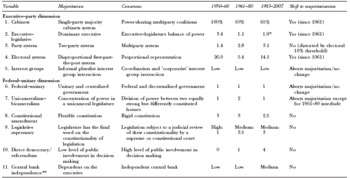
This investigation focuses chiefly on the multiparty era, that is, the post-1950 period, to trace these trends on a systematic basis with Lijphart's framework as laid out in Table 1. Demarcated by the adoption of new constitutions which signify important turning points, Turkish political history is divided into three periods:
Summary of Institutional Change in Turkey, 1950–2007

Notes:
* AKP government from 2002 to June 2011.
** Central Bank independence granted in April 2001.
The scores for each dimension are standardized by converting the variables into Z-scores – see Summary below.
Sources:-Arend Lijphart, Patterns of Democracy, New Haven, London, Yale University Press, 1999; Hament Bulsara and Bill Kissane, ‘Lijphart and Irish Democracy’, West European Politics, 32: 1 (2009) pp. 172–96; Matthew Flinders, ‘Majoritarian Democracy in Britain: New Labour and the Constitution’, West European Politics, 28: 1 (2005), pp. 61–93.
-
1) 1924 to 1960. The 1924 Constitution essentially remained until the military intervention of 1960 and subsequent adoption of a new constitution in 1961, since the transition to multiparty politics took place without a fundamental overhaul of the 1924 constitutional framework.
-
2) 1961 to 1980. The 1961 Constitution was introduced by junta leaders in light of the experience of the unrestrained majoritarianism of the governing party in the 1950s. While constitutional changes were also imposed following the 1971 coup, a new constitution was not adopted.
-
3) 1983 to 2007. The 1982 Constitution was introduced during the period of military rule from 1980 to 1983, significantly altering the political landscape by partially reversing the institutional changes adopted in 1961. Despite the anti-majoritarian institutional arrangements introduced by the 1961 Constitution, the persistence of majoritarianism is exemplified by the unitary and centralized structure, the concentration of executive power and minimal interest group participation in policy process. The introduction of popular elections for the presidency, greater political party control over the judiciary in the post-2002 period and a potential move to a fully presidential system in the future appear to be more in line with the pure majoritarianism encapsulated in the 1924 Constitution and hence represent greater majoritarianism compared to the 1960–80 period.
THE EXECUTIVE–PARTIES DIMENSION
The executive–parties dimension consists of five variables relating to the configuration of executive power (see Table 1). This study shows that, while the pure majoritarianism on this dimension during the single-party era was modified in the transition to multiparty democracy, the post-1983 period has witnessed a shift back towards the majoritarianism of the earlier period.
Concentration of Executive Power
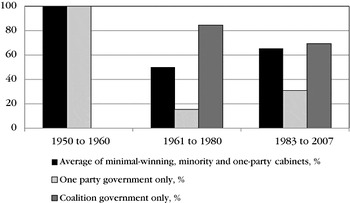
According to Lijphart's model, the most cogent contrast of majoritarian and consensus government is the existence of one-party government where there is a concentration of executive power and coalition governments, which epitomizes the principle of power-sharing. In this scheme one-party cabinets are the most majoritarian while minimal-winning and minority governments are seen to reflect an ‘intermediary position’.Footnote 5 Meanwhile, oversized cabinets reflect the consensus model of democracy under broader power-sharing.Footnote 6 As indicated by Figure 1, one party, minimal-winning and minority (MW/OPFootnote 7 ) governments have been the predominant type of cabinet in Turkish political history. Aside from the single-party era that was dominated by the Republican People's Party (CHP), the predominance of MW/OP government in the multiparty era suggests a clear majoritarian bias and an aversion to power-sharing. The newly formed Democrat Party's (DP) aversion to the CHP opposition was to some degree a result of the DP's lack of political experience in dealing with political competition or opposition and to its fears about the continued loyalty of the bureaucratic elites to the CHP.Footnote 8
Concentration vs. Sharing of Executive Power.

Sources:-Rein Taagepera, ‘Implication of the Effective Number of Parties for Cabinet Formation’, Party Politics, 8: 2 (2002), pp. 227–36; data from Turkish Directorate General of Press and Information; Ersin Kalaycıoğlu, Turkish Dynamics, Bridge Across Troubled Lands, New York, Palgrave Macmillan, 2005.
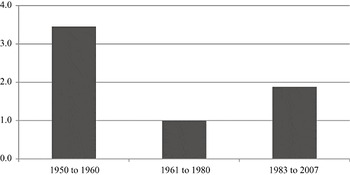
In addition, the adversarial two-party system of the 1950s was underpinned by the plurality/majoritarian electoral formula. The two-party system was largely eroded in the second period following the adoption of proportional representation (PR) in 1961, which resulted in party system fragmentation leading to the preponderance of coalition governments. In the third period, the results are mixed since, alongside the one-party governments of the Motherland Party (ANAP) in the 1980s and prior to the ascendancy of the Justice and Development Party (AKP) in 2002, the 1990s were marked by extreme fragmentation with many short-lived and unstable coalition governments. On average, one-party governments have tended to last three times longer than coalition governments, which have endured an average of 0.9 years, again underscoring the distaste for power-sharing. Oversized and minority cabinets tended to be formed only following military coups or during the height of political polarization in the late 1970s.
Executive–Legislative Relations
Lijphart argues that dominance of the executive in the Westminster model is the consequence of a two-party system rather than the parliamentary system. Under multipartism, coalitions result in more dispersed power and produce a less dominant executive.Footnote 9 In Turkey, the tradition of centralized and concentrated executive power of the single-party era continued in the post-transition period with the dominant position of the prime minister, who heads both the cabinet and the largest party in parliament.Footnote 10 The prime minister ‘sets the political agenda and determines top level bureaucratic appointments (with the president's approval) and has the last say in the substance of policies, laws, regulations, statutes’.Footnote 11 Oligarchic political parties have enabled governments to dominate parliamentary life through their majority. Military interventions negatively affected the institutionalization of the Turkish Grand National Assembly (TGNA), and thus the legislature's capacity to hold the executive to account.Footnote 12 The 1982 Constitution exacerbated this trend, by seeking to inhibit autonomous legislative action and encouraging autonomous executive actionFootnote 13 through various mechanisms, including: the use of executive decrees (which later need to be approved by parliament) to bypass parliament; the placing of restrictions on the use of parliamentary investigations and interpellations used largely by opposition parties to delay or prevent bills in the pre-1980 period;Footnote 14 the introduction of extra-budgetary funds, which gave the executive branch considerable fiscal power outside parliamentary supervision, acting as a major channel of rent distributionFootnote 15 and thus augmenting the power and rewards of office.
The extent of executive dominance relative to the legislature is measured by cabinet durability (see Figure 2)Footnote 16 with short-lived and less dominant cabinets better encapsulating the consensus model while one-party durable cabinets typify the majoritarian model. During the single-party era, the TGNA essentially acted to rubber stamp policy. With the transition to multiparty politics achieved with only small changes in the election, press and association laws of the 1924 Constitution,Footnote 17 the same majoritarian framework of the single-party era helped to produce the similarly dominant party system under the DP in the 1950s. With the establishment of separation of powers and PR, which introduced coalition politics, the 1961 Constitution helped to moderate the previous executive dominance.
Average Cabinet Duration (years).

Sources:-Data from Turkish Directorate General of Press and Information; Ersin Kalaycıoğlu, Turkish Dynamics, Bridge Across Troubled Lands, New York, Palgrave Macmillan, 2005.
With the exception of the short-lived cabinets of the 1990s, the third period marked a return to executive dominance in two ways. First, the 1982 majoritarian re-engineering of the electoral system with the establishment of a 10 per cent national threshold again introduced the bias towards a strong executive by enabling parties to gain a majority of seats with just a plurality of the vote. According to Lijphart's criteria, the 2002–11 period of AKP government saw the most durable government, and thereby the most majoritarian in Turkey's history of multiparty politics.
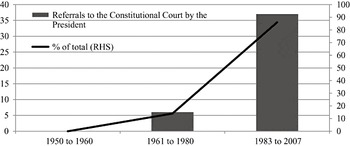
Second, there has been a move towards presidentialismFootnote 18 with the 1982 Constitution establishing the role of the president as the guardian of the state,Footnote 19 in keeping with the designation of the president as ‘national chief’ during the later years of the single-party era. Despite not having political and legal responsibility or accountability (Article 105),Footnote 20 the president has significant powers, which chiefly refer to veto powers and powers of appointment (Article 104). In practice, much has depended on the personalities, with the partisan presidencies of Özal and Demirel using the presidential office as an alternative locus of decision-making, and the return to a more parliamentary system under Sezer's presidency from 2000 to 2007.Footnote 21 The 2007 constitutional changes have solidified semi-presidentialism,Footnote 22 having paved the way for a popularly elected president, where the post was previously elected indirectly by a two-thirds majority in parliament. Given the dual structure of the executive, the Turkish system can be seen as most majoritarian when one party captures both the presidency and the parliamentary majority, as was the case in 1989–91 and also since 2007. This has two causes: first, under the 1982 constitutional regime the presidency and Constitutional Court are seen as the two key institutions with veto powers against parliamentary majorities (see Figure 3).Footnote 23 Second, the capture of the presidency means that the parliamentary majority can also exercise far more influence over appointments that are determined by the president. Political controversy surrounding the appointment of the AKP's candidate as president in 2007 was based on greater Islamist control of presidential powers, underpinned by a perception of the presidency as the ‘last bastion of secularism’.Footnote 24
Referrals to the Constitutional Court by the President.

Source:-Data from Ergün Özbudun, Türk Anayasa Hukuku, Yetkin Yayınları, Ankara, 2009.
Party System
Lijphart defines the party system as the most typical point of divergence between the majoritarian and consensus models of democracy. Three factors have been critical in the evolution of the party system in Turkey: (1) military interventions have constrained party institutionalization, which has encouraged a party system with strong oligarchical tendencies;Footnote 25 (2) post-coup party closures have led to increased voter volatilityFootnote 26 and political party fragmentation; (3) frequent change of electoral systems ‘disturbed the natural evolution of party politics…and have contributed to weakening of party system’.Footnote 27 With the exception of Islamist parties, political parties have tended to lack any ‘mass party’ characteristics such as strong grassroots support or a paying membership base.Footnote 28 Indeed, patronage networks remain more institutionalized and effective than political parties.Footnote 29
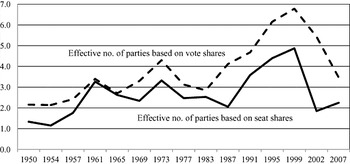
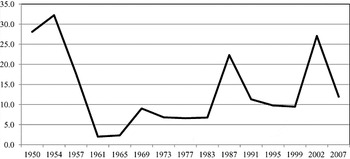
Figure 4 shows the effective number of partiesFootnote 30 in Turkey. A key result of the adoption of the 10 per cent threshold in the 1982 Constitution has been the divergence between the effective number of parties based on actual votes and seat shares, with the biggest gap apparent in the 2002 election. The emergence of a single-party government in 2002 marks a return to the two-party system with a dominant party similar to the 1950s and 1980s. Given the AKP's ‘electoral hegemony’,Footnote 31 it appears that Turkish politics has again shifted towards majoritarianism on this variable following the excessive fragmentation that defined the 1990s.
Effective Number of Parties in Turkey, 1950–2007.

Sources:-M. Laakso and R. Taagepera, ‘Effective Number of Parties: A Measure with Application to West Europe’, Comparative Political Studies, 12: 1 (1979), pp. 2–27. Michael Gallagher and Paul Mitchell, The Politics of Electoral Systems, Oxford, Oxford University Press, 2008; data from Turkish Statistical Institute.
Electoral System
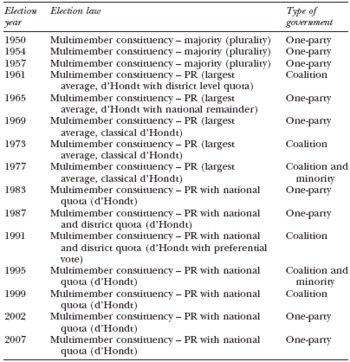
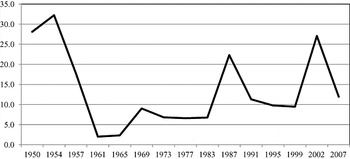
Frequent changes in the electoral system (see Table 2) are chiefly due to constitutional engineering by junta leaders and the use of electoral laws as a political instrumentFootnote 32 by political parties. Using the Gallagher index,Footnote 33 where higher numbers signal greater disproportionality, it is clear that the least proportional elections were held in the 1950s when a multimember plurality formula was used (Figure 5). The ‘winner takes all’ electoral system was in line with the tradition of using plurality elections both during the Ottoman constitutional period and the single-party period from 1924 to 1950. In 1961, the move to PR was spurred on by the massive artificial majorities created by the previous plurality formula that had underpinned the DP government's power. However, with the ensuing party system fragmentation and factionalization of 1961–80, PR came to be associated with social polarization and ineffective government dominated by unstable coalitions. This perspective formed the basis of the military's decision to move towards a more majoritarian electoral system in the 1982 Constitution.
Election Laws and Types of Government

Source:-Ersin Kalaycıoğlu, Turkish Dynamics, Bridge Across Troubled Lands, New York, Palgrave Macmillan, 2005.
Gallagher Index (Least Squares Index of Electoral Disproportionality).
Source:-Michael Gallagher and Paul Mitchell, The Politics of Electoral Systems, Oxford, Oxford University Press, 2008; data from Turkish Statistical Institute.
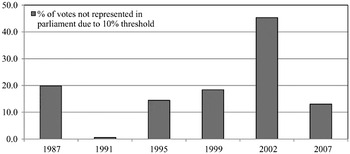
Two key changes were introduced in 1982 with the aim of establishing a less populous party system capable of achieving strong government. The first change was to implement cut-off provisions, which required an electoral quotient at the district level and a national threshold of 10 per cent. The second change was redistricting, which saw the introduction of a ceiling of seven deputies per electoral district, resulting in the subdivision of large electoral districts.Footnote 34 It has been argued that, as a result of these changes and despite the existence of a PR framework, the electoral system works as if it were a majority systemFootnote 35 since the 10 per cent threshold discriminates against parties which have strong regional representation but are unable to garner enough votes elsewhere to pass the national threshold. However, as Hale demonstrates, experience from elections in the 1990s and 2000s shows that the impact of the 10 per cent threshold has been largely inconsistent, in part because of voting behaviour and preferences.Footnote 36 For example, in the 1995 and 1997 elections the 10 per cent threshold did not prevent party system fragmentation, while in the 2002 election the 10 per cent threshold enabled the AKP to transform its 34 per cent of the national vote into a 66 per cent seat share, leaving 45 per cent of the national vote unrepresented in parliament (see Figure 6). Without a 10 per cent threshold the AKP's vote in the 2002 and 2007 elections would have garnered 35 per cent of the vote share and 47 per cent of the total seats, compared to 66 per cent and 62 per cent respectively, received under the current system. Likewise, as Hale notes, in the 2007 elections the seat share of the remaining parties (including the independent members of parliament derived mainly from the Democratic Society Party (DTP)) were largely proportional to their actual vote share, despite the 10 per cent threshold. Regardless of this, despite the varied outcomes of the existing electoral framework and exemption of independents from the 10 per cent threshold rule which allows some representation for smaller parties, the logic of the system is largely majoritarian in approach since it attempts to block out smaller players while favouring larger parties.
Impact of the 10 per cent Threshold on Parliamentary Representation.

Source:-Data from Turkish Statistical Institute.
A further element of disproportionality in the Turkish electoral system relates to malapportionment. With the subdivision of the large electoral districts in the 1982 electoral system overhaul, every province was automatically given one seat regardless of size. This automatic allocation and the existing apportionment system in Turkey has the effect of over-representing the ‘primarily small, predominantly agricultural sector dominated East and South-eastern provinces’ which are also areas more susceptible to patronage distribution.Footnote 37 In short, under the current configuration, with a high national threshold and the level of malapportionment, the electoral system cannot be said to meet the consensus ideal.
Interest Group System
Majoritarian democracy is typified by the existence of a pluralistic interest group system comprising competitive, uncoordinated and independent groups, in contrast to a consensus democracy, which consists of corporatist systems whereby interest group consultation is incorporated into the policy process.Footnote 38 Özbudun argues that associational life in Turkey consists of private associations and public professional organizations (such as trade unions and business organizations), with the former approximating the pluralistic model and latter resembling the corporatist model.Footnote 39 However, neither is effectively institutionalized as policy-making remains extremely centralized with minimal input from economic interest groups.Footnote 40 The efficacy of interest groups was undermined by the 1982 Constitution, which placed heavy restrictions on associational life (lifted only in 1995), clawing back the relatively more pluralistic approach of the 1961 Constitution, which had granted significant autonomy to various associations. In turn, the restrictive and confined nature of interest representation in Turkey has encouraged the private sector to rely on particularistic ties to the authorities and has encouraged a rent-seeking environment.Footnote 41 In short, the ‘Turkish state and policymaking process lack any significant mechanism of policy coordination’.Footnote 42 Since the economic liberalization and 2000–1 crisis, however, there has been greater involvement by international financial institutions and domestic independent regulatory agencies in shaping policy.
FEDERAL–UNITARY DIMENSION
In contrast to the executive–party dimension, where indices are largely quantitatively measured and are logically connected, the federal–unitary dimension (see Table 1) consists of intelligent estimates of indices which have weaker logical connectivity.Footnote 43 The heavily centralized and unitary nature of government in Turkey reflects a strong majoritarian leaning to the federal–unitary dimension which has been a continuous feature under the Republic and a legacy of the strong state administration of the Ottoman Empire.
Unitary and Centralized Government
The Turkish state, like its Ottoman predecessor, does not have a tradition of self-government.Footnote 44 Since its establishment, it has been a heavily centralized unitary state which reflects a persistent majoritarian approach on this variable. The commitment to remain a unitary state is epitomized by Article 123 of the Constitution: ‘the Turkish state is an indivisible whole comprising its territory and people’. Within the Ottoman polity, local government was perceived simply as an extension of the central administration, largely for the purposes of improved tax collection and as such resulted in a process of deconcentration rather than devolution or delegation.Footnote 45 Fears regarding separatism and territorial integrity underpinned by the experiences of the collapse of the Ottoman Empire reinforced the centralizing tendencies of the nascent Turkish nation-state.Footnote 46
With rapid socio-economic change building pressures on local government in the multiparty era, the first substantive change followed the return to multiparty politics in 1983. The authorities adopted a discourse of ‘small state’ coupled with decentralization and an expanding civil society in line with its embrace of neoliberal economic policies. In reality, this new turn did not mark a major departure from the Ottoman approach to local government in representing a ‘deconcentration of authority to the local branches of the central bureaucracy’.Footnote 47 The result was further centralization and a reconfiguration of power whereby the locus of decision-making shifted from traditional bureaucratic elites to political elites surrounded by technocrats chosen from the outside.Footnote 48 Like the Ottoman polity, therefore, local government in the Republic was introduced for and by the state, in a bid to tackle the administrative and fiscal priorities of the central administration as opposed to an exercise in local participation and governance.Footnote 49
Concentration of Legislative Power
Given Turkey's highly centralized unitary political system, unicameralism seems the logical corollary. The unicameral structure adopted by the Republic was a departure from the bicameralism of the Ottoman constitutional periods (1876–78 and 1908–18) when the upper house was conceptualized as a conservative check on the lower house.Footnote 50 In the founding years of the Republic, the unicameral parliament was a symbol of national sovereignty and in this sense the 1924–60 period typified the pure majoritarian model whereby the parliament ‘as a representative of the people, controlled the legislature, the executive and the judiciary’.Footnote 51 Following the experiences of majoritarian party rule in the 1950s, in the second period there was a return to the bicameral format with the 1961 Constitution. This represented a shift towards the establishment of a tutelary regime, heralding the greater involvement of the military and bureaucracy in the sharing of sovereignty.Footnote 52 With the Senate membership comprising junta leaders as life members alongside elected members, the body was envisioned as a conservative check on the lower house, much like its Ottoman predecessor, rather than a step towards more power-sharing. The Republican Senate lacked real muscle and was scrapped following the 1980 coup.
Constitutional Rigidity
In Lijphart's framework, a rigid constitution that acts to constrain parliamentary majorities as ‘higher law’ is seen as a feature of the consensus model, while a completely flexible constitution which leaves parliament unchecked reflects majoritarianism. Turkey's preference on this dimension has always been a ‘rigid’ constitutionFootnote 53 and as such can be said to be closer to the consensual model on this variable. Despite the degree of flexibility introduced since 1987, there remain the three ‘irrevocable provisions’ of the 1982 Constitution that pertain to the nature of the state as a republic, its form and characteristics. The 1924, 1961 and 1982 constitutions all required at least a two-thirds majority of the total members of parliament to make constitutional changes, which was also in keeping with the tradition of the Ottoman Constitution of 1876.Footnote 54 While the tradition of rigid constitutions means Turkey remains anti-majoritarian on this variable, this has been compromised in the third period. The introduction of an optional referendum in 1982, which later became compulsory in 1987, eased the process of constitutional amendment by lowering the acceptance requirement to a three-fifths majority of the total parliamentary membership plus referendum.
Judicial Review
The strength of a constitution, as Lijphart points out, also depends on the existence of judicial review. In the absence of judicial review, a parliament would have the final say on the constitutionality of its own laws, resulting in a heavily majoritarian dynamic. In this sense, the first period in Turkey epitomized parliamentary sovereignty since its control of all three branches of government meant that it was the sole authority on the constitutionality of its own laws. The 1924 Constitution, however, was adopted by a transformative parliament during the stages of nation-state building. Following the DP era of the 1950s, military bureaucrats established the Constitutional Court in 1961 to protect the reforms of the single-party period from parliamentary majorities. Since 1964, over half of the cases referred to the court have been nullified,Footnote 55 establishing the body as an important veto player within the political system and ranking Turkey as one of the highest in Europe in number of referrals and nullity decisions in abstract constitutional review.Footnote 56 Judicial review has been a key measure used by the opposition to defeat government bills, with 90 per cent of nullity decisions referred by opposition groups.Footnote 57 The period 1961–80 was the high point of the court's powers, when it had come to interpret its role as reviewing the constitutionality of constitutional amendments in accordance with protecting the irrevocable provisions.Footnote 58 Following the 1971 and 1980 military interventions, the court's powers were greatly curtailed and limited to procedural grounds as opposed to substance (Article 148), while the number of referring authorities was reduced.
With the growth of the electoral appeal of ‘Islamist’ parties in the 1990s, the judiciary has become an ideological battleground, with the Constitutional Court held up as a ‘bastion of secularism’ against the perceived conservative tendencies of the AKP government. This was followed by increased judicial activism and a highly controversial move by the Constitutional Court in arguably going beyond its remit by adjudicating on the substance of constitutional amendments as opposed to focusing on procedural issues.Footnote 59 In response, the AKP government has acted to reform the judiciary chiefly by expanding parliamentary and presidential control over the appointment process for the Constitutional Court and the HSYK; it has also restricted the ability of the courts to review administrative matters by stating that judicial power cannot be used as review of expediency.Footnote 60 While the reform package has been presented as a move to deepen democratization by increasing ‘democratic’ control over the judiciary, such a change, given increased parliamentary control, resonates more closely with the majoritarianism of 1924–60 in augmenting the power of the parliamentary majority.
Representative or Direct Democracy
Lijphart categorizes referendums as a majoritarian device only if they are used as the sole method of constitutional amendment. Under cases whereby it is an instrument used in addition to a three-fifths or two-thirds majority in parliament, it can serve as an anti-majoritarian, consensus-inducing device since minorities are also able to voice their objections through campaigning and thus forcing the majority to take account of their opinions.Footnote 61 However, Lijphart has also suggested that ‘when governments control the referendum, they will tend to use it only when they expect to win’,Footnote 62 reflecting the view that referendums can be a form of plebiscitarian democracyFootnote 63 rather than a manifestation of the principle of popular sovereignty. As Butler and Ranney conclude, ‘referendums are held infrequently, usually only when the government thinks that they are likely to provide a useful ad hoc solution to a particular constitutional or political problem or to set the seal of legitimacy on a change of regime’.Footnote 64 Using Gordon Smith's distinction between ‘controlled’ (by government) and ‘uncontrolled’ (popularly initiated) referendums, Qvortrup has found some support for the argument that the former type of referendum tends to result in ‘pro-hegemonic’ outcomes – that is, they are supportive of the regime.Footnote 65
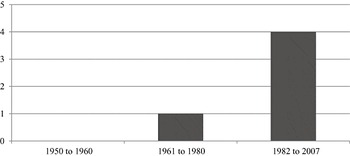
In the Turkish case referendums have not been a frequent feature of political life, having been held a total of six times in the history of the Republic, initiated by state or government authorities and thus never ‘uncontrolled’ (see Figure 7). Aside from the adoption of the 1961 Constitution, the 1982 Constitution adopted referendums for the first time as a means for constitutional amendment. The decision to call a referendum remains largely optional and is only mandatory in cases where parliamentary approval lies between more than three-fifths and two-thirds of the total membership. Rather than being construed as consensus-building instruments, since 1983 referendums have been utilized mainly to resolve political crises as well as being used by the ANAP government to attempt to buttress its declining electoral fortunes (which produced the only ‘no’ vote). In this sense, all Turkish referendums have displayed plebiscitarian elements, including the two conducted under the AKP government. Given their limited use and ‘controlled’ nature, Turkish referendums tend to be ‘pro-hegemonic’ and as such Turkey leans more towards the majoritarian angle on this variable.
Number of Referendums.

Source:-Data from Turkish Statistical Institute.
Independent Central Banks
Lijphart marks central bank independence, in relation to freedom in setting monetary policy, as a corollary of dividing power in a political system and hence locates it as a characteristic of the consensus model. Accordingly, dependent central banks would typify the majoritarian model in concentrating power with the executive. Central bank independence is measured by four groups of variables: the appointment and tenure of the governor; policy formulation; central bank objectives; and limits on lending.Footnote 66
Because of its history as a state-led economy, instrumental legal independence to the Central Bank of Turkey (CBT) was only granted following the crises of 2000–1. The CBT's high level of independence is apparent from all four of the variables listed above. First, the governor is appointed by the Council of Ministers for a fixed term of five years (and may be reappointed) (Article 27). Second, the CBT has an advisory role and is designated as the ‘financial and economic consultative body of the government’. Next, the CBT is designated as the ‘ultimate body authorized and responsible to implement the monetary policy’, whereby the maintenance of price stability was determined as the fundamental objective. Finally, the CBT is prohibited from lending or borrowing from the government or public institutions.Footnote 67 While CBT independence moves Turkey closer to the consensus model on this variable, it may be regarded as a case of institutional adaptation in response to domestic and international developments. As with central bank independence, other independent regulatory agencies were essentially created in response to the 2000–1 economic crisis and encouraged by Turkey's integration into the global economy.
SUMMARY
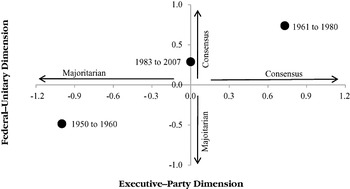
Despite frequent praetorian interruptions and political engineering by junta leaders, a consistent feature of the Turkish political system is the endurance of its majoritarian framework of politics. Clearly, the evolution of institutional change and persistence in Turkey is far more multifaceted than can be encapsulated using only the Lijphart typology. However, it provides a common analytical framework for the purposes of categorizing and analysing institutional evolution and is useful in placing systems in a comparative context. Table 1 displays a summary of the findings. The scores for each dimension were standardized by converting the variables into Z-scores whereby scores above zero indicate higher consensus and negative, lower scores are indicative of majoritarianism.Footnote 68 For the first period (1924–50), only the 1950s were statistically documented since the single-party era was a closed and undemocratic system of government with patchy data. As illustrated by Figure 8, the first period most fully exemplified the majoritarian model, scoring negatively on both of the executive–party and federal–unitary dimensions, with highly centralized government and no checks and balances to the sovereignty of the parliamentary majority. In the second period, the introduction of a separation of powers, judicial review, PR electoral system and a bicameral parliament were important in moderating the majoritarianism of the framework established by the 1924 Constitution. However, even during the least majoritarian periods – usually times of coalition government – majoritarianism was apparent in the heavily centralized and unitary administration, lack of interest group participation in policy, the executive as the locus of power and preference for one-party government or minimal-winning coalitions. Given the persistence of this framework, two crucial areas of manipulation and change in the Turkish system can be identified as being the electoral system and judicial review.
Majoritarian vs. Consensual Democracy: Composite Z-Scores.

Source:-Format based on Hament Bulsara and Bill Kissane, ‘Lijphart and Irish Democracy’, West European Politics, 32: 1 (2009), pp. 172–96.
The shift towards majoritarianism in the third period is under-represented, particularly on the federal–unitary dimension in Lijphart's model since it places equal weight on each variable. The importance of the introduction of referendums for the process of constitutional amendment and granting of central bank independence is over-stated and to some extent masks the erosion of the powers of the Constitutional Court under the 1982 Constitution, which is of far more significance in the Turkish system, where power is heavily concentrated. At the same time, the extent of the shift to majoritarianism on the executive–parties dimension is also dampened by the fragmented party system and short-lived coalitions in the 1990s, preceded by strong one-party government under ANAP in the 1980s and succeeded by the one-party dominance of the AKP since 2002. Overall, the shift towards majoritarianism in the third period is evident in the erosion and removal of the institutions introduced in 1961 to moderate the majoritarianism of the 1924 constitutional framework.
INSTITUTIONAL CHANGE AND ENDURANCE IN TURKEY
There is a paradox in the way we have understood the Turkish political system. Observations on the political system in Turkey have tended to juxtapose the stability imposed by a ‘strong [autonomous] state tradition’,Footnote 69 predating the Republic, alongside the unruly nature of political life where there is arguably a lack of consensus on the ‘rules of the game’.Footnote 70 Distinguishing between more changeable and malleable formal institutions and more persistent ‘informal’ institutions is one means of addressing this tension. Through Lijphart's typology, this study has sought to demonstrate that, despite changes in formal institutions, the majoritarian logic of the Turkish political system has endured. The analysis suggests that focusing on the endurance of certain patterns of institutional design rather than drawing sharp distinctions between change and continuity can account for the ways in which the political field is constrained by these very institutions. Historical contingency is key since new institutions are not designed as tabulae rasae;Footnote 71 there is a ‘limited degree of freedom’ in which change can occur, even during times of crisis.Footnote 72 Therefore, despite the introduction of anti-majoritarian institutions following the 1960 military intervention, the majoritarian structures have persisted in terms of the heavily centralized and unitary state system, the focus on the executive as a locus of power, minimal interest group penetration in policy-making and aversion to power-sharing. In fact, Lijphart's model under-represents the extent of the shift towards greater majoritarianism in the post-1982 period since it accords equal weighting to each variable. As Turkey's longest surviving constitution (36 years), the 1924 constitutional framework was both foundational and critical in setting the bounds of its institutional evolution.
The answer as to why Turkey's majoritarian political structure has persisted is, of course, multifaceted and rests on a more thorough exploration of the attendant ideational framework which has shaped political outcomes in a mutually constitutive manner. This is not captured only by Lijphart's approach. As Bourdieu argues, the construction of a state involves the manifestation of itself ‘simultaneously in objectivity, in the form of specific organizational structures and mechanisms and in subjectivity in the form of mental structures adapted to them’.Footnote 73 What has been critical is what are arguably the two dominant conceptions of Turkish democracy: one perspective sees democracy in a Rousseauist sense, resting sovereignty solely in the ‘general will’ or ‘nation’, in effect meaning the majority;Footnote 74 the other perspective is still majoritarian but also harbours a Rousseauist distrust of the majority and seeks to constrain it through a system of guardianship. Neither approach to democracy contains a consensual or pluralistic approach to democratic government, and both are in essence majoritarian. In this sense the institutional changes introduced by the 1961 Constitution were more in line with expanding tutelary control over the political field than an attempt at establishing a consensus model of democracy. As such, the 1961 changes did not mark a major departure from the majoritarian heart of the system. Indeed, the existence of seemingly contradictory political institutions that reflect different points of historical experience alongside the dominant institutional impulse does not negate the weight of the latter.
This also raises a question with regards to the overall consistency of Lijphart's consensus model.Footnote 75 The 1960 junta leaders introduced institutions that are defined by Lijphart as exemplifying the consensus model. However, this reflected the intention of establishing bureaucratic tutelage as the primary means of checking the parliamentary majority, not an attempt to consolidate consensus democracy. Consequently, these measures helped to preserve the majoritarian impulse of the system while at the same time the establishment of ‘guardian’ institutions encouraged further political polarization. Characterizing the Constitutional Court, for example, as typifying a consensual institution in the Turkish context is therefore problematic given its constitutive ideological underpinnings. Indeed, the court has acted in a manner antithetical to deepening consensus democracy in being ‘selectively activist, protecting social and political members of a particular coalition but not other political groups’, and adopting a narrow take on civil liberties which has entailed blocking the increased representation of excluded groups.Footnote 76 Therefore, ‘it is not simply the case that institutions matter. Rather, institutions matter in interaction with one another, and in interaction with societal features.’Footnote 77 It is for these reasons and the lack of a vision of consensus democracy that parliamentary majorities in Turkey are able to chip away at such institutions that have been represented as embodying sectional interests that undermine majority wishes.
This stress on historical contingency and the need for a more holistic approach in analysing formal and informal political institutions and their evolution has wider implications for understanding political transitions. In the Turkish case, it provides perspective on the nature of the ‘democratization’ process itself. The AKP government since 2002 has been seen as a key player in taking forward Turkey's democratization.Footnote 78 It has modified the constitution to establish the popular election of the president and is now establishing greater control by the government of the judiciary chiefly by: (1) increasing the number of Constitutional Court judges from 11 permanent and 4 substitute to 17, with parliament selecting three members and the president choosing the rest from a list of candidates put forward by various bodies; and (2) expanding the members of the HSYK from 7 to 22 members. Yet, if we place these changes in the wider context of Turkey's institutional evolution, in the absence of more representative electoral system or the possibility of transition into a fully presidential system, the emerging pattern is one of enhanced majoritarianism. The AKP's constitutional changes therefore represent not an overhaul of the 1982 Constitution but the erosion of the relatively anti-majoritarian institutions established in 1961 and in some sense a return to the pure majoritarianism of the 1924 constitutional framework in removing any remaining checks on parliamentary sovereignty. Indeed, with the state remaining the centre of rent distribution, political parties disdainful of power-sharing face little incentive for changing the majoritarian framework. While Turkey's EU membership efforts and integration to the global economy have in certain periods fostered a degree of consensus on the political as well as societal level, changes have been largely ‘a product of institutional adaptation, but “adaptation” implies that some core institutions have remained unchanged’.Footnote 79 It has been argued that, following democratic consolidation in Southern Europe, there has been a perceptible trend towards majoritarianismFootnote 80 that is in contrast to the shift towards consensus democracy in Western Europe.Footnote 81 The above analysis would suggest that the Turkish case resembles the Southern European example in its greater shift towards majoritarianism since 1983.
 where x is the original score; μ is the mean of data set; σ is the standard deviation of the data set.