Introduction
In plasticulture vegetable production systems, herbicides are primarily applied to the soil between the raised, plastic-covered beds (i.e., row middles). The presence of weeds in row middles may affect yield (Gilreath and Santos Reference Gilheath and Santos2004); host pests such as insects (Bedford et al. Reference Bedford, Kelly, Banks, Briddon, Cenis and Markham1998), nematodes from different genera such as ring (Criconemella spp.), lesion (Pratylenchus spp.), stubby-root (Trichodorus spp.), spiral (Helicotylenchus spp.), and dagger (Xiphenema spp.) (Lopez et al. Reference Lopez, Soti, Jagdale, Grewal and Racelis2021); and phytopathogenic fungi such as Curvularia sp., Fusarium sp., and Pythium sp. (Oliveira et al. Reference Oliveira, Rocha dos Santos and Rodrigues dos Santos2018).
Preemergence and postemergence (POST) herbicides are used in plasticulture vegetables to control weeds in the row middle. Paraquat has been used as one of the standards for weed control in row middles because of its strong herbicidal activity and favorable physical properties such as low vapor pressure and rapid burn-down (Taguchi et al. Reference Taguchi, Jenkins, Crozier and Wang1998). However, concerns about its phytotoxicity and increased use restrictions have complicated its use and led to evaluations of alternative options. Sharpe and Boyd (Reference Sharpe and Boyd2019) reported that glufosinate is an effective alternative herbicide option for row middles with 36% nutsedge reduction compared to 25% when paraquat was used. Other herbicides that could be used as an alternative to paraquat include glyphosate and diquat. Glyphosate controls a broad spectrum of annual and perennial weeds under varied agricultural, industrial, and domestic situations, and has low mammalian toxicity and little soil activity (Yu et al. Reference Yu, Cairns and Powles2007). Diquat is a bipyridylium herbicide, commonly used as desiccant for preharvest burndown and has fewer label restrictions than paraquat (Fortenberry et al. Reference Fortenberry, Beckman, Schwartz, Prado, Graham, Higgins, Lackovic, Mulay, Bojes and Waltz2016; US EPA 2019; Yu and Boyd Reference Yu and Boyd2020).
Herbicides are typically banded in row middles using shielded application equipment that applies herbicides uniformly while weed occurrence is non-uniform (Kargar and Shirzadifar Reference Kargar and Shirzadifar2013). Off-target applications can result in herbicide waste, unnecessary herbicide occurrence in the environment, increased herbicide drift and increased risk of crop damage, and increased chemical residues on foods. The adoption of targeted spray technology is a viable option for reducing the production cost associated with weed management via reduced herbicide inputs (Sharpe et al. Reference Sharpe, Schumann and Boyd2020). This technology predominantly relies on machine vision-linked detectors and deep learning for autonomous weed control applications (Fennimore et al. Reference Fennimore, Slaughter, Siemens, Leon and Saber2016; Ferentinios Reference Ferentinios2018).
A variety of neural networks such as YOLO (You Only Look Once) can be used for weed detection. The YOLO algorithm proposed by Redmon et al. (Reference Redmon, Divvala, Girshick and Fahardi2016) solves object detection as a regression problem and provides the location and classification of the object as an output on an end-to-end network in one step. The YOLO algorithm has been regularly improved, and version 3 (YOLOV3) can predict the objectiveness score for each bounding box using logistic regression (Redmon and Farhadi Reference Redmon and Farhadi2018). YOLO uses convolutional neural networks (CNNs), and it was selected for use in our studies because of its good performance in object and pattern recognition. It has a good reputation in fields such as the recognition of vehicles and animals, and the tracking of moving objects (Osorio et al. Reference Osorio, Puerto, Pedraza, Jamaica and Rodríguez2020).
Several authors have evaluated smart spraying technology using a machine-learning network. Partel et al. (Reference Partel, Kakarla and Ampatzidis2019), for example, focused on evaluating different methods. He compared R-CNN and YOLOV3 and observed that the YOLOV3 can be a viable solution for network framework detection in a real-time smart sprayer. Conversely, some authors have evaluated select networks in field situations. For example, Ruigrok et al. (Reference Ruigrok, van Henten, Booij, Van Boheemen and Kootstra2020) observed that smart-spray technology with a YOLOV3 network could correctly identify 83% of volunteer potato plants in a sugar beet field with 1% misclassification of the crop as a weed. Field testing is time-consuming and resource intensive, which restricts the number of studies that have occurred.
The objectives of this research were to evaluate the smart-spray technology developed by the University of Florida in terms of 1) using diquat and glyphosate as POST herbicides in row middles, 2) determining the feasibility of using targeted application of POST herbicides in the absence of preemergence applications, and 3) determining herbicide savings when using targeted spray technology.
Materials and Methods
Smart-spray technology with machine vision was previously developed by University of Florida researchers (Sharpe et al. Reference Sharpe, Schumann, Yu and Boyd2019) to identify and spray only target weeds, thus reducing herbicide inputs and minimizing off-target crop damage. The smart-spray technology consists of a digital camera (C922x Pro Stream Webcam, 1080p HD camera; Logitech®, Newark, CA) connected to an embedded Linux computer (NVIDIA Jetson Nano, Santa Clara, CA) with a color touch screen mounted to a tractor-sprayer programmed to capture real-time digital images of the vegetable row middles ahead of two sprayer nozzles. Electric solenoid valves are used to synchronously open and close nozzles based on weed detection. The prototype is designed to apply one row middle at a time with two nozzles that operate independently.
The Linux computer uses a deep learning artificial neural network previously trained for identifying weeds in images. In this study, we used the YOLOV3-tiny-3L model for weed object detection. As the sprayer moves in the field, the image processing software can discriminate the difference between the three weed classes (broadleaf, nutsedge, and grass) used to train the model. The model analyzes each image, detects the location of each weed, and sends triggering information to the corresponding solenoid valve, which opens and closes the spray nozzles at the precise time to target the weed on a site-specific basis. The sprayer boom was 1.85 m long and was positioned approximately 0.35 m off the ground with two 8003EVS nozzles (TeeJet Technologies, Wheaton, IL) with 0.28 m between nozzles. The herbicides were applied with a spray pressure of 0.24 MPa.
Two field trials were performed in consecutive seasons at the Gulf Coast Research and Education Center near Balm, FL (27.76°N, 82.22°W) to evaluate the smart-spray technology and compare it to a conventional banded application of glyphosate (GlyStar Plus; Albaugh, Ankeny, IA) in 2021 and Roundup WeatherMax (Monsanto, St. Louis, MO) in 2022) and diquat (Rely) both seasons (Table 1). The experiment was a randomized complete-block design with four replications. These herbicides were selected as alternatives to paraquat. The soil at the research site is a Myakka fine sand (sandy, siliceous hyperthermic Oxyaquic Alorthod), pH 6.5, with 1.2% organic matter. Raised beds were shaped and formed with bed-pressing equipment (Kennco Manufacturing, Ruskin, FL). The raised beds were 30.5 cm tall and 66 cm wide on the top with 81 cm between beds. The beds were formed and fumigated with 225 kg ha−1 of 1,3 dichloropropene+chloropicrin (Pic-Clor 60; Soil Chemicals Corporation D/B/A Cardinal Professional Products, Hollister, CA). Immediately following the fumigation, the beds were covered with virtually impermeable film (thickness 1.25 mm; Berry Plastics Corp, Evansville, IN) with double drip tape buried 2.5 cm beneath the soil surface in the middle of each bed.
Herbicides used in the study.

The fall trial was conducted between July and November 2021, and the spring trial was conducted between January and May 2022. The raised beds were shaped and fumigated with previously described fumigant on July 26, 2021, and January 19, 2022. The plot size was 7.6 m by 0.6 m of the row middle on each side of the raised bed. This study evaluated jalapeno pepper (‘Tormento’), with 20 plants transplanted 38 cm apart from each other, in double rows (spaced 40 cm) in the center of the bed on each plot. The plants were transplanted on August 26, 2021, and March 3, 2022, for fall and spring trials, respectively.
The trial occurred within two different seasons but the variation between seasons in Florida’s climate is often less than what might be observed in northern states when a trial is conducted over multiple years. The weather conditions including average, minimum, and maximum air temperatures in the spring and fall were similar throughout the experimental period for both crops. The monthly average temperature declined from the beginning to the end of the experiment in the fall but increased over time in the spring (Table 2). During the fall, rainfall was substantially greater, especially during the first 2 mo of the experiment when the herbicides were applied. In August and September 2021, respectively, 118.9 mm and 175.3 mm of rain fell, and in March and April 2022, 71.6 mm and 79.5 mm fell, respectively.

a Weather data were recorded from the weather station located at the Gulf Coast Research and Education Center in Balm, FL, in 2021/2022, as obtained from the Florida Automated Weather Network.
b Air temperature is presented in degrees C; rainfall is presented in millimeters.
In total, three applications of the treatments were performed for each trial. In the fall, herbicides were applied on August 25, 2021, September 15, 2021, and September 29, 2021. In the spring, herbicides were applied on February 9, 2022, March 1, 2022, and March 22, 2022. Application timing was determined by the size of the weeds with herbicides applied when broadleaves had three leaves or more, and grasses had four to five leaves.
Data collection for this study included weed density, crop injury, and crop yield. Weed density was evaluated 14 d after each application (September 8, 2021, September 28, 2021, and October 8, 2021, in Trial I; and February 23, 2022, March 16, 2022, and April 5, 2022, in Trial II) and 42 d after the third application in fall (November 2, 2021), and 28 d after the third application in spring (April 19, 2022). Weeds were separated into broadleaf, nutsedge, and grass categories for all counts. The weeds were counted before and after herbicide applications in two randomly selected areas in each plot with the quadrat (1 m × 0.63 m) location selected randomly and marked at the beginning of the experiment and all remaining counts were carried out within the same location. Crop injury was evaluated on the same dates as weed density for both trials. Crop injury ratings were based on a 0% to 100% scale, where 0% represents no damage and 100% represents complete shoot death. Weed biomass was determined at the end of each experiment (November 2, 2021, and May 26, 2022, fall and spring, respectively) by harvesting all weeds in the quadrat used for weed counts. The biomass was divided into broadleaf, grass, and nutsedge, dried in a fan oven at 60 C (10 d in the fall trial and 7 d in the spring trial), and then weighed. For pepper yield, the jalapeno pepper (Tormento) fruits were harvested twice with a 1-wk interval for both trials following commercial standards. Fruit from all 20 plants in each plot was counted, harvested, and weighed. The fall harvest occurred on October 27, 2021, November 8, 2021, and the spring harvest occurred on May 25, 2022, and June 2, 2022.
To evaluate YOLO network effectiveness, the weed detection for each category was analyzed by videos recorded during the application. The videos were extracted from the remote viewing screen of the Linux computer on an iPad (Apple, Cupertino, CA). These annotations included true positives (tp), false positives (fp), and false negatives (fn). A tp occurred when the network correctly identified the target. In this study, the target was considered identified even if just a part of the weed was identified by the model. An fp occurred when the target was falsely predicted; for example, calling something grass that is not grass. And a Fn occurred when the network failed to detect the target. The measures that were used to evaluate the YOLOV3-tiny-3L effectiveness in identifying targets were precision, recall, and F-score (Sharpe et al. Reference Sharpe, Schumann and Boyd2020; Sokolova and Lapalme Reference Sokolova and Lapalme2009). Precision measures the effectiveness of the network in properly identifying targets, calculated with Equation 1:
 $${\it{Precision}} = {{tp} \over {tp + fp}}$$
Recall evaluates the effectiveness of the network in target detection and was calculated as follows:
 $${\it{Recall}} = {{tp} \over {tp + fn}}$$
The F-score is the harmonic mean of precision and recall and gives an overall measure of the network’s classifications, and is calculated with Equation 3:
 $$F\;{\rm{score}} = {{2*{{Precision}}*{{Recall}}} \over {{{Precision}} + {{Recall}}}}$$
For comparison purposes, the testing network accuracy was calculated as follows:
 $${{Accuracy}} = {{tp} \over {tp + fp + fn}}$$
For the actuator evaluation, a camera (AKASO V50 Pro; Akaso, Frederick, MD) was fixed above the nozzles to record when the nozzles were activated and when and where the herbicide was applied. Using the same model efficacy measurements but in an adapted way it was possible to evaluate actuator accuracy (nozzles activation). True positives (tp) were considered to have occurred when the nozzles were activated where weeds occurred, false positives (fp) occurred when the nozzles were activated but no weed was present on the soil, and false negatives (fn) occurred when the weeds were present, but no nozzles activation was observed.
The herbicide volume saved during the targeted application was evaluated by recording the amount of herbicide remaining in the bottle following application. The volume saved was calculated for each application and the overall savings for all three applications.
Crop and weed data were subject to ANOVA using the MIXED procedure with SAS software (version 9.4; SAS Institute, Cary, NC). Data were subjected to two-way ANOVA, with herbicides being considered the first factor and the method of application (the smart spray or broadcast application) being the second factor. The block was considered as the random factor, and the seasons were evaluated separately. Constant variance and normality were examined and, when necessary, log or square root transformations were applied, but the original data are presented. Means were separated by Tukey’s test (P ≤ 0.05).
Results and Discussion
The species observed in both trials were similar and included carpetweed (Mollugo verticillata L.), morningglory (Ipomoea triloba L.), purple nutsedge (Cyperus rotundus L.), common lambsquarter (Chenopodium album L.), wild radish (Raphanus raphanistrum L.), goosegrass [Eleusine indica (L.) Gaertn.], common ragweed (Ambrosia artemisiifolia L.), cutleaf evening primrose (Oenothera laciniata Hill), and southern crabgrass [Digitaria ciliaris (Retz.) Koeler].
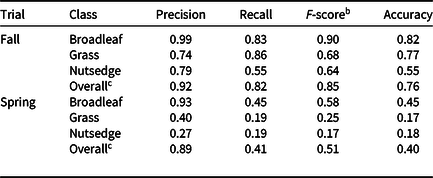
The YOLOV3-tiny-3L network was trained to detect three classes of vegetation (grass, nutsedge, and broadleaf). Results differed between seasons (Table 3) for unknown reasons, but we speculate that differences in weed size and the presence of shadows affected weed detection and identification. The primary difference between seasons was the overall weed density with 46 to 61 weeds m−2 and 120 to 140 weeds m−2 in fall and spring, respectively, prior to the first application (data not shown). Increased weed density resulted in increased levels of occlusion and therefore reduced weed detection.
Object detection accuracy for YOLOV3-tiny-3L convolutional neural network with consideration to the detection of individual broadleaf, grass, and sedge plants growing in plasticulture row middles. a

a If a bounding box was not drawn on any part of the plant, then that plant was designated as a false negative.
b F-score is the harmonic mean of the precision and the recall.
c Overall refers to the cumulative network output results across all classes (broadleaf, grasses, and nutsedges) prior to precision and recall calculations.
The overall total detection across all classes achieved a high precision (0.92 and 0.89 for fall and spring, respectively; Table 3), demonstrating that the model was able to accurately identify the targets by correct category. However, the recall between the trials demonstrated that in fall the network identified a higher number of plants (0.82) when compared to spring (0.41). These recall results influenced the F-score (0.85 and 0.51 in fall and spring, respectively), and accuracy (0.76 and 0.40 in fall and spring, respectively) of the network. These differences support our hypothesis that higher densities resulted in the equipment’s inability to differentiate between individual plants.
For the broadleaf class, the network achieved high precision measurements (0.99 and 0.93 in fall and spring, respectively), however, the recall in the spring season was 38% lower than in the fall (0.45 and 0.83 in fall and spring, respectively; Table 3). For the grasses and nutsedge classes, more plants were not correctly classified in the spring and the two categories were incorrectly identified with nutsedges identified as grasses and vice versa. When plants were too small (one to two leaves) the network was also not able to correctly distinguish the two categories. As a result, we obtained low precision and recall measurements on grass and nutsedge classes in the spring (Table 3). For grasses, differences in the precision parameter (0.74 in fall, 0.40 in spring) and recall (0.86 and 0.19 in fall and spring, respectively, were observed. For nutsedges, identification was observed with similar differences for precision (0.79 and 0.27 in fall and spring, respectively) and recall (0.55 and 0.19 in fall and spring, respectively). Sharpe et al. (Reference Sharpe, Schumann, Yu and Boyd2019) also reported that the different morphologies and growth habits between grass species can affect the ability of YOLOV3-tiny-3L to identify a repeatable unit. They observed that approximately 59% of visible grass vegetation was detected.
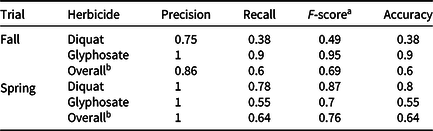
Differences were less noticeable between trials when comparing the actuation accuracy (Table 4). The application performance can be a better match for the field-level performance than the image-level performance and can therefore be considered a better indicator of overall efficacy. Ruigrok et al. (Reference Ruigrok, van Henten, Booij, Van Boheemen and Kootstra2020) reported that weed detection versus actuation accuracy underestimated the recall of the targets by 13%. They concluded that the spraying action would also kill undetected plants close to other, detected plants. The same trend was observed in this study: in spring the overall recall for the actuation observed was 23% higher than the one observed in the model, where even when misidentification or non-identification occurs, especially in high-density scenarios with significant occlusion, both plants were targeted by the system because at least one plant was identified.
Nozzle activation data.

a F-score is the harmonic mean of the precision and the recall.
b Overall refers to the cumulative network output results across both herbicides (diquat and glyphosate) prior to precision and recall calculations.
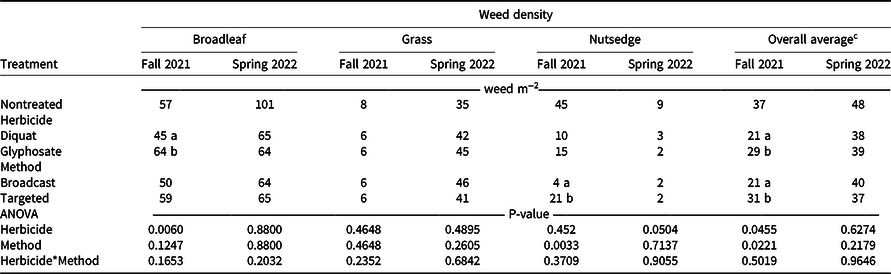
There was no significant interaction between the type of herbicide and the application method (targeted or broadcast) for weed density in both trials (Table 5). In the fall trial the diquat application was the most efficient at reducing the density of broadleaf weeds, and for the overall weeds density versus glyphosate (P = 0.0060 and P = 0.0455 for broadleaf and overall average, respectively). Banded applications were more effectively able to lower grass and nutsedge density versus targeted application (P = 0.0033 and P = 0.0221 for nutsedge and overall average, respectively). This trend was not observed in the spring when the use of smart-spray technology achieved the same control as broadcast applications.
Effect of herbicide on weed density when applied with a targeted applicator in row middles. a, b

a For weed density, all ratings were compared to the nontreated control but assigned nontreated control ratings were removed prior to analysis.
b Means within a column followed by the same letter are not significantly different according to Tukey’s test (P ≤ 0.05).
c Overall average refers to average of weed density between all weed classes.
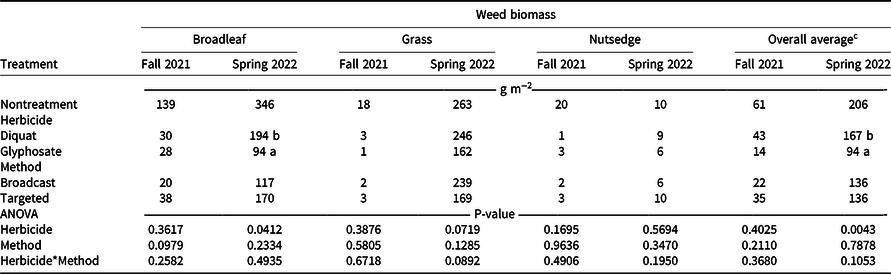
In spring, glyphosate was more effective than diquat in reducing broadleaf and overall average weed density (P = 0.0412 and P = 0.0043 broadleaf and overall average, respectively; Table 5). Glyphosate also more effectively reduced broadleaf and total weed biomass in the spring trial (Table 6). No differences were expected between targeted and broadcast applications since one of the goals of this study was to demonstrate that targeted weed management can achieve the same weed control effectiveness with lower herbicides inputs.
Effect of herbicides on weed biomass when applied with a broadcast and targeted applicator in row middles. a, b

a For weed biomass, all ratings were compared to the nontreated control but assigned nontreated control ratings were removed prior to analysis.
b Means within a column followed by the same letter are not significantly different according to Tukey’s test (P ≤ 0.05).
c Overall average refers to average of weed biomass between all weed classes.
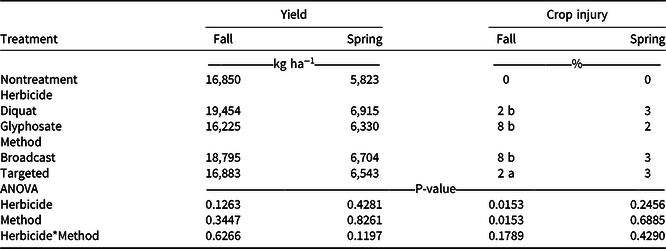
As expected, none of the treatments had a significant effect on crop yield in either season (Table 7). However, in the fall, the diquat application resulted in less crop injury compared to glyphosate, which suggests that some herbicide drift occurred (P = 0.0153; Table 7). In addition, in the fall, 8% crop injury was observed with the broadcast treatments, with only 2% injury observed where herbicides were applied with the smart-spray technology. Balafoutis et al. (Reference Balafoutis, Beck, Fountas, Vangeyte, Wal, Soto, Gómez-Barbero, Barnes and Eory2017) and Partel et al. (Reference Partel, Kakarla and Ampatzidis2019) both noted that targeted application could possibly reduce the risk of crop damage, but this has not been proven or tested. We attempted to prove this hypothesis, albeit unsuccessfully, but our data indicate that the potential for crop damage due to drift may be less likely with targeted herbicide technology compared to broadcast or banded applications.
Effect of herbicide on jalapeno pepper total marketable yield and jalapeno pepper tolerance when applied with a targeted applicator in row middles. a–c

a For injury and yield, all ratings were compared to the nontreated control but assigned nontreated control ratings of 0 were removed prior to analysis.
b Pepper yield is the average of measurements at 9 and 11 wk after transplant in the fall, and 12 and 13 wk after transplant in the spring.
c Means within a column followed by the same letter are not significantly different according to Tukey’s test (P ≤ 0.05).
The overall herbicide savings (Table 8) across all three applications and across both herbicides) was 23% for fall and 42% for spring. In the first application, the overall savings were an average of 12% and 18% in fall and spring, respectively. For the second application, the overall savings were an average of 44% in the fall and 37% in the spring. For the third application, the savings average for fall was 12% versus 71% for spring. The difference between seasons, especially on the third application, can likely be attributed to the number of plants missed by the network during the application as noted previously.
Effect of targeted application by the smart spray technology on herbicide use in row middles. a

a Abbreviations: A1, Application 1; A2, Application 2; A3, Application 3.
b Overall means the average between both herbicides on each application.
c Overall average means the average between all the three applications.
Previous research has reported reduced herbicide use when applied with targeted applications which concurs with the results observed in this study. Hussain et al. (Reference Hussain, Farooque, Schumann, McKenzie-Gospill, Esau, Abbas, Achary and Zaman2020) reported herbicide savings using a smart variable-rate sprayer using the YOLOV3-tiny model to control lambsquarter (C. album) between potato plants under different weather conditions. They observed that the smart sprayer containing three nozzles can reduce herbicide use by an average of 42%. However, the field was simulated, not showing how the system would work in real-world situations where the weed distribution is uniform. Farooque et al. (Reference Farooque, Hussain, Schumann, Abbas, Afzaal, McKenzie-Gopsill, Esau, Zaman and Wang2022) reported a smart sprayer based on CNNs for targeted detection and spot applications of agrochemicals within potato (Solanum tuberosum L.) fields infested by weeds. They observed the one-nozzle sprayer reduced spray volume by 47% for weeds when compared to a constant-rate application under all conditions tested. Our results showed significant potential for the applicability of a sprayer to achieve spot applications of herbicides in plasticulture row middles. In certain growing situations, targeted spray technology can significantly reduce the volume of herbicides applied and therefore the input costs (Balafoutis et al. Reference Balafoutis, Beck, Fountas, Vangeyte, Wal, Soto, Gómez-Barbero, Barnes and Eory2017).
We conclude that the use of the smart-spray technology developed by the University of Florida using YOLO V3-tiny-3L can effectively manage weeds in the row middle. Weed detection achieved an overall model precision of 91% and 61% recall and a precision of 91% for actuation. The weeds were successfully identified and sprayed. As a result, herbicide use was reduced by an average of 26% to 42% in plasticulture with no reduction in weed control or pepper yield.
Practical implications
Targeted weed control systems that use artificial intelligence for weed detection and identification are an effective technology for POST herbicide applications in row middles in specialty crops grown using the plasticulture system. Adoption of this technology will reduce herbicide inputs and associated costs, reduce the risk of crop damage, and reduce the labor and risks associated with filling spray tanks because less spray volume is needed. The system presented within this paper was able to detect and localize the weeds with a precision of 91% and reduced herbicide application volumes by 26% to 42%. The results presented here were based on real-world field trials in crops grown to commercial standards and we are therefore confident that similar results would be obtained on commercial farms. The current study was conducted in a pepper crop but the use of targeted herbicide applications in the row middles should be effective over a wide range of crop types grown on plastic mulches.
Acknowledgments
We thank Mike Sweatt, Laura Reuss, and the farm crew at the Gulf Coast Research and Education Center for their assistance with crop management. This research was funded by the Florida Department of Agriculture and Consumer Services grants. No conflicts of interest have been declared.