Introduction
Repeatability or reproducibility experiments are profound tools that were originally developed for independent testing of the precision of experimental protocols. In biological research, the repeatability of observational data can be used to track organismal plastic and genetic responses to stress factors at the individual or population level at various temporal scales (Avargues-Weber et al., Reference Avargues-Weber, Lihoreau, Isabel and Giurfa2015; Niemelä and Dingemanse, Reference Niemelä and Dingemanse2017; Näslund, Reference Näslund2021). Given the escalated attention on climate change in recent years, repeatability studies (though controversial) can be pivotal in investigating basal and plasticity of thermal tolerance (Morgan et al., Reference Morgan, Finnøen and Jutfelt2018; O'Donnell et al., Reference O'Donnell, Regish, McCormick and Letcher2020; O'Neill et al., Reference O'Neill, Davis and MacMillan2021) where both environmental and genetic phenotypic variation effects can be used to determine within-individual trait variability (Grinder et al., Reference Grinder, Bassar and Auer2020). If the thermal tolerance of a tested organism is consistent over time, denoting high repeatability, it indicates that the adaptive potential of the trait is high while the converse is true for low repeatability (Morgan et al., Reference Morgan, Finnøen and Jutfelt2018).
For insects, body temperature depends on ambient conditions mediating biochemical and physiological processes therein (Chown and Nicolson, Reference Chown and Nicolson2004; Sinclair et al., Reference Sinclair, Alvarado and Ferguson2015). Subsequently, such organismal responses mediate development and can cascade to population level through factors such as seasonality, geographic distribution and voltinism (Du Plessis et al., Reference Du Plessis, Schlemmer and Van den Berg2020; Phophi et al., Reference Phophi, Mafongoya and Lottering2020; Tarusikirwa et al., Reference Tarusikirwa, Mutamiswa, Chidawanyika and Nyamukondiwa2020; Nyamukondiwa et al., Reference Nyamukondiwa, Machekano, Chidawanyika, Mutamiswa, Ma and Ma2022). Of interest is how the magnitude and frequency of thermal extremes in the form of heat waves and cold snaps wrought by the changing climates influence pest physiology, survival and key life-history traits (Tollefson, Reference Tollefson2014) as it has direct implications on their population dynamics (Chidawanyika et al., Reference Chidawanyika, Mudavanhu and Nyamukondiwa2012, Reference Chidawanyika, Chikowore and Mutamiswa2020) and ultimately food security (Gregory et al., Reference Gregory, Johnson, Newton and Ingram2009). Thus, apart from magnitude of thermal exposure, insects experience different mode of thermal fluctuations (e.g. acute vs. chronic, rapid vs. slow fluctuations and/or repeated exposures) typical of diel and seasonal changes (Colinet et al., Reference Colinet, Nguyen, Cloutier, Michaud and Hance2007). Such extremes, and not average temperatures drive several organismal responses including evolutionary adaptations within and across generations (Cox et al., Reference Cox, Schubert, Travisano and Putonti2010; Travis Reference Travis2014; Buckley and Huey, Reference Buckley and Huey2016) and define geographic ranges via various demographic tipping points (Lynch et al., Reference Lynch, Rhainds, Calabrese, Cantrell, Cosner and Fagan2014).
Indeed, insects have evolved diverse morphological, physiological and behavioural adaptations to withstand and colonize otherwise lethal novel environments (Bale, Reference Bale2002; Neal et al., Reference Neal, Diaz, Qureshi and Cave2021). For example, overwintering insects are known to survive stressful low temperatures through employing cold tolerance strategies such as rapid cold hardening (RCH), freeze tolerance and freeze avoidance (Sinclair et al., Reference Sinclair, Alvarado and Ferguson2015; Feng et al., Reference Feng, Zhang, Li, Yang and Zong2018). Freeze-tolerant insects survive intracellular ice formation through use of cryoprotectants, removal of ice nucleators and anti-freeze heat shock proteins synthesis (Elnitsky et al., Reference Elnitsky, Hayward, Rinehart, Denlinger and Lee2008; Storey and Storey, Reference Storey and Storey2012; Toxopeus et al., Reference Toxopeus, Koštál and Sinclair2019). On the contrary, freeze-intolerant/avoidant insects cannot withstand internal ice formation but survive through keeping their body fluids under a supercooled condition (Sinclair et al., Reference Sinclair, Alvarado and Ferguson2015; Andreadis and Athanassiou, Reference Andreadis and Athanassiou2017). RCH, a form of phenotypic plasticity, confers survival advantages at low lethal temperature after brief pre-treatment to a prior sub-lethal temperature shock (Lee et al., Reference Lee, Chen and Denlinger1987; Teets and Denlinger, Reference Teets and Denlinger2013). Over longer time scales such prior exposure to sublethal temperatures also confer advantages to identical future identical thermal stress in what is referred to as beneficial acclimation (Leroi et al., Reference Leroi, Bennett and Lenski1994).
In nature, insects may thus face multiple stressors including repeated cold stress during diel and seasonal thermal fluctuations (Marshall and Sinclair, Reference Marshall and Sinclair2010) where the above-mentioned plastic responses play a role (Nyamukondiwa et al., Reference Nyamukondiwa, Chidawanyika, Machekano, Mutamiswa, Sands, Mgidiswa and Wall2018). Mimicking such repeated thermal exposure in manipulative experiments allows investigation of the relationship between repeatability and adaptive responses (Boake, Reference Boake1989; Morgan et al., Reference Morgan, Finnøen and Jutfelt2018; Grinder et al., Reference Grinder, Bassar and Auer2020). In this study, we used common measures of cold tolerance in critical thermal minimum (CTmin) and chill coma recovery time (CCRT) as proxies for cold hardiness (Andersen et al., Reference Andersen, Manenti, Sørensen, MacMillan, Loeschcke and Overgaard2015; Mutamiswa et al., Reference Mutamiswa, Machekano, Chidawanyika and Nyamukondiwa2018, Reference Mutamiswa, Machekano, Chidawanyika and Nyamukondiwa2019; Izadi et al., Reference Izadi, Mohammadzadeh and Mehrabian2019).
CTmin is an organism's lower thermal tolerance limit where an insect is incapacitated due to compromised neuromuscular activity (Sinclair et al., Reference Sinclair, Alvarado and Ferguson2015; Izadi et al., Reference Izadi, Mohammadzadeh and Mehrabian2019). If low temperature conditions persist, CTmin is followed by chill coma where paralysis due to complete loss of neuromuscular function occurs (Hazell and Bale, Reference Hazell and Bale2011; O'Neill et al., Reference O'Neill, Davis and MacMillan2021). The time that an insect requires to regain neuromuscular function following chill coma is what is then regarded as CCRT (Sinclair et al., Reference Sinclair, Alvarado and Ferguson2015). Given their ubiquitous occurrence in nature and capacity to define limits for organismal activity, these key indices provide valuable ecologically relevant measures of insect cold tolerance. Thus, understanding the evolutionary capacity following repeated exposure provides important information on their adaptive capacity and potential geographic range expansion in invasive insects such as Spodoptera frugiperda.
S. frugiperda is a highly invasive insect pest native to the tropics and sub-tropics of America (Goergen et al., Reference Goergen, Kumar, Sankung, Togola and Tamò2016). The larvae of this polyphagous insect cause significant economic losses in several important crops but inflict the most damage in the Poaceae family (Lu and Adang, Reference Lu and Adang1996; Nboyine et al., Reference Nboyine, Kusi, Abudulai, Badii, Zakaria, Adu, Haruna, Seidu, Osei, Alhassan and Yahaya2020). In Africa, S. frugiperda was first detected in Nigeria before rapidly spreading to 47 countries across the African continent (Goergen et al., Reference Goergen, Kumar, Sankung, Togola and Tamò2016; Cock et al., Reference Cock, Beseh, Buddie, Cafá and Crozier2017; Early et al., Reference Early, González-Moreno, Murphy and Day2018; Nboyine et al., Reference Nboyine, Kusi, Abudulai, Badii, Zakaria, Adu, Haruna, Seidu, Osei, Alhassan and Yahaya2020). It is highly destructive to maize, Zea mays, which is a staple food in many parts of Africa (Day et al., Reference Day, Abrahams, Bateman, Beale, Clottey, Cock, Colmenarez, Corniani, Early, Godwin and Gomez2017; Kasoma et al., Reference Kasoma, Shimelis and Laing2021).
S. frugiperda does not diapause, instead it is known to migrate to environments with favourable conditions for survival (Du Plessis et al., Reference Du Plessis, Schlemmer and Van den Berg2020; Vatanparast and Park, Reference Vatanparast and Park2022). It has been reported to survive in Africa, all year-round due to prevailing conducive biophysical environment (Early et al., Reference Early, González-Moreno, Murphy and Day2018; Du Plessis et al., Reference Du Plessis, Schlemmer and Van den Berg2020; Keosentse et al., Reference Keosentse, Mutamiswa, Du Plessis and Nyamukondiwa2021). The upregulation of glycerol-3-phosphate dehydrogenase and glycerol kinase genes for increased synthesis of the cryoprotectant glycerol has been attributed to the key physiological response to withstand cold environments in S. frugiperda (Vatanparast and Park, Reference Vatanparast and Park2022). However, survival has been reported to be limited in some cases in Asia where harsh winters decimate seasonal populations while annual reinvasions provide new propagules (Vatanparast and Park, Reference Vatanparast and Park2022). Nevertheless, little is known about the role of acquired/induced cold tolerance in the fitness of S. frugiperda following prior exposure. Yet, induced cold tolerance can play a key role in preserving and improving key life-history activities at acute temporal scales.
Here, we examined the consequences of repeated cold exposure on low thermal tolerance (CTmin and CCRT) of S. frugiperda life stages across 72 h. We hypothesized that CTmin and CCRT are repeatable traits and may change over time because of cold hardening. Since body water and lipid content is associated with basal and induced cold tolerance in insects (or lack thereof), we subsequently assessed the two parameters following thermal exposure to draw inferences on the performance of S. frugiperda and subsequent management.
Materials and methods
Insect culture and maintenance
The initial colony of S. frugiperda was obtained as larvae from the Agricultural Research Council, Plant Health Protection (ARC-PHP) Pretoria, South Africa. Thereafter, the insects were maintained on an artificial diet in the insectary under optimum conditions of 28°C, 65 ± 5% relative humidity (RH) and 12L:12D photoperiod. Since cannibalism is reportedly predominant among late larval instars (Chapman et al., Reference Chapman, Williams, Escribano, Caballero, Cave and Goulson1999), each third instar larva was individually placed in a separate 100 ml plastic vial with perforated screw-cap lid and soybean wheat germ artificial diet (Southland Products Inc., Lake Village, Arkansas, USA) until pupation. Pupae were maintained in open Petri dishes (30 × 30 × 30 cm3) in collapsible rearing cages made of mesh cloth until adult eclosion. Adults were provided with 25% sugar-water from a moistened cotton wool placed in a Petri dish. At least two maize plants (3–4 weeks old) were placed in each rearing cage as oviposition substrate for gravid females. After hatching, the 1st instar larvae were transferred to an artificial diet for subsequent rearing. For all the experiments F1 generation of 4th, 5th, 6th instar larvae and 24–48 h old virgin adults were used.
CTmin and repeated cold exposure assays
To the relationship between CTmin and repeated cold exposure, larvae and adults (males and females) of S. frugiperda underwent repeated cold tolerance (CTmin) assays at 0 (control), 24, 48 and 72 h intervals. CTmin were assayed using standardized dynamic and ecologically relevant protocols (Chidawanyika and Terblanche, Reference Chidawanyika and Terblanche2011; Chidawanyika et al., Reference Chidawanyika, Nyamukondiwa, Strathie and Fischer2017). Ten replicate larvae and adults were individually placed randomly in a series of 200 mm glass tubes (‘organ pipes’) connected to an insulated double-jacketed chamber linked to a programmable water bath (Grant model Tx150; Grant Instruments, UK) filled with 1:1 water:propylene glycol. In the ‘organ pipes’, insects were allowed to equilibrate for 10 min at 28°C (optimum temperature) before decreasing the temperature at a rate of 0.25°C min−1 until their CTmin were recorded. This was repeated twice for each life stage to yield sample sizes of n = 20 per treatment. To record chamber temperature, a thermocouple (type K 36 SWG) connected to a digital thermometer (53/54IIB, Fluke Cooperation, Everett, Washington, USA) was inserted into a control (centre) glass tube of the organ pipes. After each assay, insects were given time to recover before repeating the same assay across 24, 48 and 72 h intervals using the same batch of insects. CTmin was considered as the temperature at which insects did not respond to gentle prodding (e.g. Nyamukondiwa and Terblanche Reference Nyamukondiwa and Terblanche2009).
Influence of repeated cold exposure on CCRT
CCRT was assessed following Mutamiswa et al. (Reference Mutamiswa, Machekano, Chidawanyika and Nyamukondiwa2018). A total of ten replicate larvae and adults were placed individually in 7 ml screw-cap glass vials with 1 mm diameter holes pierced through cap for ventilation. The vials were then placed into a large zip-lock bag which was subsequently submerged into a water bath (Grant LTC40 model TX150) filled with a 1:1 water:propylene glycol mixture and set at 0°C for 1 h. After 1 h at chill-coma temperature, the tubes were removed from the water bath and transferred to a Memmert climate chamber (HPP 260, Memmert GmbH+ Co.KG, Schwabach, Germany) set at 28°C, 65% RH for recovery. The chamber was connected to a camera (HD Covert Network Camera, DS-2CD6412FWD-20, Hikvision Digital Technology Co., Ltd, Hangzhou, Zhejiang, China) that was linked to a computer where observations were recorded. This was repeated twice for each life stage to yield sample sizes of n = 20 per treatment. After each assay, insects were exposed to the same treatment and CCRT measured across 24, 48 and 72 h intervals using the same batch of insects. CCRT was defined as the time (in min) required for an adult to stand upright on its legs (Milton and Partridge, Reference Milton and Partridge2008).
Determination of body water content (BWC)
After 72 h interval following CTmin and repeated cold exposure assays, BWC of the insects were determined. Larvae (4th, 5th and 6th instar) and adults were individually placed in a pre-weighed 50 ml Eppendorf tubes and the initial mass of each insect before oven drying was measured (to 0.0001 g) on a Scout Pro (DHAUS) microbalance (model: Scout Pro SPU 123, Parsippany, USA). Thereafter, insects were placed in a Memmert drying oven (UL50, Memmert, Schwabach, Germany) set at 60°C for 72 h. Insects were allowed to cool under laboratory temperature conditions of 28°C for 30 min thereafter, dry mass was measured (to 0.0001 g) on a microbalance. To determine BWC, dry mass was subtracted from the initial mass following Bazinet et al. (Reference Bazinet, Marshall, Macmillan, Williams and Sinclair2010) and Weldon et al. (Reference Weldon, Nyamukondiwa, Karsten, Chown and Terblanche2018).
Determination of body lipid content (BLC)
Following BWC assays, the tested insects were further oven dried for another 72 h at 60°C. Thereafter, the insects were individually washed in 1.5 ml diethyl ether and then gently agitated at 250 rpm for 24 h at 37°C using ST 5 CAT orbital shaker (model: Zipperer GmbH, D 79219 Staufen, Germany) following the methods of Mitchell et al., (Reference Mitchell, Boardman, Clusella-Trullas and Terblanche2017). The diethyl ether was then removed from the tubes and insects were oven dried again at 60°C for 24 h, before reweighing. The lipid content for each individual was calculated by subtracting the lipid-free dry mass from the initial dry mass. Controls were exposed to the same conditions before measuring their lipid content.
Data analysis
Data analyses were carried out in STATISTICA, 13.5.0 version (Statsoft Inc., 2021) and R version 4.1.2 (R Development Core Team, 2021). Normality and equality of variances were first checked using the Shapiro–Wilk and Hartley–Bartlett tests, respectively. Data for CCRT was linear and met the conditions for normality and equality of variances (W = 0.83, P = 0.12) and were analysed using generalized linear models assuming a Gaussian distribution and an identity link function in R. The CTmin data also met the linear model assumptions and were analysed using repeated measures analysis of variance. Tukey–Kramer's post-hoc tests were used to separate statistically heterogeneous means. The relationship between CTmin and BWC and BLC were examined using linear regression in STATISTICA.
Results
CTmin and repeated cold exposure assays
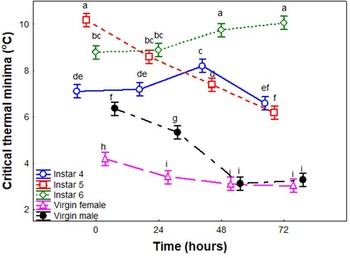
CTmin significantly varied across life stages following repeated cold exposure (F 16, 282 = 134.59, P < 0.001) (fig. 1). In 5th instar and virgin adults, cold tolerance (CTmin) improved with repeated cold exposure (fig. 1). However, 6th instar larvae showed compromised cold tolerance with CTmin increasing with repeated exposure (fig. 1). Virgin females recorded the lowest CTmin across all assays relative to other life stages (fig. 1).
CTmin in adult (virgin male and female) and larval stages of S. frugiperda following repeated cold exposure. Data points represent means of n = 20 while error bars denote 95% confidence limits for each gender and life stage. Different letters above error bars denote significant differences.

CCRT and repeated cold exposure assays
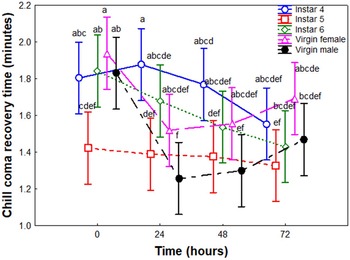
As in CTmin assays, CCRT varied significantly across life stages with repeated cold exposure (F 16, 282 = 4.06, P < 0.001) (fig. 2). CCRTs of tested instars (4th, 5th and 6th instar) decreased with repeated cold exposure (fig. 2). In adults (virgin males and females), CCRT improved following repeated exposure at 24 h interval and was compromised after 48 and 72 h intervals (fig. 2).
CCRT in adult (virgin male and female) and larval stages of S. frugiperda following repeated cold exposure. Data points represent means of n = 20 while error bars denote 95% confidence limits for each gender and life stage. Different letters above error bars denote significant differences.

Body water and lipid content
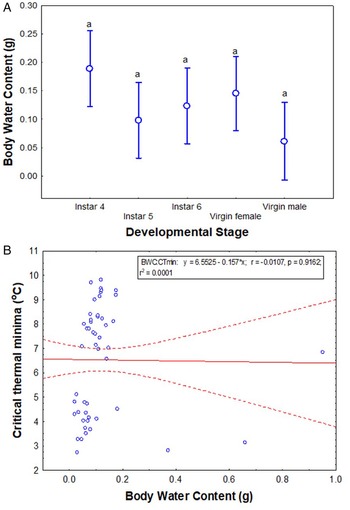
BWC did not vary significantly among life stages (F 4, 95 = 2.01, P = 0.98) (fig. 3A). There was no significant difference in BWC between all tested life stages (fig. 3A). Nevertheless, BWC was not significantly correlated with low temperature tolerance (measured as CTmin) (fig. 3B).
BWC (g) across different life stages (A) and relationship between BWC and CTmin (B) in S. frugiperda.

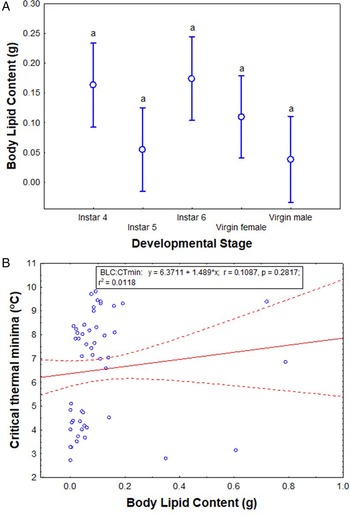
Similar to BWC, BLC did not significantly vary among life stages (F 4, 95 = 2.94, P = 0.24) (fig. 4A). As in BWC, BLC was not significantly correlated with low temperature tolerance such that CTmin decreased with BLC (fig. 4B).
BLC (g) across different life stages (A) and the relationship between BLC and CTmin (B) in S. frugiperda.

Discussion
Insect physiological and behavioural adaptations are very important for determining survival and population dynamics in both transient and seasonal cold spells (Chown and Nicolson, Reference Chown and Nicolson2004; Terblanche et al., Reference Terblanche, Hoffmann, Mitchell, Rako, le Roux and Chown2011; Andrew and Kemp, Reference Andrew and Kemp2016). As expected, our results showed that repeated cold exposure influences the fitness of S. frugiperda (determined as CTmin and CCRT). While insects may face multiple temperature variabilities in winter season, the repeated cold exposures can trigger responses that may set the insect on a different physiological path relative to a single exposure (Marshall and Sinclair, Reference Marshall and Sinclair2010, Reference Marshall and Sinclair2012). In the current study, CTmin improved with repeated exposure in 5th instar larvae, virgin males and females in agreement with Renault et al. (Reference Renault, Nedved, Hervant and Vernon2004) who reported improved survival in beetles that were exposed to repeated cold exposure. A similar trend was reported in Drosophila melanogaster, with low temperature tolerance improving following repeated cold exposure in tested insects (Le Bourg, Reference Le Bourg2007). However, compromised and fluctuating CTmin were recorded in 6th instar and 4th instar larvae, respectively. Given this variation across life stages, it therefore indicates that repeated thermal exposure impacts on CTmin are life-stage dependent. While 5th instar larvae, virgin males and females showed enhanced CTmin across subsequent exposures, virgin females recorded the lowest CTmin across treatment intervals indicating that they were the most thermally tolerant. This gives them a fitness and survival advantage when they encounter extreme cold conditions in nature.
In the present study, repeated thermal exposure improved CCRT in 4th, 5th and 6th instar larvae and this is in consonance with Andersen et al. (Reference Andersen, Folkersen, MacMillan and Overgaard2017) who reported improved chill-coma recovery, cellular survival and cold tolerance in Locusta migratoria following brief cold exposure periods. However, compromised CCRTs were recorded in adults (males and females) in keeping with van Dooremalen et al. (Reference van Dooremalen, Suring and Ellers2011) who reported CCRT decrease in Orchesella cincta following repeated cold exposure. The variations in the current study underlie that CCRT responses are life-stage dependent. Although CCRT and CTmin are measures of cold tolerance, surprisingly, 6th instar larvae recorded compromised CTmin and enhanced CCRT indicating that responses also vary across traits, thus can be trait dependent.
The changes in cold tolerance across consecutive measurements provide insight into potential benefits of short-term acclimation to extreme cold events through cold hardening. Our results showed evidence of cold hardening in S. frugiperda as indicated by improved cold tolerance in some of the life stages. This suggests significant adaptive potential for cold tolerance in this invasive insect species and that individuals may also respond directly to low temperature extremes through phenotypic plasticity. While S. frugiperda has been reported to overwinter and survive all year round in Africa (Kebede and Shimalis, Reference Kebede and Shimalis2018; Prasanna et al., Reference Prasanna, Huesing and Peschke2018; Keosentse et al., Reference Keosentse, Mutamiswa, Du Plessis and Nyamukondiwa2021), the results indicate its potential to adapt to variable thermal extremes in winter and this may give it fitness and survival advantage in the face of climate change. Insects reportedly enhance their cold tolerance through carbohydrate cryoprotectants accumulation, antifreezes synthesis, lipid membranes reordering and either removal (freeze avoiding) or retaining (freeze tolerant) of ice nucleators (Lee, Reference Lee, Denlinger and Lee2010). Therefore, differential life-stage responses shown in this study following repeated exposure assays may be a result of variation in these physiological components of cold hardiness. However, this warrants further investigation to fully elucidate the responses.
Cold tolerance is dependent on the water content remaining unfrozen in many cold hardened insects by allowing basal metabolism to continue at low temperature levels (Colinet et al., Reference Colinet, Nguyen, Cloutier, Michaud and Hance2007; Alfaro-Tapia et al., Reference Alfaro-Tapia, Alvarez-Baca, Tougeron, Lavandero, Le Lann and Van Baaren2021). Reports have shown that reduction in BWC and subsequent increase in solute concentration may increase cold tolerance in insects (Worland, Reference Worland1996). In the current study there was no relationship between cold tolerance and BWC. This may be because insects in our assays did not experience repeated cold conditions that trigger any water loss and subsequent solute concentration increase. While Keosentse et al. (Reference Keosentse, Mutamiswa, Du Plessis and Nyamukondiwa2021) reported that BWC increased with larval stage in S. frugiperda, our results report otherwise on CTmin following repeated exposure. This may be because our present study measured BWC following plastic responses while Keosentse et al. (Reference Keosentse, Mutamiswa, Du Plessis and Nyamukondiwa2021) measured basal BWC. Given these responses, it indicates that S. frugiperda may trade-off basal BWC for plasticity of thermal tolerance.
Lipid content plays a vital role in cold tolerance as they can serve as anti-freezers in the insect haemolymph (Sinclair and Marshall, Reference Sinclair and Marshall2018; Trenti et al., Reference Trenti, Sandron, Guella and Lencioni2022). In winter, most insects do not feed and may face the unreplaced energy consumption, water loss and low temperatures (Sinclair et al., Reference Sinclair, Ferguson, Salehipour-Shirazi and MacMillan2013; Williams et al., Reference Williams, Henry and Sinclair2015). Low temperature is one of the stressors which affect neutral lipid fluidity and mobilization and energy drain, since lipids are the primary overwintering source of fuel (Sinclair and Marshall, Reference Sinclair and Marshall2018). As such, most overwintering insects end winter with fewer lipid stores than at the beginning (Sinclair, Reference Sinclair2015). For example, in laboratory-reared colonies of D. melanogaster, glycogen levels decreased following repeated cold exposure (Marshall and Sinclair, Reference Marshall and Sinclair2010). In addition, there was a positive correlation between BLC and cold tolerance in Drosophila spp. (Hoffmann et al., Reference Hoffmann, Hallas, Sinclair and Partridge2001; Kaczmarek and Boguś, Reference Kaczmarek and Boguś2021). However, in the current study, our results showed no significant correlation between BLC and cold tolerance in S. frugiperda. A recent study attributed glycerol as the key cryoprotectant used by S. frugiperda (Vatanparast and Park, Reference Vatanparast and Park2022). This therefore suggests that the influence of BLC on cold tolerance may be species dependent and glycerol maybe more important in this species.
In conclusion, the current study documents life-stage-related variation in cold tolerance for S. frugiperda following repeated thermal exposure. Our results suggest that repeated cold exposure differentially influences the fitness of S. frugiperda in nature where vulnerability is life-stage and trait dependent. In addition, the study provides evidence that cold hardening may be an important mechanism for S. frugiperda to cope with repeated cold exposure over the short term. These cold tolerance responses may provide temporal fitness benefits following repeated cold conditions in nature hence population persistence under changing environments. The results also have direct implications on the geographic distribution of the pest under climate change scenarios where warming winter seasons will lead to even further spatial expansion and multivoltinism due to favourable conditions. For a polyphagous pest such as S. frugiperda this will be critical as alternative hosts will support multiple generations enough to exert pest pressure on the main crop in the subsequent season (Vatanparast and Park, Reference Vatanparast and Park2022). In such cases, management practices should consider area-wide monitoring of the pest populations even during off-season for early integrated pest management practices. This may include improved phytosanitary measures and reduction of alternative hosts on-farm. More importantly, augmentative releases to boost parasitoid populations during this period will also be a feasible option to suppress the pest populations to reduce the pressure in the main crop in the impending season. This will greatly reduce pest pressure, but costs are associated with control of the outbreak pest using synthetic pesticides on-season. Future studies should therefore determine the intensity of such parasitoid levels to maintain pest pressure well below economic injury levels.
Acknowledgements
The authors are very grateful for the National Research Foundation (NRF) and SACTA NPC trust PhD bursaries to AM and the support from the University of the Free State and NRF to FC. The authors also appreciate support from Midlands State University and Rhodes University to RM. In addition, the authors acknowledge Tsabang Mashigo and Lugisani Mulaudzi for technical assistance. The authors are also grateful to Hannelene du Plessis for kindly providing the stock culture of the fall armyworm.