Introduction
Poultry breeding has an important role to play in meeting the protein demand of the population, which has increased in this region in recent years. In poultry breeding, geese are known for their hardiness under unfavourable conditions, their adaptation capability to different feeding and breeding conditions and their high capacity of consuming cheap feed compared to other poultry (Dogan, Reference DOGAN1988). Geese are adapted to an herbivorous eating regimen and can be fed solely on meadow grass and can be grown in different climates without requiring any shelter (Muglali, Reference MUGLALI2001). Taking into consideration the many advantages goose breeding brings compared to other poultry, as well as the benefits from their meat, fat, liver and egg products, the significance of goose breeding is clear in regions where other poultry would require much higher levels of care and inputs.
As the growing rate of goslings especially in the first month is fast, this indicates the importance of feeding during this period (Selcuk et al., Reference SELCUK, AKYURT and GELIYI1983). It is known that these goslings grow rapidly in the first 8 weeks, and that live weight gain is lower after this age and their growing practically stops after 12 weeks of age (Dogan, Reference DOGAN1988). To meet these high demands for growth, NRC (Reference NRC1994) recommends an adequate protein level of 22% during the period between 0-6 weeks and 15% after the period of 6 weeks.
It is known that final live weight of native geese in Turkey is between 4.5-5 kg (Yildiz, Reference YILDIZ2000), and that male geese are heavier in weight than females (Elminowska-Wenda et al., Reference ELMINOWSKA-WENDA, ROSIŃSKİ, KLOSOWSKA and GUY1997; Onk, Reference ONK2009; Roberson and Francis, 1963b; Stevenson, Reference STEVENSON1985; Tilki et al., Reference TILKI, SAATCI, KIRMIZIBAYRAK and AKSOY2004; Tilki et al., Reference TILKI, SAHIN, SARI, ISIK and SAATCI2009). Geese breeding is especially commonplace in Kars; however modern goose breeding methods are not used. Slaughter weight of geese bred with conventional methods in Kars was 4.55 kg at the age of 24-28 weeks (Onk, Reference ONK2009), and 5.05 kg (Tilki et al., Reference TILKI, SAATCI, KIRMIZIBAYRAK and AKSOY2004) at 32 weeks. The live weight of geese during the breeding period, from the age of 10 weeks to 16 weeks was 3.90 - 4.02 kg (Sahin et al., Reference SAHIN, TILKI, KAYA, UNAL and AKSU ELMALI2008), and there was no significant difference between geese which started breeding at the age of 10 weeks and geese which started at 14 weeks in terms of slaughter and carcass characteristics. (Tilki et al., Reference TILKI, SAHIN, SARI, ISIK and SAATCI2009).
When geese breeding and production is carried out using local conventional methods, egg productivity, live weight and feather productivity cannot reach full genetic potential. More scientific studies are needed in order for geese breeding to become systematic and economically productive in Turkey. The shortcomings of breeding and feeding methods in geese breeding have limited production. Therefore, identifying how people breed geese in Turkey, especially in Kars, and identifying the shortcomings of these methods will be a positive contribution to goose breeding.
Surveying geese production in Kars
The subjects of this survey comprised small family enterprises, which were engaged in geese breeding activities in the central villages of Kars. Information was collected from by means of questionnaire forms along with direct interviews that were held with villagers. At the beginning of the study, those villages where goose breeding was carried out intensively were identified. Enterprises that were engaged in geese breeding in these villages were randomly visited and 64 volunteering breeders responded to the questionnaire. In this questionnaire, a key focus was on the feeding strategies applied by the producers.
The Student t-test function in SPSS (version 11.0) statistical package was used to determine the impact of feed that was given to the flock before and during the laying period on the number of eggs that were laid. Mean values, percentages and frequency values of data were calculated (Duzgunes et al., Reference DUZGUNES, KESICI and GURBUZ1983).
feeding breeding flocks of geese
Producers take live weight and chest width into account when choosing geese for breeding stock. Secondary considerations include feather colour, egg production, growth rate, back length and small head, in order of relative importance. It is observed that with 41% of the respondents, white feathers were more in demand when choosing breeding geese, as these are desirable in terms of retailing white flesh and for feathers in pillow making.
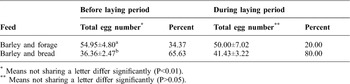
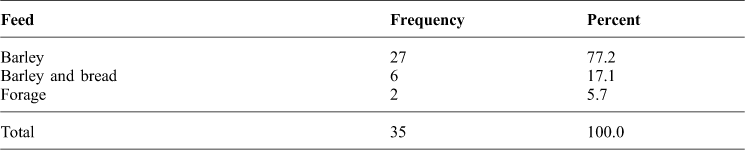
Table 1 shows the ratio and types of feed given to breeding geese before and during egg- laying, According to the survey results, 34% of the producers fed the geese on barley and forage before the laying period and 66% used with barley and bread. From the analysis of the data, the average number of eggs laid by those fed with barley and forage before laying 55, compared to 36% for those fed with barley and bread (P<0.01). However, the feed given to the breeding flock during the laying period did not affect the number of eggs. (P>0.05).
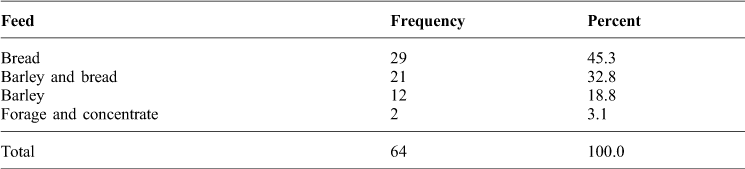
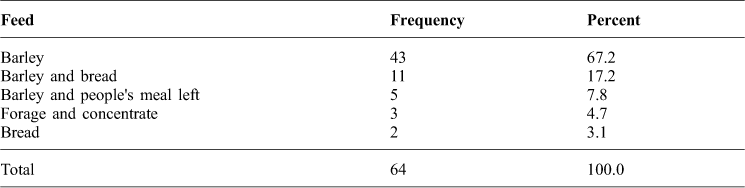
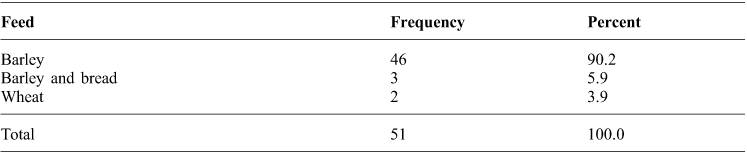
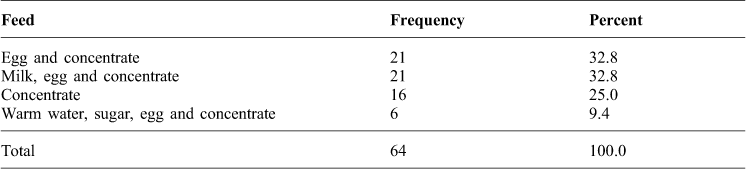
Producers revealed that the egg laying period for geese started in February and ended in July. Feed that was made available to the females during incubation and their frequencies are shown in Table 2. The feed and their percentages given to male stocks while female geese are incubating the eggs are shown in Table 3.
Feed given to geese for breeding before and during egg-laying.

* Means not sharing a letter differ significantly (P<0.01).
** Means not sharing a letter differ significantly (P>0.05).
Feed provided for breeding female geese during the incubation period.
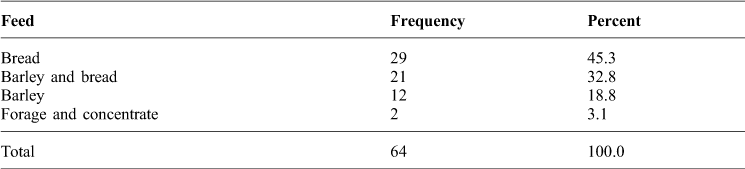
Feed given to male breeding geese.
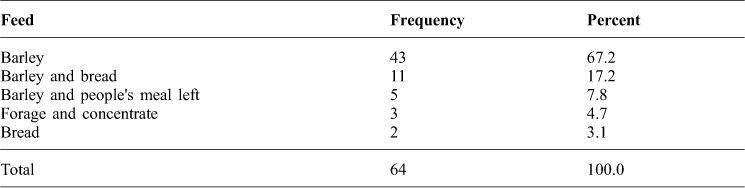
feeding the gosling
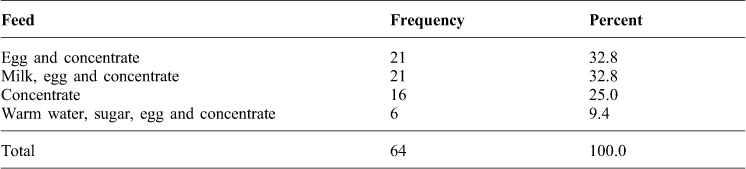
The results of the survey regarding feed given to goslings and their percentages are shown in Table 4. The majority of producers start providing concentrated feed to goslings on the third day of age (39% of respondents) and provide the first green feed by the seventh day (42%). The first time goslings are exposed to grazing pasture varies between day seven and day twenty of age, but most producers (36%) start from the tenth day.
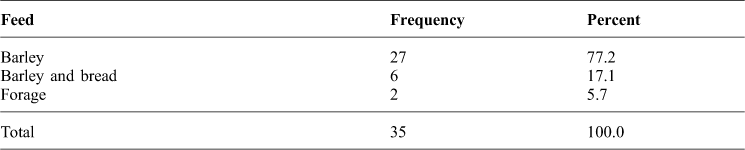
Fifty-three percent of the geese producers maintain goslings on grazing pasture until November. During pasture grazing, 45% of the producers do not allow additional breeding, although 55% do. The feed provided during this period is shown in Table 5.
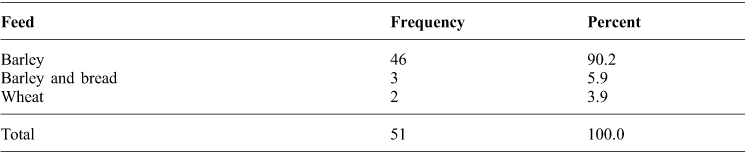
Eighty percent of the producers feed the geese with a concentrate rich in energy 15 - 40 days prior to slaughter. The majority of these produces (45%) implement an intense feeding program 30 days prior to slaughter (Table 6). According to the results of the survey conducted during the slaughter period in November, the average slaughter weight of geese was determined to be 4.85 kg (min: 2.80 kg, max: 6.00 kg).
Gosling feeding regime (average during the first 7 days after hatch).
Supplementary feeding of geese during pasture grazing.
Feed provided pre-slaughter in growing Kars geese.
Discussion
In this study, it was found that goose breeders applied two different feeding strategies to the flock, one during the laying period and the other before the laying period. Some breeders fed barley and forage and others used a combination of barley and bread. The impact of feeding that was applied to the stock before the laying period on number of eggs was found to be significant (P<0.01), while the feeding regime during the laying period on number of eggs was not significant (P>0.05). Therefore, it can be concluded geese consuming forage were selecting other items of nutritional value, and forage access appeared to have a positive impact on performance during the laying period (Muglali, Reference MUGLALI2001).
It was evaluated that female geese were not given much attention regarding their diet during the incubation period and 45% of the breeders fed them on only bread. During the incubation period geese do not need much protein and energy because of inactivity. Hence, feeding these animals on additional barley and other cereals may be considered no necessary (Muglali, Reference MUGLALI2001). However, breeders stated that female geese typically lost weight after the incubation period, which suggested that laying geese would benefit from supplementary feeding, as this situation might stem from the poorer feeding program that was applied to geese during the incubation period.
Breeders attached particular importance to feeding goslings during the first seven days after hatching and fed them on concentrate mixtures during this period. Roberson and Francis (1963a) reported that protein levels had an impact on live weight during the period between 4-8 weeks; however, a high protein level was more advantageous than low protein level in subsequent periods. Sahin et al. (Reference SAHIN, TILKI, KAYA, UNAL and AKSU ELMALI2008) reported that differences of protein levels in rations did not have a significant impact on live weights, especially in feeding regimes applied from the age of 10 to 16 weeks. Another study reported that live weight increases achieved by providing feed at this time, decreased with the weekly aging of geese (Stevenson, Reference STEVENSON1985).
Goose fat is an important food material especially in cold regions and is an important extra product from geese production (Demirulus, Reference DEMIRULUS2005). Goslings generally started grazing meadows after the age of 10 days until November by 53% of the breeders, and 77% of the breeders additional fed them with barley during this grazing period. The breeders applied a feeding program primarily based on barley starting from 30 days before slaughter. Geese fed on higher energy rations started to gain body fat after the age of 18 weeks (Jeroch et al., Reference JEROCH, SCHUBERT, PRINZ and PETZOD1978; Schubert et al., Reference SCHUBERT, JEROCH and HENNIG1977).
It was reported that mean slaughter weight of geese in November was 4.85 kg. This result was higher than that of Onk (Reference ONK2009) who reported the slaughter weight of Kars geese to be 4.53 kg, and lower than that of Tilki et al. (Reference TILKI, SAATCI, KIRMIZIBAYRAK and AKSOY2004) who reported it as 5.05 kg. This difference in slaughter weights could be due to differences in feeding periods in the study of Tilki et al. (Reference TILKI, SAATCI, KIRMIZIBAYRAK and AKSOY2004).
Conclusions
A good feeding program is needed to increase the productivity of Kars geese to meet their genetic capacity for growth and reproduction. Systematic programs are needed to be developed in Kars in order to shorten the period to slaughter weight and positively increase the marketable products obtained from the flocks.