Introduction
Deschampsia antarctica Desv. (Poaceae) and Colobanthus quitensis (Kunth) Bartl. (Caryophyllaceae) are the only native vascular plants living in Antarctica, being present at the limit of their ranges of distribution. Consequently, changes in their reproductive performance may be indicative of a biological response to climate change (Wookey et al. Reference Wookey, Parsons, Welker, Potter, Callaghan, Lee and Press1993, Havström et al. Reference Havström, Callaghan and Jonasson1993, Körner Reference Körner1999, Walther et al. Reference Walther, Post, Convey, Menzel, Parmesan, Beebee, Fromentin, Hoegh-Guldberg and Bairlein2002, Root et al. Reference Root, Price, Hall, Schneider, Rosenzweig and Pounds2003). Both species are widespread throughout the Maritime Antarctic (Greene & Holtom Reference Greene and Holtom1971, Smith Reference Smith2003), where an increase of > 1°C mean summer air temperature over the past 50 years (Turner et al. Reference Turner, Colwell, Marshall, Lachlan-Cope, Carleton, Jones, Lagun, Teid and Jagovkina2005) and a longer growing season, have caused a rapid expansion of these plants (Fowbert & Smith Reference Fowbert and Smith1994, Smith Reference Smith1994, Convey Reference Convey1996, Grobe et al. Reference Grobe, Ruhland and Day1997, Day et al. Reference Day, Ruhland, Grobe and Xiong1999, Walther et al. Reference Walther, Post, Convey, Menzel, Parmesan, Beebee, Fromentin, Hoegh-Guldberg and Bairlein2002, Robinson et al. Reference Robinson, Wasley and Tobin2003, Gerighausen et al. Reference Gerighausen, Bräutigam, Mustafa and Peter2003, Convey et al. Reference Convey, Hopkins, Roberts and Tyler2011). These observations support the principle that small changes in environmental conditions can trigger large biological changes, such as phenological changes, faster development of reproductive structures, higher production of ripe seeds, seedling establishment, growth and spreading of established plants (Day et al. Reference Day, Ruhland, Grobe and Xiong1999, Peñuelas & Filella Reference Peñuelas and Filella2001, Walther et al. Reference Walther, Post, Convey, Menzel, Parmesan, Beebee, Fromentin, Hoegh-Guldberg and Bairlein2002, Root et al. Reference Root, Price, Hall, Schneider, Rosenzweig and Pounds2003, Convey et al. Reference Convey, Hopkins, Roberts and Tyler2011, Vera Reference Vera2011).
Byers Peninsula (Antarctic Specially Protected Area No. 126) is one of the largest ice-free areas during the summer in the Maritime Antarctic region, and during the International Polar Year was considered as an International Site of Reference for the study of terrestrial, coastal and limnetic ecosystems (Quesada et al. Reference Quesada, Camacho, Rochera and Velázquez2009). This area represents a remarkable site for the study of vascular plant colonization because of the relatively mild climate (Bañón et al. Reference Bañón, Justel and Quesada2013), the very limited visits of researchers and the extensive ice-free area, providing a suitable habitat for vegetation. One of our goals was to provide data on the distribution of both vascular plants on Byers Peninsula in order to indicate a baseline for monitoring future colonization in relation to climate change. Earlier studies on distribution, plant succession and ecological aspects, carried out in 1965–66 (Lindsay Reference Lindsay1971), reported that both species were more common on the south coast, growing in restricted habitats, although a detailed distribution map was not published.
Colonization capacity may be estimated by sexual reproductive performance (seeds), quantifying floral development and seed production, seed banks, density of seedlings and individuals, and size structure of the populations, although the grass also shows vegetative dispersal (Edwards Reference Edwards1972, Smith Reference Smith2003). Few detailed studies on floral and seed development for vascular plants in Antarctica have been published, and most data available on reproductive characteristics were based mainly on field observations and herbarium specimens, studying only a few characters (Greene & Holtom Reference Greene and Holtom1971, Corner Reference Corner1971, Edwards Reference Edwards1974, Convey Reference Convey1996), making the comparisons on reproductive performance difficult. Studies on maturation stages in reproductive structures were carried out by Greene & Holtom (Reference Greene and Holtom1971) on herbarium specimens collected by Lindsay in December 1965 on Byers Peninsula, but that study was based on a few specimens collected during time periods other than our study, making comparison with our dataset difficult. Experimental manipulations indicated an improvement in the development of reproductive structures in response to higher temperatures (Edwards Reference Edwards1974, Day et al. Reference Day, Ruhland, Grobe and Xiong1999), but few floral characters were measured in these studies.
Recent investigations on the eastern side of Livingston Island, Hurd Peninsula, near the Spanish base (BAE), show that a small temperature change affects the development of flowers and seeds, and presumably the distribution of these species by increased sexual reproduction and seedling establishment (Vera Reference Vera2011, Vera unpublished data). The field studies on colonization and reproduction on Hurd Peninsula were carried out within the same 2001–02 growing season, and in both cases, at the end of January (on Hurd Peninsula was also carried out during February).
Material and methods
Study area
Byers Peninsula (62°34′35″–62°40′35″S, 60°54′14″–61°13′7″W) is bound by the Rotch Dome ice cap at the eastern end, which is the natural boundary of this ice-free ecosystem. Our vascular plant studies were carried out between 2002 and 2010, and mostly in the vicinity of the central plateau, western margin edge of Rotch Dome, and the west and south coasts. The northern coast was visited only sporadically, and Ray Promontory was not visited. Most of the vegetation and reproductive data were recorded in the summer season of 2002, between 30 January and 3 February.
The geomorphology of the studied area is dominated by raised beaches and platforms up to 105 m above sea level (a.s.l.), with an extensive interior plateau at about 70 m a.s.l. In several places, volcanic plugs and igneous rock outcrops reach higher elevations (e.g. Chester Cone, 188 m a.s.l. and Cerro Negro, 143 m a.s.l.). The coast is dominated by sandy beaches, some very extensive, such as the 13 km long South Beaches (Thomson & López-Martínez Reference Thomson and López-Martínez1996).
A weather station, located at 62°38′50″S, 61°6′37″W, and 70 m a.s.l. (for details see Bañón et al. Reference Bañón, Justel and Quesada2013), provided an indication of Byers Peninsula's climatic conditions. Mean summer (December–February) air temperature between 2001 and 2010 at 1.7 m above the ground was 1.6°C, with average maximum and minimum temperature of 3.2°C and 0.2°C, respectively. At 10 cm above the ground, the mean summer air temperature was 1.5°C with average maximum and minimum temperature of 4.4°C and -0.5°C, respectively (Bañón et al. Reference Bañón, Justel and Quesada2013). Annual total precipitation for Livingston Island was estimated at about 800 mm, similar to other locations in the South Shetland Islands (Bañón et al. Reference Bañón, Justel and Quesada2013). Average relative air humidity was 90%. The prevailing wind direction is from north-west to south-west, with frequent storms from that direction exceeding 100 km h-1, although in summer winds from the west dominate. The annual average wind speed was 24 km h-1 (Bañón Reference Bañón2004).
Microclimatic conditions inside the plant were measured with HOBO Pro V2 probes (Onset), each one carefully introduced inside the Colobanthus plant cushion logging temperature every hour.
Vascular plants distribution map
The distribution map presented in this study includes data from Lindsay (Reference Lindsay1971) and Greene & Holtom (Reference Greene and Holtom1971), and from direct observation and geographic location by GPS (7 m resolution on average) from 2002–10. Most distribution data were collected in 2002 and the track was recorded and marked on the map. The precise location of each population was plotted on the topographic map compiled by Servicio Geográfico del Ejército, Universidad Autónoma de Madrid and the British Antarctic Survey (scale 1:25 000; Servicio Geográfico 1992), and then precisely indicated on the simplified map provided by Björck & Zale (Reference Björck and Zale1996).
The observations on the presence of the vascular plants were limited to areas on the central plateau, the west and south edge of Rotch Dome, and to some locations in the north of the peninsula.
Reproductive performance
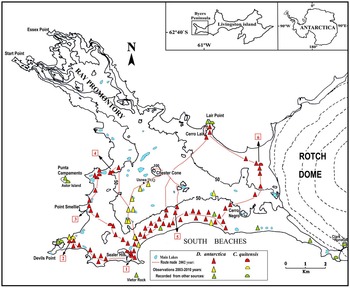
The reproductive structures study was conducted on samples collected from the locations indicated below, on Byers Peninsula (also shown in Fig. 1) between 30 January and 3 February 2002. At these locations, aspects regarding seedling establishment and plant sizes were also recorded with the Universal Transverse Mercator (UTM) values.
Distribution of Deschampsia antarctica and Colobanthus quitensis on Byers Peninsula, based on observations made between 2002–10 and other sources (Lindsay Reference Lindsay1971, Greene & Holtom Reference Greene and Holtom1971). The locations of the studied samples are shown.

Deschampsia antarctica:
1 - Sealer Hill (at the base of the hill): UTM 20E 0597066-3049316. Near sea level.
3 - Smellie Point: UTM 20E 0595131-3051731. Altitude 10 m a.s.l.
4 - Near Punta Campamento: UTM 20E 0596121-3053581. Altitude 8 m a.s.l.
5 - South Beaches: UTM 20E 0599268-3051607. Near sea level.
6 - Near Rotch Dome: UTM 20E 0603088-3053751. Altitude 8 m a.s.l.
Colobanthus quitensis:
1 - Sealer Hill (at the base of the hill): UTM 20E 0597100-3049400. Altitude: 10 m a.s.l.
2 - Devils Point: UTM 20E 0594037-3050147. Plateau, altitude 40 m a.s.l.
4 - Near Punta Campamento: UTM 20E 0596121-3053581. Altitude 8 m a.s.l.
6 - Near Rotch Dome: UTM 20E 0603088-3053751. Altitude 8 m a.s.l.
Between three and six individuals (one from South Beaches for D. antarctica) from both species, with a diameter of about 5–6 cm (D. antarctica) (smaller individuals were occasionally collected when larger individuals were absent) and about 3–5 cm (C. quitensis) were collected at each site. Plants were not collected in the same numbers, because the populations varied in the size and density of individuals between locations.
Samples of the plants were collected with the soil underneath (up to 8 cm deep) with a knife, then carefully introduced into paper bags. The samples were stored in a refrigerator at 4°C, and shipped frozen (-20°C) to Spain at the end of February. From mid-April 2002 onwards, they were kept at 4°C under dry conditions until analysis in the laboratory. The samples were studied in the first months of 2003, and the reproductive structures and different colorations from the current and last years were differentiated.
Flower production and maturation stages
The number and stage of maturity of C. quitensis flowers and of D. antarctica inflorescences was determined for samples from the sites described above. Due to the high number of flowers in C. quitensis, they were recorded in 3 x 3 cm2 samples from the middle of C. quitensis cushions (except for smaller individuals, which were counted entirely). Thirty-six cm2 samples from the middle of D. antarctica turfs (> 1 m2) were also studied. The number of Colobanthus flowers and Deschampsia inflorescences at each stage of maturation was estimated using the maturation stages defined by Holtom & Greene (Reference Holtom and Greene1967), excluding stage (0) (see legend in Fig. 2). The number of greenish colour inflorescences in D. antarctica, which developed during the current season, although the floral primordial may have formed the previous summer, and those from the previous seasons (straw-coloured) were recorded for each plant, along with those detached and those found between the leaves or on the soil. The total number of flowers of Deschampsia per m2 was estimated, considering the average number of flowers in each spikelet, the average number of spikelets per inflorescence (in the five more mature new inflorescences) and the number of inflorescences per m2. The total number of reproductive structures referred to surface area units (assuming 100% cover).
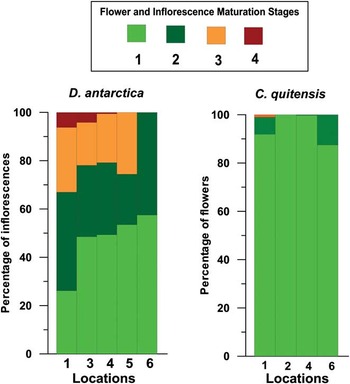
Maturation stages of both vascular plants. Left: percentage of inflorescences in each maturation stage of Deschampsia antarctica at different locations. The maturation stages were: inflorescences sheaths swollen but unopened (1), sheaths open with tops of inflorescences visible (2), inflorescences < 1/2 emerged (3), inflorescences > 1/2 emerged, most branches erect to slightly spreading (4), and inflorescences > 1/2 emerged, most branches moderately to fully spreading (5). Right: Percentage of flowers in each maturation stage of Colobanthus quitensis at different locations. The maturation stages were: flower buds visible, with sepals closed (1), sepals open, capsule closed and < 1/2 the length of the sepals (2), sepals open, capsule closed and > 1/2 the length of the sepals (3), and capsules open, seeds visible (4).

In addition, the length of the two uppermost spikelets of the Deschampsia inflorescences (in the five more mature new inflorescences) and the length of the sepals and the capsule from the ten more mature flowers in Colobanthus were measured.
Seed development and production
Estimation of potential current year seed production in Colobanthus was obtained by multiplying the number of capsules per m2 by the mean number of seeds under development from the ten most mature capsules. Flower production in Deschampsia was used as an estimation of potential seed production.
To estimate the degree of seed development in each population, the size of three seeds in each of the ten most mature capsules of Colobanthus (n = 30 per individual) was measured. For Deschampsia, seeds from five spikelets (two upper, two middle and the lowest) in each of five more mature new inflorescences (exceptionally, some individuals had less than five inflorescences) (n = 25 per individual) were measured. Seed size was determined as the length measured with a micrometer under a stereoscope microscope in dry conditions. For D. antarctica, seed length did not include the style.
Seed bank
The seed bank accumulated in previous years was estimated from all samples collected, including the plant material and the soil underneath, at different levels: a) plant, only in the case of D. antarctica (old seeds remained), b) organic stratum (surface to 2 cm depth, or less in the small cushions), constituted by the cushion of C. quitensis or leaves and mineral constituents in D. antarctica, c) mineral soil stratum (2–4 cm depth) sometimes with organic remains, and d) mineral soil stratum (4–6 cm) only in sites with deeper soils. Ripe seeds, identified as pale brown coloration and fully developed seeds, with a minimum seed size for successful germination (1.4 mm for D. antarctica and 0.5 for C. quitensis), based on data from Edwards (Reference Edwards1974), were counted in samples of 36 cm2 (D. antarctica) or 9 cm2 (C. quitensis) (some plants were smaller) in each stratum. All other incompletely filled or poorly developed seeds were also counted.
The mineral soil (air-dried) in each stratum beneath all the plants sampled (0–2 cm depth for both species and 2–4 cm depth only for D. antarctica) was analysed into four particle size classes: gravel (20.0–2.0 mm), coarse sand (2.0–0.25 mm), fine sand (0.25–0.06 mm) and smaller particles: silt + clay (< 0.06 mm). The separation was carried out using calibrated soil sieves.
Plant size and seedlings
The larger and smaller plants (measuring the largest diameter) were recorded at most locations. The presence of seedlings emerged during the growing season when this study was undertaken was recorded in the studied locations, although the number was not quantified. The seedlings of C. quitensis were identified because they had cotyledons, and sometimes produced one or two pairs of leaves (exceptionally three). The D. antarctica seedlings consisted of 1–2, and exceptionally 3, leaves (Vera Reference Vera2011).
Statistical analysis
The differences between sites for different flower characteristics and production, seed sizes and production, and particle size distribution of soils were assessed by analysis of variance (ANOVA) when data followed normal distribution. Data without normal distribution (such as new seed length of D. antarctica new inflorescences) were compared with a non-parametric test (Kruskal-Wallis).
Pearson's correlation was used to examine the relationships between the size of floral characters, number of flowers formed, seed production and size, and the soil characteristics.
Results
Distribution and habitats
On Byers Peninsula D. antarctica was considerably more widespread than C. quitensis. Most populations of both species were found near sea level, being more widespread on the south and west coasts than on the north coast. The distribution of the two species is shown in Fig. 1, but the absence of precise coordinates in those earlier works may imply some inaccuracy in the distribution of D. antarctica on South Beaches. Both species are rare in inland locations, with the exception of wet areas or the rocky outcrops at the tops of the hills where there are occasional stands of D. antarctica. Colobanthus quitensis is confined to the coastal areas, reaching up to 40 m of altitude near Devils Point, and was seen at only one inland site, close to Rotch Dome. However, D. antarctica has a wider distribution on the plateau (Fig. 1). The grass is abundant on raised beaches, and also near the coast, growing up to 70 m a.s.l., such as on Sealer Hill, a volcanic plug, although the most extensive stand of D. antarctica was observed at sea level and formed by discrete mounds up to 1.5 m in diameter and 25 cm in height. This place, at the base of Sealer Hill, is frequented by elephant seals and fur seals. Near Lair Point, a place also frequented by fur seals, a sward with large discrete mounds of D. antarctica about 1 m in diameter and 20 cm in height was also recorded. On the promontory Cerro Lair, D. antarctica reaches 50 m altitude, growing amongst mosses and lichens. Most populations of D. antarctica are formed by small individuals scattered over stony soil, although occasionally, the grass coexists with mosses and lichens. Recently deglaciated terrain in the Rotch Dome vicinity was colonized by small grass plants. Some Colobanthus cushions (mainly on Sealer Hill), were interspersed with mosses. Colobanthus plants grew on large-sized particle soils near Rotch Dome, and only exceptionally were some cushions observed over more compacted soils along with scattered mosses.
Floral development and reproductive structures
Neither species reached the most advanced maturation stages of reproductive structures by the beginning of February (Fig. 2). However, there were significant differences in the inflorescence maturation stage of D. antarctica between sites (ANOVA, P = 0.04) (Fig. 2). The better developed inflorescences occurred in the Sealer Hill population (location 1) while those close to the Rotch Dome glacier (location 6) showed a lower development stage. Although some C. quitensis flowers at Sealer Hill (location 1) showed a more advanced maturation stage, no significant differences were found between populations from different locations.
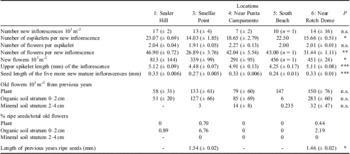
The description of the reproductive structures of Deschampsia antarctica (inflorescences and flower production, sizes of upper spikelet of the inflorescences and seed lengths) is shown in Table I. There were significant differences in the number of flowers from the current year between sites, and plants from Sealer Hill (location 1) had more flowers per m2 than those at the other sites. The size of the upper spikelets and seeds from the current season were significantly (P < 0.001) different between locations. The populations found at South Beaches and Smellie Point showed lower values for both parameters, indicating a somewhat slower development. Seed size from the previous year was estimated at two locations (3 and 6), because at the other locations, it was nil or too small for a statistical analysis. The results indicated that the average length of old seeds from location 3 (Smellie Point) was slightly greater than those from location 6 (Near Rotch Dome) (P < 0.05) (Table I).
Mean (± s.e.) current year's (new) reproductive structure production and development of Deschampsia antarctica old flowers per m2 (estimation of seeds per stratum: remaining in the plant, on the organic stratum and mineral soil stratum at each site, see methods for strata description). The percentage of old ripe seeds formed in relation to the total number of flowers developed during the previous years (old flowers) and average length (± s.e.) of more mature seeds are also shown.

Asterisks indicate the level of significance between the sites: *** P < 0.001, ** P < 0.01, * P ≤ 0.05, n.s. = non significant.
The Colobanthus quitensis plants growing on Sealer Hill (location 1) and at the Devils Point (location 2) had fewer new flowers (= capsules) per m2 than those from near Punta Campamento (location 4) and near Rotch Dome (location 6) (Table II). The number of flowers was higher on plants growing in soils with a higher percentage of gravel (r = 0.356, P = 0.02, n = 13). Sealer Hill soil presented the lowest percentage of gravels (0.96 ± 0.47), while near Punta Campamento and Rotch Dome had 9.42% (± 4.42) and 16.47% (± 6.24), respectively. In this species, the stage of floral development can be inferred by the length of sepals. Using this proxy, it was noticed that the populations from Devils Point showed lower development than those from the other locations. Also, the plants at this location showed a lower development in their capsules and were significantly smaller than those from the other locations. The largest capsules were found on Sealer Hill. The new seeds were very small (mean: 0.18 mm, range: 0.1–0.5 mm, although the larger seeds were empty). Ripe seeds from previous years were larger, reaching 0.64 mm on average (range: 0.6–0.7 mm).
Number of capsules and mean size (± s.e.) of capsules and sepals of Colobanthus quitensis from the current year. Samples collected in 2002.

Asterisks indicate the level of significance between the sites: *** P < 0.001, ** P < 0.01, n.s. = non significant.
Seed bank
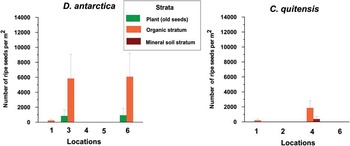
More ripe seeds from previous years were counted in the samples of D. antarctica than of C. quitensis, although it was only representative at two locations (Fig. 3): Smellie Point (location 3) and Near Rotch Dome (location 6). Deschampsia antarctica also produced a high number of incompletely filled seeds at these two locations (8610 and 6177 m-2 at locations 3 and 6, respectively), while at other locations, there was a lower density of incompletely filled seeds (i.e. Sealer Hill: 379 m-2, and Near Punta Campamento: 770 m-2), or nil such as on South Beaches.
Production of previous years’ ripe seeds from Deschampsia antarctica and Colobanthus quitensis at different locations and strata. Samples collected between 30 January and 3 February 2002.

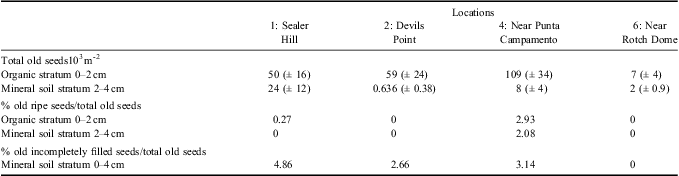
Ripe seed production was low in C. quitensis populations, with ripe seeds at only two sites: Sealer Hill (location 1) and Near Punta Campamento (location 4). At these locations, higher amounts of incompletely filled seeds were also found (3603 and 3704 m-2, respectively), the majority in the 0–2 cm stratum. No ripe seeds were found in the Colobanthus population from Devils Point, but some incompletely filled seeds were present (1529 m-2) (Table III). Seeds from near Rotch Dome showed even lower maturity. The soils studied near Punta Campamento, where the Colobanthus population produced more ripe seeds, had the lowest percentage of fine particles (silt + clay) (r = -0.57, P = 0.02), most probably less favourable to seed maturation, because they are poorly drained and probably moister and colder soils.
Mean (± s.e.) Colobanthus quitensis seeds per m2 (including poorly developed seeds) on the organic stratum (cushion portion developed in the previous seasons on 0–2 cm) and mineral soil stratum (under the cushion on 2 cm of depth) at each site. The percentages of old ripe seeds and incompletely filled seeds per total number of old seeds are also shown.
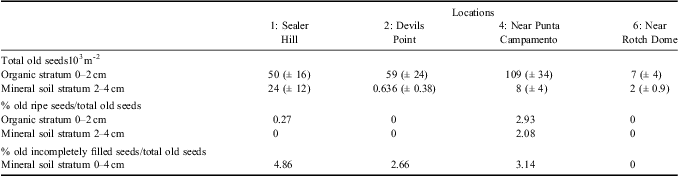
The accumulation of ripe seeds varied between different soil strata (Fig. 3, Tables I & III) including those from the previous year still remaining in the plant. The highest number of ripe seeds was found in the organic stratum (surface to 2 cm depth). Exceptionally, darker ripe seeds of Colobanthus were found in the 2–4 cm stratum, composed of mineral soil mixed with roots, and occasionally with other vegetal remains (Table III). Poorly developed or empty seeds were found in all strata (data not shown). The proportion of previous seasons’ ripe seeds to old flowers in the layers under D. antarctica was low (Table I), reaching the highest value on the surface soil (0–2 cm) and between leaves at Smellie Point, while in other populations, it was lower or nil. Seeds starting to germinate, only with emerged radicle, were found in the 0–2 cm stratum with D. antarctica samples collected at locations 1, 4 and 6 (34, 355 and 1525 m-2, respectively). In the case of C. quitensis, the percentage of ripe seeds from previous seasons in relation to total old seeds was very low: 0.27 at Sealer Hill and 2.93 at Punta Campamento, while none were detected at the other sites (Table III).
Relationship between D. antarctica plant size, flower production and seed development
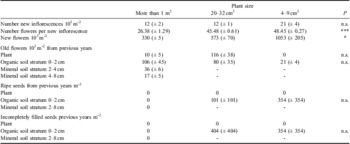
The smaller individuals at the base of Sealer Hill produced a higher amount of inflorescences per surface unit, a significantly higher number of flowers per inflorescence and consistently higher production of new flowers per m2 than those found in larger individuals (Table IV). Only those plants with a diameter larger than 1 m2 (probably aggregates of plants) showed old flowers in deep soil strata (2–8 cm). The previous years’ inflorescences still remaining in the plant did not contain any ripe seed at that location.
Differences in flowers and seed production in relation to size of Deschampsia antarctica plants at the base of Sealer Hill. Mean (± s.e.). The large plants (> 1 m2 could be aggregates of plants).

Asterisks indicate the level of significance between the sites: *** P < 0.001, * P < 0.05, n.s. = non significant.
Plant size and seedlings
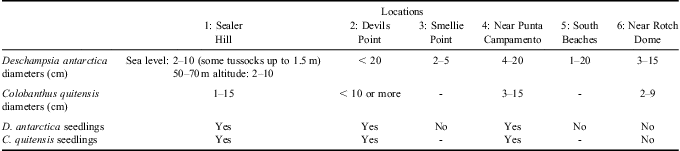
The size of Deschampsia plants was lower at a higher altitude, with a maximum 10 cm diameter in the colonies found at 50–70 m a.s.l. on Sealer Hill (Table V). Only small Deschampsia plants were recorded at other locations, for example, Smellie Point (2–5 cm diameter) and near Rotch Dome (c. 3–4 cm diameter) (Table V). However, at the latter site, some plants reached 15 cm in diameter. The largest plants, formed by a coalescence of several individuals, were discrete mounds of 1.5 m in diameter on Sealer Hill. Seedlings and small plants were noted on or within these large mounds, where older grass had died.
Diameter ranges or maximum size recorded for both species (cm) and presence of seedlings in studied populations.
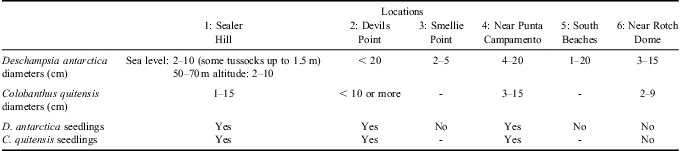
The largest cushions of Colobanthus recorded were 15 cm in diameter at locations 1 and 4, while the population at location 6 (Near Rotch Dome) reached a maximum diameter of only 9 cm (Table V). Seedlings of both species were recorded at 50% of the studied locations (Table V), at the other locations small plants were observed. No seedlings of either species were found near the Rotch Dome glacier, although there were some small plants (about 2 cm in diameter). In the populations studied, the presence of seedlings does not always correlate with the production of ripe seeds. For example, in the case of Deschampsia populations from near Rotch Dome, they produced ripe seeds in previous growing seasons (Fig. 3), but seedlings were not observed in 2002.
Discussion
Distribution
In this study we have produced the first detailed map of the vascular plants on Byers Peninsula (Livingston Island), showing that D. antarctica is much more common than C. quitensis, as has been documented throughout the Maritime Antarctic (Holtom & Greene Reference Holtom and Greene1967, Edwards Reference Edwards1972, Smith Reference Smith1994, Convey et al. Reference Convey, Hopkins, Roberts and Tyler2011, Vera Reference Vera2011). On Byers Peninsula, grass is more abundant on the south and west coasts than at other locations, and C. quitensis is abundant at a few locations on the west and south-west coasts in the studied territory. Lindsay (Reference Lindsay1971) reported differences in vegetation development between the south and north coasts. Our subjective observations indicated that the north coast of the peninsula is dryer than the west and southern coasts. In fact, much of the peninsula slopes towards the south, and most watersheds trend in that direction (Thomson & López-Martínez Reference Thomson and López-Martínez1996). Water availability, along with wind exposure, stability of substrata and nitrogen availability could be considered as the major factors affecting plant growth and distribution in the South Shetland Islands (Lindsay Reference Lindsay1971). This non-homogeneous distribution of plants has also been described in other areas of Livingston Island (Vera Reference Vera2011) and on other islands in the South Shetland Islands (Lindsay Reference Lindsay1971). Throughout the Maritime Antarctic, D. antarctica has a much wider ecological amplitude than C. quitensis (Smith Reference Smith1994, Reference Smith2003). The study by Lindsay (Reference Lindsay1971) reported that both species were quite abundant in gullies with a steep north-facing slope, although Deschampsia was also common in open sites on South Beaches extending for several kilometres. In our study, about 35 years later, Deschampsia could be more widespread. Even small plants were observed in certain inland locations, and in some coastal areas, such as Lair Point, with mounds about 1 m in diameter, where Lindsay described ‘straggling moribund tufts of grass’. However, as precise past locations are unavailable, differences in distribution cannot be confirmed. The more conspicuous presence of D. antarctica on the south coast could be attributed to environmental factors, such as the reduced prevalence of the colder southern winds, higher water availability, or a higher presence of animals that fertilize the area. The presence of mosses and lichens can facilitate the establishment of plants, acting as propagule traps and increasing water retention in their cushions (Lindsay Reference Lindsay1971). Lindsay also indicated that the absence of vascular plants on the north coast may be caused by the absence of these cryptogamic traps. However, at certain sites, the vascular plants occur on mineral soil, and do not coexist with mosses and lichens, becoming primary colonists of mineral soils (Kozeretska et al. Reference Kozeretska, Parnikoza, Mustafa, Tyschenko, Korsun and Convey2010). Studies in the area of the Spanish station (Hurd Peninsula) on Livingston Island, showed that mosses and lichens are abundant where D. antarctica and C. quitensis have been established for a long time, while at sites recently colonized by vascular plants, mainly at higher altitudes, mosses and lichen were scarce or absent (Vera Reference Vera2011).
With increasing time since deglaciation habitats become more stable and pioneer cryptogams and vascular plants increase moisture and improve conditions for the establishment of new plants. The presence of both vascular plants on promontories, although infrequent, may come from the snow cover disappearing earlier in the summer, mainly due to the effect of strong winds, thus providing a longer growing season (Vera Reference Vera2011). On the central plateau, D. antarctica occurred in restricted areas, probably associated with moist places, although its relationship with microclimatic conditions (e.g. temperature) needs to be addressed.
In other areas of Maritime Antarctica birds have been described as important vectors of the plant's dispersal, even over long distances, mainly by transporting pieces and seeds of the grass during nesting activities (Corner Reference Corner1971, Edwards Reference Edwards1972, Parnikoza et al. Reference Parnikoza, Maidanuk and Kozeretska2007, Vera Reference Vera2011, Parnikoza et al. Reference Parnikoza, Dykyy, Ivanets, Kozeretska, Kunakh, Rozok, Ochyra and Convey2012), while C. quitensis might be occasionally dispersed by them (Grobe et al. Reference Grobe, Ruhland and Day1997, Vera Reference Vera2011). The seeds may be also dispersed by the wind, probably being the main dispersion factor for small seeds, such as C. quitensis (Grobe et al. Reference Grobe, Ruhland and Day1997). The strong winds prevailing at Byers Peninsula could disperse seeds over longer distances, even plant fragments of grass (Quesada, personal observation) to locations where they can establish when conditions are favourable, such as lakeshores or moist areas. Colonization by C. quitensis at new sites is typically done with seeds (Edwards Reference Edwards1975), and local dispersal by wind is probably important, especially when seeds are produced in abundance, as suggested by Vera (Reference Vera2011). On Byers Peninsula C. quitensis produces few ripe seeds, and this could be a major reason for the sparse distribution of this plant.
Production and development of reproductive structures
The maturation of the reproductive structures varied between the Deschampsia populations investigated, being more advanced in those from the base of Sealer Hill where milder environmental conditions may occur. Floral development in C. quitensis did not vary much between sites, although morphological flower features such as sepal and capsule length were significantly lower at the Devils Point location (higher altitude) where temperature inside the plant cushion was on average 1°C lower in February 2009 (3.09°C) than at the other sites, such as the base of Sealer Hill during the same period (4.09°C), and the capsules were also more advanced. On Byers Peninsula, the size of capsules at the end of January was smaller than on Hurd Peninsula, near the Spanish station (BAE) at lower latitudes, although it was similar to higher altitudes on Hurd Peninsula (90–147 m) (Vera unpublished data). On Byers, for the populations near Punta Campamento and Rotch Dome, the size of sepals of C. quitensis flowers was similar to that of flowers from Hurd Peninsula, while those from Devils Point were significantly smaller. The most developed inflorescences of D. antarctica (Sealer Hill) from Byers Peninsula were delayed with respect to the same altitude of populations from Hurd Peninsula. Floral development of populations from Byers at the end of January, except the Deschampsia population next to Rotch Dome, was at a similar stage as those populations at higher altitudes on Hurd Peninsula. In C. quitensis the differences between both locations were even more conspicuous (Vera unpublished data). These differences in reproductive structure maturation stages between Byers and Hurd peninsulas may be due to environmental differences. The mean summer air temperature on Byers Peninsula is lower than in the area of the Spanish base Juan Carlos I (Hurd Peninsula) (summer Byers Peninsula 2001–02: 1.5°C, summer BAE 2001–02: 2.4°C (Bañón Reference Bañón2004)). At higher altitudes than on Hurd Peninsula (147 m a.s.l.), mean temperature at the bare ground surface was c. l°C lower than at 20 m a.s.l. (Vera Reference Vera2011).
Some other aspects related to reproductive structures, such as the number of flowers or seeds, or the size of seeds, were also different between populations on Byers and Hurd peninsulas at similar altitudes. The delay in reproductive structure maturation on Byers Peninsula could mean that the seeds from both species may have more difficulty in reaching maturation in one flowering season than in other places, although this needs to be confirmed at the end of the growing season. The reproductive cycle of C. quitensis and D. antarctica, from initiation of flowers to seed production, usually takes more than one year, and only some seeds reach maturation in one single flowering season in those habitats with favourable conditions (Greene & Holtom Reference Greene and Holtom1971, Edwards Reference Edwards1974, Smith Reference Smith2003, Vera unpublished data).
Seed bank
Seed production was quite low on Byers Peninsula, although Deschampsia produced a greater number of ripe seeds than Colobanthus, but at some sites, production was nil for both species. Less than 2% of Colobanthus seeds reached maturity. No ripe seeds were found in Colobanthus plants from the higher altitude location, Devils Point, although the presence of seedlings shows that in the last growing seasons, some ripe seeds might have been produced. The absence of any seeds (both ripe or incompletely filled) or seedlings near the Rotch Dome location indicates a different situation, probably due to different environmental conditions, although the presence of small plants suggest that the production of ripe seed may occur only in certain years. The irregular production of Colobanthus seeds (as in D. antarctica) has been previously documented in Antarctica (Corner Reference Corner1971, Greene & Holtom Reference Greene and Holtom1971, Edwards Reference Edwards1974, Convey Reference Convey1996), with the possibility of maintaining a seed bank (Fowbert & Smith Reference Fowbert and Smith1994). A very small proportion (< 1%) of previous years’ flowers of Deschampsia produced ripe seeds, but this proportion increased (maximum 7%) if the old flowers found in the organic stratum of the soil are included. However, these values could be higher because a portion of seeds may have germinated or degraded (Edwards Reference Edwards1974, Leck et al. Reference Leck, Parker and Simpson1989).
Temperature seems to be an important factor in the development of seeds. Studies on Hurd Peninsula indicated that in warmer habitats (based on micro-climate data), the production of ripe seeds in D. antarctica is higher (Vera Reference Vera2011, Vera unpublished data) and also the number of Colobanthus ripe seeds was much higher than on Byers Peninsula. On Hurd Peninsula, the average of ripe seeds per m2 in the seed bank for D. antarctica and C. quitensis was 4234 and 18 402, respectively (Vera Reference Vera2011).
The seed bank on Byers Peninsula was small and may not be very different from the one estimated some decades ago (1960s) on South Orkney Islands and the South Shetland Islands (Greene & Holtom Reference Greene and Holtom1971, Edwards Reference Edwards1974) or may be similar to the seed banks recently estimated in southernmost locations, such as Anvers Island (McGraw & Day Reference McGraw and Day1997, Ruhland & Day Reference Ruhland and Day2001), or at higher altitudes on Hurd Peninsula, Livingston Island (Vera unpublished data).
Population establishment and plant sizes
The first detailed study on vegetation for Byers Peninsula was obtained during the summer of 1965–66 when Lindsay stayed at the site for 25 days (Lindsay Reference Lindsay1971, Greene & Holtom Reference Greene and Holtom1971). The only data on plant size referred to tufts of D. antarctica at Lair Point, which were smaller than 10 cm in diameter (Greene & Holtom Reference Greene and Holtom1971). However, at the same location in 2002, we found mounds of this species over 1 m in diameter. In 1982, at this same location, aggregates of plants forming coalesced mounds over 1 m across were seen (Smith, personal communication 2012). The presence of extensive stands of D. antarctica on the coast at sites frequented by elephant seals and fur seals (e.g. Lair Point and at the base of Sealer Hill) represents the intense growth of grass at these sites fertilized by nutrients supplied by these animals. Over the last decades, an increase in the abundance and distribution of both vascular plants in response to warming climate has been documented (Smith Reference Smith1994, Reference Smith2003, Convey at al. 2011). On Byers Peninsula, it seems clearer in the grass. In fact, in the 2003–10 period, we have also noticed, in opportunistic observations, the presence of new colonies of Deschampsia in previously examined areas, indicating a clear spreading of this species on Byers Peninsula. Estimating the age of this species in terms of size is inaccurate because, very frequently, several individuals coalesce, forming a tussock. However, the distribution and size structure of their populations allows for an estimate regarding whether D. antarctica populations are new colonizers, or they have been established for a long time (Casaretto et al. Reference Casaretto, Corcuera, Serey and Zuñiga1994).
The size of C. quitensis cushions can be correlated with their age. Edwards (Reference Edwards1975) estimated c. 2–4 mmyr-1 in diameter for this species at Signy Island, South Orkney Islands. Vera (Reference Vera2011) estimated mean growth rates of 3.7 mmyr-1 at low altitudes, and 2.9 mmyr-1 at higher altitudes in Livingston Island. In fact, cushion dimensions have been used to estimate the establishment period in certain Antarctic locations (Fowbert & Smith Reference Fowbert and Smith1994, Grobe et al. Reference Grobe, Ruhland and Day1997, Vera Reference Vera2011). Age estimation for D. antarctica populations is more difficult, because it grows in tussocks.
Considering the known plant expansion of C. quitensis of 3 mmyr-1 in diameter on Livingston Island, we estimated that the cushions growing on a small promontory on the recently deglaciated terrain close (c. 700 m) to Rotch Dome should be about 30 years old. This site was not mentioned by Lindsay, but he reported this species occurring at the eastern extremity of South Beaches and on Clark Nunatak near Rotch Dome in 1965.
Our results showed that for these two species, there is no clear correlation between the presence of seedlings and ripe seeds in the seed bank, indicating that seeds may remain viable for several years (Ruhland & Day Reference Ruhland and Day2001). This is particularly important when plants occur under severe conditions where some biological characteristics (such as sexual reproduction) can be compromised by minor climatic interannual variations (Miller & Cummins Reference Miller and Cummins1987, Smith Reference Smith1994) which have been described for Byers Peninsula (Rochera et al. Reference Rochera, Justel, Fernández-Valiente, Bañón, Rico, Toro, Camacho and Quesada2010). Our study suggests that vascular plant populations possess low capacity for seed production, in the sites studied in the 2001/02 summer. Small differences in environmental conditions appear to affect the development of flowers and seeds, and perhaps also spreading and colonization capabilities.
Acknowledgements
This research was funded by the ECOTER project co-ordinated by Dr Leopoldo G. Sancho (ANT99-0680-C02-01) and by the LIMNOPOLAR projects (REN2000-04235, CGL2005-06549, POL2006-06635). We are very grateful to the members of ECOTER and LIMNOPOLAR expeditions for their co-operation and support. We are very grateful to anonymous reviewers for their revisions and helpful comments. This work could not have been done without the excellent logistical support provided by UTM and the crew of the Spanish Navy ship Las Palmas. The publication of this paper received financial support from the grant CTM2011-12973-E (Ministerio de Ciencia e Innovación, Spain).