INTRODUCTION
The End of Life (EoL) Care Strategy published by the Department of Health (2008) in London highlights that one feature of good EoL care is enabling patients to be able to die in the place they prefer. For the majority of cancer patients, this preferred place of death is their home (Higginson & Sen-Gupta, Reference Higginson and Sen-Gupta2000; Beccaro et al., Reference Beccaro, Costantini and Giorgi Rossi2006; Brazil et al., Reference Brazil, Howell and Bedard2005; Gomes et al. Reference Gomes, Calanzani and Gysels2013). However, in Northern Ireland (NI), only 34% of cancer patients achieve this (Blaney & Gavin, Reference Blaney and Gavin2011) and in England 24.5% (Gao et al., Reference Gao, Ho and Verne2013), in contrast to 45.4% in the Netherlands (Cohen et al., Reference Cohen, Houttekier and Onwuteaka-Philipsen2010). A systematic review identified such patient factors as longer disease duration, solid tumor diagnosis, low functional status, expression of preference for a home death by patient or caregiver, rural residence, being married, living with relatives, having family support, white ethnicity, and good social conditions as positively associated with dying at home (Gomes et al., Reference Gomes and Higginson2006). Compared to those who die in hospital, there is evidence of better psychological and social well-being among cancer patients who die at home (Higginson et al., Reference Higginson, Sarmento and Calanzani2013), and a recent study reported better outcomes in terms of grief and peace for those who die at home (Gomes et al., Reference Gomes, Calanzani and Koffman2015).
The likelihood of achieving one's preference to die at home is complex and far from being understood, as few studies have investigated the many factors involved at the same time. The aim here was to apply a multivariate approach that can estimate the relative strength of association of several factors with achieving a home death and identify possible causal factors that could form the basis for potential interventions to increase terminally ill cancer patients' likelihood of achieving a preferred home death.
METHODS
Survey
A population-based survey of bereaved caregivers of adult cancer patients (aged 18 and over) who died between December of 2011 and May of 2012 was carried out in NI using death registration data. The Demography and Methodology Branch of the Northern Ireland Statistics and Research Agency administered the survey confidentially on behalf of our study team. Those individuals who had registered the death of a person had died of cancer (defined by ICD10 codes C00–D48) during the previous 4–6 months were invited to participate in the survey. The questionnaire, which focused on the patient's final 3 months of life, considered the type and quality of care the patients received (including care provided by informal caregivers, other family members, and friends), the patient's health-related quality of life, palliative outcomes during the last week, the caregiver's perspective on care received, and bereavement. The survey methodology was based on the QUALYCARE survey undertaken in London in 2009–2010 (Gomes et al., Reference Gomes, McCrone and Hall2010; Reference Gomes, Calanzani and Koffman2015). The following tools, with adaptations, were also included: the Client Service Receipt Inventory (McCrone, Reference McCrone2009), the Palliative Outcome Scale (Hearn & Higginson, Reference Hearn and Higginson1999), and the EuroQoL EQ5D (Xia et al., Reference Xia, Hwang and Chang2005).
Research Question and Study Population
The study explored potential independent variables associated with a patient receiving care at home being able to achieve their preference to die at home. The inclusion criteria were: (1) the patient expressed a preference to die at home, and (2) they had spent some time at home during the last 3 months of life. The binary outcome variable was “died at home” (0/1). The potential independent variables were either drawn directly or derived from one or more variables, from the questionnaire. As the study tested clearly defined measures, only components of the scoring tools were employed. The variables were categorized into the following domains:
1. patient demographics (sex, age, marital status, deprivation, religion)
2. patient's mental well-being
3. patient's physical well-being
4. patient's symptom severity
5. how well patient was informed about their treatment and place of death
6. [perceived] quality of nonmedical care provided at home
7. quality of medical care provided at home
8. quality of medical care provided outside the home
9. caregiver factors (e.g., relationship with the patient, preferred place of death)
The responses related to the independent variables were simplified into binary variables (yes or no). All independent variables examined are listed in Supplementary Table I (see SUPPLEMENTARY MATERIALS for all Supplementary Tables). A “not applicable” category was applied where appropriate.
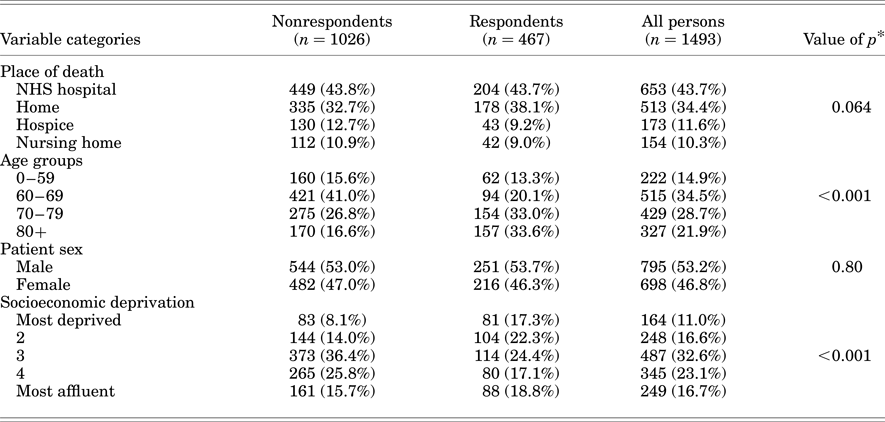
Comparison between respondents and nonrespondents' distribution of place of death and demographic characteristics

* The value of p is the probability that the distributions of respondents and nonrespondents are the same (i.e., the null hypothesis). Given that the chi-square statistic assumes independence, the null hypothesis is conventionally rejected when p < 0.05.
Statistical Analysis
The outcome variable “died at home” was related to the independent variables using logistic regression. To address nonresponse bias, each record in the analysis was weighted by its inverse probability of participation in the study after invitation. This probability was estimated by relating, through logistic regression, the patient's participation (0/1) to their sex, age, socioeconomic deprivation, and place of death.
The reference level of independent variables was set in such a way to output the odds ratio association of interest (e.g., yes or no). A nuisance parameter was used for the category “not applicable” or “unknown” to remove the influence of these patients' from the association of interest. The model independent variables consisted of a base set of the demographic variables (domain 1, Supplementary Table I), to which was added, singly, the variables across domains 2–9 (Supplementary Table I). The retained variables (with a coefficient significant at p < 0.05) formed, together with the domain 1 variables, an updated base set that was subject to a further round of a single addition of variables through domains 2–9. The final list of variables for inclusion in the model is presented in Table 2. Pairs of these variables were selected considering effect sizes or a priori hypotheses, and they were tested for interaction along with the base set. Multivariate imputation (MI), using chained equations, was employed to handle missing values when fitting the final model. The variables in the base set (Table 2), which include the demographic variables, were used as the predictor equations for MI, and 10 sets of imputed datasets were combined to estimate effects and standard errors. The analysis was carried out using Stata (v. 12; College Station, Texas).
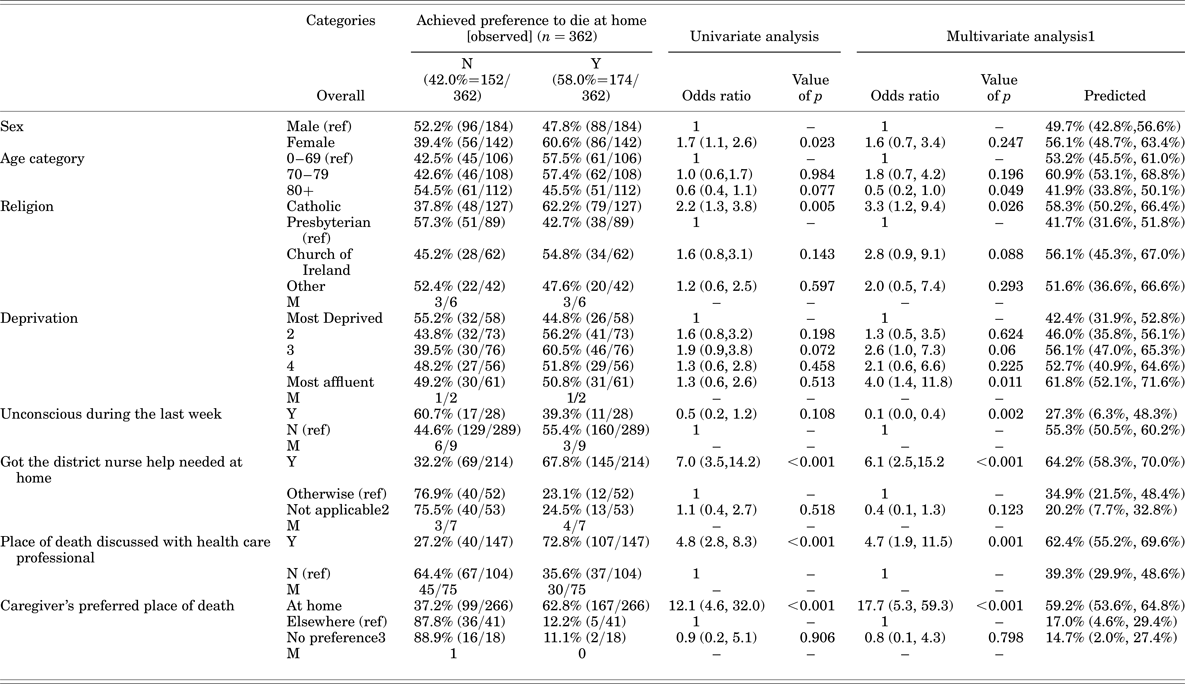
The association between a patient's desire to die at home and various explanatory factors explored through both univariate and multivariable analysis

1 The multivariate analysis comprises all of the variables reported in this table. Multiple imputation was employed to deal with the missing (M) values. In addition, each record was weighted by its probability of being sampled based on the variables in Table 1 for responders and nonresponders.
2 Seven patients did not want help, and help was not needed for the remainder (n = 40).
RESULTS
Of the 1,493 caregivers invited to participate in the study, 467 (31.3%) responded. The percentage of patients aged 60–69 was lower in the response group than in the nonresponse group (20.1 vs. 41.0%, p < 0.001, Table 1). Among the response group, a greater proportion of patients (1) were from the “most-deprived” socioeconomic quintile (17.3 vs. 8.1%, p < 0.05) and (2) died at home (38.1 vs. 32.7%, p < 0.05) than from the nonresponse group. There was no difference in terms of patient sex between the response and nonresponse groups (p = 0.80) (Table 2).
The preference for place of death of the 467 patients was distributed as follows: home 349 (74.7%), hospice 28, hospital 16, nursing home 8, elsewhere 1, no preference 23, and caregiver did not know 42. Of those who preferred to die at home, 326 patients (69.8% of 467) spent some time at home and were included in the study. Of these, 53.4% achieved their preference for a home death, and 99.0% of their caregivers were relatives.
The final model, resulting from a forward-selection approach, is presented in Table 2. The odds ratios derived from the multivariate analysis were sufficiently different from the univariate analysis to justify the former (particularly for deprivation). The factors that were positively associated with a patient's achieving their preference to die at home were: (1) living in an affluent area (least deprived/most deprived: odds ratio [OR] = 4.0, 95% confidence interval [CI 95%] = 1.4–11.8); receiving satisfactory care at home from a district nurse, yes/no: OR = 6.1, CI 95% = 2.5–15.2]); discussing place of death with a healthcare professional, yes/no: OR = 4.7, CI 95% = 1.9–11.5); and the caregiver's preference for place of death, home/elsewhere: OR = 17.7, CI 95% = 5.3–59.3). The factors inversely associated with achieving one's desire to die at home were age (over 80 years/under 70: OR = 0.5, CI 95% = 0.2–1.0); being unconscious most of the time during their final week (yes/no: OR = 0.1, CI 95% = 0.0–0.4); and being a Presbyterian (Presbyterian/Catholic: OR = 0.30, CI 95% = 0.11–0.87).
In the final model, McFadden's coefficient of determination (R 2) (McFadden, Reference McFadden and Zarembka1974) for logistic regression was 46%, and Tjur's (Reference Tjur2009) R 2 was 50%. The Hosmer–Lemeshow goodness of fit test had a p value ≥ 0.25 when the number of groups employed varied from 4 to 12. The likelihood-ratio test's p value was >0.05 when testing for interactions within the model.
DISCUSSION
This is one of very few national population-based studies that has explored the patient, service, and clinical factors associated with achieving the preferred place of death at home for terminally ill cancer patients (Weitzen et al., Reference Weitzen, Teno and Fennell2003; Cohen et al., Reference Cohen, Houttekier and Onwuteaka-Philipsen2010). Younger patients and those from more affluent areas had a greater likelihood of dying at home, as did those patients whose caregiver's preference was for a home death. Discussion with a health professional about place of death and good levels of satisfaction with the district nurse services also increased the likelihood of achieving a home death. It is important to note that a greater proportion of patients in the response group were from the “most-deprived” socioeconomic quintile than in the nonresponse group. This is in contrast to the findings of a previous mortality followback study of similar design (Gomes et al., Reference Gomes, Calanzani and Koffman2015) that included a quarter (25.3%) of respondents from the least-deprived quintile, which may have an impact on the interpretation and representativeness of the findings.
It was encouraging that overall care was described as “good or excellent” for the majority of patients across the different care settings (Supplementary Table I), suggesting a high standard of end-of-life care in a region of the United Kingdom. However, further qualitative work should be undertaken to investigate reported causes of dissatisfaction with care with a view to identifying the improvements needed in palliative and end-of-life cancer care.
There was little evidence of an association between satisfaction with care and achieving a home death. However, those who felt they did not get the district nurse help that they needed had significantly lower odds of achieving a home death. This perhaps reflected the extensive duties that district nurses perform—spanning medical, hospice, and social support—and is consistent with the conclusions from a review of the factors associated with the congruence between preferred and actual death (Bell et al., Reference Bell, Somogyi-Zalud and Masaki2010). While it is also possible that those dissatisfied with district nursing care had care needs that were more difficult to manage in a home setting, this was not apparent from the data collected in that study.
The importance of specific communication about achieving preferred place of death is evidenced with the strong independent association between “discussion of place of death with a health professional” and achieving a home death. As other direct patient care factors were not so associated, it is likely that communication is more than a proxy for patient care. This may have been mediated through both patients and caregivers aligning preferences with care needs as well as a healthcare response to meet the preferences of patients and their caregivers (Bell et al. Reference Bell, Somogyi-Zalud and Masaki2010). These findings reinforce the importance of clinician discussions about place of death reported in previous studies. This information should be recorded in the patient's clinical record to allow for routine audit and monitoring. This has previously been highlighted as a component of best practices in community palliative care in the NICE guidelines on end-of-life care (National Institute of Clinical Excellence, 2004) and has been reported in several research studies (Parker et al., Reference Parker, Clayton and Hancock2007; Clayton et al., Reference Clayton, Butow and Arnold2005). The extent to which this is applied is unclear.
In addition to communication, the role of family and caregiver support has been highlighted as very important in achieving the preferred place of death. In particular, the caregiver's preference for the place of the patient's death 3 months prior to diagnosis was strongly associated with achievement of preferred place of death. This is consistent with a previous Japanese study (Ishikawa et al., Reference Ishikawa, Fukui and Saito2013) which reported that family preference for place of death is a mediator between patient preference and actual place of death and reflects the important role of caregiver support in end-of-life care in a home setting.
Family support may also explain the lower odds of Presbyterians achieving a home death compared to members of the Church of Ireland and Catholic denominations. Previous studies have reported smaller family size among Presbyterians compared to Catholics and other denominations (Compton et al., Reference Compton, Coward and Wilson-Davis1985). This is supported by the fact that the Catholic respondents in our study were more likely to report that family members looked after the patient (57%) than did Presbyterian (38%) and Church of Ireland (30%) respondents (p < 0.01). However, other cultural and social factors may also play a role in explaining this relationship. Future studies ought to include religion and ethnicity as demographic characteristics that may influence achievement of preferred place of death.
Despite the wide array of data collected on care and quality of life, the underlying drivers of the association between achieving a home death and such demographic characteristics as younger age and residing in more affluent areas remain unclear. Though it is likely that these associations were mediated through social support, advocacy, and communication, it is also possible that the pattern is explained by a greater burden of comorbid disease in these populations, which may be manifested in more complex care needs of patients as well as limitations on caregiver capabilities.
STRENGTHS AND WEAKNESSES OF THE STUDY
Few population-based studies have been undertaken to report the end-of-life care experiences of cancer patients, and little is understood about their care needs and satisfaction with care. The overall response rate was 31%. While a low response rate was expected, given the sensitive subject matter and the target population surveyed, such response rates leave room for bias (Calanzani et al., Reference Calanzani, Higginson and Koffman2016; Gomes et al. Reference Gomes, Calanzani and Gysels2013). Comparing profiles of respondents to nonrespondents, a greater proportion of nonresponses were in the patient age group of 60–69, perhaps reflecting a greater number of spouse caregivers who found participation difficult. In addition, responses were higher in patients living in lower socioeconomic areas. Inverse weighting by response probability was applied to compensate for observed profile differences. In addition, multivariate analysis and multiple imputation of missing values were employed to reduce bias in estimation of population effect sizes. The multivariable modeling approach succeeded in isolating a small number of variables with significant associations.
Another important issue for consideration was the fact that patient preference for place of death was not canvassed directly, and therefore its measurement is open to misclassification. However, 19% of caregivers did not concur with the patient's preference for a home death, which broadly agrees, and sometimes more strongly, with other studies (Bell et al., Reference Bell, Somogyi-Zalud and Masaki2010; Gomes et al., Reference Gomes, Calanzani and Koffman2015), and this suggests, at least, that caregivers were discriminating between their and the patient's preference. Even so, as patient preferences are shaped by a complex of issues (Tang, Reference Tang2003), each of which may change during their illness, future studies might consider a prospective assessment of patients' preferences at variable timepoints.
CONCLUSIONS
Several factors have been identified as associated with achieving the preferred place of death at home. Interventions must target groups at high risk of not achieving their preferences, including the oldest patients and those from more economically deprived communities. It is evident that the rapidly changing health and care requirements during the last weeks of life mean that these preferences may change and may not always be achieved. However, for many, undesirable hospital deaths can be avoided with clear communication about preferences involving patients, caregivers, and healthcare workers. Achievement of a home death has the potential to improve the psychological aspects of dying for patients and their families.
ACKNOWLEDGMENTS
The authors thank Professor Irene Higginson and her research team at the Cicely Saunders Institute for the use of the instruments from the QUALYCARE study (funded by Cicely Saunders International). Our study was funded by Cancer Focus NI and was carried out by the Northern Ireland Cancer Registry, which is funded by the Public Health Agency. We also thank the Northern Ireland Statistics and Research Agency for their facilitation of the survey methodology. Ethical approval was granted by the Office of Research Ethics Committees of Northern Ireland.
SUPPLEMENTARY MATERIALS
To view supplementary materials for this article, please visit https://doi.org/10.1017/S1478951517000876.