Most wood in the ocean is quickly colonized and consumed by many types of animals and microbes. Wood falls in the deep sea have been well studied and include a diverse macrofaunal assemblage, including over 40 species of Xylophagainae bivalves and many species of crustaceans, polychaetes and even anemones (Turner Reference Turner2002, Bernardino et al. Reference Bernardino, Smith, Baco, Altamira and Sumida2010). Two pieces of wood were recovered from the sea floor at McMurdo Station, Antarctica in November 2010, having lain there for c. 50 years with no obvious deterioration. Archaeologists usually study ancient wood from anaerobic conditions, but these samples are from highly oxygenated waters. There are many parallels between the benthos of McMurdo Sound and that of the deep sea (Dayton & Oliver Reference Dayton and Oliver1977), and therefore a comparison with the deep sea is of interest.
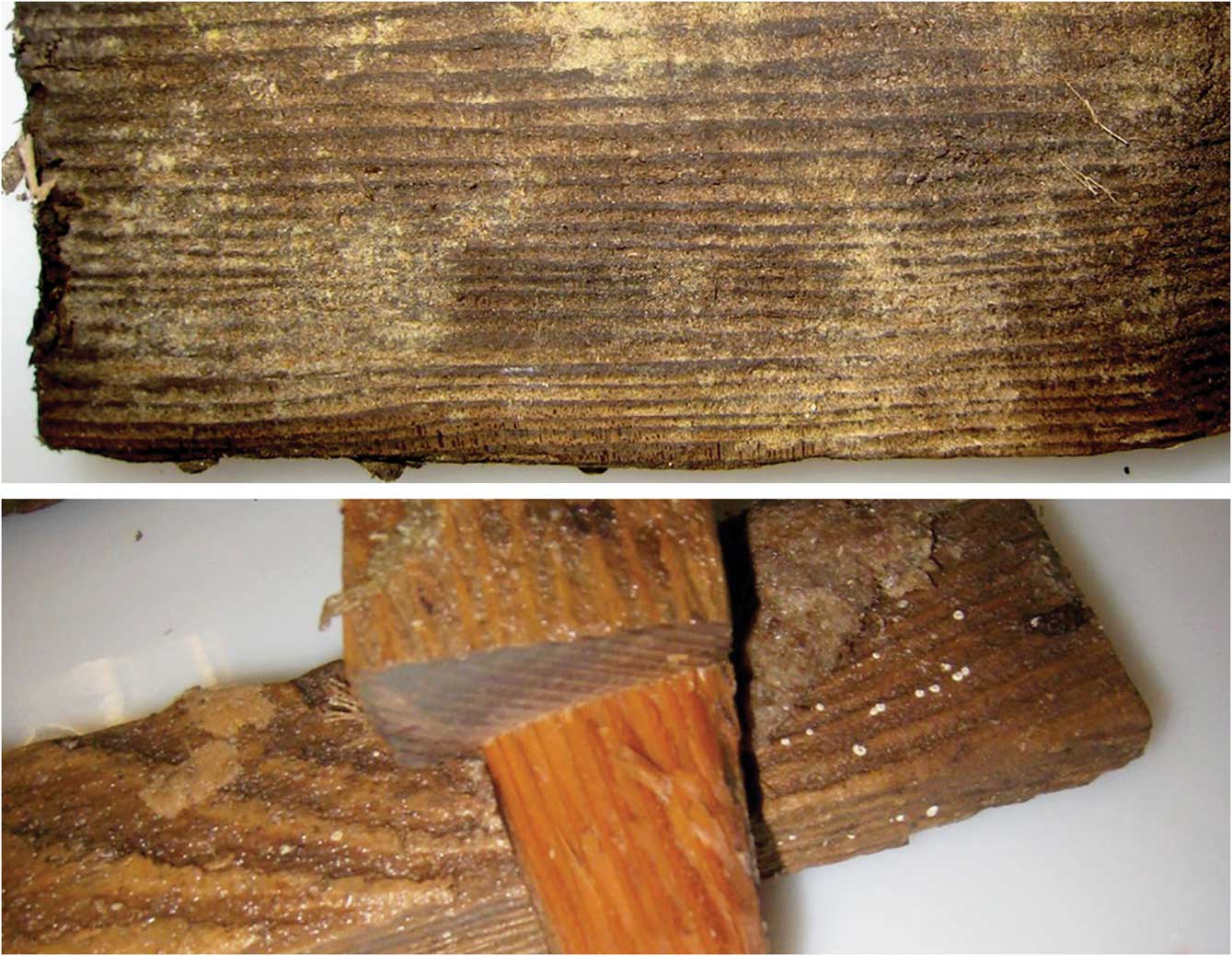
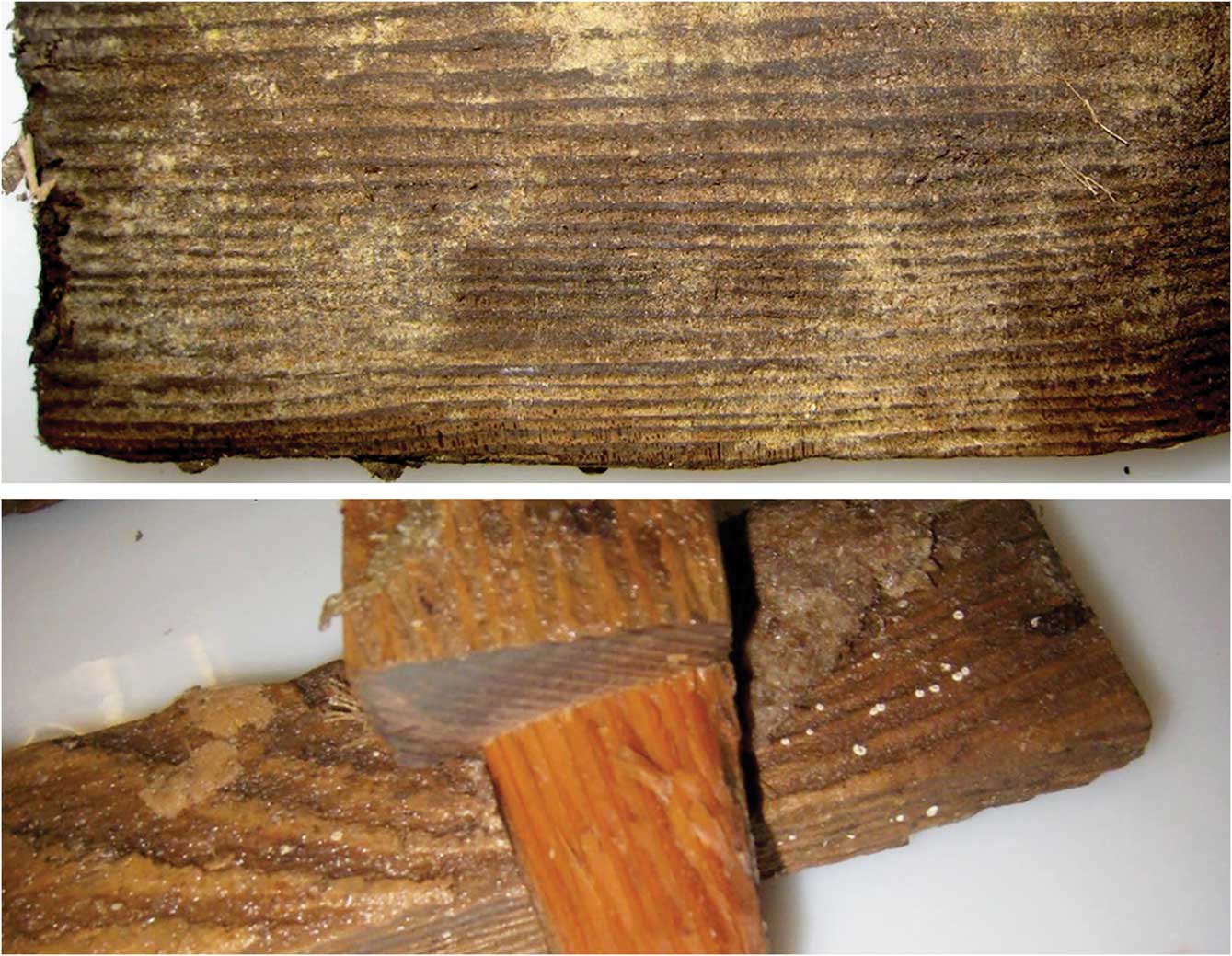
The oldest sample is from a wooden gangplank from an oil tanker that had supplied fuel for the construction of McMurdo Station during the International Geophysical Year in the late 1950s. The gangplank fell into the sea and sank to a depth of c. 25 m before 1960. It was found in 1967, and the biota that grew on the surface over the decades was monitored (Dayton et al. Reference Dayton, Jarrell, Kim, Thrush, Hammerstrom, Slattery and Parnell2016). There were patterns of heavy sponge settlement in the 1970s, which were removed by anchor ice in the 1980s, and some large sponges settled in the late 1990s. The other piece of wood was construction waste scavenged in 1974 to support settlement plates. Both pieces of wood were collected in late 2010. Unlike the gangplank (Fig. 1, top), the construction waste appeared new when it went into the sea and it still looked new in 2010, and when cut it still had the smell of fresh wood (Fig 1, bottom). There was never any indication of wood-boring macrofaunal decomposers of any sort, nor any obvious microbial activity.
(Top) Sample of the gangplank that had been in the water at McMurdo Sound for over 50 years, and (bottom) sample of wood that had been in the water 36 years.
The lack of decomposition over c. 50 years is interesting because cellulose, the most abundant component of plant material, must be degraded by fungi and bacteria (Palacios et al. Reference Palacios, Zbinden, Baco, Treude, Smith, Gaill, Lebaron and Boetius2006). Glover et al. (Reference Glover, Wikklund, Taboada, Avila, Cristobo, Smith, Kemp, Jamieson and Dahlgren2013) report well-preserved wood associated with a 14-month experiment deployed to 568 and 650 m near Deception Island off the Antarctic Peninsula. They suggest that the preservation reflects the lack of wood-boring Teredo or Xylophaga molluscs in the Antarctic resulting from both the wood and the barrier to dispersal posed by the Circum-Antarctic Current. However, preservation of wood occurs in the Arctic as well, as evidenced by the recent discovery of the Erebus and Terror ships in shallow, well-oxygenated waters. The Arctic Ocean has abundant wood from several large river systems, including the Mackenzie, Yukon, Ob, Yenisey and Lena rivers, and driftwood is common. In addition, there is ample opportunity for dispersal into the Arctic Ocean, so the explanations for the preservation of wood in the Antarctic are not relevant to the Arctic, yet wood persists there as well. For some reason, polar waters seem to lack the many species of wood-boring metazoan animals that in turn depend on symbiotic microbes. The temperatures are not much lower than those found in the deep sea, but the small differences may be sufficient to inhibit the microbiota, or there may be some other aspect of polar seas that restricts microbiota.
The recovered wood is available in the Scripps Institution of Oceanography collections for study. In addition, the authors welcome efforts to collect fresh material, and offer their help to interested parties.
Acknowledgements
The authors wish to thank Drs Charles Amsler, Craig McClain and Craig Smith for helpful comments and insights. Funding was provided by the National Science Foundation over multiple grants.
Author contributions
PKD conceived the paper; PKD, GAR, JSO, SK, KH, KC, JF, JB and SJ executed the research and interpreted the findings; PKD and SJ contributed photographs and observations; PKD and KH wrote the paper.