BACKGROUND
Clostridium difficile (C. difficile) infection (CDI) is a major public health threat in the healthcare setting, and it is associated with considerable morbidity, mortality, and economic costs.Reference Redelings, Sorvillo and Mascola 1 – Reference Gabriel and Beriot-Mathiot 6 Reporting of CDIs has been mandatory in England’s National Health Service since 2004, and C. difficile is considered 1 of the 3 most urgent pathogen threats by the Centers for Disease Control and Prevention in the United States. 7 , 8 Beginning in 2017, CDI rates will be included among the hospital-acquired complications used by the Centers for Medicare and Medicaid to penalize the lowest-performing hospitals. 9
Control of CDI is especially challenging given multiple sources of transmission and its complex, poorly understood pathogenesis and set of risk factors.Reference Hedge, Strain, Heins and Farver 10 Clostridium difficile has large reservoirs in the environment, including asymptomatic carriers that may account for more than half of disease transmission.Reference Eyre, Cule and Wilson 11 , Reference Walker, Eyre and Wyllie 12 Its spores can persist on hard surfaces for up to 5 months, further complicating disease eradication.Reference Kramer and Kampf 13
Bundled interventions targeting catheter-associated urinary tract infections (CAUTIs) and central-line–associated bloodstream infections (CLABSIs) have been successful in reducing the rates of these device-associated HAIs. Seeking to continue this trend, hospitals have implemented targeted C. difficile intervention bundles. Unlike CAUTI and CLABSI, however, the evidence for these bundles is far less robust. Few randomized clinical trials have examined interventions to reduce CDI incidence, and those that have all focused on single interventions, such as patient hand hygiene,Reference Kundrapu, Venkata, Jury, Deshpande and Donskey 14 disposable equipment,Reference Jernigan, Siegman-Igra, Guerrant and Farr 15 daily chlorhexidine bathing,Reference Noto, Domenico and Byrne 16 or environmental disinfection,Reference Kundraphu, Sunkelsula, Jury, Sitzlar and Donskey 17 , Reference Barbut, Menuet, Verachten and Girou 18 rather than an intervention bundle.
Bundled interventions require a high degree of compliance to be effective,Reference Furuya, Dick, Perencevich, Pogorzelska, Goldmann and Stone 19 and adherence with complex bundle components may be challenging and variable across settings. Given the lack of direct evidence for CDI bundle adherence and intervention outcomes, we undertook a systematic review to examine common bundle components, to evaluate component adherence and study replicability, and to assess the effectiveness of bundles on reducing hospital CDI rates.
METHODS
For the purposes of this review, a bundle was defined as any set of multiple (>1) interventions focused on reducing CDI in the inpatient setting.
Search Strategies
We conducted a comprehensive search of 4 databases: the Cochrane Central Register of Controlled Trials, PubMed, Web of Science, and the Cumulative Index to Nursing and Allied Health. We sought to capture articles and abstracts published between each database’s date of inception and May 28, 2015. Thus, the search start date was different for each database. Another search was run closer to publication to include articles available through April 30, 2016. The search strategy was designed and conducted by an experienced librarian with input from the study team. The following keywords were used to search for bundled interventions aimed at reducing C. difficile infections: (c difficile OR c. difficile OR clostridium difficile OR “c diff” OR “c. diff”) AND (“infection control” OR bundle OR bundled OR bundles OR “multiple control” OR “multiple controls” OR “control package” OR “control packages” OR “integrated control” OR “integrated controls” OR multipronged OR multi-pronged). We followed the Preferred Reporting Items for Systematic Reviews and Meta-analyses statement guidelines in conducting this systematic review.Reference Moher, Liberati, Tetzlaff and Altman 20 The protocol was registered at PROSPERO, an international prospective register of systematic reviews (no. 2015:CRD42015023252).
All abstracts retrieved using this search strategy were screened, and potentially relevant articles were identified for a full text review. Bibliographies were manually inspected to identify relevant studies not previously identified by our database search.
Inclusion/Exclusion Criteria
We included all inpatient studies that examined the effectiveness of a CDI-specific intervention bundle and provided data on the rates of CDI before and after intervention implementation. Single intervention studies (studies without bundles) and studies that did not provide data to evaluate effectiveness were excluded, as were abstracts, review articles, and editorials. There were no language restrictions.
Data Abstraction
The primary outcome of this review was the mean difference in the rates of hospital-acquired CDI. Rates were measured at the hospital level in units defined by each article. For every study, we abstracted the following: the interventions included in each bundle; C. difficile case definition; infection rates before and after intervention implementation; C. difficile outbreak status; hospital setting; study population; study design; and intervention adherence rates.
All studies were abstracted and screened independently by 2 reviewers (A.B. and C.N.). For disagreements regarding article inclusion, resolution was reached by discussion between the 2 reviewers.
Assessing Bundle Effectiveness and Adherence
We assessed the effectiveness of the bundles by extracting the reported point estimates and calculating the difference in infection rates before and after intervention implementation. Bundled interventions were categorized into 10 primary components: antibiotic stewardship, contact precautions, dedicated equipment, staff education, patient education, environmental cleaning, hand hygiene, isolation and/or cohorting, proton-pump inhibitor stewardship, and systems and workflow changes.
Adherence has been previously defined as the extent to which specified program components are delivered as outlined in a program manual.Reference Dane and Schneider 21 We evaluated adherence by identifying and quantifying the number of adherence measures within a given component of the CDI prevention bundle. A study was considered to have assessed adherence if it reported a method of measuring compliance for 1 or more bundle elements, such as direct observation or tracking glove use.
TiDier Checklist
We assessed the replicability of each study included in the final analysis using the Template for Intervention Description and Replication (TiDier) checklist.Reference Hoffmann, Glasziou and Boutron 22 This tool consists of 12 dichotomous items that assess the description of an intervention and evaluate its replicability. The score reflects the number of items that a given intervention addressed, with higher scores indicating better replicability. The maximum score was 12.
Bias Assessment
To assess the quality and risk of bias for each study, we used a modified version of the Checklist for Measuring Quality instrument developed by Downs and Black.Reference Downs and Black 23 , Reference O’Connor, Tully, Ryan, Bradley, Baxter and McDonough 24 This tool contains 27 dichotomous items regarding reporting, external validity, bias, confounding, and power. The maximum possible score of the modified instrument is 28, and the assessment of power was modified from a 0–5 scale to 0–1.
RESULTS
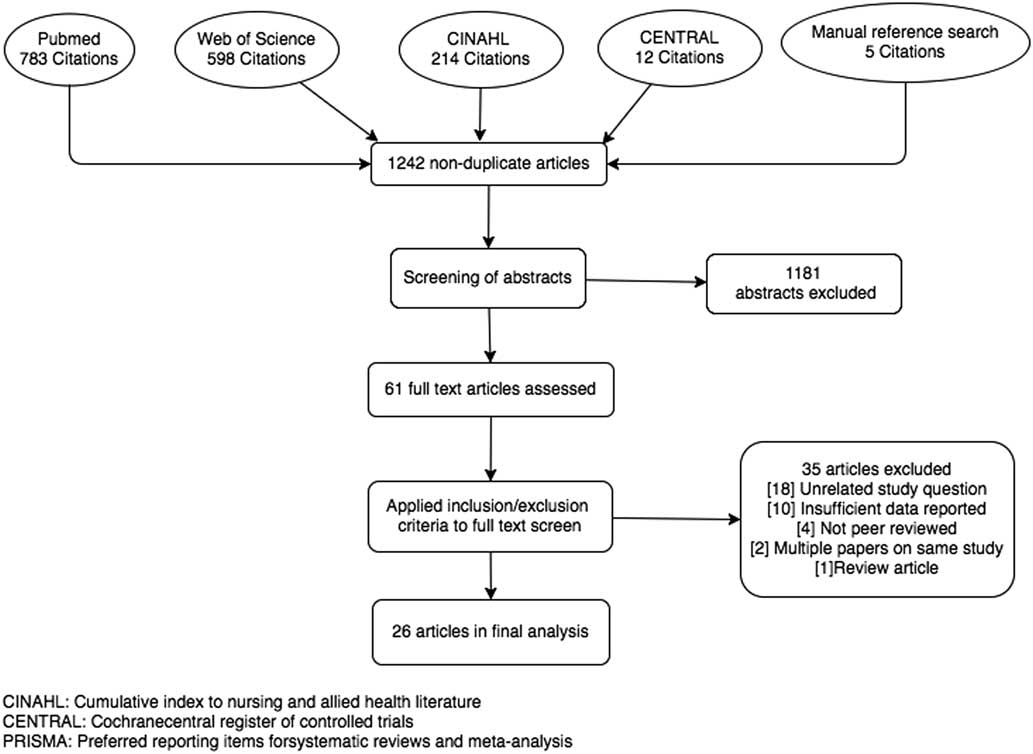
Our search strategy identified 1,242 distinct articles, of which 1,181 were excluded based on abstract information. The remaining 61 full-text articles were reviewed, and 26 met inclusion criteria. This process is summarized in the PRISMA flow diagram (Figure 1).
PRISMA flow diagram for CDI prevention bundle systematic review; CENTRAL: Cochrane central register of controlled trials; CINAHL: Cumulative index to nursing and allied health literature

Characteristics of Included Studies
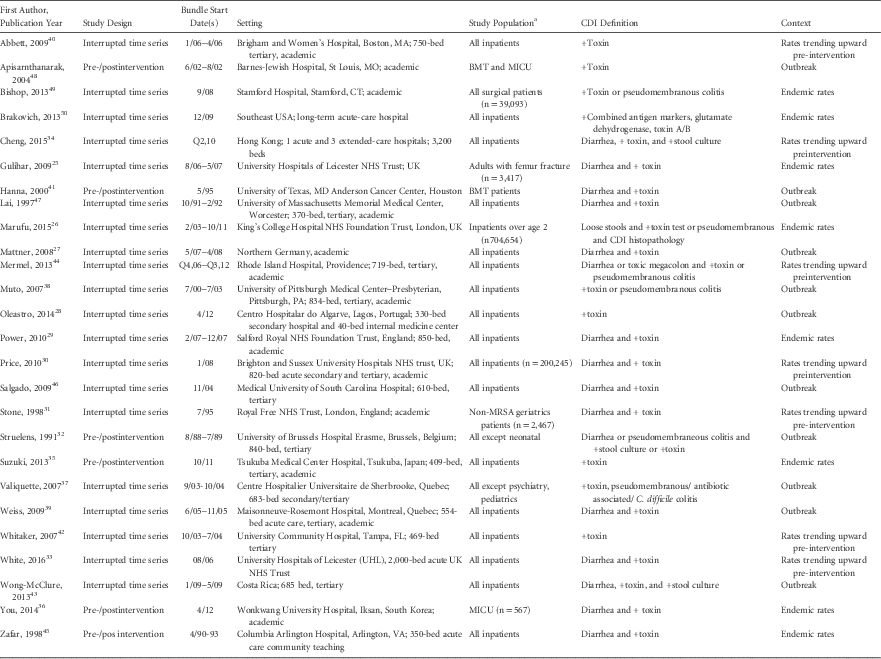
While details of the case definitions for CDI differ between studies, they were generally consistent. Most required clinical symptoms and a positive C. difficile test. A comprehensive description of the studies is listed in Table 1. The study locations varied, including 9 in Europe,Reference Gulihar, Nixon, Jenkins and Taylor 25 – Reference White, Wiselka and Bell 33 3 in Asia,Reference Cheng, Chau and So 34 – Reference You, Song, Cho and Lee 36 and 14 in North America.Reference Valiquette, Cossette, Garant, Diab and Pepin 37 – Reference Brakovich, Bonham and van Brackle 50 Most studies examined all hospital wards (17 of 26; 65%). Others analyzed specific wards or patient populations only: bone marrow transplant,Reference Hanna, Raad and Gonzalez 41 , Reference Apisarnthanarak, Zack and Mayfield 48 medical intensive care unit,Reference You, Song, Cho and Lee 36 , Reference Apisarnthanarak, Zack and Mayfield 48 geriatric ward,Reference Stone, Beric, Quick, Balestrini and Kibbler 31 surgical inpatients,Reference Bishop, Parry and Hall 49 all units except psychiatry and pediatrics,Reference Valiquette, Cossette, Garant, Diab and Pepin 37 all units except neonatal,Reference Struelens, Maas and Nonhoff 32 hip-fracture patients,Reference Gulihar, Nixon, Jenkins and Taylor 25 and patients over 2 years of age.Reference Marufu, Desai, Aldred, Brown and Eltringham 26
Study Characteristics

a The total sample size is reported for all studies that provided this information.
NOTE. BMT, bone marrow transplant; C. difficile, Clostridium difficile; CDI, C. difficile infection; MRSA, methicillin-resistant Staphylococcus aureus; MICU, medical intensive care unit; NHS, National Health System.
Our literature search did not identify any randomized controlled trials. Among the included studies, 20 were interrupted time seriesReference Gulihar, Nixon, Jenkins and Taylor 25 – Reference Stone, Beric, Quick, Balestrini and Kibbler 31 , Reference White, Wiselka and Bell 33 , Reference Cheng, Chau and So 34 , Reference Valiquette, Cossette, Garant, Diab and Pepin 37 – Reference Abbett, Yokoe and Lipsitz 40 , Reference Whitaker, Brown, Vidal and Calcaterra 42 – Reference Mermel, Jefferson and Blanchard 44 , Reference Salgado, Mauldin, Fogle and Bosso 46 , Reference Lai, Melvin, Menard, Kotilainen and Baker 47 , Reference Bishop, Parry and Hall 49 , Reference Brakovich, Bonham and van Brackle 50 and 6 were quasi-experimental pre-/postintervention studies.Reference Struelens, Maas and Nonhoff 32 , Reference Suzuki, Senda and Yamashita 35 , Reference You, Song, Cho and Lee 36 , Reference Hanna, Raad and Gonzalez 41 , Reference Zafar, Gaydos, Furlong, Nguyen and Mennonna 45 , Reference Apisarnthanarak, Zack and Mayfield 48 In total, 11 studies were conducted in the midst of a C. difficile outbreak;Reference Mattner, Winterfeld, Oswald and Solbach 27 , Reference Oleastro, Coelho and Giao 28 , Reference Struelens, Maas and Nonhoff 32 , Reference Valiquette, Cossette, Garant, Diab and Pepin 37 – Reference Weiss, Boisvet and Chagnon 39 , Reference Hanna, Raad and Gonzalez 41 , Reference Wong-McClure, Ramirez-Salas and Mora-Brenes 43 , Reference Salgado, Mauldin, Fogle and Bosso 46 – Reference Apisarnthanarak, Zack and Mayfield 48 8 studies were quality improvement projects to reduce endemic rates;Reference Gulihar, Nixon, Jenkins and Taylor 25 , Reference Marufu, Desai, Aldred, Brown and Eltringham 26 , Reference Power, Wigglesworth, Donaldson, Chadwick, Gillibrand and Goldmann 29 , Reference Suzuki, Senda and Yamashita 35 , Reference You, Song, Cho and Lee 36 , Reference Zafar, Gaydos, Furlong, Nguyen and Mennonna 45 , Reference Bishop, Parry and Hall 49 , Reference Brakovich, Bonham and van Brackle 50 and 7 studies were conducted in the context of upwardly trending CDI rates.Reference Price, Cheek and Lippett 30 , Reference Stone, Beric, Quick, Balestrini and Kibbler 31 , Reference White, Wiselka and Bell 33 , Reference Cheng, Chau and So 34 , Reference Abbett, Yokoe and Lipsitz 40 , Reference Whitaker, Brown, Vidal and Calcaterra 42 , Reference Mermel, Jefferson and Blanchard 44
Intervention Bundles Components
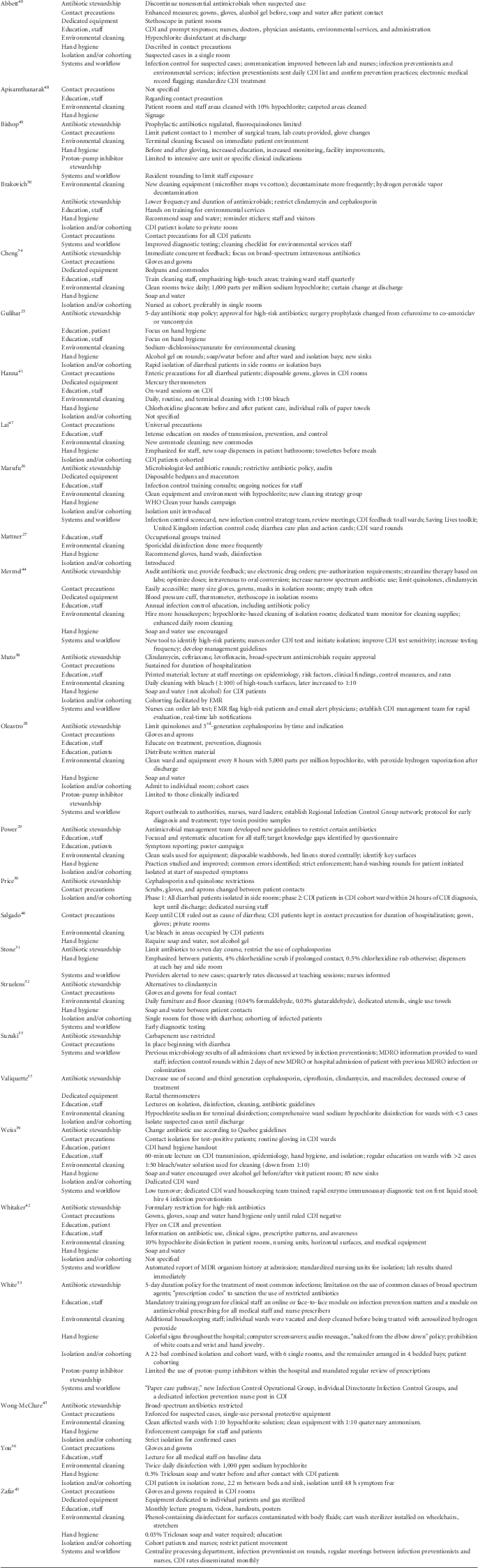
The types of interventions implemented as part of a CDI bundle varied widely across studies (Table 2). Among the 10 bundle components, hand-hygiene and environmental cleaning components were the most common interventions employed. Both were included in 23 of 26 studies (88.5%). These were followed by isolation and/or cohorting (20 of 26, 77%). Contact precautions, antibiotic stewardship, and staff education were each included in 19 of 26 studies (73%). System and workflow changes were reported in 14 of 16 studies (54%), dedicated equipment was reported in 7 of 26 studies (27%), patient education was reported in 5 of 26 studies (19%), and proton-pump inhibitor stewardship was reported in 3 of 26 studies (12%).
Intervention Details

NOTE. CDI, Clostridium difficile infection; MDRO, multidrug-resistant organism.
Within each category, the interventions were multifaceted. Hand-hygiene measures included sink installation, improving signage, and education initiatives. Hand hygiene referred to a variety of practices across studies, including increased use of pure alcohol-based hand rubs, soap and water, and chlorhexidine scrubs.
Environmental cleaning interventions included a diverse range of practices and agents. Some focused on increasing cleaning frequency, including enhanced daily decontamination, cleaning at discharge, and environmental cleaning for patients meeting symptomatic and diagnostic criteria. Others expanded the types of surfaces to be cleaned. The most common agent used for cleaning was sodium hypochlorite.
For isolation and cohorting interventions, CDI patients were often assigned single or side rooms and were nursed as a cohort after a positive lab test. Some studies isolated symptomatic patients before case confirmation. Isolation was typically required until 48 hours after resolution of symptoms or continued until discharge. Enhanced contact precautions included expanding precautions to suspected cases and continuing these practices throughout the duration of hospitalization.
Antibiotic stewardship programs involved formulary restrictions, monitoring physician prescribing, and tracking hospital antibiotic consumption and purchasing. Antibiotic-specific education initiatives promoted shortened treatment courses, limited nonessential medications, and promoted the timely de-escalation of empiric therapy.
Staff education initiatives included information on CDI treatment, prevention, diagnosis, transmission, etiology, and epidemiology, as well as contact precaution and isolation policies, hand hygiene, and antibiotic use. These interventions were disseminated through both ongoing and solitary programs. Patient education was conducted primarily via handouts, flyers, and signs that stressed the importance of hand hygiene in preventing C. difficile transmission.
Systems and workflow interventions aimed to change hospital practices to optimize prompt CDI diagnosis, and upon diagnosis, to rapidly involve infection prevention teams and to start appropriate CDI patient care. Most interventions improved communication between diagnostic labs and healthcare providers using electronic medical record flagging or email notifications. Two studies addressed patients identified as asymptomatic C. difficile carriers.Reference Cheng, Chau and So 34 , Reference Hanna, Raad and Gonzalez 41 Use of dedicated equipment included stethoscopes, thermometers, blood pressure cuffs, and bed pans. Finally, proton-pump inhibitor interventions restricted these medications according to specific clinical indications.
Adherence to Bundle Components
The measures used to assess adherence varied across studies. Evaluation of contact precautions included direct observations of staff, availability and quantity of personal protective equipment, and glove use. Antibiotic stewardship programs were quantified by the reduction of antibiotic use and typically reported reduction at the single antibiotic level. Hand-hygiene adherence was measured by direct observation and alcohol-based gel rub use. Surface swabbing and usage of cleaning materials was tracked to assess environmental decontamination.
Almost all articles reported measuring adherence for at least 1 component in the bundle (25 of 26, 96.2%) and 46.2% measured adherence for each component (12 of 26, Supplementary S1). However, most studies only stated that they had evaluated adherence to a bundle component without reporting compliance results. For example, adherence to antibiotic stewardship was assessed in 17 of 19 studies (89.5%). However, only 3 studies reported the actual results of their adherence data (Supplementary S1).Reference Stone, Beric, Quick, Balestrini and Kibbler 31 , Reference Struelens, Maas and Nonhoff 32 , Reference Weiss, Boisvet and Chagnon 39 Furthermore, because all three studies used different adherence measures, average antibiotic stewardship compliance could not be determined.
TiDier Scores
The level of detail with which interventions were described varied widely both between and within studies. The average TiDier score across all interventions was 6.0, ranging from 1.027 to 10.4.Reference Zafar, Gaydos, Furlong, Nguyen and Mennonna 45 Two studies provided comprehensive descriptions for a single bundle component, obtaining the maximum score of 12 for these interventions.Reference Valiquette, Cossette, Garant, Diab and Pepin 37 , Reference Mermel, Jefferson and Blanchard 44 Only 9 studies scored ≥10 on any single intervention (Supplementary S1).Reference Power, Wigglesworth, Donaldson, Chadwick, Gillibrand and Goldmann 29 , Reference White, Wiselka and Bell 33 , Reference Cheng, Chau and So 34 , Reference Valiquette, Cossette, Garant, Diab and Pepin 37 – Reference Weiss, Boisvet and Chagnon 39 , Reference Mermel, Jefferson and Blanchard 44 , Reference Zafar, Gaydos, Furlong, Nguyen and Mennonna 45 , Reference Bishop, Parry and Hall 49 The average TiDer score for a given bundle component was 5.7, ranging from 8.2 for systems and workflow interventions to 3.0 for proton-pump inhibitor stewardship. Most interventions had an average TiDier score between 5 and 7. Each intervention component evaluated an average of 2.1 adherence measures, ranging from 3.3 for systems and workflow interventions to 1.3 for dedicated equipment.
Improvement in C. difficile Rates
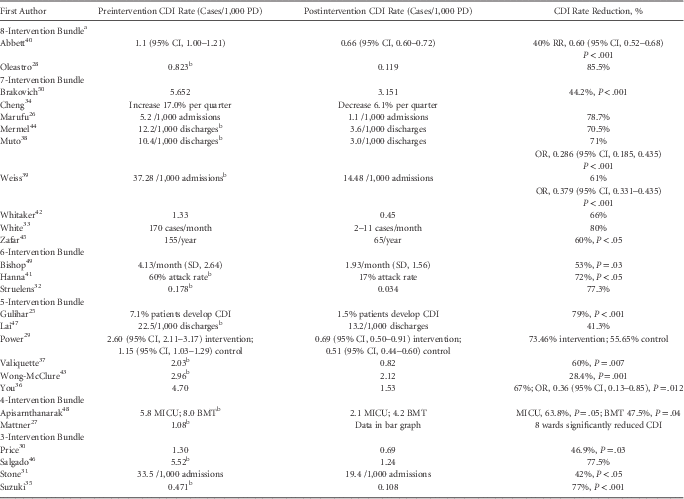
All 26 studies showed a decrease in the rate of CDIs after bundle implementation (Table 3). The improvement was significant at the 0.05 level for the 15 studies reporting P values (60%, 15 of 25).Reference Gulihar, Nixon, Jenkins and Taylor 25 , Reference Price, Cheek and Lippett 30 , Reference Stone, Beric, Quick, Balestrini and Kibbler 31 , Reference Suzuki, Senda and Yamashita 35 – Reference Hanna, Raad and Gonzalez 41 , Reference Wong-McClure, Ramirez-Salas and Mora-Brenes 43 , Reference Zafar, Gaydos, Furlong, Nguyen and Mennonna 45 , Reference Apisarnthanarak, Zack and Mayfield 48 – Reference Brakovich, Bonham and van Brackle 50 The odd ratio for developing CDI under the intervention bundle compared to the control period was reported in 3 studies and ranged from 0.29 to 0.38.Reference You, Song, Cho and Lee 36 , Reference Muto, Blank and Marsh 38 , Reference Weiss, Boisvet and Chagnon 39 The relative risk was 0.60 in the single study reporting this measure.Reference Abbett, Yokoe and Lipsitz 40
CDI Bundle Effectiveness

NOTE. BMT, bone marrow transplant; CDI, Clostridium difficile infection; CI, confidence interval; MICU, medical intensive care unit; OR, odds ratio; PD, patient days; SD, standard deviation; RR, relative risk.
a Education is considered 1 intervention, even when it includes staff and/or patient components.
b Preintervention data were collected during CDI outbreak.
Study Quality
The average study quality score, as assessed by the modified Downs and Black checklist,Reference Gulihar, Nixon, Jenkins and Taylor 25 was 15.2 of 28 (Supplementary S2). Total scores ranged from 13 to 18. All studies performed well on questions regarding external validity and poorly on confounding.
DISCUSSION
The overarching goal of bundled interventions is to implement combinations of evidence-based strategies that complement each other and work synergistically. In the case of CDI, the paucity of evidence-based interventions for prevention has led to considerable variation among bundle elements. The lack of adherence data and consistently low TiDier scores among many of these studies indicate that details on intervention implementation have been poorly reported. Thus, it is challenging to corroborate and compare results among studies.
According to the Society for Healthcare Epidemiology of America and Infectious Diseases Society of America’s 2014 CDI prevention strategies compendium,Reference Dubberke, Carling and Carrico 51 none of the 10 interventions compiled in this review were supported by level 1 evidence for CDI prevention. Antibiotic stewardship and contact precautions using gloves were designated as having a moderate quality evidence of effectiveness (level 2), referring to either a small number of supporting studies, moderate study limitations, or variation in results among studies. Contact precautions using gowns, hand hygiene, isolation and cohorting, environmental cleaning, patient and staff CDI education, dedicated equipment, and several systems and workflow interventions were rated as having low-grade evidence (level 3), a category used when studies have major flaws, considerable variation, or are based on expert consensus. The recommendation for proton-pump inhibitor stewardship was considered unresolved. This lack of strong evidence for any single intervention is likely related to the heterogeneity in the selection of bundle components.
Bundle implementation was associated with a decline in CDI rates in all 26 studies published in the literature, making this a potentially promising approach for reducing CDI. However, methodological limitations preclude the assessment of a causal relationship between bundled interventions and CDI rates.
Our systematic review extends and updates the findings of a prior review. In 2014, Yakob et alReference Yakob, Riley, Paterson, Marquess and Clements 52 conducted a review of 21 articles on CDI interventions and their effectiveness, from which they identified 6 eligible studies. In our review, we incorporated 5 articles from this prior reviewReference Muto, Blank and Marsh 38 – Reference Abbett, Yokoe and Lipsitz 40 , Reference Salgado, Mauldin, Fogle and Bosso 46 , Reference Bishop, Parry and Hall 49 as well as 21 additional articles. We did not include 1 article from Yakob’s study, because pre- and postintervention rates were not clearly reported.Reference Koll, Ruiz and Calfee 53 Given the rapidly changing epidemiology of C. difficile and use of CDI bundles, our up-to-date analysis is highly relevant to the current state of CDI control.
Many hospitals have not achieved declines in CDI rates despite intensive efforts to implement prevention strategies.Reference Kamboj, Sheahan and Sun 54 , Reference Roth 55 While neither of these studies implemented a CDI bundle, they are otherwise similar to many of the studies that met our inclusion criteria. Our review sheds light on 3 potential reasons for a lack of decline in CDI rates. First, compliance to interventions may be below the threshold necessary to be effective. A 2011 study by Furuya et alReference Furuya, Dick, Perencevich, Pogorzelska, Goldmann and Stone 19 found that the effect of a CLABSI bundle was not observed until compliance with at least 1 bundle element reached 95%. If adherence to bundle elements was low in the reviewed studies, the potential impact of C. difficile bundles may have been underestimated.
Second, the lack of infection control strategies focusing on asymptomatic carriers may have contributed to the lack of decline in CDI rates. Only 8% of CDI bundles included surveillance of asymptomatic carriers. However, focusing exclusively on patients with clinical CDI neglects the much larger reservoir of colonized asymptomatic hospital patients.Reference Gerding, Johnson, Peterson, Mulligan and Silva 56 Asymptomatic patients are an important reservoir of infectious C. difficile spores, and the impact of interventions focusing on colonized patients should be rigorously evaluated in future studies.
Finally, hand hygiene is especially complex in the context of CDI. Alcohol-based hand rub is an essential component of most horizontal hand-hygiene interventions and its benefits have been widely reported. 57 – Reference Cohen, Gerding and Johnson 59 Horizontal, or broad-based, approaches aim to reduce all infections, instead of targeting specific pathogens. The use of alcohol gels is typically counted in adherence data, but pure alcohol-based hand rubs are not active against C. difficile spores.Reference Jabbar, Leischner and Kasper 60 Chlorhexidine mixed gels have some efficacy;Reference Gerding, Muto and Owens 61 thus, distinguishing between chlorhexidine mixed gels, pure alcohol-based rubs, and soap and water is essential in the context of CDI bundles. Hand-hygiene compliance data that include the use of pure alcohol-based rubs may provide hospitals with an inaccurate assessment of CDI prevention efforts.
This review has several limitations. First, given the heterogeneity of bundles, it is unclear whether CDI reduction can be attributed to a similar mechanism across all studies. We attempted to mitigate this aspect by loosely defining a bundle as any infection control rollout with >1 intervention, hypothesizing that successful bundle implementation is itself a significant factor regardless of the specific components implemented. Second, most studies we reviewed in this study lacked rigorous statistical testing assessing the significance of the decline in CDI rates postintervention. This deficiency was especially common among studies implementing interventions mid-outbreak, which often lacked definitive comparison rates. Outbreak rates, without contemporaneous controls, can appear statistically significant even when the observed effect is due to regression to the mean. When preintervention CDI rates were unclear, we have presented the highest level of CDI incidence during the outbreak prior to bundle implementation. In addition, publication bias may have favored the publication of studies in which bundles showed a beneficial effect. If studies reporting no reduction in CDI rates after bundle introduction were less likely to be published, then our findings may have overestimated the positive impact of bundle introduction. Finally, it was impossible to quantify the overall effectiveness of bundle implementation and intervention adherence, given the range of outcome and adherence measures employed. The variety of outcome measures used and the paucity error measurements reported made it impossible to undertake a meta-analysis. The development and use of standard intervention-specific adherence measures would facilitate comparisons across future studies.
Ultimately, this review draws from a wide range of hospital types, locations, and infection control contexts. Given that CDI rates improved across all studies despite contextual differences and the variety of bundle components, a tailored bundle approach may be effective. However, this approach should be tested using cluster randomized clinical trials in multiple sites and settings with attention to implementation and process factors to facilitate replication and generalizability.
ACKNOWLEDGMENTS
We acknowledge health sciences librarian Lia Vellardita, MA, at the University of Wisconsin–Madison for her assistance with our literature search. The content is solely the responsibility of the authors and does not necessarily represent the official views of the Agency for Healthcare Research.
Financial support: Funding for this article was provided by the VA Patient Safety Center of Inquiry. This project was supported by the Agency for Healthcare Research and Quality (grant no. R03HS023791).
Potential conflicts of interest: Dr. Safdar is supported by a National Institutes of Health, Veterans Affairs Merit Award, and a Veterans Affairs Patient Safety Center award. Anna Barker is supported under NIH awards UL1TR000427 and TL1TR000429, administered by the University of Wisconsin-Madison’s Institute for Clinical and Translational Research. All other authors report no conflicts of interest relevant to this article.
SUPPLEMENTARY MATERIALS
To view supplementary material for this article, please visit https://doi.org/10.1017/ice.2017.7