1. Introduction
There is solid evidence that forests could play an important and cost-effective role in helping to mitigate global climate change (Watson et al., Reference Watson, Noble, Bolin, Ravindranath, Verardo and Dokken2000; Metz et al., Reference Metz, Davidson, Swart and Pan2001; Sohngen and Mendelsohn, Reference Sohngen and Mendelsohn2003; Fisher et al., Reference Fisher, Nakicenovic, Alfsen, Morlot, de la Chesnaye, Hourcade, Jiang, Kainuma, La Rovere, Matysek, Rana, Riahi, Richels, Rose, van Vuuren, Warren, Davidson, Bosch, Dave and Meyer2007; Nabuurs et al., Reference Nabuurs, Masera, Andrasko, Benitez-Ponce, Boer, Dutschke, Elsiddig, Ford-Robertson, Frumhoff, Karjalainen, Krankina, Kurz, Matsumoto, Oyhantcabal, Ravindranath, Sanchez and Zhang2007; Tavoni et al., Reference Tavoni, Sohngen and Bosetti2007; Wise et al., Reference Wise, Calvin, Thomson, Clarke, Bond-Lamberty, Sands, Smith, Janetos and Edmonds2009; Rose et al., forthcoming). As a result, international climate negotiations have dedicated discussion on agriculture, forestry, and other land uses, and countries such as the United States are seriously considering the role global forests could play in managing the costs of domestic climate policies (e.g., USEPA, 2009). For example, the recent US climate legislation proposals allow for the purchase of global forest carbon sequestration to ‘offset’ greenhouse gas (GHG) emissions from entities under the domestic GHG emissions cap. Analyses of these proposals estimate that additional forest carbon, especially from international forests, could be critical to containing the cost of abatement, especially in early compliance years with non-US forests providing approximately a quarter of abatement from 2012 to 2020, and all forests globally accounting for a third.Footnote 1
Although many institutional mechanisms have been proposed for realizing forest carbon abatement, including the conservation development mechanism, global forest sector policies, national commitments, bilateral agreements, and domestic offsets programs, it is not yet clear how net increases in global forest carbon will actually be accomplished.
Implementation of the full range of forest carbon sequestration alternatives has been limited in international agreements, and resolving the details and developing the programs for crediting actions that increase forest carbon stocks remain extremely challenging. To date there are no internationally accepted protocols for crediting increases in carbon due to forest management changes and avoided deforestation, and the protocol available for afforestation is problematic and limited in use.
The Kyoto Protocol originally contained language that allowed for a full range of land-use options to be used as credits against carbon emissions; however, subsequent negotiations reduced these options. As a result, for almost 10 years, policies focused primarily on afforestation. Since the Conference of Parties (COP) in Montreal in December 2005, there has been wider discussion about the possibility of including reductions in deforestation as a forestry option. This trend has continued through the recent COPs in Copenhagen in December 2009 and Cancun in November 2010 with the emphasis shifting toward avoided deforestation as the dominant or lead strategy. In addition to issues about the type of sequestration, there are timing issues of when policies might start, and what regions will be included and when.
Limiting mitigation choices could have important welfare consequences – by increasing the overall cost of mitigation, by altering the geographic distribution of mitigation and the corresponding financial flows, and by creating unintended consequences that actually diminish net climate benefits, as well as affect potential cobenefits. In order to evaluate the design of effective policies, it is useful to assess the scale of these consequences. To date, no studies have explicitly examined the implications of limited global forest carbon sequestration policies. Previous forest carbon supply estimates have traditionally made two types of strong assumptions. First, most global studies assume immediate, comprehensive, and global access to forest carbon abatement options (e.g., Sohngen and Mendelsohn, Reference Sohngen and Mendelsohn2003; Fisher et al., Reference Fisher, Nakicenovic, Alfsen, Morlot, de la Chesnaye, Hourcade, Jiang, Kainuma, La Rovere, Matysek, Rana, Riahi, Richels, Rose, van Vuuren, Warren, Davidson, Bosch, Dave and Meyer2007; Nabuurs et al., Reference Nabuurs, Masera, Andrasko, Benitez-Ponce, Boer, Dutschke, Elsiddig, Ford-Robertson, Frumhoff, Karjalainen, Krankina, Kurz, Matsumoto, Oyhantcabal, Ravindranath, Sanchez and Zhang2007; Kinderman et al., Reference Kindermann, Obersteiner, Sohngen, Sathaye, Andrasko, Rametsteiner, Schlamadinger, Wunder and Beach2008; Wise et al., Reference Wise, Calvin, Thomson, Clarke, Bond-Lamberty, Sands, Smith, Janetos and Edmonds2009; USEPA, 2009, 2010). One exception is Calvin et al. (Reference Calvin, Edmonds, Bond-Lamberty, Clarke, Kim, Kyle, Smith, Thomson and Wise2009), who consider staggered regional accession to a coalition with a long-run climate objective that values forest carbon. However, they neither evaluate types of forest sequestration activities nor investment behavior within regions. Second, in the cases that allow for consideration of a more limited set of forest sequestration abatement, there are assumed to be no interactions between forest carbon activities over time and across regions (e.g., McKinsey & Company, 2009; USEPA, 2009, 2010).
Choices could be limited because policy makers decide to or have to leave some countries or options out of the policy mix. The Kyoto Protocol did both. Many countries did not have carbon targets and the potential gains from avoided deforestation were largely ignored by the policy makers. This study examines these two kinds of constraints over time – country and activity – on the supply of forest carbon sequestration. To conduct this analysis, we use a global forest and land use model and evaluate the implications for individual activities and regions, as well as the implications for net global forest carbon. Along the way, we also explore interactions between technologies and global regions, as well as over time.
We find that a global policy focused only on afforestation could have significant unintended consequences, while eventual comprehensive policies could offer substantial sequestration, but not without near-term carbon stock losses and long-run implications for the composition of sequestration and forests themselves. We also find that afforestation and avoided deforestation incentives adversely affect the cost of one another, and can lead to different types of forests. Finally, throughout the study, we find that forest sequestration activities are not mutually exclusive and the actual sequestration supply of each activity and region is a function of the eligibility of the other forest sequestration activities within and across global regions. This result has broad implications for estimating activity and region-specific sequestration.
2. Framework
2.1 Model
The global forest and land-use model used in this paper is based on the model described in Sohngen et al. (Reference Sohngen, Mendelsohn and Sedjo1999) and Sohngen and Mendelsohn (Reference Sohngen and Mendelsohn2003, Reference Sohngen, Mendelsohn, Schlesinger, Kheshgi, Smith, de la Chesnaye, Reilly, Wilson and Kolstad2007).Footnote 2 The model maximizes the net present value of consumer's plus producer's surplus arising from forestland management. The model determines timberland area, tree species and age class structure, timber prices, timber investments, and access into currently inaccessible forests for different ecosystem types around the world.Footnote 3 The model manages age classes by explicitly solving for the harvesting age, management intensity (e.g., cost per hectare spent regenerating and managing sites), and the area of forestland maintained in each of the ecosystem types.
The model assumes a global demand function for timber. The model manages 146 individual ecosystem types, which together satisfy global timber demand. Differences in timber quality are accounted for with quality adjustment factors for each ecosystem type, and the net value of timber in each ecosystem type is also a function of harvesting and transportation costs to the nearest demand center. For exposition purposes, the individual ecosystem types are aggregated into the following 13 geographical regions: the United States, Canada, Central America, South America, Europe, Russia, China, Japan, Southeast Asia, Oceania, Africa, Central Asia, and Japan.
One of the key determinants of the area of land in forests is opportunity cost. The opportunity costs are the value of the agricultural practices that could otherwise be undertaken on the forested land. The model accounts for these opportunity costs via land supply functions that represent the costs of renting forestland. Separate land supply functions are specified for each ecosystem type. In tropical regions, the land supply functions are assumed to shift over time, while in most temperature and boreal regions, the land supply functions are fixed. The land supply shifts in tropical regions represent the increasingly valuable opportunities associated with converting forestland to agriculture. The rate of the shift in land supply is selected to calibrate the model's regional tropical deforestation rates to deforestation rates in the literature. Historical tropical deforestation primarily reflects the demand from agricultural uses (crops and livestock), and not urban and suburban development or biofuel policies. To the extent that these or other factors increase the non-forest demand for land in the future, our results would underestimate the cost of carbon sequestration and emission reductions through forestry actions.
In the baseline, the model assumes a zero carbon price, and solves for the optimal area, age class distribution and management of forests in response to timber demand and the opportunity cost of land. We assume that timber demand shifts outward over time with global economic and population growth. For forest carbon policy scenarios, we introduce carbon prices so that gains in forest ecosystem carbon are credited and losses debited. Specifically, we implement the optimal tax and subsidy scheme proposed by van Kooten et al. (Reference van Kooten, Binkley and Delcourt1995). This scheme pays the carbon price for annual carbon growth in forests, and taxes net emissions at the time of harvest. Net emissions are determined as carbon releases to the atmosphere, less permanent storage in marketed products.
When carbon incentives exist, the model adjusts forest management and forestland area for carbon values, as well as timber returns and opportunity costs. The shifts in the opportunity cost of tropical forests described above are unaffected by the carbon price scenarios; however, forestland becomes more valuable, and more land is maintained in forests, in addition to inducing longer timber rotations and more intensive management of forests.
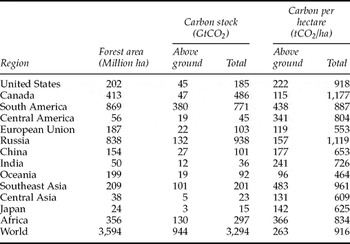
The strength of the carbon sequestration incentive varies across global regions because of differences in the physical characteristics of regional forests, timber quality, and land market conditions. For instance, a higher current carbon stock per hectare implies a relatively stronger incentive in biophysical terms for additional forest acreage (table 1). From table 1, we also see that it is the combination of above and below ground carbon that defines the incentive for adding or protecting forest carbon. Below ground forest carbon represents 70 per cent of global forest carbon and is 75–90 per cent of the total carbon stock in temperate regions.Footnote 4
2005 regional forest area, carbon stock, and carbon per hectare

2.2 Scenarios
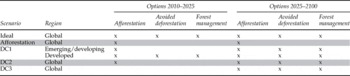
We consider six policy scenarios (table 2). We start with our benchmark – an ‘ideal’ policy in which landowners globally can be credited for any gains in forest carbon they are able to provide from 2010 onward. That is, carbon gains are credited immediately in all regions of the world for afforestation, reductions in deforestation, increases in management intensity, adjustments in rotation ages, and changes in the quantity of carbon stored in wood product markets. In this paper, ‘ideal’ refers to ideal management of forest carbon and timber supplies and not the full range of positive and negative goods, services, and externalities associated with forested ecosystems. Given the infeasibility of an immediate, comprehensive, global forest carbon policy, we consider various policies with restrictions and delays to the sequestration activities eligible for carbon crediting. First, we consider a policy in which carbon payments are only provided for afforestation. Under this policy, only nonforested lands that are then forested can generate carbon payments. This policy is consistent with the practical policy and implementation appeal of afforestation because it is readily measurable and verifiable, unlike the other forest sequestration activities.
Global forest carbon policy scenarios

Notes: DC = Delayed comprehensive.
Emerging/developing = South America, Central America, Russia, China, India, Southeast Asia, Central Asia, and Africa.
Developed = United States, Canada, European Union, Oceania, and Japan.
Second, given the unlikely availability of immediate forest carbon crediting programs, we consider three variants of delayed policies. In each variant there is a delayed global comprehensive policy for forestry mitigation that begins in 2025. Therefore, from 2025 onward, all forest carbon changes from the baseline are valued. However, the activities and regions credited through 2025 (2010–2025) vary across scenarios. Each variant is progressively further removed from the ideal policy. The first delayed comprehensive (DC) policy credits afforestation in developing regions and all activities in developed regions (DC1 in table 2) during the 2010–2025 period. The second credits only afforestation globally (DC2). Finally, the third provides no credit for forest carbon changes at all anywhere in the world before the comprehensive policy begins in 2025 (DC3). Given the programmatic and institutional challenges to crediting global forest carbon, DC1 is still fairly optimistic.
For each of the forestry policies, we evaluate responses in the context of different levels of aggressiveness in international mitigation in the energy, transportation, industry, and commercial sectors. We do this with alternative carbon price pathways where higher prices represent more aggressive international action on energy-related GHG emissions. Specifically, we evaluate the following four rising carbon price pathways, each beginning in 2010: $1/tCO2, $5/tCO2, $15/tCO2, and $30/tCO2, all rising at 5 per cent per year. Although the carbon price paths we use are exogenous, they are representative of the estimated marginal costs of abatement in other sectors for different levels of policy stringency. The set of carbon price pathways that we have chosen span the range of estimated prices found in analyses of proposed US climate legislation (e.g., USEPA, 2009, 2010), climate stabilization scenarios (e.g., Clarke et al., Reference Clarke, Edmonds, Krey, Richels, Rose and Tavoni2009; Rose et al., forthcoming), and those used in global forest sequestration supply estimates (e.g., Sathaye et al., Reference Sathaye, Makundi, Dale, Chan and Andrasko2006; Sohngen and Sedjo, Reference Sohngen and Sedjo2006). The price paths are capped at $250/tCO2. The cap is meant to proxy a backstop technology whose development is induced by high carbon prices. The combinations of policies and carbon price paths characterize a broad set of possible forest carbon policy futures useful for investigating interactions and a meaningful range of implications.
3. Results
We begin by describing our baseline. In the baseline scenario, global forest area is projected to decrease over time – from 3,594 million hectares in 2005 to 3,212 million hectares in 2055, and 3,172 million hectares in 2095. Nearly all of these losses are projected to occur in tropical regions, as the opportunity costs of holding land in forests rise with time, leading to conversion of additional land to agriculture. As a result, an additional 193 GtCO2 and 225 GtCO2 are emitted to the atmosphere cumulatively by 2055 and 2095, respectively. Forestland area in temperate and boreal regions, however, is projected to remain roughly constant over the century. However, some temperate and boreal regions are projected to experience shifts in carbon stocks from accessing forests not previously accessed. This occurs primarily in regions such as Canada and Russia. Overall, there is a modest loss of 5.3 GtCO2 by 2095 in temperate and boreal regions, with total timber harvests increasing due to rising average global timber prices.
In the next few sections, we analyze forest sequestration supply responses to the policies from a number of perspectives. First, we consider the implications for specific sequestration activities. Second, we examine the aggregate response. Third, we explore regional implications, including a detailed evaluation of sequestration activity in a few regions that provides some perspective on potential on-the-ground implications for forests. Finally, we discuss the inherent tension that we observe between carbon sequestration supplies from afforestation and avoided deforestation.
3.1 Sequestration activity responses
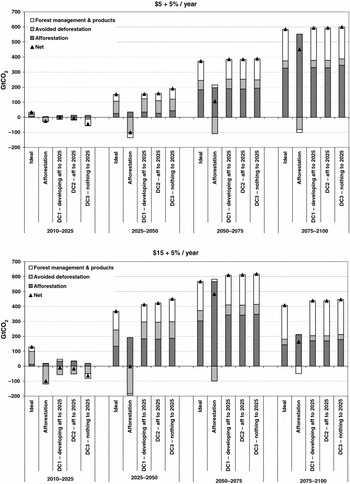
Over the period 2010–2025, the ideal policy yields relatively large gains in forest carbon (figure 1). In fact, the ideal policy is the only policy to generate positive carbon gains during this period; the other policies all generate net losses in forest carbon.Footnote 5
Cumulative global forest carbon gains above baseline by activity and time period for carbon prices of $5/tCO2 + 5%/year and $15/tCO2 + 5%/year

Under the ideal policy, avoided deforestation provides significant carbon gains in the near term and is the largest single component (40 per cent and 70 per cent of 2010–2025 carbon gains, respectively, with the $5 and $15 rising carbon price pathways). By 2025–2050, afforestation plays a larger role, particularly under the higher price scenario, as carbon accumulation accelerates from early afforestation land conversion decisions and additional new forests during the 2025–2050 period.Footnote 6 In the second half of the century, afforestation and forest management and forest product storage provide almost all of the annual sequestration services (almost 90 per cent from 2050 to 2100).
Under the nonideal policies, we find important departures from this pattern – in net gains in the short-run, and overall in the composition of carbon gains across activities and regions. These departures will have consequences for the environmental integrity and cost of climate policies, ecosystems and biodiversity, commodity markets, and regional income. We focus first on the afforestation only policy, and then on the delayed comprehensive policies.
The afforestation only policy causes carbon losses from forests on net during the period 2010–2025 and beyond. While afforestation leads to gross sequestration on newly forested areas that exceed that supplied under the ideal policy (e.g., afforestation carbon gains increase 30 per cent with the $15 + 5 per cent carbon price), it also induces losses in forest cover elsewhere. For example, with the $15 + 5 per cent carbon price, 17 GtCO2 of new forest carbon is generated via afforestation from 2010 to 2025. However, the gain is more than offset by losses of 119 GtCO2 over the same period, for a net carbon loss of approximately 100 GtCO2. Under this policy, incentives are placed on afforestation but there are no countervailing measures to limit the existing forest and carbon losses. The mechanism at work here is not a direct swapping of tropical forests for new forests. Instead, new forests are grown on agricultural lands that, in turn, increase agricultural expansion pressure on previously inaccessible forests. When afforestation occurs, agricultural land values increase, thereby increasing the opportunity cost of holding land in forests. If the opportunity cost increases enough to cover the net cost of clearing the land, further deforestation will occur. The afforestation carbon gains therefore come at a huge accelerated deforestation cost.
The delayed comprehensive policies (all three) also accelerate deforestation over the period of 2010–2025. As a matter of fact, compared to the afforestation only policy, the delayed comprehensive policies produce greater immediate net losses in 2015. The greater the price signal, the larger the net losses during this period of partial coverage. The net losses are smaller for the delayed comprehensive policies that provide some early sequestration incentives, i.e., DC1 and DC2. However, surprisingly, the cumulative accelerated deforestation losses over the entire period of 2010–2025 are smaller than under the afforestation only scenario, even with a policy that credits afforestation in the near term (DC2), and the carbon gains from afforestation with all three delayed policies are larger. These results are the confluence of interactions between activities, over time, and across regions.
First, the incentive for early afforestation is affected by future incentives for avoided deforestation. Future credit for avoided deforestation increases the cost of future afforestation by increasing the value of agricultural land and the cost of agricultural expansion into forests. However, instead of diminishing the supply of near-term afforestation carbon, afforestation activity shifts forward in time and 2010–2025 afforestation increases relative to that under the afforestation only policy. For instance, the afforestation carbon gains are twice as high under the DC2 policy with $15 + 5 per cent, and almost three times greater with $5 + 5 per cent.
Second, under the delayed policies, timber prices are higher than they are under the afforestation only policy and therefore timberland is worth more. The total value of afforestation includes both the carbon value and the timber value. Timber prices are higher because future timber supplies are reduced because of the post-2025 forest management carbon incentive.
Lastly, the expectation of a payment for avoided deforestation also reduces the incentive for accelerating near-term deforestation (but doesn't prevent it). Comparing the accelerated deforestation carbon losses of the afforestation only and DC2 policies, we find that the increased deforestation losses cumulatively over the 2010–2025 period are 50 to 60 per cent less with the rising $5 and $15 carbon prices, respectively. However, how can a reduction in accelerated deforestation be consistent with increased afforestation? If landowners expect future incentives for avoiding deforestation, they don't necessarily reduce the area of land deforested, but they do alter the actual land that gets deforested. That is, if landowners have an option over which land to deforest, they will deforest land with the least carbon today and hold the land with the most carbon for the future. At the same time, it is not that more trees are being planted cumulatively over this timeframe, but instead that afforestation plantings are occurring earlier in time and more tree growth, and carbon accumulation, is occurring during the period.
Therefore, the expectation of a future comprehensive policy provides both an incentive for increased afforestation and a disincentive for preprogram increases in deforestation. We find the former of these two price signals to be stronger. In fact, the afforestation gains are greater than under the ideal policy (e.g., 50 per cent and almost 200 per cent, respectively, for the price scenarios in figure 1).Footnote 7 So much so that we still see afforestation and accelerated deforestation when there is no incentive at all for early afforestation (DC3).
Overall, the opportunity to clear forest while existing carbon stocks are unvalued, for what turns out to be primarily future afforestation carbon gains (discussed next), is simply too appealing for maximizing the intertemporal net value of carbon and timber. Thus, even under the delayed comprehensive policies, the carbon releases from accelerated deforestation are still sizable over the initial 15-year period, with additional losses of 13.9–27.5 GtCO2 and 49.9–56.8 GtCO2 under the $5 + 5 per cent and $15 + 5 per cent carbon price scenario, respectively.
The near term is only part of the story however. The nonideal policies also have interesting long-run effects. Immediately after 2025, we see a rapid increase in afforestation carbon gains with all the nonideal policies at levels that substantially exceed those observed under the ideal policy. For example, an additional 2–20 GtCO2 and 50–60 GtCO2 is generated under the nonideal policies relative to the ideal policy with the rising $5 and $15 price paths, respectively, during the 2025–2050 period (figure 1).
Overall, the delayed comprehensive policies generate net gains post-2025 that exceed the ideal policy. Therefore, by delaying policy, society is able to increase net sequestration in future periods (although, as discussed below, the cumulative gains across the century are smaller). The larger future period gains are driven by increased afforestation, as well as increased forest management and timber product sequestration that is set up by the pre-2025 decisions. The early increases in deforestation have lowered the cost of future afforestation across all of the post-2025 periods. The early accelerated deforestation effects therefore ripple through into future periods. However, they do diminish over time such that gains from the delayed comprehensive policies in future periods begin to look like those that would be gained under the ideal policy.
The afforestation only policy during this period, on the other hand, could continue to produce increased deforestation and net carbon losses. Not until beyond 2050 are net gains finally realized after massive global afforestation – for example, approximately 195–565 GtCO2 of new sequestration during the 2050–2075 period in figure 1.
The forest management and product results are another example of how market expectations influence landowner decisions and responsiveness to the design of a forest carbon policy. While carbon prices generally encourage delays in timber harvesting, increased management intensity, and forest species adjustments, forest management is also responsive to timber market expectations, as large increases in afforestation can suppress future timber prices and provide an incentive for harvesting earlier when timber prices are higher relative to the future. Thus, forest management and product carbon responses are driven by timber price, as well as by carbon price expectations. For instance, under the DC3 policy, earlier harvests occur in order to begin optimizing forest stocks for future carbon markets, and to anticipate lower future timber prices because of new timber supplies from afforested land. This leads to an initial release of carbon from forest stocks during the initial two decades when carbon is not valued, and later when carbon is valued, longer rotations. Overall, we find that afforestation and forest management/products are synchronized to maximize timber and carbon supplies in a way that increases the value of the other. This opportunity for coordination further strengthens the appeal of accumulating carbon via afforestation.
3.2 Aggregate sequestration
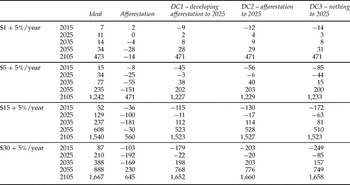
It is also instructive to evaluate cumulative changes over time in order to understand the potential aggregate implications. Throughout the century, the cumulative net forest carbon sequestration under the nonideal policies falls short of that realized under the ideal policy (table 3). The degree of difference varies by policy, carbon price, and year. However, by 2055 all of the delayed comprehensive policies overcome the potentially sizable 2015 accelerated deforestation carbon losses and yield substantial cumulative net gains of the same order of magnitude as the ideal policy. In general, the three delayed comprehensive policies look quite similar, with net losses contained to the pre-comprehensive period, and carbon gains rapidly converging toward the ideal policy sequestration gains once the comprehensive policy is in place. Thus, if society commits to a comprehensive policy, as much carbon can be sequestered by the end of the century as can be sequestered when the comprehensive program is adopted from the beginning.Footnote 8
Cumulative global forest carbon gains above baseline by 2015, 2025, 2035, 2055, and 2105 by policy and carbon price scenario (GtCO2)

With little long-run implication in terms of cumulative carbon gains, one might conclude that program delays are inconsequential. However, we should not ignore the differences in the temporal distribution of the carbon accumulation. While delaying the forest carbon policy clearly reduces the direct costs of implementation, the differences in cumulative sequestration through 2025 relative to the ideal policy (e.g., an annual average 9–13 GtCO2 per year lower in the $15 + 5 per cent scenarios) would likely contribute to additional climate change impacts.Footnote 9 Furthermore, to the extent that forest carbon is an eligible abatement strategy, delayed availability will affect the compliance cost of a climate policy, especially if the accelerated deforestation carbon emissions are taken into account.
The afforestation only policy also generates large cumulative carbon gains by 2105, but only 35 per cent of that realized under the ideal and delayed comprehensive policies. In contrast to the delayed policies, however, the afforestation only policy yields cumulative net losses through 2055 for all but the highest carbon price pathway, and even then the aggregate carbon gains are well short of those under the other policies. Thus, it could take the afforestation only policy half a century to only return to baseline global forest carbon stock levels. A higher price scenario would send an even stronger signal that shifts the timing of the conversion to net positive carbon gains forward in time, but increases the magnitude of the net losses prior to that point in time.
3.3 Regional sequestration responses
Under the ideal policy, tropical regions, in particular Africa, Southeast Asia, and South America, are responsible for most of the carbon gains by 2050. There are gains in temperate and boreal regions as well, notably China, Russia, the European Union, Canada, and the United States, but over time the tropical gains far outpace those from the temperate and boreal regions.
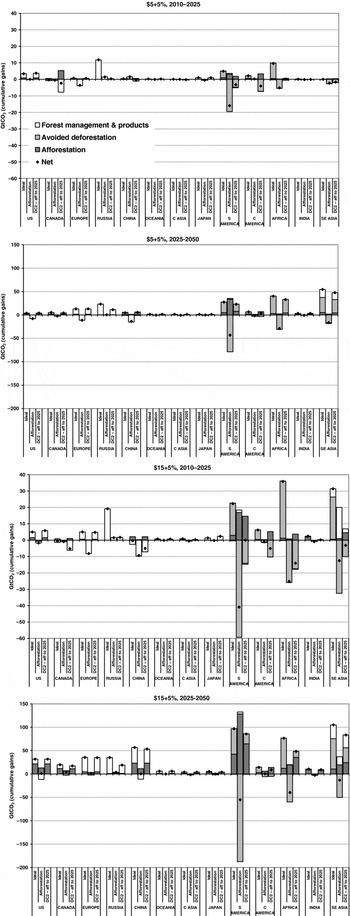
Figure 2 illustrates the specific activities that generate the gains and losses in each region. The responses to the ideal policy are the typical regional delineation of sequestration potential for activities reported in the literature – temperate regions are the main source of afforestation and forest management and products sequestration supplies, while tropical forests provide avoided deforestation carbon (and a noteworthy amount of afforestation). Russia, for example, could provide a large amount of additional carbon by 2025 through forest management, primarily by reducing harvests of boreal forests. The Russian boreal forests are a large storage reservoir for carbon and maintaining those stocks is a potent, and valuable, carbon asset. Meanwhile, South America, Central America, and Africa supply substantial avoided deforestation carbon even at lower prices, while avoided deforestation in Southeast Asia is only viable at higher carbon prices.
Regional carbon responses 2010–2025 and 2025–2050 for carbon prices of $5 + 5%/year and $15 + 5%/year. For Legend see next page. Regional carbon responses 2010–2025 and 2025–2050 for carbon prices of $5 + 5%/year and $15 + 5%/year

Conversely, under the nonideal policies, we find sizable carbon losses from 2010 to 2025 from both the tropical and the temperate regions. The afforestation only policy hits the tropical regions particularly hard in terms of net carbon losses, especially South America and Africa (40 and 25 GtCO2 net losses, respectively, by 2025). The delayed comprehensive policies are not nearly as hard on these and other regions through 2025; and by 2050, all the regions produce net gains, with some regions taking longer to generate net gains than others because of larger accelerated deforestation responses and early and slower afforestation carbon accumulation (e.g., Africa). Of course, the cumulative carbon gains by 2050 are smaller than under the ideal policy, and more so for some regions than others. The fully delayed policy DC3 (not shown) is the worst of the delayed policies, with the largest temperate/boreal and tropical losses pre-2025 and smallest cumulative net gain by 2050.
We also find that the pattern of regional sequestration activity deviates substantially from that under the ideal policy (and in the literature). In particular, tropical regions are simultaneously the source of large carbon gains and losses. For example, with the afforestation only policy, we see large-scale accelerated tropical deforestation. However, we also see that these same regions are now the suppliers of most of the afforestation carbon gains as well, especially South America. Forest management provides some gains in Southeast Asia because of adjustments in the management of the valuable dipterocarp forests, but these are not enough to offset the losses from deforestation. Under the delayed comprehensive policies (only DC2 is shown in figure 2), we see significant increases in tropical afforestation relative to the ideal policy, but it could increase or decrease between the DC2 and afforestation only policies depending on the region – for example, decreasing in South America, but increasing in Southeast Asia and Africa. By the 2025–2050 period, the carbon gains in the tropics under the delayed policy come from substantially more afforestation and less avoided deforestation than under the ideal policy. Overall, these detailed regional results illustrate that more realistic policies will affect the potential of individual sequestration activities and regions; and there is a lot at stake, especially in the tropics.
Temperate forest management and product sequestration supplies are also dramatically altered, with reduced (e.g., Russia) or negative (e.g., Europe and the United States) supplies under the afforestation only policy as the afforestation-based timber production and delayed timber removals from the tropics flood future timber markets. Under the delayed comprehensive policy, temperate region responses are directionally similar to those under the ideal policy, with noticeable differences in magnitude for some regions (e.g., Russia and China).
3.4 The forests
Our results indicate that alternative climate policy designs will have substantial and different impacts on forests. In this section, we look a bit more closely at what is happening to the forests themselves – that is, the composition and extent of forests.
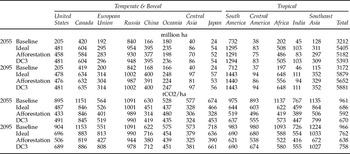
We find that across all the policies – ideal and nonideal – there is the potential for substantial and similar gains in forest acreage – approximately 60 to 70 per cent increases in global forestland by 2055 and 80–85 per cent gain by 2095 under a $15 + 5 per cent carbon price (table 4). This includes the afforestation only policy, which despite increasing deforestation, produces a sizable increase in forestland. The largest acreage gains by 2055 in table 4 are in South America at around 560 million hectares. However, there are also substantial gains of approximately 200–300 million hectares by 2025 in each of the United States, Canada, China, Southeast Asia, and Africa. On a percentage basis, there are acreage increases of over 100 per cent by 2055 in Africa, Japan, Southeast Asia, Central Asia, India, China, Central America, and the United States.
Forest acreage and forest carbon density in 2055 and 2095 – baseline and policy with $15+5% carbon price

DC3 = DC3 - nothing to 2025 (i.e., delayed comprehensive policy starting in 2025 and no policy before 2025)
While the forest acreage is increasing in all cases, the composition of the forest is also changing. The lower portion of table 4 reports the average carbon density of the forests. The new forests created under all of the policies are expansive and have much lower carbon densities, and thereby lower averages. This is in part due to young and growing forests. However, it is also due to the fact that the new forests will never become old growth, as they are instead managed tree species that are rotationally harvested for timber. The carbon density results also illuminate the effect of having avoided deforestation within a policy. Average carbon density is higher under both ideal and delayed comprehensive policies compared to the afforestation only policy. In terms of total acreage and average carbon density, the forests resulting from the delayed comprehensive policies look fairly similar to the ideal policy. However, as discussed next in the context of a few regions, the forests are not quite the same.
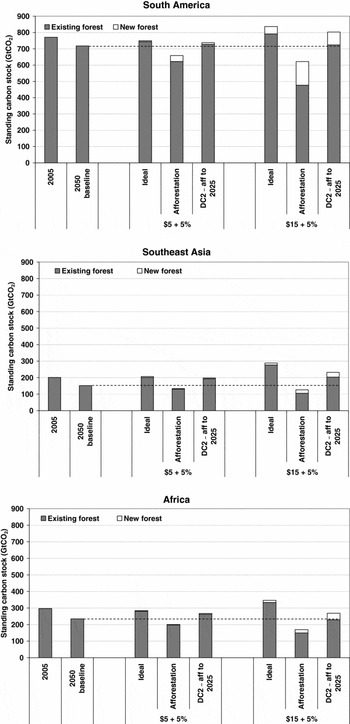
Figure 3 shows the current carbon stocks (2005) and the projected baseline and policy carbon stocks in 2050 in South America, Southeast Asia, and Africa. Baseline deforestation over the next 50 years results in less stored carbon in existing forests. The carbon stocks in figure 3 are not carbon gains or losses from the baseline, but an accounting of carbon in and above the ground that is in place in 2050 under different policy types and stringency (carbon price). The dashed horizontal line across the figure is there to facilitate comparison of 2050 carbon stocks under the baseline and policy scenarios.
Forest carbon stocks in South America, Southeast Asia, and Africa in 2005 and 2050 under baseline and select policy scenarios

Under the ideal policy, more carbon is stored in 2050. Most of the gain results from avoiding deforestation that increases ‘existing forest’. It is important to note that the vast majority of the existing carbon is unaffected since most of the current carbon in the regions lies in currently inaccessible forest.
Comparing the resulting forests under the different policies, we immediately notice that the forests will be different. While the ideal policy expands the carbon in existing forests beyond 2050 baseline levels and even beyond 2005 levels with a higher carbon incentive as both extent and carbon intensity increase, the afforestation only policy results in substantial losses of the existing forest that are only partially offset by new forest. For instance, each of the regions in figure 3 lose approximately 15 per cent and 35 per cent of the existing forest carbon with afforestation only incentives of $5 + 5 per cent and $15 + 5 per cent, respectively (losses of approximately 95, 20, and 35 GtCO2 compared to 2050 baseline levels in South America, Southeast Asia, and Africa with the lower incentive, and 240, 45, and 85 GtCO2, respectively, with the higher incentive). In terms of total carbon stocks (existing and new), none of the three regions has managed to return to their baseline levels by 2050 under the afforestation only policy.
For the delayed comprehensive policy, more carbon is stored in 2050 relative to the baseline, but less carbon is stored relative to the ideal policy. Nearly all of the carbon gain is due to afforestation in excess of ideal policy afforestation levels. Interestingly though, with the delayed comprehensive policy, at least as much carbon is maintained in existing forests as in the baseline. Therefore, despite accelerated near-term carbon losses, the delayed comprehensive policy reduces deforestation sufficiently in later years to preserve the same amount of forest carbon as the baseline in South America and Africa, while protecting more in Southeast Asia. We find, however, that this outcome may be vulnerable to higher carbon prices (discussed below).
3.5 Afforestation versus avoided deforestation
Across our results, we observe a tension between afforestation and avoided deforestation; and, overall, we see afforestation dominating avoided deforestation in accumulating carbon, which is more pronounced with the delayed policies. For example, we find that without an incentive for either activity before 2025, and with an incentive for both after 2025 (DC3), afforestation is clearly preferred and avoided deforestation gains are not just smaller, but negative. This result is despite the fact that afforestation carbon gains are gradual over time and deforestation carbon losses are immediate (net of carbon in timber products, which is modest in the tropics). Cumulatively, afforestation generates 40 per cent of the cumulative forest gains to the end of the century with the ideal policy, and 50 per cent with the delayed comprehensive policies, while avoided deforestation provides 20–25 per cent under the ideal policy and 10–15 per cent under the delayed comprehensive policies. Of course, we also see the expansion of afforestation when existing carbon stocks are not valued at all; and, under the nonideal policies as a whole, we see a significant boost in afforestation at the expense of accelerated deforestation in regions not known for large-scale afforestation potential.
From our South America results, we can see from comparing the afforestation only and delayed comprehensive results that avoided deforestation crediting, immediate or delayed, constrains afforestation gains (figure 3). The same outcome appears in Southeast Asia, which is slower to afforest. We also find that afforestation's share of the regional carbon gains is larger under the delayed comprehensive policies compared to the ideal policy. For instance, with $5 + 5 per cent, 50 per cent of the carbon gain in South America comes from afforestation under the delayed comprehensive policy versus 20 per cent under the ideal policy. Higher carbon prices only exacerbate this effect. With $15 + 5 per cent, the afforestation share of the carbon gain in South America increases to 90 per cent (versus 40 per cent under the ideal policy). We observe this pattern in other regions as well (e.g., Southeast Asia and Africa), though the carbon stocks and specific afforestation shares differ (e.g., smaller and larger for Southeast Asia, respectively) due to differences in forest and market conditions. The effect can become so pronounced with a higher carbon price that deforestation could actually accelerate even when there is a carbon incentive to reduce deforestation. We see this in the Africa results in figure 3 when we compare the existing forest under the delayed comprehensive policy across the two price scenarios. Intuitively, we would expect the carbon in existing forest to increase with the higher carbon incentive. However, we instead find less existing forest carbon. The effect occurs in the other regions as well at higher carbon prices (in a particular year or later in time).
To further explore the afforestation–avoided deforestation relationship, we also ran avoided deforestation only scenarios, which only offered carbon incentives for avoided deforestation in South America, Central America, Southeast Asia, India, and Africa starting in 2010. We found further evidence of the tension between afforestation and avoided deforestation. Specifically, we found that the avoided deforestation carbon gains could increase substantially by 2050 when there are no afforestation incentives. For instance, with the rising $5 and $15 carbon prices, we observed increases in the avoided deforestation sequestration in South America of over 150 per cent and 40 per cent, respectively, relative to the ideal policy. The increases were even greater when compared to the avoided deforestation carbon gains under the delayed comprehensive policies. This is a critical area for future research.Footnote 10 When considering an avoided deforestation only policy, land market feedbacks on global agriculture should reasonably be expected. While our framework captures changes in agricultural land rents, it does not explicitly estimate agricultural land management and production implications.
4. Conclusion
Within the climate change literature, authors typically assume that ideal forest carbon crediting schemes will provide carbon immediately for the full range of forest carbon sequestration activities throughout the globe. Such ideal policies, however, are unlikely. Given the large area of land involved, the many contracts and/or national agreements that will have to be developed, and the technical aspects of implementing sequestration programs, it seems more plausible that society will continue to slowly incorporate forest carbon sequestration into global policy. This paper examines the implications of less than ideal forest carbon policies that limit and delay the incentives for global forest sequestration activities.
We found that less than ideal policies not only reduce net carbon gains associated with forestry actions but they can also cause additional climate damages in the near term. For instance, policies such as the Kyoto Protocol, which allow only afforestation activities to be credited, can increase deforestation in the near term. This increase in deforestation leads to additional carbon emissions given the large stock of carbon in standing forests. Moving forward, these results suggest that Kyoto-type proposals are fundamentally flawed because they accelerate deforestation and thereby generate massive leakage. It takes more than half a century before the global forest estate is able to restore the lost forest carbon with carbon from newly afforested (and credited) forests. We also found that delaying a complete forest carbon policy has negative carbon consequences for existing forests, but these consequences are not as dramatic as never going beyond an afforestation only policy.
Although our results imply that net forest carbon stock losses may be inevitable in the near term, our results also provide some hope. In particular, if policy makers ultimately shift toward more comprehensive crediting systems for forest carbon sequestration, they could limit nearer term losses. Specifically, if society can credibly commit to a comprehensive system for crediting forest carbon by 2025, then near-term leakage is substantially reduced, and society can sequester nearly the same amount of cumulative carbon in the long run as an ideal policy.
In addition, we found tension and synergies between the different sequestration technologies. Specifically, there is tension between afforestation and avoided deforestation such that the sequestration supply from either activity would increase if there were no carbon incentive for the other. However, we also found that simultaneous incentives will sequester more carbon. Nonetheless, even when both sequestration activities are credited, afforestation outcompetes preservation of existing tropical forest carbon, on a carbon (and timber) basis, and delayed comprehensive policies and more stringent policies hasten this effect. Conversely, we found synergies between afforestation and forest management and product sequestration. The two activities are synchronized over time and across regions to maximize the value of current and future carbon and timber, which only increases the appeal of afforestation relative to avoided deforestation.
The conflict between afforestation and avoided deforestation suggests that avoided deforestation has a twofold opportunity cost that will make it more difficult to manage. The opportunity costs of reducing deforestation are not only the value of the displaced deforesting agricultural activities but also the increased cost to afforestation from the resulting higher returns to agricultural land. While the outcome is similar to new forests directly displacing tropical forests, the mechanism here is very different. New forest displacement of tropical forests for forest carbon benefits occurs indirectly as agricultural activities displaced by afforestation shift into previously inaccessible forests. Unfortunately, proposed safeguards for preventing direct displacement of tropical forests with new forests will likely struggle with preventing this kind of indirect displacement.
The tension between afforestation and avoided deforestation highlights a fundamental issue of growing carbon versus protecting standing stocks. The former can yield more carbon over time, but gradual carbon gains at the expense of immediate losses are not clearly preferable from an atmospheric perspective. The timing of net carbon release and uptake can affect the potential impacts of climate change and future options for climate management.
Finally, we found that expectations play an important role. In our modeling, decisions are made with expectations about the future: expectations about future carbon incentives, eligible sequestration activities, and timber supplies and prices. Rising carbon prices provide an incentive to delay sequestration, while expectations of future carbon incentives for existing forests provide mixed signals for, on the one hand, early period afforestation, which accelerates deforestation, and, on the other hand, early forest preservation for future carbon crediting. At the same time, expectations of reduced future timber prices due to future timber from today's afforestation activity can encourage earlier near-term harvests.
In summary, less than ideal global forest carbon policies will have leakage. However, there are policy design opportunities for managing the leakage. The global leakage penalty is reduced with a future comprehensive global forest carbon policy. Early action or mitigation target adjustments could also be used to manage and internalize the leakage. Overall, the forest carbon policy transition will have implications for climate objectives and for the mitigation burden placed on regions and other sectors.
One important implication from our results is that forest carbon sequestration supplies cannot be separated, combined, or discounted (e.g., a uniform percentage reduction) without welfare and climate consequences. Carbon sequestration activities are linked to other activities, regions, and across time. The cost and sequestration potential of one forest sequestration activity and region is a function of the incentives for other forest sequestration activities and regions. For instance, we found larger afforestation and reduced, even negative, avoided deforestation supplies globally with nonideal versus ideal policies. As a consequence, simply adding up and summing different components of supply for fixed time periods (e.g., McKinsey & Company, 2009) provides an incorrect estimate of total potential supply.
There are some important limitations of this analysis. For example, our approach accounts for some of the inevitable delays that occur when policy makers purposely limit policy actions, but we still assume that actions can be undertaken the moment policies are implemented. Obviously, numerous other factors may slow the ultimate provision of forest offset credits to carbon markets (e.g., Cacho et al., Reference Cacho, Marshall and Milne2005; Antinori and Sathaye, Reference Antinori and Sathaye2007), but we have not considered those here. In addition, while we have tried to account for future land use change resulting from agricultural development, our projections contain much uncertainty. Demand for biofuels due to regional mandates, technological improvements, or climate policy could increase the demand for agricultural land. As shown in Sohngen and Sedjo (Reference Sohngen and Sedjo2006), any increases in the opportunity costs of forestland will translate into increased costs of carbon sequestration in forests.
As a final note, it is important to keep in mind that other forest and land conversion values are not considered in our analysis. Not all forests are alike when it comes to non-carbon and non-timber forest amenities. Changes in the composition and continuity of the forest will affect other forest benefits, such as biodiversity, habitat, environmental services (e.g., precipitation and microclimate), non-timber products, and aesthetic value (e.g., Rose and Chapman, Reference Rose and Chapman2003). The implications for these amenities may also be considered by decision–makers, and could potentially affect the relative appeal of afforestation and avoided deforestation.
Our results illustrate the difficulty of designing large-scale forest policies that effectively sequester carbon. The supply of carbon from regions and individual activities, as well as the net climate benefits, will be heavily affected by forest carbon policy design choices.