In 1670, two leading Quakers, George Fox and Ellis Hookes, published A Primmer and Catechism for Children. Designed as a handy guide to teach the young how to read and spell, together with a didactic dialogue between a scholar and a master, it incorporated various other useful appendices, including an ABC; a guide to pronouncing proper names in Scripture; a discussion of dipthongs, consonants, syllables, vowels, spelling and other points of grammar; a list of weights, coins and measures; a page of proverbs; and various multiplication tables. A further addition was a dictionary of ‘hard words used in our English tongue’. One of its entries was ‘Education’, which was defined as ‘bringing up’.Footnote 1
This article explores the place of education in the early Quaker movement, from its beginnings in the 1650s to the mid-eighteenth century.Footnote 2 By contrast with previous scholarship on this topic, which has focused largely on formal instruction in schools, it offers fresh insight into Quaker practices of child-rearing within the forum of the home. By focusing particular attention on printed texts prepared for parental use, it traces the evolution of the sect's views on the nurture and instruction of the young from the radical and anarchic evangelicalism that marked its early phases to the more disciplined, inward-looking and endogamous community that it progressively became. It deepens our understanding of the inherent tensions within Quaker thinking on this topic and explores how this dynamic subtly changed as the Society of Friends was steadily transformed from a body of voluntary converts into one dominated by people who had inherited the faith from their mothers and fathers. In the process, it illuminates the complementary roles families and institutions played in perpetuating Quakerism as it moved into its second and third generations. More broadly, this article offers a case study in how education is implicated in the transition of evangelical movements into tolerated churches and the domestication of Dissenting groups as denominations. As membership of the sect became a function less of a blinding moment of insight than of passive birthright, Quakers ironically found it necessary to rely on methods that their founders had insisted had no efficacy in the mysterious work of becoming one of the Children of Light.
Early Quakerism was a religion rooted in the overpowering emotional experience of regeneration and rebirth. Its founders and earliest adherents were men and women who felt an extraordinary internal transformation as they discerned the workings of the ‘Light within’ their hearts and minds. They thought of themselves as the children of God and as a special generation appointed by the Lord to usher in his rule on earth.Footnote 3 They were filled with heady excitement about the end of the world and the anticipated second coming of Christ.Footnote 4 This sense of urgency manifested itself in the provocative forms of proselytism in which they engaged in the 1650s, including running naked through the streets as a sign, disrupting church services and engaging in protests and ‘testimonies’ of other kinds.Footnote 5 Quaker ministers, both men and women, roused their hearers to experience the same kind of spiritual turmoil and to recognize the seed of salvation that lay within them.
The consequence was a movement marked by family conflict and intergenerational friction. Many early Quakers were young people who took pride in abandoning what they described as their ‘carnal’ ties to their mothers, fathers, sisters and brothers and found surrogate parents and siblings in the guise of fellow Friends. Thomas Ellwood recalled the violent rage into which his father had fallen when he became a Quaker, impounding his horse, confiscating his allowance in an effort to prevent him from attending meetings, and flying at him with both fists in fury at his disobedience. He found asylum in the home of Isaac and Mary Penington, who were ‘tender nurses to me in this time of my religious childhood’.Footnote 6 As Nicholas Gates recounted in his Tender Invitation to all, to embrace the Secret Visitation of the Lord to their Souls (1708) he too had become an ‘Alien to my Father's House’ and had been many times threatened with being ‘Cast off’.Footnote 7 When Edward Burrough's mother and father, ‘the old man and old woman … according to the flesh’, died within ten days of each other, he disdained to attend their funeral, saying ‘it is only pertaining to outwards, and I feel no freedom to it at present’.Footnote 8 As Richard Vann has argued, in this atmosphere of eschatological expectancy and youthful zeal the education and upbringing of future generations hardly seemed a priority.Footnote 9
Early Quakers were also vehement in their repudiation of ‘humane learning’ and its institutions. They disparaged the ancient universities for teaching the ‘Heathen Arts’ and insisted that such institutions could make neither true ministers nor real Christians. They attacked the study of theology and classics and called for them to be ejected from the curriculum. Convinced that Jesus alone was the word of God, they insisted that only through the revelatory workings of the indwelling Light did the canonical text of Scripture become a source of spiritual truth.Footnote 10 They also fiercely rejected ‘teachers’: this was a derogatory term which Friends used to disparage the clergy of the Church of England, whose ‘brain knowledge’, for all its Latinate erudition, was superficial and empty, a mere earthly wisdom.Footnote 11 The pretension of university learning was likewise repudiated. The only ‘teacher’ and ‘schoolmaster’ that human beings required was Christ, who alone could nurture and water the seed within them and, in the words of Fox and Hookes, ‘open the eyes of the blind’.Footnote 12 What early Quakers called ‘convincement’ was a supernatural process of revelation involving the Holy Spirit in which the intellect and reason had no part to play. ‘Education’ in a formal institutional sense was irrelevant to the mystery of salvation. The inspiring figures whose preaching brought many into the arms of the sect were catalysts rather than conduits of this.
At the same time Quaker theology had two features that made it more open to acknowledging the salutary effects of nurture and upbringing, at least in theory. The first was its insistence that all people held within them the capacity to be saved. Quakers strongly rejected the Calvinist doctrine of predestination, by which God had elected a minority to salvation and the majority to reprobation. Denying that the Lord had made decisions about the fate of believers before the beginning of time, they believed in the possibility of redemption in an ahistorical present and stressed the presence of ‘an Evangelical and Saving Light and Grace in all’.Footnote 13 Secondly, they condemned traditional Protestant teaching on original sin as an ‘invented and unscriptural barbarism’. They stepped back from neo-Augustinian pessimism about human nature. Men and women were tainted as a result of the fall, but Adam's guilt was not transmitted to his posterity until they had committed acts of disobedience themselves. His evil and corrupted seed was not imputed to infants until they actively embraced it. In short, Quaker soteriology was predicated on the possibility of human perfectibility and universal salvation.Footnote 14 Children were innocent creatures but the root of sin could still easily germinate within them.Footnote 15
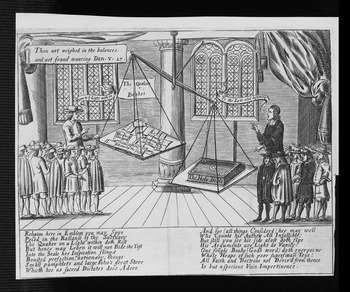
This is the context in which the various primers and catechisms prepared by George Fox and other leading Quakers in the first decades of the movement must be assessed. Fox's Catechisme for Children, that they may come to learn of Christ the Light was published in 1657 and John Perrot's A Primer for Children appeared in 1660. William Smith wrote A New Primmer in 1662 and his New Catechism appeared in 1667. Stephen Crisp's New Book for Childern dates from 1681.Footnote 16 As Kate Peters has shown, in the 1650s Quakers creatively utilized the printing press to combat their enemies and to win new converts, confident that reading a written text could be as efficacious as hearing a Quaker minister preach.Footnote 17 To their opponents within and beyond the Church of England, the importance they attached to their own writings, usurping the pre-eminent place of the sacred canon of Scripture, was arrogant, presumptuous and blasphemous: a satirical image in the Baptist minister Benjamin Keach's The Grand Imposter Discovered (1675) depicted a set of scales on which the Bible outweighed a pile of Quaker books (Fig. 1). The portable, pocket-sized library of educational textbooks they produced in the late seventeenth century reflected Friends’ continuing investment in the printed book as a didactic device and as a vital tool in building their movement.
The Quakers' books weighed in the balance: Benjamin Keach, The Grand Imposter Discovered (London, 1675), facing p. 193. Reproduced by permission of the Bodleian Libraries, University of Oxford, shelfmark 8o Z 46 (2) Th.

Although many were explicitly addressed to children and those young in years, these works were also clearly intended to be read by adults who were novices in the Quaker faith and who had yet to recognize the stirrings of grace within them. The figures of ‘Father’ and ‘Child’ in these dialogues invoke forms of spiritual as well as biological kinship. The terms are arguably deployed as much metaphorically as they are literally; it was common for early Quakers to describe newly convinced Friends as ‘new begotten babes’.Footnote 18 Their aim is to prepare their readers to perceive the Light within their souls and to experience the inner direction of the Spirit. In short, they are devised for people who are not yet Friends themselves. William Smith's primer includes passages in which the Child asks: ‘must I be born again’, and how he or she will know when this has happened. The reply is: ‘by diligent waiting in the Light, whereby thou wilt come to feel the effectual working of God's Power’. By the end the Child is better informed, but is still a probationer in the faith who has yet to be sincerely convinced.Footnote 19 Such texts seek to cultivate the conditions in which the immortal seed within people might begin to sprout and in which they will cast off the old man and be reborn as new creatures. They are not envisaged as instruments of that salvation themselves. The Herefordshire Quaker Humphrey Smith's To all Parents of Children (1660) insisted that no amount of education could bring children to Christ without the Light. They would come to be heirs of the promise of God only by divine regeneration, not by human effort. Yet it is indicative of the tensions within Quaker thinking that Smith's tract also advertised itself as an attempt to prevent iniquity from passing ‘by tradition from Parents to Children, and so from one Generation to another’.Footnote 20
These little books also serve to explain and instruct their readers in Quaker principles and values: the sect's controversial teachings regarding tithes and oaths; its refusal of hat honour and flattering titles; its use of the informal pronouns ‘thee’ and ‘thou’ instead of ‘you’ (a denial of deference to social superiors that scandalized contemporaries as impolite and disrespectful); its rejection of pagan names for the months and days of the week; and its denunciation of Anglican baptism and communion as ‘the Pope's inventions’.Footnote 21 They teach antagonism towards churches as steeple houses and false teachers, preachers, priests and professors as ‘blind Guides’ and deceiving Antichrists.Footnote 22 They also foster hostility to those who scorn and deride the people called ‘Quakers’, in the process happily embracing the derogatory nickname levelled against them as a linguistic weapon as a badge of honour.Footnote 23 In this sense they serve as mechanisms for Quaker socialization, for the inculcation of cultural habits that were already becoming emblems of identity and tokens of differentiation. This included the deployment of a vivid scriptural vocabulary, suffused with words such as ‘abomination’, ‘caterpillar’, ‘drowsiness’, ‘filthiness’, ‘heritage’, ‘lasciviousness’, ‘pestilent’, ‘reprobate’ and ‘zealous’, which Fox and Hookes taught children to spell out in syllables in the ABC that prefaced their Primmer and Catechism.Footnote 24
Thirdly, these works are devices for instructing readers in useful forms of knowledge. They are presented as edifying alternatives to the profane and frivolous books that poured from contemporary presses. Stephen Crisp presented his little textbook as ‘a fruit of the Plant of Righteousness’, published to counteract the poison ‘sprung forth of the corrupt Tree’ of conventional Christianity.Footnote 25 Fox's own concern with how children were trained up by ‘customary teaching’ found expression in an admonitory pamphlet addressed to schoolmasters and schoolmistresses in 1657, which accused these ‘fleshly’ teachers of fostering a culture of ‘filthy jesting’, backbiting, and railing, ‘brazen-facedness’, immodesty and boldness that corrupted the tender minds and manners of their pupils and drowned so many in ‘the deep Ditch’ and ‘Pit’ of vanity and lust.Footnote 26 Quaker educational texts prioritize instruction in literacy and basic arithmetic and serve as aids to Bible reading.Footnote 27 They embody the dual conviction that education cannot in and of itself bring one to Christ but that it can assist in the formation of practical skills that have utility in secular life. In a famous letter written to his wife and children in 1682, William Penn recommended ‘the useful parts of mathematics, as building houses or ships, measuring, surveying, dialling, navigation’, but reserved pride of place for agriculture, which he saw as ‘industrious, healthy, honest and of good example’. Penn instructed his spouse to ‘keep an ingenious person in the house to teach them’ rather than send them to schools, ‘too many evil impressions being commonly received there’.Footnote 28
Penn's worries aside, the emphasis on ‘useful knowledge’ served as an incentive to the movement's early foundation of schools for both boys and girls. Fox provided the stimulus for establishing one for each sex at Waltham Abbey and Shacklewell respectively in 1668, and by 1671 there were at least fifteen under the care of Quarterly Meetings.Footnote 29 Alongside mathematics and agriculture, natural science and modern languages featured prominently in the academic curriculum; in keeping with the vocational spirit of Quaker educational thinking, theology and the classics were conspicuous by their absence.Footnote 30 The vital importance that Friends attached to teaching and training the young is also reflected in the proliferation of unlicensed Quaker schoolmasters and tutorsFootnote 31 and their precocious commitment to educating the children of the poor. In 1662 Friends imprisoned in the Ilchester Friary began a school instructing local boys in the rudiments of reading, writing and bookkeeping; elsewhere they funded teachers for the offspring of the needy and indigent.Footnote 32 The society felt a moral imperative to step in where fathers and mothers could not afford to provide suitable instruction for their young. It acted in loco parentis. Indeed, the meetings conceived of themselves as a second, supplementary family that shared in the sacred responsibility of child-rearing.Footnote 33
The later seventeenth century saw further educational developments. In 1695 John Bellers issued a set of proposals for ‘raising a college of industry’ to train Friends in manufacturing trades and husbandry. Designed to bring profit to the rich, succour the poor and educate Quaker youth, this novel experiment in social welfare was a remedy for idleness akin to both a workhouse and a commune, as well as a response to Bellers's perception that few private persons had the resources or energy to give their children an ‘exact Education at Home’. This was a process which he compared with cultivating the soil in which plants grew: a sound instructor was akin to ‘a good Seeds-man’.Footnote 34 It also reflected a precocious piece of political arithmetic: in a supplementary petition to Parliament he calculated that the true annual cost of idleness was somewhere in the region of £5,200,000.Footnote 35
As the sect acquired the trappings of institutionalization, the emphasis on upbringing and nurture became more pronounced, Quakerism moved into its second and third generations and as its adherents themselves moved into a new phase of the lifecycle, the duties and responsibilities of parenthood acquired growing importance. The relationships of spiritual kinship that the sect served to forge became closely entangled with biological ties. The encompassing celestial family of Friends increasingly overlapped with those bound by blood. By the mid-eighteenth century, 80 to 90 per cent of Quakers were the children of Friends.Footnote 36
Adult Quakers naturally yearned for ways to ensure that their own offspring would find the Light within themselves. John Field's Friendly Advice … unto believing Parents and their tender Offspring (1688) was a sign of the times. It stressed the necessity of ‘Christian education’ of children as a blessing of God, taking note of the grief that unruly sons and daughters caused to mothers and fathers who ‘cockered’ and ‘fondly’ indulged them, as well as underlining the importance of keeping them away from evil influences. It concluded with the warning that parents who neglected this imperative task would have their children's blood on their hands.Footnote 37 John Banks's An Epistle to Friends (1692) provided similar words of good counsel and wholesome advice to parents and children. Urging parents to labour to restrain the wild and wanton nature of their offspring and to beget a love of the truth and of other Friends, it encouraged attendance at meetings and education at home through reading Scripture and Friends’ books. Banks firmly underlined the godly duty of parents to train up their children, who were to wait in the fear of the Lord until they felt him at work in their hearts. He acknowledged that convincement could not be taught, but implied that the groundwork could be laid by education and nurture.Footnote 38 Bellers too thought that unless ‘more Care, and a better Method’ were taken too many Quakers would ‘leave the service, and lose the Blessing of Upholding the Profession of Truth in succeeding Ages to the Families of Strangers, whilst the Posterity of the present Professors of it, may have little Share in it’.Footnote 39 Growing stress on the role of the family in the economy of salvation and upon the home as a key locus of religious instruction had the consequence of raising the profile of Quaker ‘mothers in Israel’ as spiritual educators, as Naomi Pullin has demonstrated.Footnote 40
This was accompanied by an evolving preoccupation with the ‘rising generation’. Increasingly Quakers were created not through the enthusiastic conversionary zeal that had marked the sect's first phase but by carefully cultivating the faith of one's offspring. Friends’ concern with upbringing in the setting of the family and classroom intensified.Footnote 41 The Welsh schoolmaster John Kelsall noted in his diary many meetings at which the matter of bringing up the ‘young generation … in the service of the truth’ was stressed as an imperative of the sect in the early eighteenth century. Visiting Quaker ministers, both women and men, earnestly pressed this upon their listeners, lamenting how frequently parents fell short of expectations in this respect. The future of the sect increasingly seemed to lie in and with its children, who were regarded as ‘the heritage of the Lord’.Footnote 42 As Anthony Benezet wrote to Samuel Fothergill in 1758, ‘next to our more immediate duty to God’, the education and training of youth ought to ‘be the chief concern of everyone that really desires the welfare and enlargement of the borders of Zion’.Footnote 43
It is also significant that in 1737 the London Yearly Meeting formalized the status of the children of Quakers in the rules drawn up regarding removal and settlement. The result was to make membership of what later became known as the Society of Friends a privilege of birth.Footnote 44 Declaring that ‘the right education of children, and the nurture of the young, is of very great consequence to them, and to the succeeding generation’, in 1760 the Yearly Meeting ‘pressingly’ exhorted all parents and heads of families to procure useful learning for their children and to
labour to bring them acquainted with the holy seed, which is sown by the divine hand in every heart for that gracious end: that they may, through the Lord's blessing upon such pious and paternal endeavours, be induced to place their affections upon it, and cleaving thereto in faithful obedience, come to experience it to be unto them, Christ within the hope of their glory … .Footnote 45
In 1766, it reiterated ‘the great and lasting importance of religious education to their offspring’. Directing the young ‘into the path of purity, by which they may obtain the pearl of great price’ was to be preferred over supplying them with ‘superfluous and uncertain riches’, which were all too ‘frequently the sorrowful means of their declension and ruin’. A year later the Meeting renewed the call to Quaker parents to take every opportunity to impress ‘a sense of the Divine being’ upon their children in ‘their tender years’, saying that ‘though virtue descendeth not by lineal succession, nor piety by inheritance, yet we trust the Almighty doth graciously regard the sincere endeavours of their parents, whose early and constant care is over their offspring for their good; who labour to instruct them in the fear of the Lord’.Footnote 46 Such statements reflected the conviction and hope that although saving faith was not hereditary, a salutary environment might be conducive to instilling in children a sincere and lifelong commitment to Quakerism.
In this task parents were to be aided by professional educators. The London Yearly Meetings repeatedly emphasized the need to recruit schoolmasters and mistresses who were faithful Friends, and their proliferation flew in the face of official efforts to maintain an Anglican monopoly on education through the continuing harassment of Quaker teachers, especially following the Schism Act of 1714.Footnote 47 Sending one's children to Quaker schools became a way of keeping them uncontaminated by contact with the wider world and protecting them from ‘the wiles of Satan’. Parents were advised against allowing their offspring to enrol for training and apprenticeship with those outside the society. The Yearly Meeting repeatedly stressed the need for children to be given ‘a suitable and guarded education … by which they may be prevented from mixing with others not of our religious persuasion’. By the 1770s, schools were envisaged as places of quarantine from the ‘hurtful habits’ of the world.Footnote 48
These are telling symptoms of the rise of birthright Quakerism, a trend that, paradoxically, had intensified after the Act of Toleration of 1689. Just at the moment when Quakers had more room for manoeuvre, they also turned inward to focus ever more attention on consolidation within the forum of the family through intermarriage and by preventing the haemorrhage of the young. Catechisms and primers became instruments of indoctrination in a theology that was solidifying, especially through the Scottish Quaker Robert Barclay's Apology, into written form.Footnote 49 Experiences of regeneration themselves changed between the first and second generations, as Nikki Coffey Tousley has shown, with confident assurance giving way to greater doubt in the sphere of discernment.Footnote 50
However, the inherent tensions within Quaker attitudes to education continued to rear their heads. There was growing anxiety about the fact that ‘mere education’ was taking the place of the tumultuous emotional experience of rebirth and regeneration: it was becoming an ersatz substitute for the empowering zeal felt by the sect's founders and first converts. Like the plain testimonies of simple dress, hat honour and levelling language, it was congealing into custom. It is telling that some of the frictions that led to schismatic divisions within the movement in North America during the 1690s centred on unease about these very developments. A hallmark of this group, which was led by George Keith, was its insistence that the children of Friends should themselves be obliged to demonstrate their own sincere convincement when they came to years of discretion. Their parents were required to register the dates of their ‘Spirituall Birth’ as well as their ‘outward birth’ in the Monthly Meeting register.Footnote 51 John Hands's Seasonable Epistle of 1705 included a section addressed specifically to ‘those that are Friends by Education, but not by Conversion’, seeking to rouse them to a true realization of the seed within, while John Crook called upon the children and servants of believing parents and masters to examine themselves and assess whether they had derived their religion simply ‘by Tradition, only because of your outward Relations’, rather than by the ‘inward Work of God’ upon their souls.Footnote 52 The compelling criticism that Barclay had levelled against the early church – that when men and women became Christians ‘by birth and education, and not by conversion, and renovation of Spirit’, then ‘Christianity came to be lost’, ‘and nothing remained but a shaddow and image’ – had come home to roost among the Friends themselves.Footnote 53 In this way, Quakerism faced some of the same problems that beset New England puritanism in the wake of the Halfway Covenant of 1662, which extended the right of baptism to the children of visible saints, a decision that provoked anguish in some quarters even as it offered comfort to worried parents.Footnote 54 Although Friends repudiated the exclusivist doctrine of election and reprobation that underpinned congregational ecclesiology, they too drifted towards the view that faith could be passed down the generations. Biological kinship and spiritual kinship converged steadily.
By the early eighteenth century, education in the guise of a devout and careful upbringing was increasingly perceived as key to the survival of the society, but the deep-seated ambivalence about learning that had been at the heart of Quakerism from the beginning persisted. Quaker theology was conducive to recognizing the power and agency of nurture, both through its repudiation of predestination in favour of the theoretical possibility of universal salvation and through its resistance to Augustinian teaching on original sin and its stress on childhood as a state of innocence. This partly helps to explain why Friends placed so much emphasis on the merits of utilitarian education and vocational training. However, the sect's radical insistence on feeling the emotional upheaval of an internal conversion experience wrought in the soul by the only true ‘teachers’, the Light of Christ and the Holy Spirit, ultimately rendered human strategies for spiritual instruction ineffectual and futile. Eighteenth-century Quakerism was thus caught between a rock and a hard place.