INTRODUCTION
The objective of this study was to date and reconstruct the diet of Early to Middle Neolithic cultures in the Russian Far East. In recent years, carbon and nitrogen isotope ratios of charred residues on pottery unearthed from archaeological sites have provided information about prehistoric diets (e.g. Craig et al. Reference Craig, Saul, Lucquin, Nishida, Tache, Clarke, Thompson, Altoft, Uchiyama, Ajimoto, Gibbs, Isaksson, Heron and Jordan2013; Lucquin et al. Reference Lucquin, Gibbs, Uchiyama, Saul, Ajimoto, Eley, Radini, Heron, Shoda, Nishida, Lundy, Jordan, Isaksson and Craig2016). The authors have engaged in such studies in northeast Asia. At the Ustinovka 8 site in the Russian Far East, we investigated differences in radiocarbon ages of charcoal and residues on pottery and demonstrated that carbon and nitrogen isotope ratios in charred residues on pottery can be used for dietary reconstruction (Kunikita et al. Reference Kunikita, Yoshida, Miyazaki, Saito, Endo, Matsuzaki, Ito, Kobayashi, Fujimoto, Kuznetsov, Krupyanko and Tabarev2007). In the same study, we described the possibilities that marine resources (including salmon and trout) were used by the Zaisanovka culture of the Late Neolithic and millet was used by the Lidovka culture of the Bronze period. We also attempted to date and reconstruct diet on the basis of the world’s earliest emergence of pottery, and identified the use of marine resources at the Taisho 3 site in Hokkaido (Kunikita et al. Reference Kunikita, Shevkomud, Yoshida, Onuki, Yamahara and Matsuzaki2013). Our findings led to the conclusion that the cultural transitions in the East Asian region occurring during the Neolithic period should be understood as broad-based changes. Identifying the age and subsistence activities of regional cultural groups is thus important for discussing the process of cultural formation.
The present article examines the transition of cultural groups in the Russian Far East and attemptd to reconstruct their diet on the basis of pottery residues. A variety of cultural groups arose in northeast Asia between the late Early Neolithic and the Middle Neolithic periods. In the Russian Far East, known groups include the Rudnaya, Boisman, and Vetka cultures; the ages of these cultures have been discussed in various studies (e.g. Kuzmin et al. Reference Kuzmin, Jull, Orlova and Sulerzhitsky1998; Kuzmin Reference Kuzmin2006, Reference Kuzmin2012). Large numbers of human bones have been excavated from the Boisman culture; based on dietary analysis of the collagen content of these bones, this group has been shown to have successfully adapted to the maritime environment (Kuzmin et al. Reference Kuzmin, Richards and Yoneda2002). One of the major challenges when dating artifacts in northeast Asia stems from the fact that sites often include multiple cultural strata; in such cases, carefully excavated sites with clear stratigraphy give us reliable dates. Therefore, this study focused on analysis of residues on pottery, which can be dated directly. Analyses of charred residues on pottery have been reported for Japan, Sakhalin, and the Amur River region, but few studies have addressed this subject in the Primorye. Examples have been reported for Sakhalin (Kuzmin et al. Reference Kuzmin, Vasilevski, Gorbunov, Burr, Jull, Orlova and Shubina2004) and the Amur River Basin (Shevkomud and Kuzmin Reference Shevkomud and Kuzmin2009; Morisaki and Sato Reference Morisaki and Sato2015). The present study constructed a cultural chronology on the basis of pottery residues and reconfirms the existence of the Boisman culture, which has been described as a group that was well adapted to the maritime environment. Pottery residues containing marine resources will appear older than contemporaneous terrestrial substances, such as charcoal, based on carbon and nitrogen isotope analysis due to the marine 14C reservoir effect. The difference in 14C age of marine and terrestrial organisms is around 300–800 yr in regions such as Hokkaido where deep ocean currents from the North Pacific rise to the surface (Kunikita et al. Reference Kunikita, Yoshida, Miyazaki and Matsuzaki2006), 310–575 yr at the Malaya Gavan site in the Amur River region (Kunikita et al. Reference Kunikita, Shevkomud and Yoshida2011), and around 400 yr at the Ustinovka 8 site. The R value for the Sea of Japan has been estimated as 400 yr (Kuzmin et al. Reference Kuzmin, Burr and Jull2001, Reference Kuzmin, Burr, Gorbunov, Rakov and Razjigaeva2007). For the measurements in this study, the difference in 14C age was estimated to be 400 yr based on previous estimates for the Ustinovka 8 site, due to its geographical proximity to the study sites. These dates were assumed to result from anadromous fish (i.e. salmon), not freshwater fish.
MATERIALS AND METHODS
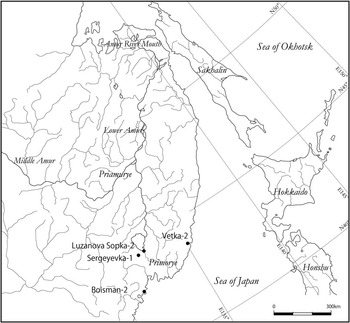
The samples analyzed herein were obtained from four archaeological sites in the Primorye: Luzanova Sopka 2, Sergeyevka 1 (Batarshev and Popov Reference Batarshev and Popov2008), Boisman 2 (Popov Reference Popov2008), and Vetka 2. The Luzanova Sopka 2 and Sergeyevka 1 sites are located approximately 200 km inland from Vladivostok, near Lake Khanka. The Boisman 2 and Vetka 2 sites are located in coastal areas (Figure 1). A total of 27 samples were analyzed, 4 from the Rudnaya culture, 19 from the Boisman culture, and 4 from the Vetka culture (Table 1). Of those from the Boisman culture, six samples were of the newly designated the proto-Boisman type pottery (Moreva Reference Moreva2005). This proto-Boisman-type pottery was excavated from the bottom stratum of the Boisman 2 site and is believed to mark the origin of the Boiman culture.
Map of northeast Asia showing the four site locations in this study

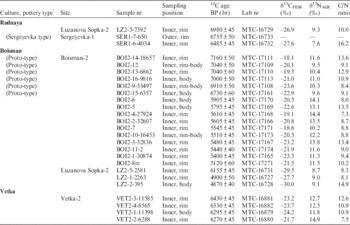
14C ages and δ13C, δ15N, and C/N values of samples.

Sample preparation for 14C dating was conducted following the methods of Yoshida et al. (Reference Yoshida, Ohmichi, Kinose, Iijima, Oono, Abe, Miyazaki and Matsuzaki2004). The concentration of the alkali treatment for the charred remains on pottery was set at a level at which the test sample did not dissolve completely. The measurements were conducted using the Micro Analysis Laboratory, Tandem accelerator (MALT) of the University Museum at the University of Tokyo. The C/N analysis of the carbon-nitrogen isotope ratio was conducted using a DELTA V stable isotope ratio mass spectrometer (Thermo Fisher Scientific Company) at the SI Science Company, Japan.
RESULTS AND DISCUSSION
Radiocarbon Dating
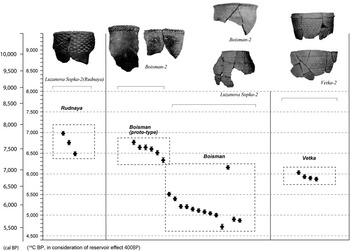
Table 1 and Figure 2 present the 14C dates and the carbon and nitrogen isotope ratios of the charred materials. The four samples from Rudnaya culture were dated from 9080 to 6485 BP, the six proto-Boisman type samples from 7160 to 6730 BP, the 13 Boiman culture samples from 5905 to 4870 BP, and the four Vetka culture samples from 6430 to 6270 BP. Charcoal from the Rudnaya Pristan, the site type of the Rudnaya culture, has been dated from 7690 to 7390 BP, while charcoal from the Chertovy Vorota site has been dated from 6825 to 5890 BP (Kuzmin et al. Reference Kuzmin, Jull, Orlova and Sulerzhitsky1998). At the Chertovy Vorota site, human bones have been dated to 7110 and 7010 BP, which, after correcting for the marine 14C reservoir effect, become 7020 and 6920 BP, respectively (Kuzmin et al. Reference Kuzmin, Richards and Yoneda2002). The authors have also dated pottery residues from the Ustinovka 8 site to between 7020 and 6770 BP. One of the samples from the Rudnaya culture dated in this study was found to be extremely old (9080 BP, MTC-16730), whereas the others were dated from 6980 to 6485 BP, close to the dates reported for the Chertovy Vorota site. Given the low carbon content of the specimen dated to 9080 BP (24%) and the fact that only a single specimen of that date was found, we will postpone discussion of this specimen until other specimens of a similar age are obtained. The Rudnaya culture persisted over an extremely long period, and some researchers have proposed dividing it into an earlier Rudnaya stage (7700–6500 BP) and a later Sergeyevka stage (6500–6000 BP). In this study, Sergeyevka-type specimens were dated to 6755 and 6485 BP, close to the transition from the Rudnaya stage to the Sergeyevka stage. Our measured dates of 6980–6485 BP translate to calibrated dates of approximately 7800–7400 cal BP. The dates obtained in this and previous studies are believed to correspond to the early stage of the Rudnaya culture; the transition in subsistence activities of the Rudnaya culture will be a focus for further study.
Radiocarbon ages and calibrated ages of the Rudnaya, Boisman, and Vetka cultures

Age estimates for the Boisman culture obtained in our study can be compared to previously reported age estimates based on charcoal and human bones found at the Boisman 2 site. Kuzmin et al. (Reference Kuzmin, Jull, Orlova and Sulerzhitsky1998) and Kuzmin (Reference Kuzmin2012) dated the Boisman culture artifacts to between 6355 and 4470 BP. They also dated nine specimens of human bone to between 6080 and 5690 BP, which, after correction for the marine 14C reservoir effect, translates to 5780–5390 BP (Kuzmin et al. Reference Kuzmin, Richards and Yoneda2002). Residues on the proto-Boisman type pottery have previously been dated to 7010 BP (Kuzmin Reference Kuzmin2012). In this study, we dated the proto-Boisman type pottery to between 7160 and 6730 BP and the Boisman culture specimens to between 6155 and 4870 BP. The ages for the proto-Boisman type pottery were similar to those for the pottery residues. As described below, the majority of these specimens are likely affected by the presence of marine products, meaning that the marine 14C reservoir effect must be taken into account, and that the specimens are ~400 yr younger than their 14C ages indicate (Kuzmin et al. Reference Kuzmin, Burr and Jull2001, Reference Kuzmin, Burr, Gorbunov, Rakov and Razjigaeva2007; Kunikita et al. Reference Kunikita, Yoshida, Miyazaki, Saito, Endo, Matsuzaki, Ito, Kobayashi, Fujimoto, Kuznetsov, Krupyanko and Tabarev2007). The Boisman culture specimens other than those from the Luzanova Sopka 2 site, which were unaffected by marine products, were dated from 5505 to 4720 BP (5905 to 5120 BP, in consideration of reservoir effect 400 BP). This date range is consistent with the dates reported in the aforementioned studies. The proto-Boisman-type pottery specimens were confirmed to be older than those from the Boisman culture, which is consistent with their stratigraphic relationship within the site. The calibrated ages of the former specimens were between 7600 and 7300 cal BP, whereas those of the latter specimens ranged from 7100 to 5400 cal BP. Charred materials from burned dwellings associated with the Vetka culture have been dated to between 6010 and 5830 BP. We dated our Vetka culture specimens to between 6430 and 6270 BP on the basis of pottery residues; when the marine 14C reservoir effect is taken into account, the range becomes 6030–5870 BP. This is highly consistent with the dating of charred materials in previous studies, and translates to calibrated dates of approximately 6900–6700 cal BP. These results suggest that the cultures in the Russian Far East evolved in the following order: early-stage Rudnaya culture, late-stage Rudnaya culture and proto-Boisman type, early-stage Boisman culture and Vetka culture, and late-stage Boisman culture.
FOOD HABITS BASED ON ISOTOPE ANALYSIS
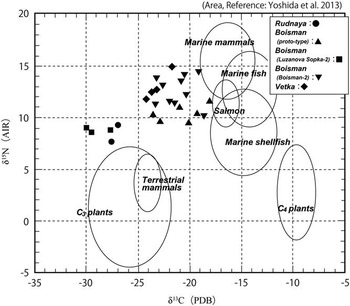
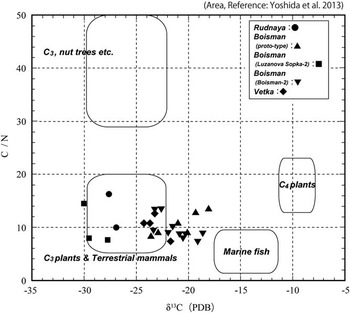
Figures 3 and 4 present carbon and nitrogen isotope ratios and C/N values of the charcoal found on the inner surfaces of pottery from the Rudnaya, Boisman (proto-type), Boisman (Luzanova Sopka 2 site), Boisman (Boisman 2 site), and Vetka cultures. The ovals indicate the typical distribution of the native food sources collected in the Japanese archipelago and the North Pacific (Yoshida and Nishida Reference Yoshida and Nishida2009; Yoshida et al. Reference Yoshida, Kunikita, Miyazaki, Nishida, Miyao and Matsuzaki2013). Since the influence of an impure ingredient can be considered, the samples of outer on pottery were not measured carbon and nitrogen isotope ratios and C/N values.
Carbon and nitrogen isotope ratios of the charcoal found on the inner surfaces of pottery from the study sites

Carbon isotope ratios and C/N values of the charcoal found on the inner surfaces of pottery from the study sites

Carbon and nitrogen isotope ratios and C/N ratios of all the specimens fell in the range between marine and terrestrial products. The most notable observation was that the ratios differed between inland and coastal sites. The specimens from inland sites had carbon isotope ratios lower than –25‰ (–26.9 to –30.0‰), and nitrogen isotope ratios lower than 10‰ (7.6 to 9.3‰). In contrast, the specimens from coastal sites tended to have carbon isotope ratios higher than –25‰ (–18.1 to –24.2‰), and nitrogen isotope ratios higher than 9.0‰ (9.5 to 14.9‰). The nitrogen isotope ratios of the former specimens were relatively high (9‰), indicating that the diet consisted of inland organisms, mainly freshwater fish; the nitrogen isotope ratios of the latter specimens show the influence of salmon, trout, and other marine organisms. Therefore, we needed to account for the marine 14C reservoir effect in specimens from coastal areas. However, many specimens had carbon isotope ratios of around –24‰, and it is possible that they comprised a mixture of marine and terrestrial specimens. Although little basic data on the distribution of carbon and nitrogen isotope ratios for freshwater fish are available, we believe that carbon isotope ratios range between –25‰ and –30‰ and that nitrogen isotope ratios are around 10‰ (data not shown). The C/N ratio graph (Figure 4) shows little change in C/N ratio between different cultures, suggesting that the cultures made little use of nuts and other foods with low nitrogen content. A comparison of cultures showed little difference between samples from the Rudnaya (δ13C –27.6 and –26.9‰, δ15N 7.6 and 9.3‰) and Boisman cultures (δ13C –30.0 to –27.7‰, δ15N 8.7 to 9.1‰), which both came from inland sites. In contrast, slight differences in nitrogen isotope ratios were observed between the coastal proto-Boisman-type pottery specimens and those from the Boisman and Vetka culture. The nitrogen isotope ratios of the proto-Boisman-type pottery specimens tended to be low (9.5–11.6‰), whereas those of the Boisman and Vetka culture specimens tended to be slightly higher (10.2–14.9‰). This may indicate that the Boisman culture became increasingly adapted to the maritime environment over time. The pottery residue data from this study are consistent with the results of previous analysis of bone collagen (Kuzmin et al. Reference Kuzmin, Richards and Yoneda2002), which indicate that the Boisman culture was adapted to the maritime environment. The people of inland cultures around Lake Khanka likely made greater use of freshwater fish and terrestrial animals and plants than salmon and trout.
CONCLUSION
This study used 14C dating, carbon and nitrogen isotope composition, and C/N ratios to analyze the diet of Neolithic cultural groups in the Primorye in the Russian Far East. Our results from pottery residue samples confirmed and further refined the age estimates of cultural transitions reported in previous studies. We obtained dates from the late-stage Rudnaya culture (6980–6485 BP, 7800–7400 cal BP), proto-Boisman type (6760–6330 BP, 7600–7300 cal BP), Boisman culture (6155–4720 BP, 7100–5400 cal BP), and Vetka culture (6030–5870 BP, 6900–6700 cal BP). The analyses of carbon and nitrogen isotope composition and C/N ratios reveal differences between inland and coastal sites. The results seem to indicate that the diet of inland cultures consisted primarily of freshwater fish and terrestrial animals and plants, whereas that of coastal cultures consisted mainly of marine organisms. Our results suggest that the dietary differences between cultures were more dependent on the types of food that were locally available. However, it has been pointed out that the stable isotope data on charred food residues are still not the best indicators of the types of food used (Heron and Craig Reference Heron and Craig2015). As we see in a recent study (Lucquin et al. Reference Lucquin, Gibbs, Uchiyama, Saul, Ajimoto, Eley, Radini, Heron, Shoda, Nishida, Lundy, Jordan, Isaksson and Craig2016), for 54 samples of the Incipient Jomon (13,800–10,900 cal BP) with active use of aquatic food (mostly marine fish), the charred food residues are characterized by δ13C –26.8 to –22.2‰, δ15N 3.2 to 13.0‰. Therefore, the higher δ15N values are not always an undeniable indicator of marine food, unless δ13C and δ15N values for compound-specific markers are studied. We will continue to investigate cultural transitions and diet in greater detail on the basis of further analysis of younger stages of the Neolithic period and the Paleometal period.
ACKNOWLEDGMENTS
The authors would like to thank the staff of the Micro Analysis Laboratory, Tandem accelerator (MALT) and Radiocarbon Dating Laboratory, The University Museum, The University of Tokyo. We are grateful to the reviewers and editors of Radiocarbon for assistance with work on this paper. This work was supported partly by the Grant-in-Aid for Scientific Research of the Japan Society of the Promotion of Science (JSPS) (subject #: 15K16867, 23720379, and 23251014).