Introduction
Shared book reading between parents and their children is an important home literacy activity that can have a lasting impact on children’s language and emergent literacy development (Barnes & Puccioni, Reference Barnes and Puccioni2017; Bus, van IJzendoorn, & Pellegrini, Reference Bus, van IJzendoorn and Pellegrini1995; Reese, Sparks, & Leyva, Reference Reese, Sparks and Leyva2010). Through reading, parents can help scaffold and promote vocabulary development, knowledge of print concepts, phonological awareness, and narrative skills (Bus et al., Reference Bus, van IJzendoorn and Pellegrini1995; Dowdall et al., Reference Dowdall, Melendez-Torres, Murray, Gardner, Hartford and Cooper2020). Therefore, it is important to consider the frequency with which parents read, and the quality of extra-textual discussions that parents engage in while reading. Research in typical development (TD) has demonstrated that children’s language and literacy improves when parents provide input that is linguistically challenging and engaging but also adapted to a child’s developmental level (Bruner, Reference Bruner1981; Dickinson & Tabors, Reference Dickinson and Tabors2001; Rowe, Reference Rowe2012).
Repeated exposure to high-quality book reading experiences may be particularly important for children who are at risk for language impairments, including children with Down syndrome (DS). In addition to intellectual disability, children with DS present with language impairments early in life (Abbeduto, Warren, & Conners, Reference Abbeduto, Warren and Conners2007). In particular, children’s expressive vocabulary, grammar, and emergent literacy skills are often lower than would be expected given their nonverbal mental age and chronological age (Abbeduto et al., Reference Abbeduto, Warren and Conners2007; Kay-Raining Bird & Chapman, Reference Kay-Raining Bird, Chapman, Burack, Hodapp and Zigler2011). Thus, it is crucial to understand children’s early language learning experiences and how they may impact linguistic development in DS.
Given the rich opportunities that shared book reading provides, a growing number of studies have begun to specifically examine the reading practices of parents of children with DS. Surveys show that most parents of children with DS engage in shared book reading regularly, begin shared book reading at an early age, and are highly motivated to read with their child (Al Otaiba, Lewis, Whalon, Dyrlund, & McKenzie, Reference Al Otaiba, Lewis, Whalon, Dyrlund and McKenzie2009; Lusby & Heinz, Reference Lusby and Heinz2020; Ricci, Reference Ricci2011; van Bysterveldt, Gillon, & Foster-Cohen, Reference van Bysterveldt, Gillon and Foster-Cohen2010). Moreover, parents report tailoring their book reading practices to meet the needs of their child (Ricci, Reference Ricci2011). When assessing the quality of mother-child book reading interactions, Barton-Hulsey, Lorang, Renfus, and Sterling (Reference Barton-Hulsey, Lorang, Renfus and Sterling2020) found that mothers of children with DS used a greater number of utterances that were similar in vocabulary diversity but reduced in grammatical complexity compared to mothers of children with TD matched on chronological age. Mothers of children with DS used more questions, descriptions, labels, and gestures, whereas mothers of children with TD used more utterances to read verbatim to their child. Mothers of children with DS also provided a larger quantity of input to children with DS with lower receptive language skills. These findings highlight how mothers of children with DS may be uniquely adapting their input during book reading.
However, prior research has focused almost exclusively on mothers, despite the fact that research in TD has demonstrated that fathers play an essential and unique role in children’s language development (Cutler & Palkovitz, Reference Cutler and Palkovitz2020). Fathers may communicate with their children differently than mothers, and in some cases use language that is more complex and conversationally demanding (e.g., more diverse vocabulary and Wh-questions; Duursma, Reference Duursma2016; Malin, Cabrera, & Rowe, Reference Malin, Cabrera and Rowe2014; Rowe, Coker, & Pan, Reference Rowe, Coker and Pan2004). In turn, TD children tend to produce longer, more complex utterances with fathers (Rowe et al., Reference Rowe, Coker and Pan2004). Moreover, the quality of paternal language input uniquely contributes to children’s language and literacy development over and above maternal contributions (Pancsofar & Vernon-Feagans, Reference Pancsofar and Vernon-Feagans2006, Reference Pancsofar and Vernon-Feagans2010).
However, to our knowledge, only one study has examined paternal language input to children with DS. de Falco, Venuti, Esposito, and Bornstein (Reference de Falco, Venuti, Esposito and Bornstein2011) found that during a free-play interaction, mothers used more descriptive language (i.e., comments regarding the child, parent, or environment) than fathers. Yet, mothers and fathers did not differ on the use of directives, questions, and affect-salient input (e.g., praise, discouragement). Although this work is informative, several questions remain. First, it is unclear how fathers engage with their children during other naturalistic activities, namely shared book reading, and whether their input differs in meaningful ways from mothers. Additionally, research has yet to examine how fathers may vary their language input as a function of their child’s language abilities. Evaluating father-child interactions on a broader range of input variables could also provide a more comprehensive profile of how fathers are supporting their children’s language development.
Research in TD has shown that most language (~90%) directed towards children is considered to be contextualized, or focused on the here and now (e.g., directives, questions, descriptions, conversational language; Rowe, Reference Rowe2012). Conversely, decontextualized talk refers to more complex, abstract input that often expands on or moves beyond the information presented in the immediate context (e.g., the book). Examples include making connections to past/future experiences (i.e., narrative talk; “There’s a farm like daddy used to live on.”), engaging in pretend talk (e.g., “Shh. She’s sleeping. Let’s be quiet [referring to a book character].”), and providing logical explanations, predictions, or definitions (i.e., explanatory talk; “Well cereal goes in a bowl too. But that is soup.”). While decontextualized input occurs less frequently, research in TD has found that it is often a stronger predictor of preschool children’s language and emergent literacy development than contextualized input (Demir, Rowe, Heller, Goldin-Meadow, & Levine, Reference Demir, Rowe, Heller, Goldin-Meadow and Levine2015). Decontextualized input is thought to be particularly beneficial because it models the language children will be exposed to in school (e.g., narratives, causal frameworks), and it is more lexically diverse and grammatically complex than contextualized input (Demir et al., Reference Demir, Rowe, Heller, Goldin-Meadow and Levine2015; Leech, Wei, Harring, & Rowe, Reference Leech, Wei, Harring and Rowe2018). There is also evidence that fathers of children with TD use more decontextualized input than mothers during book reading (Duursma, Reference Duursma2016). Thus, this is an important area for investigation among both mothers and fathers.
As such, the aims of this exploratory study were to (1) compare the quantity and quality of input provided by mothers and fathers of children with DS during separate parent-child shared book reading interactions, and (2) examine the relationship between parental input and various child characteristics (e.g., chronological age, language ability). Building on prior research (Barton-Hulsey et al., Reference Barton-Hulsey, Lorang, Renfus and Sterling2020; de Falco et al., Reference de Falco, Venuti, Esposito and Bornstein2011), quantity was evaluated in terms of total number of utterances and quality was evaluated in terms of linguistic characteristics (e.g., grammatical complexity and lexical diversity) and the function of parental input (e.g., proportion of reading verbatim as well as extra-textual talk that was contextualized or decontextualized). Overall, addressing these aims will provide crucial insight into the early home literacy experiences of children with DS, and the unique contribution of paternal input during book reading. Findings could also inform the development of parent-mediated language interventions, highlighting ways to effectively involve both mothers and fathers in order to maximize language and literacy gains for young children with DS.
Methods
Participants
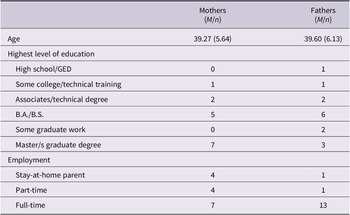
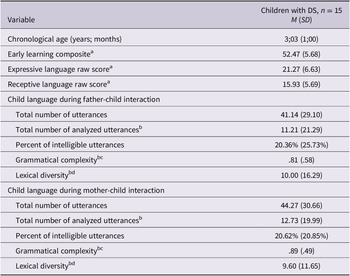
Participants included 15 verbally expressive children with DS (seven females) and their biological mothers and fathers. Children ranged from 2;0 to 5;01 years of age (M = 3;03, SD = 1;0) and lived in two-parent households. Families were recruited from clinics, early intervention programs, and DS centers near Madison, Wisconsin, USA, and they provided genetic documentation of trisomy 21. All parents reported their children were non-Hispanic/Latinx and White, and the primary language spoken in the home was English. See Table 1 for more information on parent characteristics and Table 2 for more information on child characteristics.
Parent Characteristics

Note. Standard deviation is in parentheses.
Child Characteristics

Note. aBased on the Mullen Scales of Early Learning (Mullen, Reference Mullen1995). bBased on SALT transcripts. cMeasured via MLU. dMeasured via NDW.
General procedure
All procedures were approved by the institutional review board, and written informed consent was obtained from parents. Procedures included an assessment of children’s developmental level and the shared book reading interactions of mother-child and father-child dyads. Assessments took place in the families’ homes over the course of two visits.
Measures
Developmental assessment
The Mullen Scales of Early Learning (MSEL; Mullen, Reference Mullen1995) is a play-based developmental assessment. A trained examiner administered four subscales: Visual Reception, Fine Motor, Expressive Language, and Receptive Language. This provided a composite score (standard score: M = 100; SD = 15) of children’s developmental level. We also calculated the raw expressive and receptive language scores, which were utilized in subsequent analyses (See Table 2). Raw language scores were used in the analyses because past research has suggested they are less prone to floor effects compared to standard scores (Mervis & Klein-Tasman, Reference Mervis and Klein-Tasman2004).
Shared book reading
Language samples were obtained from video recordings of mother-child and father-child dyads separately engaging in book reading. While interactions ranged from 8 ½ to 12 minutes, we analyzed the first 8 minutes immediately following the examiner’s directions for consistency across interactions. Examiners directed parents to interact as they typically would when reading with their child. Mothers and fathers were provided with the same five board books, which were selected because of their appropriateness for preschool-aged children. However, on three occasions, parents also used their own books to support continued child participation. The order of interactions was counterbalanced, and book reading activities did not occur consecutively.
Coding of parent and child language
Using the Systematic Analysis of Language Transcripts (SALT) software conventions (Miller, Andriacchi, & Nockerts, Reference Miller, Andriacchi and Nockerts2011), language samples were transcribed by trained research assistants from video files. Transcripts were used to obtain the following dimensions of child, maternal, and paternal language: total number of analyzed utterances, grammatical complexity (i.e., mean length of utterance in morphemes [MLU]), lexical diversity (i.e., number of different words [NDW]), as well as the percent of intelligible utterances among children. All variables were calculated out of the total number of analyzed utterances (e.g., excluded unintelligible and abandoned utterances), except for percent intelligibility and lexical diversity, which were calculated using all utterances. The video file was corrupted for one father-child dyad and was not transcribed. Therefore, subsequent group comparisons (i.e., paired sample t-tests) between mothers and fathers only included 14 mother-child and 14 father-child dyads, whereas correlational analyses included 15 mother-child dyads and 14 father-child dyads.
To obtain transcription reliability, 24% of the audio files were transcribed by a second transcriber. Reliability was calculated for parents and children separately, and included utterance segmentation, number of morphemes, number of words, word identification, and intelligibility. Overall agreement was 88.85% across the parental variables (85.92 – 96.48%) and 78.69% across the child variables (46.49 – 95.18%). Because reliability fell below 80% for two of the child variables – utterance segmentation (67.33%) and word identification (46.49%) – the two transcribers separately transcribed the 29 files and then met to discuss disagreements and came to 100% agreement on all child utterances.
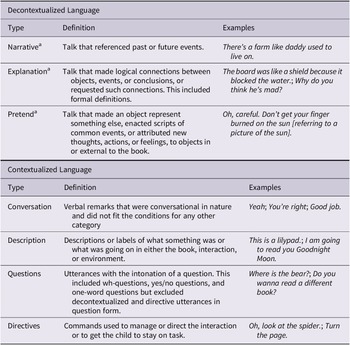
The language samples were also coded for the function of parental input. First, the primary coder went line-by-line to identify when parents were reading or using decontextualized or contextualized input. Reading utterances included instances when the parent read the text of the book verbatim. Using a modified version of Rowe’s (Reference Rowe2012) coding scheme, decontextualized language was categorized as narrative, explanatory, and pretend talk. All other utterances directed towards the child were considered contextualized. Utilizing coding schemes adapted from Barton-Hulsey et al. (Reference Barton-Hulsey, Lorang, Renfus and Sterling2020) and de Falco et al. (Reference de Falco, Venuti, Esposito and Bornstein2011), contextualized utterances (main code) were further categorized as directives, questions, descriptions, or conversation (supplemental codes). See Table 3 for definitions and examples of these variables.
Description of Functional Categories

Note. aThe definitions used for the decontextualized input categories are adapted from Rowe (Reference Rowe2012).
Proportions were calculated out of the total number of analyzed utterances to control for variability in input quantity (Bryce & Jahromi, Reference Bryce and Jahromi2013; Zampini, Fasolo, & D’Odorico, Reference Zampini, Fasolo and D’Odorico2012). Based on previous research (McHugh, Reference McHugh2012), coding reliability was calculated line-by-line using percent agreement. Agreement was achieved when the primary and secondary coder marked all the same main codes (e.g., contextualized) and supplemental codes (e.g., type of contextualized language) on a given parent utterance. The primary and secondary coder independently coded 21% of the language samples and reached 90.8% (88 - 94%) agreement.
Data analysis plan
Aim 1
We ran a series of paired samples t-tests to examine differences between mothers (n = 14) and fathers (n = 14) in the quantity and quality of their input. Quantity was measured by the total number of utterances. Quality included grammatical complexity, lexical diversity, and the proportion of reading, decontextualized talk, conversation, description, questions, and directives. We collapsed across decontextualized categories here and in subsequent analyses because parents used this type of input infrequently. Effect sizes were interpreted as small (d = .20), medium (d = .50), and large (d = .80; Cohen, Reference Cohen1988).
Aim 2
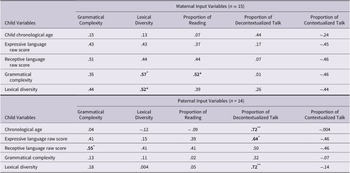
To investigate the relationship between parent input and child characteristics separately for mother-child (n = 15 dyads) and father-child dyads (n = 14 dyads), we utilized Pearson correlations. Parental input included grammatical complexity, lexical diversity, and the proportion of reading, decontextualized, and contextualized input. We collapsed across contextualized categories to reduce the number of correlations and because there were few differences that emerged between parents for contextualized input. Child characteristics included chronological age and language ability (i.e., expressive and receptive language raw scores, grammatical complexity, and lexical diversity).
Results
Aim 1. Differences between mother and father input
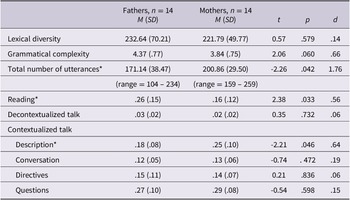
Paired samples t-tests revealed that mothers produced more utterances and used a higher proportion of descriptive language than fathers. However, fathers used a higher proportion of reading utterances. Parents did not differ on any other type of input. See Table 4 for descriptive and inferential statistics.
Overall Quantity and Quality of Parental Input

Note. Proportions are calculated out of the total number of utterances. *p < .050.
Aim 2. Correlations between child characteristics and parent input
Child chronological age
A positive association was found between child chronological age and the proportion of paternal decontextualized input. No other significant associations were found (Table 5).
Correlations Between Child Characteristics and Parent Input

Note. *p < .050; **p < .010.
MSEL scores
Child expressive language raw scores were positively associated with the proportion of paternal decontextualized input. For receptive language, child receptive language raw scores were also positively associated with paternal grammatical complexity (Table 5).
Child language during book reading
Child grammatical complexity and lexical diversity were positively related to maternal lexical diversity. Similarly, child grammatical complexity was positively related to the proportion of maternal reading. Moreover, child lexical diversity was positively related to paternal decontextualized input (see Table 5).
Post-hoc analyses
Because reading and decontextualized input were generally positively associated with child language whereas contextualized input was not associated, analyses were conducted post-hoc to compare the linguistic characteristics of these types of input. Using SALT, grammatical complexity (MLU) and lexical diversity were obtained separately for reading, decontextualized, and contextualized utterances. Type-token-ratio (TTR), or the number of different words divided by the total number of utterances, was selected to represent lexical diversity rather than NDW because these three types of input varied greatly in terms of total number of utterances (reading = 38.07 (23.22); decontextualized = 4.38 (4.04); contextualized = 145.38 (45.29)), thus making comparisons of NDW difficult to interpret. Repeated-measures analysis of variance were conducted for mothers and fathers separately, and the same pattern of findings emerged for both parents. A significant main effect of input type was found for grammatical complexity, F(2, 22) ≥ 11.39, ps ≤ .001, 𝜂p2 ≥ .62, where reading and decontextualized utterances did not differ from one another, ps = 1.00, but both were more grammatically complex than contextualized utterances, ps ≤ .020. A significant main effect was also found for TTR, F(2, 22) = 36.47, p ≤ .001, 𝜂p2 ≥ .77. Decontextualized utterances had larger TTRs than reading and contextualized utterances, ps ≤ .023, and reading utterances had larger TTRs than contextualized utterances, p ≤ .001.
Discussion
Shared book reading has facilitative effects on children’s language and literacy development (Barnes & Puccioni, Reference Barnes and Puccioni2017; Bus et al., Reference Bus, van IJzendoorn and Pellegrini1995). However, few studies have directly examined the book reading behaviors of parents of preschool age children with DS, particularly among both mothers and fathers. Thus, the first aim of our study was to compare the quantity and quality of maternal and paternal input. Although parents did not differ in their proportion of decontextualized talk, conversational language, directives, and questions, we found that mothers said more and used a greater proportion of descriptive language than fathers. In contrast, fathers spent a greater proportion of the time reading the book text. It is also of note that a medium effect size (d = .66) emerged for grammatical complexity, with fathers using more grammatically complex input than mothers. This is not surprising considering that fathers spent a greater proportion of time reading, and post-hoc analyses revealed that reading utterances were more linguistically complex than contextualized talk.
Overall, these results build on the work of de Falco et al. (Reference de Falco, Venuti, Esposito and Bornstein2011) who also found that during free play interactions mothers were more talkative and used more descriptive language than fathers of children with DS, but parents used a similar proportion of directives and questions, suggesting parents’ style of input may be consistent across contexts. Our findings also align with research in TD that has demonstrated that fathers tend to use more linguistically complex input than mothers, which in some cases has resulted in children using more complex language with fathers (Duursma, Reference Duursma2016; Malin et al., Reference Malin, Cabrera and Rowe2014; Rowe et al., Reference Rowe, Coker and Pan2004). Although this latter finding did not emerge here, fathers’ use of grammatically complex input could have important implications for children’s later linguistic development and involvement of fathers in early language intervention.
Despite these differences, parents spent most of the book reading interaction engaged in contextualized talk (76%), followed by reading (21%), and decontextualized talk (3%). Although parents used decontextualized talk infrequently, this pattern aligns closely with research in TD (Rowe, Reference Rowe2012). Nevertheless, research in TD has also found that parental use of decontextualized input is strongly predictive of children’s linguistic outcomes, and can be targeted through parent-training (Demir et al., Reference Demir, Rowe, Heller, Goldin-Meadow and Levine2015; Leech et al., Reference Leech, Wei, Harring and Rowe2018). As such, research should examine whether such positive outcomes would extend to parent-child dyads with DS.
The present study also explored how parental input varied as a function of children’s chronological age and language ability. Similar to previous research in DS (Lorang, Venker, & Sterling, Reference Lorang, Venker and Sterling2020), our findings suggest that parental input was more closely linked to child language ability than chronological age. Both fathers and mothers used more complex language with children who had better language skills, though the specific pattern of associations was distinct for each group. When examining the mother-child book reading interactions, mothers used more complex language (i.e., more lexically diverse and higher proportion of reading utterances) with children who had better expressive language skills during book reading. In line with research in TD (Rowe, Reference Rowe2012), fathers used a greater proportion of decontextualized input with children who were older and had better expressive language skills. Fathers also used more grammatically complex input with children who had better receptive language – which is noteworthy, as few studies have examined the relationship between parent input and children’s receptive language skills. Moreover, research has found that speech-language pathologists often consider children’s receptive language more important than their expressive language when modeling language input for children with language delays (Venker, Yasick, & McDaniel, Reference Venker, Yasick and McDaniel2019).
Overall, these findings provide preliminary evidence that mothers and fathers of children with DS may be adapting their language input in unique ways as a function of their child’s language skills. It is also possible that different dimensions of paternal and maternal input impact children’s language development. Longitudinal research will be needed to test these assertions and disentangle potential mechanisms of change in parent input and child language.
Limitations of the current study include the relatively wide age range and small sample size, which reduces the generalizability of the findings, particularly when considering the known heterogeneity in language skills observed across the DS phenotype. Finally, studies that explore other dimensions of high-quality input, such as the level of parent-child synchrony (e.g., repetitions, expansions, extension of child topics), will be needed to gain a more comprehensive understanding of the distinct ways mothers and fathers of children with DS may be supporting their child’s language development during book reading.
Conclusion
This study provides initial insight into the ways that fathers and mothers of children with DS contribute to their children’s early home literacy environment through shared book reading. Specifically, findings suggest there may be differences in the ways fathers and mothers adapt their language and engage with their child with DS during book reading, highlighting the need for additional research that continues to explore the impact of parental input, particularly among fathers, on language development in children with DS.
Acknowledgements
The authors would like to thank the families that participated in the study and the Research in neuroDevelopmental Disabilities Language Lab members. This study was supported by grants U54 HD090256 (Chang), T32HD007489 (Hartley), T32 DC005359 (Ellis Weismer), F31 DC018716 (Lorang), a UW- Madison Faculty Research Grant through the Wisconsin Alumni Research Fund (Sterling, PI), a Vilas Life Cycle Award (Sterling), and start-up funds from the University of Wisconsin - Madison.
Competing interests
The author(s) declare none.