Fontan circulation is associated with the suboptimal long-term outcome due to multiple factors, such as ventricle dysfunction, atrioventricular valve regurgitation, pulmonary artery size, and pulmonary vascular resistance, all resulting in chronic venous congestion. Reference Rychik, Atz and Celermajer1 The creation of fenestration in the total cavopulmonary connection system is one of the possible surgical strategies used in patients with significant risk factors for Fontan haemodynamics. Various attitudes to fenestration creation have been adopted among different centres, some creating the fenestration in all Fontan procedures, whereas others use it in high-risk patients only. Many studies have documented the benefit of fenestration in the early post-operative course; however, the long-term outcome is believed to be comparable between patients with or without fenestration. Reference Toncu, Radulescu, Dorobantu and Stoica2 Our study aims to evaluate the difference in long-term survival (more than 20 years) between non-fenestrated and fenestrated patients after total cavopulmonary connection and to analyse potential predictors of adverse outcome.
Materials and methods
The study group was recruited from all consecutive patients in the Czech Republic who underwent total cavopulmonary connection procedure between 1992 and 2016 at a median (interquartile range) age of 4.7 (3.5–6.4) years. Three hundred and fifty-one consecutive patients (143 females) were identified in the nation-wide single-centre institutional database. The composite study endpoint was defined as death, total cavopulmonary connection take-down, or indication for a heart transplant. Deceased patients were identified by matching the cohort with the National Death Registry by using a unique personal identification number. Two types of total cavopulmonary connection were present in our study group, intra-atrial tunnel (n = 175) and extra-cardiac conduit (n = 176). There were six early deaths (≤30 days from the operation). These patients were excluded from long-term survival analysis resulting in a final study group of 345 patients. Median (IQR) duration of follow-up after total cavopulmonary connection was 14.4 (7.1–19.7) years. Three groups of patients were defined based on the presence of fenestration in the total cavopulmonary connection system: Group 1 – patients without fenestration, Group 2 – patients with fenestration created and closed later spontaneously or interventionally, and Group 3 – patients with fenestration open, which could not be closed for various haemodynamic reasons.
Statistics. SigmaPlot for Windows Version 14.5 (Systat Software Inc., San Jose, California, United States of America) was used for all statistical analyses. Differences in continuous variables between the groups were analysed using ANOVA on ranks. Paired t-test was used for intra-patient comparisons. Proportions were tested by the Chi-square test. Survival probability was analysed by the LogRank test and Cox regression proportional hazard model. Four surgical eras were defined according to quartiles based on total cavopulmonary connection date: 1992–1996, 1996–2001, 2001–2009, and 2009–2016.
Results
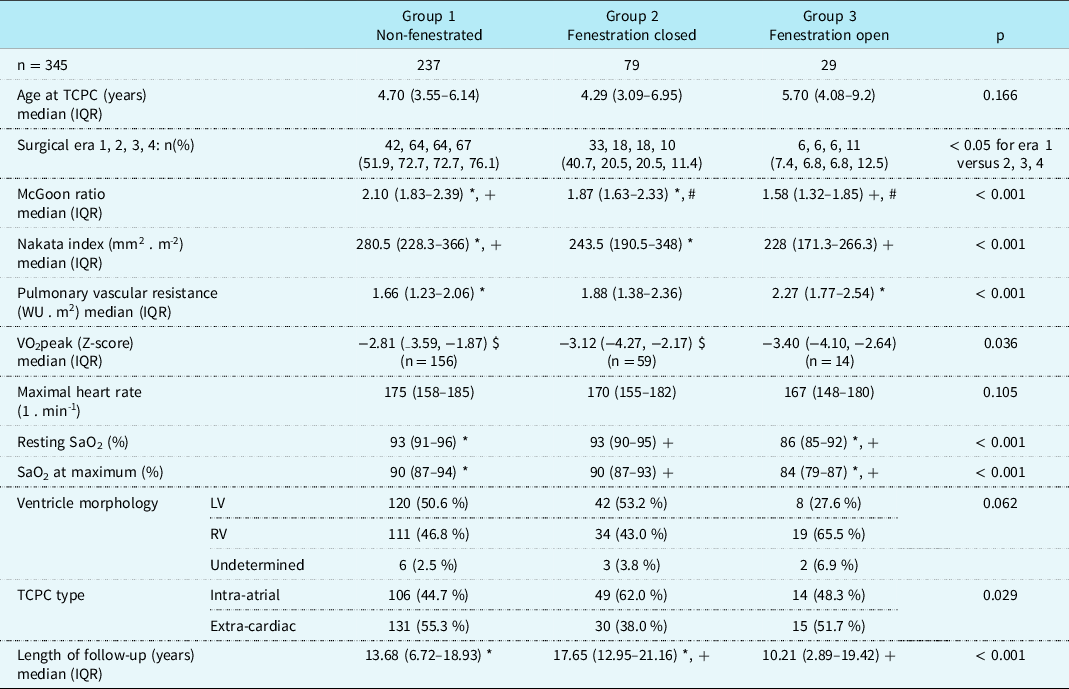
The type of cavopulmonary connection (intra-atrial or extra-cardiac) was dependent mainly on the surgical era (per cent of extra-cardiac conduits was 1.1, 25.0, 76.1, and 97.7% among the total of operated patients during the four surgical eras). Fenestration in the total cavopulmonary connection circuit was absent in 237/345 patients (68.7%, Group 1). Fenestration was created in 108/345 patients (31.3%), who were considered higher-risk candidates according to institutional criteria pre-operatively (Fisher score 4–5) Reference Fisher, Geva and Feltes3 or decided by the surgeon intra-operatively mainly because of high systemic venous pressure (>15 mmHg). The operation technique of the fenestration creation was a 4-mm puncture in the intra-atrial tunnel and a 4-mm puncture with side-to-side anastomosis in the extra-cardiac conduit. In 79 fenestrated patients (22.9 %, Group 2), fenestration was closed later interventionally (n = 66, catheterisation or surgical closure) or closed spontaneously (n = 13). Fenestration could not be closed for various haemodynamic reasons in 29 patients (8.4%, Group 3). These three groups showed significant differences in baseline demographic, anatomic, haemodynamic, and surgical data (Table 1). Specifically, pulmonary artery size decreased, and pulmonary vascular resistance increased from Group 1 to Group 3. If testing combined Groups 1 and 2 against Group 3, single ventricle was more frequently of right ventricular type in the latter (p = 0.035). There were more patients with fenestration created and closed in the first surgical era.
Group characteristics. TCPC – total cavopulmonary connection, IQR – interquartile range, WU – Wood units, VO2peak – peak oxygen uptake, SaO2 – arterial oxygen haemoglobin saturation. *, +, # p < 0.05, $ p = 0.013

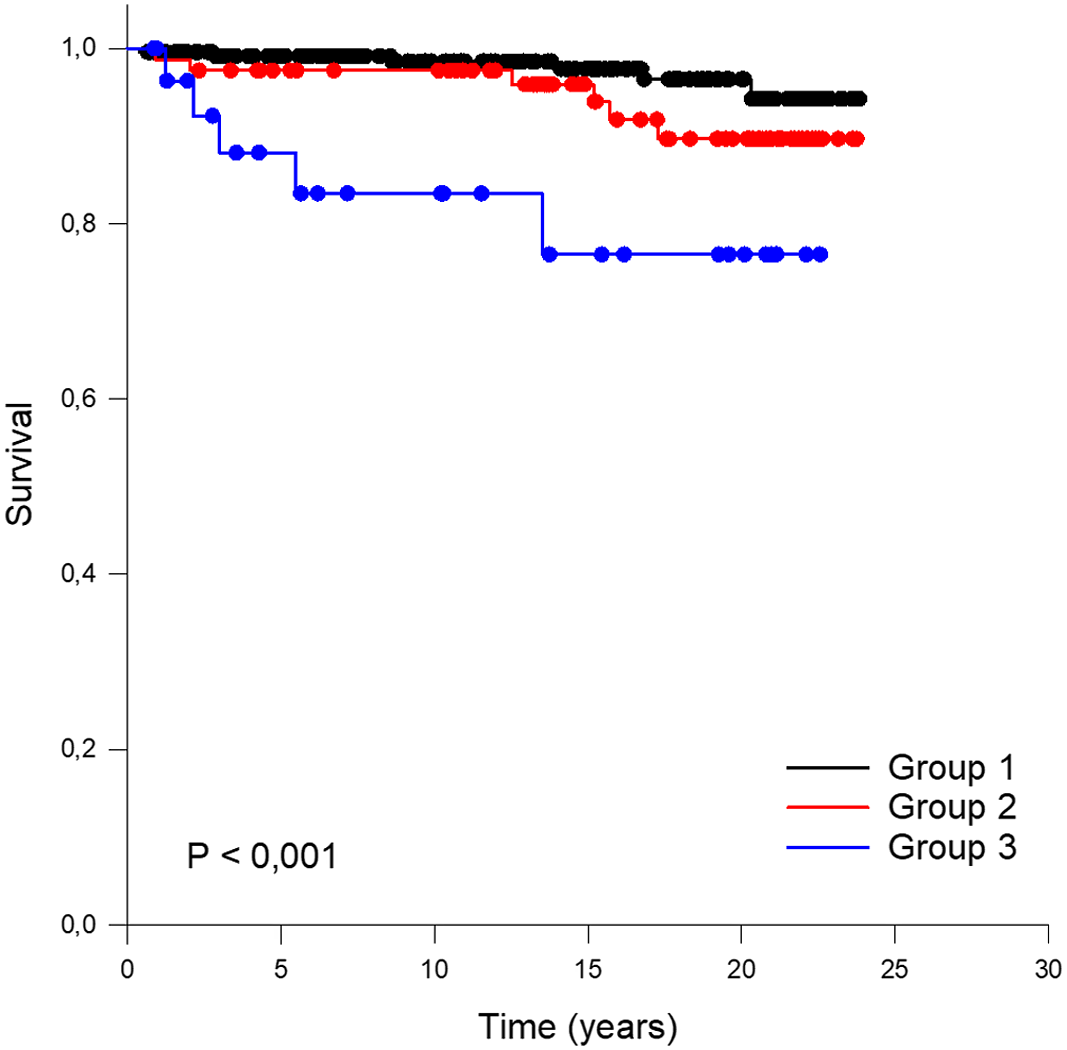
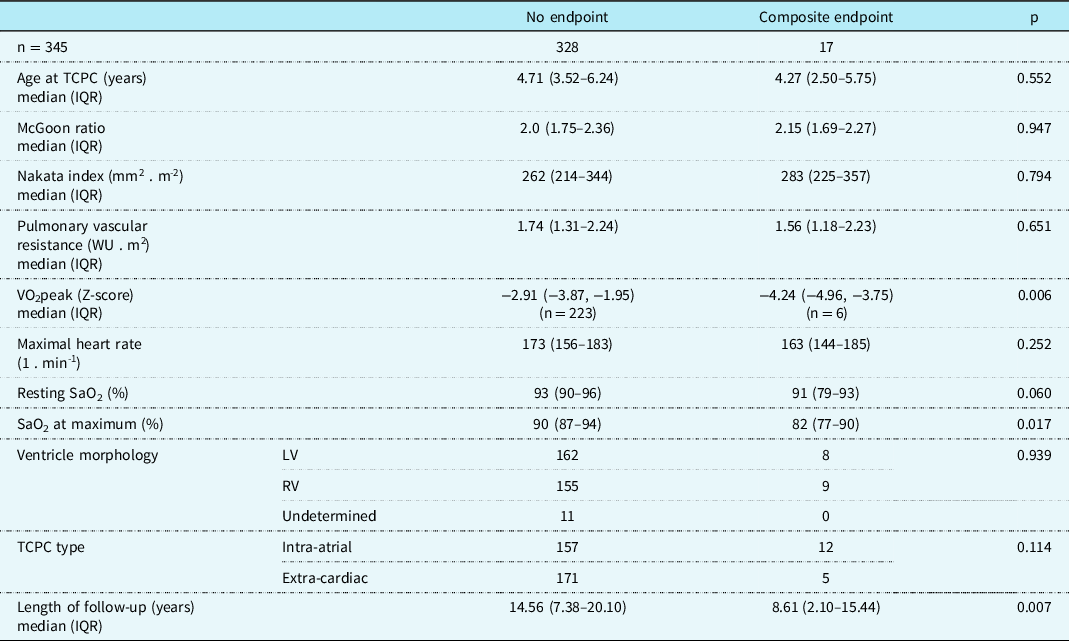
A total of 12 patients died, 3 underwent take-down, and 2 were transplanted during long-term follow-up with the highest rate of adverse outcome (20.8%) in Group 3 (Table 2). When compared to the rest of the patients, the patients reaching endpoint did not differ in analysed pre-operative parameters (age at total cavopulmonary connection, McGoon ratio, Nakata index, pulmonary vascular resistance, ventricular morphology, or type of total cavopulmonary connection) (Table 3). Overall mean survival probability until the composite endpoint was 97.1 and 92.9% at 10 and 20 years after total cavopulmonary connection, respectively. There was a significant difference between the three groups with the worse survival probability in patients with patent fenestration as compared to both the non-fenestrated and fenestration closure groups (Fig 1, p < 0.001). On the contrary, the survival of patients after fenestration closure did not differ from the non-fenestrated group. Long-term survival was not influenced by the age at total cavopulmonary connection, McGoon ratio, Nakata index, pulmonary vascular resistance, gender, systemic ventricle morphology, and type of total cavopulmonary connection. We also analysed the probability of freedom from composite endpoint based on surgical era in all three groups and found no difference.
Survival probability until composite endpoint. Group 1 – non-fenestrated. Group 2 – fenestration closed. Group 3 – fenestration open.

Long-term survival according to the presence and fate of fenestration

Differences in characteristics between patients reaching composite endpoint and the rest of patients. TCPC – total cavopulmonary connection, IQR – interquartile range, WU – Wood units, VO2peak – peak oxygen uptake. SaO2 – arterial oxygen haemoglobin saturation

The presence of fenestration which could not be closed (Group 3) for various haemodynamic reasons (high total cavopulmonary pressure or pulmonary vascular resistance – 31%, small pulmonary arteries size – 31%, impaired ventricular function or significant atrioventricular valve regurgitation – 21%, pulmonary vein stenosis – 7%, other – 10%) carried a hazard ratio of 5.72 (95% confidence interval 2.01–16.27, p = 0.005) for reaching the composite endpoint as compared to pooled Groups 1 and 2. According to our institutional policy, the anticoagulation with warfarin (International Normalized Ratio 2–3) was indicated in patients with open fenestration or 6 months after interventional fenestration closure, other patients were on lifelong anti-aggregation therapy with acetylsalicylic acid.
Data from the last cardiopulmonary exercise test at median (interquartile range) 12.8 (7.65–18.23) years after total cavopulmonary connection (not available in all patients) showed a significant difference in peak oxygen uptake Z-score (patient data were compared with national reference values of exercise indices for healthy peers) Reference Máček, Vávra and Radvanský4 between the three groups Table 1). Peak oxygen uptake was also significantly lower in patients reaching the composite endpoint compared to the rest of the patients (Table 3), but the CPET data were available only in 6/17 patients. The maximal heart rate during the CPET did not differ among Groups 1–3. Resting arterial oxygen haemoglobin saturation and saturation at maximum exercise was significantly lower in Group 3 as compared to Groups 1 and 2 (p < 0.001 for both).
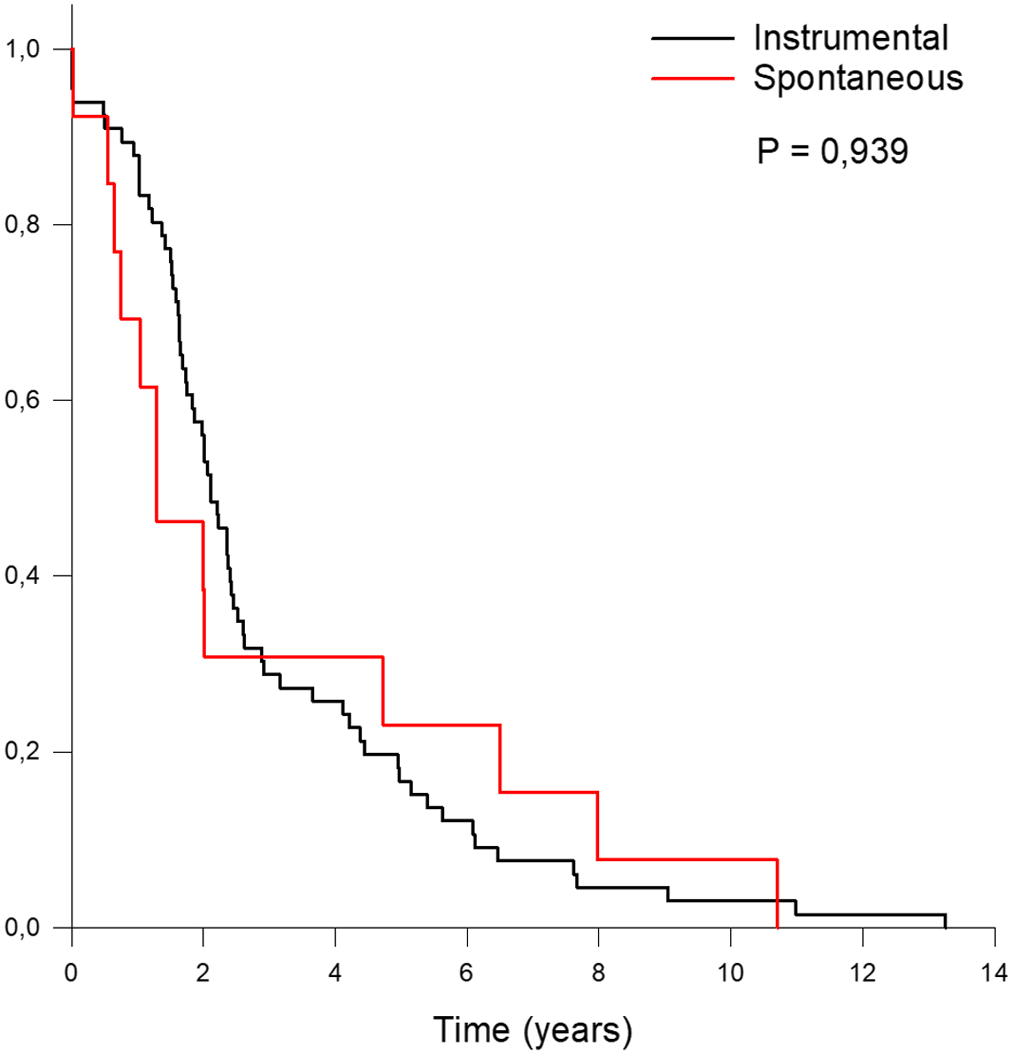
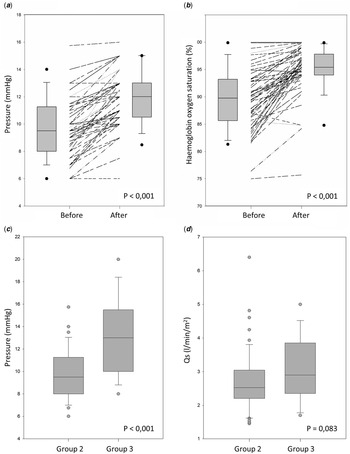
Time to fenestration closure did not differ between patients with instrumental and spontaneous closure (Fig 2). Catheter closure (58 patients, 26 females) was performed at median (interquartile range) age of 6.7 (5.47–10.31) years using the coils (Flipper PDA Closure Detachable Coil in 34, Jackson coil in 3), occluders (Rashkind occluder in 12, Amplatzer Septal Occluder in 8), and Covered CP Stent in 1 patient. Due to occlusion, the pressure in the total cavopulmonary connection system and arterial oxygen haemoglobin saturation increased significantly from mean 9.8 (SD 2.2) to 11.8 (2.1) mmHg and from 89.5 (5.6) to 94.9 (4.4)%, respectively (both p < 0.001, Fig 3). Significant persisting residual shunt required a re-intervention in 6/58 (10%) patients (five patients after the previous occlusion with the Flipper PDA Closure Detachable Coil and one patient with the Rashkind occluder). When comparing the total cavopulmonary pressure and indexed systemic blood flow between 58/79 (73%) catheterised patients from the Group 2 and 17/29 (59%) catheterised patients from the Group 3, significantly higher pressure was measured in Group 3 compared to Group 2 (p < 0.001), but no significant difference was found in indexed systemic blood flow (p = 0.083, Fig 3).
Freedom from fenestration closure.

Haemodynamic data before and after instrumental fenestration closure. (a) Total cavopulmonary connection system pressure. (b) Arterial haemoglobin oxygen saturation. (c) Pressure in the total cavopulmonary connection system in Group 2 and Group 3. (d) Indexed systemic blood flow (Qs) in Group 2 and Group 3.

McGoon ratio and Nakata index (where available) at fenestration closure were compared with pre-total cavopulmonary connection values. No change in the McGoon ratio (mean (SD) 2.01 (0.50) versus 1.94 (0.35), p = 0.222) but a significant decrease in Nakata index was found: mean (SD) 279.1 (132.8) versus 223.1 (83.28) mm2. m-2, (p < 0.001).
Discussion
Different attitudes to fenestration creation in total cavopulmonary connection may be found in the literature. Kotani et al Reference Kotani, Chetan and Saedi5 described a group of 326 patients with almost routine fenestration (94 % of patients). Over a mid-term follow-up (median 5.05 years), fenestration closed spontaneously in 25 % or was closed by catheter intervention in 62 % of patients. Despite no significant difference in pre-operative pulmonary artery pressure and pulmonary vascular resistance between the closed and persisting fenestration patients, the latter had a higher probability of death and Fontan failure. An utterly opposite approach has been documented by Nakano et al, Reference Nakano, Kado and Tatewaki6 reporting 500 extra-cardiac conduit total cavopulmonary connection patients with the fenestration created only in 6 (1.2%) patients and with 15 years survival rate of 92.8%. The percentage of subjects receiving a fenestration varied widely among centres (13–91%) in a multi-centric study of 536 patients by Atz et al. Reference Atz, Travison and McCrindle7 Persisting fenestration was found in 19% of the fenestrated patients at median 8 years after Fontan procedure, and information was not available in another 17% of patients. The rate of spontaneous closure was 40%, catheter closure 59%, and surgical closure 1%. As this study was performed on surviving patients only, no data on long-term survival are given. Gorla et al Reference Gorla, Jhingoeri and Chakraborty8 reported the rate of spontaneous fenestration closure of 22% in a group of 67 fenestrated Fontan patients. Patients with higher pre-operative pulmonary vascular resistance and a history of post-operative systemic venous thromboembolism had a higher likelihood of persisting fenestration.
Our centre consistently adheres to the strategy of fenestration creation only in higher-risk patients resulting in 31.3% of patients being initially fenestrated. Fisher score Reference Fisher, Geva and Feltes3 was used as a helping clue, not a strict guideline, in the decision process of our team. All factors included in the score were unfortunately not available for retrospective analysis. We present at least the basic parameters which show differences between the three patient groups with decreasing pulmonary artery size and increasing pulmonary vascular resistance from Group 1 to Group 3. Group 3 also includes a significantly larger proportion of the patients with the systemic right ventricle. Interestingly, despite these differences, freedom from the composite endpoint of death, heart transplant, or total cavopulmonary connection take-down was not different between the non-fenestrated patients (Group 1) and those in whom fenestration was closed (Group 2). In the fenestration closure group, the Nakata index was even lower at the time of occlusion than before the total cavopulmonary connection, precluding the conclusion that this risk factor would resolve by pulmonary artery growth. This finding is consistent with the study of Kansy et al, Reference Kansy, Brzezinska-Rajszys and Zubrzycka9 who showed a reduction of McGoon ratio and Nakata index in Fontan patients in serial angiographies. Also, Adachi et al Reference Adachi, Yagihara and Kagisaki10 proved reduction of Nakata index with no impact on the mid-term outcome. Although long-term survival in our study was not different between Groups 1 and 2, we found significantly worse exercise capacity (represented by peak oxygen uptake) in Group 2 than in Group 1, pointing towards a suboptimal functional outcome despite a similar survival probability. This difference could not be explained by the potential residual right-to-left shunt, as there was no difference in resting or maximal arterial oxygen saturation between the two groups. However, the pre-operative size of the pulmonary arteries was smaller in Group 2 and thus may play a role in the exercise capacity difference.
Patients with non-closed fenestration had the worst long-term survival. We could, however, find no other predictor of poor outcome, including pulmonary artery size, pulmonary vascular resistance, and systemic ventricular morphology. Other non-analysed factors as single-ventricular function, atrioventricular valve regurgitation, aortopulmonary collateral flow, etc., may play a role, with non-closed fenestration being a surrogate for generally unfavourable haemodynamics.
Interventional catheterisation was the most frequent mode of closure in our study group. Various types of devices have been used throughout history, developing from the Rashkind occluders over a period of coil closures up to the contemporary use of the Amplatzer septal occluders. There was a relatively high proportion of coil occlusions in our group (37/58 patients). Despite being technically easy, this method resulted in a significant number of residual shunts in 5/37 (13.5%) patients. The use of detachable coils for the fenestration occlusion was described only in smaller series of patients. Kim et al Reference Sung, Kang, Huh, Heung, Yang and Jun11 described a group of 13 patients with only 5 complete occlusions during a median follow-up of 23 months. Also, Jeong et al Reference Jeong, Huh, Lee, Yang, Jun and Kang12 claimed only three complete occlusions in a group of seven patients fenestrations closed using detachable coils.
Study limitation
The retrospective design of the study does not allow us to test for all potential predictors of the outcome, and we could analyse only the available data. Some factors (like ventricular function or atrioventricular valve regurgitation) included in the Fisher score were not available for retrospective analysis, as an important part of the historical echocardiographic data is available only in the form of semi-quantitative descriptions without the possibility for a reliable statistical analysis. The decision about the necessity of fenestration changed with time and with the development of surgical techniques like the possibility of plasty of atrioventricular valves, favouring nowadays a perioperative decision on fenestrating the cavopulmonary connection depending on the surgical result. Our data are not sufficient to describe and analyse all the detailed differences in multiple parameters known as weak points of Fontan circulation, especially the long-term function of the liver Reference Chaloupecký, Svobodová and Hadačova13 and kidneys. Reference Khuong, Wilson and Grigg14 , Reference Lee, Levin and Kiess15 However, we believe that the presented survival data are up to a certain level unique as they represent an unbiased whole country total cavopulmonary connection population cross-matched with the National Death Registry.
Conclusions
Overall mean survival probability until composite endpoint of death, total cavopulmonary connection take-down, or indication for a heart transplant was 92.9% at 20 years after total cavopulmonary connection. Patients with persisting risk factors preventing fenestration closure were at significantly higher risk of reaching composite end-point than the rest of the group. Survival of patients after fenestration closure was not different from the non-fenestrated group despite a mild increase in systemic venous pressure. Their maximal exercise capacity was, however, significantly lower, pointing towards a worse functional outcome.
Acknowledgements
None.
Financial support
This work was supported by the Ministry of Health, Czech Republic – conceptual development of research organisation, Motol University Hospital, Prague, Czech Republic 00064203.
Conflict of interest
None.
Ethical standards
The research does not involve human or animal experimentation.