Influenza infection causes serious illness and death in patients with cancer. However, immunization with annual flu vaccine is low. We demonstrated that a recommendation by the patient’s oncologist was the strongest predictor of vaccination not only for patients but also for their households, underscoring the importance of a well-informed provider.
Patients with cancer experience greater morbidity and mortality of influenza infections than the general population.Reference Kunisaki and Janoff 1 Annual inactivated influenza vaccination is recommended for immunocompromised patients who are at least 6 months old and for their family members by the Centers for Disease Control and Prevention and the Infectious Diseases Society of America.Reference Rubin, Levin and Ljungman 2 Unfortunately, low vaccination coverage (9%–40%) has been reported in patients with cancer and stem cell transplant.Reference Pedrazzoli, Baldanti and Donatelli 3 , Reference Ariza-Heredia, Gulbis and Stolar 4
With the aim of understanding the barriers that prevent wide vaccination uptake among cancer patients and their household, we evaluated the influenza vaccination practices at a tertiary cancer center.
METHODS
Patients 18 years or older who had influenza infection confirmed in our microbiology laboratory were contacted by telephone and asked to provide verbal consent to participate in this observational study. In addition, a waiver of consent to obtain available data from the patients’ medical records in case the patient and/or a designated person could not be contacted in 2 different attempts was requested. The study was approved by our institutional review board.
The telephone survey included questions about the influenza vaccine, whether the vaccine was recommended by their provider, the main reason for the patient not receiving the vaccine when that was the case, household members’ vaccination status, and the reasons for household members not undergoing vaccination when that was the case (Online Appendix A).
Demographic information, including age, sex, race, spoken language, marital status, type of insurance, religion, previous influenza vaccination, and place of residency (urban versus rural), was obtained. Data on vaccine eligibility for the nonvaccinated patients according to guidelines,Reference Rubin, Levin and Ljungman 2 , Reference Fiore, Shay and Broder 5 type and status of malignancy, stem-cell transplant, comorbidities, received chemotherapy, clinical variables, treatment, and outcomes were also collected.
The influenza vaccination status of the patients and household members represented the main predictive variable in this study. Descriptive statistics were used to summarize the demographic and clinical characteristics of participants. A bivariate analysis was conducted to compare factors predictive of vaccination in the vaccinated and nonvaccinated participants. These characteristics were compared using a χ2 test or Fisher exact test for categorical variables and t test or Wilcoxon rank sum test for continuous variables to identify their associations with outcome. Univariable and multivariable logistic regression analyses were used to calculate the odds ratios and 95% CIs for the effect of the patient and household member vaccination status on the outcomes of interest. A 2-sided P level of .05 was considered statistically significant.
RESULTS
We identified 154 eligible patients with laboratory-confirmed influenza. One hundred eight patients consented verbally to participate in the survey, for a response rate of 70%. We also included vaccination rates in 12 patients from medical records.
The survey showed that 52 (43%) of the 120 patients received the flu vaccine, and 64 (53%) did not. Four patients (3%) did not remember whether they had undergone vaccination, and they were excluded from the analysis. We determined that 39 patients (61%) of the nonvaccinated patients had been eligible to receive the influenza vaccine by current recommendations.Reference Rubin, Levin and Ljungman 2 , Reference Fiore, Shay and Broder 5
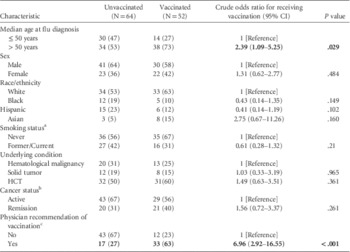
Recommendation by a healthcare provider was the strongest predictor of vaccination. Patients whose oncologists recommended the vaccine were more likely to have been vaccinated than were those who did not receive such recommendation (crude odds ratio, 6.96 [95% CI, 2.92-16.55]; P<.001). Furthermore, age older than 50 years was also a significant predictor of vaccination (crude odds ratio, 2.39 [95% CI, 1.09–5.25]; P=.029) (Table 1).
Influenza Vaccination Status in Patients with Cancer: Characteristics y and Underlying Medical Conditions

NOTE. Data are no. (%) of patients unless otherwise indicated. HCT, hematopoietic stem cell transplantation. Bold indicates statistically significant values (p<.005).
aData was available for 114 patients for smoking status.
bData was available for 113 patients for cancer status.
cData was available for 105 patients for physician recommendations.
In terms of sociodemographic factors, we describe a trend of more frequent vaccination in white and Asian patients than in Hispanic and African Americans patients, although it was not statistically significant (P=.19). There was no association between vaccination status and the other demographic and clinical variables (Table 1).
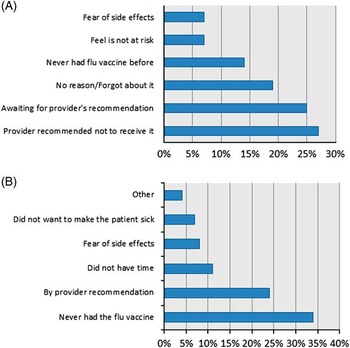
Of the 64 patients who did not receive the influenza vaccine and who responded to our survey, the main reason cited for nonvaccination was the recommendation against it by the patient’s oncologist (56 [88%]). Information on influenza vaccination of household members for 88 patients was analyzed. Full household vaccination occurred in 38 (43%) of the households. A healthcare provider’s recommendation against vaccination was also among the most common reasons behind the lack of vaccination (Figure 1). Notably, 16 household members (18%) had flu-like illness around the time patients were diagnosed with influenza infection.
Primary reasons for not undergoing influenza vaccination. A, Patients’ answers; B, Household members’ answers.

Vaccination status did not have a significant effect on hospital admission, progression to pneumonia, or mortality. In multivariable analysis, patients who experienced progression to pneumonia were more likely to be neutropenic, to be older, and to have not received oseltamivir early in the course (all, P<.05)
DISCUSSION
Vaccination as a public health intervention has been shown to lessen or eliminate the burden of many infectious diseases. Proper understanding of the barriers to appropriate influenza vaccination coverage is essential for designing future improvement strategies to increase compliance.Reference Dexter, Teare, Dexter, Siriwardena and Read 6 Therefore, we sought to determine factors associated with decisions regarding influenza vaccination in a cohort of cancer patients diagnosed with influenza and their household members.
In our cohort, healthcare provider’s recommendation was the most significant determining factor for immunization for the patients. Literature on influenza vaccination in general population and other immunocompromised populationsReference Loulergue, Mir, Alexandre, Ropert, Goldwasser and Launay 7 supports the importance of the role of the physician in vaccination decisions, and this is not an exception in oncological patients, resulting in our study in an approximately 7-fold greater likelihood of vaccination when patients receive a recommendations by their provider. Furthermore, 61% of the nonvaccinated patients met criteria for vaccination, underscoring how providers should be well informed of current recommendations and the benefits of influenza vaccination in patients with cancer. This study also highlights the unrecognized effect of the oncologists’ recommendations on household vaccination. Because immunocompromised patients are at greater risk for complications from influenza than the general population, providing an indirect protective effect via herd immunity (cocooning) by vaccination of family members becomes a crucial aspect of reducing their risk of infection.Reference Fine, Eames and Heymann 8
Furthermore, we found that patients older than 50 years were more likely to have received the influenza vaccine than were younger patients, probably related to the perception of being at higher risk of complications at older age. Different from other studies, concerns about vaccine side effects or effectiveness were not identified as significant barriers to vaccination in patients with cancer.Reference Zimmerman, Santibanez and Janosky 9 , Reference Earle 10
Lastly, the lack of protection of the influenza vaccine on severity of illness in this specific cohort of patients should be interpreted with caution owing to the design of our study that identified only patients who had influenza infection, which systematically underestimates the effectiveness of the vaccine.
Our study had a number of limitations because this was a single-institution study of patients with influenza, which may limit the generalizability of the results. In addition, we had to rely on patient reports to obtain data on the recommendations for influenza vaccination. Such reports are subject to patients’ interpretation of physician recommendations.
In conclusion, physician attitudes and recommendations play major roles in the influenza vaccination decisions of cancer patients and their household members. One targeted intervention should be to strengthen the recommendation of physicians, especially oncologists, encouraging their participation in promoting influenza vaccination of both patients and their family members.
ACKNOWLEDGMENTS
We acknowledge Michael Worley, Scientific Publications, and especially our patients at MD Anderson Cancer Center who were willing to participate in our survey.
Financial support. None reported.
Potential conflicts of interest. R. F. C. reports that he has received research funding from Gilead, GlaxoSmithKline, ADMA Biologics, Ansun Biopharma, and Roche. All other authors report no conflicts of interest relevant to this article.
Supplementary Materials
To view Supplementary Materials for this article, please visit http://dx.doi.org/10.1017/ice.2015.150