Introduction
Two earthquakes of magnitude 7.8 and 7.6 occurred in Turkey on February 6, 2023. Both earthquakes are considered one of the biggest disasters in Turkey’s and the world’s history due to their intensity and impact area. Following these great earthquakes, thousands of aftershocks have occurred and continue to do so to date. This severe earthquake in Turkey caused many deaths, life-threatening injuries, destruction, material damage, and many other adverse situations in the ten provinces located at and near the event’s epicenter, and its devastating effects continued for months afterward.Reference Ata1–Reference Strecker, Bürgmann and Çökmez3 The health of women, who are among the most vulnerable groups, is most affected by these negativities. Women are more vulnerable to disasters than men due to some genetic, psychological, physiological, legal, and social factors.Reference Akter, Roy and Aktar4, Reference Fatema, Islam and East5
In the earthquake region, women’s limited access to general hygiene products, menstrual hygiene materials, clean underwear, clean water, showers, toilets, and hand washing, hygiene problems related to sheltering in crowded living spaces, and privacy problems have caused women not provide adequate personal hygiene.Reference Akter, Roy and Aktar4, 6–Reference Budhathoki, Bhattachan and Castro-Sánchez9 In light of this information, the inadequate conditions caused by the earthquakes in Turkey cause women not to have the desired level of hygiene conditions and the emergence of undesirable health behaviors. Therefore, this situation risks affecting women’s genital hygiene behaviors. Unwanted genital hygiene behaviors can lead to serious health problems for women’s health.Reference Umami, Paulik and Molnár10, Reference Bardin, Giraldo and Benetti-Pinto11 Considering that an estimated 4.1 million of the population affected by this devastating earthquake are of reproductive age, it is evident that addressing genital hygiene behaviors is a necessity for women’s health. A recent study conducted among female health care professionals in the earthquake region reported that 30.2% experienced women’s health problems and 58.6% had difficulty accessing hygiene products. Furthermore, a significant negative correlation was found between poor genital hygiene behaviors and increased severity of menstrual symptoms.Reference Gürel, Atilla and Savaş12 These findings provide initial empirical evidence of the impact of disaster conditions on women’s hygiene-related health. To date, no study has been encountered that specifically examines the effects of earthquakes on genital hygiene behaviors. Given the scale of the disaster and the specific vulnerabilities faced by women in such contexts, investigating this issue can provide valuable insights for future disaster preparedness and women’s health planning. Considering the risk of natural disasters occurring in the coming years, it is essential to reveal the effects of the earthquake on women’s health and contribute to the literature on this subject to protect and maintain women’s health. Therefore, this study aimed to determine the genital hygiene behaviors and risk factors of women of reproductive age after the earthquake.
Methods
Study Design
The research was conducted in the province of Malatya, which was heavily damaged by the earthquake, between May 10, 2023, and January 5, 2024, after the earthquake that occurred in Turkey on February 6, 2023, and affected 11 provinces and was conducted in a descriptive and relationship-seeking type.
Sample
The research population consisted of women who lived in Malatya province after the February 6, 2023, earthquake in Turkey. The research was conducted using an online survey. The online survey was created via a web-based form tool (Google Forms®). The study utilized the snowball sampling method to reach more participants. Initially, the survey link was shared with women living in the region via WhatsApp® and social media platforms such as Facebook®. These participants were then asked to share the data collection form with their own contacts. Since it is difficult to reach women affected by the earthquake, the aim was to reach the sample determined using the snow sampling method. In this way, participants received the invitation to complete the survey digitally, through personal messages and social media sharing. The data of women who completed the online survey were transferred to the online registration system. The survey included a consent form and information about anonymity, and participation was entirely voluntary. Participants were required to confirm their informed consent before proceeding with the survey by checking a consent box after reading a detailed explanation of the study’s purpose, procedures, and confidentiality measures. Only the researcher had access to the collected data, which were securely stored in the online system. All data were kept in a password-protected account, and no personally identifiable information was collected. Participation involved no incentives or obligations, and participants could withdraw from the survey at any point without any consequences.
The sample number of the study was calculated using the G*Power™ 3.1.9.7 program. As a result of the Power analysis of the sample size of the research, it was calculated as 295 women in total, with a 5% error level, 63% effect size, and 99% ability to represent the universe (power).Reference Özkan and Tosun13 The study was completed with 296 women who met the criteria and agreed to participate. Criteria for inclusion in the research: being in Malatya on February 6, 2023, being between the ages of 15 and 49, and being literate. The exclusion criteria of the study are: going out of the city in the early period after the earthquake, having a diagnosed psychiatric disease, and being pregnant. These criteria were based on participants’ self-reports, and no external verification was performed.
Data Collection
Personal Information FormReference Özkan and Tosun13–Reference Kartal, Engin and Teke15 and Genital Hygiene Behavior ScaleReference Karahan16 were used in the research.
The Participant Information Form
The form developed by the researchers consists of 25 questions: 6 questions regarding women’s sociodemographic characteristics (age, marital status, education level, employment status, and so on) and 19 questions regarding post-earthquake hygiene characteristics (place of residence, type of laundry, and so on).Reference Özkan and Tosun13–Reference Kartal, Engin and Teke15
Genital Hygiene Behavior Scale (GHBS)
The scale was originally developed in Turkish by Karahan in 2017.Reference Karahan16 Since this study was conducted with Turkish-speaking participants, the original Turkish version of the scale was used. The 5-point Likert-type scale consists of 23 items. Scale: It consists of three subdimensions: “General Hygiene Behaviors,” “Menstrual Hygiene,” and “Abnormal Finding Awareness.” A minimum of 23 to 115 points can be obtained from the scale measuring women’s genital hygiene behaviors. As the score obtained from the scale increases, the rate of women exhibiting correct genital hygiene behavior increases. The scale is self-reported, and participants responded to the items based on their own perceptions and behaviors. The Genital Hygiene Behavior Scale has also been used in other recent studies, supporting its applicability in post-disaster and health care-related research contexts.Reference Gürel, Atilla and Savaş12, Reference Erdi, Aksüt and Öztaş17 Karahan determined Cronbach’s alpha value to be 0.80 for the total score of the scale, 0.70 for the general hygiene habits subdimension, 0.74 for the menstrual hygiene subdimension, and 0.81 for the abnormal finding awareness subdimension.Reference Karahan16 In this study, Cronbach’s alpha value of the scale total score was 0.80, the general hygiene habits subdimension was 0.79, the menstrual hygiene subdimension was 0.81, and the abnormal finding awareness subdimension was 0.78.
Data Analysis
The data obtained in the research were evaluated on a computer using the SPSS® 22.0 statistical program. Frequency and percentage analyses were used to determine the descriptive characteristics of the women participating in the research, and mean and standard deviation statistics were used to examine the scale. As previously stated, all data were kept in a password-protected account, and no personally identifiable information was collected, ensuring security throughout the analysis. Kurtosis and Skewness values were examined to determine whether the research variables showed normal distribution. In the relevant literature, the results of the Kurtosis and Skewness values of the variables between +1.5 and –1.5Reference Tabachnick and Fidell18 or +2.0 and –2.0Reference George and Mallery19 are accepted as a normal distribution. Since it was determined that the variables were normally distributed, parametric methods were used to analyze the data. Independent groups t-test and one-way analysis of variance (ANOVA) were used to examine differences in the Genital Hygiene Behavior Scale total and subdimension scores according to women’s descriptive characteristics, including marital status, educational level, employment status, family type, current place of residence, laundry washing method, underwear sharing, vaginal symptoms, hygiene practices, and source of genital infection information. The t-test was applied for comparisons between two groups (e.g., marital status: married vs. single; employed vs. unemployed), while ANOVA was used for variables with three or more groups (e.g., educational level, bathing frequency). Post hoc analyses (Tukey, LSD) were conducted following significant ANOVA results to determine which specific groups differed. The level of statistical significance was set at p < .05.
Ethical Considerations
Before starting the research, to conduct the study, ethical approval was received from the İnönü University Health Sciences Non-invasive Clinical Research Ethics Committee (Date: June 6, 2023; ID:023/4714). Participants were informed about the study objectives, and informed consent was obtained electronically via Google Forms®.
Results
Looking at the descriptive characteristics of the women, the average age is 30.51 ± 7.99. It was determined that 54.4% were married, 68.6% had a university degree or higher, 53% were unemployed, and 88.2% had a nuclear family. All participants reported that they were affected by the earthquake; however, their current places of residence varied due to displacement caused by the disaster. Specifically, 64.5% of the women were staying at their own homes, 14.5% at a relative’s house, 14.2% in tents or other collective accommodations, 6.8% in dormitories, and 6.8% in containers. On average, participants were living with 4.71 ± 2.41 other individuals (Table 1).
Distribution of women according to descriptive characteristics

* Normal vaginal discharge: Vaginal discharge is slightly transparent, odorless, bloodless, colorless, and acidic. It looks like egg white. SD: standard deviation.
Regarding the laundry habits of the women, it was determined that almost all of them (90.2%) washed their laundry using the same washing machine as the people they lived with, and 7.4% reported sharing underwear. It was found that women shared a common toilet with an average of 4.47 ± 2.43 people in their living environment, which may increase the risk of poor genital hygiene due to reduced privacy, limited access to cleaning materials, and potential contamination in shared sanitary facilities. In this study, it was found that 40.9% of women had abnormal vaginal discharge findings, and only 18.2% applied to a health institution due to these complaints. According to self-reported data, nearly half of the women (47.6%) stated that they had experienced a genital infection before, 26% reported vaginal itching, 3.4% reported using deodorizers for their genital area, and 27% used daily pads. According to self-reported data, 38.2% of the participants used razors or depilatory creams for genital hair removal, and 20.3% reported applying them once a week. The majority of women (82.1%) stated that they bathed every 2-3 days, more than half (56.4%) took standing showers, and they shared their bathrooms with an average of 4.61 ± 2.45 people. Additionally, 74.3% reported having knowledge about genital infections, and 62.6% stated that they received this information from health care personnel (Table 1).
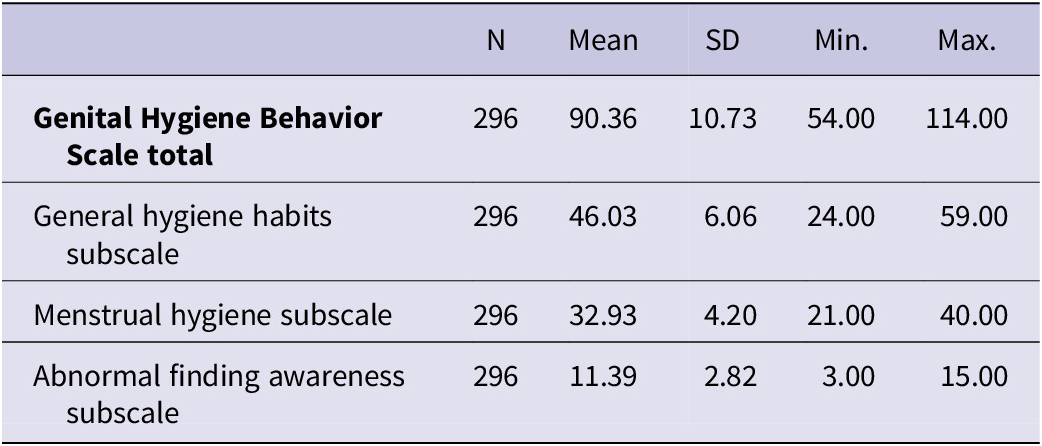
Women’s Genital Hygiene Behavior Scale total mean is 90.36 ± 10.73, general hygiene habits subdimension mean is 46.037 ± 6.06, menstrual hygiene subdimension mean is 32.94 ± 4.20, and the average abnormal finding awareness subscale was found to be 11.39 ± 2.82 (Table 2). These findings suggest that while participants maintain acceptable hygiene behaviors in daily and menstrual contexts, their awareness of abnormal genital findings could be improved. This highlights the importance of increasing health education efforts—especially in post-disaster settings where access to health care services may be disrupted—to enhance early recognition of symptoms and promote timely health-seeking behavior.
Women’s genital hygiene behavior mean scores

When examining the differentiation of women’s Genital Hygiene Behavior Scale scores according to descriptive characteristics, it was seen that women’s Genital Hygiene Behavior Scale total score was significantly affected by their education level, employment status, share underwear, frequency of bathing, type of bathing, and knowledge about genital infection (p < .05). Women’s general hygiene habits subdimension scores were affected by working status, share underwear, frequency of bathing and shape and knowledge about genital infection (p < .05). Women’s menstrual hygiene subscale scores were affected by their educational status, employment status, share underwear, vaginal itching, method of removing hair from the genital area (p = .001), bath frequency and shape, and knowledge about genital infections (p < .05). Women’s abnormal finding awareness subscale scores were affected by their working status, share underwear, and the nature of vaginal discharge, going to a health institution for abnormal vaginal discharge, vaginal itching, bath frequency and type, knowledge about genital infections (p < .05) (Table 3).
Differentiation of genital hygiene behavior scores according to descriptive characteristics

Note: Coding of categorical variables and interpretation of post hoc comparisons. Categorical variables included in the analyses were numerically coded to represent their respective subcategories (e.g., 1, 2, 3). These numerical values were assigned solely to define group membership and do not indicate ordinal or continuous scaling. In post hoc analyses, statistically significant pairwise group differences were reported according to these category codes using the following notation format: Post hoc∞ = a > b (p < .05). This notation indicates that the mean score of group “a” was significantly higher than that of group “b.” Where multiple comparisons were significant, all relevant pairwise differences were reported accordingly (e.g., 2 > 1; 3 > 1; 3 > 2).
*Normal vaginal discharge: Vaginal discharge is slightly transparent, odorless, bloodless, colorless, and acidic. It looks like egg white. βSD: standard deviation, #F: ANOVA testi; μt: Bağımsız gruplarda T-Testi; ∞PostHoc: Tukey, LSD.
Limitations
This study has several limitations that should be considered when interpreting the results. First, all data were self-reported, which may introduce reporting bias. Participants may have underreported or overreported their hygiene behaviors or health status, potentially affecting the accuracy and reliability of the findings. Second, due to the anonymous and online nature of the survey, it was not possible to verify whether respondents fully met the inclusion criteria (e.g., being female, residing in Malatya, and being affected by the earthquake). This limitation may have led to the inclusion of ineligible participants, reducing the internal validity of the study. Third, although technical measures were implemented—such as restricting responses to one per device—duplicate entries or multiple responses from a single participant cannot be entirely ruled out. This may have distorted descriptive statistics and affected the interpretation of frequencies and proportions. Fourth, the study used snowball sampling to recruit participants, which may have limited sample diversity due to homophily, as individuals tend to refer others who are similar to themselves. Because this is a nonrandom method, not all individuals had an equal chance of participating, which limits the representativeness and generalizability of the results. Moreover, it is difficult to estimate sampling error or conduct inferential statistical analysis using snowball sampling, making population-level generalization problematic. Finally, the study did not assess women’s genital hygiene behaviors prior to the earthquake. As a result, it is not possible to determine the extent to which the observed behaviors were influenced by the disaster, limiting causal interpretations.
Discussion
Following major natural disasters, access to clean water, hygiene products, and private sanitation facilities often becomes limited, potentially affecting women’s reproductive health and hygiene practices. The findings of this study highlight the multifaceted factors that can influence genital hygiene behaviors in such contexts, including sociodemographic characteristics, personal hygiene practices, and awareness of genital health. Understanding these relationships is critical for guiding public health interventions that aim to protect women’s health during and after disasters.
The study found that women with higher education levels had higher total scores for genital hygiene behavior. Consistent with these results, several studies in the literature have identified education level as a positive factor influencing genital hygiene behaviors.Reference Özkan and Tosun13, Reference Çankaya14, Reference Adıbelli, Kılınç and Akpak20 It is observed that women with higher education levels have better skills in following, understanding, and applying resources related to health and hygiene behaviors. They maintain these skills in extraordinary situations such as earthquakes. Based on this, it is critical to increase women’s knowledge and awareness levels through predisaster training so that they can maintain their genital hygiene after the disaster.
The study found that employed women had higher total scores for genital hygiene behavior. When studies in the literature were examined, genital hygiene behavior scores of working individuals were found to be higher.Reference Adıbelli, Kılınç and Akpak20–Reference Kurt Durmuş and Zengin22 It is thought that this result is because working women have economic freedom, so they can pay more attention to their hygiene, meet their hygiene needs more efficiently, and benefit from health services more easily in case of health problems. It is thought that financial difficulties, especially after an unexpected disaster such as an earthquake, may make it more difficult for non-working women to have adequate hygiene conditions compared to working women and may negatively affect their hygiene behavior.
The study found that approximately one-tenth of women shared underwear, and these women had lower total scores for genital hygiene behavior. Consistent with this finding, Karadeniz, Öztürk, and Ertem, in a study conducted independently of the earthquake, reported that women who shared underwear with family members had lower total genital hygiene behavior scores.Reference Karadeniz, Öztürk and Ertem23 It is thought that, in addition to inadequate hygiene conditions due to the earthquake disaster, women’s inability to access the personal products they need forces women to use shared underwear, and therefore, this situation negatively affects genital hygiene behaviors.
In the study, it was found that approximately half of the women had abnormal vaginal discharge, and their awareness of abnormal findings was at a lower level. Türkmen and Karagüzel, in their study, found that young people with a history of foul-smelling discharge had lower abnormal finding awareness and also lower mean genital hygiene behavior scores.Reference Türkmen and Karagüzel24 In their study on students, Tiryaki, Gezginci, and Göktaş determined that students who did not have normal vaginal discharge had lower genital hygiene behavior scores compared to students with normal vaginal discharge.Reference Tiryaki, Gezginci and Göktaş25 These results indicate that women do not have sufficient knowledge and awareness to identify vaginal discharge and recognize abnormal vaginal discharge. This situation is considered to have worsened in the post-earthquake period due to limited resources, lack of healthy living environments, restricted access to hygienic products, and insufficient availability of clean water and toilets.
It was found that women who did not seek health care for vaginal discharge had lower abnormal finding awareness scores. Similarly, Özkan and Tosun reported that women who avoided health care visits for vaginal discharge exhibited lower genital hygiene behavior scores.Reference Özkan and Tosun13 In line with these results, it is seen that the reason why women do not apply to health institutions despite having vaginal discharge is due to insufficient awareness of abnormal findings regarding genital hygiene. It is also thought that this finding is because women do not care about the abnormal differences in their bodies due to the changes in their priorities, resulting from the losses and difficulties caused by the earthquake, and do not apply to a health institution.
The study found that women with vaginal itching had lower menstrual hygiene and abnormal finding awareness scores. Similar to our findings, Özkan and Tosun also found that women with vaginal itching had low genital hygiene behavior scores.Reference Özkan and Tosun13 It is thought that this result is due to women’s inability to engage in appropriate genital hygiene behaviors due to inadequate conditions, especially after the earthquake.
The study determined that women who had undergone laser epilation exhibited higher average menstrual hygiene scores compared to those using other hair removal methods (razor/depilatory and waxing). Similarly, Akgül’s study found that women who had laser epilation demonstrated more positive genital hygiene behaviors than those using alternative methods.Reference Akgül26 In line with this result, it is thought that the laser epilation method causes less skin dryness, trauma, and irritation compared to other hair removal methods, and the longer extended hairlessness period compared to other methods has a positive effect in terms of genital hygiene, especially in inadequate conditions such as earthquakes.
It was determined that women who bathed once a week or less frequently had lower genital hygiene behavior scores. In a study, it was determined that bathroom habits are related to genital hygiene behaviors and that inadequate genital hygiene behavior increases the risk of vaginal infection.Reference Umami, Paulik and Molnár27 Ergün et al. also noted that as women’s bathing frequency increased, their genital hygiene behaviors increased.Reference Ergün, Gök and Karlıdağ28 However, since this study relies on self-reported data and the majority of participants lived in homes, with relatives, or in dormitories with access to running water, these results should be interpreted cautiously. Therefore, it cannot be generalized that bathing once a week or less frequently alone is insufficient to provide the desired level of genital hygiene behavior.
The study found that women who bathed while sitting on a stool had lower average total genital hygiene behavior scores. Sholt et al. found in their study with students that the total mean score of genital hygiene behaviors was lower in those who bathed while sitting.Reference Solt, Hur and Karaman29 Sevil et al. found that the frequency of genital tract infections was higher in students who bathed sitting down.Reference Sevil, Kevser and Aleattin30 It seems that more than one-third of the women in our study share the same bathroom with an average of 4 people in public areas, which is a significant risk factor in maintaining genital hygiene. Taking a bath while sitting in a bathroom with such conditions may increase the risk of genital and urinary tract infections.Reference Yurttaş, Gültekin and Ejder Apay31, Reference Süt32 For this reason, it is critical to increase women’s knowledge and awareness of general and genital hygiene before disasters.
The study found that women knowledgeable about genital infections had higher average genital hygiene behavior scores. Ergün et al. found that women who received information about genital hygiene had higher genital hygiene behavior score averages.Reference Ergün, Gök and Karlıdağ28 Another study found that women who received training on genital hygiene had higher genital hygiene behavior score averages.Reference Karadeniz, Öztürk and Ertem23 These results suggest that women knowledgeable about genital infections demonstrate the expected level of genital hygiene awareness following disasters.
Since this study did not include a matched control group or pre-earthquake data, it is not possible to determine whether the earthquake itself led to an increase in female hygiene-related issues. Therefore, the results should be interpreted with caution and considered descriptive of the post-disaster period only.
Conclusions
This study achieved its objective of identifying women’s genital hygiene behaviors and associated risk factors in the aftermath of a major earthquake. The findings provide valuable insights into how disrupted living conditions may influence hygiene practices and highlight the need for targeted public health interventions in disaster settings. Moving forward, the results can inform the development of preventive strategies and health education programs aimed at minimizing infection risks and promoting safe hygiene behaviors among women affected by disasters. Integrating genital hygiene assessments into routine post-disaster health care and conducting future longitudinal and face-to-face research will be essential to better understand and address the evolving needs of women in such contexts.
Author contribution
Fatma Keskin Tore and Gulcin Nacar conceived and designed the study; Berfin Hatun and Didem Simsek Kucukkelepce acquired the data; Didem Simsek Kucukkelepce, Gulcin Nacar, and Fatma Keskin Tore analyzed and interpreted the data and drafted the manuscript. Fatma Keskin Tore, Gulcin Nacar, Berfin Hatun, and Didem Simsek Kucukkelepce critically revised the manuscript for important intellectual content. All authors read and approved the final manuscript.
Competing interests
No potential conflict of interest was reported by the author(s).