The International Relations (IR) literature on the response to the initial violence in Syria tends to concentrate mainly on legal and normative issues.Footnote 1 Much of this work focuses on the failure of the UN Security Council to respond collectively. Broader discussion on the foreign policies of the Security Council’s permanent members, including the UK, is underdeveloped. Indeed, academic discussion on UK policy toward Syria is either subsumed within analyses of the region or limited to a consideration of the August 2013 House of Commons vote in parliament, which denied then-Prime Minister David Cameron the political mandate to use force in response to the Ghouta chemical weapon attack.Footnote 2 In the lead up to that vote, the government supported the goal of removing the Assad regime but constantly faced the challenge of explaining how that goal would be realised. Given its unwillingness and inability to mobilise support for military intervention (either directly as in Libya or indirectly by arming proxies), or to tailor policy goals to match available means, the government risked criticism that its approach lacked credibility. The purpose of this article is to examine how the UK government tried to close this ends-means gap and how, having failed to do that, it adopted a ‘discursive strategy’ to legitimise its continuing support for what in effect was regime change.Footnote 3
There is nothing inherently problematic about calling on Assad to go without being willing or able to effect it through military intervention. It is a fundamental tenet of realist ethics, however, that a failure to match policy means and ends is the mark of an imprudent foreign policy.Footnote 4 If it is allowed to persist, it can negative consequences. Indeed, foreign policy realists have argued that the ‘Assad must go’ stance was imprudent. It was not realisable, they argue, and by sticking to it Western governments helped block United Nations efforts to negotiate what would have been a relatively swift end to the conflict.Footnote 5 Others have argued that Western powers at the Security Council let the perfect (political transition) be the enemy of the good (humanitarian access), and that a collective response demanding the latter was only achieved in 2014, after the threat of Western military intervention had been removed.Footnote 6
More specifically in the context of UK policymaking, the realist argument found expression in the frustration of those who complained about the ends-means gap in government strategy; something that emerged because of the failure to satisfactorily answer the ‘second-order questions’ about how to effect policy.Footnote 7 Indeed, as we demonstrate in this article, the government’s ongoing commitment to regime change complicated its argument for limited military action in response to the 2013 chemical weapons attack. In this sense, it is at least arguable that the insistence on removing Assad was made at the expense of other policy goals. Historians with a normative focus will debate whether there was a cost, and if so, whether that was a price worth paying. Our objective here is more modest. By situating UK policy in the discursive context leading up to the 2013 vote we demonstrate how the UK government tried to close the gap between ends-means, and how, having failed to do that, it rationalised policy through a discursive strategy that drew on themes deeply embedded in British foreign policy culture.
We argue that the resources for the government’s discursive strategy on Syria can be found in the earlier articulation of ‘liberal conservatism’, a concept that sought to transcend traditional binaries by accepting that British values should inform policy while acknowledging that there were limits to what could be done to advance them. A policy that from an ideal-liberal or ideal-conservative position might have been criticised as half-baked was maintained by a liberal conservative strategy that gave consideration to, but did not completely follow through on either archetype. To illustrate this strategy in action, the article discusses the interplay of two basic discourses: a liberal insistence that the UK should support ‘the Arab Spring’ by backing what was represented as the inevitable removal of Assad; and a conservative insistence that direct military intervention was not possible because ‘Syria was not Libya’. We nuance this discussion with six supporting sub-discourses, but our central argument is that the interaction of these two basic discourses articulated a middle ground between liberalism and conservativism, which sustained UK policy during this period.
Following two sections that explicitly map the article’s approach, we develop this argument in sections that loosely reflect chronological developments prior to the August 2013 vote. The third section illustrates how the insistence on regime change was squared with a policy of non-intervention by a discursive strategy that emphasised the inevitability of Assad’s overthrow. The fourth demonstrates how ‘the Arab Spring’ discourse, and the sense that the UK was on ‘the right side of history’, was used to marginalise the UN Security Council and legitimise alternative diplomatic tracks. The fifth and sixth sections consider how the government responded to the radicalisation of the Syrian opposition and the conservative realist argument that by working for the overthrow of Assad the government contradicted its counter-terrorist efforts. In squaring this circle, the government adopted a Blair-like argument that removing Assad was consistent with UK values and in its security interests because it was the Syrian leader’s crimes that had radicalised Western enemies. The focus on bringing Assad to justice also enabled the government to address the liberal charge that Western states were mere ‘bystanders’ without provoking conservative arguments about the costs of intervention.
British foreign policy as culturally embedded discourse
Discourse analytic research employs an array of theoretical and methodological approaches across a wide range of disciplines.Footnote 8 In IR, studies of discourse have most frequently been associated with poststructural and constructivist work,Footnote 9 much of it focused on US foreign policy and European integration,Footnote 10 as well as critical studies of terrorism and security.Footnote 11 In UK foreign policy studies discourse analysis has been used by Oliver Daddow on relations with Europe, Jamie Gaskarth on ethics, Adam Humphreys on the national interest, David McCourt, Cristian Cantir and Juliet Kaarbo on role conceptions and contestation, and Steven Kettell and Jack Holland on counter-terrorism.Footnote 12 UK case studies have also informed Kai Opperman and Alexander Spencer’s project on the ‘discursive nature of policy fiascos’.Footnote 13 Likewise, Mark Bevir, Oliver Daddow and Ian Hall’s project on interpretivist approaches to foreign policy analysis situates policy agents in discursive structures that reference historical traditions and dilemmas as a means of legitimising or contesting current practice.Footnote 14 The point of these studies is to explore and analyse the discursive construction of the social world by investigating how discourses articulate and contest sociopolitical reality in ways that influence thinking and action.Footnote 15 The rise and fall of discourses helps to shape the parameters of what is politically possible. Policy positions are enabled on the back of ‘successful’ discursive strategies, and policy choices are rendered off limits by discursive strategies that ‘fail’. Our approach builds on these studies in order to analyse the discursive context prior to the 2013 vote on military intervention in Syria and to address the specific question of how the ends-means gap in UK foreign policy emerged at this time.
How, then, do we understand the term ‘discourse’? While we adopt a broadly ‘Critical Constructivist’ understanding of discourse,Footnote 16 our approach is intentionally focused on the principal component of British foreign policy discourse between 2011 and 2013: language. That is to say, we acknowledge that discourses encompass a range of important features – such as images, landscapes, body language, etc. – but we focus on the linguistic core at the heart of British foreign policy discourses on Syria. Ours is an analysis focused on the written and spoken word, which gave shape to emergent British foreign policy discourses after 2011. For the purpose of this article, discourses are identifiable where linguistic regularities create a relative predictability in meaning production. The boundaries of a discourse might also mark the limits of what it is possible to say in a given context. This might be seen, for example in the way that language saturates objects with meaning; consider, for example, that chemical weapons are ‘barbaric’ and ‘off limits’, whereas conventional weapons, killing vastly more people, are often considered ‘legitimate’.Footnote 17 What marks out statements that cling (intertextually) together to form these discourses is that: (i) they are predictable in demonstrating a relative, if always impermanent, fixity in meaning production; (ii) they are reasonably widespread, demonstrating a degree of resonance, repetition and amplification across society; and (iii) arguing otherwise becomes reasonably challenging, or even impossible, at least from within the (porous) borders of the discourse itself.
For political elites, of course, the creation of resonant discourses is vitally important. The etymological proximity of the verb ‘to legislate’ and the adjective ‘legitimate’ is not coincidental; electoral victory is insufficient to govern without consideration of the will of the public.Footnote 18 Political elites actively seek legitimacy – including in the realm of foreign policy.Footnote 19 Yet the boundaries of a discourse depend on its interactions with competing discourses – it is both challenged by and reliant on other discourses for legitimising its meanings.Footnote 20 This continuous process of strategic agency and discursive struggle is, in effect, a battle to control meaning, and define events and identities, in order to enable, shape, and constrain policy outcomes.Footnote 21 Our article therefore draws on the insights of seminal constructivists such as Roxanne Doty and Jutta Weldes, in recognising that, in establishing the context of politics and policy, discourses define the (im)possible and the (im)probable; they shape understandings of what is natural and normal, and even what is to be counted as a problem in the first place.Footnote 22 Understanding policy outcomes – and in this instance a policy gap – requires an analysis of the discursive context that enables, inspires, and guides them.
Where then do discourses come from? And how do they rise and fall, win and lose? Following Bevir, Daddow and Hall, Holland and others working outside IR, our approach views discourse as culturally embedded.Footnote 23 Longstanding foreign policy traditions comprise a British foreign policy culture.Footnote 24 British foreign policy discourses are embedded within this cultural landscape in two senses. They are drawn from, and usually framed to mesh with, this specific domestic context.Footnote 25 A sense of elite agency is, therefore, at the forefront of our approach, as is the importance of crafting resonant discourses.Footnote 26 This might be achieved through appeals to extant identities and widely-held values, or logical, emotive, or populist language. Tony Blair, for example, excelled in crafting a resonant foreign policy discourse, which drew on powerful images of a great nation, with a long history of global leadership, balanced by appeals to common sense that combined both morality and interest.Footnote 27
In order to explore the discursive context of the 2013 vote we analysed the statements on Syria of political and media elites, the principal contributors to Britain’s discursive context in the lead up to the 2013 debate. Government statements were analysed for patterns that indicated the presence of strategies to defend policy position. Those of opposition political parties were analysed in addition to newspaper articles, including reporting and editorial/comment pieces, to identify the discursive context in which policy was being created and sold. This model enables an analysis of the arena of wider foreign policy debate, exploring the (potential) hegemonic position enjoyed by a government, or the scope for contestation and evolution in discourse and policy.Footnote 28 As Lene Hansen notes, a focus on the media, alongside the debates of political elites, enables a deeper analysis, responsive to those moments when a government position does not respond adequately or fully to the discursive context.Footnote 29 We gathered qualitative data for this analysis using the terms ‘Syria AND Intervention’ to filter a Lexis-Nexis search of ‘all UK newspapers’ from March 2011 to August 2013, Hansard and government websites. This led to an analysis of 2,152 sources.Footnote 30 NVivo software was used to organise this data around specific ‘nodes’, which helped to map the discursive landscape between 2011 and 2013. A combination of inductive and deductive analysis was used to identify the basic discourses;Footnote 31 the latter guided by semi-structured interviews of 18 diplomats (not all UK) serving on the Security Council, as well as the secondary literature on British foreign policy discourse, culture, and national identity.
Establishing the discursive context of British foreign policy
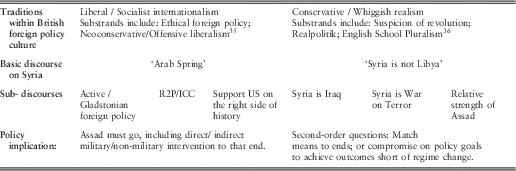
In our analysis the historical and cultural background to UK foreign policy is structured by two traditions identified by Bevir, Daddow, and Hall. The first is a liberal/socialist tradition, which privileges cosmopolitan responsibilities as integral to the national interest. The second is a conservative/whiggish tradition, which is suspicious of moralism and emphasises the need for scepticism and prudence in the service of the national interest and international order.Footnote 32 Emerging from these traditions are what we call, following Hansen, two ‘basic discourses’. These act as the ‘the main convectors of discussion’ or ‘the key points of structuring disagreement within a debate’ on – in our case – Syria.Footnote 33 The remainder of this section describes these specific discourses in their ‘ideal type’ format.Footnote 34 Table 1 summarises the discussion.Footnote Footnote
Culturally embedded British foreign policy discourses towards Syria (2011–13).

Interpreted from within the liberal internationalist tradition, the early protests against the Assad regime were something the UK should support, especially because they were part of the historic movement sweeping the Arab world toward democracy. We recognise that as a description of the various revolutions happening at the time, the term ‘Arab Spring’ does not adequately capture the plurality of experiences. We also recognise that the UK response to each of these experiences was different, a point we return to in the conclusion.Footnote 37 We think it is an appropriate label to describe our first basic discourse on Syria, however, because it captures the sense in which British policymakers accepted regime change as inevitable and legitimised a strategy of calling for Assad to go by appealing (at least initially) to a sense that events in Syria were part of a larger movement of history. We find a number of sub-discourses informing and helping to underpin this discursive strategy. These included the sense that calling for Assad to go was morally and legally the right thing to do in the context of international norms such as the responsibility to protect populations from crimes against humanity and to prosecute the perpetrators. It was also represented as being consistent with a ‘Gladstonian’ identity that portrayed the UK as an active and influential leader of the kind of progressive change these norms symbolised.
Interpreted from within the conservative realist tradition, the violence in Syria looked very different. As Ian Hall and Nicholas Rengger note, political conservativism as a foreign policy tradition is traceable to Edmund Burke’s reaction to the French Revolution and his scepticism toward the liberal idea that reason was powerful enough to create new social orders. Change from this perspective was not always ‘salutary reform’. If change had to happen it ‘must do so prudently’ without disrupting those structures that maintained order. Prudence, from this perspective, is the statesman’s chief virtue.Footnote 38 This tends to make conservatives (but not neoconservatives) realists; although realists are not necessarily conservatives in the broader sense of the term.Footnote 39 We call the basic discourse that resonated most with this tradition ‘Syria is not Libya’. This reflected a sense that the military intervention the UK had committed to in Libya could not be repeated in Syria because the situation was different in ways that made the use of force imprudent. A number of sub-discourses reinforced this basic point: an extension of metaphorical reasoning that implied that if ‘Syria’ was not ‘Libya’ (a policy success, at least initially) it was probably ‘Iraq’ (a failure not to be repeated);Footnote 40 or, given the changing character of the opposition, ‘Syria’ was ‘the new front against al Qaeda’. Another sub-discourse emphasised the continuing strength and resilience of the Assad regime in comparison with the opposition. In this situation, an ideal-type conservative realist could have drawn on Burkean-type scepticism and appeals to the national interest to argue against the liberal commitment to democratisation.
It is our finding that the government was neither willing nor able to argue for an ideal-type conservative position; but at the same time it was neither willing nor able to follow through on the ideal-type liberal position by effecting regime change through military intervention.Footnote 41 In this respect, there is a synergy between the government’s approach to Syria and the vision of liberal conservatism that David Cameron set out in his JP Morgan lecture on 11 September 2006. There he described himself as ‘Liberal – because I support the aim of spreading freedom and democracy, and support humanitarian intervention. Conservative – because I recognise the complexities of human nature, and am sceptical of grand schemes to remake the world’.Footnote 42 Syria tested his government’s ability to balance these instincts and to sell the resultant policy to various constituencies. We argue, however, that the government was able to pursue a strategy that legitimised a position between the ideal-liberal and ideal-conservative types. Positions that, from an ideal-type perspective, were ‘empty’ because ‘they lack relevant ends-means reasoning’,Footnote 43 were nevertheless legitimised, at least to the extent that the government could maintain that Assad must go without committing the means to effect that.
‘The Arab Spring’ and ‘Syria is not Libya’: Two basic discourses
In March 2011 Syrian protesters began calling for a lifting of the 48-year emergency law – which enabled the state to outlaw public gatherings. Hope that the regime would avoid violence by reforming were short lived. In August of 2011, following developments in the Arab League that saw Qatar and Saudi Arabia call for Assad to go, and attacks against US Ambassador Ford who had indicated support for opposition groups, the US called on Assad to step aside.Footnote 44 With the US taking such a lead it would have been difficult for the UK not to follow. Our interview data, however, suggests that UK policy, at least at the United Nations in New York, was out in front of American thinking and the government in London did not hesitate in calling for Assad to go.Footnote 45 As one well-placed diplomat put it to us, the UK came out of the Libya experience ‘thinking it had been a good exercise’ and that on Syria they actively tried to convince the US ‘to push the boundaries’ of its policy.Footnote 46 Of significance for us is how discursively the government defended the insistence that Assad must go in the context of these ‘boundaries’, which in the period under consideration limited US intervention to the supply of non-lethal aid. Crucial to this strategy, at least in the initial phases of the crisis, was the representation of the violence in Syria as part of the historic and unstoppable movement toward democracy known as ‘the Arab Spring’.
To repeat the above qualification, we are not claiming here that the UK had a consistent approach to all the events labelled as part of the Arab Spring. As Philip Leech and Jamie Gaskarth note, the UK response to the violence in Bahrain for example was less damning and they explain that in terms of elite networks.Footnote 47 We do note, however, that Assad’s repression in Syria was discursively linked to events in Libya and the ‘tide’Footnote 48 or ‘wave of demand for change in the Arab World’.Footnote 49 David Cameron for instance, noted that ‘what is happening in what I call the Arab Spring is that leaders have to show they have the consent of the people … and President Assad is not doing that’.Footnote 50 Likewise, Deputy Prime Minister Nick Clegg insisted that ‘[Assad] is as irrelevant to Syria’s future as Qadhafi is to Libya’s’.Footnote 51 More than that, this linkage represented Assad’s attempts to hold on to power as destined to fail. Liberal values, according to Foreign and Commonwealth Minister, Alistair Burt MP, ‘spread by themselves over time – not because Western nations are advocating them, but because they are the natural aspirations of all people everywhere. … Governments that set their face against reform altogether – as Libya has done and Syria seems to be – are doomed to failure’.Footnote 52
Of course, this language can be interpreted as an attempt to deter Assad and to encourage peaceful reform, although its usefulness was sure to be questioned in the context of statements ruling out military intervention.Footnote 53 Still, invoking the Arab Spring to argue Assad’s departure was inevitable helped legitimise the call for him to go even in that context. In the August 2011 speech that called on Assad to go, for instance, the Deputy Prime Minister Nick Clegg described the Assad regime as ‘a single family continu[ing] to wage war on an entire nation’. He accepted that regional experiences varied but insisted that ‘[t]he direction of travel is set. The fundamental forces driving these changes are here to stay.’Footnote 54 Likewise, Foreign Secretary William Hague described the Arab Spring as more important for the twenty-first century than 9/11. He insisted Assad had taken the ‘wrong route’ and that it was ‘just a matter of time’ before he was replaced.Footnote 55 This sense of inevitability was repeated in March 2012 when, following the withdrawal of British diplomats from Damascus, the Foreign Office announced Ambassador Collis’s view that the regime would not last another year.Footnote 56
Constructing Assad’s downfall as inevitable in this way was important because it enabled the government to avoid answering the awkward questions about intervention. In certain respects, ‘liberal conservatism’ had prepared this discursive terrain. It appealed to ‘humility and patience’ because according to Cameron it understood the limits of Western military power and recognised ‘that democracy cannot quickly be imposed from outside’.Footnote 57 When Cameron introduced the idea in 2006 it had resonated with the widespread concern about being dragged into another Iraq-type scenario, something the government had explicitly addressed with respect to the Libya intervention by ruling out ground forces. Defending the decision to rule out military intervention in Syria was therefore consistent with its own narrative and a relatively easy sell. By consistently arguing that ‘Syria is not Libya’ (Kim Sengupta called it ‘a government mantra’)Footnote 58 official discourse could maintain a principled commitment to liberal interventionism while demonstrating a conservative realist sensitivity to situational difference and the need for prudence.Footnote 59 Furthermore, this discourse found widespread support in non-official discourse, even after the successful overthrow of Gaddafi.Footnote 60 This support included statements by the Labour Party foreign affairs spokespersons.Footnote 61
If the ‘Syria is not Libya’ discourse helped explain why the government was not trying to remove Assad through direct military intervention, it did not guarantee policy coherence. The second order question of how to realise regime change if Assad did not fall remained a possibility. That potentially created a ‘plausibility gap’ in the government’s discursive strategy. In these early stages, however, this was not a problem because the official ‘Arab Spring’ discourse also found support within the wider debate. Syria’s suspension from the Arab League in November 2011, for instance, was portrayed as a ‘humiliation’Footnote 62 for an ‘ailing regime’ that was ‘losing touch with reality’Footnote 63 and entering ‘cardiac arrest’.Footnote 64 Likewise The Times seemingly echoed the Foreign Office’s assumption that Assad’s downfall was a matter of time. ‘The longer Mr Assad remains’, it editorialised, ‘the greater the risk that the eventual reckoning for his regime will be terrible.’Footnote 65 The withdrawal of Western Ambassadors was represented as ‘cranking up the pressure’ on a ‘doomed’ regime.Footnote 66 The ‘noose’ was said to be tightening around Assad’s neck’.Footnote 67 His ‘grip was weakening’.Footnote 68 His ‘days were numbered’.Footnote 69 The regime was ‘doomed’, ‘on its last legs’, ‘rotting from inside’.Footnote 70 Reinforcing this assessment was the insistence that Assad became weaker as the death toll increased. Assad was portrayed as ‘having stepped in blood so far he could not turn back’ and, like Macbeth, his downfall was inextricably sealed.Footnote 71
The significance of this non-official discourse then is that it facilitated the government’s claim to be meeting the challenge of the moment, which was regularly equated with historic events like the end of slavery, the Cold War, and apartheid.Footnote 72 A discourse that framed the violence in Syria as a prelude to Assad’s downfall enabled the government to legitimise the call for Assad to go despite acknowledging the lack of capacity to influence events through military intervention. Furthermore, it enabled the government to defend its preferred conception of British identity by acting within liberal tradition without having to answer, at least initially, the conservative realist’s second order questions of what to do if Assad should stay. Thus, Hague perpetuated a liberal sub-discourse (see Table 1) that framed support for the Syrian opposition in terms of a ‘Gladstonian love of freedom’. This, he insisted, ‘must always animate British foreign policy, even if it is not and never will be the only consideration’; and it allowed him to merge these values with UK interests. Even while ruling out a Libya-like intervention, Hague insisted it would be a ‘fundamental strategic error for Britain to sit on the sidelines’. It was ‘strongly in our national interest’ that the peoples of the Middle East aspirations for political and economic freedom were fulfilled.Footnote 73
The right and wrong sides of history: Marginalising Russia and the UN
A significant aspect of the ‘Syria is not Libya (it could be Iraq)’ discourse was the failure to unite the UN Security Council. Of course, the UK government insisted that the resolutions it proposed on Syria were not seeking authorisation for a Libya-like military intervention, and that the Russian and Chinese were being disingenuous to make such claims.Footnote 74 In terms of the domestic discursive context, however, a divided Security Council resonated with memories of the 2003 decision to invade Iraq and this reinforced existing opposition to the idea of military intervention in Syria.Footnote 75 The three Russian and Chinese double vetoes during this period (October 2011, February 2012, and July 2012) are particularly interesting for our purposes, however, because of the way their discursive strategy resonated with a conservative realist suspicion of revolutionary change. For instance, the Russian Ambassador to the UN regretted what he saw as the West’s eagerness to embrace the opposition and ‘a lack of an appeal to them to distance themselves from extremists’. Undermining Assad he warned ‘could trigger a full-fledged conflict in Syria and destabilization of the region as a whole’.Footnote 76 From this perspective, the West’s policy on Libya was irresponsible not only because it had gone beyond the Security Council mandate agreed in Resolution 1973. Its irresponsibility lay in a substantive commitment to revolutionary change. The vetoes were against the idea of regime change even without military intervention. To legitimate its position, the UK government had to discursively counter or marginalise this argument.
Before demonstrating how the UK government did that it is important to offer some context. Alongside their vetoes, the Russians and Chinese advocated an international response that tried to end the conflict without regime change. For instance, they supported the appointment of the joint UN-Arab League peace negotiator, former Secretary General Kofi Annan. The hope was that Annan could persuade the regime and the opposition, which had loosely coalesced under the Syrian National Council (SNC) to accept his six-point plan. However, Western powers, including the UK, stressed that among these six points references to ‘political transition’ meant a national government that was ‘inclusive and democratic for all Syrians’ and did not include Assad.Footnote 77 The additional difficulty for Annan was that the Arab League was also calling for Assad to be removed. This made negotiations extremely difficult and it risked the implementation of Annan’s other points, such as the withdrawal of heavy weaponry. As UN mediator Jean-Marie Guéhenno puts it: ‘How could a mediator mediate if one of the organizations on behalf of which he was working has clearly sided with one of the parties?’.Footnote 78 Prejudging the outcome of a political transition, moreover, made it less likely that the process would ever get started. However, having backed the SNC, which refused to talk to Assad, Western powers, including the UK, could only accept a plan that delivered regime change. This argument was also used to oppose Iranian inclusion in the talks.Footnote 79 Annan had considered this necessary given Iran’s supposed leverage over the Syrian regime.Footnote 80 As Guéhenno put it: ‘for some countries, the fall of Assad would prove to be a much more important goal than a quick end of the war’.Footnote 81
The UN-Arab League mediation efforts concluded in the period under consideration with a diplomatic fudge. This insisted that a transitional government would be formed by ‘mutual consent’.Footnote 82 When the Western powers insisted that meant regime change because the SNC would not consent to a regime that included Assad, and when they proposed supporting that interpretation with a Chapter 7 Security Council Resolution, the Russians complained that the UN was once more being ‘blackmailed’.Footnote 83 In July, Russia was again joined by China in vetoing the proposed resolution. Ultimately, Annan resigned after the collapse of the UN-observed ceasefires complaining that Security Council division made his task impossible.Footnote 84 While official UK discourse regretted his resignation, a significant part of the wider discourse welcomed it. Annan and his plan were represented by some as simply giving the Assad regime cover to continue its brutal repression.Footnote 85 Indeed, this was the charge the UK government directed at Russia in particular. Helped by the Arab Spring discourse, which insisted on the inevitability of Assad’s downfall, western government legitimised what happened at the UN by arguing Russia was on the wrong side of history.Footnote 86 Its veto was a ‘mistake’Footnote 87 and would be something to ‘regret’.Footnote 88
More than that, Russian actions were framed as shameful because they were deemed to be motivated by a particularly narrow view of the national interest and not value-driven; or at least driven by values that enabled Russia to benefit at the expense of the Syrian people. Cameron argued that supporting Assad was not in Russia’s interests.Footnote 89 They should, he insisted, take a good ‘look at their conscience’.Footnote 90 This discursive strategy was a relatively easy sell in a national discursive context that was especially critical of Putin. He was portrayed as a ‘hard-nosed unsentimental calculator of national advantage’ and his Syria policy was interpreted mainly as a defence of Russia’s material interests (for example, arms sales, military bases).Footnote 91 He had displayed ‘monstrous hypocrisy’.Footnote 92 Likewise, China’s position was represented as being driven by a dutiful commitment to Russia and their strategic alliance.Footnote 93 This othering of Russia and China helped reaffirm the Gladstonian sub-discourse (see Table 1) that ‘Britain had no special interests which ran counter to those of the rest of mankind’.Footnote 94
Finding the means
As the violence escalated through 2012, critics attacked the inexorable teleology of ‘the Arab Spring’ discourse that underpinned the government’s discursive strategy. For instance, following the May 2012 massacre of 108 civilians (nearly half of them children) in the village of Houla, Martin Fletcher wrote that ‘certain truths have become self-evident’. The Assad regime in his view was ‘impervious to diplomatic or economic pressure’. Fletcher feared the Western response was simply more ‘rhetoric’.Footnote 95 In this sense, the government’s discursive strategy of marginalising the Russian position may have found support in non-official UK discourses but it was not without its critics. For some, the government’s ‘rhetoric’ on Russia was a convenient ‘alibi’ for Western inaction.Footnote 96 This illustrates the weaknesses in the government’s discursive strategy. Relying on the ‘Arab Spring’ or ‘right side of history’ discourse risked perpetuating a ‘plausibility gap’, which Kettell describes as a disjuncture ‘between the explanatory power of the projected discourse and the “real” situation … “on the ground”.’Footnote 97 The discursive resources in ‘liberal conservatism’ were stretched at this point and the tensions implicit in that concept were being exposed. The government had demonstrated conservative ‘humility’ by accepting the limits of direct intervention, but not enough to accept ‘that Russia may be right’ or to let it lead the UN process.Footnote 98 It instead relied on the liberal’s ‘faith’ in democratic progress and the conservative’s predilection for ‘patience’,Footnote 99 but both were tested by the rising violence.
A sub-discourse that emphasised Assad’s relative strength (see Table 1) also challenged the government’s claim to be resisting ‘strategic shrinkage’Footnote 100 by maintaining the activity of a global power. To counter this, and to address the emerging plausibility gap, official discourse would represent the UK as leading the efforts to support the Syrian opposition. The UN Security Council may have been unable to act but the UK would not, as Hague put it, ‘sit on the sidelines’.Footnote 101 Talks with the Syrian opposition began in November 2011 following the creation of the Turkish-based umbrella organisation, the SNC and the Free Syrian Army (FSA), which had been created by defectors from the Syrian Army.Footnote 102 Despite concerns that this opposition was not as significant as their counterparts in Libya, Western powers supported the creation of an international support group on the model of the Libya Contact Group. The so-called ‘Friends of Syria’ was a group of over sixty states that first met with the SNC in Tunis in February 2012. Creating this ad hoc group outside formal UN processes was of course another part of the Western strategy to marginalise Russia, which was not represented at these meetings.Footnote 103 But the UK government also seized on this development as part of its discursive strategy to legitimise its support for regime change and its claim to be doing something to realise it. The UK was to play ‘a very active role’ in the new group.Footnote 104 It was represented in official discourse as ‘a driving force’.Footnote 105
This position found some support in non-official discourse.Footnote 106 It was not without its critics however. It sat awkwardly alongside reporting that questioned the coherence and, in some cases, the legitimacy of the opposition groups, especially those based in Turkey.Footnote 107 Of course, the official response emphasised UK efforts to address this problem by working to help unite disparate groups.Footnote 108 Yet doubts over whether that was possible were difficult to silence. A year on from the creation of the SNC, for instance, the US called for greater unity among opposition groups.Footnote 109 Indeed, the White House in particular had concerns and we know from insider accounts that this prevented the UK from acting to close the ends-means gap by arming the FSA. In February 2012, for instance, Downing Street decided not to send arms. The Chief of the Military Staff, General David Richards, was reportedly told by Hugh Powell, the Deputy National Security Adviser, that the plans were ‘more than the market could bear’. They were unsellable in Washington, as well as contrary to parliamentary and public opinion.Footnote 110 This was confirmed later in the year when Secretary of State Hillary Clinton teamed up with CIA Director David Petraeus to convince the White House to arm the Syrian opposition. The president rejected the plan. Clinton writes in her memoirs that the president required more time ‘to evaluate the Syrian opposition’ before escalating the US commitment.Footnote 111
UK support for the Syrian opposition was thus limited to non-lethal equipment, which left the government again exposed to a plausibility gap.Footnote 112 In that context, a renewed push to coordinate and arm opposition groups began immediately after the November 2012 US presidential election. The timing suggests that for the UK government the White House was the most significant audience, although it was not clear that the elections had changed US attitudes.Footnote 113 For the prime minister, arming the moderate opposition would assist political transition by showing that ‘we are working with a credible and strengthening and growing force’.Footnote 114 Yet through 2012 a sub-discourse that insisted Syria was in fact a new front in the war on terror (see Table 1) and not the Arab Spring emerged in the UK media. This view had limited exposure in 2011 and, as noted, its association with Russia made it easy to dismiss. Even without that association, there were those who argued the Syrian opposition were ‘extraordinary patriots’Footnote 115 and the idea that they could be terrorists was rejected as ‘laughable’.Footnote 116 From December 2011, however, reports of ‘Al-Qaida type attacks’ increased, something that official discourse accepted in June 2012.Footnote 117 At no point, however, did the UK government consider adopting an ideal-type conservative realist position that saw Assad as a lesser evil and a tacit ally in the war on terror.
Indeed the government responded to the ‘Syria is the war on terror’ sub-discourse by defending its position with a Blair-like merger of values and interests.Footnote 118 In arguing for the European Union arms embargo to be lifted for instance, David Cameron argued that the rise of al-Qaeda in Syria represented a ‘strategic imperative’ for the West to arm the Syrian opposition to ensure a broad-based coalition topples President Bashar al-Assad.Footnote 119 This initiative was again accompanied by a discourse asserting UK activity. The UK was portrayed as ‘taking the lead’, ‘forcing the pace’, and ‘out in front’ on the question of creating a united opposition that could be armed.Footnote 120 This strategy was only half successful, however. The arms embargo was lifted but no arms were supplied at that time. As insider interview data attests, the task of selling the policy was made more difficult by the discourse of moral equivalence that strengthened after the media reported in May 2013 on images of an opposition soldier eating the heart of a Syrian soldier.Footnote 121 Still, even while official discourse recognised ‘that there are extremists among the Opposition’, it worked to counteract the implication that Assad was a tacit ally. There were, the prime minister insisted ‘millions of ordinary Syrians who want to take control of their own future – a future without Assad’.Footnote 122
There is an irony implicit in the way we have structured our analysis of the discursive context. The sub-discourse on the incoherence and changing character of the Syria opposition reinforced the idea that ‘Syria was not Libya’ (see Table 1) and made it difficult for the UK government to argue for military intervention of any kind. But in the aftermath of regime change in Libya there also emerged a discourse that suggested Libya was not an example of the UK ‘saving’ the Arab Spring.Footnote 123 ‘Libya’ was instead framed by some as a political vacuum in which al-Qaeda thrived. This argument resonated especially well after al-Qaeda claimed responsibility for the 11 September 2012 attack against the American Embassy in Benghazi.Footnote 124 ‘Regime change’ in this sense was easily represented as counterproductive, especially when it was linked to a UK failure to commit to rebuilding.Footnote 125 With the rise of anti-Western extremism in states where the UK had overthrown regimes (for example, Iraq, Libya), arguing that there was a merger of Western values and interests became more difficult. The difficulties in Libya also helped to further undermine the Arab Spring discourse. The events in Benghazi were used to portray the Arab Spring as ‘phoney’ and ‘doomed to failure’.Footnote 126 It was an example of ‘blowback’ against Western intervention. The implication from this growing discourse was clear. Trying to depose Assad would achieve nothing other than playing into the hands of the UK enemies. By the end of 2012 then, ‘Libya’ had a different, although still contested, meaning for the debate on Syria. Even if ‘Syria’ was ‘Libya’, it would be reason to oppose military intervention and regime change.
Maintaining the merger of values and interests
If the presence of al-Qaeda in the discourses on Syria complicated the government’s discursive strategy it did not fundamentally change it. The government remained committed to the argument that the removal of Assad was the right thing to do in terms of its values and its interests, including the fight against al-Qaeda. Indeed, from the start of the democratic protests in 2011, ‘the Arab Spring’ was discursively linked to the war on terror in ways that tried to silence the ideal conservative-realist argument about the tension between democracy promotion and national security. Foreign Office Minister Alistair Burt, for instance, linked the Arab revolutions and the death of Osama bin Laden in May 2011 to reinforce the right side of history sub-discourse. Those ‘who argued that 9/11 and Al Qaeda’s narrative of despair was the authentic expression of Muslim grievances were thankfully all too wrong’.Footnote 127 Likewise, William Hague argued that in the Arab Spring there was ‘the seed of Al Qaeda’s long-term defeat and irrelevance’.Footnote 128 The implication was that supporting opposition movements, at least in Libya and Syria, was not only right in terms of British values, it was right in terms of the ongoing war on terror. As Cameron put it: ‘democracy and open societies are not the problem’; tolerating dictators in the name of stability was. Democracy gave the people a choice ‘between dictatorship or extremism’.Footnote 129 In merging interests and values this way, the government’s discursive strategy on Syria marked a clear continuity with ‘Blairite’ foreign policies. Indeed, the government’s discursive strategy found support on the opposition benches for this reason. Former Foreign Secretary Jack Straw, for instance, linked the Arab Spring to the war on terror, arguing that what was happening in the Arab world had shown that al-Qaeda had failed.Footnote 130
As noted, the argument that history was moving in a particular direction and that extremism was being defeated was challenged by the sub-discourses emerging in 2012. It is clear, however, that the discursive context was structured by another significant sub-discourse that has not yet been discussed. This emerged from within the liberal tradition and made it difficult to consider an ideal-type conservative realist policy. What Table 1 refers to as the ‘R2P/ICC’ sub-discourse appealed to those international norms that insist states have a responsibility to intervene to protect populations from governments that have manifestly failed to stop atrocity crimes. The significance of this sub-discourse increased in November 2011 when the UN agencies accused the regime of committing crimes against humanity.Footnote 131 From that moment on there was a constant risk of the UK and other states being painted as ‘bystanders’ whose ‘dithering … played into Assad’s hands’.Footnote 132 The comparisons to the atrocities in Bosnia, which official discourse did not deny, were particularly challenging to a liberal conservative government.Footnote 133 This is because that idea had not only been a response to what had been painted as the imprudent liberalism of the Blair years. It was also a response to the hyper-realism of John Major and the argument that by failing to stop genocide in the Balkans his Conservative government had presided over Britain’s ‘unfinest hour’.Footnote 134
To counteract the ‘bystander’ identity, official discourse stressed the UK’s status ‘as one of the most active [countries] in the world when it comes to promoting human rights’.Footnote 135 Preventing the loss of life in Syria meant stepping up support to the opposition, ‘thereby increasing the pressure on the regime’.Footnote 136 Through its non-lethal aid to the Syrian opposition, the UK would support groups that would collect evidence so that ‘a day of reckoning for Assad’s crimes’ was guaranteed.Footnote 137 Indeed, from April 2012 Hague spoke openly about the possibility of a Security Council resolution to refer the Syrian situation to the International Criminal Court (ICC), and in January 2013 the UK joined 57 states in petitioning the Security Council.Footnote 138 Again this served two purposes. It formed part of a coercive strategy to deter the regime, although this also lacked credibility to the extent that the Russian and Chinese had demonstrated a willingness to veto these kinds of Security Council resolutions. The second purpose was to reinforce the claim that the UK was exploring every avenue possible in its efforts to support the Syrian people overthrow the regime. Official discourse emphasised how the UK ‘led the way’Footnote 139 in calling on international community to ‘end this culture of impunity and hold to account those responsible’ for the atrocities.Footnote 140 Part of this strategy was to emphasise the human rights monitoring that the government was supporting. As the prime minister put it: ‘we write down what has been done so that no matter how long it takes, people should always remember that international law has got a long reach and a long memory’.Footnote 141 Predictably, this found support among human rights and R2P advocacy groups, but also in the wider discourse.Footnote 142
This then was the position of the government at the onset of the chemical weapons crisis that culminated in the vote in parliament in August 2013. The government had consistently argued that the removal of Assad was consistent with UK values and UK interests. Its discursive strategy had relied on an argument that the fall of the regime was inevitable and when the plausibility of this argument was challenged the government responded to the doubters by arguing that the UK was leading efforts to support the opposition as they tried to overthrow the regime. This strategy had been working within the boundaries of what we have called the ‘Syria is not Libya’ discourse, which limited the ability of the government to close the plausibility gap by arguing for a Libya-like military intervention or arming the rebel groups whose ability and character was questioned from 2012 onwards. These boundaries were reinforced by the sense that the White House was opposed to deeper involvement in the conflict. This is why the president’s August 2012 statement that the regime’s use of chemical weapons would be a ‘red line’ was so significant.Footnote 143 When a year later it was reported that the regime had used chemical weapons on a massive scale, it seemed to offer an unmissable opportunity to construct an argument for military intervention. It seemed possible, in other words, to close the gap between stated ends and available means.
As we know, parliament rejected the government argument for force and the reasons for that are covered in the existing literature. However, two points are worth mentioning to complete our analysis. The first is that the vote illustrated the significance of the ‘Syria is potentially another Iraq’ sub-discourse (see Table 1), as well as the failure of the government’s discursive strategy to counteract that. Indeed, the government was easily portrayed as rushing to support the US president, as prejudging the evidence of UN weapons inspectors, of failing to command consensus at the UN Security Council, relying on questionable (if not ‘dodgy’) intelligence reports and contested legal advice. By helping to create this sense of ‘deja vu’, the government’s discursive strategy failed to sell policy.Footnote 144 Cameron was again represented as the ‘heir to Blair’ and ‘Syria’ was easily framed as ‘another Iraq’, which the prime minister acknowledged after the vote.Footnote 145 This framing, together with concerns that the removal of Assad would only benefit extremist forces, made a military response politically impossible.
The second point is perhaps less obvious, and this relates to how the insistence on removing Assad influenced the vote. The government in fact argued in parliament that force would be used for the limited purpose of punishing the use of chemical weapons and not to overthrow the regime. This was an articulation of a values-based interest (upholding the chemical weapons taboo), but it was separate to, and complicated by, the government’s longstanding commitment to overthrowing Assad. There was support in parliament for the government’s proposal of limited strikes, but others dismissed it as ‘tosh’.Footnote 146 The argument for limited force, in other words, was simply not trusted in the context of broader policy and the insistence that Assad must go. The concern was that the government had changed its justification for intervention but not its end goal.Footnote 147 The argument that the government had gone beyond the UN mandate on Libya exacerbated this concern (another aspect of the changing meaning of ‘Libya’). The government in this sense was a victim of its own success. Its discursive strategy of linking values and interests to legitimise its support for the removal of Assad was so convincing that parliament did not believe the government would restrain itself after parliament authorised the use of force.
Conclusion
The Syria crisis highlights issues that are at the core of what it means to be a liberal democratic state in international society. Whether or not that state has a responsibility to support democratic revolutions and defend the human rights of foreigners has traditionally divided these states along the liberal/conservative fault line that we describe in this article. After the Iraq War, and in the context of economic austerity, the Cameron-led government addressed foreign policy issues with a ‘Conservative accent’,Footnote 148 but it was never willing or able (given the significance of liberal inspired discourses) to follow an ideal-type conservative realist policy. The need to legitimate a conservative foreign policy through discursive strategies that also resonated with a deeply embedded liberal tradition had been anticipated by the articulation of ‘liberal conservativism’. This attempt to articulate a via media between ideal-types also characterises the government’s discursive strategy on Syria. The calls for Assad to go resonated with liberals, but by ruling out intervention the government mollified conservative concerns.
A difficulty of holding the centre ground of course is that one can be attacked from both sides. It appears in this instance, however, that the government’s strategy to legitimise a centrist approach found support in non-official discourse. Indeed, when the government tried to follow through on its liberal rhetoric by arming the Syrian opposition and by launching air strikes, its arguments were less well received. It was checked by conservative realists and the political strength they drew from sub-discourses that spoke to the public’s concern that ‘Syria was not Libya’ or that ‘Syria was another Iraq’, as well as concerns about the coherence and character of the Syrian opposition. Likewise, it was politically impossible to argue that Assad might stay given the strength of the liberal argument and the support it drew from appeals to the ‘Arab Spring’ and the ‘R2P/ICC’ sub-discourse. Realists and liberals will argue the merits of policy and as noted, the first phase of historiographical debate has begun. That debate will likely centre on an approach that failed to match the ends and means of policy. Our article explains the discursive context to that failure and the way in which it both enabled the government and limited it to the pursuit half-measures.
Acknowledgements
The research for this article was supported by an EU Marie Curie International Outgoing Fellowship, project number: 627740 and the RCUK ‘Rights and Ethics in a Security Context’ research programme, grant number: ES/L013355/1. The authors would like to thank James Souter, Xavier Mathieu, Ben Fermor, and Blake Lawrinson for their research assistance.
Supplementary Material
To view supplementary material for this article, please visit: https://doi.org/10.1017/S0260210517000134