John Bowlby set a strong expectation for scientific support of attachment theory, and demonstrated a willingness to revise his ideas in light of emerging methodologies and evidence (Bowlby, Reference Bowlby1979; Bretherton, Reference Bretherton1992). While the field of research surrounding attachment theory has grown exponentially in the past 20 years, findings have been critiqued for an almost exclusive focus on transmission of attachment from adult attachment status and caregiving representations to offspring (Barbaro, Boutwell, Barnes, & Shackelford, Reference Barbaro, Boutwell, Barnes and Shackelford2017; Verhage et al., Reference Verhage, Schuengel, Madigan, Fearon, Oosterman, Cassibba and van IJzendoorn2016). Evidence of risk assocations is scant and rarely harvested to explore combined effects. With respect to both understanding and advancing early identification of problem pathways, we focus on the infant attachment group most clearly associated with the development of future psychopathology, namely, the disorganized attachment classification. We first discuss the nature of this attachment group, and replicated evidence to date on its major preceding determinants. We then aim to extend the evidence base to factors beyond adult attachment representations that predict offspring attachment disorganization, through a comprehensive and systematic review of the literature, with meta-analyses.
Attachment Disorganization
The disorganized attachment classification emerged in the context of systematic attempts to understand infant–parent dyads who could not be classified according to the traditional attachment coding system (Main & Solomon, Reference Main, Solomon, Brazelton and Yogman1986). Relative to the three major organized forms of attachment in infancy and early childhood years (secure, avoidant and ambivalent/resistant attachments) disorganized attachments are typified by intense contradictory behavioral strategies and/or relational incoherence in the child–parent dyad, especially manifest at peak points of affective need in the child (Main & Solomon, Reference Main, Solomon, Greenberg and Cummings1990), and maturing into role-reversed controlling interactions in the pre-school years (Cassidy & Marvin, Reference Cassidy and Marvin1999/1992). Disorganized attachment relationships were first thought to reflect the profoundly confusing effects for the young child of apprehension during states of heightened need, triggering contradictory internal motivations to both approach the caregiver and to avoid him or her as a source of fear (Hesse & Main, Reference Hesse and Main1999, Reference Hesse and Main2000). Disorganization of attachment in infancy sits on the pathway to several adverse behavioral and social–emotional sequalae emergent across later childhood (Carlson, Reference Carlson1998; Forbes, Reference Forbes2009; van IJzendoorn, Schuengel, & Bakermans-Kranenburg, Reference van IJzendoorn, Schuengel and Bakermans-Kranenburg1999) and in young adult romantic relationships (Weinfield, Whaley, & Egeland, Reference Weinfield, Whaley and Egeland2004), with higher prevalence in borderline personality disorders in adulthood (Beeney et al., Reference Beeney, Wright, Stepp, Hallquist, Lazarus, Beeney and Pilkonis2017).
Population prevalence of attachment disorganization is estimated at 14%–18% in normative middle-class dyads (Opie et al., Reference Opie, McIntosh, Esler, Greenwood, Tan, Kothe and Olsson2019; van IJzendoorn et al., Reference van IJzendoorn, Schuengel and Bakermans-Kranenburg1999), and 25% in low socioeconomic samples (van IJzendoorn et al., Reference van IJzendoorn, Schuengel and Bakermans-Kranenburg1999). Special population estimates include young children reared in institutional settings (54%; Lionetti, Pastore, & Barone, Reference Lionetti, Pastore and Barone2015) and children residing in foster care (22%; Vasileva & Petermann, Reference Vasileva and Petermann2018). While rates of disorganized attachment in maltreated populations are upward of 80% (Carlson, Cicchetti, Barnett, & Braunwald, Reference Carlson, Cicchetti, Barnett and Braunwald1989; Cicchetti & Barnett, Reference Cicchetti and Barnett1991; Cyr, Euser, Bakermans-Kranenburg, & van IJzendoorn, Reference Cyr, Euser, Bakermans-Kranenburg and van IJzendoorn2010), levels of disorganized behaviors are found beyond maltreating contexts, and may appear in lesser forms across all attachment classifcations in infancy (Granqvist et al., Reference Granqvist, Sroufe, Dozier, Hesse, Steele, van IJzendoorn and Duschinsky2017). Prevalence rates of disorganized attachment show cross-cultural stability (Posada & Trumbell, Reference Posada, Trumbell, Gojman-de-Millan, Herreman and Sroufe2016). Meta-analytic evidence indicates moderate long-term stability of disorganized attachment across early childhood (Opie et al., Reference Opie, McIntosh, Esler, Greenwood, Tan, Kothe and Olsson2019) and into adult life (van IJzendoorn et al., Reference van IJzendoorn, Schuengel and Bakermans-Kranenburg1999).
Pathways to Disorganized Attachment: The Current Replicated Evidence
The largest body of replicated etiological evidence on infant attachment disorganization comes from studies of adult attachment states of mind associated with unresolved loss and trauma, and their enactment through helpless or hostile parenting responses when attending to anxiety states in their own child (Lyons-Ruth & Spielman, Reference Lyons-Ruth and Spielman2004; Main & Hesse, Reference Main, Hesse, Greenberg and Cummings1990). Two meta-analyses involving over 47 studies have found moderate to strong evidence for the unresolved-disorganized intergenerational relationship. Van IJzendoorn (Reference van IJzendoorn1995) found a large effect (r = .31, k = 19), with 53% correspondence between infant disorganized attachment and parent unresolved trauma or loss status on the Adult Attachment Interview (AAI; George, Kaplan, & Main, Reference George, Kaplan and Main1985). Verhage et al. (Reference Verhage, Schuengel, Madigan, Fearon, Oosterman, Cassibba and van IJzendoorn2016) found a medium effect (r = .21, k = 47, N = 2,945). Specifically, there is well-replicated support for a strong predictive relationship between displays of frightened or frightening behaviors, negative-intrusive and disoriented behaviors, presumed largely unconscious on the part of the caregiver, and disorganized attachment in the dyad (Abrams, Rifkin, & Hesse, Reference Abrams, Rifkin and Hesse2006; Lyons-Ruth, Bronfman, & Parsons, Reference Lyons-Ruth, Bronfman and Parsons1999; Madigan, Moran, & Pederson, Reference Madigan, Moran and Pederson2006).
Contributions by Other Pathways
In light of the above pool of replicated evidence, the intergenerational transmission of unresolved fear in the adult attachment system became central in the etiological narrative about attachment disorganization (Bernier & Meins, Reference Bernier and Meins2008). However, this has left other potential spheres of influence less well explored, including individual-level processes (e.g., temperament, genetics, and mental health) relational processes (family form and support) and contextual processes (social–economic disadvantage). Little is also known about differential susceptibility, yet it is clear that some infants are particularly sensitive to disorganizing attachment behaviors in the absence of an alarming environment (Duschinsky, Reference Duschinsky2018).
Evidence for the role of familial and social stress in the genesis of infant attachment disorganization is more substantial. The original meta-analysis by van IJzendoorn (Reference van IJzendoorn1995) identified marital conflict as a significant predictor of disorganization, and new meta-analytic evidence continues to support its role in infant attachment insecurity (Tan, McIntosh, Kothe, Opie, & Olsson, Reference Tan, McIntosh, Kothe, Opie and Olsson2018). Verhage et al. (Reference Verhage, Schuengel, Madigan, Fearon, Oosterman, Cassibba and van IJzendoorn2016) found transmission between unresolved parental attachment representations and infant attachment disorganization was moderated by psychosocial risk (n = 1,090, r = .22, p < .01). Accruing social stressors in their own right account for significant variation in risk for harsh parenting (Begle, Dumas, & Hanson, Reference Begle, Dumas and Hanson2010). Arguments have been made for and against the causal influence of child maltreatment on disorganized attachment behaviors (Duschinsky, Reference Duschinsky2018; Granqvist et al., Reference Granqvist, Sroufe, Dozier, Hesse, Steele, van IJzendoorn and Duschinsky2017). Cyr et al. (Reference Cyr, Euser, Bakermans-Kranenburg and van IJzendoorn2010) found that while maltreated children were more likely to be classified as disorganized than nonmaltreated children, nonmaltreated children living in contexts of high socioeconomic risk were as likely to be classified with a disorganized attachment as maltreated children (Q = 2.07, p = .15).
States of chronic confusion or alarm in the infant with respect to the caregiver may also arise through unanticipated physical separation from the caregiver, for example, through hospitalization, or parental separation (Duschinsky, Reference Duschinsky2018; Main, Hesse, & Hesse, Reference Main, Hesse and Hesse2011; McIntosh, Pruett, & Kelly, Reference McIntosh, Pruett and Kelly2014; Sroufe & McIntosh, Reference Sroufe and McIntosh2011), parent mental illness (Main & Stadtman, Reference Main and Stadtman1981; True, Lyon, Pisani, & Oumar, Reference True, Lyon, Pisani and Oumar2003), or other preoccupying conditions engendering dysregulating responses from parents (Lieberman, Reference Lieberman2014). While each of these circumstances may theoretically give rise to chronic or repeated lack of assuagement of infant need, the evidence supporting these transmission pathways remains poorly replicated.
The purpose of this systematic review is to extend our understanding of the determinants of disorganized attachment, and in doing so, scope the “attachment disorganization transmission gap” unexplained by parent's unresolved attachment trauma. Our search was limited to longitudinal studies where there was clear temporal separation between exposure and outcomes. We further limited the scope of our review to risk relationships for which there was evidence of replication in two or more cohort studies. For each replicated risk factor in the extant literature, we have presented study specific estimates, as well as pooled estimates using meta-analysis, with the aim of summarizing the most promising areas for intervention and future research.
Method
This review was conducted in accordance with the evidence-based guidelines for systematic reviews described in the PRISMA statement (Liberati et al., Reference Liberati, Altman, Tetzlaff, Mulrow, Gøtzsche, Ioannidis and Moher2009).
Search strategy
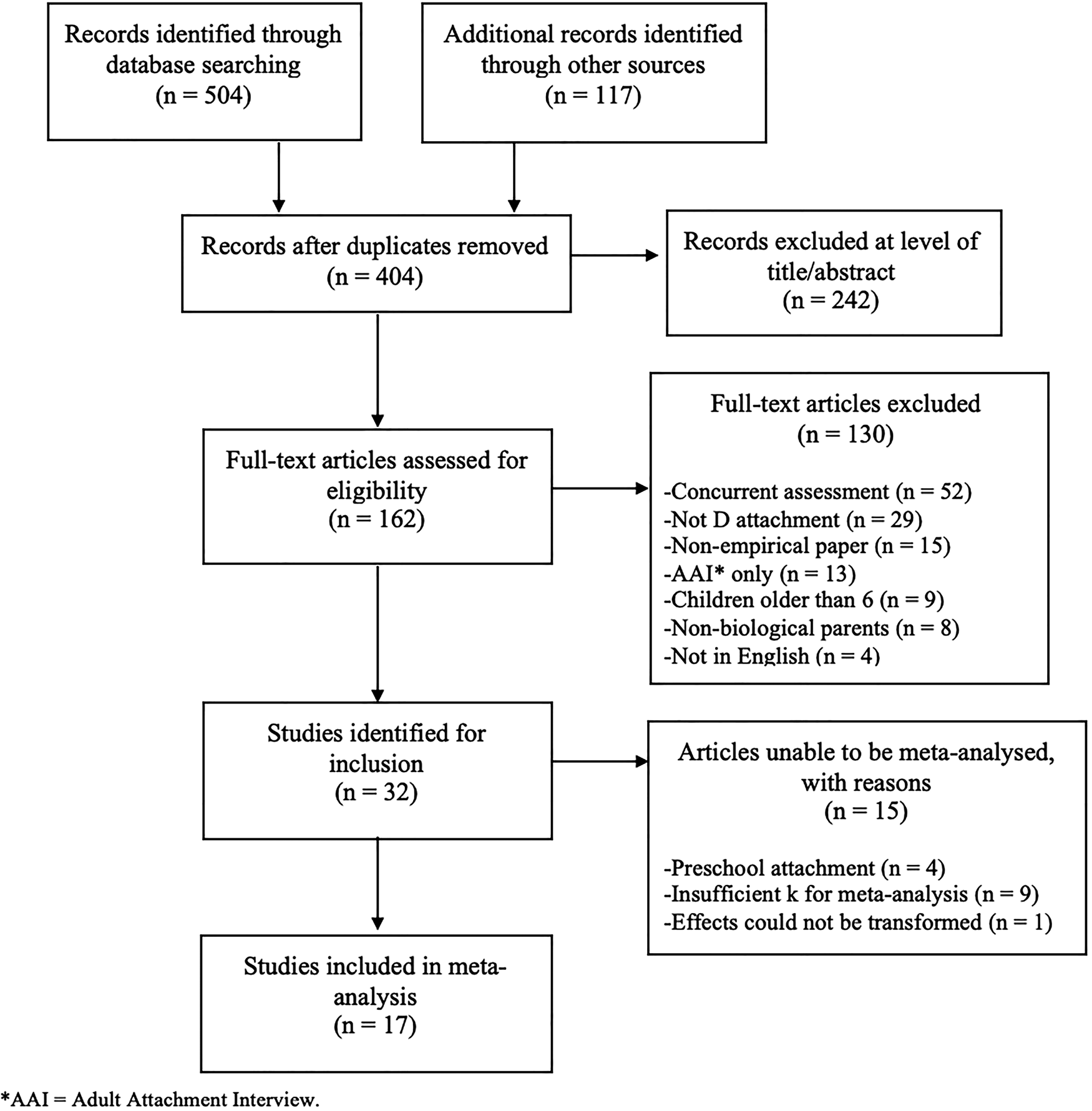
A systematic search of Academic Search Complete, CINAHL, MEDLINE, and PsycINFO was first conducted in November 2017 and updated in July 2019. Empirical studies published in English were identified, using the following search terms: “disorgani*ed attachment” OR “attachment disorgani*ation” AND precursor* OR predictor* OR longitudinal OR intergenerational. A total of 473 articles was located. An additional 31 dissertations and theses were located through ProQuest using the same terms. A further group of 117 articles was located through Web of Science citation searching and manual searching of reference lists of relevant articles. Of the 621 articles identified, 217 exact duplicate articles were filtered, leaving 404 articles to be screened at the level of title and abstract.
Study screening
Inclusion criteria were as follows: studies (a) reported on observational assessments of attachment disorganization in (b) biologically related dyads with (c) children aged 1 to 6 years old. Studies were (d) longitudinal in nature, with a gap of at least 6 months between predictor and attachment measurement, and included (e) an assessment of a predictor of attachment disorganization. Gray and published literature was examined. Given established replication of evidence, effects regarding adult attachment status as assessed by the AAI were excluded from this review. Genetic studies were excluded, given the focus on modifiable risk.
Based on title and abstract review, 242 papers were excluded. A total of 162 papers were screened on their full manuscripts; of these, 130 were excluded. Papers were excluded when they provided concurrent assessments of predictors and attachment (n = 52), did not provide results specific to the disorganized attachment classification (n = 29), were of a nonempirical nature (i.e., commentary or editorial [n = 15]), utilized only adult attachment style from the AAI as a predictor of attachment (n = 13), assessed children over the age of 6 (n = 9), assessed attachment in nonbiological dyads (n = 8), or were not published in English (n = 4). A total of 32 studies comprised the final database. Of these 32 studies, 15 could not be meta-analysed (details of study characteristics and reasons for exclusion are indicated in online-only Supplementary Table S.1). A futher 4 studies reported on several outcomes related to preschool attachment, resulting in an insufficient number of effects for meta-analyses in this category. One effect could not be transformed for meta-analysis, and 9 effects across several categories were of insufficient number to meta-analyze. On completion, 48 effects from 17 studies (N = 6,099) were included in narrative review (see the flow diagram in Figure 1).
Flow diagram of the screening process.

Data extraction
The following study characteristics were extracted: year of publication, representativeness of the sample to the broader population, sample size, and attrition data. The following variables were extracted for the review and meta-analysis: time point of the predictor (preconception, prenatal, or postnatal), whether the effect came from gray or published literature, predictor measure, time gap between predictor and attachment measurement, results from statistical analyses pertaining to the relationship between the predictor and disorganized attachment status, and sample size used for those analyses.
Data analysis
To be included in a specific meta-analysis, at least two independent correlation coefficients were required (i.e., from two separate studies) to demonstrate replication. All meta-analyses were conducted using the correlation coefficient as the effect size of interest. For replicated risk relationships in which all effects contributing to the analyses were from independent studies, we used the Metafor package (Viechtbauer, Reference Viechtbauer2010) in R software (R Core Development Team, 2017). When a risk relationship was based on multiple correlations from the one study, we used a robust variance meta-analytic estimation method using the Robumeta package in R (v3.3.2; Fisher & Tipton, Reference Fisher and Tipton2014), which adjusts standard errors to account for within-cluster correlation of effects.
Study-specific and pooled effects (meta-analysis) were estimated with random effects and used inverse variance weighting in analysis. The I 2 statistic (Borenstein, Hedges, Higgins, & Rothstein, Reference Borenstein, Hedges, Higgins and Rothstein2009) was used to assess heterogeneity in effects beyond those expected due to chance variation. Confidence intervals are not yet available for I 2 when estimated with a robust variance estimator.
We further examined whether replicated effects were moderated by the following variables: (a) exposure time point (preconception, prenatal, or 0–6 months postnatal), (b) original versus derived correlation coefficients, and (c) gray or published literature. For moderation analyses, at least two independent effects were required per level of the moderator variable. When this was not possible, we conducted sensitivity analyses when at least two independent effects were available for at least one of the levels of the moderator variable. The sensitivity analysis thus permitted an examination of differences when meta-analyzing the subgroup of the moderator, relative to the overall meta-analytic effect obtained when all levels of the moderator were included in the analysis.
Results
Sample characteristics
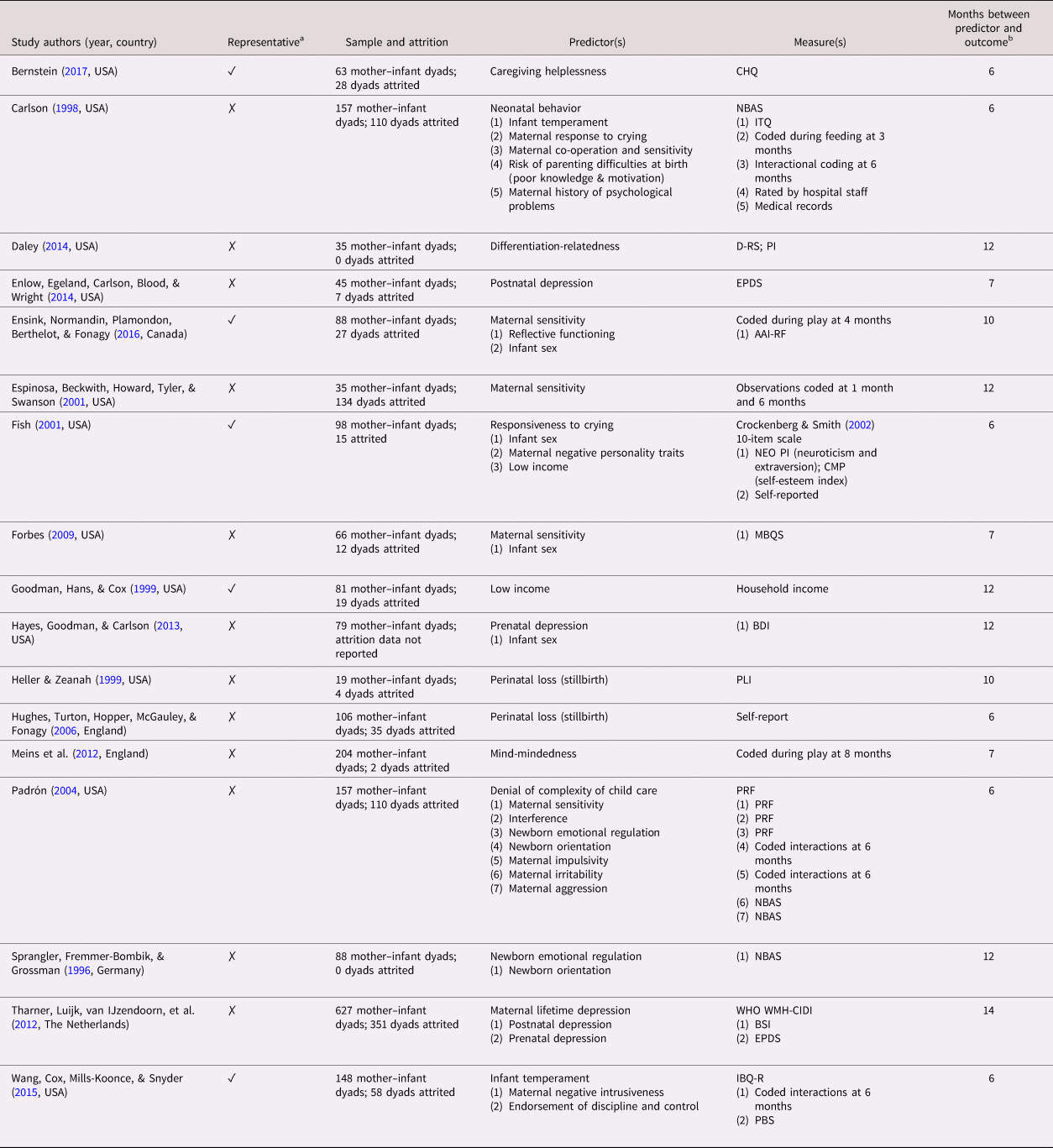
Table 1 below provides a summary of the characteristics of all studies included in the systematic review. The studies had a mean publication year of 2008 (SD = 7.41), and were conducted in six different countries (Canada, Denmark, Germany, the Netherlands, the United Kingdom, and the United States), with most studies conducted in North America (75%). Of the papers included in the previous meta-analysis on a similar topic (van IJzendoorn et al., Reference van IJzendoorn, Schuengel and Bakermans-Kranenburg1999), 4 were included in the present analysis, with the remaining papers excluded due to concurrent assessment of the predictor and attachment. There was evidence of replication across 41 effects from 17 studies. A further 54 effects from nonreplicated studies are tabled in the online-only supplementary materials, but excluded from meta-analyses. Of these, 33 effects could not be meaningfully clustered into a domain with at least 1 other similar study due to construct heterogeneity. The remaining 21 effects could not be transformed into an appropriate statistic for meta-analysis. For completeness, these studies are summarized in Supplementary Table S.1, and represent the nonreplicated associations in the literature scoped for this project.
Constructs and measurement for studies included in meta-analysis

Note: Abbreviations for Predictor Measures: Adult Attachment Interview: Reflective Functioning Scale (AAI-RF); Beck Depression Inventory (BDI); Brief Symptom Inventory (BSI); Carey Infant Temperament Questionnaire (ITQ); Caregiving Helplessness Questionnaire (CHQ); Clinical Measurement Package (CMP); Differentiation-Relatedness Scale of Self and Object Representations (D-RS); Edinburgh Postnatal Depression Scale (EPDS); Infant Behaviour Questionnaire—Revised (IBQ-R); Maternal Behaviour Q-Sort (MBQS); Neonatal Behavioural Assessment Scale (NBAS); Neuroticism, Extraversion, Openness Personality Inventory (NEO PI); Parent Behaviour Scale (PBS); Perinatal Loss Interview (PLI); Personality Research Form (PRF); Pregnancy Interview (PI); World Health Organization World Mental Health Composite International Diagnostic Interview (WHO WMH-CIDI).
a Study authors indicated that the sample was representative of the broader population drawn from.
b All studies measured attachment using the Strange Situation Procedure (between the ages of 12 and 18 months.
Replicated risk associations
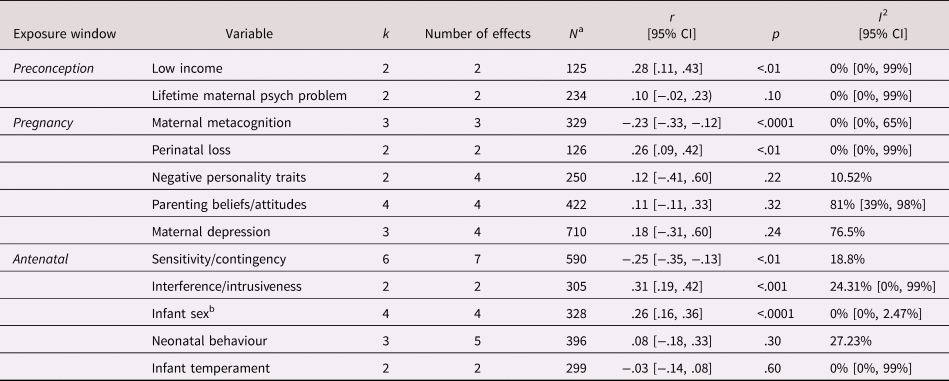
Meta-analysis of effects was possible for thirteen exposures across three developmental windows: preconception (any time point measured prior to pregnancy; 4 studies), prenatal (14 studies), and postnatal (17 studies). Antenatal effects from 0 to 6 months of age were not included, as Strange Situation Procedure assessments are valid from 11 months of age, and a gap of 6 months between predictor assessment and attachment assessment was required for inclusion. Replicated effect estimates were available for the following variables (see Table 2): low income and lifetime maternal psychological problems in the preconception window, and for maternal metacognition, pregnancy loss, negative maternal personality traits, parenting beliefs and attitudes, and maternal depression in the pregnancy window. In the postnatal window (0–6 months postbirth) effects for maternal sensitivity and interference, parenting beliefs and attitudes, maternal depression, infant sex, neonatal behavior, and infant temperament were meta-analyzed.
Meta-analytic results grouped by exposure window

Note: aUnique N reflects the number of participants from k studies. bMale sex coded as 1, female sex coded as 0
Study-specific and pooled exposure–outcome associations are presented in Table 2, by exposure window. Results of moderation and sensitivity analyses are described where relevant, and the results of all conducted moderation and sensitivity analyses can be found in the supplemental materials. Findings from 32 longitudinal single studies were extracted but could not be included in meta-analysis because study design, measurement, and modeling procedures were not sufficiently aligned.
Predictors in the preconception window
Low income status
Women in lower income brackets in the preconception window were more likely to have offspring classified disorganized than women in higher socioeconomic groupings, k = 2, N = 125, r = .28, 95% confidence interval (CI) [.11, .43], p <.01. Both effects were in the same direction (r = .34, Fish, Reference Fish2001; r = .25, Goodman, Hans, & Cox, Reference Goodman, Hans and Cox1999). This finding is supported by Raby, Steele, Carlson, and Sroufe (Reference Raby, Steele, Carlson and Sroufe2015), identified in our systematic review of unreplicated studies.
Mental health problems
Lifetime maternal psychological problems (measured retrospectively at 30 weeks’ gestation and in the preconception window via access to lifetime public mental health records of mothers) were not associated with later attachment disorganization. No moderator or sensitivity analyses were possible for the preconception window. Significant predictive associations with lower maternal age at conception (Bailey, Tarabulsy, Moran, Pederson, & Bento, Reference Bailey, Tarabulsy, Moran, Pederson and Bento2017) and single motherhood at birth (Carlson, Reference Carlson1998) were also found in systematically identified single studies.
Predictors in the pregnancy window
Loss of a child
Experiences of perinatal loss of a child (through miscarriage, stillbirth, or death of the infant within 1 day of delivery) prior to the birth of the study child were associated with later disorganization in the study child's attachment to mother, k = 2, N = 126, r = .26, 95% CI [.09, .42], p < .01. Both effects were comparable and in the same direction (r = .22, Heller & Zeanah, Reference Heller and Zeanah1999; r = .27, Hughes, Turton, McGauley, & Fonagy, Reference Hughes, Turton, McGauley and Fonagy2006). The findings are supported in our systematic review of unreplicated studies, where Heller and Zeanah (Reference Heller and Zeanah1999) found extended emotional dependence on others after loss of a prior pregnancy/child predicted later infant disorganized attachment status.
Metacognitive dysfunction
Reduced maternal metacognitive function, collated for differentiation-relatedness (measured in the third trimester), mind-mindedness (measured at 8 months of age) and reflective functioning (measured in the third trimester), was associated with later attachment disorganization, k = 3, N = 329, r = –.23, 95% CI [–.33, –.12], p < .0001. All three effects were in the same range (r = –.28, Daley, Reference Daley2014; r = –.22, Ensink, Normandin, Plamondon, Berthelot, & Fonagy, Reference Ensink, Normandin, Plamondon, Berthelot and Fonagy2016; r = –.23, Meins et al., Reference Meins, Fernyhough, de Rosnay, Arnott, Leekam and Turner2012). Consistent single study evidence was found for low reflective functioning about prior trauma (Berthelot et al., Reference Berthelot, Ensink, Bernazzani, Normandin, Luyten and Fonagy2015) and elevated symptoms of maternal posttraumatic stress disorder (Enlow, Egeland, Carlson, Blood, & Wright, Reference Enlow, Egeland, Carlson, Blood and Wright2014) in the postnatal period (see Supplementary Table S.1).
Personality traits
The evidence in this domain is inconsistent, reflecting divergent clustering of personality construsts. Overall no overall relationship was found between attachment disorganization and negative maternal personality traits measured in pregnancy. Effects for impulsivity (r = .11;Padrón, Reference Padrón2004), aggression (r = .16; Padrón, Reference Padrón2004) and an overall measure of negative maternal personality traits (r = .18; Fish, Reference Fish2001) were positive, but the effect for irritability was marginally negative (r = –.003; Padrón, Reference Padrón2004).
Parenting approaches
There was inconsistency in the effects within studies of beliefs and attitudes related to parenting (measured in the third trimester of pregnancy) and their association to later disorganized attachment. Risk of parenting difficulties identified by a nurse at birth (r = .41; Carlson, Reference Carlson1998) and self-reported endorsement of discipline and control (r = .14; Wang, Cox, Mills-Koonce, & Snyder, Reference Wang, Cox, Mills-Koonce and Snyder2015) were in the same direction. Self-reported caregiving helplessness was close to a zero effect (r = .01; Bernstein, Reference Bernstein2017), and maternal denial of complexity of childcare was negative (r = –.11; Padrón, Reference Padrón2004). We suspect the result reflects a limitation stemming from clustering different data sources and constructs related to parenting beliefs and attitudes. While these constructs theoretically align, differing conceptualizations likely obscure significant risk associations, a limitation also noted by Reijman, Foster, and Duschinsky (Reference Reijman, Foster and Duschinsky2018).
Maternal depression
Maternal depression was not associated with later infant disorganized attachment status. All effects in this meta-analysis were in the same direction, however mixed in strength (r = .30, Enlow et al., Reference Enlow, Egeland, Carlson, Blood and Wright2014; r = .002, r = .03, Tharner, Luijk, Raat, et al., Reference Tharner, Luijk, Raat, IJzendoorn, Bakermans-Kranenburg, Moll and Tiemeier2012; r = .31, Hayes, Goodman, & Carlson, Reference Hayes, Goodman and Carlson2013). No significant moderator or sensitivity analyses emerged in this window, and there were no significant differences between effects obtained prenatally or postnatally. We therefore grouped the effects for depression (2 for prenatal and 2 for postnatal) together under one category of maternal depression.
Infant sex
Male infants were more likely to belong to a disorganized dyad, k = 4, N = 328, r = .26, 95% CI [.16, .36], p < .0001, with all effects in the same direction (r = .25, Ensink et al., Reference Ensink, Normandin, Plamondon, Berthelot and Fonagy2016; r = .30, Fish, Reference Fish2001; r = .28, Forbes, Reference Forbes2009; r = .24, Hayes et al., Reference Hayes, Goodman and Carlson2013).
Sensitive caregiving
Higher sensitivity and contingency of caregiving response (between 3 and 6 months postpartum) was protective of disorganized attachment, k = 7, N = 590, r = –.25, 95% CI [–.35, –.13], p < .01. All effects in this meta-analysis were in the same direction (r = –.38, Carlson, Reference Carlson1998; r = –.29, Carlson, Reference Carlson1998; r = –.17, Ensink et al., Reference Ensink, Normandin, Plamondon, Berthelot and Fonagy2016; r = –.48, Espinosa, Beckwith, Howard, Tyler, & Swanson, Reference Espinosa, Beckwith, Howard, Tyler and Swanson2001; r = –.17, Fish, Reference Fish2001; r = –.11, Forbes, Reference Forbes2009; r = –.29, Padrón, Reference Padrón2004). A combined effect for caregiving interference and intrusiveness at 6 months of age was positively associated with later disorganized attachment, k = 2, N = 305, r = .31, 95% CI [.19, .42], p < .001, with consistency in the direction of effect sizes (r = .37, Padrón, Reference Padrón2004; r = .25, Wang et al., Reference Wang, Cox, Mills-Koonce and Snyder2015).
Neonatal behavior
There was no evidence that neonatal behavior (newborn emotional regulation and orientation, as measured by the Neonatal Behavioral Assessment Scale Brazelton, Reference Brazelton1978), was associated with later offspring attachment disorganization. There was some inconsistency in the direction of effects within this category. Three effects identified a positive relationship between newborn emotional regulation and orientation and later attachment disorganization (r = .11, Carlson, Reference Carlson1998; r = .18, r = .21, Sprangler, Fremmer-Bombik, & Grossman, Reference Sprangler, Fremmer-Bombik and Grossman1996), and two effects identified a negative relationship (r = –.006, r = –.03, Padrón, Reference Padrón2004). Based on sensitivity analysis, there did not appear to be a significant difference between the effects drawing from published studies (Carlson, Reference Carlson1998; Sprangler et al., Reference Sprangler, Fremmer-Bombik and Grossman1996) and unpublished studies (Padrón, Reference Padrón2004). One likely source of variance lies in sampling, with effects from Padrón (Reference Padrón2004) based on a sample at risk due to poverty, while the positive effects were all from samples within the general population.
Infant temperament
Infant temperament (measured at age range 3−6 months) was not associated with later attachment disorganization, with effects in the same direction (r = –.05, Carlson, Reference Carlson1998; r = –.01, Wang et al., Reference Wang, Cox, Mills-Koonce and Snyder2015). We could not test effects for breastfeeding status and disorganized attachment, given only one study in this field fitting our criteria (Tharner, Luijk, Raat, et al., Reference Tharner, Luijk, Raat, IJzendoorn, Bakermans-Kranenburg, Moll and Tiemeier2012).
Discussion
The purpose of this systematic review and meta-analysis was to expand our understanding of the major determinants of offspring disorganized attachments, beyond adult attachment representations. We focused exclusively on risk factors for which there was evidence of replication in at least two longitudinal studies. Our findings suggest medium to large effects related to mothers’ low socioeconomic status (r = .28, k = 2), perinatal loss of a child (r = .26, k = 2), caregiving intrusiveness (r = .31, k = 2), and infant male sex (r = .26, k = 4). Maternal sensitivity (r = –.25, k = 6) and higher metacognition during pregnancy (r = –.23, k = 3) were associated with lower risk of offspring attachment disorganization. Estimates for each are near equal to or greater than prior meta-analytic evidence for transmission via unresolved adult attachment status. The originality of this finding regarding the protective role of sensitive caregiving is noteworthy, given prior meta-analytic evidence in the field, that sensitivity is essentially unrelated to disorganization (van IJzendoorn et al., Reference van IJzendoorn, Schuengel and Bakermans-Kranenburg1999). The finding may reflect advancing methodologies utilized since that early meta-analytic harvest, with respect to measurement of caregiving sensitivity. Our findings also uphold the views of recent landmark papers on disorganized attachment, which caution against a singular view of the origins of disorganized relationships (Duschinsky, Reference Duschinsky2018; Granqvist et al., Reference Granqvist, Sroufe, Dozier, Hesse, Steele, van IJzendoorn and Duschinsky2017), and support consolidation of theorized pathways to disorganized relationships beyond mother's adult attachment status.
Akin to the established evidence, strongest risk was predicted by caregiving interference/intrusiveness, and reduced maternal metacognition (differentiation-relatedness, mind-mindedness, and reflective functioning). Robust protective prediction was found with caregiving sensitivity/contingency. Confirming prior meta-analytic findings, we found moderate prediction to offspring disorganized attachment from low maternal socioeconomic status in the preconception window. We found elevated risk of infant sex (male) in the disorganized pathway. Our findings point to the strong significance of maternal perinatal loss and posttraumatic stress disorder, suggesting recent loss and trauma are as important to the genesis of disorganizing care as parents’ childhood attachment trauma. Moreover, these findings provide a tangible lever for preventative efforts to minimize enduring trauma originating in pregnancy.
We did not find replicated evidence for several factors that theoretically at least have been thought to predict offspring attachment disorganization: lifetime maternal psychological problems and negative maternal personality traits. Inconsistent findings were identified within studies of beliefs and attitudes related to parenting, and infant temperament, and neonatal behavioral qualities. Meta-analysis of pre- and postnatal depression associations was nonsignificant.
Social–environmental factors in the etiology of disorganized attachment
Our findings place impoverished socioeconomic circumstance, marginalization, and contextual stress firmly in the pathway toward infant attachment disorganization, confirming prior meta-analytic work (Cyr et al., Reference Cyr, Euser, Bakermans-Kranenburg and van IJzendoorn2010; Verhage et al., Reference Verhage, Schuengel, Madigan, Fearon, Oosterman, Cassibba and van IJzendoorn2016). Although not tested here, snow-balling effects are likely, as found elsewhere (Booth, Macdonald, & Youssef, Reference Booth, Macdonald and Youssef2018; Tharner et al., Reference Tharner, Herba, Luijk, van IJzendoorn, Bakermans-Kranenburg, Govaert and Tiemeier2011). Specifically, both number and severity of stressors and negative life events impact a caregiver's capacity to respond sensitively to the needs of his or her child. Low-income environments bring attendant risks, including unemployment, unstable living arrangements, family disruption, diminished provision of attuned care, parental distress in the context of financial strain, time constraints of sole-carer provision, and interpersonal stress (Brown, Gustafsson, Mills-Koonce, & Cox, Reference Brown, Gustafsson, Mills-Koonce and Cox2017; Espinosa et al., Reference Espinosa, Beckwith, Howard, Tyler and Swanson2001; Forbes, Reference Forbes2009; Miljkovitch, Danet, & Bernier, Reference Miljkovitch, Danet and Bernier2012; Raikes & Thompson, Reference Raikes and Thompson2010).
Caregiver factors in the etiology of disorganized attachment
Results showed maternal meta-cognitive processes during pregnancy were predictive of later infant disorganized attachment. Specifically, these included lower maternal ability to differentiate self and infant need states (Daley, Reference Daley2014), reduced mind-mindedness (Meins et al., Reference Meins, Fernyhough, de Rosnay, Arnott, Leekam and Turner2012), low parental reflective functioning (Berthelot et al., Reference Berthelot, Ensink, Bernazzani, Normandin, Luyten and Fonagy2015), and low reflective functioning for trauma (Ensink et al., Reference Ensink, Normandin, Plamondon, Berthelot and Fonagy2016). Reflective functioning enables sensitive response by a parent, through valuing and accurate reading of the infant's affective states, and consideration of the paent's own effect on the infant, with associated inhibition of negative parenting behaviors, such as intrusiveness or punitiveness (Ensink, Rousseau, Biberdzic, Begin, & Normandin, Reference Ensink, Rousseau, Biberdzic, Begin and Normandin2017). While not testable in the current study, accrued risks in this domain would likely suggest parental legacies of traumatic events not fully integrated (Berthelot et al., Reference Berthelot, Ensink, Bernazzani, Normandin, Luyten and Fonagy2015).
Of interest is our finding on the predictive significance of grief accompanying the loss of a child in the disorganized attachment pathway of the next-born child. Both may generate a potent sense of helplessness in making meaning from loss, with enactments through caregiving behaviors subsequently perceived as alarming to the infant (Heller & Zeanah, Reference Heller and Zeanah1999; Lyons-Ruth, Melnick, Bronfman, Sherry, & Llanas, Reference Lyons-Ruth, Melnick, Bronfman, Sherry, Llanas, Atkinson, Goldberg, Atkinson and Goldberg2004).
Our findings on maternal depression in the pre- and postnatal windows are also of interest. Replicated associations were found for maternal depression and disorganized attachment in clinical samples (Enlow et al., Reference Enlow, Egeland, Carlson, Blood and Wright2014; Hayes et al., Reference Hayes, Goodman and Carlson2013) but not for nonclinical samples (Tharner, Luijk, van IJzendoorn, et al., Reference Tharner, Luijk, van IJzendoorn, Bakermans-Kranenburg, Jaddoe, Hofman and Tiemeier2012). As with prior studies (Flowers, McGillivray, Galbally, & Lewis, Reference Flowers, McGillivray, Galbally and Lewis2018; Lyons-Ruth & Jacobvitz, Reference Lyons-Ruth, Jacobvitz, Cassidy, Shaver, Cassidy and Shaver2008; Wan & Green, Reference Wan and Green2009), the window of exposure appears to be less significant than clinical severity and comorbidity.
Infant factors in the etiology of disorganized attachment
The only significant infant factor in the meta-analytic suite was infant sex (male). The finding was robust across high and low sample risk status and low socioeconomic status, rural and ethnic minority groupings (Ensink et al., Reference Ensink, Normandin, Plamondon, Berthelot and Fonagy2016; Fish, Reference Fish2001; Forbes, Reference Forbes2009; Hayes et al., Reference Hayes, Goodman and Carlson2013). Our finding is in contrast to null findings for gender in previous meta-analytic work on disorganized attachment (van IJzendoorn et al., Reference van IJzendoorn, Schuengel and Bakermans-Kranenburg1999). The newly replicated evidence is in keeping with Schore's (Reference Schore2017) theoretical model of “boys at risk,” namely, that due to normative maturational delay across the perinatal period in the stress regulating circuits of the male brain, male infants are more vulnerable over a longer period of time to stressors in the caregiving environment. As such, boys may display more overtly disorganized behaviors, especially in infancy, responding to relational stress with a greater tendency for “fight or flight,” where girls may be more likely to “tend and befriend” a distressing caregiver (Hazen, Jacobvitz, Higgins, Allen, & Jin, Reference Hazen, Jacobvitz, Higgins, Allen, Jin, Solomon, George, Solomon and George2011). Earlier attention to the onset of gendered differences that may place young boys at greater risk than girls for socioemotional problems may help guide early prevention and education efforts (Zahn-Waxler, Shirtcliff, & Marceau, Reference Zahn-Waxler, Shirtcliff and Marceau2008).
Mixed results regarding the relevance of premature birth suggest, as with maternal depression, that “severity” of prematurity (gestational age 28–32 weeks) is a more relevant marker of risk than birth weight, likely through greater attendant neurodevelopmental risk. Severe prematurity is also associated with extended separation from the caregiver after birth, another risk factor for disordered attachments (Wazana et al., Reference Wazana, Moss, Jolicoeur-Martineau, Graffi, Tsabari, Lecompte and Meaney2015).
Relational factors in the etiology of disorganized attachment
In line with prior findings, reduced maternal caregiving sensitivity in the postpartum to 6 month window significantly predicted later attachment disorganization, with maternal interference (Padrón, Reference Padrón2004) intrusiveness (Wang et al., Reference Wang, Cox, Mills-Koonce and Snyder2015) insensitivity (Ensink et al., Reference Ensink, Normandin, Plamondon, Berthelot and Fonagy2016; Espinosa et al., Reference Espinosa, Beckwith, Howard, Tyler and Swanson2001; Forbes, Reference Forbes2009), and lack of contingency (Carlson, Reference Carlson1998; Fish, Reference Fish2001) all bearing a significant relationship to attachment disorganization.
Within the wider context of relational supports for organized attachment, marital conflict accounted for a significant amount of variance in disorganized attachment classifications for mother–father–infant triads. This is consistent with other meta-analytic findings for insecure attachment in the infancy–preschool window (Tan et al., Reference Tan, McIntosh, Kothe, Opie and Olsson2018).
Limitations
The meta-analytic evidence of this study should be considered in light of its limitations. The categorical nature of data associated with attachment classifications and lack of reporting of disorganization scores (in infancy, on a scale from 1 to 9) brings a loss of power to detect effects. The full scope of influence of predictive factors on subthreshold disorganized attachment behaviors (i.e., a disorganization scale score of <5) remains a problem for researchers (van IJzendoorn & Bakermans-Kranenburg, Reference van IJzendoorn and Bakermans-Kranenburg2008). Future research would undoubtedly benefit from the reporting of both categorical and continuous scale data for attachment disorganization.
Disorganized attachment was treated as a homogenous category in this meta-analysis and review. However, several disorganized subtypes exist within the preschool attachment coding system (Cassidy & Marvin, Reference Cassidy and Marvin1999/1992), and evidence suggests that different profiles of disorganized infant attachment behavior exist, differentiated by experiences of fear of the caregiver, and disorganizing experiences within the relationship not characterized by fear (Duschinsky, Reference Duschinsky2018). Distinctions between disorganized dyads with underlying secure or insecure patterns may also be important to consider (Bernier & Meins, Reference Bernier and Meins2008). However, as in all forms of attachment research, the cost of breaking typically small samples into multiple categories is statistical power.
A further limitation lies in combining levels of risk in samples within meta-analytic categories, given low study numbers in each risk category. As such, the moderating impact of risk status on predictive factors of attachment disorganization could not be fully tested as recommended (Verhage et al., Reference Verhage, Schuengel, Madigan, Fearon, Oosterman, Cassibba and van IJzendoorn2016). We note too that cultural and gender homogeneity of samples drawn from means with full diversity of ethnic or socioeconomic backgrounds was not possible. In line with calls to advance fatherhood research (Volling et al., Reference Volling, Cabrera, Feinberg, Jones, McDaniel, Liu and Cookston2019), future research should endeavor to expand examination of attachment development and its predictive pathways across all family forms and contexts.
Conclusion
Our study presents newly replicated evidence that highlights modifiable risk factors in the pregnancy and perinatal pathways toward infant attachment disorganization. Each may a be useful prevention target. These include support for expectant mothers to resolve and better integrate loss of prior pregnancies, enhanced relational support within and beyond the home, and enhanced caregiving sensitivity in the organization of infant trust. The study alerts us to additional cautions for sociodemographic risk groups, clinical groups, and infant males.
As with related fields, it is likely that patterns of risk are better predictors of disorganized attachment outcomes than any one single factor. Our results support calls from other researchers for an integrated etiological perspective on contributors to a threshold vulnerability to infant disorganized attachment (e.g., Bernier & Meins, Reference Bernier and Meins2008). Optimally, these updated meta-analytic findings may inform the development of multidomain indices to support frontline practitioners in recognizing potentially disorganizing pathways, and with them, opportunities for prevention.
Financial Support
This study was funded by the Centre for Social and Early Emotional Development, Deakin University.
Supplementary Material
The supplementary material for this article can be found at https://doi.org/10.1017/S095457941900172X.