Introduction
Australian trauma systems emphasize the initiation of resuscitation and invasive interventions in the prehospital environment. This is facilitated by specialty prehospital and retrieval medicine teams, dependent upon patient factors, retrieval team composition, scene geography, and resource availability. Transport of these patients to definitive care should be carried out as quickly and safely as possible. As transport time between scene and medical facility is relatively fixed, scene time can account for the majority of mission length and should be minimized to include only procedures and interventions required to resuscitate and stabilize a patient prior to transport. In addition, stabilization of severely injured trauma patients on-scene may prevent clinical decompensation, secondary injury, and reduce the need for emergency-department-based resuscitation, thus allowing for rapid definitive diagnostics and intervention upon arrival to hospital.Reference Garner1
The determinants of scene time are multi-factorial, encompassing both non-modifiable (eg, patient entrapment or mechanism of injury) and modifiable (eg, interventions performed by the retrieval team) factors. Literature has studied the latter, focusing on the prolongation of scene time due to execution of airway maneuvers, such as prehospital intubation (PHI).Reference Garner1 – Reference Høyer, Christensen and Andersen4 However, only one study has thoroughly studied the effect of patient demographics, retrieval team composition, and interventions on scene time.Reference Wyen, Lefering and Maegele5 These factors, if not measured and reviewed, can increase scene time, total mission time, and complicate the estimation of arrival time at receiving facility. Additionally, accurate scene time aids in mission planning, notification of the receiving facility, roster utilization, and benchmarking for training and simulation.
South Australian Ambulance Service (SAAS; Adelaide, South Australia) MedSTAR is the emergency medical retrieval service serving South Australia, responding to both prehospital trauma and critical care inter-facility transfer (IFT) requests. Scene time for SAAS MedSTAR’s adult prehospital and IFT cases has remained stable over the past 10 years at 30 minutes and 50 minutes, respectively. Owing to the vast distances across South Australia, the time for medical care to arrive at the patient and transport from scene to definitive care may encompass many hours; it is important to minimize prehospital time in order to minimize mortality.Reference Gonzalez, Cummings, Phelan, Mulekar and Rodning6 This study analyzed the service’s database data to identify variables that were associated with increased prehospital scene time, with the goal to establish a relative guide to case times.
The aim of this study was to identify which mission characteristics, patient demographics, or medical team interventions prolonged scene time and to quantify their impact on scene time. This study’s hypothesis was that interventions performed by the retrieval team, more than patient demographics or mission characteristics, would incur significant increases in scene time. This information will help define training goals to ensure that scene time is viewed as an important component of patient care. These data should mark the first step to establishing key performance indicators (KPIs) for common prehospital interventions, such as PHI, finger decompression, and resuscitative thoracotomy.
Methods
Setting
The SAAS MedSTAR is a single-site, physician-led emergency medical retrieval service that provides medical care to critically ill or injured patients as part of the state-wide government-run ambulance service, providing intra-state and inter-state retrievals using road, rotary-, and fixed-wing platforms since 2009. The service carries out approximately 2,400 missions per year, 22% primary trauma retrievals and 78% inter-hospital retrievals. Of the latter, 86% of patients are retrieved from rural medical centers or hospitals. Rotary-wing, fixed-wing, and rapid-response vehicle platforms are utilized for 37%, 28%, and 35% of missions, respectively, with the latter serving only the Adelaide metropolitan area. All teams are tasked and supervised by a senior medical consultant in the service following an established process of clinical coordination.
Medical retrieval teams for prehospital missions consist of a physician (medical consultant or registrar), a rescue paramedic, and either a critical care nurse or a second critical-care-trained rescue paramedic. The SAAS MedSTAR’s medical staff include intensivists, anesthetists, emergency medicine physicians, and rural general practice physicians who work part-time in retrieval medicine, as well as on-going time in their parent specialty. All new staff undergo an intensive two-week orientation program as well as structured on-going in-service education. MedSTAR has established clinical practice guidelines (CPGs) to which all medical teams are oriented and credentialed. The CPGs guide procedures such as PHI, resuscitative thoracotomy, and traumatic brain injury (TBI) management. MedSTAR’s TBI protocol includes guidance on sedation, PHI, ventilator settings, and intracranial pressure and cerebral perfusion pressure management using intravenous fluids, hypertonic saline, and vasoactive medications. All CPGs are available to teams via a dedicated MedSTAR application installed on team-issued smartphones.
Adherence to the PHI CPG is monitored through weekly audit and monthly clinical governance days (CGDs). MedSTAR CGDs are monthly multidisciplinary education and training days attended by all members of the retrieval service, including pediatrics teams. Monthly data including airway registry, case load and case mix, mortality, Ground Air Medical qUality Transport (GAMUT) data, and procedures are presented and reviewed. In addition, several long and short cases from both adult and pediatric teams are reviewed and critiqued, as well as an invited guest speaker presentation and multidisciplinary team meetings.
All cases are logged on paper case cards and electronically in a retrieval database (Air Maestro, Avinet; Adelaide, Australia). The database is maintained and checked by an administrative support officer. Uniformity of terminology is ensured by the use of drop-down menus and check boxes. Selected cases are reviewed during the service’s weekly clinical audits and monthly CGDs.
Study Design
In this retrospective database model building study, data were extracted from the service’s retrieval database. Recorded information includes basic demographic information as well as mission time points, including decision to retrieve, dispatch, arrival at patient, departure from scene, and arrival at destination hospital. Scene time was defined as time interval between “doors open” and “door closed” for fixed-wing and rotary-wing missions and “team arrival” and “depart scene” for rapid-retrieval vehicle missions. All time points were logged using the clock on the service-provided smartphones, which are standardized to the mobile service provider’s clock. Diagnostic information, timings, and details of procedures/interventions performed were also recorded. This study was approved by the Ethics Committee of the Royal Adelaide Hospital (Adelaide, South Australia) through the Low and Negligible Risk (LNR) Research pathway.
Inclusion/Exclusion Criteria
All patients retrieved from a prehospital scene by the SAAS MedSTAR General Service from January 1, 2015 through August 31, 2016 were included in the study. There were no exclusion criteria.
Model Derivation and Validation
Statistical analysis was performed using STATA 13MP (StataCorp; College Station, Texas USA). The data variables (age, gender, and weight; retrieval platform; intubation performed by the retrieval team or prior to team arrival; arterial line placement performed by the retrieval team or prior to team arrival; finger thoracostomy; or central line placement performed by the retrieval team or prior to team arrival) were assessed as predictors of scene time. All procedures undertaken and recorded in the database were included for analysis. Stepwise multiple linear regression was then used to identify significant scene time predictors (P value .05).
Results
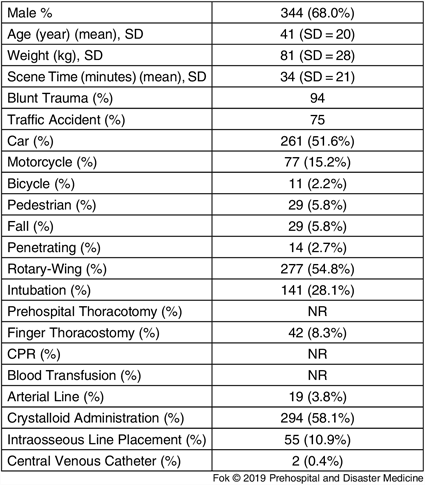
There were 506 prehospital retrievals from January 1, 2015 through August 31, 2016. The median age was 41 years old (range 15 to 95 years). The median weight was 81kg (range 42kg to 200kg). One-hundred forty-two patients (28.1%) were intubated by MedSTAR and 19 (3.8%) had an arterial line placed by MedSTAR. The mean scene time was 34 minutes with a standard deviation of 21 minutes and a range of 0 to 129 minutes (Table 1).
Demographics of Study Patients

Abbreviation: CPR, cardiopulmonary resuscitation.
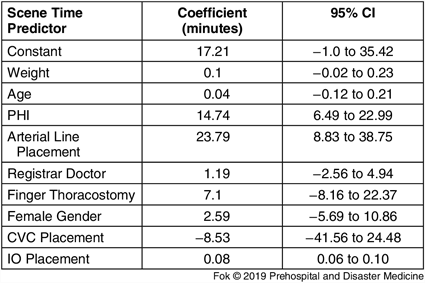
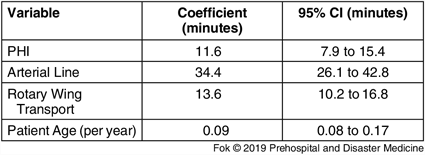
The initial model identified patient age, rotary wing transport, arterial line insertion, and PHI as significant predictors of prolonged scene time (Table 2). The final model included patient age, rotary wing transport, intubations, and arterial line placements performed by the retrieval team, with an adjusted R-squared of 0.16 (Table 3).
Mission Variables as Predictors of Scene Time

Abbreviations: CVC, central venous catheter; IO, intraosseous; PHI, prehospital intubation.
Significant Scene Time Coefficients after Multiple Linear Regression

Abbreviation: PHI, prehospital intubation.
Discussion
Unlike in North America, where a majority of critically-injured trauma patients can be brought to a trauma center within one hour, the time from injury to arrival at a tertiary center can be delayed for hours due to the distances across Australia.Reference Bickell7 Prehospital and retrieval medicine systems aim to reduce mortality by minimizing time to definitive care following illness or injury. Invasive interventions, such as PHI, finger thoracostomy, and intravenous line placement, are performed in the prehospital environment to resuscitate and stabilize the critically injured patient prior to transport. Undoubtedly, these interventions increase scene time and may delay transfer to definitive care. However, these interventions provide time-critical definitive care, can expedite subsequent investigations and management, and decrease the therapeutic vacuum upon arrival at receiving institutions.Reference Easton8
Literature studying the consequences of prehospital interventions on scene time is limited. Increased number and invasiveness of interventions have been associated with longer scene times.Reference Corfield, Adams, Nicholls and Hearns9 In the context of the head injury retrieval trial (HIRT), Garner, et al identified pelvic binder application, thoracic decompression, and patient entrapment as specific independent predictors of prolonged scene time.Reference Garner1 Van der Velden, et al found that chest tube placement, PHI, and placement of a second intravenous line prolonged scene times.Reference van der Velden, Ringburg, Bergs, Steyerberg, Patka and Schipper3 Nakstad, et al and Hoyer, et al have quantified the on-scene time delay due to PHI at 8.2 minutes and 7.5 minutes, respectively.Reference Nakstad, Strand and Sandberg2 , Reference Høyer, Christensen and Andersen4 Wyen, et al identified trauma from motor vehicle collisions and PHI as predictors of prolonged scene time, 9.3 minutes and 8.0 minutes, respectively.Reference Wyen, Lefering and Maegele5
This study identifies predictors of increased scene time and quantifies their impact on scene time. All patients retrieved by SAAS MedSTAR were analyzed, regardless of admission status at the receiving facility. The model found that two mission characteristics and two interventions significantly increased scene time: patient age and rotary wing transport; and PHI and arterial line insertion, respectively.
With the world’s population aging, the percentage of elderly patients involved in major trauma has also increased. The UK has seen the mean age of major trauma victims increase from 36.1 to 53.8 years, with over one-quarter of patients being over 75 years old.Reference Kehoe, Smith, Edwards, Yates and Lecky10 The same trend has been observed in Australia, with an increase in the proportion of elderly patients involved in major trauma increasing from 25.1% to 36.7% between 2007 and 2016.Reference Beck, Cameron, Lowthian, Fitzgerald, Judson and Gabbe11 Elderly patients have more serious injuries and decreased physiological reserves to compensate for these injuries compared to younger trauma patients.Reference Atinga, Shekkeris, Fertleman, Batrick, Kashef and Dick12 The increase in scene time with older patients may reflect time required to stabilize these patients prior to transport.
The speed of rotary-wing aircraft is significantly faster than that of ground vehicles. However, significant time is required to safely shut-down and start-up the aircraft, to unload and reload stowed medical equipment, and to secure patients safely in the aircraft. The time to perform similar actions may not be as long in ground transport. There are limited venues to minimize the time required to safely prepare the aircraft, patient, and crew for flight, given the strict aviation safety operational guidelines; but nevertheless, optimization of these processes should be explored by retrieval services. Diaz, et al has previously described a 10-mile radius within which ground transport would be faster than rotary-wing transport.Reference Diaz, Hendey and Bivins13 The additional time required for rotary-wing operations must be considered for missions in which both ground and rotary-wing transport give equivocal calculated transport times.
Most interestingly, of all the interventions that retrieval teams perform, the model found only PHI and arterial line placement significantly increased scene time by 11.6 minutes and 34.4 minutes, respectively. Though previous studies have not described the time required for arterial line placement and only a small percentage of missions (3.8%) had arterial line placement, the time required to establish them was longer than envisioned. It is unknown whether other retrieval services encounter similar data. This highlights the need to critically assess the factors contributing to this delay and the utility of performing interventions at the scene.
The time required for PHI is similar to previously published data from physician-led retrieval/Emergency Medical Services (EMS) services. However, previous literature does not describe whether similar checklists were used by other services. Given that MedSTAR’s PHI checklist should be followed and completed, 11.6 minutes may be the minimum time required to safely perform a checklist-guided PHI by MedSTAR’s teams.
This study’s results differ from those of Garner, et al. Though both studies identified that doctor type (consultant versus registrar) did not significantly prolong scene time, this study’s data showed that thoracic decompression did not prolong scene time, while PHI did prolong scene time, in contrast to their data. Garner, et al was limited to only patients with presumed severe head injury, whereas this study included all trauma mechanisms.Reference Garner1 In addition, SAAS MedSTAR’s CPGs allow for individual team members to perform thoracic decompression simultaneously and independently, whereas all team members work together and methodically to perform PHI. This may explain the difference in the results.
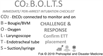
This study is one of few which identifies which medical interventions increase scene time as well as quantifies the temporal “cost” of performing these interventions on scene time. These data provide retrieval teams and services information which brings scene time awareness to the forefront, highlighting the influence that therapeutic decisions can ultimately have on scene time, and the consequential delay in transporting patients to definitive care. Based on this study’s data, SAAS MedSTAR has introduced a “rapid check” PHI checklist to address scenarios in which the time required to perform MedSTAR’s standard PHI checklist would result in the deterioration of patient’s clinical state (Figure 1). Arterial lines continue to not be routinely performed in prehospital missions.
SAAS MedSTAR “Rapid Check” Checklist Scenario.

As retrieval services optimize prehospital interventions, it is reasonable to expect the time required to safely execute each intervention to approach a minimum duration. Wyen, et al has reported a similar trend as their prehospital and scene time have also remained constant over two decades.Reference Wyen, Lefering and Maegele5 The SAAS MedSTAR scene time reflects this pattern, as prehospital scene time has remained constant at approximately 30 minutes over the previous two years.
Though two interventions that significantly prolonged scene time were identified, this study did not examine the effect of scene time on patient-centered outcome, such as mortality or hospital length-of-stay. Characterizing the effect on mortality due to prolonged scene time and prehospital interventions is challenging due to “confounding by indication,” as more severely injured patients are likely to require more interventions.Reference Wyen, Lefering and Maegele5
The impact of scene time on mortality is inconsistent in the literature. Harmsen, et al performed a systemic review to assess the impact of scene time on patient mortality.Reference Harmsen, Giannakopoulos, Moerbeek, Jansma, Bonjer and Bloemers14 A majority of studies found no impact on mortality with increased scene time; however, these studies were performed in North American EMS systems, which emphasize a “scoop and go” philosophy and are staffed by paramedics who have a limited scope of practice compared to MedSTAR’s physician-led system.Reference Harmsen, Giannakopoulos, Moerbeek, Jansma, Bonjer and Bloemers14 – Reference Feero, Hedges, Simmons and Irwin16 Two studies have shown that scene time is not associated with a change in mortality in penetrating trauma if kept below 20 minutes.Reference McCoy, Menchine, Sampson, Anderson and Kahn17 , Reference Funder, Petersen and Steinmetz18 A recent study of North American trauma registry patients showed that mortality may not be associated as much with scene time, but more with which interventions are performed during prehospital time, specifically PHI.Reference Brown, Gestring and Guyette19 In contrast, when physician-led helicopter EMS teams perform more prehospital interventions, scene time is prolonged compared to paramedic-led ground EMS (GEMS) teams, but this does not impact mortality.Reference Ringburg, Spanjersberg, Frankema, Steyerberg, Patka and Schipper20 This implies that the increased scene time spent performing life-saving procedures by experienced medical personnel can offset the detriment of increased scene time. Time spent on-scene performing prehospital interventions must be carefully balanced against the mortality benefit gained by performing these interventions.
Given that transport time to the scene and from the scene to the destination hospital is easily calculable, further research should focus on further identifying and quantifying other factors that may influence scene time. These data would have implications for both individual retrieval services, as well as for the field of prehospital and retrieval medicine (PHARM) as a whole. On the local level, by inputting these data into an algorithm, it is conceivable that with the limited information available at the time of mission dispatch, estimated scene time, time of arrival, and mission times can be projected. Benefits of having these data include more precise fuel requirement estimation, predicting resource availability, optimizing crew tasking, and facilitating training and simulation to match the scene conditions.
Industry-wide KPIs should be developed to establish benchmark times for scene time and performance of prehospital interventions, similar to those established for management of sepsis, myocardial infarction, and cerebral vascular accidents.
Limitations
This study may have limited applications to different retrieval services as it was conducted in a physician-led retrieval service based in Australia, similar to other retrieval services across Australia and Europe. However, these results may not be applicable in North America where most prehospital and critical care transport services are led by critical care paramedics, and the scope of practice may differ than that of physician-based retrieval teams. Furthermore, this retrospective study is limited by the inherent biases of such a study design.
Conclusions
Retrieval medicine requires the use of specialist medical teams and highly limited resources. The estimation of accurate mission time is crucial to optimize preparedness at the receiving facility and for tasking of limited retrieval resources. This study identifies two mission characteristics, patient age and rotary wing transport, and two medical interventions, PHI and arterial line placement, as predictors of prolonged scene time and quantifies the prolongation in scene time incurred. As a patient’s age is unmodifiable, the remaining predictors highlight the need to carefully select which transport platform should be utilized and which interventions should be performed during prehospital missions.
Acknowledgment
The authors would like to acknowledge Ms. Kate Kerin for excellent assistance and provision of data for this paper.
Conflicts of interest
none