INTRODUCTION
The concept of “wisdom” has been a compelling and emergent topic of interest informing debates and investigations within many disciplines, and it has had a prominent place in ancient philosophy, beginning with Socrates, Plato, and Aristotle (Ardelt, Reference Ardelt, Steinberg and Jordan2005; Bluck & Glück, Reference Bluck, Glück, Steinberg and Jordan2005; Osbeck & Robinson, Reference Osbeck, Robinson, Steinberg and Jordan2005). In recent times, wisdom has become a focus of attention in such fields as aging and human development (Ardelt, Reference Ardelt2000; Baltes & Kunzmann, Reference Baltes and Kunzmann2004; Gugerell & Riffert, Reference Gugerell and Riffert2011; Yang, Reference Yang2014); psychology (Staudinger & Glück, Reference Staudinger and Glück2011); trauma and therapy (Abernathy, Reference Abernathy and Walz2006; Linden, Reference Linden2008); professional practice (Carr et al., Reference Carr, Bondi and Clark2011; Kinsella & Pitman, Reference Kinsella and Pitman2012); and business leadership (Küpers & Statler, Reference Küpers and Statler2008; Yang, Reference Yang2011), among others. While the construct of wisdom is difficult to operationalize and control for randomized empirical research, investigations of clinicians' and patients' experiential wisdom may contribute to advancing oncology practices. The reasons for the need for wisdom-based epistemologies for practitioners and patients are manifold (Butlin, Reference Butlin2015) in light of the rising cancer rates (Statistics Canada, 2014); the uncertainty inherent to cancer care (Holland & Lewis, Reference Holland and Lewis2000); patients' struggles to make meaning of their illnesses (Breitbart, Reference Breitbart2005; Breitbart et al., Reference Breitbart, Rosenfeld and Gibson2010; Chochinov, Reference Chochinov2003; Vos, Reference Vos2014); patients seeking quality of life while dying (Angiola & Bowen, Reference Angiola and Bowen2013); physician-assisted suicide developing into a legally sanctioned option in some regions (Fine, Reference Fine2015); and reports of healthcare practitioner burnout and grief in oncology care (Granek et al., Reference Granek, Tozer and Mazzotta2012; Lyckholm, Reference Lyckholm2007). Being attentive to the urging of clinicians (MacLeod, Reference MacLeod2003; Roy, Reference Roy2012) to better understand the meaning of “wisdom” and “wise practice” may foster best practices in oncology care and inform organized efforts to attend to wisdom, such as those reflected in the Choosing Wisely initiatives in North America (see, e.g., www.choosingwisely.org).
Theories of wisdom (Bangen et al., Reference Bangen, Meeks and Jeste2013; Schmit et al., Reference Schmit, Muldoon and Pounders2012; Staudinger & Glück, Reference Staudinger and Glück2011) generally acknowledge that difficult situations, challenges to personal or collective morals, and even tragic life situations are significant factors in the formation of wisdom (Glück et al., Reference Glück, Strasser and Bluck2009; Webster, Reference Webster2003). Bluck and Glück's (Reference Bluck and Glück2004) research highlights wisdom as implicated in meaning-making, which has been identified as a valuable therapeutic intervention for those living with cancer (Breitbart et al., Reference Breitbart, Poppito and Rosenfeld2012, Reference Breitbart, Rosenfeld and Pessin2015; Greenstein & Breitbart, Reference Greenstein and Breitbart2000; Lee et al., Reference Lee, Cohen and Edgar2006). Bluck and Glück (Reference Bluck and Glück2004) define wisdom as follows:
Wisdom is an adaptive form of life judgment that involves not what but how one thinks. It is a combination of experiential knowledge, cognition, affect, and action that sometimes occurs in a social context. Wisdom is defined as a personal resource that is used to negotiate fundamental life changes and challenges and is often directed toward the goals of living a good life or striving for the common good. (p. 545)
Applying wisdom in cancer care seems relevant given that cancer inevitably brings “fundamental life change and challenges” and that the “goals of living a good life” are central aims of clinicians and patients in treatment decision making. As such, oncology care may be a prime context in which to elucidate the wisdom developed through clinician and patient experiences.
OBJECTIVES AND RESEARCH QUESTIONS
To investigate the potential significance of the phenomenon of wisdom, a scoping review (Arksey & O'Malley, Reference Arksey and O'Malley2005; Rumrill et al., Reference Rumrill, Fitzgerald and Merchant2010) was undertaken, in the context of oncology healthcare, to examine: (1) how the concept of wisdom has been used; (2) the ways in which wisdom has been a focus of inquiry; and (3) how wisdom has been characterized, when the term is used.
The following research questions guided the review:
-
■ What genres of articles in oncology healthcare use the term “wisdom”?
-
■ In what ways is the concept of “wisdom” a focus of inquiry in the context of oncology healthcare?
-
■ How is “wisdom” characterized in the oncology healthcare literature?
SCOPING REVIEW METHODOLOGY
Rumrill and colleagues (Reference Rumrill, Fitzgerald and Merchant2010) state that a scoping review is useful when seeking to know “who is using specific terms and for what purpose” (p. 402). It offers a topography of a topic as a means of understanding and interpreting the existing state of knowledge (Rumrill et al., Reference Rumrill, Fitzgerald and Merchant2010). This approach is typically chosen as a means to map key concepts underpinning a research area, identify what the main sources and types of evidence are, and highlight where there may not have been a previous comprehensive review (Caty et al., Reference Caty, Kinsella and Doyle2015). Arksey and O'Malley (Reference Arksey and O'Malley2005) contend that a scoping review is “guided by a requirement to identify all relevant literature regardless of study design” (p. 22). A scoping review aims to give “a narrative account of existing literature” (p. 27), rather than synthesizing the findings of different kinds of study designs and methodologies. The process is iterative rather than linear, “requiring researchers to engage with each stage in a reflexive way” (p. 22). Arksey and O'Malley (Reference Arksey and O'Malley2005) highlight four main reasons to employ a scoping review in a particular area:
-
■ To examine the extent, range, and nature of research activity
-
■ To determine the value of undertaking a full systematic review
-
■ To summarize and disseminate research findings
-
■ To identify gaps in the existing literature
They state that the scoping review methodology is appropriate when “it is difficult to visualize the range of material that might be available,” for helping to identify “the overall state of research activity,” and to highlight gaps in the literature, “particularly where no research has been conducted” (p. 21). The topic of wisdom in oncology care fits these criteria well given that no reviews in this domain were found during a preliminary search of the literature.
A scoping review thus provides a useful means to map current scholarly conversations on the place of “wisdom” in oncology care. The five steps include: (1) identifying the research question, (2) identifying relevant studies, (3) selecting studies, (4) charting the data, and (5) collating, summarizing, and reporting the results.
METHODS
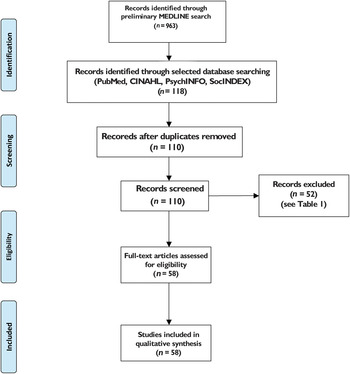
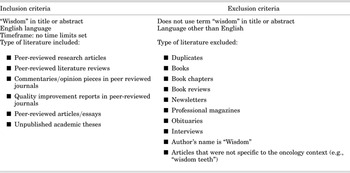
In consultation between the first author and oncology reference librarians, the search terms Wisdom AND Cancer AND Oncology OR Palliative OR End-of-life OR Spirituality OR Existential were selected for a preliminary MEDLINE search covering the period from 1980 to March of 2015. This produced 963 records. Four electronic databases—CINAHL, SocINDEX, PubMed, and PsychINFO—were then selected to search for records addressing the uses of “wisdom” in the oncology care literature. It was reasoned that if the word “wisdom” did not appear in either the title or abstract, then the likelihood of it being a major concept in the study was decreased; therefore, the key search terms were used to search titles and abstracts, resulting in 118 records. Duplicates were removed (n = 8) and the inclusion and exclusion criteria were applied (see Table 1), resulting in 58 records (see Figure 1 and Table 1).
PRISMA flow diagram (source: Moher et al., Reference Moher, Liberati and Tetzlaff2009).

Inclusion/exclusion criteria

Given the amount of published literature available, literature deriving from networks, conferences, books, and book reviews were excluded. A secondary search of reference lists was then conducted manually to identify articles where “wisdom” appeared in the title, and one additional reference was found. This study was excluded, however, as it did not fit all of the keyword search criteria (see above) because it had no reference to “oncology” or “cancer” in the title or abstract.
Data Analysis
The first author (HB) conducted the initial analysis and the subsidiary thematic analyses. The second author (EAK) was intimately involved in each step of the study, providing quality control of the process, guidance on methodology, review of the analyses, checking of accuracy, and representation of the data. The third (CG) and fourth (GB) authors have each engaged extensively in dialogical inquiry into the concept of wisdom in oncology healthcare, which informed the concept, design, and methodology for our scoping review. They reviewed the findings for relevance, coherence, and broader application in specifically different clinical contexts (psychiatric oncology care, radiation oncology), and contributed to assessment of the analysis, representation of the findings, and quality checking for relevance, resonance, worthiness of topic, coherence, and richness of description (Tracy, Reference Tracy2010).
Data from all 58 records were initially analyzed and extracted from the records by the first author according to the research questions (see above). This highlighted that almost no empirical studies had taken place that foregrounded, at the outset, the concept of wisdom for a topic of study.
As a result, in consultation with the second author, the first author developed the first question and applied it to all 58 included articles/studies: “What genres of articles in oncology healthcare use the term ‘wisdom’?” This approach enabled a distinction between wisdom as a formal construct, wisdom as a focus of empirical inquiry, and more informal discussions in commentary pieces or case examples. This brought to light that many of the articles had used the word “wisdom” without explicating it conceptually or making it a primary focus. This analytical step iteratively provoked refinement of the second research question—“In what ways is the concept of ‘wisdom’ a focus of inquiry in the context of oncology healthcare?”—which allowed for identification of the rubric of genres for all 58 articles/studies and finalizing the ones reported in the Results section.
From this analysis, we noted that one of the genres identified included articles that discussed wisdom as a finding but where wisdom was not foregrounded in the study design—that is, it was not highlighted in the Objectives or Method section of the article. These research studies reporting wisdom as a finding seemed pertinent to the aim of this study with potentially rich data since wisdom emerged as a topic of interest without the researchers looking for it explicitly. It was decided that a thematic analysis would be conducted on those 16 articles to investigate what was being discovered about wisdom in their findings.
Broadly speaking, “Thematic analysis is a method for identifying, analyzing, and reporting patterns [themes] within data” (Braun & Clarke, Reference Braun and Clarke2006, p. 79). Thematic analysis is viewed as a skill and methodology that, as Vaismoradi et al. (Reference Vaismoradi, Turunen and Bondas2013) argue, “provide core skills to researchers for conducting many other forms of qualitative analysis” and “that qualitative researchers should become more familiar with thematic analysis as an independent and reliable qualitative approach to analysis” (p. 400). For example, in the case of our study, it proved useful as a means to analyze a portion of the data that indicated depth and breadth to the concept of wisdom in an otherwise generally impoverished dataset where wisdom was used anecdotally with little critical or reflective examination. Vaismoradi et al. (Reference Vaismoradi, Turunen and Bondas2013) state that “thematic analysis involves the search for and identification of common threads that extend across an entire interview or set of interviews” (p. 400) or, in the case of this scoping review, across a set of studies. Fereday and Muir-Chochrane (Reference Fereday and Muir-Cochrane2006) differentiate inductive data-driven categorization of themes developed using words and phrases from the data itself from a deductive analysis using theory-driven codes predetermined by a template created from the field's literature on the topic of inquiry into which the data is thematized. For the purposes of our study, an inductive data-driven analysis was selected, and the themes were developed and categorized using words and/or phrases appearing in the studies.
Braun & Clarke's (Reference Braun and Clarke2006) method for thematic analysis was employed. In line with their characterizations of different epistemological perspectives, a constructionist epistemology rather than an essentialist/realist one was to be adopted, as the aim was to gain insight into how meanings pertaining to the concept of wisdom were taken up in the texts without aiming to empirically prove its existence or verify research from other fields on its characterizations. As well, Braun and Clarke's work highlights the importance of a rich description of themes that characterize wisdom and its meanings or uses rather than a detailed account of one aspect in detail. Finally, their “phases of thematic analysis” (p. 87) were followed in our study, including: (1) familiarizing yourself with the data, (2) generating initial codes, (3) searching for themes, (4) reviewing themes, and (5) producing the report. Outcomes of this analysis were reviewed by the second author and iteratively reworked in dialogue and a second analysis. The third and fourth authors were asked to review the representation of findings of the scoping review overall and the thematic analysis specifically in the interests of veracity and trustworthiness, with contributions focusing the analysis on the worthiness of the topic, richness of rigor, resonance, contribution to the oncology field, and meaningful coherence (Tracy, Reference Tracy2010). The relevance of key themes was foregrounded as a result.
For question three—“How is ‘wisdom’ characterized in the oncology healthcare literature?”—all 58 records were analyzed for characterizations of the term “wisdom.” This involved examining the adjectives used, the interpretations offered, and the contexts of its use. The aim was to examine the ways in which the concept of “wisdom” is tacitly, formally, and informally adopted in the published oncology literature. Originally, this section only included the 26 articles where wisdom's use did not fit into any of the other genres assigned. However, given the number of adjectives characterizing wisdom in all of the articles and, as well, the number of articles where wisdom was simply used without it tying into any theme or focus of the study whatsoever, it was decided to include all 58 articles in the analysis of wisdom's characterizations.
RESULTS
Part I: What Genres of Articles in Oncology Care Use the Term “Wisdom”?
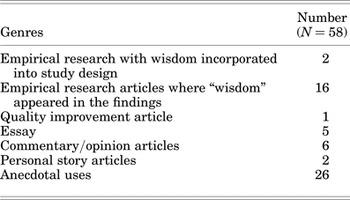
Asking the question “What genres of articles in oncology healthcare use the term ‘wisdom’?” allowed for a clearer distinction to be made between wisdom as a formal construct, wisdom as a focus of empirical inquiry, and more informal discussions in commentary pieces or case examples. This brought to light that many of the articles had employed the word “wisdom” without explicating it conceptually or making it a primary focus. The analysis of the 58 records organized according to the genres identified in Table 2 represents a summary of current scholarship on wisdom in oncology care.
Genres of records with “wisdom” in title or abstract

Part II: In What Ways Is the Concept of “Wisdom” a Focus of Inquiry in the Context of Oncology Care?
Empirical Research with Wisdom Incorporated into the Study Design
Of the 58 articles, only 2 research articles explicated wisdom as a central concept integrated into the methodology and design of the study. Both were by Cueva and colleagues (Reference Cueva, Cueva and Dignan2014; Reference Cueva, Kuhnley and Lanier2005), who employed arts- and theater-based methodology in their cancer education initiatives with Alaska's indigenous peoples as a means to integrate “dynamic wisdom” and to “share cancer information in a culturally respectful way” (Reference Cueva, Cueva and Dignan2014, p. 529). The authors argue that arts- and theater-based approaches can allow for culturally sensitive knowledge and wisdom, specifically, to be revealed.
Empirical Research Articles Where “Wisdom” Appeared in the Findings
A total of 16 articles reported “wisdom” as a finding in their results, even if they did not specifically articulate wisdom conceptually in their study at the outset. These findings were of particular interest; therefore, a thematic analysis was undertaken. Wisdom was depicted around four common themes as: (1) acquired and/or passed on, (2) an inner resource, (3) “practice wisdom” as derived from practitioners' lived experience(s), and (4) informing a culture of conventional wisdom.
Wisdom as “acquired” and/or “passed on”
Six articles depicted wisdom as something acquired and/or passed on—even as a legacy—from the illness experience with cancer (Austin, Reference Austin2001; Costa & Pakenham, Reference Costa and Pakenham2012; Gessert et al., Reference Gessert, Baines and Kuross2004; Greszta & Siemińska, Reference Greszta and Siemińska2011; McTaggart, Reference McTaggart2001; Williams, Reference Williams1995). Costa and Pakenham's (Reference Costa and Pakenham2012) study focused on “benefit finding” (BF) as a capacity some individuals mobilize in adversity. Their study was the only one to use a scale specifically designed to measure wisdom—the Self-Assessed Wisdom Scale (2003). They state, “most prior research on BF has relied on positive affect as the main indicator of positive adjustment. Hence, findings in this study showing that BF is strongly associated with wisdom and spiritual well-being are noteworthy” (p. 742). They suggest that the wisdom and spiritual well-being measures tap into more existentially oriented growth emerging from adversity, which the purpose-in-life and self-acceptance scales do not.
Greszta and Siemiénski (Reference Greszta and Siemińska2011) undertook a cross-sectional study of 50 patients that investigated wisdom related to changes in patients' value systems following a cancer diagnosis. They identified an increase in a cluster of values that included “delayed gratification (wisdom, inner harmony)” (p. 55). Austin's (Reference Austin2001) grounded theory study reported on posttraumatic growth in 20 women with breast cancer, with the women's processes of “distilling insights” and “creating wisdom” implying an active role in wisdom's formation.
Wisdom was also associated with a theme of legacy or something that can be passed on. McTaggart's (Reference McTaggart2001) interpretive descriptive study of mother/daughter relationships in the face of cancer highlights a process of “acquiring wisdom” passed on by mothers with breast cancer to their daughters. Gessert and colleagues' (Reference Gessert, Baines and Kuross2004) intervention study of “ethical wills” used Likert-type scales to measure a variety of existential themes emerging through patients' experiences. They describe an ethical will as “a statement, usually written, capturing one's values, wisdom, hopes, and advice. Their findings indicate wisdom as being reflected in “reduced suffering” in the categories “concern for loved ones,” “unfinished business,” and “fear of the future” (p. 517).
Williams (Reference Williams1995) used “narrative analysis” in her dissertation on the phenomenon of transcendence in the experience of parents of children with cancer. Drawing on the accounts of three participants, she identified wisdom as something of value that can be passed on, as a means for coping within a supportive group environment.
Wisdom as an “inner resource”
Five articles point to wisdom as an “inner resource” within people's illness experience of cancer (Back et al., Reference Back, Trinidad and Hopley2014; Baerg, Reference Baerg2007; Hauser-Meyers, Reference Hauser-Meyers2006; Smith, Reference Smith2005; Wilensky, Reference Wilensky1988). Back and colleagues (Reference Back, Trinidad and Hopley2014) used previously audiotaped conversations between standardized patients and oncology fellows who were giving patients the news that the goals of care needed to be reframed because a cure was no longer a possibility. They played the recordings of the interviews to current patients and family members of patients who had recently died and then interviewed the participants, asking them to identify the statements they found most useful in these conversations. Their study aimed to draw on patient and family perspectives to elicit guidance for practitioners. The researchers employed the constant comparative method to identify three kinds of statements that were perceived as most helpful: “we're in a different place,” “here's what we can do now,” and “use your inner wisdom” (pp. 3–4). They did not discuss how using inner wisdom might occur.
Hauser-Meyer (Reference Hauser-Meyers2006) conducted a retrospective phenomenological study with seven women living with advanced breast cancer who practiced transcendental meditation focusing on their existential experiences. Her study suggests that meditation may foster a sense of “inner wisdom.” She writes, “Initially, these women came to meditation looking for freedom from fear, and what they discovered was an inner wisdom that gave peace, hope, and meaning in their lives, with improved physical health for some” (p. 2).
Similarly, in her dissertation, Smith (Reference Smith2005) discusses analysis of dreams in groups as an inner resource for tapping wisdom and inner guidance. This echoes a theme of other studies that depict wisdom as an “untapped resource” within the individual, but also adds the notion that this resource can function as a form of guidance. Wilensky (Reference Wilensky1988) used six case studies to explore the use of hypnosis to “tap into a person's own body wisdom to provide information about physical problems,” thereby challenging the mind–body split and pointing to the body's wisdom. Baerg's (Reference Baerg2007) case study of counseling adolescents with cancer found that through the use of art and poetry “the teens find valuable hints to healing, and gain wisdom and insight that begins to soothe their souls” (p. 65).
“Practice wisdom” as derived from practitioners' lived experience(s)
Four articles suggested that wisdom emerges within practitioners' practice experience as cancer care providers (Cueva, Reference Cueva2011; Johansen et al., Reference Johansen, Holtedahl and Davidsen2012; Jordens & Little, Reference Jordens and Little2004; O'Callaghan, Reference O'Callaghan2005). Wisdom is often termed in this context as “practical wisdom” or “practice wisdom.” Jordens and Little (Reference Jordens and Little2004) utilized narrative inquiry and genre theory to study ethical reasoning from interviews with clinicians treating colorectal cancer. They concluded that “policy genre is both the unfolding of practical wisdom in speech, and the appropriate choice of genre where a display of ethical identity is called for” (p. 1635). Music therapist O'Callaghan (Reference O'Callaghan2005) explored her own reflexivity through reflexive journaling during her music therapy practice, which she suggests was implicated in “extending practice wisdom” (p. 55). Cueva (Reference Cueva2011) conducted a narrative inquiry study with 11 researchers on their experiences as principal investigators in oncology care research. She states, “I was privileged to move beyond people's academic profiles to learn from their gems of insight and wisdom” (p. 194). She presents the results as a means to share their “collective wisdom” (p. 199), suggesting a legacy dimension to wisdom in the field of oncology care.
Johansen and colleagues (Reference Johansen, Holtedahl and Davidsen2012) offer some perspective on “practical wisdom” and its tensions in the clinical practices of general practitioners (GPs) in oncology care. They used a thematic narrative approach in a study with 14 GPs in Norway. The interviews explored in depth experiences of being a GP for people with cancer at different crucial points in the course of their illness, and the findings reveal themes of loyalty, honesty, and shared humanness. Practical wisdom was identified as a knowledge that tended to become subordinated to the judgment of specialists in the biomedical model of care. This tension was noted specifically between primary care physicians who have access to the day-to-day lived experience of their patients versus the larger institutionalized healthcare delivery model (e.g., hospitals) and the specialists who only work within these contexts, with fewer opportunities to know their patients' experiences over time.
Wisdom as informing a culture of “conventional wisdom”
One study discussed wisdom as informing a culture of “conventional wisdom.” Raffa's (Reference Raffa1998) grounded theory study of breast cancer prevention organizations identified conventional wisdom as a constraining and dominant culture in such organizations, which can create conflict with new and emergent views.
Quality Improvement
One article reported a quality-improvement project where the aim was to integrate “spiritual wisdom as a component of care” (English & Picchi, Reference English and Picchi2014, p. 50). The program was in the context of a Catholic healthcare pilot project, focused on outcomes related to spiritual wisdom. The aim was to increase the competence of “palliative care teams” in recognizing and addressing spiritual suffering and integrating the patient's beliefs and values into advanced health planning” (p. 51). This was a result of a strategic initiative to “bring spiritual wisdom to the care of the seriously ill, with an interdisciplinary approach to meeting spiritual needs and relieving spiritual suffering.” The program focused on spiritual wisdom by “listening intently to the soul in conversations with seriously ill patients and their loved ones” with a view to “embed spiritual assessment and healing presence into the structure and design of the goals-of-care and patient and family conversation” (p. 51).
Essay Articles
Five essay-style articles were identified where wisdom was explicitly used. Three incorporated wisdom as a concept in their discussions. The topics included: how nurses can enable courage and wisdom in cancer patients to assist with feelings of helplessness (Richardson et al., Reference Richardson, MacLeod and Kent2012); how “soul-wisdom” (p. S48), as a source of inner guidance, comfort, healing, including a “gut feeling” (p. S48) is experienced by cancer patients and caregivers (Vachon, Reference Vachon2008); and how the “wisdom of the body” (Solodow, Reference Solodow1988, p. 2) can be harnessed for its natural healing abilities from a Japanese health psychology approach. Ho (Reference Ho2005) wrote about dance movement therapy for Chinese cancer patients. She suggests that the movement therapy allowed participants to “regain and embody the traditional wisdom of balance” and the “wisdom of mind–body interconnectedness,” important concepts in Chinese culture. Cunningham (Reference Cunningham1993), in his essay “Does Cancer Have Meaning,” details three methods of therapy that he employed with support groups to yield an understanding of the meanings of cancer. These included: (1) to engage in reflection through writing an autobiographical account of the cancer experience; (2) to get in touch with “inner sources of unconscious wisdom” through dreams, mental imagery, hypnosis, or an imagined dialogue with a wise person; and (3) to search the spirit by drawing on transcendental practices (such as meditation) in order to discern and use higher levels of meaning for healing (p. 69).
Comment or Opinion Articles
Six commentaries or opinion pieces discussed wisdom. Two journal editorials by physicians reflect explicitly on “practical wisdom” as a means to enhance care and clinical practice in palliation, and as a critical element in palliative care. They note that practical wisdom has received little attention and is perhaps even endangered (MacLeod, Reference MacLeod2003; Roy, Reference Roy2012). Roy (Reference Roy2012) paints a bleak picture of palliative care devoid of wisdom as “subservient to the dictates of technology, regulations, rigidly espoused principles, or blindly followed routine” (p. 67). He notes that it is difficult to demonstrate knowledge of wisdom. Yet, he also contends that he is able to recognize its presence or “glaring absence” in his observations over the course of caring for the dying for some 30 years (p. 68). MacLeod (Reference MacLeod2003) foregrounds the practical wisdom (phronesis) gleaned from clinical experience and argues for attention to wisdom as a means to improve physicians' caring practices. Further, Solomon (Reference Solomon2008), in his editorial commentary on a special edition focusing on family in palliative care, asserts that clinical wisdom involves the “necessity of focusing on family” (p. 408).
Another commentary piece is offered in Yancey's (Reference Yancey2004) editorial on studies covering the WISEWOMAN (Well-Integrated Screening and Evaluation of Woman Across the Nation) chronic disease screening and health promotion initiatives in underserved populations. In addition, Mehta (Reference Mehta2013) demonstrates how an ancient Hindu story from the Bhagavata Purana offers insights on wisdom for grieving and preparing a person for dying in contemporary palliative care. Liao and Arnold (Reference Liao and Arnold2006) further highlight the significance of wisdom in their editorial commentary on a paper that reviewed the literature on cancer pain.
Personal Stories
Two peer-reviewed articles focusing on wisdom gleaned from personal stories of cancer were identified. A nurse discussed how spiritual scripture offered a means to source hope, meaning, and courage during her experience of breast cancer, and a physician presented stories of the wisdom gained by four individuals who integrated psychotherapy into their healing from a life-threatening illness (Sealy, Reference Sealy2013; Zucker, Reference Zucker2002).
Anecdotal Uses
The genre “anecdotal uses” was categorized to cover articles that employed the term “wisdom” in a self-evident, everyday sense or in a taken-for-granted manner, without an analysis of the term from a conceptual, theoretical, or methodological perspective. This genre was the largest and most varied category with the 26 selected articles. These anecdotal uses reflected a multitude of meanings while also suggesting that wisdom is a tacit, submerged phenomenon in oncology discourses. Three prevalent anecdotal uses identified in the data included: conventional wisdom, wisdom as supportive of professional practice, and wisdom as contributive to society.
Conventional wisdom
“Conventional” wisdom was variously depicted as beneficial for improving “accuracy of prediction and reducing conflict at the end of the life” (Ridley & Fisher, Reference Ridley and Fisher2013, p. 642); as associated with “capturing and optimizing collective knowledge and insight” (Robson & Rew, Reference Robson and Rew2010, p. 230); as a cumulative process acquired by a profession (Zebrack et al., Reference Zebrack, Burg and Vaitones2012); and as erroneous where popular wisdom is shown to circulate tenacious medical myths (Whorton, Reference Whorton2000). Reyna and Farley (Reference Reyna and Farley2006) argue that, “despite conventional wisdom, adolescents do not perceive themselves to be invulnerable” in their behaviors, such as in relation to smoking and its cancer risks (p. 1). Bull (Reference Bull2004) bluntly states, “Conventional wisdom for surviving this disease is just plain wrong” (p. 5). Lippman and colleagues (Reference Lippman, Melnychuk and Shimmin2007) encourage alternative viewpoints, “even ones that question supposedly “established” wisdom” (p. 484). McKenna and colleagues (Reference McKenna, Zevon and Corn1999) challenge the “conventional wisdom that stress and personality influence the development of breast cancer” (p. 520). Barber (Reference Barber1980) argues against the “traditional wisdom” of certain individuals being “unhypnotizable,” using the case of a patient with chronic cancer pain, to show responsiveness to treatment (p. 4). Bobo and colleagues (Reference Bobo, Schilling and Gilchrist1986) point out that “conventional wisdom has long shielded alcohol-treatment clients from … pressures to quit smoking” (p. 21) despite the link between smoking and cancer.
However, Foley's (Reference Foley2001) editorial argues that “conventional wisdom” is something to be challenged in order to further best practices beyond the current status quo, while acknowledging that this is never easy. Eliott and colleagues (Reference Eliott, Kealey and Olver2008) indicate that complementary and alternative medicine users believe that they are perceived as “challenging medical wisdom” (p. 52). Others use the term “wisdom” to imply a tacit guiding principle by which practices can be debated or questioned (Balon, Reference Balon2004; Newell et al., Reference Newell, Girgis and Sanson-Fisher1999).
“Common wisdom” was also depicted as a source of knowledge, often overlooked, such as the “common wisdom” that healthcare is “dominated by costs in the last year of life” and that such knowledge is deemed important for “future planning in healthcare” (Polder, Reference Polder, Barendregt and van Oers2006, p. 1720). Like conventional wisdom, common wisdom infers a more limited scope or validity compared to other examples of wisdom discussed in this review.
Wisdom as supportive of professional practice
Wisdom was also associated with ways to support colleagues in dealing with challenges in clinical practice. For instance, “words of wisdom” (Demierre et al., Reference Demierre, Kim and Zackheim2003, p. 1485) were noted as a means to advise fellow oncologists on how to avoid burnout in cancer care (Lyckholm, Reference Lyckholm2007, p. 269). Other uses included suggestions that “nurses need wisdom” in discussing issues of sexuality in palliative care (Woodhouse & Baldwin, Reference Woodhouse and Baldwin2008, p. 20) and that “optimal cancer care balances the need for scientific knowledge, statistical analysis, and rational thought with the need for wisdom, kindness, compassion, and love” (Geffen, Reference Geffen2004, p. 93). Wisdom was also used to speak of “practical,” “clinical,” “cumulative,” or “experiential” wisdom in practice and education (Mullan & Boston, Reference Mullan and Boston2006; O'Donnell, Reference O'Donnell2007; Reference O'Donnell2011; Sigband, Reference Sigband2001).
Wisdom as contributive to society
Wisdom was also depicted as contributive to society. Aucoin and Wassersug (Reference Aucoin and Wassersug2006) draw on the traditional historical role of eunuchs as offering positive contributions to society, including wisdom, in order to reflect upon the implications for modern-day men with prostate cancer. Lampert (Reference Lampert2004) implicates wisdom in being “humane” (p. 97) as she reflects on attitudes toward death in her psychotherapy practice with cancer patients.
Part III: How Is “Wisdom” Characterized in the Oncology Care Literature?
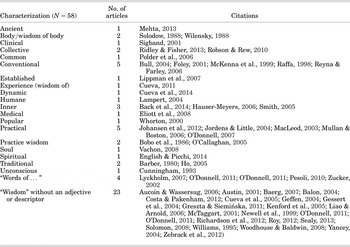
All 58 records were analyzed, and 21 different characterizations were identified (see Table 3).
Characterizations of wisdom in oncology care

Wisdom was often combined with an adjective giving it a variety of characterizations. It was characterized as dynamic, as something found, gained, or acquired through lived experiences, created through distilling insights, that can be ancient, shared, and passed on. Wisdom was characterized as something that could be harnessed for healing and soothing of the soul, or tempering feelings of helplessness in others. It was depicted as often being mediated by words yet culled from experience, transmitted through storytelling, and as a constituent of clinicians' practice and care. As well, wisdom was suggested to be critical and humane. Wisdom was referred to as soul wisdom or spiritual wisdom or practical wisdom or body wisdom or unconscious wisdom, thereby considering additional dimensions of human life, which can be lost in clinical oncology treatment discourses.
The most frequent characterization (11) was encapsulated with adjectives such as “conventional/established/traditional/collective wisdom.” These characterizations depict a social character to conceptions of wisdom beyond the individual. This type of wisdom was depicted as something that guides and sometimes as an approach that is constraining with respect to possibilities for new actions and insights. Foley (Reference Foley2001) challenges “conventional wisdom,” suggesting a “culture” of tacit, collective knowledge, which may or may not serve the cancer population. The second most common use was “practical wisdom” or “practice wisdom” (7), which located wisdom as arising from lived experience of practitioners (see Table 1).
LIMITATIONS
One limitation of this review is that only four databases were searched. These databases were the ones deemed by expert oncology librarians as the most likely to fulfill the purpose of our review; nonetheless, some articles may have been missed. Furthermore, texts such as published books and social media were not included, though they also may offer insights. It is important to note that a “scoping review” cannot be read as an appraisal of evidence (Grant & Booth, Reference Grant and Booth2009); it does not evaluate the quality of research studies or findings (Arksey & O'Malley, Reference Arksey and O'Malley2005). Rather, our scoping review maps the ways that “wisdom” is depicted in the published literature, as a concept, a focus, and/or a finding. Thus, this review offers a snapshot of genres of peer-reviewed articles, the ways in which wisdom is a focus of inquiry, and how wisdom is characterized in the literature reviewed.
Furthermore, wisdom is alluded to in the Discussion sections of research articles on interventions such as meaning-making therapy (Breitbart et al., Reference Breitbart, Rosenfeld and Gibson2010; Reference Breitbart, Poppito and Rosenfeld2012, Reference Breitbart, Rosenfeld and Pessin2015; Greenstein & Breitbart, Reference Greenstein and Breitbart2000; Vos, Reference Vos2014); dignity therapy (Chochinov, Reference Chochinov2006; Chochinov et al., Reference Chochinov, Kristjanson and Breitbart2011; Hack et al., Reference Hack, McClement and Chochinov2010; McClement et al., Reference McClement, Chochinov and Hack2007) and Managing Cancer and Living Meaningfully (Lo et al., Reference Lo, Hales and Jung2014; Rodin et al., Reference Rodin, Walsh and Zimmermann2007). Yet, due to the absence of “wisdom” in the title, abstracts, and explicit designs of these intervention studies (and perhaps others), they were not included in our scoping review, despite the potentially meaningful findings they may have offered. Finally, variations on the term “wisdom”—such synonyms or variations as “wise” or “wisely”—were not included in our search. It is thus possible that other literature that examines or references the concept of wisdom may have been missed (such as the Choosing Wisely articles referenced below). However, it is likely that the core search on wisdom will have surfaced a largely representative cross-section of the types of available literature.
SIGNIFICANCE OF RESULTS
This study highlights that tacitly circulating through oncology literature is reference to the resource of wisdom as dwelling in human experiences and practices within oncology care. Our findings suggest that the concept of “wisdom” is used in the oncology literature with a breadth of meanings and a taken-for-granted presence suggesting the importance of the concept for the field. Nonetheless, the terminology is unclear and varied, and a scholarly focus on wisdom has not been applied in cancer care to the degree it has in other fields. As such, it behooves us to examine this concept as it is depicted in the sociomaterial, messy, complex, and technologically sophisticated environments (Fenwick, Reference Fenwick2014) that aim to alleviate the suffering of those living with cancer.
Critical questions for oncology care are thus raised. “What is wisdom in healthcare specifically?” “How can the wisdom of patients and the clinical wisdom of frontline care providers be best elucidated?” “How might wisdom inform cultures of care, interventions offered, and best practices in the midst of busy and often fragmented healthcare systems?” (Breitbart, Reference Breitbart2004; Chochinov, Reference Chochinov2013). Our findings suggest that more rigorous studies focused on the concept and elements of wisdom in oncology care are required if deepened understandings and insights are to be gleaned and passed on to oncology patients and practitioners with ever more sophisticated medical technologies at their disposal. Better understanding of wisdom's formation and preservation in clinical life is perhaps more pressing than ever in countries like Canada, which have now decriminalized assisted dying (Attaran, Reference Attaran2015; Chochinov, Reference Chochinov2016; Fine, Reference Fine2015), where “wise” protocols for best practices will be needed to guide assisted dying in healthcare and clinical practice.
It can be noted that there are wide variations in approaches to wisdom depicted in the oncology literature. For example, Webster's (Reference Webster2003) scale using quantitative measures developed for an individual's self-assessment of their perceptions of personal wisdom was utilized in Costa and Packenham's (Reference Costa and Pakenham2012) study of benefit finding for patients with thyroid cancer. Glück and Bluck (Reference Glück, Bluck and Baron2005) prefer to use a qualitative methodology to study wisdom, integrating autobiographical stories to identify the ways in which individuals across age groups use and experience “wisdom to transform negative … life situations” into positive ones (p. 543). These differing approaches highlight the question as to what type of research methodologies are most appropriate for studying the intangibles in lived experiences—such as wisdom. Indeed, whether wisdom is best measured with a scale is a subject of debate in the current literature focusing on wisdom. For example, Küpers (Reference Küpers2007; Reference Küpers and Statler2008) studies wisdom extensively in the complex and changing context of business leadership and argues for wisdom as simultaneously being individually embodied and also embedded within social matrices that foster or constrain “wisdom-supportive” environments (p. 185). As a result of this awareness, Küpers has called for phenomenological approaches rather than the experimental/quantitative approaches characterizing earlier decades of wisdom research in the fields of psychology and adult development. Yang (Reference Yang2013; Reference Yang2008) also challenges quantitative approaches to wisdom research, arguing for a process view of wisdom that uses qualitative methodologies. These point to potential directions for taking up research on wisdom in oncology care, a field with a burgeoning focus on qualitative methodologies, as a means to examine the nuances of the lived experiences of those living with cancer.
Beyond the approaches to research, the focus of the research is also of importance. Our findings suggest that more research focusing specifically on wisdom is required. Such research might assist in clarifying the meaning(s) of statements such as “use your inner wisdom” by physicians—for instance, when the goals of care need reframing, as identified in the study conducted by Back et al. (Reference Back, Trinidad and Hopley2014). Such research may also help solidify wisdom as a unique construct and personal resource within oncology practice, distinct from the conventional wisdom of traditional practices and guidelines.
Findings of particular interest were empirical studies where wisdom emerged as a finding. Wisdom was identified as “acquired and passed on” and as an “inner resource,” emerging from participants' experiences with cancer. Back et al.'s study (Reference Back, Trinidad and Hopley2014) was a key example of research that did not have wisdom as a focus in its study design. The aim was to identify patient preferences for types of communication with their oncologists, yet emerging from the findings was a clear preference from patients and bereaved family members for the concept of “inner wisdom” at the point where treatment becomes focused on quality of life versus a curative approach. Due to the fact that wisdom was not identified at the outset as a concept of inquiry, the findings of Back and coworkers (Reference Back, Trinidad and Hopley2014) suggest that the notion of “inner wisdom” exists tacitly enough for patients to identify that they prefer this statement over the others that were employed. Findings such as this offer some potential direction for the field of psycho-oncology, as it aims to offer empirically based interventions for enhancing quality of life when living with cancer. Further investigations of harnessing those potential benefits for patients and providing such resources as “inner wisdom” are promising. This finding also highlights a potential direction for existing research on meaning-making and other existential–spiritual therapies to foreground wisdom in the study design, and to identify appropriate methodologies for investigating patients' inner lives, as well as garnering patients' own voices in the research on wisdom.
Attending to the ways in which wisdom may emerge through living with cancer and become an inner resource may have untapped therapeutic value for patients as well as clinicians. Incorporating a focus on wisdom in patients' experiences of living with cancer and their encounter with the systems providing treatment could inform broader perspectives on clinical treatment programming. This may strengthen patients' agency and autonomy (Sherwin, Reference Sherwin1992) through recognition that they have wisdom to contribute to their own care.
Wisdom was also identified in this review as “practice wisdom,” deriving from clinicians' experiences. This finding is interesting in light of recent calls for attention to practical or practice wisdom in professional practice, in health professional education, and for integration into such contexts as oncology and palliative care (Kinsella & Pitman, Reference Kinsella and Pitman2012; MacLeod, Reference MacLeod2003; Roy, Reference Roy2012; Zucker, Reference Zucker2002). Such “practical wisdom” arising from lived clinical experience may temper the limitations of “conventional wisdom” as promoted by evidence-based guidelines like the Choosing Wisely initiative (American Society for Radiation Oncology, 2015; Levinson et al., Reference Levinson, Kallewaard and Bhatia2014). In that program, “wise choices” are grounded in evidence-based care and on one level may represent a form of “conventional wisdom” that may not always serve patients well considering the uncertainties and nuances of individual patient care (Bauman, Reference Bauman2015). Our scoping review did not include the literature related to the Choosing Wisely initiatives because only the concept “wisdom” was used as a search term, and not its variant forms of “wisely” or “wise.” The Choosing Wisely campaign, launched in 2012 in the United States by the American Board of Internal Medicine (Levinson et al., Reference Levinson, Kallewaard and Bhatia2014), holds that “the goal is to provide high-quality care, prevent harm, and decrease the use of unnecessary care” (Levinson et al., Reference Levinson, Kallewaard and Bhatia2014, p. 2). Since then, it has been launched in many other countries and has grown exponentially (Cassel & Guest, Reference Cassel and Guest2012; Levinson et al., Reference Levinson, Kallewaard and Bhatia2014). The literature associated with the uptake of this campaign in a variety of countries and medical contexts might benefit from a separate review because of its growth (Cassel & Guest, Reference Cassel and Guest2012; Levinson et al., Reference Levinson, Kallewaard and Bhatia2014). The Choosing Wisely guidelines aggregate the published evidence, as identified by medical experts, to identify practices that are either associated with harm or an absence of benefit. Thus, these guidelines are best viewed as a subset of evidence-based practice organized through the lens of harm avoidance and system optimization. While it is stated that the guidelines are intended to serve as a starting point for discussions with patients, it is unclear how patients' perspectives on the meaning and application of wisdom are garnered. For example, while Levinson and colleagues (Reference Levinson, Kallewaard and Bhatia2014) mention that such key terms as “avoiding harm” and “wise choice” were evaluated for their resonance by key stakeholders in the campaign (including physicians and patients and in a variety of countries), perhaps further conceptual, philosophical, and theoretical investigations of wisdom have potentially significant application and educative value in such movements. Adoption of the Choosing Wisely moniker also illustrates the need for a better understanding of the nature of wisdom in medical practice to reduce the cooption of a potentially powerful concept to serve more pedestrian needs. Further unpacking of wisdom's meaning(s), which our scoping review points toward as a valuable endeavor for oncology, could support more rigorous investigation among oncology patients as to how this body of evidence in the Choosing Wisely campaign has been established as “wise,” which stakeholders have contributed to this understanding of wisdom, what criteria were being used to identify wise choices, and finally, by what criteria the wisdom of a choice was assessed.
Characterizations of wisdom in our scoping review reflect it as multidimensional and integrating practical, spiritual, transcendental, embodied, emotional, and psychological aspects that are reflected in studies focusing on wisdom in other fields (Ferrari & Weststrate, Reference Ferrari and Weststrate2013; Glück & Bluck, Reference Glück, Bluck, Ferrari and Weststrate2013; Sternberg & Jordan, Reference Sternberg and Jordan2005; Trowbridge & Ferrari, Reference Trowbridge and Ferrari2011). Due to wisdom's ineffability (Aldwin, Reference Aldwin2009), it may offer a concept that might circulate between and around such dualities as clinician/patient perspectives, psychological/spiritual concepts (Brennan, Reference Brennan2006; Salander, Reference Salander2015; Wein, Reference Wein2014), and transcendent/practical dimensions (Wink & Helson, Reference Wink and Helson1997) in the search for a more integrative bio-psycho-spiritual paradigm (Breitbart & Alici, Reference Breitbart and Alici2009; Chochinov, Reference Chochinov2003; Holland, Reference Holland2009; Sulmasy, Reference Sulmasy2002).
Of note is that the two empirical studies focused directly on wisdom were conducted among Alaskan indigenous communities, suggesting the possibility of a cultural valuing of wisdom. One might ask whether there are distinct cultures of wisdom in oncology care contexts that can be intentionally elucidated and in what direction they might point the field of psycho-oncology.
Diffuse concepts regarding wisdom—such as “wisdom of the body,” “unconscious wisdom,” and “soul-wisdom”—appear in essays rather than empirical research studies. An evidence-based-medicine paradigm, for example, has little epistemological flexibility for studying such intangibles (Fenwick, Reference Fenwick2014; Greenhalgh et al., Reference Greenhalgh, Howick and Maskrey2014; Kinsella, Reference Kinsella, Whiteford and Hocking2012). For instance, “embodied soul” was a central concept in medical practice from Greco-Roman times up to the 18th and 19th centuries, when it was all but erased from Western medical practice as a philosophical conceptualization of human beings, their illnesses, and how they might best be treated (Bates, Reference Bates2009; de Pablo & Evans, Reference de Pablo and Evans1994; Wright, Reference Wright1991). Such discourse is reentering the medical oncology literature through editorial and narrative pieces and is also mirrored in an increased focus on patient-centered practices and patient communication (Bauman, Reference Bauman2015; Butlin, Reference Butlin2015). One wonders if such discourses reflect a hunger or longing for different kinds of conversations in oncology care. For example, MacLeod (Reference MacLeod2003), a palliative care physician, appeals for a revival of interest in how medical practices can integrate wisdom into medicine.
The prevalent anecdotal uses identified in our scoping review further reflect a potential tension in oncology discourses between a form of “conventional wisdom” that may constrain new approaches, knowledge, or innovations (Bull, Reference Bull2004; Foley, Reference Foley2001; Raffa, Reference Raffa1998) and a “collective wisdom” that may improve knowledge and practice (Ridley & Fisher, Reference Ridley and Fisher2013; Robson & Rew, Reference Robson and Rew2010). Wisdom in oncology discourses thus seems to have a dual nature that can be renewing, enlightening, and revolutionizing to clinical practice and commonly held knowledge, but which when unquestioned can become ossified into restrictive and perhaps even harmful beliefs and practices that run contrary to new evidence. The tension between the wisdom that renews and conventional wisdom that constrains suggests that there may be a place for epistemic reflexivity (Kinsella & Whiteford, Reference Kinsella and Whiteford2009)—a form of critical interrogation into how such conventional wisdom comes to hold sway in the development of knowledge relevant for practice in oncology care.
The findings of our review further depict wisdom in a range of people—including patients, clinicians, family members, groups, and researchers—in the context of cancer care. Nonetheless, the absence of representations of the wisdom of those living with cancer was particularly noteworthy and may in part be explained by the exclusion of numerous books and articles that may have offered further insights into the wisdom of those living with cancer. This absence reflects how the wisdom of patients can be significantly muted beneath the voices of clinicians and researchers.
Questions are raised as to why patients' voices are absent. Perhaps it is reflective of “who” drives research agendas (usually not the patients) and what gets funded by national research bodies (e.g., the quest for a cure). Further, the culture of oncology may be focused on hope to a greater degree than wisdom in light of a tradition of interventionist focus rather than the more emergent focus on quality of life. Or, perhaps wisdom is an overly retrospective concept—one looks back for wisdom—at the same time that cancer care is a prospective culture of survivorship. If wisdom is identified as a valuable construct in clinical oncology care, how then to integrate and harness its contribution effectively? There is a disturbing gap between the absence of contributions from patients in the literature reviewed and the growing expert discourses focusing on clinical phronesis (practice wisdom) in the medical humanities, medical education, professional practice discourses, and in the editorials, commentary, and opinion pieces by physicians speaking to the concept of wisdom. This gap suggests that researchers in oncology, editors of expert journals, clinicians, managers, and senior administrators may need to be more proactive in promoting publication about care-improvement initiatives based on patient experience (Bak et al., Reference Bak, Macdougall and Green2014; Barnes & Cotterell, Reference Barnes and Cotterell2011; Robert et al., Reference Robert, Cornwell and Locock2015; Rogers et al., Reference Rogers, Pickles and Hide2008; Tsianakas et al., Reference Tsianakas, Robert and Maben2012) and research that reflects patients' voices about their cancer, their care, and their well-being.
A fruitful task for scholars and practitioners may well be to learn more about the phenomenon of wisdom—to find effective means to document and harness wisdom; to discover ways to embody wisdom, individually and collectively; to engage in critical reflexivity about what has come to be accepted as conventional wisdom; and to encourage and support the emergent wisdom of those living with cancer and optimize ways of sharing this wisdom with patients and providers. This may help to close some of the gaps between practice and conventional wisdom, patients' and clinicians' wisdom, and academic and grassroots frontline wisdom.
ACKNOWLEDGMENTS
The authors would like to express their sincere thanks to Gabriel Boldt, Sylvia Katzer, and Jill McTavish, clinical oncology librarian specialists at the London Regional Cancer program, London Health Sciences Centre, Ontario, for their expertise and support for this study.