Introduction
Organisms living in the intertidal zone are under constant variation of abiotic and biotic factors (Raffaelli & Hawkins, Reference Raffaelli and Hawkins1996). Combined with desiccation (Somero, Reference Somero2002), wave impact is one of the most important physical factors controlling the survival and morphology of intertidal organisms (Denny et al., Reference Denny, Daniel and Koehl1985). Hydrodynamic forces can negatively affect growth of benthic invertebrates by reducing the foraging windows, resulting in less energy intake (Brown & Quinn, Reference Brown and Quinn1988). Other consequences of intense wave exposure on organisms inhabiting the rocky intertidal include damage and dislodgement (Dayton, Reference Dayton1971; Paine & Levin, Reference Paine and Levin1981).
To avoid wave dislodgement, several adaptations have been selected in organisms living in the intertidal zone, including plastic responses of behavioural and morphological traits (Denny, Reference Denny2006). Mobile invertebrates frequently exhibit behavioural strategies to minimize the impact of waves. Crabs can modulate their postures according to water flow, minimizing the risk of dislodgement (Martinez, Reference Martinez2001) while hermit crabs can actively choose shells of distinct morphology according to the wave action conditions (Argüelles et al., Reference Argüelles, Álvarez and Alcaraz2009). Sessile animals are exposed to wave impact during their whole lifetime and morphological attributes are selected to minimize the stress caused by the impact of waves on them, allowing their survival under variable regimes of wave exposure. For example, the feeding legs of barnacles are longer in calm waters for enhancing filtration rates, but shorten with wave exposure, being smaller in turbulent areas to remain erect and ensure filtration (Arsenault et al., Reference Arsenault, Marchinko and Palmer2001). Mussel shells are smaller and narrower in exposed sites, reducing the impact of hydrodynamic forces (Steffani & Branch, Reference Steffani and Branch2003). More sedentary animals may show morphological adaptations rather than specialized behaviours to cope with the abiotic pressure from harsh coastal environments. Sea stars, for example, can alter their body form in response to water flow resulting in reduced lift and drag, developing narrower arms and lighter bodies when transplanted from sheltered to exposed areas (Hayne & Palmer, Reference Hayne and Palmer2013). Intertidal periwinkles have developed larger feet in higher hydrodynamic conditions in both laboratory flume experiments and field translocation experiments, indicating that phenotypic plasticity in foot size may be advantageous (Trussell, Reference Trussell1997).
Among slow-moving organisms from the intertidal zone, limpets are one of the most abundant (e.g. Christofoletti et al., Reference Christofoletti, Takahashi, Oliveira and Flores2011), being widely distributed along the shore with varying density, size and form (Branch & Marsh, Reference Branch and Marsh1978; Brown & Quinn, Reference Brown and Quinn1988; Hobday, Reference Hobday1995). Several limpet species show homing behaviour, returning to a scar in the rock during low tides after feeding (Cook, Reference Cook1971; Hartnoll & Wright, Reference Hartnoll and Wright1977; Gray & Hodgson, Reference Gray and Hodgson1998; Sebastián et al., Reference Sebastián, Steffani and Branch2002). Others, such as Lottia gigantea, are territorial and home range may depend on body size (Fenberg, Reference Fenberg2013). Therefore, although they can move, such specific behaviours with short distance movements (Iwasaki, Reference Iwasaki1999) may impose similar abiotic pressures throughout their lives. When compared with sheltered areas, sites exposed to waves frequently show higher density of limpets (Branch & Odendaal, Reference Branch and Odendaal2003) and shells tend to be more conical, promoting larger dissipation of the energy generated by wave impact (Denny & Blanchette, Reference Denny and Blanchette2000; Tanaka et al., Reference Tanaka, Duque-Estrada and Magalhães2002). While the effects of wave exposure already have been broadly investigated among areas, such effects may also occur at a smaller spatial scale as a result of the sedentary habit of most limpets. However, it is still poorly assessed.
Lottia subrugosa (d'Orbigny, 1846) is the most common limpet species on the Brazilian coast, being very abundant in the intertidal zone (Rios, Reference Rios2009; Christofoletti et al., Reference Christofoletti, Takahashi, Oliveira and Flores2011) and occurring mostly in bare rock gaps formed in the beds of Brachidontes mussels, Tetraclita barnacles and Crassostrea oysters (Tanaka & Magalhães, Reference Tanaka and Magalhães2002). As with other limpets, this species exhibits homing behaviour, moving short distances for feeding when submerged, and returning to the same spot when emersed (Paresque et al., Reference Paresque, Alves, Stein and Gonçalves2007; Rosário & Ourives, Reference Rosário and Ourives2007). Lottia subrugosa is thus a suitable model to test how wave action may affect morphological traits related to energy dissipation and attachment effectiveness at both large and small scales. While the importance of wave action on limpet morphology has been explored across large-scale exposure gradients, including studies on L. subrugosa (Tanaka et al., Reference Tanaka, Duque-Estrada and Magalhães2002), nothing has been done regarding these effects on smaller scales. Therefore, using limpet position on boulder sides as a proxy of wave impact regime at a considerably smaller spatial scale (metres), our aim in this study was to describe differences in size, foot area and shell shape on boulder sides exposed and sheltered from waves, and test if such small-scale differences are consistent through time and different shores. We expected to observe small individuals with more conical shells (higher energy dissipation) and a larger foot (more efficient attachment) in the boulder side exposed to wave impacts. Considering such effects on a much smaller scale than previous studies may help to understand several aspects of L. subrugosa ecology.
Materials and methods
Data collection
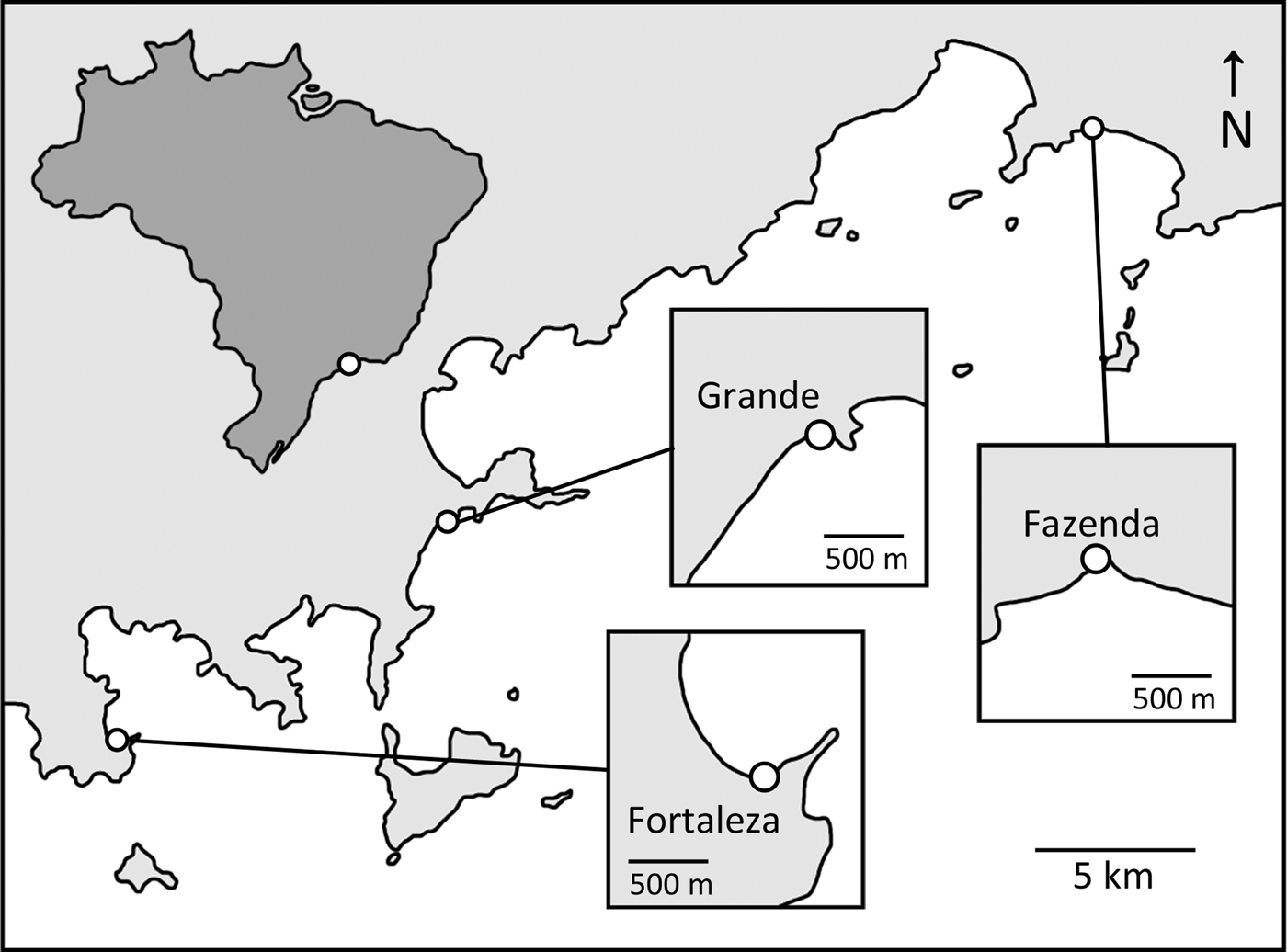
Sampling was conducted at three shores located along the coast of Ubatuba in the state of São Paulo, SE Brazil (Figure 1): Fortaleza (23°31′55″S 45°09′45″W; May 2008 and December 2016), Grande (23°28′01″S 45°03′36″W; June 2012 and December 2016) and Fazenda (23°21′27″S 44°51′57″W; July 2010, November 2011, July 2013 and March 2016). Gathering information from previous studies and wave fetch (km) estimated from an area of 0.64 km2 centred in each shore coordinate (following Burrows et al., Reference Burrows, Harvey and Robb2008), we were able to classify each shore regarding the wave exposure regime: Fortaleza is the most sheltered shore among the three sites studied here (Paula & Oliveira-Filho, Reference Paula and Oliveira-Filho1982; Széchy & Paula, Reference Széchy and Paula2000; wave fetch: 3.1 ± 0,6); Grande is a wider shore (~15 m between upper and lower intertidal limits) exposed to intense wave impacts (Tanaka et al., Reference Tanaka, Duque-Estrada and Magalhães2002; wave fetch: 4.9 ± 0.6); and Fazenda is also a more exposed shore (Machado et al., Reference Machado, Nassar and Széchy2011; wave fetch: 3.7 ± 0.2), but a narrower one when compared with Grande (~5 m between upper and lower intertidal limits). The three shores are composed of rocky boulders and bed rocks over sandy substratum. We only used granitic boulders, frequently round-shaped, to sample the organisms, selecting the ones with a clear separation between the side exposed to waves and the opposite sheltered side, as a proxy of wave action (Cusson & Bourget, Reference Cusson and Bourget1997; Guichard & Bourget, Reference Guichard and Bourget1998).
Study shores along Ubatuba coast, SP, south-eastern Brazil: Fortaleza (23°31′55″S 45°09′45″W), Grande (23°28′01″S 45°03′36″W) and Fazenda (23°21′27″S 44°51′57″W).

In each sampling event, we delimited a transect along the shore (~50 m long) and randomly selected isolated large boulders with at least 2 m of diameter within the midlittoral zone. We observed several size classes of L. subrugosa in assemblages from all shores, but we did not select for size while carefully detaching the organisms from exposed and sheltered sides of the boulders. We considered only bare rock areas with vertical orientation and avoided sampling the limpets in positive/negative surfaces or over mussel/barnacle beds. We also sampled the organisms from faces facing south or north, ensuring that both faces would be under a similar light stress regime throughout the day in the three shores. Limpet position on boulder sides was used as a proxy of wave impact regime on a small spatial scale. We had a variable number of individuals among shores and years, ranging from 21 in Fortaleza 2008 to 50 in all sites in 2016 (for details see Results). Using a calliper (± 0.05 mm), we measured the foot length and width after total relaxation (for 2016 sampling events), and the shell length, width and height (for all sampling events). After manipulation, all organisms were returned to the same spot they were removed from.
Data analysis
We tested the effects of the position on rocky boulders on morphological traits of L. subrugosa focusing on size, attachment effectiveness and energy dissipation. Size was estimated by shell length (Tanaka et al., Reference Tanaka, Duque-Estrada and Magalhães2002); attachment effectiveness was estimated by a proportion between foot surface area and basal shell area (both calculated using length and width in an ellipse area as a proxy), with proportionally larger foot assumed to attain a stronger attachment (Etter, Reference Etter1988; Trussell, Reference Trussell1997; Tanaka et al., Reference Tanaka, Duque-Estrada and Magalhães2002); and energy dissipation was estimated by shell shape using a shell conical index (shell height divided by shell length), with higher values standing for more conical shells, which indicate more dissipative shells (Denny, Reference Denny2000; Denny & Blanchette, Reference Denny and Blanchette2000; Tanaka et al., Reference Tanaka, Duque-Estrada and Magalhães2002).
To test the small spatial scale effect of wave action on limpets morphology, and the consistency of eventual patterns among shores, we used 2016 data (shell size, foot relative area and shell shape index) in a two-way ANOVA, testing the effect of boulder side (fixed, two levels: exposed and sheltered) and shore (random, three levels: Fortaleza, Grande and Fazenda). Additionally, for each site separately, we compared shell shape index in a two-way ANOVA between boulder sides across time (random; Fortaleza: 2008 and 2016; Grande: 2012 and 2016; and Fazenda: 2010, 2011, 2013 and 2016), testing for temporal consistence of small spatial scale patterns of shell shape. When we observed deviation in the ANOVA assumptions, data transformation was not sufficient to solve problems with normality and homoscedasticity. However, we decided to keep with the ANOVA test because it is more powerful than non-parametric tests and robust regarding deviation of assumptions when sampling is balanced and replication high (Underwood, Reference Underwood1997).
Results
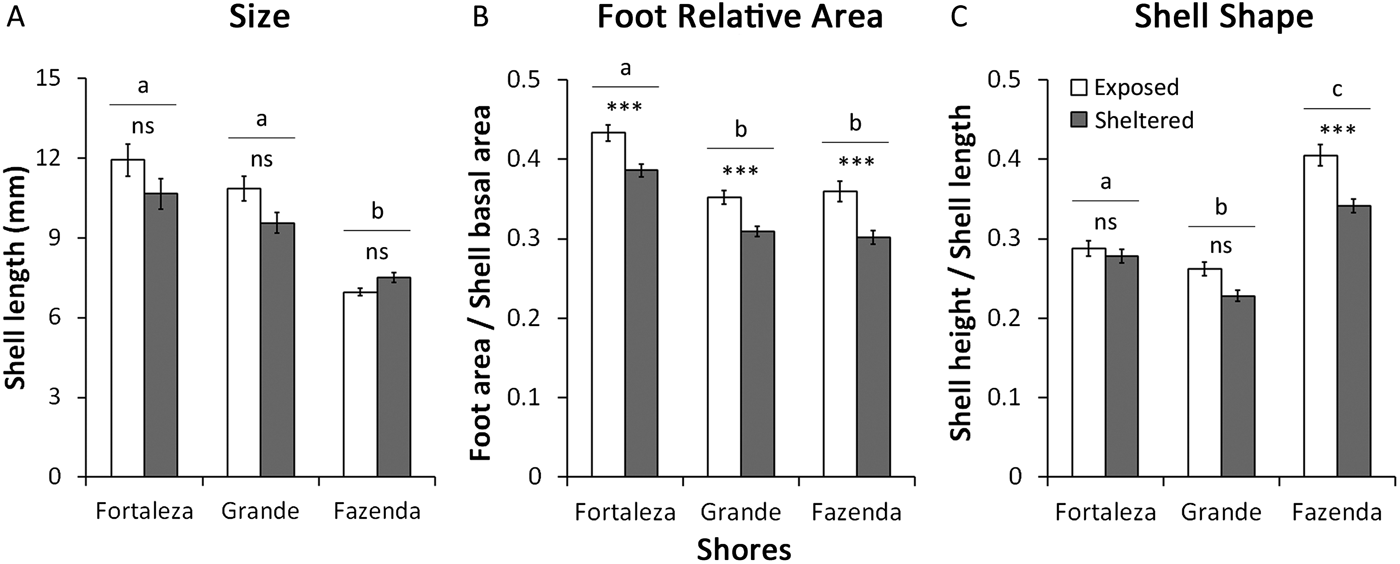
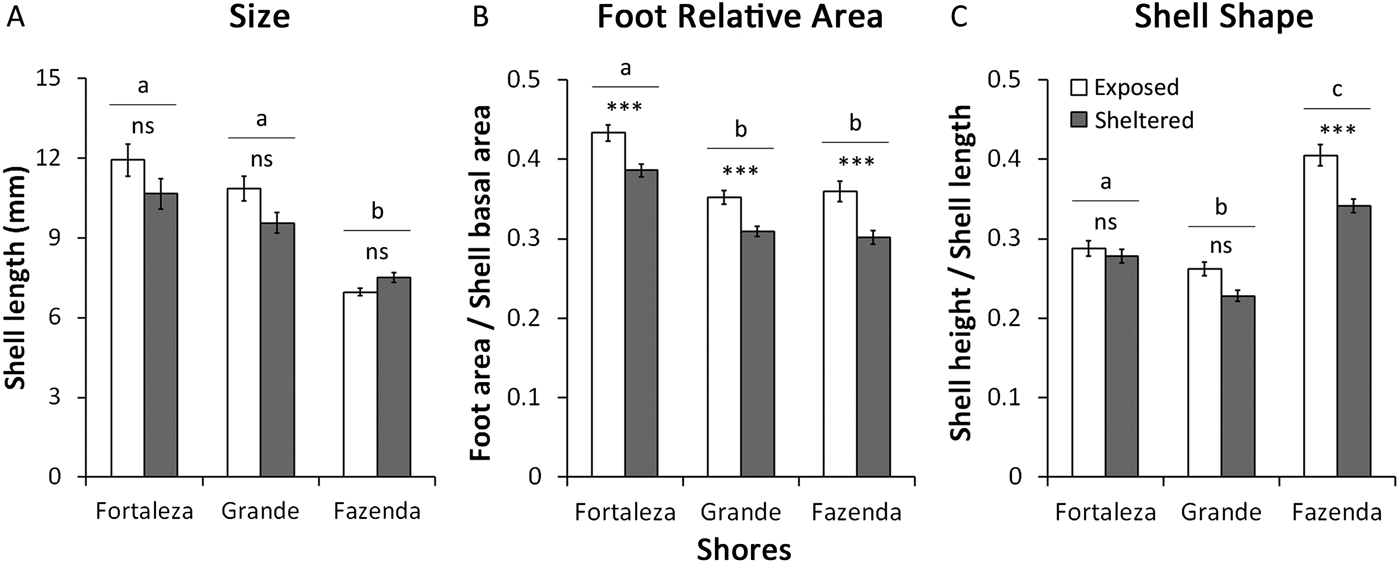
Small spatial scale effects of wave action were not observed for limpet size, but consistently led individuals to proportionally large feet in the exposed boulder side for all three shores, and more conical shells in the exposed boulder side in Fazenda shore. Differences were also observed among shores. Limpets in Fortaleza were larger and with proportionally larger feet, but with intermediate conical shells. In Grande and Fazenda, limpets showed proportionally smaller feet in both shores, but they were smaller and with more conical shells in Fazenda, and larger and with more flattened shells in Grande (Table 1, Figure 2).
Wave action effects on (A) size (mean ± SE), (B) foot relative area (mean ± SE) and (C) shell shape (mean ± SE) between exposed (white bars) and sheltered (grey bars) boulder sides and among shores (Fortaleza, Grande and Fazenda). N = 50 for each boulder side in each shore. Ns, not significant and ***P < 0.001 for comparisons between boulder sides within each shore. For each variable, differences among shores sharing a single letter are not significant (P > 0.05).
Summary results of a two-way ANOVA comparing wave action effects on size (shell length), foot area proportion (foot area/shell basal area) and shell shape (shell height/shell length) among shores (large-scale – Fortaleza, Grande and Fazenda) and boulder sides within shores (small-scale – exposed and sheltered)

ns, not significant.
*P < 0.05; ***P < 0.001.
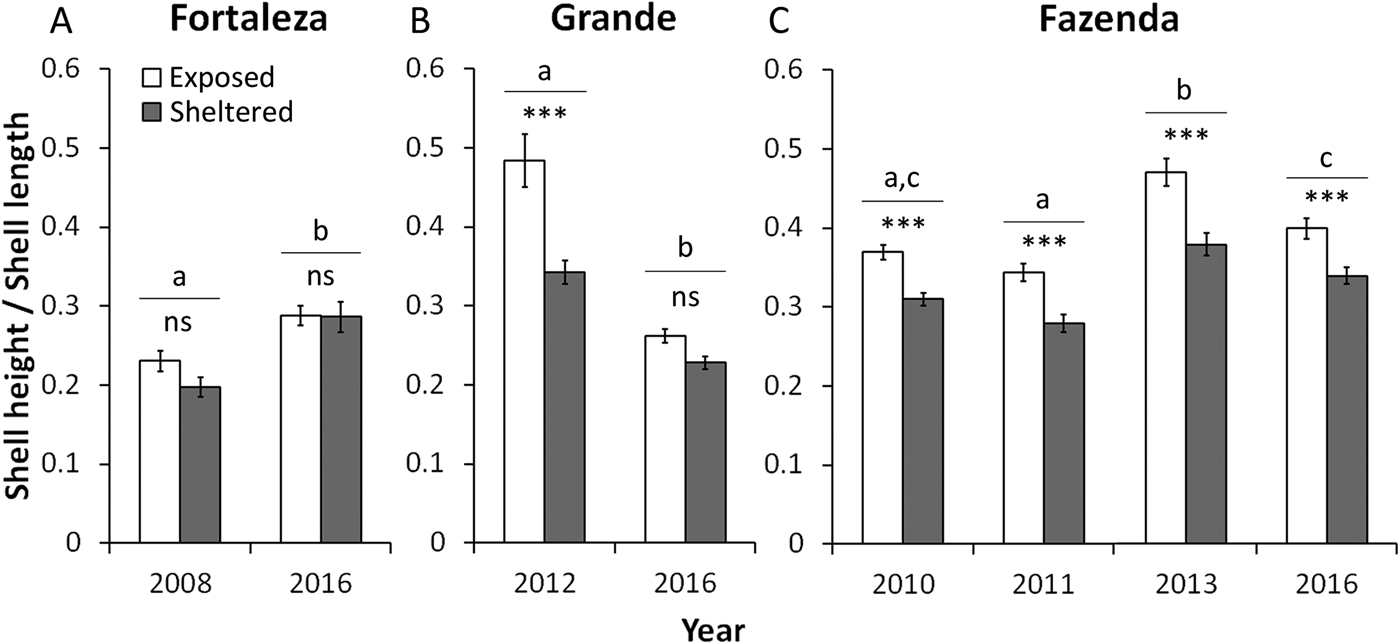
Although shell shape was variable across time within sites, regardless of the position of limpets on rocky boulders, small spatial scale patterns were consistent for Fortaleza, with no differences in shell shape between boulder sides in both years, and in Fazenda, with limpets showing more conical shells in the boulder side exposed to wave impacts in the four years. In Grande, we observed variation between years, with more conical shells in the boulder side exposed to waves in the first year, but no effect of the limpets' position on rocky boulders in the second one (Table 2, Figure 3).
Wave action effects on shell shape (mean ± SE) between exposed (white bars) and sheltered (grey bars) boulder sides across time for (A) Fortaleza (N = 21 for each boulder side in each year), (B) Grande (n = 50 for each boulder side in each year) and (C) Fazenda (N = 45 for each boulder side in each year). ns: not significant and ***P < 0.001 for comparisons between boulder sides within each year of each shore. For each shore, differences among years sharing a single letter are not significant (P > 0.05).

Summary results of a two-way ANOVA comparing wave action effects on shell shape (shell height/shell length) between exposed and sheltered boulder sides in Fortaleza, Grande and Fazenda across time

ns, not significant.
*P < 0.05; **P < 0.01; ***P < 0.001.
Discussion
Our results indicate that the position of the limpets on boulders, used here as a proxy for wave action at a small spatial scale, may affect morphological traits of Lottia subrugosa. Larger feet in limpets inhabiting the exposed sides of boulders were observed in all sites. However, while the effects on shell shape followed the same small spatial scale pattern with more conical shells (higher wave energy dissipation) in the boulder side exposed to waves, this effect was not pervasive across sites, being observed at one exposed shore for all years (Fazenda) and in other exposed shore for just one year (Grande). These results indicate that for L. subrugosa both greater attachment and more conical shells may be effective strategies to cope with wave action dislodgement at very small spatial scales. Although not tested, differences of wave exposure regime among shores may have modulated the small spatial scale effects of wave action on the morphological traits analysed in our study.
For organisms living on a rocky shore, the effective attachment is an important feature since wave action can easily lead to dislodgement from the rock surface (Denny, Reference Denny1985; Denny et al., Reference Denny, Daniel and Koehl1985; Trussell, Reference Trussell1997; Denny & Blanchette, Reference Denny and Blanchette2000). Larger feet can enhance attachment and were already observed at wave exposed sites for several intertidal gastropods, as in whelks (Kitching, Reference Kitching1976; Etter, Reference Etter1988; Gibbs, Reference Gibbs1993), topshells (Frid & Fordham, Reference Frid and Fordham1994), periwinkles (Grahame & Mill, Reference Grahame and Mill1986; Chapman, Reference Chapman1997; Trussell, Reference Trussell1997) and limpets (Denny & Blanchette, Reference Denny and Blanchette2000), including L. subrugosa (Tanaka et al., Reference Tanaka, Duque-Estrada and Magalhães2002). Here we observed a consistent wave action effect at small spatial scales, with proportionally larger feet occurring in individuals from boulder sides directly exposed to wave impact in all shores, even at the most sheltered one. Wave action can reach high values of force impact and velocity (Carstens, Reference Carstens1968; Denny, Reference Denny1985, Reference Denny2000), and the strategy of having a larger foot can provide a better attachment, enhancing L. subrugosa survival under wave impact. Surprisingly, the proportionally larger feet were observed at our most sheltered site, Fortaleza. The absence of intense wave action results in a larger time window for feeding, which associated with the amounts of organic matter provided by the surrounding vegetation, may lead to higher growth rates and larger general sizes and foot area in this shore (Denny et al., Reference Denny, Daniel and Koehl1985; Brown & Quinn, Reference Brown and Quinn1988). Besides, this result may indicate that not only wave action can trigger a more effective attachment, but also other factors such as predation, which is usually higher in sheltered sites (Pais et al., Reference Pais, Azurro and Guidetti2007 and references therein; Silva et al., Reference Silva, Hawkins, Boaventura, Brewster and Thompson2010), and may exert an important risk of dislodgement for limpets (Branch, Reference Branch1978; Lowell, Reference Lowell1987; Iwasaki, Reference Iwasaki1993; Denny, Reference Denny2000).
Besides being effectively attached, the way that organisms dissipate the energy resulting from breaking waves may confer advantages against dislodgement (Trussell et al., Reference Trussell, Johnson, Rudolph and Gilfillan1993; Denny, Reference Denny2000; Denny & Blanchette, Reference Denny and Blanchette2000). Several intertidal gastropods change their body shape in order to enhance energy dissipation after wave impact (Denny et al., Reference Denny, Daniel and Koehl1985; Trussell et al., Reference Trussell, Johnson, Rudolph and Gilfillan1993; Denny & Blanchette, Reference Denny and Blanchette2000), which was also demonstrated for L. subrugosa among variable exposure shores (Tanaka et al., Reference Tanaka, Duque-Estrada and Magalhães2002). Although it was not a general pattern as observed for relative foot area in our study, we indeed observed shell shape variations for L. subrugosa. More conical shells, on average, occurred at the exposed shore Fazenda in 2016 when compared with the other shores, and in boulder sides (small spatial scale) exposed to wave action through all years in Fazenda (2010, 2011, 2012, 2016) and for one year in Grande (2012). For coiled shell snails, being more flattened is more advantageous than being taller in areas with intense wave impacts (Denny, Reference Denny2000). This is a result of their limited attachment surface (Denny, Reference Denny2000), which imposes a lower tenacity (Miller, Reference Miller1974) and a higher lift coefficient (Denny, Reference Denny1995). However, for limpets that have a wider attachment surface, more conical and taller shells can enhance wave energy dissipation when compared with more flattened ones (Denny, Reference Denny1985, Reference Denny2000; Denny & Blanchette, Reference Denny and Blanchette2000). The direct impact in a more flattened shell may transfer a greater amount of energy to the organism, decreasing stability and enhancing the chances of detachment, while more pointed shells are more hydrodynamic and can easily dissipate the energy transferred by direct wave impact (Denny, Reference Denny1985, Reference Denny2000; Denny & Blanchette, Reference Denny and Blanchette2000). Additionally, the proportionally higher height in more conical shells may promote the development of the muscle associated to the foot, favouring a more efficient attachment (Branch & Marsh, Reference Branch and Marsh1978).
The theoretical ideal ratio between shell height and length is 0.53; however, most limpet species show an average ratio of 0.34 (Denny, Reference Denny2000), only 64% of the hydrodynamic optimum and very similar to the mean ratio of our study (0.33 ± 0.005). Although the mean ratio observed in our study leads to suboptimal energy dissipation, limpets commonly have the shell apex slightly shifted towards the shell margin, which may enhance energy dissipation even with a non-ideal shell shape when it is positioned downstream (Denny, Reference Denny1995, Reference Denny2000). Besides, we observed a higher average ratio when just individuals from exposed boulder sides are considered (0.37 ± 0.008), with ratios close to 0.5 in Grande 2012 and Fazenda 2013. This highlights that wave action at a small scale can trigger shell shape towards the optimum which consequently may enhance L. subrugosa survivorship, as observed for the congeneric species L. gigantea, with an increase of 4.1% in survivorship in individuals with shells closer to the optimum (Denny & Blanchette, Reference Denny and Blanchette2000).
We observed variations in shell shape across time for all shores regardless of boulder side, probably related to inter-annual differences in growth. Within sites, small spatial scale effects of wave action were consistent for Fortaleza and Fazenda, but not for Grande. Organisms from Fortaleza, the most sheltered shore, were not affected by wave action in both years, with similar shell shape between boulder sides. On the other hand, limpets from Fazenda, one of the more exposed shores, showed a very clear pattern, with more conical shells in exposed boulder sides in all four years. We are aware that for Fortaleza and Grande the number of sampling events was low, which may limit the extent of our results. However, even with low time replication for some sites and not enough sites to properly test a wave exposure regime at a larger scale, the effect of wave action on shell shape considering the small scale tested here seems to take place in more exposed shores and not in the more sheltered one across time. This suggests that in some way wave exposure regime on the shore may modulate the extent of small-scale effects of wave impact.
Contrary to what we expected, wave action effects in Grande, which is the most exposed shore in our study, were not consistent as in Fazenda. Those effects were observed in 2012, with more conical shells in the exposed boulder site, but not in 2016. We believe that this variable effect is due to the differences in topological organization between Grande and Fazenda. While Fazenda is a narrow shore, with most boulders forming a clear line directly exposed to waves, Grande is a much larger shore, with some boulders being sheltered by others, which may decrease wave energy before reaching all boulders. Since we randomly selected boulders to sample L. subrugosa individuals, we may have chosen boulders with different exposure levels, leading to the variation between years observed for Grande.
The small spatial scale variation in the morphology of L. subrugosa observed in our study can be caused by three different evolutionary mechanisms: (1) individuals with different genotypes, which may cause variable morphologies since juvenile stages are under selection between boulder sides (Boulding et al., Reference Boulding, Holst and Pilon1999; Denny & Blanchette, Reference Denny and Blanchette2000; Denny, Reference Denny2006), with only juveniles with more conical shells and larger feet surviving on more exposed boulder sides; (2) individuals show the same genotype but phenotypic plasticity takes place (Etter, Reference Etter1988; Gibbs, Reference Gibbs1993; Trussell, Reference Trussell1997), and changes in shell and foot morphology will occur ontogenetically, being dependent on wave action regime; and (3) both mechanisms may operate (Harley et al., Reference Harley, Denny, Mach and Miller2009; Hollander & Butlin, Reference Hollander and Butlin2010), with the selection of juveniles with more suitable morphology on boulder sides with more intense wave impact, but also with variability triggered by wave action pressure throughout ontogeny. Following individual morphology from early juvenile stages and transplantation experiments would help to answer this question.
We are aware that the evolutionary mechanisms related to limpet morphology are difficult to establish, with some limpet species being different morphotypes of a single species (e.g. Teske et al., Reference Teske, Barker and McQuaid2007) while variable morphology of a single species (e.g. shell banding patterns) can indicate breaks in the lineage and beginning of speciation for other limpets (e.g. Joseph et al., Reference Joseph, Vakani and Kundu2018). However, such phenomena have not been investigated for L. subrugosa populations on the Brazilian coast and, based on the available literature, L. subrugosa is the only abundant limpet occurring in our study sites (Rios, Reference Rios2009). Although our data do not allow us to identify the evolutionary mechanism acting here, we show a clear pattern of variability in morphological traits of L. subrugosa at a considerably small spatial scale. This may confer a higher survival for individuals facing direct impact of waves, either by a more effective attachment and/or by shells with a more dissipative shape. Other factors, not measured in our study, such as predation pressure, density of individuals and competition for space may also influence the morphological traits investigated here, but we have no reason to believe that they also vary in the wave exposure contrasting conditions established by our sampling approach (exposed vs sheltered sides of the boulder). Therefore, our study provides some of the first evidence that factors affecting limpet morphology at larger spatial scales may also act at smaller ones, resulting in variable morphology in boulder sides under different wave exposure conditions and that sometimes are separated by less than a metre.
Acknowledgements
The authors thank the support provided by the University of Campinas (UNICAMP) and Associated Colleges of Jaguariúna (FAJ), and the staff and students involved in the undergraduate courses Introduction to Ecology – UNICAMP and Applied Ecology – FAJ, and grad course Field Ecology – UNICAMP, for enabling field sampling and helping in data collection. The authors also thank A.L.P. Souza and C.A.M.M. Cordeiro for helping with the wave fetch analyses.
Financial support
This research received no specific grant from any funding agency, commercial or not-for-profit sectors.