Implications
In several areas, dried citrus pulp (DCP) may conveniently replace conventional cereals in diets for ruminants. Feeding DCP to small ruminants could improve important quality traits of meat, such as the resistance to oxidative deterioration. Citrus pulp (CP) notoriously contains phenolic compounds with antioxidant properties. Moreover, high levels of lipophilic antioxidants, such as vitamin E, may occur in whole DCP. This study demonstrates, for the first time, that vitamin E contributes most to the improvement of the antioxidant capacity of tissues from lambs fed whole DCP and highlights that the standardization of CP is needed to optimize its positive effects.
Introduction
Citrus fruits represent one of the most important agricultural productions in several areas worldwide where they are destined to human consumption as fresh fruits or processed juice. In the latter case, a substantial amount of waste biomass is produced, known as whole CP, composed of peels, inside portions of the fruit and seeds. The CP can be processed by pressing and drying the biomass to obtain the dried citrus pulp (DCP), which can be used in the formulation of diets for ruminants to replace high levels (30% or higher) of cereals (Bampidis and Robinson, Reference Bampidis and Robinson2006). Feeding CP to ruminants can result in positive effects related to the presence of residual bioactive molecules. Citrus fruits have received special attention for their content of phenolic compounds and it has been shown that citrus by-products are richer in polyphenols than the portions consumed by humans (Balasundram et al., Reference Balasundram, Sundram and Samman2006; Nogata et al., Reference Nogata, Sakamoto, Shiratsuchi, Ishii, Iano and Ohto2006). Recently, we have demonstrated that feeding lambs with concentrate-based diets including up to 35% DCP increased the resistance of muscle lipids and proteins to oxidative deterioration (Gravador et al., Reference Gravador, Jongberg, Andersen, Luciano, Priolo and Lund2014; Inserra et al., Reference Inserra, Priolo, Biondi, Lanza, Bognanno, Gravador and Luciano2014). The results of these studies were discussed in the light of the possible antioxidant effects of the polyphenols present in CP, in agreement with results provided by studies in which sheep were fed with either citrus extracts or with purified citrus flavonoids (Gladine et al., Reference Gladine, Morand, Rock, Bauchart and Durand2007c; Bodas et al., Reference Bodas, Prieto, Jordán, López-Campos, Giráldez, Morán and Andrés2012).
However, although citrus flavonoids clearly possess antioxidant properties, research has not yet clarified their bioavailability and their mechanisms of action when ingested as components of the diet of animals, including humans. Indeed, it is known that dietary flavonoids are poorly absorbed in the gastrointestinal tract and, if absorbed, can be actively metabolized in the animal organism (Khan et al., Reference Khan, Huma and Dangles2014). Therefore, possible indirect effects have been proposed to explain their potential antioxidant activities in vivo, such as the interaction with other antioxidants, or possible antioxidant activities exerted in the gastrointestinal tract (Halliwell et al., Reference Halliwell, Rafter and Jenner2005). This is, for example, the case of dietary high molecular weight condensed tannins, which have been shown to increase the antioxidant capacity of sheep liver and muscle through unknown mechanisms that do not apparently involve their absorption and deposition in the tissues (Luciano et al., Reference Luciano, Vasta, Monahan, López-Andrés, Biondi, Lanza and Priolo2011; López-Andrés et al., Reference López-Andrés, Luciano, Vasta, Gibson, Biondi, Priolo and Mueller-Harvey2013). Moreover, when CP is fed to ruminants, it should be stressed that compounds other than polyphenols can greatly contribute to the total intake of bioactive molecules. Indeed, if whole CP does not undergo further processing before drying, it may contain remarkable levels of essential oils and tocopherols occurring in peels and seeds (Fontanel, Reference Fontanel2013).
In the light of the above, the aim of this study was to understand the antioxidant effects of dietary whole DCP in lamb tissues. We hypothesize (i) that citrus polyphenols could increase the overall antioxidant capacity of animal tissues and (ii) that residual lipophilic antioxidants, such as vitamin E, in whole DCP might contribute to increasing the antioxidant status of the animal tissues. Moreover, possible effects of antioxidants present in the DCP might be exerted in the gastrointestinal tract of the animals, leading to a reduction of oxidative damages at the level of the intestine (Lindley et al., Reference Lindley, Goss-Sampson, Muller and Milla1994). To test these hypotheses, we used the same lambs from the experiment of Inserra et al. (Reference Inserra, Priolo, Biondi, Lanza, Bognanno, Gravador and Luciano2014) and we measured the antioxidant status of the lipophilic and hydrophilic fractions, as well as the extent of lipid oxidation, in the liver, blood plasma and muscle. Furthermore, lipid oxidation was measured in the small intestine and in the faeces.
Material and methods
Animals and diets
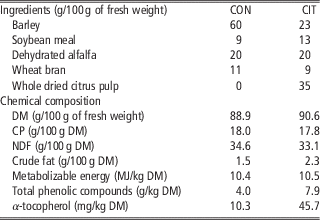
The experiment was conducted from February to May 2012 and the experimental protocol was approved by the European Community under the Seventh Framework Programme for Research, Technological Development and Demonstration Activities (Integrated Project LOWINPUTBREEDS FP7-CP-IP 222623). All the procedures involving animals were conducted by specialized personnel. In total, 17 male Comisana lambs, born within 10 days, were selected. At 90 days of age, lambs were weighed (mean BW 19.12 kg±SD 4.26 kg) and individually penned indoor. Animals were randomly assigned to two dietary treatments and, for 10 days were adapted to the experimental diets. Subsequently, for 56 days, lambs were fed a barley-based concentrate diet (CON – eight animals) or a concentrate-based diet including 35% as-fed whole DCP (including CP, peel and seeds) in partial replacement of barley (CIT – nine animals). The diets were formulated to be isonitrogenous and isoenergetic and no vitamin E (α-tocopheryl acetate or α-tocopherol) was added. The ingredients and chemical composition of the diets are reported in Table 1. All the ingredients were ground (5-mm screen) and mixed to avoid selection. Each day, the diets were given to lambs at 0900 h and the feed was continuously available in the feeders until 1800 h, after which feeders were removed. For each animal, the amount of feed offered and refused was recorded daily. Water was continuously available. The weight of the lambs was recorded weekly at 0800 h before supplying fresh feed.
Ingredients and chemical composition of the experimental diets

CON=control barley-based concentrate diet; CIT=concentrate diet including 35% (as-fed) whole dried citrus pulp; DM=dry matter.
Sampling procedures
Samples of the feedstuffs were collected four times during the trial, finely milled (0.5-mm screen), vacuum-packed and stored at −30°C. A sample of each diet was finally prepared for analyses by mixing equal amounts of the subsamples collected during the trial. Before 3 days of the end of the trial, faeces (~15 g) were collected directly from the rectum of each lamb, vacuum-packaged and stored at −30°C. Before 2 days of slaughtering, after 12 h of fasting, blood (~8 ml) was sampled from the jugular vein of each lamb and collected into a heparin tube. The tubes were kept refrigerated at 4°C, centrifuged for 10 min at 1500×g at 4°C and the plasma was stored at −80°C. At the end of the experiment, lambs were transported to a commercial abattoir and slaughtered. The small intestine (20 cm length) was sampled ~5 cm after the pylorus and stored at −80°C. Samples of liver and of longissimus thoracis et lumborum muscle (~150 g) were collected from the carcasses within 20 min from slaughtering, vacuum-packed and stored at −80°C.
Analyses of feeds
Dry matter (DM) and CP of the experimental diets were determined according to the Association of Official Analytical Chemists (1990) procedures. The NDF was analysed according to Van Soest et al. (Reference Van Soest, Robertson and Lewis1991) and the fat was extracted according to procedure of Folch et al. (Reference Folch, Lees and Stanley1957). The metabolizable energy was calculated using the ‘ASSIST.T’ software, version 1.3.1 developed by CRPA spa, Italy (www.crpa.it/assist). Total phenolic compounds were assessed according to Makkar et al. (Reference Makkar, Blümmel, Borowy and Becker1993) with an extraction from feedstuffs using aqueous acetone (70%, v/v) and a subsequent analysis by Folin–Ciocalteu reagent. Standard solutions of gallic acid (GA) were used to express the phenolic compounds as g of GA equivalents/kg of DM. The procedure described by Schüep and Rettenmaier (Reference Schüep and Rettenmaier1994) was adapted to the measurement of vitamin E (α-tocopherol) in feedstuffs. In brief, feed samples were homogenized with an aqueous butylated hydroxytoluene (BHT) solution (0.06%). Vitamin E was extracted three times using hexane/ethyl acetate, dried under N2 and dissolved with acetonitrile. The analysis was performed using a Perkin Elmer series 200 HPLC (Perkin Elmer, Italia, Milan, Italy), equipped with an autosampler (Jasco, model AS 950-10, Tokyo, Japan) and an Ultrasphere ODS column (250×4.6 mm internal diameter, 5 μm particles size; CPS Analitica, Milan, Italy). The flow rate was 1.5 ml/min and α-tocopherol was identified using a FD detector (Jasco, model FP-1525) set at excitation and emission wavelengths of 295 and 328 nm, respectively). Quantification was based on external calibration curves prepared with varying amounts of pure α-tocopherol (Sigma-Aldrich, Bornem, Belgium) in ethanol.
Measurement of the antioxidant status of liver, plasma and muscle
The radical scavenging and the reducing capacity was measured in plasma and in aqueous extracts from liver and muscle by means of the trolox equivalent antioxidant capacity (TEAC), the ferric reducing antioxidant power (FRAP) and the Folin–Ciocalteu assays in order to measure the contribution of hydrophilic antioxidants to the antioxidant status of the tissues. The liver (0.5 g) and muscle (1 g) were homogenized with 10 ml distilled water, centrifuged at 3000×g for 20 min at 4°C and the supernatant was filtered using Whatman No. 541 filter paper. Plasma was appropriately diluted with distilled water for analyses. The TEAC, FRAP and Folin–Ciocalteu assays were performed using the methods described by Luciano et al. (Reference Luciano, Vasta, Monahan, López-Andrés, Biondi, Lanza and Priolo2011) and López-Andrés et al. (Reference López-Andrés, Luciano, Vasta, Gibson, Biondi, Priolo and Mueller-Harvey2013).
Vitamin E (α-tocopherol) was determined in the lipid fraction extracted from liver, plasma and muscle as a measurement of the antioxidant capacity of the lipophilic fraction. The α-tocopherol in muscle and liver samples was extracted according to Schüep and Rettenmaier (Reference Schüep and Rettenmaier1994) with some modifications, whereas α-tocopherol was extracted from blood plasma according to Zaspel and Csallany (Reference Zaspel and Csallany1983). In brief, liver and muscle (2 g) were homogenized with aqueous BHT (0.06%), saponified with ethanolic KOH (60%) at 70°C for 30 min and extracted with hexane/ethyl acetate (9 : 1, v/v). Plasma (0.5 ml) was saponified in 1 M ethanolic KOH at 50°C for 1 h, sonicated and extracted two times with 4 ml of n-hexane containing BHT (200 mg/l). The extracts were dried under N2 stream and resuspended with acetonitrile. The HPLC analysis of α-tocopherol was performed as described above for feedstuffs.
Lipid oxidation measurements
Lipid oxidation in faeces was measured using the TBARS assay described by Pierre et al. (Reference Pierre, Taché, Petit, Van der Meer and Corpet2003) with modifications as follows. Faecal water was prepared by homogenizing 1.5 g of faeces with 10 ml of cold (2°C) distilled water for 60 s. The homogenates were incubated for 1 h at 37°C with thorough mixing every 15 min. Subsequently, the homogenates were centrifuged for 10 min at 2500×g at 20°C and the supernatant (2 ml) was further centrifuged for 20 min at 20 000×g at 20°C. In glass test tube, 100 µl of supernatant was diluted with 100 µl of distilled water. SDS (200 µl, 8.1%, w/v) and 2 ml of thiobarbituric acid reagent (0.5%, w/v thiobarbituric acid in 10% v/v acetic acid) were added. For each sample, a blank was prepared by replacing the thiobarbituric acid reagent with 2 ml of 10% acetic acid. Samples were incubated at 95°C for 60 min, after which the absorbance was measured at 532 nm.
The TBARS assay described by Siu and Draper (Reference Siu and Draper1978) was adapted to the measurement of lipid oxidation in the small intestine and plasma as follows. The small intestine was dissected longitudinally, rinsed with distilled water and cut finely using a scalpel. The intestine (1 g), was homogenized with 10 ml of cold distilled water (2°C) for 60 s. Then, 10 ml trichloroacetic acid (10%, w/v) was added, samples were vortex-mixed and centrifuged at 3000×g for 20 min at 4°C and the supernatants were filtered using Whatman No. 541 filter paper. In a glass test tube, 1 ml of 0.06 M aqueous thiobarbituric acid was added to 4 ml of filtrate. The samples were incubated at 80°C for 90 min, after which the absorbance was measured at 532 nm. Blood plasma (1 ml) was diluted with 5 ml of distilled water. Trichloroacetic acid (10% w/v, 1.5 ml) was added to 1.5 ml of diluted plasma, after which the samples were mixed and centrifuged at 2500×g for 10 min. The supernatant (2 ml) was placed into a glass test tube and 500 µl of 0.06 M aqueous thiobarbituric acid was added. The samples were mixed and incubated at 80°C for 90 min in a water bath, after which the absorbance was measured at 532 nm. The TBARS assay in liver and muscle was performed following the same procedure described by Inserra et al. (Reference Inserra, Priolo, Biondi, Lanza, Bognanno, Gravador and Luciano2014).
The resistance of muscle lipids to peroxidation was also assessed by incubating muscle homogenates in the presence of the ferric chloride/sodium ascorbate (Fe/Asc) system as catalyst of lipid peroxidation, following the procedure described by Monahan et al. (Reference Monahan, Skibsted and Andersen2005) with modifications. The muscle (12.5 g) was homogenized with 37.5 g cold phosphate buffer (4°C, 50 mM, pH 7.0) and a volume (3 ml) was collected immediately. Then, ferric chloride hexahydrate and l-sodium ascorbate were added at equimolar concentration to the remaining muscle homogenate (45 µM final concentration), which was incubated in a temperature-controlled IKA KS-4000 orbital shaker (IKA-Werke GmbH & Co. KG, Staufen, Germany) set at 37°C and 190 r.p.m. The homogenate (3 ml) was collected after 30 and 60 min of incubation. Each collected aliquot of homogenate was mixed with trichloroacetic acid (3 ml, 10%) and filtered. The clear filtrate was used for the TBARS assay following the same procedure as for liver and muscle. In all the TBARS assays described above, standard solutions of 1,1,3,3,-tetraethoxypropane were used to express the results as µg of malonaldehyde (MDA)/g of faeces, intestine, liver and muscle, or as µg MDA/ml of plasma.
Statistical analyses
The data related to the antioxidant status parameters and lipid oxidation measured in faeces, intestine, liver, plasma and muscle were analysed using a GLM model to test the effect of the dietary treatment (diet: CON or CIT). The data related to the development of lipid oxidation in muscle homogenates incubated in the presence of Fe/Asc were analysed using a GLM mixed model. The fixed factors tested in the model were the diet, the incubation time (time: 0, 30 and 60 min) and their interaction (diet×time), whereas the individual animal was considered a random factor nested with the diet. Post hoc comparisons of the least squares means were performed using the Tukey’s adjustment for multiple comparisons. In all the statistical analyses, the individual lambs were considered as the experimental units and significance was declared for P⩽0.05. The statistical analyses were performed using the software Minitab, version 16 (Minitab Inc., State College, PA, USA).
Results and discussion
Antioxidant status parameters of liver, plasma and muscle
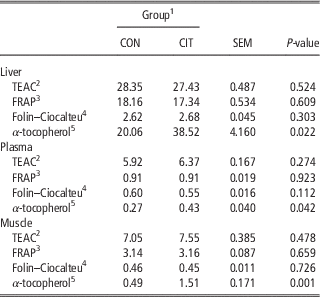
The concentration of phenolic compounds in the DCP used in the present study was 10.87 g GAE eq./kg DM, which is similar to the content of GAE eq./kg reported for whole lemon powder (García-Salas et al., Reference García-Salas, Gómez-Caravaca, Arráez-Román, Segura-Carretero, Guerra-Hernández, García-Villanova and Fernández-Gutiérrez2013). Therefore, it was expected that including 35% DCP in a diet for lambs to partially replace barley could increase the concentration of phenolic compounds in the diet, which was confirmed by the twofold greater concentration of phenolic compounds found in the CIT diet compared with the CON diet (Table 1). Citrus phenolic compounds possess antioxidant activities and their intake with the diet has been suggested to increase the antioxidant capacity of animal tissues. In the light of this, we recently demonstrated that the oxidative stability of the meat from the same lambs used in this study was increased by feeding the CIT diet and we attributed this effect to the presence of flavonoids in the DCP (Inserra et al., Reference Inserra, Priolo, Biondi, Lanza, Bognanno, Gravador and Luciano2014). However, it has been reported that the possible mechanisms explaining the antioxidant effects of dietary citrus flavonoids are far from being clear and several authors suggest that their antioxidant effects in vivo are likely to be overestimated (Khan et al., Reference Khan, Huma and Dangles2014). Regarding the bioavailability of phenolic compounds, it was demonstrated that the muscle from sheep fed rosemary contained several phenolic compounds originally present in the diet and this was associated to a higher overall antioxidant capacity of muscle, measured by FRAP and TEAC assays (Moñino et al., Reference Moñino, Martínez, Sotomayor, Lafuente and Jordán2008). With respect to citrus flavonoids, Bodas et al. (Reference Bodas, Prieto, Jordán, López-Campos, Giráldez, Morán and Andrés2012) demonstrated that naringenin could be detected in the liver from lambs receiving a diet supplemented with 1.5 g/kg naringin. Similarly, Gladine et al. (Reference Gladine, Morand, Rock, Bauchart and Durand2007c) showed that the administration of citrus extract to sheep at 10% of the diet DM resulted in the appearance of naringenin in blood plasma, but had no effect on the radical scavenging activity of plasma, measured with the TEAC assay. The same authors reported that supplementing the diet of rats with either 5 or 0.5 g/kg of citrus extract did not affect the radical scavenging activity of blood plasma, liver and muscle (Gladine et al., Reference Gladine, Morand, Rock, Guffrat, Bauchart and Durand2007a and Reference Gladine, Rock, Morand, Bauchart and Durand2007b). These results are in agreement with those found in the present study in which the assessment of the overall antioxidant capacity of the hydrophilic fraction of blood plasma, liver and muscle showed that feeding CP did not affect the radical scavenging activity and the reducing capacity of tissues, measured with the TEAC, FRAP and Folin–Ciocalteu assays (P>0.05; Table 2). The TEAC, FRAP and Folin–Ciocalteu assays used in the present experiment, and in the above cited studies, are not specific for phenolic compounds and they measure the overall contribution of antioxidant compounds bearing radical scavenging and reducing properties (Niki, Reference Niki2010). In this sense, these assays could detect the presence of absorbed phenolic compounds and/or of their metabolites if these molecules are still able to exert antioxidant activities. Moreover, these tests could indicate if dietary phenolic compounds are able to indirectly improve the overall antioxidant capacity of animal tissues through mechanisms that do not necessarily involve their detectable presence in the tissues. For example, recent studies demonstrated that feeding lambs with fresh herbage or with a plant extract rich in condensed tannins increased the overall antioxidant capacity of liver and plasma measured by the FRAP and the Folin–Ciocalteu assays (López-Andrés et al., Reference López-Andrés, Luciano, Vasta, Gibson, Biondi, Priolo and Mueller-Harvey2013 and Reference López-Andrés, Luciano, Vasta, Gibson, Scerra, Biondi, Priolo and Mueller-Harvey2014). However, the authors reported that no phenolic compounds, nor their metabolites, could be detected in the tissues and concluded that dietary phenolic compounds might be able to improve the antioxidant capacity in vivo through still unknown indirect antioxidant effects. The results obtained in the present study seem to suggest that dietary flavonoids might have not been effective in increasing the antioxidant capacity in the tissues tested. Certainly, it will be important in future studies to test the possible bioavailability of flavonoids when DCP is fed to animals instead of selected flavonoids or purified citrus extracts.
Effect of the dietary treatment on the antioxidant status of liver, plasma and muscle

1 Group CON was fed a control barley-based concentrate diet. Group CIT was fed a concentrate diet including 35% (as-fed) whole dried citrus pulp.
2 Trolox equivalent antioxidant capacity (TEAC). Expressed as µmoles of trolox equivalents/g for liver and muscle, of as µmoles of trolox equivalents/ml for plasma.
3 Ferric reducing antioxidant power (FRAP). Expressed as µmoles of Fe+2 equivalents/g for liver and muscle, or as µmoles of Fe+2 equivalents/ml for plasma.
4 Expressed as mg of gallic acid equivalents (GAE)/g for liver and muscle, or as mg of GAE/ml for plasma.
5 Expressed as µg of α-tocopherol/g for liver and muscle, or as µg of α-tocopherol/ml for plasma.
Among the exogenous antioxidants of dietary origin, vitamin E has been extensively proved to play a major role in protecting animal tissues against lipid peroxidation, with α-tocopherol accounting alone for most of this activity (Burton and Traber, Reference Burton and Traber1990). In the present experiment, α-tocopherol was measured in the lipid fraction extracted from liver, blood plasma and muscle to assess the possible effect of the dietary treatment on the antioxidant status of the lipophilic fraction of the tissues. We found that feeding lambs with the diet containing 35% DCP (CIT) increased the concentration of α-tocopherol in plasma (P<0.05) and resulted in a twofold and threefold greater concentration of α-tocopherol in liver and in muscle, respectively (P<0.05 and P<0.01 for liver and muscle, respectively; Table 2). Mourão et al. (Reference Mourão, Pinheiro, Prates, Bessa, Ferreira, Fontes and Ponte2008) found that the inclusion of 5% or 10% DCP in the diets of broilers did not affect the concentration of α-tocopherol in muscle compared with a conventional cereal-based diet. To our knowledge, no information has been previously reported on the effect of feeding CP to ruminants on the vitamin E concentration in the tissues. In the present study, the experimental diets were not supplemented with vitamin E (α-tocopheryl acetate or α-tocopherol) in order to better appreciate the contribution of DCP to the vitamin E content of the formulated diet. The higher concentration of α-tocopherol found in liver, plasma and muscle from lambs fed the CIT diet were at least partially due to the greater concentration of α-tocopherol in the CIT diet compared with the CON diet, consequent to the partial replacement of barley with DCP (Table 1). Indeed, the α-tocopherol content of the DCP included in the CIT diet was 80.7 mg/kg, whereas barley contained 12.2 mg/kg. Very scarce information is available on the content of fat-soluble compounds, such as vitamin E, in CP. However, it should be considered that seeds are removed during the production of citrus juice and, together with peel and pulp, are a component of DCP. It has been reported that citrus seeds can contain remarkable concentrations of essential fatty acids, such as linoleic and α-linolenic acids, whereas noticeable concentrations of α-tocopherol can be found in the unsaponifiable matter of the seed oil (Fontanel, Reference Fontanel2013). For example, we recently demonstrated that replacing barley with 24% and 35% whole DCP in concentrate-based diets for lambs resulted in a higher intake of fat and fatty acids (Lanza et al., Reference Lanza, Scerra, Bognanno, Bognanno, Buccioni, Cilione, Biondi, Priolo and Luciano2015), which demonstrates that DCP may represent a dietary source of fat-soluble compounds.
Resistance to lipid oxidation
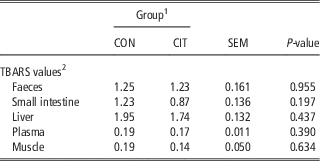
Studies on the antioxidant effects of dietary phenolic compounds suggest a possible direct antioxidant activity exerted in the gastrointestinal tract, such as the reduction of lipid peroxidation, which would result in an overall improvement of the animal antioxidant status (Kerem et al., Reference Kerem, Chertrit, Shoseyov and Regev-Shoshani2006). Moreover, antioxidant effects in the gastrointestinal tract might be obtained by increasing the intake of vitamin E (Halliwell et al., Reference Halliwell, Rafter and Jenner2005). In the present study, the inclusion of 35% DCP in the diet increased the concentrations of both phenolic compounds and α-tocopherol of the diet and, therefore, the amounts of these compounds reaching the gastrointestinal tract of the lambs compared with the CON diet. We have measured the extent of lipid oxidation in the small intestine and in the faeces to assess possible antioxidant effects of DCP exerted in the gastrointestinal tract. The results obtained showed that lipid oxidation (TBARS values) in the small intestine and in the faeces was not affected by the dietary treatment (P>0.05; Table 3). These results can be partially explained considering that the diets supplemented to the lambs were not expected to promote lipid peroxidation, as we did not supplement the diets with readily oxidizable fatty acids or with pro-oxidant compounds. Indeed, most of the studies demonstrating effects of the diet on the lipid oxidation in the intestine or in the faeces have been conducted using monogastric animals, such as rats, which were generally subjected to factors inducing oxidative stress including, for example, feeding diets rich in haem iron or in fat and oxidized fatty acids, or diets simulating antioxidant deficiency (Lindley et al., Reference Lindley, Goss-Sampson, Muller and Milla1994; Pierre et al., Reference Pierre, Taché, Petit, Van der Meer and Corpet2003).
Effect of the dietary treatment on lipid oxidation (TBARS values) measured in small intestine, faeces, liver, plasma and muscle

1 Group CON was fed a control barley-based concentrate diet. Group CIT was fed a concentrate diet including 35% (as-fed) whole dried citrus pulp.
2 Expressed as µg of malonaldehyde (MDA)/g for small intestine, faeces, liver and muscle, or as µg MDA/ml for plasma.
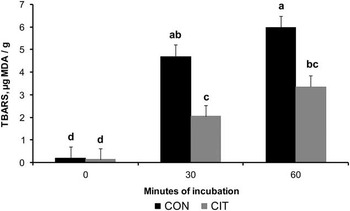
In the present study, it was hypothesized that possible effects of citrus antioxidants in the gastrointestinal tract, together with their absorption and delivery to the liver, plasma and muscle could have increased the resistance of these tissues to lipid oxidation. We found no effect of the dietary treatment on the extent of lipid oxidation (TBARS values) measured in liver, plasma and muscle (P>0.05; Table 3). In the case of citrus phenolic compounds, it has been demonstrated that adding a citrus extract to diets enriched in highly oxidizable fatty acids reduced the extent of lipid peroxidation in the liver and plasma of rats (Gladine et al., Reference Gladine, Morand, Rock, Guffrat, Bauchart and Durand2007a and Reference Gladine, Rock, Morand, Bauchart and Durand2007b). The same authors included 10% of citrus extract in the diet of sheep which were made highly susceptible to lipid oxidation already by continuous infusion of linseed oil into the duodenum (Gladine et al., Reference Gladine, Morand, Rock, Bauchart and Durand2007c). This experimental design allowed to generate an oxidative challenge already in vivo and the authors reported that citrus extract increased the resistance of plasma lipids to oxidation. Once again the fact that, in the present study, animals were not subjected to conditions promoting lipid peroxidation could partially explain why an effect of feeding CP on lipid oxidation was not observed in liver, plasma and muscle collected from the animals and immediately stored at −80°C without being subjected to further oxidative stresses until analyses. Nevertheless, using the same animals of the present experiment, Inserra et al. (Reference Inserra, Priolo, Biondi, Lanza, Bognanno, Gravador and Luciano2014) demonstrated that the CIT diet reduced the susceptibility to lipid oxidation of muscle, which could be appreciated when meat was stored for 6 days at 4°C. Therefore, in the present study, we also assessed the resistance of muscle lipids to oxidation by incubating muscle homogenates in the presence of Fe/Asc as catalyst for inducing lipid peroxidation (Monahan et al., Reference Monahan, Skibsted and Andersen2005). We found that TBARS values dramatically increased with time of incubation in the presence of the catalyst (P<0.001; Figure 1). Moreover, the dietary treatment affected the TBARS values measured over the incubation time and a significant diet×time interaction was found (P<0.01). Indeed, as shown in Figure 1, although the TBARS values did not differ between the CON and CIT treatments at the beginning of the incubation, the muscle from lambs fed with the CIT diet exhibited lower TBARS values compared with the CON treatment after 30 and 60 min (P<0.01). These results confirmed those reported by Inserra et al. (Reference Inserra, Priolo, Biondi, Lanza, Bognanno, Gravador and Luciano2014) and demonstrate that the inclusion of CP in a concentrate-based diet for lambs is able to improve the resistance of muscle to lipid oxidation under pro-oxidant conditions. In the light of the results found for the antioxidant status parameters measured in muscle, it can be stated that, in the present study, the positive effect of DCP on the resistance of muscle lipids to oxidation could be explained by the higher deposition of α-tocopherol in muscle from the animals fed the CIT diet compared with the CON treatment. Indeed, it has been widely demonstrated that the concentration of vitamin E in muscle plays a major role in protecting lipids from oxidation and some authors were able to develop models to predict the development of lipid oxidation in meat based on the levels of vitamin E in muscle (Sales and Koukolová, Reference Sales and Koukolová2011). In the present study, we found no correlation between the α-tocopherol content in the muscle and the TBARS value at the start of the incubation in the presence of Fe/Asc catalyst, whereas a negative correlation was evident with the TBARS values measured after 30 min (−0.61; P<0.01) and 60 min (−0.55; P=0.01).
Interactive effect of the dietary treatment (CON and CIT) and of the time of incubation (0, 30 and 60 min) on the TBARS values in muscle homogenates incubated with the ferric chloride/sodium ascorbate system. Values presented are the least squares means with standard error bars. Diets were as follows: control barley-based concentrate diet (CON); concentrate diet including 35%, as-fed, dried citrus pulp (CIT). a,b,c,dIndicate differences between mean values (P<0.05). MDA=malonaldehyde.

Conclusions
Despite the fact that flavonoids are generally considered the main antioxidants in citrus fruits, the results of this study lead to the conclusion that α-tocopherol plays the major role in the improvement of the antioxidant capacity of muscle from lambs fed diets supplemented with DCP. The greater concentration of α-tocopherol found in the liver, plasma and muscle from lambs fed CP compared with the control treatment could be explained in the light of the higher concentration of α-tocopherol in the CIT diet. This result was rather unexpected, as there is no information on the effects of feeding CP to ruminants on the concentration of α-tocopherol in the animal tissues.
Certainly, further research should clarify the antioxidant effect of dietary CP in ruminants. Indeed, the chemical composition of CP can greatly vary depending on several factors. For example, the whole CP can undergo further processing before drying to obtain essential oils and seed oil, thus reducing the content of potential antioxidants in the final product destined to animals. Therefore, it would be necessary to study different available CP in order to standardize its application in livestock feeding and to optimize the positive effects on meat quality.
Acknowledgements
The authors gratefully acknowledge funding from the European Community financial participation under the Seventh Framework Programme for Research, Technological Development and Demonstration Activities, for the Integrated Project LOWINPUTBREEDS FP7-CP-IP 222623. The views expressed in this publication are the sole responsibility of the authors and do not necessarily reflect the views of the European Commission. Neither the European Commission nor any person acting on behalf of the Commission is responsible for the use which might be made of the information contained herein.