Introduction
An examination of contemporary armed conflicts shows that belligerents are often supported in their military operations by one or more third parties. The involvement of these third parties can vary in terms of the form and intensity of the support given: direct involvement in the conduct of hostilities, logistical assistance, or financial or political support. The intervening parties may be States, acting on their own or in coalition with other States, or supranational organizations with or without a United Nations (UN) mandate. The parties receiving support may be governments or non-State armed groups, depending on the goals pursued by the intervening power(s).
The legal position of the International Committee of the Red Cross (ICRC) on the notion of armed conflict involving foreign intervention refers only to situations in which the foreign intervention has a bearing on the application of international humanitarian law (IHL). This article does not, therefore, cover situations involving foreign intervention in support of a party to an international armed conflict (IAC), because these situations raise no specific legal issues concerning the determination of the applicable IHL rules. In such cases, the application of IHL is clear: all the different relationships between belligerents are governed by the law of IAC. This article is concerned only with situations in which foreign intervention is a component added into a pre-existing non-international armed conflict (NIAC).
It does not, however, cover all forms of direct and indirect foreign intervention in a pre-existing NIAC. Situations involving financial or political support are not included, as this type of assistance has no bearing on the application of IHL.
A look at recent conflicts shows that there are numerous examples of the types of situations examined in this article.Footnote 1 Despite the frequency with which such situations occur, there remains some uncertainty when it comes to determining the law applicable to them. It may seem, at first glance, that these armed conflicts are in a grey area of IHL, with no specific rules applicable to them. They may also appear not to fit into the traditional IAC/NIAC dichotomy established in this body of law, casting doubt on the nature and scope of the legal framework governing them.
This difficulty in assessing armed conflicts involving foreign intervention raises the possibility of them being considered a third category of armed conflict,Footnote 2 in addition to the traditional categories of IAC and NIAC. Such an interpretation of the law would be problematic in that it would open the door to a definition of the applicable legal framework based on a subjective choice of rules,Footnote 3 or to an overly idealistic approach to the application of IHL.Footnote 4
For the ICRC, armed conflicts involving foreign intervention do not form a third category of conflicts, but merely constitute a specific manifestation, in a particular context, of an IAC, a NIAC or both types of conflict simultaneously. The notion of armed conflict involving foreign intervention therefore fits perfectly well into the traditional IAC/NIAC dichotomy established by IHL.
The rules applicable to IACs and NIACs can be transposed to armed conflicts involving foreign intervention, because such situations are merely a form of IAC or NIAC; the rules of IHL are sufficiently flexible to govern such situations effectively and to deal with any humanitarian issues arising from them.
In light of these considerations, the ICRC's position is based on three key points:
-
1. The components of the notion of armed conflict involving foreign intervention are clearly defined. The ICRC's position identifies the various relationships between belligerents stemming from the notion of armed conflict involving foreign intervention and specifies the situations that are excluded.
-
2. The rules of IHL applicable to the various situations covered by the notion of armed conflict involving foreign intervention are determined. The ICRC confirms the choice of a fragmented approach for this purpose, based on the factual relationships between the belligerents and the traditional criteria for determining the existence of an armed conflict established in the relevant provisions of IHL. The ICRC's position therefore specifies how the various situations should be classified, qualifying them as an IAC, a NIAC or, in some cases, a conflict with dual IAC-NIAC classification, in which the laws governing both types of armed conflict apply in parallel. Based on a factual assessment of the situation, using the traditional criteria for establishing the applicability of IHL, armed conflicts involving foreign intervention are classified under the classic IAC-NIAC dichotomy. This same classification is used to identify the applicable legal framework (law of IAC, law of NIAC or both), which determines the terminology used to qualify the situation.
-
3. The term “internationalized internal armed conflict”, a source of confusion in the determination of applicable IHL, will no longer be used. It quite wrongly suggests a blanket application of the law of IAC in such situations, which is contrary to the fragmented approach described above. It could also give the impression that these situations form a third category of armed conflicts. The ICRC now uses new terminology consistent with the IHL applicable to the situations in question.
Types of situation covered by the notion of armed conflict involving foreign intervention
Types of intervention covered by the ICRC's position
In order to define the scope of application of the ICRC's position as precisely as possible, the notion of armed conflict involving foreign intervention must first be analyzed.
“Internationalized internal armed conflict” was the term used by the ICRC for many years to refer to situations in which one or more third States intervened in a pre-existing armed conflict affecting all or part of the territory of a given State. While this criterion remains valid, it is important to identify the characteristics of foreign intervention more precisely.
As explained in the introduction to this article, contemporary armed conflicts are increasingly characterized by the intervention of third parties in support of one or more of the parties to the conflict.Footnote 5 Such interventions, which vary in form and intensity, generally consist of military, financial, logistical or political support. However, not all types of intervention by a third party in support of one or more of the belligerents are taken into account in the ICRC's position on the concept of armed conflict involving foreign intervention. While political and/or financial support provided by third parties to the belligerents might have implications in terms of the law of international responsibility,Footnote 6 this type of assistance has no bearing on the applicability and application of IHL to the situation in question. Support of this kind is not therefore taken into account in the ICRC's position, which only covers foreign intervention that actually affects the applicability of IHL. Military or logistical support provided by third parties to one of the parties to a pre-existing conflict can, on the other hand, influence the application of IHL – and therefore falls within the scope of application of the ICRC's position – if it is considered as contributing to the collective conduct of hostilities.
In some cases, the support provided by a third power is an action integrated into a military operation conducted by the party to the pre-existing conflict and is therefore considered an “act of war”. Such an act must be regarded as an integral part of the pre-existing NIAC. Therefore, actions such as logistical support involving the transportation of the troops of one of the belligerents on the front line, the provision of intelligence used immediately in the conduct of hostilities and the involvement of members of the third power in planning and coordinating military operations conducted by the supported party are all types of support that fall within the scope of application of the ICRC's position – in the same way as direct involvement by the intervening power in combat operations does – because they have a bearing on the applicability ratione personae and ratione materiae of IHL. In the ICRC's view, a third power supporting one of the belligerents can be regarded as a party to the pre-existing NIAC when the following conditions are met: (1) there is a pre-existing NIAC taking place on the territory where the third power intervenes; (2) actions related to the conduct of hostilities are undertaken by the intervening power in the context of that pre-existing conflict; (3) the military operations of the intervening power are carried out in support of one of the parties to the pre-existing NIAC; and (4) the action in question is undertaken pursuant to an official decision by the intervening power to support a party involved in the pre-existing conflict.
According to this support-based approach, the nature of the intervening power's involvement in the pre-existing NIAC could mean that it is considered a “co-belligerent”, making it a party to the conflict. When there is a close link between the action of the intervening power and the pre-existing NIAC, the assessment can be made on the basis of the nature of the support provided rather than on the traditional criteria for determining the existence of a NIAC, which will already have been met for the pre-existing conflict.
It is important to note that this approach, which takes into account the support provided to one of the parties to a pre-existing NIAC, complements, but does not replace, the test for determining the application of IHL based on the traditional criteria established in this body of law.Footnote 7 It also prevents a situation in which powers making an effective contribution to military operations and undeniably involved in the collective conduct of hostilities in the context of a pre-existing NIAC can avoid being considered as parties to the conflict and therefore claim protection from direct attacks on their armed forces, under the pretext that the intensity of the armed violence has not reached the required threshold.
The ICRC therefore draws a distinction based on the nature of the internationalization of the conflict. It distinguishes between internationalization in the factual sense of the term (manifestation of a foreign intervention, whatever the form or extent) and internationalization that has a bearing on the applicability of IHL ratione personae (intervening power becomes a party to the conflict) or, depending on the circumstances, alters the scope of application of IHL ratione materiae (extension of the legal framework when application of the law of IAC – including occupation law, where relevant – is triggered).
The ICRC's position also takes into consideration the diversity of intervening powers, extending the circle to cover international and regional organizations. International organizations are increasingly involved in military operations to assist one or more parties already involved in an armed conflict. In recent years, the UN (in the Democratic Republic of the Congo (DRC)), NATO (in Afghanistan and Libya) and the African Union (in Somalia) have been directly involved in both international and non-international armed conflicts. The particular status of international and regional organizations under public international lawFootnote 8 means that they must be considered – through their subsidiary organs, which are the missions they deploy on the ground (such as MONUSCO,Footnote 9 the UN mission in the DRC, and ISAF,Footnote 10 the NATO mission in Afghanistan) – parties to the international or non-international armed conflict,Footnote 11 if the criteria for determining that IHL applies to them are met.
Lastly, it is important to note that situations in which there is no objective link between foreign intervention in the territory of a third State and a pre-existing armed conflict in that territory are not included in the scope of the ICRC's position, as the notion of armed conflict involving foreign intervention presupposes the existence of such a link. Such situations occur when a third power intervenes in a territory where a pre-existing NIAC is in progress, but not in support of one of the parties and without exercising overall control over a non-State party, or when it intervenes in a territory where there is no conflict taking place.Footnote 12
Similarly, spillover NIACs that extend into the territory of one or more neighbouring States, with the express or tacit consent of the government(s) concerned,Footnote 13 are not covered by the ICRC's position on the notion of armed conflict involving foreign intervention, unless a third party intervenes in the pre-existing armed conflict.Footnote 14
In short, the ICRC's position covers foreign intervention by one or more States, a coalition of States or an international or regional organization that become a party to a pre-existing conflict as defined by IHL.
Different forms of foreign intervention covered by the ICRC's position
Situations covered by the ICRC's position on the notion of armed conflict involving foreign intervention are those in which a factual link can be established between the intervention of one or more third powers and the pre-existing or concomitant armed conflict. This link can take two possible forms.
Foreign intervention in support of one of the parties to a non-international armed conflict
Foreign intervention can take place with a view to providing support to one of the parties to the conflict. Very often, this support (which can be regarded as a form of “co-belligerency”) consists of pooling military resources with one of the parties to the pre-existing or concomitant armed conflict in joint military operations aimed at weakening or neutralizing the adversary. Collaboration of this kind sometimes calls for the establishment of military coordination arrangements, consisting of common structures or platforms or even, at their most advanced, an integrated chain of command. However, the intervening power's support is not always so readily apparent. It may be military action of a more unilateral nature, although the purpose is the same: to weaken the military resources of a party to the conflict for the benefit or on behalf of the adversary. The key issue is to assess whether the military action of the third party in the prevailing circumstances can be reasonably and objectively interpreted as action designed to support one of the parties to the conflict to the detriment of the other. If it can, this military action will effectively be considered part of the collective conduct of hostilities by the intervening power and the supported party against the enemy. It would therefore clearly be considered support as defined by the ICRC's position.
Foreign intervention in the form of overall control over one of the parties to a non-international armed conflict
The link between the intervention of one or more third parties and the armed conflict is stronger when the intervening power exercises some sort of control over the supported party. In some conflict situations, foreign intervention involves exercising significant and progressive control over one of the parties to a pre-existing armed conflict. Most commonly, it is over an insurgent non-State party in a pre-existing NIAC that control is exercised by a third party.Footnote 15 One such example was the conflict in the former Yugoslavia in the 1990s, when the Serbian government exercised control over certain armed groups fighting in the NIACs taking place in Bosnia and Croatia. This kind of control entails a relationship of subordination between the non-State party and the intervening power.
In order to determine the existence of such a relationship of subordination, it must be proved that the non-State party is indeed acting on behalf of the intervening power. A link must therefore be established between the actions of the non-State party and the intervening power for those actions to be legally regarded as being committed directly by the latter. The question of attribution thus plays a major role – if the actions of the non-State party can be attributed to the intervening power,Footnote 16 the relationship of subordination is thereby established.
Attribution, which is the process of establishing a link between an act and the individual or entity deemed to have carried it out, is particularly complicated in the case of collective entities such as States and international organizations, which must necessarily act through individuals. The second step in this process, after establishing who carried out the act (or series of acts), is to determine whether the individual or group of individuals concerned discharges a function within the collective entity. If this is the case, the acts of the individual or individuals can be interpreted as being those of the entity itself.Footnote 17 Applied to the situations covered by the ICRC's position, the concept of attribution will help to reveal the extent of the relationship between the non-State party and the intervening power and play a crucial role in establishing whether the members of the non-State armed group can be considered agents of the latter, which will have legal implications, particularly with regard to the classification of the situation under IHL. Attribution ensures that the intervening power is prevented from hiding behind a proxy to avoid its international obligations and responsibilities under IHL and from refusing to be considered a party to the conflict.Footnote 18
IHL is silent on the issue of attribution. It does not contain any specific criteria for establishing that an armed group initially perceived to be acting independently in a pre-existing NIAC is, in fact, subordinate to a third power, which would turn the conflict into an international one.Footnote 19 The only reference to such a relationship of subordination is to be found in Article 4A(2) of the Third Geneva Convention of 1949, but it describes it in a factual way, without defining the legal conditions for establishing that a group of individuals forming an organized militia or resistance movement within the scope of this provision ultimately “belongs” to an intervening third power.Footnote 20 As there is no specific test under IHL for establishing whether a non-State armed group “belongs” to a third power, one must refer to the general rules of public international law, which help to determine when and under what conditions private individuals (including members of non-State armed groups) are ultimately held to be acting as de facto agents of a third power.
In this regard, international law on responsibility and the developments therein concerning attribution offer suitable solutions that can be transposed to IHL. To all intents and purposes, the test for determining a connection between a non-State party and a third power for the purpose of classifying a conflict under IHL – just like under the international law on responsibility – involves attributing actions carried out by an individual or a group of individuals to a bearer of international obligations (a State or international organization).Footnote 21
The International Law Commission (ILC),Footnote 22 international courts such as the International Court of Justice (ICJ), the International Criminal Tribunal for the former Yugoslavia (ICTY), the International Criminal Court (ICC) and the European Court of Human Rights,Footnote 23 and doctrineFootnote 24 have also established that the question of attribution linking the acts of a de facto entity to an intervening outside power is determined by the notion of control. As Stefan Talmon so rightly points out, “the question of whether or not an act of a secessionist entity can be attributed to an outside power thus becomes a question of how one defines ‘control’”.Footnote 25 International courts called on to examine this question initially interpreted the concept of control in different ways when it came to attributing the actions of a non-State party to a third power. The different tests put forward, such as effective control and overall control, became the subject of a doctrinal debate.
International jurisprudence and doctrine have long wavered between the stricter effective control option favoured by the ICJ in a decision rendered in 1986,Footnote 26 and the broader notion of overall control espoused by the ICTY in 1999.Footnote 27 In its judgment of 17 July 1999 on the Tadić case, the ICTY held that:
In order to attribute the acts of a military or paramilitary group to a State, it must be proved that the State wields overall control over the group, not only by equipping and financing the group, but also by coordinating or helping in the general planning of its military activity. Only then can the State be held internationally accountable for any misconduct of the group. However, it is not necessary that, in addition, the State should also issue, either to the head or to members of the group, instructions for the commission of specific acts contrary to international law.Footnote 28
The notion of overall control does not therefore refer simply to monitoring or checking, but also requires the exercise of some form of authority over the entity in question. There is no question, however, that the concept of authority referred to is broader and more general than the issuing of orders, and refers rather to general direction and coordination.
The recent case law of international courts displays a clear tendency towards applying the overall control test for the purpose of classifying armed conflicts.
The ICTY was clearly the forerunner in this area, as it was in its cases that the concept of overall control was first developed.Footnote 29 This approach was later followed by the ICC, whose Pre-Trial Chamber and Trial Chamber used the overall control test in the Lubanga case. The Pre-Trial Chamber made it clear that “where a State does not intervene directly on the territory of another State through its own troops, the overall control test will be used to determine whether armed forces are acting on behalf of the first State”.Footnote 30 Some years later, the ICC Trial Chamber echoed the analysis of the Pre-Trial Chamber in its judgment of 14 March 2012, in which it stated that:
As regards the necessary degree of control of another State over an armed group acting on its behalf, the Trial Chamber has concluded that the ‘overall control’ test is the correct approach. This will determine whether an armed conflict not of an international character may have become internationalised due to the involvement of armed forces acting on behalf of another State.Footnote 31
Lastly, in its decision of 26 February 2007, the ICJ expressly stated that the notion of overall control could be used to determine the legal characterization of a situation under IHL: “Insofar as the ‘overall control’ test is employed to determine whether or not an armed conflict is international, … it may well be that the test is applicable and suitable.”Footnote 32
The ICRC has consistently opted to apply the overall control criterion for the purpose of determining the legal classification of a conflict situation under IHL when there seemed to be a close connection, if not a relationship of subordination, between a non-State party and a third power. The reason for this choice is that the notion of overall control takes better account of the reality of the relationship between the non-State armed group and the third power, in that it does not imply that the armed group is not subordinate to the State if specific instructions are not issued for every belligerent act. Additionally, the overall control test is particularly useful because it assesses control over the non-State party as a whole, thereby allowing its overall actions to be attributed to the intervening foreign power. This is wholly consistent with the classification of armed conflicts in IHL, whereby the overall actions carried out by persons participating in organized armed violence are objectively assessed based on criteria established by the rules of this body of law.Footnote 33
The option chosen by the ICRC is therefore in line with recent international jurisprudence of the ICJ, the ICTY and the ICC.Footnote 34
The use of the notion of control for determining applicable IHL has a decisive legal impact, because the non-State party becomes subordinate to the intervening third power. In the eyes of international law, the members of the non-State armed group become agents of the third power. In terms of IHL application ratione personae, this means that the intervening power entirely substitutes the non-State party and becomes itself a party to the pre-existing armed conflict instead of the non-State armed group.Footnote 35 The link between the foreign intervention and the pre-existing armed conflict – whether it takes the form of support given to one of the parties to the armed conflict or overall control over that party – is the crucial element that places an armed conflict involving foreign intervention within the scope of the ICRC's position.
It is important to note, in this regard, that the timing of the support given by one or more intervening powers can vary. The intervention generally takes place once the NIAC is in progress, but it can also coincide with the outbreak of the conflict, although this is more uncommon. The vast majority of armed conflicts involving foreign intervention fall into the first category. Some examples are MONUSCO in the DRC (from 2008) and NATO operations in Libya (2011) and Afghanistan (from 2003).
Foreign intervention resulting in control over the non-State party is less common, although not exceptional, as evidenced by the situations observed in the former Yugoslavia between 1992 and 1996.
The different relationships between belligerents covered by the ICRC's position on the notion of armed conflict involving foreign intervention are as follows:
-
• State party v. non-State party;Footnote 36
-
• State, coalition of States or international or regional organization intervening in support of the State party v. non-State party;
-
• State party v. State, coalition of States or international or regional organization intervening in support of the non-State party;
-
• State party v. State, coalition of States or international or regional organization exercising overall control over the non-State party;
-
• State, coalition of States or international or regional organization intervening in support of the State party v. State, coalition of States or international or regional organization intervening in support of the non-State party or exercising overall control over it.
The ICRC and the rules of IHL applicable to armed conflicts involving foreign intervention
As the question of determining IHL applicable to armed conflicts involving foreign intervention is open to controversy, the ICRC has undertaken to clarify how IHL is applicable to this type of conflict.
For the ICRC, determining the applicable law involves the objective application of the traditional criteria for armed conflict to the facts on the ground. On this question, both the prevailing doctrineFootnote 37 and international jurisprudenceFootnote 38 have consistently maintained that armed conflicts should be classified based on an assessment of the facts in light of the conditions established for IACs in Article 2 common to the four Geneva Conventions and Article 1 of Additional Protocol I (AP I) of 1977, and for NIACs in Article 3 common to the four Geneva Conventions and Article 1 of Additional Protocol II (AP II) of 1977.Footnote 39 In connection with the Boškovski case, the ICTY noted the following:
Consistent with this approach, Trial Chambers have assessed the existence of armed conflict by reference to objective indicative factors of intensity of the fighting and the organisation of the armed group or groups involved depending on the facts of each case.Footnote 40
The ICRC proposes a fragmented approach to the determination of applicable law. It has used this approach consistently for this purpose in numerous cases involving different types of armed conflict. The approach consists of determining applicable IHL by examining each bilateral relationship between belligerents separately in light of the facts on the ground. This fragmented approach reflects the current state of the law, as it has been validated by the ICJFootnote 41 and reaffirmed by the ICTYFootnote 42 and more recently the ICC. In the Lubanga case, the Pre-Trial Chamber of the ICC specified that
an internal armed conflict that breaks out on the territory of a State may become international – or, depending on the circumstances, be international in character alongside an internal armed conflict – if i) another State intervenes in that conflict through its troops (direct intervention) or if ii) some of the participants in the internal armed conflict act on behalf of that other State (indirect intervention)”.Footnote 43
Most of the doctrine also supports this approach.Footnote 44
This fragmentation in the application of legal regimes according to the parties involved in the armed conflict means that applicable IHL – law of IAC, law of NIAC or both – depends on the nature of the different bilateral relationships, as identified above, that can exist between belligerents in an armed conflict. In other words, according to this fragmented approach, when different types of actors – State and non-State – are involved in the same conflict, the rules of IHL applicable to them vary depending on the nature of the relationship that each belligerent has with each of the others. When a State party is engaged in military activities against one or more non-State parties, the relationship is governed by the law of NIAC. If this same State is also fighting against another State in the context of that same conflict, their relationship will be governed by the law of IAC. Accordingly, the direct intervention of a third State in support of one or more non-State parties does not internationalize all the relationships between the parties to the conflict, and the law of IAC does not apply to all the actors involved in that conflict. In this case, the intervention of a third power is a separate component added onto the pre-existing NIAC, leading to a situation in which there are two armed conflicts, different in nature, existing concurrently with each other in the same territory.Footnote 45
This fragmented approach, supported by most of the jurisprudence and doctrine,Footnote 46 responds to the need to adopt a method that results in a legal outcome more consistent with the reality of the conflict on the ground. It has the advantage of being precise, because by focusing on the bilateral relationships, it takes better account of the nature of the parties to the conflict and their ability to implement the relevant provisions of IHL. Furthermore, the fragmented approach tends to preserve the coherence of the legal system established under IHLFootnote 47 and avoids negative responses from States and international organizations, which are always averse to the idea of applying the law of IAC to their relationships with non-State armed groups.
In summary, the fragmented approach has the twofold advantage of being accepted by States and international organizations – which have also opted for a differentiated approach to the application of IHL in armed conflicts involving foreign intervention – and of resulting in a practical outcome that is more consistent with the realities of contemporary armed conflicts.
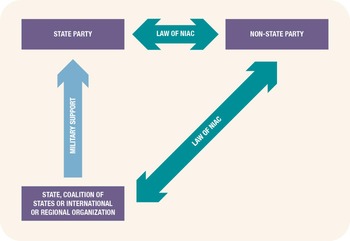
Law applicable in the case of foreign intervention in support of the State party
Pursuant to the fragmented approach described above, the ICRC considers that when a foreign power intervenes in support of the State party, the law of NIAC applies. The belligerent relationship between the State party and the non-State party is governed by the law of NIAC, as is the belligerent relationship between the intervening foreign power and the non-State party.
In accordance with the fragmented approach described above, the situation referred to here therefore covers the following two belligerent relationships:
-
• State party v. non-State party;
-
• State, coalition of States or international or regional organization intervening in support of the State party v. non-State party.
As explained above, the applicability of IHL to the relationships between belligerents identified in the context of foreign intervention in support of the State party is determined – as it is for relationships between the parties in “traditional” armed conflicts – with reference to the classic criteria for NIAC pursuant to common Article 3 and Article 1 of AP II.
The legal framework governing the situation described above is therefore as follows: common Article 3, AP II (provided that the State party has ratified the Protocol and the conditions of applicability are met) and customary law of NIACs will be applicable to the belligerent relationship between the State party supported by the intervening power on one side and the non-State party on the other.Footnote 48
Foreign intervention does not therefore alter what IHL applies (it is still the law of NIAC); it simply extends the scope ratione personae to include the party intervening in support of the State party, regardless of whether that party is a multinational force,Footnote 49 a State or a coalition of States.
Relationships between the parties to the conflict and the IHL applicable in this scenario.

The main reasons for rejecting the option of applying the law of IAC in such situations include the following.
First, common Article 2 implies that the law of IAC only applies when the armed conflict is between at least two entities possessing international legal personality, be it a conflict between two States or between one State and a coalition of States. On the other hand, when the conflict is between an entity with international legal personality and a non-State armed group with no legal status under international law, the law that applies is that of NIAC.
Second, a blanket application of the law of IAC would not be an acceptable solution for the State party or for the powers intervening to assist it, because the implementation of the relevant rules would mean them having to grant members of the non-State armed groups combatant and prisoner-of-war status (provided that the established criteria were met), and that in itself would make it impossible for them to be prosecuted for the mere fact of having taken up arms. It is quite inconceivable that States would be willing to renounce the possibility of dealing with individuals taking part in armed uprisings under domestic law.
Third, application of the law of IAC would require not only State parties and intervening States but also non-State parties to fulfil the relevant IHL obligations. IHL is intended to be a realistic and pragmatic body of law based on the principle of effectiveness. It is therefore pointless to impose on a party to a conflict obligations that the party cannot fulfil because it does not have the means to do so. The law of IAC was designed to be applied by States possessing logistical means that the vast majority of non-State armed groups simply do not have. Making the whole of IHL applicable de jure to non-State armed groups incapable of complying with its provisions would render those provisions meaningless and prevent them from fulfilling the purpose for which they were crafted. Systematic failure to respect a body of law spells its demise; it is therefore much more realistic to require non-State armed groups to implement the more basic provisions established in the law of NIAC.
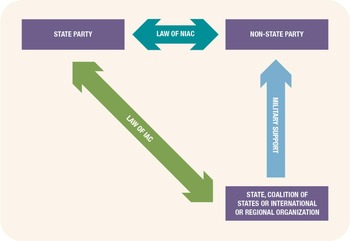
Law applicable in the case of foreign intervention in support of a non-State party
In this scenario, the ICRC considers that when a foreign power intervenes in support of a non-State party, the law of NIAC and the law of IAC apply in parallel. The belligerent relationship between the State party and the non-State party is governed by the law of NIAC, while the belligerent relationship between the State party and the intervening foreign power is governed by the law of IAC.
In accordance with the fragmented approach described above, the scenario referred to here therefore covers the following two belligerent relationships:
-
• State party v. non-State party;
-
• State party v. State, coalition of States or international or regional organization intervening in support of the non-State party.
It is here that the full significance of the fragmented approach advocated by the ICRC can be appreciated, as such situations give rise to the application of a composite legal framework including both the law of IAC and the law of NIAC.
As explained above, the applicability of IHL to the relationships between belligerents identified in the context of foreign intervention in support of the non-State party is determined with reference to the classic criteria pursuant to common Article 2 and Article 1 of AP I (for IACs) and the criteria drawn from common Article 3 and Article 1 of AP II (for NIACs). If foreign intervention in support of the non-State party involves the occupation of territory, Article 42 of the Regulations annexed to Hague Convention IV of 1907 (complemented by paragraph 2 of common Article 2) provides the criteria for determining whether occupation law applies to the situation in question.Footnote 50
Relationships between the parties to the conflict and the IHL applicable in this scenario.

Therefore, pursuant to the fragmented approach, the belligerent relationship between the State party and the non-State party will be governed by the law of NIAC and, at the same time, the belligerent relationship between the State party and the foreign intervening party will be governed by the law of IAC. The legal framework governing the NIAC situation will be common Article 3, AP II (provided that the State party has ratified the Protocol and the conditions of applicability are met) and customary law relating to NIACs. The IAC situation existing alongside the NIAC will be governed by treaty law and customary law relating to IACs (including occupation law, where relevant), specifically the provisions of the Geneva Conventions, AP I and the Regulations annexed to Hague Convention IV of 1907.
The involvement of UN-mandated multinational forces as an intervening party in no way modifies the determination of IHL applicable to these situations. The same approach is used as in armed conflicts in which there is foreign intervention by a State or coalition of States without a UN mandate.
Lastly, in practical terms, this fragmented approach will have little impact in terms of the law of the conduct of hostilities, because the vast majority of the IHL treaty-based rules applicable in IACs are also generally accepted as applying in NIACs as a matter of customary law. The status of detainees is, however, a different matter.Footnote 51 The fragmented approach means that the legal rules applicable to persons captured and detained in the context of the belligerent relationship between the State party and the non-State party are not the same as those applicable to persons captured and detained in the context of the belligerent relationship between the State party and a State, a coalition of States or an international or regional organization intervening in support of the non-State party.Footnote 52
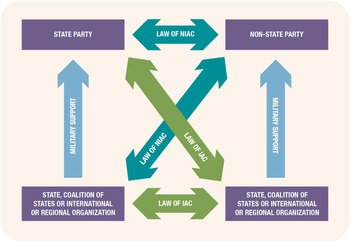
Law applicable in the case of foreign intervention in support of both the State party and the non-State party
In this scenario, the ICRC considers that when foreign powers intervene in support of both the State party and the non-State party, the law of NIAC and the law of IAC apply in parallel:
-
• The law of NIAC governs the belligerent relationship between the State party and the non-State party and the belligerent relationship between the foreign power intervening in support of the State party and the non-State party.
-
• The law of IAC governs the belligerent relationship between the State party and the foreign power intervening in support of the non-State party and the belligerent relationship between the foreign power intervening in support of the State party and the foreign power intervening in support of the non-State party when the criteria for international armed conflict are satisfied for both belligerent relationships.
Relationships between the parties to the conflict and the IHL applicable in this scenario.

The scenario referred to here is a combination of the situations examined above:
-
• State party v. non-State party;
-
• State party v. State, coalition of States or international or regional organization intervening in support of the non-State party;
-
• Non-State party v. State, coalition of States or international or regional organization intervening in support of the State party;
-
• State, coalition of States or international or regional organization intervening in support of the State party v. State, coalition of States or international or regional organization intervening in support of the non-State party.
An example of such a case is the situation in the DRC in 1998–99, when the FARDCFootnote 53 were supported by Angolan, Namibian, Chadian and Zimbabwean forces in a NIAC against a rebel group known as the Rally for Congolese Democracy, which received military support from Burundian, Ugandan and Rwandan forces. In this situation, the law of IAC governed the relationships between the States allied with the State party (Angola, Namibia, Chad and Zimbabwe) and the States allied with the non-State party (Burundi, Uganda and Rwanda).
As explained above, a belligerent relationship between two or more entities with international legal personality is governed by the law of IAC. Consequently, the belligerent relationship between the State party and a power intervening in support of the non-State party and the relationships between the intervening powers are governed by the law of IAC. In accordance with the fragmented approach described above, the belligerent relationships existing correlatively between the State party and the non-State party and between the non-State party and the power intervening in support of the State party are, however, governed by the law of NIAC.
Relationships between the parties to the conflict and the IHL applicable in this scenario.

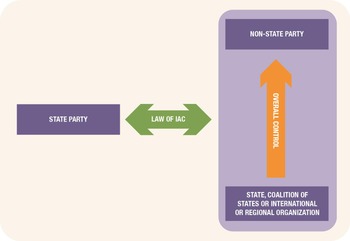
Law applicable in the case of foreign intervention resulting in control over the non-State party
In this scenario, the ICRC considers that when foreign intervention in support of the non-State party results in a situation in which the intervening foreign power exercises control over it, the law of IAC alone applies. The belligerent relationship between the State party and the non-State party disappears, and the only belligerent relationship remaining is the one between the State party and the intervening foreign power.
In accordance with the fragmented approach described above, the scenario referred to here therefore covers the following belligerent relationship:
-
• State party v. State, coalition of States or international or regional organization exercising overall control over the non-State party.
The ICRC therefore considers that, in the event of foreign intervention resulting in overall control over the non-State party by the intervening power, it is the law of IAC that applies.
In this scenario, the initial support provided by the intervening power turns into control over the non-State party.Footnote 54
As explained above, since IHL does not provide its own criteria for the notion of control, it is necessary to look to public international law (particularly developments in the law of responsibility) in order to determine whether a non-State armed group is acting on behalf of a third party. If it is established that such control does exist, the acts of the non-State armed group can be attributed to the intervening party.
Under this specific hypothesis, when the control exercised can be legally qualified as “overall control”, the non-State armed group is considered to have been “absorbed” by the foreign intervening power and to have become its agents under public international law. The intervening power therefore substitutes the non-State party, becoming the single party engaged in armed conflict against the government forces of the territory in which the military operations are taking place.
As the members of the non-State armed group are considered agents of the intervening power because they are under its control, the law of IAC will govern the relationship between the State party and the intervening power, now the only party fighting the government forces. The initial NIAC between the State forces and the non-State party turns into an IAC.
The law of IAC applicable in such cases is to be found in the Geneva Conventions of 1949, AP I (when the conditions of applicability are met) and customary law relating to IACs.
This legal framework also includes occupation law (Regulations annexed to Hague Convention IV of 1907, the Fourth Geneva Convention and AP I), when the third State exercises overall control over a non-State armed group or groups exercising effective control over a given territory.Footnote 55
Terminology used by the ICRC to refer to armed conflict situations involving foreign intervention
The term “internationalized internal armed conflict” is misleading, as it blurs the fundamental distinction between IACs and NIACs established in IHL. It might seem to suggest that a single legal framework – the law of IAC – applies to such situations or that they constitute a third category of armed conflict for which the applicable legal framework is uncertain.
As the legal reality is otherwise, the ICRC has chosen to use terms that are consistent with the IHL applicable to the various situations covered by the notion of armed conflict involving foreign intervention.
Based on this, the ICRC considers that armed conflict involving foreign intervention is simply a manifestation, in a particular context, of an IAC, a NIAC or both in parallel, depending on the specific circumstances.
Therefore, when a foreign power intervenes in favour of the State party against the non-State party, the ICRC classifies the situation as a NIAC, because the law of NIAC alone applies.
As the aim is to align the terminology with applicable law, these situations will henceforth be considered by the ICRC to be NIACs, and not internationalized NIACs, as only the law of NIAC is applicable. While it is true that this new designation gives no indication that the NIAC involves foreign intervention, it is, legally speaking, more accurate, in the sense that the applicable legal framework is clearly identified from the outset, without the determination being clouded by ambiguities about the scope of application of IHL ratione materiae inherent in the concept of internationalized internal armed conflict.
When a foreign power intervenes in support of a non-State party over which it does not have overall control, the ICRC classifies the situation as an “armed conflict with a double legal classification”, as the law of IAC and the law of NIAC apply in parallel in accordance with the fragmented approach advocated by the ICRC.
It was in relation to this situation in particular that the ambiguity created by the term “internationalized internal armed conflict” was particularly troublesome, because it misleadingly gave the impression that the law of IAC applied to the entire situation, ignoring the fragmented approach described earlier in this article.
When foreign powers intervene in support of the State party and in support of a non-State party over which the foreign power does not exercise overall control, the ICRC also classifies the situation as an “armed conflict with a double legal classification”, as the law of IAC and the law of NIAC apply in parallel in accordance with the fragmented approach advocated by the ICRC.
This new terminology will also be applicable when support given to the non-State party results in occupation of the territory where the armed conflict is taking place. As occupation is a form of IAC and occupation law is itself a branch of the law of IAC, effective control of the territory by the intervening power following on from the support provided to the non-State party therefore fits in perfectly with the concept of an armed conflict with a dual legal classification, provided that this effective control over the territory does not also entail overall control over the rebel forces.
Lastly, when the State party is in conflict with an intervening foreign power exercising overall control over a non-State armed group, the ICRC classifies the situation as an IAC, as the law of IAC alone applies. The situation qualifies as a state of “occupation” if foreign intervention accompanied by overall control over the non-State armed group results in effective control over all or part of the territory in question.
The position also draws inferences, with regard to the terminology to be adopted, from the notion of overall control and its implications in terms of applicable IHL.
When the non-State party is legally absorbed by the foreign power because it is considered to be under its overall control, the only two parties remaining in the conflict are the intervening foreign power and the State party. Such situations are therefore classified as IACs, with any other classifications becoming superfluous.
However, when non-State armed groups under the overall control of the intervening foreign power exercise effective control over all or part of the territory concerned, occupation law applies. Based on this and for the sake of accuracy and consistency between the terminology and applicable IHL, the situation is classified as occupation.