Introduction
Present study
The purpose of this study is to identify the perceptions of 80 Korean university students majoring in English about sociocultural elements embedded in the Korean language and KVE. A secondary objective is to enhance students’ awareness of the connection between culture and language and some of the unique sociocultural characteristics of these two languages. To this end, all participants took part in a 3-part classroom activity in which they examined pairs of KVE and Korean sentences, translated both KVE and Korean sentences, and took part in small focus group discussions. Specifically, the study has two research questions:
1) What sociocultural aspects of KVE and Korean did the participants identify?
2) What reasons did participants identify for these sociocultural aspects?
Englishes today
Since the postmodern era, the status of today's Englishes has been theoretically discussed and framed within several models by many ELT scholars and practitioners – terms often used are: World English(es) (Brutt–Griffler, Reference Brutt–Griffler2002; Kachru, Reference Kachru, Quirk and Widdowson1985; Kubota, Reference Kubota and Matsuda2012; Matsuda, Reference Matsuda2003; Rajagopalan, Reference Rajagopalan2004), English as an international language (McKay, Reference McKay2003; Modiano, Reference Modiano1996), English as a family of languages (Canagarajah, Reference Canagarajah2006), English as a lingua franca (Jenkins, Reference Jenkins2000, Reference Jenkins2006), and English as an intercultural language (Green & Lee, Reference Green and Lee2016; Sifakis, Reference Sifakis2004). Although each of the models is slightly different from each other in its classifications (or labeling) of Englishes, the foundation for each model of English reflects the current realities of Englishes and clearly identifies the following paradigm:
(1) Englishes today are heterogeneous languages with multiple norms and grammars that focus on the varieties people speak and use for actual communication (Canagarajah, Reference Canagarajah2006; Kubota, Reference Kubota and Matsuda2012);
(2) they are ‘multicultural’ in that speakers of more than one country and culture are almost always involved (Jenkins, Reference Jenkins2006), naturally creating ‘interculturally multidialectical users of Englishes’ nourished from/within intercultural knowledge, skills, and attitudes (Green & Lee, Reference Green and Lee2016);
(3) they become ‘descriptive’ in how they function today for ‘communication’ throughout the world (Sifakis, Reference Sifakis2004), not prescriptive in how the language should be used (Jenkins, Reference Jenkins2000; McKay, Reference McKay2003); and,
(4) they accommodate the active roles exerted by users of Englishes as ‘agents’ (Jenkins, Reference Jenkins2006) in the spread and sophistication of Englishes since they are contributing to the shaping of the language and the functions it fulfills and so, as speech communities, take possession of the language (Brutt–Griffler, Reference Brutt–Griffler2002; Rajagopalan, Reference Rajagopalan2004).
This paradigm certainly advocates an active investigation of Englishes used in any sociolinguistic/sociocultural context.
English in South Korea
Both the impact of English on the Korean language and the use of English in South Korea (hereinafter Korea) have been researched by many. From high school English textbooks, Baik and Shim (Reference Baik and Shim1998) report that English loanwords have become increasingly prevalent, more so than Chinese character loanwords, and that those English loanwords that have penetrated the Korean language via an indirect source (i.e., Japanized loanwords) have been replaced by Korean renditions of the original English words from more direct contact between Korean and English. Woo (Reference Woo2001) finds that more than 78% of all the loanwords from the textbooks used by Korean primary schools (1st, 2nd, 3rd and 4th grades) are from English.
Shim (Reference Shim1994) identifies an extensive use of Korean-English code-mixing and code-switching – indicating an ever-increasing amount of the Englishization of Korean. She finds viable Korean-English bilingual communities constantly emerging, and most younger Koreans (aged 15 to 45) are able to pronounce such English phonemes as /f/ and /v/, which are not present in Korean phonology, and that at least 50% of the younger generation are bilingual (Korean-English). Shim (Reference Shim1999) again investigates the use of English in many Korean middle- and high-school textbooks and detects some lexico-semantic, morpho-syntactic, and pragmatic aspects of English. Koreans, as many believe, have mainly learned American English, but she claims that a substantial portion of what is learned and tested in those textbooks is different from American English. Those different lexico-semantic, morpho-syntactic, and pragmatic aspects of English become a ‘codified variety of Korean English [which] now serves as the endonormative standards for English education in Korea’ (p. 247).
Most recently, Rudiger (Reference Rudiger2014) detects some more emerging idiosyncratic patterns of English from lexical and morpho-syntactic aspects. She adds that ‘ … these emerging patterns could be possibly traced back to substrate language influence, i.e., influences the Korean language has on the English spoken in Korea’ (p. 13). In addition, McPhail (Reference McPhail2018) suggests that KVE should find social legitimacy among its members, as opposed to the lack of prestige attached to its under its former name, Konglish.
Previous studies
A number of previous studies have examined sociocultural aspects of both Korean and KVE. With regards to Korean, Whitman (Reference Whitman2017) reports that, ‘Korea has been under such an intense influence throughout history, especially from China, that in lots of ways the most important legacy of Korean culture is its language and its unique writing system’ (p. 1), a statement that highlights the importance of examining sociocultural aspects of the language. Several studies (Jendraschek, Reference Jendraschek2009; Lee, Reference Lee1996; Suh, Reference Suh and Kim1978) conclude that honorification, which manifests itself in the use of pronouns, titles, speech styles, and lexicon, is a major sociocultural component of the Korean language. According to Jendraschek (Reference Jendraschek2009), ‘Lexical and grammatical choices are determined by social status, age, and (in some cases) gender’ (p. 15).
Moen (Reference Moen2009) looks at the Korean EFL classrooms and maintains that, ‘Korean grammar reinforces Confucian hierarchies by using grammatical endings based on Confucian relationships’ (p. 3). In addition, the use of lexicons in both English and Korean that express emotions, as well as the practice of using personal names in English as opposed to in Korean, are mentioned as examples of how linguistic practices have cultural manifestations.
Regarding aspects of socioculture reflected in both Korean and KVE, Chang (Reference Chang2010) examines several characteristics of Korean and English through an analysis of word connotations, syntactic differences, and terms of address. Specific linguistic factors identified in the study include the use of honorifics in Korean, which the author maintains, ‘stems from the Confucian value of respecting others and humbling oneself’ (p. 136); the use of ‘our’ in Korean as opposed to ‘my’ in English, possibly representative of collectivist/individualistic values; differences in responses to yes/no questions, which could represent a self/other orientation; differences in connotation between Korean terms and their English equivalents (e.g. gohyang/hometown); and syntactic differences (e.g., the omission of personal nouns and pronouns in Korean).
Kim (Reference Kim and Kim1978) investigates 27 levels of emotion expressed in English and Korean. Although the study identifies a number of similarities between the two languages, it notes several differences. These include the use of more words that express sadness and an overlapping of the concepts of shyness and shame in Korean.
Of note is the fact that none of these studies have examined students’ perceptions of the socioculture reflected in Korean and KVE.
Methods
The purpose of this study is to identify the perceptions of university students in Korea about sociocultural aspects of Korean and KVE through their participation in an EFL classroom activity. The study attempts to answer the following research questions:
1) What sociocultural aspects of Korean and KVE did the participants identify?
2) What reasons did participants identify for these sociocultural aspects?
The study also aims at raising the awareness of participants to the connection between language and socioculture and ways in which socioculture is specifically reflected in both Korean and KVE. By means of focus group discussions following the classroom activity, the study examines what aspects of socioculture participants identified when comparing pairs of Korean and English sentences and translating Korean and English sentences. The participants were also asked to hypothesize about the possible reasons for these sociocultural aspects.
Participants
Eighty English majors at a public university located in a southern province of Korea took part in the study; 75 participants were undergraduate students (18 sophomores, 33 juniors, and 24 seniors), and 5 participants were graduate students. There were 44 female participants and 36 male participants. During the implementation of this study, all participants were enrolled in one of four courses offered by the English Department of the university. The study was conducted by a bilingual speaker of English and Korean and a native English speaker, who was the instructor of these courses.
Research design and procedures
In a classroom setting, all participants took part in an activity called What's in a Sentence? (see Appendix). The activity had three parts. In Part One, the participants were put in small groups and asked to examine five pairs of English and Korean sentences that had similar meanings. All sentences in this section had been written by the researchers. Participants were then asked to discuss the following questions: Do you notice any differences in grammatical structure or word usage that might represent the different sociocultural values of those using the languages? If so, what are these differences? What do you think the differences mean? In Parts Two and Three, the participants were asked to translate sentences from English to Korean and vice versa, compare their translations with other students, and hypothesize about how differences in sociocultural values might have influenced their translations. Specifically, they were asked to discuss the following questions: Were your translations the same as your partner(s)? If not, how and why do you think they were different? If they were different, do you think there are any differences that have to do with sociocultural values represented in the two languages?
Following the completion of each part of the activity, the instructor asked all students to take part in focus group discussions. In these focus group discussions, the participants reported the findings of their small groups. The instructor asked all participants to elaborate on their findings and express additional opinions related to the activity questions. The instructor took notes and the participants’ responses were recorded; the participants were informed beforehand that their comments would be recorded and confidential. All the discussions were held in English.
Data analysis
Following the completion of the classroom activity, transcripts of the recordings were made; these transcripts and notes taken during the focus group discussions were then reviewed and coded by the native English researcher before being reviewed by the bilingual researcher. This process ensured a measure of triangulation. In the process of coding, the following three steps were followed: description, analysis, and interpretation (Glesne, Reference Glesne2006). The researchers did not rely on a pre-assigned coding system in order to more accurately identify themes which emerged from the data and were not pre-determined or prejudiced by the researchers’ interpretations or expectations. In addition, special attention was paid to themes directly identified by the participants that related to sociocultural aspects of both languages and the possible reasons for those aspects, but symbolic interaction, ethnographic, and critical theory themes were also taken into account (Bogdan & Biklen, Reference Bogdan and Biklen2007).
Findings
Participants’ responses during activity
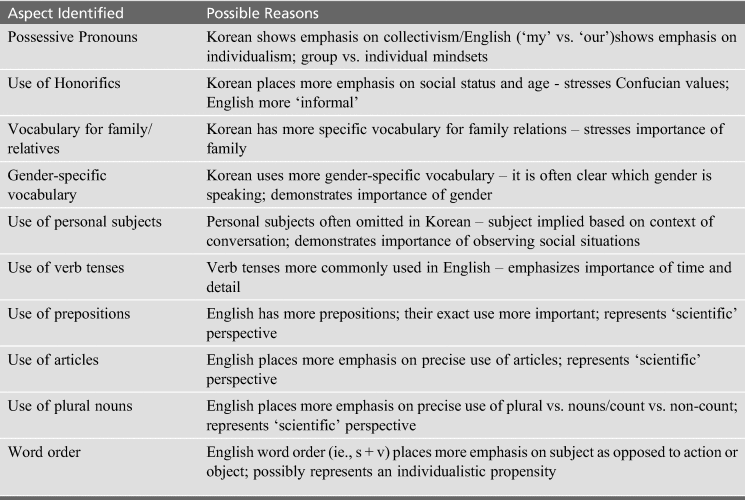
The participants identified ten differences between Korean and English that they felt might be representative of socioculture (Table 1). The most commonly identified linguistic aspect was the difference in use of possessive pronouns – specifically, in the use of ‘my’ in English versus ‘our’ (우리) in Korean. Examples given from the activity were: my/our family, my/our country, and my/our school. The explanation given for this difference was an emphasis on such sociocultural value/norms as ‘collectivism’ in Korean as opposed to the concept of ‘individualism’ in English-speaking countries.
Sociocultural Aspects Identified by Participants

Also identified was the use of honorifics in Korean. Ten students spoke about the fact that they used different ‘levels of politeness’ when translating the sentences. When asked their perceptions of this aspect, the most common response was the belief that Koreans place more emphasis on social status or age. In the words of one participant, ‘When I talk to someone older in Korean, or like my parents, I should have respect. So I must speak politely’ [sic]. When speaking English, three students stated that it isn't as important to take into consideration social status or age when speaking to someone.
Participants also expressed the opinion that there is more vocabulary used for family members or relatives in Korean than in English. The opinion that this was due to the family-oriented socioculture of Korean society was given by five students. One participant stressed that family relationships are accorded particular significance in Korea, adding, ‘and it's complicated.'
A sociocultural aspect identified in two classes was related to the use of more gender-specific terms in Korean than in English. In the words of one participant, ‘When I see a sentence in Korean, I sometimes can know if a man or woman is talking. But I usually can't in English.’ When asked what significance this has related to culture, four participants stated their opinion that this shows the importance of gender roles in Korean society.
The more explicit use of personal subjects in English than in Korean was also mentioned as another possible sociocultural aspect. Five participants noted that personal subjects (e.g., I, you) are often not used in Korean whereas they are rarely omitted in English. For this, two participants stated that in Korean the subject is usually embedded on the context of the conversation, so there is no need to use the subject. One participant hypothesized that this difference signifies the importance of observing social situations in Korea and the need to make inferences as opposed to the need to ‘be more exact’ in English.
The more explicit and specific use of verb tenses, prepositions, articles, and plural versus singular nouns in English than in Korean were also identified. Regarding verb tenses, two participants stated that the notion and expression of time is more important when speaking English. ‘To me, it seems that English speakers are more concerned about being accurate with time,’ said one participant. Two participants stated the perception that English places more emphasis on the precise use of prepositions. One of these participants expressed the belief that this is related to ‘the scientific thinking’ prevalent in Western cultures. Similar opinions were given about the use of articles and plural versus singular nouns in English.
A final aspect identified was the difference in word order and sentence structure between English and Korean. This comment was made by one graduate student (‘I'm not sure, but I think English and Korean sentence order tells us something about culture.’) This student went on to hypothesize that English sentence structure puts more emphasis on the person or thing doing the action and Korean sentence structure emphasizes the object and/or action more. When asked the reason for this observation, the participant replied that this might represent a more individual-oriented sociocultural emphasis in English.
In the course of the focus group discussions, a number of other themes emerged. In Parts Two and Three of the activity, several students noted that some vocabulary was the same in Korean and English (e.g., ice coffee, computer). One participant also noted that there are several words (e.g., talent) that come from English but have a different meaning when used in KVE. Finally, several participants talked about the difficulty they had in translating several words and expressions from Korean to English that had sociocultural connotations or were related to feelings.
Discussion and conclusion
The results of this study indicate that, through the act of identifying several sociocultural aspects of both Korean and KVE, the participants’ awareness of the relationship between language and culture was enhanced. The fact that the participants identified ten specific sociocultural aspects reflected in both Korean and KVE illustrates that they were able to articulate their perceptions of how socioculture is embedded within language. In addition, there is evidence that the activity promoted a consideration of KVE, the concept of loanwords, and the difficulty in translating several sociocultural concepts. It is hoped that this study serves as an encouragement for ELT educators interested in promoting similar concepts in their classrooms.
Although this was not a sociocultural linguistic study per se, the findings also provide insight to those interested in discovering the specific ways in which sociocultural concepts are represented in language. In this study, which compared the Korean and English languages, both lexical and grammatical characteristics were identified. The two most commonly mentioned characteristics were the use of personal pronouns and the use of honorifics. These qualities appeared to be the most obvious to the participants. Two lexical qualities, related to vocabulary for family and gender, were the second most commonly mentioned. Grammatical characteristics, such as the use of personal subjects, verb tenses, prepositions, articles, nouns, and word order, were also mentioned, although not as frequently.
With an awareness of how elements of socioculture are intrinsically embedded in language, individuals can not only become more cognizant of the concept of World Englishes but also be empowered to use localized varieties of English as a means of conveying their own sociocultural values and make more enlightened decisions regarding their use of the language.
Appendix
Handout for What's in a Sentence?
Part One – Look at the pairs of English and Korean sentences below. Although they may not be literal translations of each other, they are meant to represent similar ideas. Do you notice any differences in grammatical structure or word usage that might represent the different cultural values of those using the languages? If so, what are these differences? What do you think the differences mean?
1) My father works in an international trading company.
우리아버지는 국제무역회사에서 일하십니다.
2) There are many things I like about my country.
나는 우리나라에 대하여 좋아하는 것들이 많이 있습니다.
3) Where do you live?
어디 사십니까?
4) This is my brother.
이 사람이 우리 형입니다.
5) I put the dishes on the table.
식탁에 그릇을 놓았다.
Part Two – Translate the following sentences from English to Korean and then compare your translations to another student's. After that, discuss the questions below with your partner.
1) How do you know that guy?
2) My family's been living in my hometown for many generations.
3) Would you like a cup of ice coffee?
4) My sister knows a lot about computers.
5) She had a cold so she couldn't come to class.
Were your translations the same? If not, how and why do you think they were different? Looking at your translations, are they exactly the same (grammar, vocabulary, word order. etc.) as the original English text? If not, do you think there are any differences that have to do with different cultural values represented in the two languages?
Part Three – Translate the following sentences from Korean to English and then compare your translations to another student's.
1) 우리 학교 선배들은 영어를 잘 한다.
2) 이 곰탕은 좀 싱겁다.
3) 마음이 좀 찹잡하다.
4) 탤런트가 되고 싶어요.
5) 그 남자의 마음이 왔다 갔다 한다.
Again, were your translations the same? If not, how and why do you think they were different? Looking at your translations, do you think they are exactly the same (grammar, vocabulary, word order. etc.) as the original Korean text? If not, do you think there are any differences that have to do with different cultural values represented in the language?
 PROF. KANG–YOUNG LEE holds a PhD in English linguistics and pedagogies from Korea University, Korea. He achieved an MA in both journalism and English (American literature) from Southern Illinois University, Carbondale, USA, and a BA in English from the same university. He is now a head professor in the General English Language Teaching dept. at Chungbuk National University, Korea. His primary research interests lie in English language pedagogies and English as an intercultural language (EIcL). He has been the author of several papers concerning EicL, its politics, and its implications for ELT classrooms in some internationally-renowned journals. Email: kangyounglee@chungbuk.ac.kr.
 PROF. RANDY GREEN received his PhD in curriculum and instruction from Indiana State University, Terre Haute, Indiana and has over 35 years of teaching and administrative experience in the ESL/EFL field. He is currently an associate professor in the English Department at Gyeongnam National University of Science and Technology (GNTECH), Jinju, Korea as well as the Associate Dean of GNTECH's International Exchange and Language Education Program. Previously, he served as the Associate Director of International Student Services and the Director of INTERLINK Language Center at Indiana State University. His academic interests include English as an intercultural language, World Englishes, critical pedagogy, and sociocultural linguistics. Email: rgreen@gntech.ac.kr.