Background
The Boston Globe Spotlight report on concurrent and overlapping surgery in October 2015 spurred a national debate on this practice and examination of existing policies.Reference Abelson, Saltzman and Kowalczyk 1 While some argued that leaving a patient in the hands of a trainee while the attending surgeon operated in another room was an unacceptable risk to patient safety,Reference Mello and Livingston 2 others argued that with appropriate precautions, overlapping surgery (OS) provided greater patient access to care and enhanced training without jeopardizing surgical outcomes.Reference Guan, Karsy and Brock 3 The only existing public regulations at that time were based on billing rules: the Centers for Medicare and Medicaid Services (CMS) permitted some overlap of surgical procedures as long as the teaching (billing) physician was “physically present” for the “critical portions” of the procedure. In these rules, the definition of critical portions is determined by the surgeon (“that part [or parts] of a service that the teaching physician determines is (are) a critical or key portion”). 4
After this story broke in the national media, the American College of Surgeons (ACS) updated a section of their Statement on Principles to guide surgeons more precisely through the intricacies of OS. 5 This section defined concurrent and overlapping surgery and clearly indicated that “concurrent surgery,” when critical portions of two procedures overlap, was “inappropriate.” This update also provided potentially acceptable OS scenarios, elaborated on key terms used in CMS billing language (e.g., “critical portions,” “immediately available,” “backup surgeon,” “physically present”), and stated the need for patient-surgeon transparency about overlapping cases.
Since this report was released, there has been no assessment of whether and how hospitals have implemented these recommendations from the SFC. In order to assess the national response to both this report and the attention of the national media, we contacted hospitals across the country and evaluated their OS policies and informed consent documents. The purpose of our study was to examine the presence of policies, determine what aspects of the SFC recommendations were implemented, and assess variations in these policies.
Given the concern of patient safety and questions of inappropriate reimbursement, the U.S. Senate Finance Committee (SFC) investigated this issue in 2016. The Committee asked 20 unidentified teaching hospitals to create and share their policies surrounding OS. 6 After evaluating these policies in comparison with the ACS recommendations and definitions, the committee urged all hospitals to make policies specifically prohibiting concurrent surgery, regulating OS, and increasing transparency with patients (Table 1). Regarding critical portions, the report indicated that while many hospitals used the ACS definition (“…those stages when essential technical expertise and surgical judgment are necessary to achieve an optimal patient outcome”), 7 a substantial number “have developed, or expect to develop, lists of procedures, generally by surgical department, of the critical components, most of which also identify the procedures and patient conditions where overlapping surgical procedures are not appropriate,” 8 and recommended that all hospitals follow the latter pathway.
2016 Senate Finance Committee Report on Concurrent and Overlapping Surgery Patient Safety Recommendations 16

Since this report was released, there has been no assessment of whether and how hospitals have implemented these recommendations from the SFC.
In order to assess the national response to both this report and the attention of the national media, we contacted hospitals across the country and evaluated their OS policies and informed consent documents. The purpose of our study was to examine the presence of policies, determine what aspects of the SFC recommendations were implemented, and assess variations in these policies.
Methods
We generated a list of hospitals based on the U.S. News and World Report (USNWR) “Top Hospitals” rankings as of April 2018 9 : we included all top 20 hospitals as well as the top hospital in each state if not already in the top 20. Because hospitals receiving coverage in the national media might have a unique perspective on this issue, we additionally conducted a media search for articles on concurrent/overlapping surgery between October 2015 and April 2018 and included any hospitals receiving media attention that were not already on our list. We used online information and/or telephone calls to hospital departments to identify the Chair of Surgery, Director of Perioperative Services, and Chief Compliance Officer for each hospital, and contacted these individuals via email and/or phone call between April and August 2018 and requested a 10-minute phone call regarding OS policies with them or a designee. Non-responders were re-contacted up to three times. Hospital representatives were given the option of sharing policy documents via secure file transfer, or if they refused this, discussing the details of their policies in a structured phone interview with study personnel. All hospitals were assured that data collected would remain confidential and results would only be published in aggregate. For hospitals that did not respond, study personnel searched for policies or consent forms published online and included these in the study data. Data were abstracted from documents or interviews and entered into a secure REDcap electronic data collection form (www.projectredcap.org).Reference Harris, Taylor and Thielke 10
We defined a “concurrent or overlapping surgery policy” as a document or part of a document that included regulations for situations in which an attending surgeon is responsible for two overlapping procedures. For each hospital, we assessed the following:
-
1. Adoption of the five recommendations from SFC Report [Table 1]
-
2. Definitions of the key terms “immediately available” and “backup surgeon” and “physically present”
-
3. Descriptions of specific medical or surgical conditions (e.g., comorbidities) that would preclude overlap (a concept introduced by the SFC Report)
-
4. Explicit discussion of permissibility of surgeon’s moving back and forth between overlapping cases
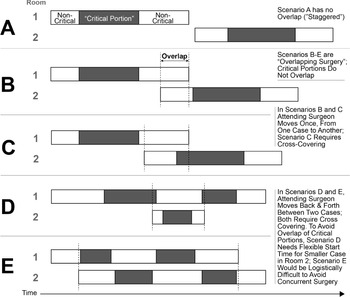
Regarding the latter, it is theoretically possible that two cases could have multiple, staggered overlapping portions between them or that during an intervening non-critical portion between two critical portions of a longer case, a teaching surgeon might leave the room to complete a small procedure in another room (e.g., biopsy) before returning to the prior room for the next critical portion to begin [Figure 1]. 11 However, the language of CMS seems to imply that critical portions occur only centrally within a surgical procedure (“In the case of surgery, the teaching physician’s presence is not required during opening and closing of the surgical field”). 12 This is echoed by the two scenarios described by the ACS, neither of which include returning to the prior operating room:
“The first and most common [overlapping surgery] scenario is when the key or critical elements of the first operation have been completed, and there is no reasonable expectation that the primary attending surgeon will need to return to that operation… The second and less common scenario is when the key or critical elements of the first operation have been completed and the primary attending surgeon is performing key or critical portions of a second operation in another room.” (emphasis added) 13
In the latter example, a “backup attending” would need to be identified. It is theoretically possible that this backup attending system could be used to allow a surgeon to complete staggered critical portions in two rooms with more substantial overlap, such as in Figure 1, scenarios D or E. This might still be in the spirit of CMS regulations if the procedures in question included periods of obvious non-criticality (e.g., awaiting intraoperative pathology or transitioning between distinct procedures in a multi-part operation). These latter scenarios would make the most efficient use of surgeon time, and for that reason we investigated whether they would be permissible at hospitals.
Diagrams of example overlapping surgery scenarios
Black bars represent the “critical portions” of procedures, during which the attending surgeon must be present, whereas the white areas represent the “non-critical portions” that may be handled by a trainee without attending presence in appropriate circumstances. Scenario A shows two rooms with no overlap (“staggered”). Scenarios B and C represent the two overlapping scenarios described by the ACS (see text); scenario C requires a “backup attending” because some of the non-critical portion of the case in room 1 overlaps with the critical portion of the case in room 2. The greater degree of overlap allows the second room to end incrementally earlier through scenarios A-C. Scenarios D and E represent hypothetical scenarios not described by the ACS where one attending moves back and forth between two cases, but is always present for the intermittent, critical portions of each. These scenarios involve substantial overlap and therefore increase efficiency of surgeon time, but would require a backup attending and careful planning to ensure primary attending presence for critical portions of each case. Scenario D would require some flexibility as to when the second, small case (e.g., a biopsy) was started to ensure that timing would be appropriate; scenario E would be the most difficult to avoid inadvertent overlap of critical portions (and therefore becoming “concurrent surgery”).

We provided participating hospitals with an advance copy of our results prior to publication, and all policies sent to us were destroyed upon publication. The Vanderbilt University Medical Center IRB approved this research.
Results
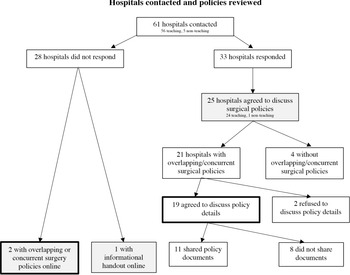
In total, we identified and contacted 61 hospitals (58 from the USNWR rankings and 3 additional from media reports; Figure 2). Of these 61, 33 responded (54%), and 25 agreed to discuss their policies with us, although two of these 25 agreed only to disclose the presence of a policy and declined to provide any further details. Online search identified policies from two additional hospitals and an informational handout discussing policy for one additional hospital, for a total of 28 hospitals with policy information. These 28 hospitals were located in 22 states and ranged from smaller private institutions to large public hospitals (Figure 2).
Flowchart of hospital participants
Grayed boxes indicate the 28 hospitals that served as a data source for this paper. Bold outline boxes indicate the data sources for policy detail analysis (19 of these 21 had policy details and permitted some overlapping surgery; see text and table).

Presence of a Policy
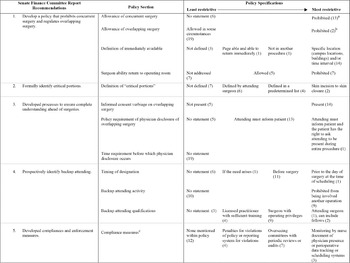
Twenty-four of the 28 responding hospitals (86%) had overlapping or concurrent surgery policies. For one hospital, we were able to review only an educational handout describing its policy of concurrent surgery prohibition. Two other hospitals completely prohibited both concurrent and overlapping surgery, and two refused to discuss anything other than the existence of a policy, leaving 19 hospitals that permitted OS and provided policy details. These 19 hospitals included only 1 identified via media search. The variations of these policies and their adoption of SFC recommendations are summarized in Figure 3 and reported below. Of note, 13 of the 19 policies (68%) explicitly prohibited concurrent surgery.
Policy adoption of SFC recommendations
*An additional hospital had an educational handout which indicated concurrent surgery was prohibited at that institution.
**Data from these two hospitals that prohibited overlapping surgery is not included elsewhere in this figure as it does not apply.
***Because some hospitals had multiple compliance ensuring measures, the total data here will exceed19.

Attending Regulation
Of the policies we reviewed from the hospitals permitting OS, most (16/19, 84%) policies defined “immediately available,” with all but two giving specific geographic markers as to where the surgeon must be (e.g., in a hospital building or on a specific campus). Four required that the surgeon must be able to return to the operating room within a specific time interval between 5 to 10 minutes. By providing specific locations or time intervals, these hospitals avoid the pitfall noted in the SFC report — an imprecise requirement for a surgeon to be “on campus” can result in a delay in return to the operating room at institutions with large or disconnected campuses.
Most (16/19, 84%) policies defined either “backup attending” or “qualified practitioner,” referring to the surgeon designated to take over the surgical case should the primary surgeon become unavailable. These terms were used interchangeably within policies. Of these sixteen, 9 (56%) provided definitions similar to the definition of “qualified practitioner” under the ACS guidance, requiring this surgeon to be licensed, have operating privileges, and be able to conduct a portion of a procedure without supervision. One hospital specifically prohibited all fellows from fulfilling this back up attending role.
Five of the 19 (26%) defined “physically present” within their policies. All five defined this term as within the operating room of the patient, with one further specifying that if the room was partitioned by curtains, the surgeon must be within the curtains within the patient’s partitioned area. No policies required that the attending surgeon be scrubbed into the case in order to be “physically present.”
Seven of nineteen hospitals (37%) specified explicitly that an attending could not return to a surgery after scrubbing into another procedure, thus prohibiting surgeons from going back and forth between rooms.
Critical Portions
Sixty-three percent (12/19) defined “critical portions” within the policy, and of these 12, half (n=6) were either identical to or very similar to the ACS definition (7). Two hospitals defined “critical portions” more broadly as “skin incision to skin closure.” Three hospitals (16%) defined this term on a departmental level and had predetermined lists of “critical portions” for certain procedures (a fourth hospital was in the process of creating such lists). No hospital reported having specific comorbidities or surgical conditions for which OS was unsuitable.
Surgeon-Patient Transparency
Fourteen (74%) of the 19 policies required the primary attending to tell the patient his or her surgery will (n=12) or may (n=2) be overlapping. The other 5 policies had no such requirement of disclosure. No hospitals had a minimum time period before surgery that a patient must know his or her procedure will or may be overlapping. One hospital’s policy noted that a patient has the right to ask the attending surgeon to be present for the entirety of the case. All 19 hospitals were willing to share their consent document details with us, and of these, 14 (74%) included language describing OS. Three of these 14 (21%) required patients to initial specifically next to the section with this language as well as at the end of the document.
Back up Attending Designation
Of these 19 hospitals, 12 (63%) required that a backup attending be chosen in advance of the surgical procedure for any planned overlapping case. One of these twelve required this backup be designated at the time of scheduling (thus in elective cases before the day of surgery). The other hospitals’ policies either did not specify when a backup attending was to be designated (n=6) or indicated a backup was only to be designated if the need arose (n=1). About half of the policies (10/19, 53%) specified explicitly that this backup attending could not be in another procedure.
Compliance and Tracking
Less than half (7/19, 37%) of policies identified measures to ensure compliance within the policy itself. Some of these hospitals (4/19, 21%) reported during phone calls that they had departmental or perioperative monitoring of overlapping surgeries not mentioned within the policy document. Compliance measures included review by surgery department, perioperative services, or a compliance or corporate integrity department, as well as penalties if the policy was violated.
One hospital developed a data management system that analyzes in/out times and other data to both identify surgeries with potential overlap as well as stratify them by risk. At another hospital, in order to book an OS, the scheduling system requires a manual override by an anesthesiologist who must have conferred with the attending surgeon, ensuring all policy requirements are met before booking a surgery. A third hospital reported a special approval process by a department chair in order for a surgeon to be allowed to schedule OS.
When asked about OS oversight, 13 of the 19 hospitals (68%) responded that these surgeries were tracked. Representatives from one hospital remarked this was tracked in several different statistical measurements, like incision-to-closure (“skin-to-skin”) overlap, or the time both patients were in rooms or under anesthesia. None of the four hospitals without policies tracked whether surgeries done at their institution had overlapping components.
Creation or Revision of Policy
All of these 19 policies reviewed had been created de novo (n=4) or revised (n=15) since March of 2016.
Discussion
Overlapping surgery and the roles of attending surgeons, trainees, and assistants in surgery is an area of increasing scrutiny by lawmakers and the public. The SFC report, while not law, is evidence of interest in this topic at the highest levels of government and a potential portent of intervention. In light of this, we reached out to 61 leading hospitals to see how they responded to the recommendations of the SFC, the revisions of the ACS Statement on Principles, and national media attention. Despite multiple contacts, many hospitals did not respond or refused to share data, suggesting that this is a particularly sensitive topic for hospitals. For those that did respond, we found substantial variability in the policies, with none meeting all the concerns of the SFC. However, public scrutiny did appear to have a motivating effect on hospitals, with all responding hospitals that allowed OS having updated their policies since March 2016.
Most hospitals’ policies included the key definitions of “immediately available” and “backup attending.” The ACS provided clear guidance on how to define these terms, and, importantly, these definitions seem particularly suited to specification by individual hospitals, as they are affected by each hospital’s characteristics (campus geography and staffing structure). In contrast, what constituted “critical portions” was less commonly defined within policies, and, when defined, showed great variation: about a third (6/19) of hospitals defined the term broadly as at the surgeon’s discretion, a third (6/19) explicitly defined “critical portions” for each procedure, on the one hand, or used a blanket statement like “skin incision to skin closure,” on the other, and a third (7/19) had no definition.
This diversity of this aspect of the policies likely reflects the controversial nature of critical portions and an unresolved debate about the relative merits of strict regulation versus surgeon judgment, and how patient safety, trainee education, and system efficiency will be influenced by strategies governing OS. For example, if all but the most minor portions of a case (e.g., closing skin) are considered critical, then this places a significant limitation on opportunities for trainees to develop independence during residency; essential autonomy would have to occur after training, without the availability of a more experienced attending as backup. Conversely, policies that offer no standards for definition and rely solely on attending surgeon judgement carry a degree of moral hazard — while the attending surgeon might be expected (and intend) to make delegation decisions that are neutral or favor the patient’s care over other considerations, competing priorities (e.g., desires to care for more patients, better training opportunities, or a shorter work day) can influence these decisions, and may do so unequally for some patients versus others. Further analysis of potential regulatory strategies regarding critical portions and their impact on patient care and surgeon training is warranted. As the SFC Report states, guidelines should, “identify the critical components of particular procedures while accounting for the individualized clinical judgment the surgeon must bring to each case.” 14
Patient comorbidities that would limit overlap was notably absent in any hospital policies we examined; while this was only mentioned in the SFC report and not part of their listed recommendations, it seems logical that certain patient conditions would make a patient a poor candidate for overlapping surgery. Standards for this might include surgical problems of high complexity and unpredictability, or comorbidities for which prolonged anesthesia is dangerous.Reference Sun, Mello and Rishel 15
Standards for what metrics ought to be tracked (and potentially subject to audit) should also be considered (Table 2), as we identified substantial diversity in hospitals’ compliance and tracking protocols. Differences in perioperative informatics systems and staffing structures aside, hospitals and regulators ultimately must speak the same “language” when considering expectations and the effects of policies.
Potential Operational Metrics in Overlapping Surgery

As a final consideration, we found that 74% of the participating hospitals had policies for patient disclosure, but it remains unclear how the disclosure happens in practice. While beyond the scope of the present study, further work is needed to examine the language in consent documents and how surgeons actually discuss OS (and trainee participation) with patients.
While these SFC recommendations may eventually become requirements in whole or in part, either through changes to CMS rules or through other mechanisms such as revision of the Joint commission guidelines, it may be that some hospitals are waiting to find out which, if any, of the recommendations will be included in future regulations before adopting policies on this controversial topic. Further research should consider the rationale for a given hospital’s policy, whether the SFC recommendations are optimally formulated, and whether other mechanisms, such as national practice guidelines, should be generated to guide OS. The lack of transparency and level of variation in policies among prominent US hospitals is clear evidence that more work needs to be done regarding OS.
The results reported herein may not represent the full spectrum of hospital policies nor the frequency of particular components due to the selection bias of hospitals willing to participate. We might suspect that hospitals that did not participate also had incomplete policies, but they may also have had comprehensive or even innovative policies but were reluctant to become involved in a study on such a nationally controversial topic. Furthermore, some of the hospitals that participated only read us their policy and did not share documents; despite our structured and specific interview questions we may have lost nuances in verbal transmission.
Our sample may have included hospitals that were also represented in the SFC report (their sample was unidentified), but the hospitals that participated in our study were not instructed to develop policies prior to participation; the substantial number of hospitals that did not specifically include the SFC recommendations in their policies may therefore be more representative of current practices. Our criteria for including hospitals was based on a national ranking that employs quality metrics and reputational scores and may not represent less prominent hospitals. Our media search may have missed hospitals that should have been included based on our criteria. However, even with this circumscribed sample, the diversity in adoption of SFC recommendations was substantial enough to uncover potential limitations in current regulatory strategy.
Conclusion
There remains substantial diversity in institutional policies regulating overlapping surgery, especially regarding “critical portions” definitions and compliance tracking. Hospitals may not yet be adopting current recommendations due to ongoing controversy about the optimal balance between individual surgeon judgment and standardization of care, and this is worthy of further study. Standardized metrics should be developed for compliance and tracking to enable ongoing assessment of the success of oversight of overlapping surgeries.
Funding Sources
This work was funded by a grant from the Greenwall Foundation.