I
The first Dixie Professor of Ecclesiastical History was Mandell Creighton, Anglican cleric and future bishop of Peterborough (1891) and London (1896). His election in 1884 represented a departure in the approach to Church History in the University of Cambridge. Creighton's research was on the papacy during the Reformation, and before his arrival most Cambridge scholars assumed that Ecclesiastical History was the study of the ancient church, a field in which Joseph Lightfoot had set the standard of scholarship. But according to Creighton's biographer: ‘the electors were determined that continuity in Christian history should not be overlooked’.Footnote 1
In some respects, my own election 126 years later represented something of a break with the Cambridge tradition of Ecclesiastical History. This time, the electors, mindful of the necessity for historians to make comparisons and connections across the world, sought to assert a new set of global continuities.Footnote 2 The period marked by the existence of the Dixie Chair has witnessed a remarkable transformation in the constituency and character of what used to be known as Christendom. This change commenced with the intensification of the missionary movement, which was global in reach and multi-national in membership, and resulted in the shift in the heartlands of Christianity to the global south. On the turn of the twenty-first century, The Sunday Times (London) reported that ‘The average Anglican in the world is a 24 year old African woman.’Footnote 3 The publication in 2002 of Philip Jenkins's influential The next Christendom offered, in popular form, a description of that transformed global religious landscape. African bishops now considerably outnumber British ones in the Anglican Communion; the vast majority of baptisms within the Catholic church take place outside of Europe, and the largest chapter of Jesuits no longer resides in the United States but in India. Evangelical Christians in Nigeria, Ghana, Brazil, and South Korea view the European church as apostate and its post-Christian societies as sites of mission.Footnote 4
Missionary movements have had an immense effect on changing patterns of Christian adherence across the globe and more generally on the making of world history. Mission work created close encounters of peoples from a great diversity of ethnic and racial backgrounds, well ahead of the globalization and multi-culturalism of the later twentieth century.Footnote 5 As some of the first great transnational organizations, missions linked communities in disparate parts of the globe via travel, correspondence, print, and shared institutions. The Swiss Basel Mission, for example, connected workers in India, China, New Guinea, and what became Cameroon and Ghana. While in the early eighteenth century, the Dominican Order relocated two troublesome African friars from East Africa to Goa, then to Macao and finally to Bahia, Brazil.Footnote 6
Indeed, the study of missions breaches traditional boundaries of periodization allowing us to write deep histories of cultural encounter which begin with the Iberian empires in the early modern age. And there are fruitful comparisons to be made between the nineteenth- and twentieth-century missionary encounter and the expansion of the church in antiquity. Missionaries in the modern era sought to make connection with what Peter Brown describes as the neutral technologies of civilized living – feasts, sacrifices, holy places – in much the same manner as Pope Gregory's instructions to his evangelists embarking on mission to seventh-century Britain, recounted by Bede.Footnote 7 Most significantly, analysis of missions also has broad implications for central historical narratives of the modern era. A key task for religious history is to historicize the southwards relocation of the church's axis and to interrogate its relation to major processes such as globalization, racial interaction, the construction of new social and political institutions, scientific advance, and identity formation. Such an enterprise must necessarily be interdisciplinary, drawing upon anthropology, sociology, literary studies as well as history.
Since the publication of the Comaroffs’ Of revelation and revolution: Christianity, colonialism and consciousness in South Africa in 1991, the subject of the missionary encounter has been one of the supreme historical and anthropological topics of research.Footnote 8 The extraordinary and unpredictable nature of contact, in which the actors found themselves in unfamiliar and challenging circumstances, presented situations where the struggles of human existence were amplified and values were laid bare. The interaction of religions with contrasting codes of belief and practice has provided rich examples of how the construction of identity through difference, or ‘otherness’, has occurred. Post-modernists’ suspicion of grand narratives and disposition to view socio-cultural formations as constructions have undermined anthropologists’ confidence in the authenticity and stability of the cultures they had hitherto made the object of study. This in turn has made the more dynamic notion of religious encounter a new and fertile field for scholars interested in the study of cross-cultural fertilization whether understood as hybridity, bricolage, creolization, syncretism, or, most recently, entanglement.Footnote 9 Historians of religious encounter are fortunate in the wealth of their sources. Missionaries provided copious, though not unproblematic, accounts of such moments motivated by their need for propagandist literature and images, their curiosity, and sense that they were reliving the Acts of the Apostles. Converts also produced their own texts such as diaries, memoirs, canonical and tribal histories, and newspapers. In Africa, where new Christians were usually the first literate colonial subjects, these literary productions were also important in shaping political as well as religious cultures.Footnote 10
My own research has sought to expand the notion of missionary encounter in Africa. First, I have tended to work on missionary movements within radical evangelicalism and Pentecostalism, which have often been neglected in favour of historic mission churches.Footnote 11 These lesser-known movements represent an important primitive strand of Christian religion that emerged from the shadows of Western states in response to secularization and which, in missionary form, often eschewed connections with empire and were selective in their response to modernizing Christianity. Today, however, their born-again descendants have a global reach and remarkable influence.Footnote 12 Secondly, I have sought to reconstruct the encounter over the longue durée, attentive to moments of rupture, revival, and reprise within a sequence of religious change.Footnote 13 Thirdly, I have become interested in the explanatory power of intimate relations between missionaries and indigenous peoples on whom they often relied. I am intrigued by how these contacts brought about changes embodied in dress and deportment, manners and mores, and how they were domesticated within new Christian households. This connects with my fourth concern: the agency of indigenous Christians in the spread of Christianity and the creation of religious communities and cultures. Finally, I have examined the impact of the environment – disease, death, hunger, and isolation – in shaping patterns of missionary interaction.Footnote 14 This last point causes me to observe that I am not the first Dixie Professor to work on the missionary encounter. In 1959, Owen Chadwick published a less-well-known but no less remarkable book, Mackenzie's grave, a study of the tragic failure of the pioneering endeavour of Bishop Charles Frederick Mackenzie's Universities Mission to Central Africa in 1862. Rejecting the triumphalism that characterized so many accounts of mission at that time, Chadwick narrates a story of missionary failure amidst the trials of hunger, isolation, and disease encountered within the wider context of the violence and the instability of Africa's internal slave trade. His book is an important reminder of the contingency of Christian mission in pre-colonial Africa.Footnote 15
Returning to my own work, my current research explores religious encounter through the lens of the missionary contribution to scientific research. There is now a considerable body of literature, which establishes that Catholic and Protestant missionaries were responsible for much of the knowledge produced about Africa and parts of Asia and the Pacific, before the establishment of university disciplines.Footnote 16 In the late nineteenth and early twentieth centuries when amateur science was viewed as an educational and recreational activity at almost all levels of society, missionaries also viewed themselves as both scholars and representatives of science of every kind. Working in collaboration with museums, universities, collectors, and armchair academics, these amateur intellectuals made contributions to zoology, entomology and botany, medicine, and, in particular, linguistics and social anthropology. In addition, they were zealous practitioners of other fields of measurement and delineation ranging from geography, cartography, meteorology, and hydrography to archaeology and palaeontology.
My concern is to reconstruct knowledge pathways to illuminate how Africans dialogically shaped missionary texts, images, and collections, and consider what this reveals about the missionary encounter. In the latter half of this article, I will illustrate how much criticism of missionary ethnography was made in ignorance of what that ethnography reveals about indigenous African dissent. Through their contact with missionaries, Africans were offered the opportunity and example of other ways of looking at life. Drawing authority from new social communities (churches), which they were deeply involved in creating, African Christians generated a far-reaching critique of ‘custom’. In the first instance, however, it is useful to examine the ways in which the missionary encounter has been portrayed in both popular and scholarly literature, and what we can learn from this.
II
In England, at the beginning of the nineteenth century, the missionary was regarded as kind of tinker who, in the words of the Reverend Sydney Smith, ‘could not look a gentleman in the face’. This view was supported by a traveller to Tahiti who claimed that no great discernment was necessary to grasp that English missionaries were ‘selected from the dregs of the people’.Footnote 17 However, by the mid-nineteenth century, the social position of Protestant missionaries had been transformed from religious eccentrics to representatives of Victorian values. Much of this rehabilitation was due to the missionary icon, David Livingstone. His influential work of 1857, Missionary travels and researches in South Africa, sold 60,000 copies while his scientific lectures of the same year in Cambridge met with considerable acclaim.Footnote 18 Urbanization and industrialization had not yet diminished Christian adherence in most of Western Europe. And neither had scientific advances undermined religious belief. Missionary societies emerged out of new prominent groups in urban industrial society, a manifestation of the respectability and self-confidence of this aspiring middling sort.Footnote 19 Literate, prosperous, and earnest, they made missionary periodicals the most widely circulated literature of the Victorian era.Footnote 20 As new types of social organization, voluntary transnational missionary bodies crystallized around international issues such slavery and the condition of so-called native women, allowing ordinary members to work alongside religious specialists as activists.Footnote 21
Nevertheless, the image of the missionary as social failure seemed to stick in some quarters, even in the established church, which was not as interested in mission as one might assume.Footnote 22 The autobiography of the Anglican missionary Cecil Tyndale-Biscoe makes the point well. Like Bishop Mackenzie, Biscoe was one of the many Cambridge graduates who participated in successive waves of missionary outreach in the nineteenth and twentieth centuries. However, Mackenzie and Biscoe were rather different characters, representing different ends of the Anglican missionary spectrum. Mackenzie was an outstanding graduate in Maths from St Johns who was made Fellow of Caius before founding the Anglo-Catholic Universities Mission to Central Africa. Biscoe, graduate of Jesus College, joined the evangelical Church Missionary Society. He was a great all-round sportsman who coxed the Cambridge crew to victory in the Boat Race of 1884 but made a rather unpromising student. After completing his curacy in the slums of White Chapel, London, Biscoe was summoned to a meeting with Frederick Temple, then bishop of London. Biscoe writes:
On his desk were my examination papers, and as he turned over the sheets he exclaimed loudly: ‘Shocking! Shocking! You don't know anything Biscoe’ ‘I know I do not’ I replied.
Bishop: Then how do you think you can teach anybody if you do not know anything yourself?
Biscoe (scratching his head): Well, sir perhaps there may be some people in the world almost as ignorant as I am.
Bishop: I doubt it! I doubt it! You are only fit to teach the blacks, there now!
Biscoe: Sir, if you can only persuade my parents and the Church Missionary Society to send me to central Africa, I shall be most grateful.
Bishop: Ah, then you'll do! You'll do!Footnote 23
The embodiment of muscular Christianity, Biscoe ended up in Kashmir where he was renowned for founding schools, introducing soccer, and for his strong imperial sentiments.
A survey of the popular cultural representation of missionaries in film in the twentieth century shows that they were invariably portrayed either as figures of fun or people with high ambitions who were frustrated by the overwhelming forces they took on – not least the power of human nature itself. But what is notable about these representations is that they amount to the precise opposite of missionaries’ own self-image. To quote John Mackenzie, missionaries viewed themselves as ‘a people who controlled their own natural and human environments with the help of their technology, science, and Western medicine, as well as through their moral aura, their moral force and state of grace’.Footnote 24 The truth lies between these two sets of characterizations.
Some scholars are rather too quick at reproducing familiar literary tropes about missionaries, reducing them to objects of anthropological irony or what Mark Sweetnam describes as ‘a two dimensional metonym for ignorance, repression and hypocrisy’.Footnote 25 Undoubtedly, such characterizations do emerge from a limited reading of missionary popular literature. While creative encounters and exchanges did occur in the contact zone, missionaries often felt compelled to characterize their work as a battleground between diametrically opposed Christian truth and heathen superstition.Footnote 26 They deployed defamatory categories about heathen darkness, ignorance, and superstition and they loved to tell evolutionary stories of progress because, as Nancy Hunt observes, quaint tales of reformed cannibals eating with knives and forks, and female ex-slaves who became house girls, mothers, and Bible translators, convinced metropolitan readers of the value of their work.Footnote 27 When conversions were not forthcoming, descriptions of hard-hearted, sinful, slothful heathens helped account for failure to mission supporters back home. Nowhere was missionary rhetoric stronger then when describing combat with the traditional healer who had immense social and moral influence, especially when it came to marking key liminal moments. Mission doctors often cast themselves as heroic agents who single-handedly annihilated ‘traditional’ systems of healing even though they only had limited control over a range of diseases in an age prior to the availability of antibiotics.Footnote 28 Such triumphalism was also out of place when it is remembered that Livingstone, the great missionary role model, had actively engaged with African therapeutic systems and sought to remain on good terms with local practitioners.Footnote 29 Moreover, the late nineteenth-century missionary dual with the traditional healer occurred when the Western church was experiencing a revival of spiritual healing.Footnote 30
It is hardly surprising, then, that until recently, the figure of the missionary did not fare well in Africanist historiography. From the 1960s to the late 1980s, it was unfashionable to make missionaries the explicit object of study.Footnote 31 Nationalist, Marxist, and Africanist historiography cast them as cultural imperialists, the heroes of a discredited colonial history.Footnote 32 It was argued that missionaries had disparaged and undermined indigenous cultures in ways that made them complicit in colonial domination. Instead, scholars chose to research a different type of Christianity.Footnote 33 Africanist historians were in search of the resilient African initiative that had produced new and vibrant forms of Christianity or that, in association with missionaries, had created successful peasants, entrepreneurs, and political leaders. In their quest for a usable past, they wrote about African independent churches led by great African prophets who could be turned into proto-nationalists and resistance figures. But the passage of time showed that most African Christians continued to adhere to the historic mission churches and scholars returned to study their legacy. By reading out African voices from missionary sources, through the collection of oral history and the observation of African appropriations of mission Christianity, historians and anthropologists came to grasp that the real agents of Africa's Christianization were Africans themselves: evangelists, catechists, labour migrants, teachers, and Bible women.Footnote 34 It was these local actors who seized hold of the material, spiritual, and intellectual resources of Christianity and used them to find healing and personal security, to make the most of the colonial labour economy, and to take hold of the land through pilgrimage and the construction of new holy places. The linguistic work of missionaries was surely their greatest achievement but recent work on the production of vernacular scriptures shows how Africans were creatively involved in the translation process, placing their own ideas and images into the final texts.Footnote 35 Indeed, Jeffrey Cox's reconstruction of the material basis of the British missionary enterprise has shown that it could not have happened on such a large scale without its considerable level of non-Western support. His careful statistical analysis reveals that over 80 per cent of the missionary workforce was African or Asian and that white women outnumbered white male workers.Footnote 36
World historians, with some notable exceptions, were slow to engage with religious history. This paucity of reflection on the global dimensions of religious change was partly because social and cultural historians within area studies were interested in processes of localization and adaptation. Scholars were also rather too quick to relegate religious expansion to a facet of imperial or political history.Footnote 37 But recent advances in world history have brought new insights, historicizing processes such as the growth of transnational religious connections and consciousness, increasing hybridization, and the dialectical play of homogenization and indigenization. They have also illuminated the multi-polarity of these developments.Footnote 38 The initial emphasis on more tangible types of cross-cultural encounter such as trade, technology, disease, and development has given way to a growing interest in the sharing of knowledge and the meeting of ideologies, including religions.Footnote 39 Comparative study of religious encounters reveals notable patterns in the reception of Christianity such as its initial attraction to the socially marginal and the importance of Western education and biomedicine in broadening the appeal. There were other contexts alongside Africa, such as the Pacific, where the massive scale of conversion relative to the number of Western missionaries was such that indigenous peoples had much latitude to inculturate Christianity.Footnote 40 Comparison of China with Africa highlights the presence of large-scale, sometimes violent Chinese resistance to Christianity and the inability of missionaries to dismantle the social economy of healing in Chinese traditional medicine, and missionary failure to come to terms with Chinese nationalism.Footnote 41 The tendency to decentre Europe in accounts of global transformation relocates missionary impetus in new hubs such as Los Angeles, Freetown, and Johannesburg. And the search for lateral connections and exchanges outside of the West draws out the significance of religious movements and religious agents beyond formal mission. It highlights, for instance, the importance of Christianized ex-slaves in spreading Christian modernity into the African interior from the West African coast, or the role of Polynesian missionaries in evangelizing Melanesia.Footnote 42 Work on networks and modes of diffusion of knowledge across the globe highlights missionary exchange outside the formal structures of colonialism.Footnote 43 Lastly, the study of missionary itineraries, the transnational activities of Bible Societies and their colporteurs, and the linguistic regions created by vernacular scriptures challenge the conventional geo-political spatial categories of historical writing, particularly the nation-state.Footnote 44 These insights also help us move beyond the academic fixation with mission's relationship to empire, or at least help us comprehend how Christianity came to outlast its framework of transmission.
Other scholarship, influenced by post-colonial theory, has analysed missionaries as agents in the making of colonial and metropolitan identities.Footnote 45 Following Edward Said's path-breaking Orientalism (1978), and Valentin Mudimbe's idea of a ‘colonial library’, scholars have read missionary publications for their imperialist discourses to show how Africa was used as a negative trope in the delineation of the colonial ‘other’, a means of constructing European identities of race, class, and gender.Footnote 46 But while missionaries often used the tropes of darkness and savagery to elicit funding from their readers, they just as frequently stressed the picturesque and romantic sides of African life in their ethnographic writings. At the same time, their publications also contained fascinating references to science as ordered knowledge.Footnote 47 In the late nineteenth- and early twentieth-century mission field, science was the apotheosis of Christianity. Living on the edge of empire and beyond its confines, missionaries quickly became men-(and occasionally women-)-on-the-spot who supplied scholars in the metropole with objects and images of indigenous material culture and detailed ethnographies. Their engagement was more about a reordered world than plunder and the accumulation of profits. David N. Livingstone called these missionary contributions ‘a significant chapter in the global story of modern science’.Footnote 48
III
My current research reconstructs the ethnographic processes of William F. P. Burton, co-founder of the Congo Evangelistic Mission (CEM) established in Mwanza, South-East Belgian Congo in 1915. The case-study approach allows us to gauge in detail how the interaction of metropolitan, colonial, and local influences shaped missionary knowledge production. Burton's missionary organization, the CEM, embodied the changing face of the twentieth-century missionary enterprise. It was a transnational Pentecostal faith mission founded in South Africa and initially managed in the USA before it transferred its base to England. It drew personnel from all three of these locations as well as Switzerland, the Netherlands, and New Zealand. This type of Protestant movement was in the ascendant as many of the historic liberal missionary agencies suffered a crisis of confidence following the First World War and Britain declined as a sending nation. The CEM's theology and practices were both conservative and destabilizing in their relation to Belgian colonialism. Missionaries encouraged proselytizing and preaching by the laity and stressed spiritual rebirth through the descent of the Holy Spirit made manifest in revival, public confession, dramatic testimony of faith, and gifts of the spirit. They rejected formal politics but also shunned the formal colonial project of health, education, and development because it slowed continuous gospel proclamation in a time of millennial urgency.Footnote 49 They preferred divine healing to biomedicine. Suspicious colonial officials collected and collated their publications and forwarded them to superiors. Burton's claim to have healed another missionary's arm through prayer was met with incredulity, and his account of termites being chased from the house following a time of intercession was accompanied by a large exclamation mark in the margin added by the provincial governor, Gaston Heenan, who received the report. Regarding the CEM's pneumatic practices such as glossolalia, Heenan observed: ‘Certain members of the group bordered on otherworldliness or neurosis.’Footnote 50
Burton was public school educated and studied for a degree in Engineering at Liverpool University. He was a member of the Royal Geographical Society, to which he delivered a lecture in Oxford in 1927. He wrote twenty-eight books and numerous articles in a range of missionary and scientific publications. His principal scientific text was L’âme Luba (The Soul of the Luba), which appeared in the Belgian native affairs publication Bulletin des juridictions indigènes in 1939, later updated and published by the Central Africa Museum in Tervuren, Belgium, as Luba religion and magic in custom and belief in 1961.Footnote 51 More popular inspirational versions of these studies appeared as sketches of African life and missionary work. Burton also adapted some of his work on fables and proverbs into children's stories published by Methuen.Footnote 52 He was also a collector, photographer, cartographer, botanist, and painter. He supplied artefacts and photographs to the University of Witwatersrand, South Africa, and the Central African Museum in Tervuren, Belgium.Footnote 53 He was in regular correspondence with Winifred Hoernlé, the so-called ‘mother of south African Anthropology’, and Audrey Richards her colleague, who became a pioneer of British anthropology and was the founder of the Cambridge African Studies Centre.
According to the pre-eminent historian of Central Africa, Jan Vansina: ‘Ethnographic accounts are the single most important, most massive and most used source of knowledge we claim to have of Central African societies and cultures.’ They remained important sources on cultural change into the early twentieth century.Footnote 54 Burton's data covers a remarkable range: unpublished correspondence and published propaganda and ethnography, visual and material culture. He devotedly recorded African Christian confessions, sermons, and testimonies, sometimes verbatim, sometimes stereotyped, in order to demonstrate the redeeming power of the Word. When this data is supplemented with fieldwork it is possible to engage in much-needed source criticism of his published scientific work and to examine how it relates to the broader dynamics of religious encounter. Missionary images, in particular, reveal a far more complex attitude towards African subjects than the simple oppositions that evangelical prose usually allowed because, as Paul Jenkins observes, photography permitted missionaries ‘a greater freedom to pursue’ their interest in non-Western cultures ‘than did [their] written reports to the guardians of orthodoxy at home’.Footnote 55
Missionaries embodied a good number of contradictory tendencies. They embraced empire because it appeared part of God's providential plan for the spread of the gospel. But the practical workings of imperial policies often horrified them, such as when indirect rule empowered Muslim emirs or traditionalist chiefs, or when labour migration and urbanization were accompanied by what they saw as the less savoury aspects of modern living.Footnote 56 Missionaries also often manifested a schizophrenic attitude towards Africans, seeking simultaneously to preserve the past, promote economic change, and protect them from the worst effects of modernity. This was apparent in Burton's career, which spanned forty-five years in Belgian Congo. In the 1920s, he moved from an epistolary ethnography, providing armchair specialists with data, to salvage anthropology: a commitment to preserving a vanishing Luba culture. In his ethnographic texts, he did not so much write about what was happening around him but write about what he imagined pre-contact Luba society looked like. His ethnography was characterized by a bounded timelessness in which few of his observations were given an orientation in time or space. In the instances that he did provide a geographical location for his material, it often came from villages and chieftaincies close to his mission at Mwanza, or from Kabongo in the north where his colleague, Harold Womersley, also conducted research. Specifics were often generalized to give the impression that the Luba lived in an unchanging, unified culture called Lubaland.Footnote 57 There was little reference to the transformations that urbanization, labour migration, and the production of cash crops had brought across CEM territory. Burton preferred to write about so-called ‘traditional’ secret societies such as Bambudye or Bakasandji which had a strong Luba constituency, rather than more recent neo-traditional societies that had a multi-ethnic reach and had assimilated aspects of Western clothing and modernity into their practice.Footnote 58 His writing style was descriptive with little progression of argument, the major concern being to identify normative behaviour. In the preface to Luba religion and magic Burton admitted ignoring ‘all that was uncommon’.Footnote 59 The use of the passive voice, the impersonal ‘we’, and generalized statements created the impression of scientific authority, although Burton, as missionary, could not resist intervening in his texts to condemn certain practices as ‘vile’, ‘filthy’, or ‘immoral’. It is difficult to fit his work into a single theoretical school. At times, he took a historical/diffusionist perspective, but he also employed notions and terminology from functionalist anthropology, writing about ‘types’ within a Luba ‘social system’.Footnote 60
This reproduction of a homogeneous tribal culture was also manifest in Burton's collecting and photography. He photographed coiffures and cicatrization, dancers and diviners, hunters and fishermen, craftsmen and their artistic productions. Most human subjects, beside chiefs and sculptors, were de-individualized, reduced to ‘types’ involved in traditional activities. His ethnographic photography contained few images of modernity – Western clothes, brick houses and bicycles – and the modern objects that did impinge were usually ignored in accompanying commentaries. Burton was of course deeply aware of social and religious change. He wrote to the Belgian colonial authorities protesting about how labour migration emptied the countryside of able-bodied young men.Footnote 61 As a missionary, he worked for the transformation of bodies and spaces but his ethnographic thinking had been captured by the Belgian ethno-museological genre.
Under the tutelage of museum curators at Tervuren, Burton was initiated into the Trait School of collecting and requested to locate objects that would complete the museum's collection of sculptures from Katanga. He was asked to discourse on the makers, users, and purpose of the artefacts he collected, and identify analogous objects. In this collecting, he was participating in a broader colonial exercise of mapping so-called tribes in terms of the presence or absence of certain cultural elements. He arrived at a similar set of arrangements with University of Witwatersrand anthropologists. Burton's commitment to the study of so-called tribal cultures represented through the Trait School at Tervuren and the functionalism of Witwatersrand anthropologists in the 1920s sat well with his missiological aims. His ideal was a stable rural community of monogamous nuclear families under a Christian chief who would protect his people from the pitfalls of colonial modernity.Footnote 62
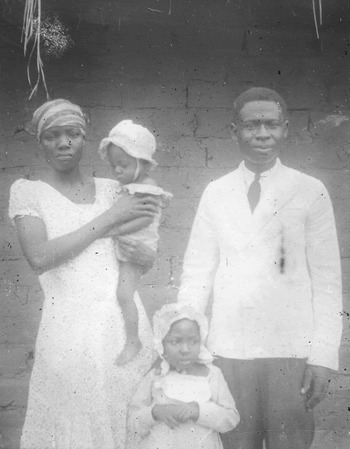
Burton's missionary writings and photography provide a strong contrast to his social scientific work. He wrote hagiographies and cameos of named evangelists recounting their spiritual and material development. And in a genre also found in colonial publications, his missionary photographs were records of progress: roads, railways, bridges, houses, and Western clothing which were all intended to demonstrate the benefits of colonial rule and modernizing Christianity. Figure 1 was a popular type of image found in missionary propaganda. Taken from a magic lantern slide, it shows a pastor and his nuclear family in cotton clothes outside a square brick house: the products of patient evangelical activity.
An evangelist and his family. Courtesy of CAM, Preston no. 75.

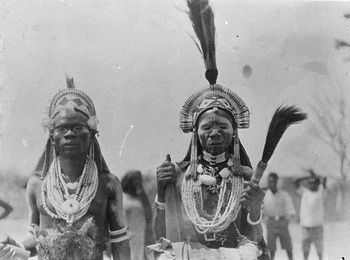
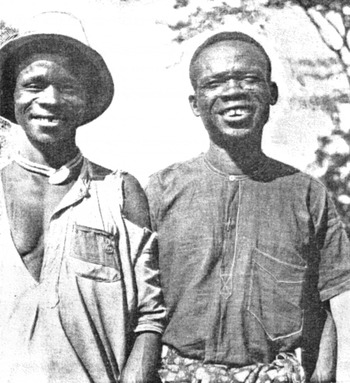
Another favourite missionary trope was the ‘before and after’ shot (see Figures 2 and 3). In this case, an ethnographic image of two Luba Bavidye (mediums) originally taken for the University of Witwatersrand was recycled to create a visual narrative of conversion. It was printed in a 1933 edition of the bi-monthly journal, the Congo Evangelistic Mission Report (CEMR), alongside the post-conversion picture of the same two men – now called Peter and David – smiling and dressed in modern clothing. The CEMR caption reads ‘“Kabondo Dianda Sorcerers”. Three years ago we photographed these Consulters with the spirit world. Since then they have been saved, and now they are happily testifying of Jesus Christ and his abounding grace’.Footnote 63
‘LUBA 2 bavidye’. Courtesy of the University of Witwatersrand Art Museum and the Burton Collection at the Witwatersrand Museum of Ethnology (BPC 12G.19).

Peter and Stephen. Courtesy of CAM, Preston, CEMR, 43, July–Aug. 1933.

While missionary photographs were created within an unequal power relationship in a colonial setting, Christopher Pinney highlights how scholars interpreting such images should consider ‘the “photographic event” – the dialogic period during which the subject and photographer come together’, observing that ‘no photograph is so successful that it filters out the random entirely’.Footnote 64 Close scrutiny of Figure 3 reveals that the outward transformation of the mediums into converts was not complete. Peter continues to wear a cone shell necklace as a sign of status amongst the Luba and both men's smiles reveal their filed front teeth, which acted as a ‘tribal’ mark.
Although Burton's research interests were numerous, his ethnographic publications focused on Luba religion and magic, particularly as they were practised by so-called secret societies, better termed associations. Easily demonized by missionaries who found them difficult to comprehend, these were populist institutions, which were committed to the maintenance of traditional morality and certain rites of passage. They could control healing, initiation, and funerals and were essentially educational societies with a strong public presence. Burton was much exercised about the Bambudye and Bakasandji Associations. The former was a political faction whose function was to initiate candidates into the rules and regulations of royal authority. The latter were doctors who dealt with malevolent spirits through spirit possession and controlled witchcraft accusation.Footnote 65 Essentially, the associations covered the same ground that the church wanted to occupy.Footnote 66 Burton was irked that some officials saw their activities as harmless entertainment and so he set out to expose them.Footnote 67 As Burton described it in a 1925 CEMR article, research was literally a means of ‘drawing back a veil’, of making public what lay beneath surface appearances.Footnote 68 In the unpublished 1929 preface to his manuscript Luba religion and magic in custom and belief, he explained:
The causal white may scarcely notice the startled cry in the darkness of the night, the small white mark upon a native's body, or the waving of a few leaves in the hand of one of his caravan porters, accompanied by a muttered spell. Yet a few judicious enquiries conducted in the right way, would lay bare a whole underworld of fearful custom, of which the white man has not even dreamed. We are convinced that for lack of such knowledge much missionary preaching is like a boxer striking the empty air instead of planting well-directed blows in the spot where they are most likely to take effect.Footnote 69
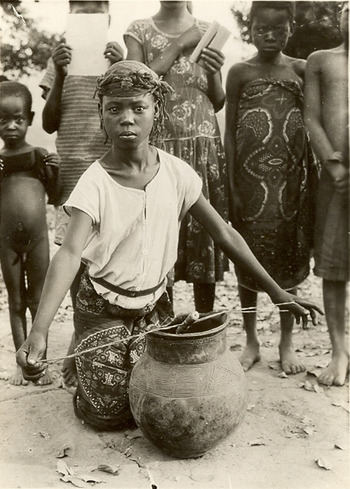
In this scientific mode of revelation, Burton used photography to subject traditional practitioners and their sacred objects to the spectator's gaze, thereby neutralizing their power. His image of the lion drum of the Tupoyo Society (Figure 4) was a prime example. The accompanying caption read: ‘The turning, first in one direction and then in the other, of the small stick, causes a roaring noise, at the mouth of the water pot, very much resembling roaring of lion in the distance. It is this “lion roaring” that is used by the Tupoyo Society to deceive the outsiders into believing that there is a lion in their society lodge.’
‘LUBA. Tupoyo Society’. Courtesy of the University of Witwatersrand Art Museum and the Burton Collection at the Witwatersrand Museum of Ethnology, BPC 07L5.

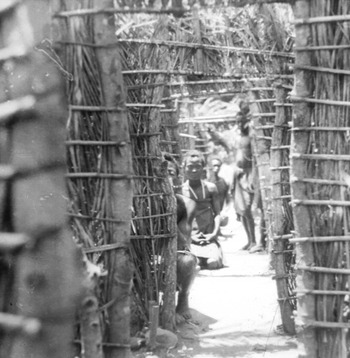
Although Burton cast these associations as fraudulent, debauched, and cannibalistic, he was not simply reproducing notions of alterity present in European discourses about Africa but also reflecting the views of his informants. Many of these were converts who had chosen to locate themselves outside of traditional Luba society and cast it in negative terms. Young men were his most enthusiastic and active informants. They bore the brunt of elder male gerontocratic power in Luba society. As John Peel observes from the Nigerian context, conversion offered young men an exit strategy and Christianity, in its ideology of individualism, provided ‘a ready legitimation to the new cultural choices which now beckoned’.Footnote 70 Young male converts were willing to break secrets or make public what was unspoken. They told Burton the passwords needed to gain entrance to a secret lodge. His photography and missionary articles recording the event, one of which was aptly entitled ‘Invading a Bambudye Sanctuary’ (Figure 5), made what was private and sacred accessible to the viewer's gaze.Footnote 71
A Bambudye Association Lodge. Courtesy of CAM, Preston no. 4.

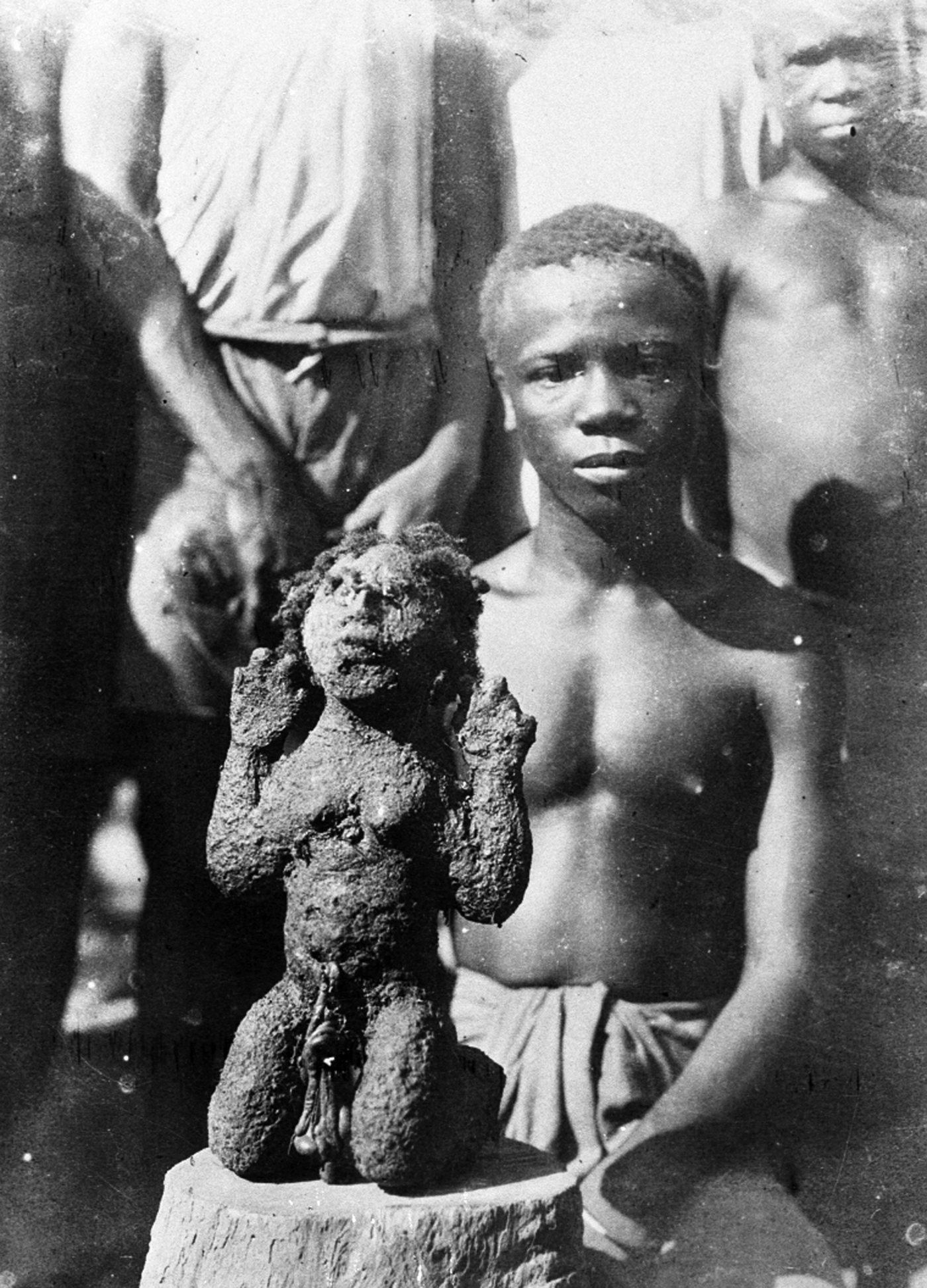
These youthful converts also engaged in acts of disenchantment and iconoclasm, using the resources of Christianity to purify and intensify their own religious experience. The young male evangelist, Lomami, pictured in Figure 6, seized the sacred object, known locally as a Kanzundji. The object had been used by a local traditional religious practitioner to divine witches. Burton considered the object as no more than a trophy and subsequently sawed it in half, encouraging his evangelists to parade it around local villages to demonstrate its mundane nature.Footnote 72
‘LUBA. A Kanzundji’. Courtesy of the University of Witwatersrand Art Museum and the Burton Collection at the Witwatersrand Museum of Ethnology, AL19.

While Burton arrived in Belgian Congo with preconceived ideas about the pervasiveness of ‘cannibalism’, like most missionaries he never witnessed it and his accounts were second hand, fleshed out by his African co-workers. Many of his accounts of anthropophagy were provided by Christian porters on evangelistic trek, men who were keen to distance themselves from the threatening pagan ‘others’ they encountered in alien territories.Footnote 73 Pioneering missionaries depended on these workers for introductions and local knowledge, especially before they had honed their linguistic skills. Burton and his colleagues describe evangelists intervening in their preaching to clarify meanings, and missionaries wryly acknowledged that once they had retired to their tent at night it was their carriers and servants who explained to villagers what they had really meant to teach in their sermons.Footnote 74 Evangelistic treks were great occasions for Burton to collect ethnographic data. But, always on the move, there was little opportunity for corroboration and hence he was deeply reliant on his porters for their interpretations (see Figure 7).
Porters on trek. Courtesy of CAM, Preston no. 3.

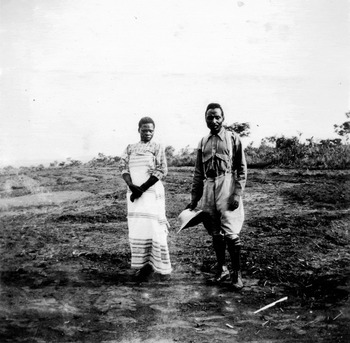
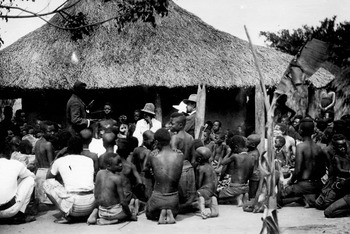
Another group of informants who distanced themselves from traditional religion were Christianized former slaves. Slavers had originally taken them from Katanga to the Angolan coast, to work in plantations. There, they were Christianized by Protestant missions and returned as missionaries in their own right when the Portuguese Republic abolished domestic slavery in 1910. The returnees were literate Christians with marketable skills. They built in brick, were trained in carpentry and animal husbandry, and planted different crops. They had no wish to live under traditional chiefs and exhibited a deep anxiety about the contaminating effects of contact with pagan lower orders. Residing at mission stations or in Christian villages, they drew upon idioms of respectability to assert spatial and moral boundaries between themselves and ‘pagan’ neighbours. Working closely with the CEM and American Methodist missionaries, the ex-slaves pushed the Christian frontier well beyond mission stations. Clothes were a key marker of their respectable status. In Figure 8, Kaluwashi, one of the most influential ex-slaves dons the apparel of a missionary: khakis, boots, braces, and all-important pith helmet. The accompanying image, Figure 9, provides an important insight into how evangelism has often been conducted in Africa. It is Kaluwashi, Bible in hand, who preaches to the paramount Chief Kabongo, while the linguistically challenged white missionaries remain seated.
‘Kaluwashi and wife’, 1917, Mission Albums Collection, Africa 6, 30271. Courtesy of the General Commission on Archives and History, The United Methodist Church, Madison, New Jersey, USA.

‘Kaluwashi preaching to Chief Kabongo’, c. 1917, Mission Albums Collection, Africa 6, 30272. Courtesy of the General Commission on Archives and History, The United Methodist Church, Madison, New Jersey, USA.

The final social category who put itself outside traditional Luba society was women fleeing abusive relationships and domestic slavery. William Burton's wife, Hettie, founded a women's refuge. Besides women in flight, the refuge attracted other socially marginal females such as widows who lacked the security of living children. Deeply affected by the loss of her new born baby son, Hettie threw herself into women's work, recording her experiences in a book entitled My black daughters. She formed deep friendships with women such as the former slave, Sala Kamone (Figure 10), who revealed to her the traumas of slavery and the details of female initiation.Footnote 75
Sala Kamone. Courtesy of CEM Preston, no. 82.

William Burton also engaged with chiefs, mediums, sculptors, and secret society members, often drawn by beauty and curiosity as much as by the evangelical desire to know and confront his enemy. Although he wrote in derogatory terms about the ‘weird dances and paraphernalia’ of Luba diviners, there were numerous occasions when his aesthetics ran counter to his written appraisals. In spite of his commentaries, Burton took many fine photographs of the Luba. The images exhibited no trace of pity as part of a strategy to raise funds, but rather creativity and dignity through their depiction of skills, arts, and crafts.Footnote 76 Many of them were subsequently transformed into careful gouache and watercolour paintings and together they represent some of his most significant social scientific work.
While much of Burton's published work for church audiences was constrained by the simple oppositions of modernizing Christianity versus heathen superstition, it is clear that during his forty-five years of mission work he constructed deep relations of trust and respect with Luba traditionalists, evident from the negotiations involved in posing photographs. Like many pioneering missionaries, he was dependent on the patronage of the local chief, Mwanza – Kazingu. Although Kazingu never converted, and to Burton's horror continued to imprison his rivals, the two nevertheless became good friends. Kazingu allowed Burton to photograph him in his precious crown and subsequently to have a copy made for the University of Witwatersrand (Figure 11).
‘LUBA. My old friend Chief Kajingu [sic] of Mwanza in full regalia’. Courtesy of the University of Witwatersrand Art Museum and the Burton Collection at the Witwatersrand Museum of Ethnology, BPC 13·11.

Burton also spent much time in a local village called Kabishi, which was an atelier producing sculpture for chiefs across the Luba polity. Burton photographed and painted the shrine on the perimeter which intrigued him, and he eventually formed a close friendship with a sculptor, Kitwa Biseke, whom he proselytized in a dialogue of proverb and scripture.Footnote 77 Burton's technically brilliant photograph of Biseke (Figure 12) in which the sculptor became the sculpture, with sacred objects on display, would have required a good deal of co-operation between the photographer and carver. Through his connection with Kabishi, Burton was drawn into local networks of artistic patronage, commissioning sculptures for museums and sending local children to art school in Elisabethville.Footnote 78
Burton's desire to convert chiefs and his interest in history led him to interview numerous traditional leaders and ‘men of memory’: keepers of royal traditions. These gerontocratic elites, whose status and powers of arbitrary justice had declined under colonialism, exaggerated the pre-colonial reach of the Luba polity and their connection with it. They also elaborated models of custom that suited their interests over and against women and youth. These partialities found their way into language primers, local histories, and native affairs publications, all of which equated Luba identity with a specific body of proverb, tradition, and folklore. The texts were disseminated back across the Luba polity via schools and churches by a committed body of teachers and evangelists, becoming one of a number of ways CEM missionaries unintentionally participated in the construction of Luba ethnic nationalism.
‘LUBA. A Kitwa (chief's personal wood carver) carving a Kitumpo (for divining) with a knife & adze only. The Kitwa's Kibango (carved staff) is behind him’. Courtesy of the University of Witwatersrand Art Museum and the Burton Collection at the Witwatersrand Museum of Ethnology, BPC 05·13.

The triumphal tone of printed missionary sources often obscured the contingencies of early mission work. Loneliness, illness, the necessities of food, shelter, protection, and translators made Burton and other missionaries reliant on local society in the opening stages of the encounter. Such close engagement with the Luba meant that his view of them shifted over time. He moved from an aggressive intrusive mode of research to a position of greater sympathy as he came to appreciate their cultural riches through study of language, folklore, and proverb. Embarking on a second sequence of research in the 1940s and 1950s, he collected and collated, with African assistants, a vast collection of 1800 proverbs, and wrote on Luba oral culture.Footnote 79 His sympathies and understanding also shifted in sympathy with the second generation of Luba Christians. This group of converts did not experience the rupture of conversion, or the old life, as a social and spiritual entity. Disenchantment had rendered practices such as drumming and dancing or the partaking of palm wine as no more than harmless heritage. Thus, second-generation Christians sought a self-conscious rapprochement with their parents’ former culture in acts of ‘reprise’.Footnote 80 Burton's shift, which drew upon nineteenth-century fulfilment theology in asserting Christianity's continuity with so-called primal religions, brought him in line with contemporary missiological thinking.Footnote 81 He came to believe that beneath the superstructure of so-called African superstition lay a deeper metaphysics, which could be marshalled and Christianized.Footnote 82
IV
There was an intrinsic tension between missionaries’ interest in local culture and their endeavours to transform it. Indeed, as this article has shown, some of the data missionaries gathered was generated through their efforts to challenge local beliefs and practices. This was certainly the case when missionaries relied upon information provided by converts, especially if it was presented in the form of a triumphal narrative of overcoming a custom that was believed to be inimical to Christianity. In such circumstances, any sense of the inherent value of the custom was lost.Footnote 83 Nevertheless, missionary interactions with indigenous peoples were recorded in a range of literary genres extending from ethnographic writing to public and personal correspondence, reportage and history, propaganda and inspirational writing. Photographs and the collection of material objects also marked their encounters. Moreover, they did not simply interact with converts. Curiosity, a sense of aesthetics, a desire to know their ‘enemy’, and the need to make converts drove them from their verandas to engage with a great variety of people. Their ethnographic photographs record them in situations far from mission stations interacting with dancers and diviners, chiefs and sculptors in a manner that could shock supporters back home.Footnote 84 Missionary scholars were also aware of the charged nature of material gathered from and by youthful converts. This was made clear in an impressively reflexive article published in Africa: The Journal of the International Institute (1931). The article was written by Diedrich Westermann, an ethnographer and missionary statesman who advised researchers to seek out informants and assistants from a range of social categories.Footnote 85 However, scrupulous research methods did not make missionaries immune to criticisms from their detractors.
At the inaugural International Conference of Anthropological and Ethnological Sciences (London, 1934), George Basden, a missionary ethnographer working with Church Missionary School in Nigeria presented a paper entitled ‘How far can African customs be incorporated into the Christian system?’ After the lecture, Jomo Kenyatta, then student at the London School of Economics and future first president of independent Kenya, stood up to attack the methods of missionaries:
In Kenya, missionaries have not gone the right way in presenting Christianity to Africans, declaring that all African customs and beliefs are bad, and that before an African can adopt Christianity he must cast such things away, and overlooking the fact that the African obtains much good by adherence to his beliefs, and that the idea of ‘brotherhood’ is so great a part of African beliefs and life. Missionaries have obtained most of their ideas of African customs from converts to whom their old gods have become devils … Co-operation with Africans themselves is what is required, for African beliefs and customs maintained a social system adequate to African needs.Footnote 86
While Kenyatta's observation about the partial nature of converts’ testimony was powerfully articulated, what is also notable about his intervention was his rigorous functionalism. Learnt from his mentor, Bronislaw Malinowski, and expressed more clearly in his 1938 book Facing Mount Kenya, it caused Kenyatta to see Kikuyu life as an ‘integrated culture’ from which ‘No single part’ was ‘detachable’. In his distinction between converts and Africans themselves, he ignored the religious choices made by some Kikuyu, elevating instead a version of pristine culture over society, thereby suggesting that African Christians were no longer part of the social field. As Bruce Berman and John Lonsdale show in their work on Kenyatta, his functionalism was more than just a tool of social science. Functionalism was the means by which he asserted his authority as a Kikuyu spokesman schooled in local wisdom and tradition, against youthful self-confident mission converts whom he cast as detribalized and disorientated. He believed that he could shepherd the Kikuyu into modernity along a different path from that advocated by paternalistic missionaries.Footnote 87 Kenyatta's struggles within Kikuyu society illustrate how the charged nature of ethnographic information given to missionaries is its saving grace. If untrammelled by evangelical rhetoric, a convert's rejection of traditional practices could illuminate customs and the regard in which they were held.
Moreover, the sum of local testimonies were a means of reconstructing the full extent of missionary interactions and the parameters of social conflict and debate within African society between Christian and traditionalist, men and women, elders and youth. The multitude of local religious encounters captured in the sources counters the tendency to describe collective representations and systems of coherence and stability found in interwar social anthropology.Footnote 88 It rescues Africans from the depersonalized, abstracted aggregates known as ‘tradition’.Footnote 89 The Protestant missionary desire to create new individualized subjects and to celebrate their progress in writing also offers the opportunity to identify informants shrouded in anthropological texts.Footnote 90
Because missionaries recorded testimonies from a range of social categories, Christian and traditionalist, as well as studying how consensus was achieved through public ritual, their data provides a sense of the contested nature of religious ideas and the contingent nature of religious identities. Religious boundaries shifted and were transgressed, and religion was a process in which different actors made new religious arguments in the context of shifting relations of power. Missionaries appear more grounded, deeply involved in these processes.
Burton was a representative of a small but influential group of missionaries and administrators who had a keen interest in ‘native culture’ but were also actors in colonial settings. When combined with radical evangelical Protestantism, this stance at times could lead to contradictory attitudes towards Africans. There has been a tendency to see missionaries as unyielding proponents of a Western lifestyle and indeed their published propaganda often suggests this. But Burton's photography, collecting, and ethnography also show him to be moved by those he encountered. It was missionaries such as Burton, intent on changing customs and beliefs, who provided some of the most intimate and detailed early ethnographic accounts, thereby helping to shape the development of the secular discipline of anthropology, which in the course of its professionalization has been distinctly ambivalent about their contributions.Footnote 91 Thus, the paradoxical role of missionaries as social scientists as well as proselytisers usefully expands the notion of religious encounter.