Introduction
How well do standard theories perform in explaining policy outputs and outcomes in Central and Eastern Europe? Is there a need for a revision of theories in the light of fresh empirical evidence from the region? These questions raised in the introduction to this special issue are of direct relevance to the study of compliance with EU law. The new Central and Eastern European EU member states have had to adapt their policies to the requirements of the acquis communautaire. At the same time, however, not only their policy legacies, but also their administrative and legal systems were in many respects unlike those in the states of the EU-15. Against this background, problems of compliance were only to be expected. Still, would these be different solely in terms of magnitude or also in terms of quality? If the latter, there might be a case for recasting political science theories that aim at explaining cross-national differences in compliance records.
This article compares the performance of state institutions and related patterns of compliance with EU law in the Czech Republic, Hungary, Slovakia and Slovenia, which joined the EU on 1 May 2004. The state institutions highlighted below include the court and legal systems as well as labour inspectorates and equal treatment authorities. These are of crucial relevance when it comes to enforcing EU social standards, e.g. on working time and equal treatment and formed the core of the two research projects summarised here (see Falkner et al. Reference Falkner, Treib, Hartlapp and Leiber2005 and Reference Falkner, Treib, Holzleithner, Causse, Furtlehner, Schulze and Wiedermann2008).
‘Compliance’ with EU law is a complex concept (Hartlapp and Falkner Reference Hartlapp and Falkner2009). It does not relate to only one stage, it is the outcome of a multi-phase process, including law-making at domestic level(s), which may involve adopting new rules or adapting existing ones; control of these laws with regard to their application in practice; and enforcement in cases where the laws are not followed. More parsimoniously, the implementation process can be divided into two major phases: transposition into domestic law; and enforcement, encompassing monitoring and application and, if necessary, the follow-up to any problems detected.
Existing studies of compliance with EU law covering the new EU member states indicate that formal transposition requirements have typically been fulfilled in a satisfactory manner. This point is highlighted in both the political science ‘compliance literature’ (e.g. Sedelmeier Reference Sedelmeier2006: 21) and by relevant EU Commission reports. The latter show that, according to official statistics, the new member states from Central and Eastern Europe even outperform the EU-15 when it comes to transposition. At the same time, the few studies that have been devoted to application and enforcement of EU law tend to suggest that legal transposition is not followed up appropriately (e.g. Treib Reference Treib2008: 18).
The two sections that follow summarise four empirical studies of the implementation of three EU directives on working time and equality issues in the Czech Republic, Hungary, Slovakia and Slovenia (Causse Reference Causse, Falkner, Treib and Holzleithner2008, Furtlehner Reference Furtlehner, Falkner, Treib and Holzleithner2008, Schulze Reference Schulze, Falkner, Treib and Holzleithner2008, Wiedermann Reference Wiedermann, Falkner, Treib and Holzleithner2008). In line with expectations voiced in the earlier literature, they show a good transposition record both in terms of timeliness and in terms of correctness, with 10 out of 12 cases completed largely on time and in an essentially correct manner (Falkner et al. Reference Falkner, Treib, Holzleithner, Causse, Furtlehner, Schulze and Wiedermann2008: 162). Note that the performance of the EU-15 in transposing six similar labour-law directives was far worse with ‘not even one-third of all cases (…) transposed “almost on time” and “essentially correctly”’ (Falkner et al. Reference Falkner, Treib, Hartlapp and Leiber2005: 267). However, the performance of the East Central European countries in transposition is not matched at the later enforcement stage.
Since the application of EU law is de-centralised, the state is responsible for effective law enforcement. Different kinds of rules require different types of law enforcement. In the case of labour law and equal treatment policies, two types are crucial: administrative enforcement with direct state involvement, and individual enforcement via citizens’ action in the courts. Note that administrative enforcement is a necessary condition for compliance in those fields where active enforcement by the state is known to be indispensable. In other areas, enforcement shortcomings could, in theory, be irrelevant, because of perfect application on the ground. However, it seems highly unlikely that enterprises should stick to expensive rules if the latter cannot be enforced via the courts or by other state institutions. Among the legal acts studied, the equal treatment directives rely on individual enforcement. Those whose rights are violated are expected to take legal action. Still, state authorities and state activities do matter, at least indirectly, for the effectiveness of this route depends on adequate framework conditions. Most crucially, the court system has to work well, individuals need to have good access to the courts and must be well informed about their rights. Administrative enforcement, in turn, matters in many other fields, such as working time regulation. Here, the state should ensure that labour inspectorates have sufficient resources to cope with their tasks, that they are well-organised and that they have effective sanctions at their disposal (Hartlapp Reference Hartlapp2007, Hartlapp Reference Hartlapp2005).
Courts and legal systems
Czech Republic
A state seeking to ensure proper enforcement of the standards guaranteed to its citizens must provide an adequate court system to ensure that individuals can seek protection of their rights. In the Czech Republic, there are no formal barriers that would deter persons concerned from going to court. However, a number of structural problems are apparent (for details see Wiedermann Reference Wiedermann, Falkner, Treib and Holzleithner2008). There are no labour courts and therefore the civil courts also have to deal with such proceedings. In general, the Czech court system is regarded as expensive to use and risky for individuals. Legal uncertainty arises from partly inconsistent adjudication, favoured by the strong emphasis on the constitutionally enshrined independence of judges. The latter are seen to be at times unaware of judgements of higher courts or even unwilling to adhere to them. A further problem is that proceedings are said to take too much time, with a duration of five years a not uncommon phenomenon. Violations found by the European Court of Human Rights illustrate that the Czech Republic frequently fails to meet the requirements of Article 6 (1) of the Convention for the Protection of Human Rights and Fundamental Freedoms according to which ‘everyone is entitled to a fair and public hearing within a reasonable time’. Against this background, even trade unions, labour authorities and labour inspectorates often warn against seeking legal redress, and employers, too, appear dissatisfied with the court system (Wiedermann Reference Wiedermann, Falkner, Treib and Holzleithner2008 with further references).
The Czech legal culture and its relationship to the appropriate implementation of EU law is the subject of debate. Experts hold that a case-law tradition as in the EU’s legal approach is missing (Kühn Reference Kühn2005; see also Matczak et al. Reference Matczak, Bencze and Kühn2010). At least the higher courts of the Czech Republic are seen to be dedicated to the sound application of EU law. At the same time, however, the practice of Czech ordinary courts is sometimes considered ‘anti-European’ or ‘isolationist’. There are serious doubts as to whether lower-level judges are fully aware of European law and their own duty to ensure the precedence of EU law over national law (Kühn Reference Kühn2005: 3–5). Even some time after EU accession, ‘old’ Czech legislation is sometimes applied instead of ‘new’ European legislation (Wiedermann Reference Wiedermann, Falkner, Treib and Holzleithner2008: 51–52). Additionally, the EU’s preliminary reference procedure, a core feature in making the decentralized application of EU law feasible, is said to be regarded as ‘strange’, ‘complicated’ and ‘external’ (Mucha et al. Reference Mucha, Rakovsky, Krepelka, Passer, Rakovsky, Krepelka and Passer2005). Few preliminary rulings are requested and lower level courts refer cases to the higher Courts of the Czech Republic rather than to the ECJ. All this indicates that more and better training of judges is indispensable. It cannot come as a surprise that trust in the courts as institutions of conflict settlement is rather low among the Czech population and that there is no lively litigation culture (see e.g. also Anderson et al. Reference Anderson, Bernstein and Gray2005).
Hungary
As outlined by Causse (Reference Causse, Falkner, Treib and Holzleithner2008 with further references), the Hungarian legal system first underwent fundamental change with the dismantling of its communist heritage, but soon added new rules anticipating EU membership. These challenges were accompanied by training courses to familiarize judges with EU law and by exchange programmes. However, the Hungarian court system is regarded as seriously under-funded, with a shortage of personnel and a growing case load (see also e.g. Open Society Institute 2002: 115–17). Recently, some attempts have been made to reduce judges’ workload by expanding the authority of judicial clerks.
Compared to some older EU member states and also to the Czech Republic, there are fewer complaints regarding the length of court proceedings lodged with the European Court of Human Rights, but it is still seen as a problematic feature of the Hungarian enforcement system that court proceedings take relatively long. In the field of labour law, specialised courts exist and they generally take about one to two years to decide at first instance. This is within the European average, but still subject to criticism in the country (Causse Reference Causse, Falkner, Treib and Holzleithner2008 with further references).
The number of cases in labour courts is rather low in comparison with other industrialized countries. Experts relate this to cultural factors, to weak interest representations as an institutional support, and to a labour market more favourable to employers, where employees often seem unaware of existing legislation (see also Tóth et al. Reference Tóth, Nacsa and Neumann2004: 2, Vajda Reference Vajda2006: 14). Regarding working time standards, the excessive complexity of the legislation hinders effective implementation and even lawyers consider some provisions ambiguous (Causse Reference Causse, Falkner, Treib and Holzleithner2008 with further references).
Notwithstanding various training programmes for judges, deficiencies in knowledge of EU law are reported, in particular as regards anti-discrimination law, equal treatment between men and women, and sexual harassment law. More systematic measures seem indispensable to allow for satisfactory implementation of the relevant standards and to fight the scepticism of the Hungarian citizens vis-à-vis their legal system (Causse Reference Causse, Falkner, Treib and Holzleithner2008: 86).
Slovakia
The Slovak government holds that it has already fulfilled its share of obligations by transposing the directives and making the rights enshrined therein, in theory, available for the general public (Schulze Reference Schulze, Falkner, Treib and Holzleithner2008: 113). However, there are a number of obstacles to challenging infringements in Slovak courts. Those who decide to enforce their rights through the courts seem to have little backing by institutional mechanisms. Provisions of the Labour Code do not necessarily safeguard employees. Thus, the Code allows work contracts under commercial law, which can be seen as a legal ‘escape route’ depriving employees of the protection of labour law (Barancová Reference Barancová2006). Some employers reportedly also encourage potential employees to register as self-employed. In some job postings, this status is even mentioned as a precondition for employment (Schulze Reference Schulze, Falkner, Treib and Holzleithner2008: 113–14).
The crucial precondition for effective enforcement, i.e. a well-functioning judiciary, cannot (at least yet) be taken for granted in Slovakia. Most importantly, scarcity of resources is widely regarded to impair the court system. As in the other countries studied, shortcomings in the training of the legal professions are reported, too. Thus, ‘poor availability of competent legal assistance dissuades most citizens from filing complaints’ (Fialová Reference Fialová, Meseznikov and Kollar2005: 152) and little use is made of the existing provisions.
In labour disputes, both employees and employers are reluctant to go to court. Since the Slovak court system lacks labour courts, such disputes are settled in specialized civil courts. The main problems cited are: a backlog of cases resulting from overly long procedures and a lack of predictability. Judges are seen as overwhelmed by frequent changes in relevant legislation, and the absence of case law makes it often hard to assess any likely outcome. As Schulze (Reference Schulze, Falkner, Treib and Holzleithner2008) notes, Slovakia does not have a well-established system for systematically publishing court rulings, except those of the Constitutional Court, and, since early 2006, some decisions from regional and district courts. Moreover, many judges are seen to lack familiarity with EU-derived law and specialized legislation, such as anti-discrimination provisions (Schulze Reference Schulze, Falkner, Treib and Holzleithner2008: 117).
Slovenia
At the time when the case study on Slovenia was carried out, the Slovenian court system was in the midst of reform, but at least until then, the situation was not markedly better than in the other countries studied (Furtlehner Reference Furtlehner, Falkner, Treib and Holzleithner2008: 143). It remains to be seen whether the ten-year Action Plan (European Commission 2002: 22) adopted in 2002, with its emphasis on out-of-court dispute settlements, the introduction of paralegals to assist fully trained lawyers and with its option to transfer judges to overburdened courts, will succeed in eliminating oft-noted shortcomings. Among the latter are, in the first place, slow proceedings and a large backlog of pending cases (see also European Commission 2004). There were about 600,000 pending cases in 2006 and the average length of court procedures was two to three years (Austrian Federal Economic Chamber 2006). Slovenes perceive court proceedings as a rather expensive exercise, even though trade unions provide free legal assistance to their members, non-unionised employees and those who lack the necessary financial means receive free legal services, and courts may exempt employees from paying the court fee altogether (Kanjuo Mrcela Reference Kanjuo Mrcela2004).
Another disincentive to file a court case is the suspicion that court decisions might not necessarily reflect the legal situation. Courts are seen to come to different conclusions in similar cases, and EU legislation is still often perceived as imposed from outside rather than constituting an integral part of the Slovenian legal system. Finally, judges and lawyers are seen to have insufficient knowledge about rights and obligations stemming from EU directives (Furtlehner Reference Furtlehner, Falkner, Treib and Holzleithner2008: 149). Moreover, in general, Slovenes’ trust in public institutions is low, and the enforcement bodies of labour law as well as the courts are no exception (Furtlehner Reference Furtlehner, Falkner, Treib and Holzleithner2008: 144).
Labour Inspectorates and Equal Treatment Bodies
Next to the courts, other state institutions matter in the enforcement of EU-related norms. In the present context, these institutions include labour inspectorates and bodies that the new member states needed to put in place on the basis of the EU’s equal treatment directives. Since these structures do not matter in the same way for all policy areas, their treatment will be briefer than the courts’. The findings summarised below indicate that transposition data are not a reliable guide when it comes to the implementation of EU derived standards. Crucial structural conditions for effective implementation are evidently not fulfilled.
Czech Republic
As reported by Wiedermann (Reference Wiedermann, Falkner, Treib and Holzleithner2008), the newly established labour inspectorate in the Czech Republic has not existed long enough to allow for a final judgement, but it would appear that supervision has been more effective in some areas than in others. Occupational health and safety, as well as working time issues, appear to have been given higher priority than equal treatment matters. As regards the latter, even labour inspectors have stated that they lack experience. Interviewees revealed that breaches of anti-discrimination provisions were hardly ever followed by penalties. If so, the latter were low (up to approximately 500 Euro). Another shortcoming has concerned the issue of proving misconduct. In civil court cases, the burden of proof should, in principle, fall on the employer following a plausibility check of the claimant’s arguments. However, this important legal principle enshrined in EU and, meanwhile, also in Czech law, de facto does not seem to have been applied in administrative procedures (Wiedermann Reference Wiedermann, Falkner, Treib and Holzleithner2008: 54). Overall, only the employers’ representatives seem satisfied with the workings of the labour inspectorates. By contrast, trade unions and, in particular, non-governmental organisations representing anti-discrimination concerns have been critical about the state of affairs (Wiedermann Reference Wiedermann, Falkner, Treib and Holzleithner2008: 55).
Turning to the equal treatment body provided for in Article 8a of the EU’s Equal Treatment Directive, no such unit was found in the Czech Republic at the time when the research was conducted. Rather, there co-existed a number of different institutions dealing with equal treatment or anti-discrimination affairs. It seemed that they all suffered from a high turnover of staff and a lack of continuity in their work. One of them, the ‘Government Council for Equal Opportunities for Women and Men’, had been established to satisfy the EU Commission’s demands during the membership negotiations, but it was deemed rather inefficient (Wiedermann Reference Wiedermann, Falkner, Treib and Holzleithner2008: 56 with further references).
Hungary
Causse’s (Reference Causse, Falkner, Treib and Holzleithner2008) research concluded that neither working time nor equal treatment issues were priorities for Hungary’s National Labour Safety and Labour Affairs General Inspectorate, the state authority in charge of supervising employment conditions and health and safety in the workplace (Causse Reference Causse, Falkner, Treib and Holzleithner2008: 85). A narrow focus on health and safety was among the criticisms voiced, as was a lack of inspectors, although the situation was expected to improve at the time when the study was conducted. At the same time, the main ambition of the reform was to fight illegal work, and it was feared that this focus would marginalise all other functions of the labour inspectorate.
The Hungarian labour inspectorate should also, in principle, supervise anti-discrimination provisions. However, investigations can only be conducted following a complaint, not at the initiative of the inspectorate. A further weakness was seen in the insufficient training of inspectors to keep them up to date with new legislation (Causse Reference Causse, Falkner, Treib and Holzleithner2008: 86 with further references).
By contrast, the Hungarian Equal Treatment Authority has seemed to be on a rather promising path to enforce rights. It started work in 2005, vested with more powers than EU law prescribed. It can initiate lawsuits to protect the rights of persons and groups whose rights have been violated, and it can even conduct ex officio investigations to establish whether the principle of equal treatment has been violated. It is empowered to impose administrative sanctions. Causse (Reference Causse, Falkner, Treib and Holzleithner2008: 87) concludes that this ‘not only gives the Equal Treatment Authority a more effective and active role than many of its EU counterparts, but it also provides victims with more options to protect their rights’.
However, the Hungarian Equal Treatment Authority lacks adequate resources to make full use of its far-reaching competences. Too many cases have been brought to the attention of the few staff members, a fact also highlighted in a recent paper which concludes that ‘the story of the gender equality machinery illustrates several of the symptoms of state weakness’ (Krizsan Reference Krizsan, Schimmelfennig and Trauner2009: 27).
Slovakia
Schulze’s (Reference Schulze, Falkner, Treib and Holzleithner2008: 123) research in Slovakia has led her to conclude that the labour inspectorate should be strengthened with an increase in resources, including an increase in staff, especially those with an expertise in monitoring issues. However, the number of labour inspectors has even declined in recent times, with further reductions likely (Schulze Reference Schulze, Falkner, Treib and Holzleithner2008: 117). Combined with a business structure in which more than 90 per cent of enterprises employ an average of three employees only, this makes for an insufficient infrastructure for enforcing labour law and equality standards in an active manner.
Expert focus groups used harsh words about the quality of Slovak labour inspectorates. While the few inspectors seem in need of training and confronted with a work overload, the institutional focus has been on illegal work and health and safety in the workplace. The labour inspectorate is also seen to have much closer relations with employers than employees, with the (explicit or implicit) agreement of the government. Although the inspectorates could, in principle, impose sizeable fines and even close down a business if necessary, this is hardly ever done (Schulze Reference Schulze, Falkner, Treib and Holzleithner2008: 118 with further references).
The Slovak Centre for Human Rights, the institution serving as Equal Opportunities Body according to the relevant EU directive, does not look like a great success story either. It has an extremely wide-ranging mandate and the government’s intention seems to have been mainly to reduce the number of court cases. Financial resources are scarce, even when compared to the Hungarian counterpart with its much narrower scope of competences (Schulze Reference Schulze, Falkner, Treib and Holzleithner2008: 120).
Slovenia
Although the number of inspectors is considerably higher in the Slovenian labour inspectorate than in the three other countries studied, there is also much criticism concerning the enforcement situation (Furthlehner Reference Furtlehner, Falkner, Treib and Holzleithner2008). The frequency of inspections depends on a company’s size, and even though law regulates inspection frequency, it is not, in practice, always adhered to. As in Hungary, a closer relationship to the employer than the employee is criticised by experts (Furtlehner Reference Furtlehner, Falkner, Treib and Holzleithner2008: 151). Additionally, the study revealed that many companies seem unaware of the new labour laws that have been introduced in connection with EU membership. The labour inspectorate must, at least in part, accept the blame because its tasks include the provision of expert information about the laws in force in its area of competence (Furtlehner Reference Furtlehner, Falkner, Treib and Holzleithner2008: 150).
A similar information deficit was also detected in the field of equality law. This impinges on the overall situation in enforcing equal treatment provisions, although the institutional setting is somewhat more satisfactory than in other countries. There are several bodies for the promotion, analysis, monitoring and support of equal treatment of all persons. The Advocate of the Principle of Equality assists victims of discrimination based on any personal circumstance by dealing with cases of unequal treatment. However, few cases had been filed after approximately four years in office (i.e. at the time when the empirical research on which this paper draws was conducted). The Advocate is also perceived as weak as the only sanction at its disposal is to inform the responsible labour inspectorate. Furthermore, there is a Governmental Office for Equal Opportunities, originally called Office for Women’s Policy. Most recently, in 2005, a government Council for the Implementation of the Principle of Equal Treatment has been set up, composed of ministers, directors of government offices, representatives of professional organizations, national minorities and non-governmental organizations. Its success remains to be seen, but it will, in any case, depend on improvements in the level of information (Furtlehner Reference Furtlehner, Falkner, Treib and Holzleithner2008: 155).
A Comparative Perspective on Enforcement Structures
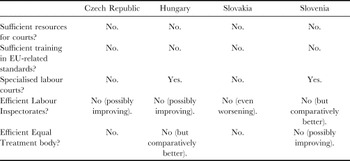
The above review of relevant state institutions paints a negative picture (Table 1).
This summary representation should, however, be interpreted with caution, for a number of reasons:
Structures for Enforcing EU-related Standards on Labour Law

Source: From Falkner et. al. Reference Falkner and Treib2008 interviews with experts and practitioners.
Kind and source of information gathered: The information on institutional factors summarised above stems from expert interviews and focus group discussions on the EU directives, plus the available literature. The study’s analytical focus was on the quality of implementation of specific EU standards, not on a direct comparison of state structures. Though collected with great care as kind of auxiliary findings, insights on institutional aspects in our study rested to a large extent on the judgements of policy experts and practitioners of each country. We applied no direct measurement of institutional capacities or performance. Most findings on institutional aspects were therefore not quantified and cannot easily be compared across countries beyond a somewhat general level.
Ongoing change and relevance of findings: Some reforms were under way when the evidence on which this article relies was collected. Their effects could not be evaluated, but at least some data on an indirect indicator are available. Thus, public opinion should reflect if the institutional problems outlined above have been significantly reduced by recent developments. As recent Eurobarometer data underlines, low trust in public institutions is common to many countries of Central and Eastern Europe. In the Czech Republic, the courts and the domestic legal system are trusted by less than one third of the population. Czech public opinion is critical with regard to the state administration, which is deemed transparent by only 17 per cent of respondents and regarded as opaque by as many as 74 per cent (ibid., 5). Similarly, in Slovakia, only 31 per cent trust their justice and legal system – a figure 15 points below the EU-27 average, and only 36 per cent of Slovaks trust the police, i.e. 27 points below the EU-27 average (Eurobarometer 69, Spring 2008, National Report Slovakia, Executive Summary, 4). In Hungary, the situation is somewhat better, but far from satisfactory. Less than half of the respondents trust their national justice and legal system (Eurobarometer 69, Spring 2008, National Report Hungary, Executive Summary, 2). For Slovenia, Eurobarometer does not give any data on trust in the domestic institutions.
Problems of comparability and generalisation of findings: It is difficult to establish the degree to which any institution is in need of reform, even more so in complex institutional settings. Overall, however, the findings across the four countries are similar to an extent that justifies grouping the four states into the same category. The problems indicated by the experts and practitioners involved were in principle the same, notwithstanding some clear differences in degree. It should be noted that even if fully comparable data e.g. on numbers of judges or labour inspectors could be collected in future research, extremely intricate weighting in relation to the specific societal needs would be indispensable to judge their adequacy for proper enforcement of standards. Therefore, expert opinions may be in any case more realistic indicators than official data.
Regarding the policy studied, labour law may be particularly prone to reluctant enforcement by individuals, for a number of reasons. There will always be a risk of dismissal when reporting on unlawful treatment or when suing the employer. High levels of unemployment act as a further deterrent. In exchange for higher income, employees also tend to accept unduly long working hours or other detrimental conditions. In short, there are some reasons to expect that the findings in the field of labour law might paint an overly negative picture of the state of institutional conditions. At the same time, the information collected in expert interviews and in focus group discussions went beyond the field of labour law directives in many aspects, and the information on the court systems also matters for many other fields of compliance with EU standards.
Findings in Context
As outlined above, the four countries studied have largely succeeded in aligning their legislation with EU directives. Despite their good transposition record, however, our study has revealed a multitude of obstacles in the way of making living rights out of the legal provisions. Insufficient resources and structures of state institutions matter critically for compliance failure. Whilst already before EU accession, new domestic coordination structures improved administrative capacities to transpose EU directives and to coordinate responses to the European Commission’s units controlling transposition deadlines (Dimitrova and Toshkov Reference Dimitrova and Toshkov2007, Zubek Reference Zubek2008), the same has not been accomplished when it comes to institutions in charge of securing the application and enforcement of the standards laid down in law. To improve the situation, reforming the state institutions in terms of resources and organisation seems crucial.
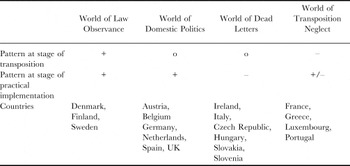
Do these findings indicate a need to revisit earlier political science accounts based on Western European experiences? Do they question the state of the art in implementation theory that severe deficiencies of the labour inspectorate and the judiciary, combined with little litigation activity and weakly organized civil society actors, reduce many of the provisions laid down in European legislation to ‘dead letters’ in these countries? Previous research on Western Europe suggests otherwise. Thus, our comparative study on related EU directives and their implementation in the EU-15 showed quite similar patterns for two ‘old’ member state, i.e. Ireland and Italy (Falkner et al. Reference Falkner, Treib, Hartlapp and Leiber2005) to those found in Central and Eastern Europe. Moreover, the shortcomings on the level of a) co-ordination and steering capacity, b) availability of resources and sanctions, and c) availability of information found in the domestic systems for enforcing labour law were so significant that four countries – Greece, Ireland, Italy and Portugal – were regarded as neglecting a sufficient level of practical compliance (Falkner et al. Reference Falkner, Treib, Hartlapp and Leiber2005: 275). In a typology that distinguished different ‘worlds of compliance’ based on differential logics of responding to EU adaptation requirements, two countries were therefore classified differently regarding the enforcement and application phase, as opposed to the transposition stage. Table 2 presents the typology as we refined and extended it later:
Four Worlds of Compliance

+ = respect of rule of law; o = political pick-and-choose.
Source: Falkner and Treib Reference Falkner and Treib2008: 309.
In short, the ‘worlds of compliance’ typology refers to typical process patterns during implementation of EU law in four clusters of countries. Its most important feature is that it offers a filter deciding which factors to consider in explaining implementation processes in each setting (Falkner et al. Reference Falkner, Hartlapp and Treib2007): cultural factors leaning towards the rule of law; political factors such as party ideologies and veto players; or administrative failures leading to transposition neglect. The basic argument of the typology is that implementation processes typically depend on different factors within each of the various worlds, and that it makes sense to differentiate our expectations (and theories) according to this insight so that we can better anticipate forthcoming implementation processes.
In the world of dead letters, which includes the four countries studied here, the typical mode is to transpose EU directives on the basis of rather politicised decision-making processes (until our study’s cut-off-date, in a rather compliant manner; but our expectation that this might change with EU accession in the absence of a continued ‘conditionality carrot’, actually seems to hold according to very latest EU data). In other words, there were controversial debates involving different interests and/or ideologies on the national level. Rather than regarding transposition as a mere translation into domestic law, there were (at least some) tendencies to pick-and-choose amongst the elements prescribed in EU law. In any case, then there was significant non-compliance at the later stage of monitoring and enforcement, mostly because of insufficient structures and means for enforcement (Falkner et al. Reference Falkner, Treib, Holzleithner, Causse, Furtlehner, Schulze and Wiedermann2008: 172, Falkner and Treib Reference Falkner and Treib2008). By contrast, the world of law observance, including primarily the Nordic countries, shows a very strong culture of respect for the rule of law amongst political and administrative actors. This usually ensures fast and compliant action. In the world of transposition neglect, the typical mode of reaction to an EU-derived implementation duty is inactivity as the bureaucracies fail to initiate adequate responses. Long phases of bureaucratic inertia and rather apolitical transposition processes result, e.g. in Greece, France or Portugal. Finally, administrations work more dutifully in the world of domestic politics. In this largest cluster with countries such as Austria, Germany, the Netherlands or the UK, however, conflict and compromise determine transposition in processes that depend on the fit with the political preferences of governing parties and other powerful players in the domestic arena (see also Treib Reference Treib2003, Reference Treib2004; Leiber Reference Leiber2005). As already noted, ‘the world of dead letters’ represents an extension of the original typology. Including more cases alerted us to the usefulness of an additional ideal-type.
This article suggests that no fresh approach is needed when studying institutional performance and compliance with EU law in Central and Eastern Europe. The typical procedural mode we found in the Czech Republic, Hungary, Slovakia and Slovenia involves serious problems in the second phase of the implementation process, resulting mainly from shortcomings of the four countries’ enforcement systems which, at least in part, seem related to the shared post-communist legacies. However, the pattern is not novel, as previous research on Ireland and Italy revealed (Falkner et al. Reference Falkner, Treib, Hartlapp and Leiber2005). Therefore, a slightly adapted typology has been suggested with the cluster ‘world of dead letters’ comprising both some old and some new member states.