INTRODUCTION
Acrothamnion preissii (Sonder) E.M. Wollaston, 1968 is a filamentous red alga native to the Indo-Pacific region. In 1969, this species was discovered off the coast of Livorno, Italy (Cinelli & Sartoni, Reference Cinelli and Sartoni1969) and subsequently spread westwards, having been recorded from the Tuscan Archipelago (Papi et al., Reference Papi, Pardi, Lenzini, Benedetti Cecchi and Cinelli1992; Pardi et al., Reference Pardi, Papi, Piazzi and Cinelli1993) and the Ligurian coast of Italy (Bianchi & Morri, Reference Bianchi and Morri1994), southern France (Boillot et al., Reference Boillot, Caram and Meinesz1982; Thélin, Reference Thélin1984), Monaco (Di Martino & Giaccone, Reference Di Martino and Giaccone1996) and the Balearic Islands (Ferrer et al., Reference Ferrer, Ribera and Gómez Garreta1994). Acrothamnion preissii also extended its range in a southerly direction, with records from Naples (Guala et al., Reference Guala, Esposito and Buia2004), Ustica (Piazzi & Cinelli, Reference Piazzi and Cinelli2000) and Sicily (Giaccone & Di Martino, Reference Giaccone and Di Martino1996), and has more recently invaded the Adriatic Sea where it was found for the first time in Dubrovnik, Croatia (Despalatović et al., Reference Despalatović, Grubelić, Nikolić, Dragičević, Dulčić, Žuljević, Cvitković and Antolić2008).
In the Mediterranean Sea, A. preissii occurs mainly on living or dead rhizomes of Posidonia oceanica (Linnaeus) Delile, 1813 and amongst sciaphilic algae on vertical walls or overhangs, but it can also grow epiphytically on P. oceanica leaves or on macroalgae and on coralligenous or maerl bottoms down to a depth of 40 m (Ferrer et al., Reference Ferrer, Ribera and Gómez Garreta1994; Piazzi & Cinelli, Reference Piazzi and Cinelli2003; Weitzmann et al., Reference Weitzmann, García, Cebrián and Ballesteros2009; Klein & Verlaque, Reference Klein and Verlaque2011). This species can sometimes form dense turfs that trap sediment and smother underlying native species, thus reducing the species richness and functional algal diversity of the epiphytic macroalgal community where it occurs (Piazzi & Cinelli, Reference Piazzi and Cinelli2000, Reference Piazzi and Cinelli2003; Piazzi et al., Reference Piazzi, Balata and Cinelli2002). Acrothamnion preissii may have an economic impact since it can clog up fishing nets (Cinelli et al., Reference Cinelli, Salghetti Drioli and Serena1984). It is therefore considered to be an invasive species (Boudouresque & Verlaque, Reference Boudouresque and Verlaque2002) and it has been included in the list of the 100 ‘Worst Invasives’ in the Mediterranean Sea by Streftaris & Zenetos (Reference Streftaris and Zenetos2006) and in the ‘Black List of [Mediterranean] Marine Invasive Species’ by Otero et al. (Reference Otero, Cebrian, Francour, Galil and Savini2013). At present, invasive populations of A. preissii are known from France, Italy, Monaco and Spain (Otero et al., Reference Otero, Cebrian, Francour, Galil and Savini2013).
Here we present the first record of A. preissii from the Maltese Islands. This represents a southwards expansion of its known distribution range in the Mediterranean Sea by some 100 km, which now extends to the central Sicilian Channel.
RESULTS
Tufts of algae containing filamentous rhodophytes were collected during a dive at Cirkewwa, on the northern coast of the island of Malta, in April 2014. Microscopic examination of this material revealed the presence of Acrothamnion preissii (Figure 1). In the field, this alga was preferentially growing as an epiphyte on the rhodophyte Phyllophora crispa (Hudson) P.S. Dixon, 1964 on a shaded vertical rock face beneath an overhang at depths of 20 to 25 m. Although moderately common, A. preissii did not dominate the P. crispa epiphytic assemblage, which also included Chaetomorpha sp. Kützing, 1845, Feldmannia lebelii (Areschoug ex P.L. Crouan & H.M. Crouan) G. Hamel, 1939, Halopteris filicina (Grateloup) Kützing, 1843, Heterosiphonia spp. Montagne, 1842 and another invasive red alga, Womersleyella setacea (Hollenberg) R.E. Norris, 1992. Acrothamnion preissii was also found growing on Cystoseira spinosa Sauvageau, 1912 on a horizontal rock platform at depths of 20 to 25 m, but here it occurred at a much lower abundance than on P. crispa.
Photomicrographs of Acrothamnion preissii collected from Cirkewwa, Malta (see Figure 2).

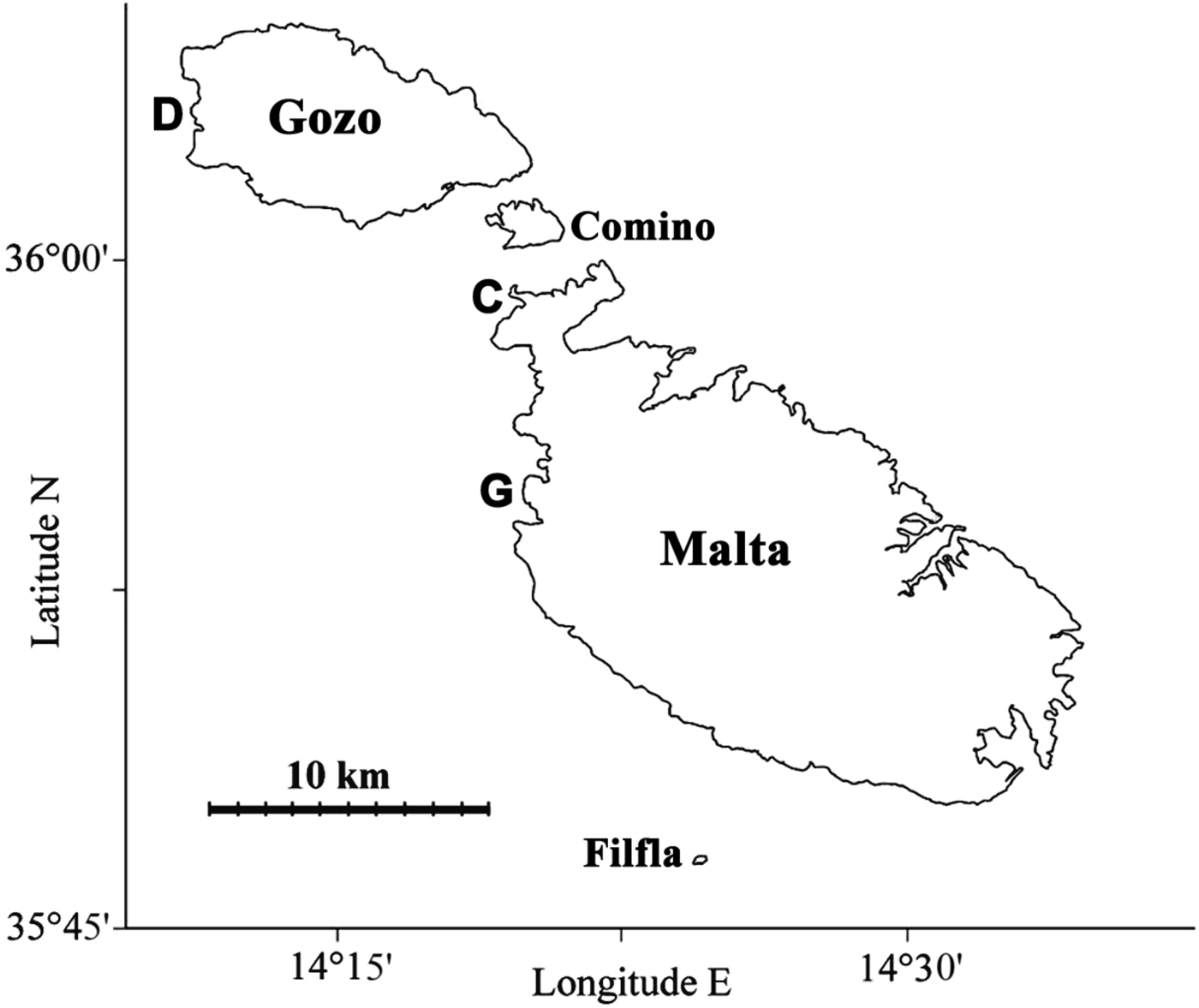
To assess whether A. preissii has a more widespread distribution in the Maltese Islands, surveys were made at two additional sites, one located a few kilometres away from Cirkewwa, on the western side of the island of Malta, and the other on the west coast of the island of Gozo (Figure 2). No specimens of A. preissii were recorded from Gnejna, Malta. In the case of Dwejra, Gozo, a few tufts of this species were recovered from Cystoseira foeniculacea (Linnaeus) Greville, 1830 at a depth of 25 m, indicating that A. preissii is present in the area but at a very low abundance. Filamentous rhodophytes did not form extensive turfs at any of the three sites surveyed.
Map of the Maltese Islands showing the location of the three sampling sites: Cirkewwa (C), Dwejra (D) and Gnejna (G). Acrothamnion preissii was present at Cirkewwa and with low abundance at Dwejra; it was not recorded from Gnejna.
DISCUSSION
Acrothamnion preissii is distributed in the north-western and central Mediterranean Sea. It is frequent along the Ligurian and adjacent southern French coasts and in the northern Tyrrhenian, and less common around the Balearic Islands, the central Tyrrhenian coast of Italy (Campania) and around Sicily (e.g. Klein & Verlaque, Reference Klein and Verlaque2011), but was not known to occur further south prior to the present record, despite detailed surveys for this species undertaken in other central Mediterranean sites (e.g. in Cape Bon [Tunisia], in Pantelleria and in Lampedusa; see Piazzi & Cinelli, Reference Piazzi and Cinelli2000; Piazzi et al., Reference Piazzi, Balata and Cinelli2002; Furnari et al., Reference Furnari, Giaccone, Cormaci, Alongi, Catra, Nisi and Serio2010). Thus, the present report of A. preissii from the Maltese Islands represents the first record of this species from the central Sicilian Channel and indicates a southwards expansion of its distribution range by some 100 km. Given that A. preissii is a small and inconspicuous alga that is not identifiable in the field, it can easily be overlooked and remain unnoticed in the absence of regular meticulous collection and examination of epiphytic assemblages (Piazzi & Cinelli, Reference Piazzi and Cinelli2000; Meinesz, Reference Meinesz2007). Therefore, although there is an 18-year gap between the present Maltese record and that from Sicily in 1996 by Giaccone & Di Martino (Reference Giaccone and Di Martino1996), this does not necessarily imply that A. preissii has extended its range recently. On the other hand, this species was not present around the islands in 1994–1995 when Cormaci et al. (Reference Cormaci, Lanfranco, Borg, Buttigieg, Furnari, Micallef, Mifsud, Pizzuto, Scammacca and Serio1997) carried out detailed sampling of marine algae in Malta.
According to Sartoni & Sarti (Reference Sartoni and Sarti1976), the original introduction of A. preissii into the Mediterranean region was likely due to transportation via shipping activities. Its subsequent westwards expansion from Livorno along the northern coasts of the western Mediterranean basin may have occurred naturally due to the dominant currents in the area (Boillot et al., Reference Boillot, Caram and Meinesz1982), enabling A. preissii to spread via vegetative multiplication (Boudouresque & Verlaque, Reference Boudouresque and Verlaque2002). On the other hand, its westernmost limit of distribution along the southern coasts of France is Marseille (Klein & Verlaque, Reference Klein and Verlaque2011), so the spread of A. preissii to the Balearic Islands may have involved human-mediated vectors of dispersal. No information on how this species spread southwards to Sicily and Malta exists, but this could include both natural range expansion and mechanisms based on anthropogenic activities; multiple introductions of species via different vectors are not uncommon (Verlaque et al., Reference Verlaque, Ruitton, Mineur and Boudouresque2007).
The reported habitats of A. preissii from the Maltese Islands (as an epiphyte on macroalgae at depths of 20 to 25 m, in low quantities on Cystoseira spp. and moderately common on the sciaphilic Phyllophora crispa) are similar to those elsewhere in the north-western Mediterranean Sea (e.g. Klein & Verlaque, Reference Klein and Verlaque2011). No examination of the epiphytes on Posidonia oceanica rhizomes was carried out, so it is not known if A. preissii also occurs in this habitat in the Maltese Islands. However, no extensive dense turfs were observed at any of the locations surveyed, including amongst P. oceanica beds. This indicates that thus far neither A. preissii nor Womersleyella setacea (from which A. preissii cannot be distinguished in the field) can be considered to be acting invasively in the infralittoral waters of the Maltese Islands, although W. setacea may be invasive on some maerl beds in the upper circalittoral (Sciberras et al., Reference Sciberras, Rizzo, Mifsud, Camilleri, Borg, Lanfranco and Schembri2009). Whether these algae will persist without attaining a high biomass or eventually enter an invasion phase can only be ascertained by regular surveys of their reported habitats. Such monitoring is essential given that control of these species can only be carried out effectively early in the invasive process; once they become invasive, even containment may be impossible (Otero et al., Reference Otero, Cebrian, Francour, Galil and Savini2013).
ACKNOWLEDGEMENTS
We are grateful to Enric Ballesteros (Centre d'Estudis Avançats de Blanes, CSIC) for confirming the identity of the species, to Vincenzo Di Martino (L'Istituto per i Sistemi Agricoli e Forestali del Mediterraneo, CNR) for supplying us with some hard-to-find literature and to Sandro Lanfranco (University of Malta) for the provision of laboratory facilities. Comments by Dr Cynthia D. Trowbridge (Oregon Institute of Marine Biology) and an anonymous referee helped improve the paper. This research was supported by the Albert II Foundation through the CIESM (Commission Internationale pour l'Exploration Scientifique de la Mer Méditerranée) project ‘Tropical Signals’. Additional funding was received from the European Community's Seventh Framework Programme (FP7/2007–2013) under Grant Agreement No. 287844 for the project ‘Towards COast to COast NETworks of marine protected areas (from the shore to the high and deep sea), coupled with sea-based wind energy potential’ (COCONET).