Although there is wide agreement that conflict over territory is especially common and destructive, there is less consensus about why that is the case.Footnote 1 Understanding the role of territory in international conflict requires complementing realist and materialist understandings of the value of territory with one grounded in the constructivist theories that dominate studies of nationalism and geography. These theories suggest that homeland territoriality, because it raises the value of a specific territory and provides an imperative to establish sovereignty over it, plays a distinctive role in driving international conflict. This article integrates constructivist understandings of the role of territory into quantitative studies of territorial conflict by presenting a systematic, replicable operationalization of the homeland status of territory that is consistent with constructivist theories of nationalism. This measure is then used to test the implication that the loss of subjectively defined homeland territory increases the likelihood of international conflict relative to the loss of nonhomeland territory.
It is unexceptional to observe that a state that loses territory valued by its population is more likely to engage in conflict across that border. However, significant works on territorial conflict, secessionist wars, and partitions still tend to minimize the impact that the perception of a particular territory as part of the homeland might have on conflict. The canonical studies of territorial conflict usually emphasize a combination of a territory's economic value, strategic location, and demographic characteristics, rather than nationalist ideology, as the main links between territory and conflict.Footnote 2 Weidmann for example, suggests that it is the improved communication and mobilization possibilities provided by territorial concentration rather than anything about the particular territory that are actually related to violence.Footnote 3 While recognizing the symbolic value of territory, Walter concludes that reputational concerns play a more significant role in accounting for variation in the onset of separatist wars.Footnote 4 At least one study concluded that the intangible value of homelands may be less important than we might otherwise expect because states are more likely to successfully negotiate over territory that is part of the metropole than over colonial dependencies.Footnote 5
Many supporters of partition as a policy solution to ethnic and nationalist wars also minimize the role of perceptions that a particular territory is part of the homeland as a cause of conflict.Footnote 6 Their argument boils down to the reasonable position that a peace based on mutual deterrence and the separation of populations is more likely than a peace based on forcing groups that have already started fighting to live together. In these accounts, a territory's demographic and strategic characteristics clearly matter for (re)establishing security, but any connection to a specific territory is secondary. After all, if attachment to a particular territory played a significant role we might expect the exclusion of a group from this territory to exacerbate rather than reduce conflict.Footnote 7 Instead, this argument largely assumes that any territory will do for the location of the national state as long as it has relatively defensible borders and is reasonably ethnically homogenous. From this perspective, therefore, it is not at all obvious that dividing homelands would lead to any more conflict than dividing nonhomeland territory. As a result, this scholarship has not devoted significant attention to operationalizing nationalist attachment to territory or to testing the assumption that it is secondary.
This article does both. Building on scholarship of nationalism and geography, I argue that homeland territoriality provides an analytically and theoretically distinct way in which actors evaluate the costs and benefits of engaging in conflict over land. The constitutive role of homelands in defining the nation and the nationalist imperative to establish sovereignty over the homeland make actors especially likely to seek the recovery of lost homeland territory, thereby increasing the incidence of international conflict.
Significant scholarship has implicitly recognized the idea that conflict over homelands may be qualitatively distinct from conflict over other kinds of territory. This distinction is implicit in the hypotheses that the emotive value of homelands leads to international conflict by lowering the domestic barriers to engaging in territorially revisionist policies or by transforming divisible territory into indivisible homelands.Footnote 8 In this vein, the Issue Correlates of War's (ICOW) “index of intangible value” represents a groundbreaking effort to include a measure of the perception that territory is part of the homeland in studies of territory and conflict.Footnote 9
Yet empirically testing the role of nationalist conceptions of the homeland has been hampered by two factors. First, there is a persistent gap between the realist and materialist measures used to identify “homelands” and their value and the constructivist underpinnings of the intuition that homeland territory plays a different role than nonhomeland territory in conflict. To address this gap, I develop an operationalization of the “homeland” status of a territory based on the domestic discourse about land on the other side of international borders. Since this is a constructivist measure that operationalizes the way theories of nationalism understand homelands, it enables a sincere test of the constructivist expectation that losing homeland territory would lead to more conflict than losing nonhomeland territory. To be sure, the use of a discourse-based measure raises questions about potential endogeneity because the presence of homeland discourse could itself be caused by prior conflict, by the act of drawing a border, or by the machinations of political elites intent on using homeland discourse to legitimate nationalism. To address this possibility, this study complements the main analysis with a second measure of homeland status that is less susceptible to such concerns because it is based on the presence of co-ethnics in a territory as identified before the border was drawn.
Second, the tendency of studies of territorial conflict to restrict their analysis to cases where conflict exists limits their ability to explain why only some territory becomes contested in the first place.Footnote 10 As a result, to test the hypothesis that the loss of homeland territory is more likely to lead to conflict than the loss of nonhomeland territory, this article sharpens the universe of cases to include all states that experienced a new international border drawn between 1945 and 1996. These cases thus include all those in which states plausibly lost territory that they could have seen as part of their homeland, regardless of whether they claimed this land as appropriately theirs or engaged in conflict over it.
Homelands, Nationalism, and Conflict
Although there is some evidence that humans' territorial nature may be hardwired,Footnote 11 the types of spaces we seek to control, the ways we identify these areas, and the tactics with which we exercise this control are all historically contextual. Human territoriality, understood as “the attempt by an individual or group to affect, influence, or control people, phenomena, and relationships, by delimiting and asserting control over a geographic area,” is a strategy whose particular deployment varies over time.Footnote 12
A wide array of phenomena in international relations show that forms of territoriality are sensitive to historical, ideational, and technological developments. For example, the shifting conceptions of space engendered by modern mapping technologies changed how states pictured, demarcated, and sought to control their realms.Footnote 13 In another example, for most of modern history the unpopulated atolls in the East China Sea were relevant only as obstacles to seafaring vessels. It was only after the invention of the internal combustion engine and the discovery of oil underneath them that the application of various strategies of territorial control to these once-forsaken areas accelerated (along with international conflict).Footnote 14
The “homeland” is a conceptual shorthand for a similarly contextual form of territoriality. To be sure, groups have always had locations that they were from, in which they resided, and to whose landscapes they were emotionally tied. People have also always sought to control particular locations for material reasons (as in the timeless conflict between farmers and ranchers). “Homelands,” however, are more than these locations. They are a specific form of territoriality engendered by the rise of nationalism that asserts that a particular group of people (the “nation”) ought to control a particular territory because that land is part of who the people are. In terms of its effect, nationalism is like the discovery of oil; it is a change (in this case ideational rather than technological) that revamps the way territory is valuated.
The identification of a particular territory as the national “homeland” may be based on a historical tie to the land, but it is primarily a social and political act.Footnote 15 As a result, the historical link between a nation and its homeland can be more or less tenuous, either because the nation was not actually present on that land or because “the nation” as such did not yet exist at the time. For example, the Boers claimed South Africa as their divinely promised homeland despite being settlers from another continent.Footnote 16 French nationalists could believe that “l'Hexagone” was the French homeland despite needing to first forge a “French” nation from the multiple groups in the area to inhabit it.Footnote 17 Similarly, the fact that the forefathers of Uzbek nationalists are unlikely to have thought of themselves as “Uzbek” before their consolidation as an ethnonational group in the early 1920s does not prevent an Uzbek nationalist poem from calculating the worth of the homeland in terms of “the remains of our forefathers [w]ho turned into dust for this precious soil.”Footnote 18 Despite its subsequent power, the initial identification of particular territory as the homeland may even be essentially random, as in the persuasive argument that the boundaries of homelands could have originated as solutions to coordination dilemmas.Footnote 19 The constructed character of homelands means that determining the homeland status of territory by relying on apparently objective features of the world is likely to introduce a significant (and unaccounted-for) source of error.
The constructed character of homelands does not, however, render them epiphenomenal or rob them of their power. The territorial dimension of nationalism is so fundamental that it is usually embedded in its very definition. For example, Anderson's cardinal definition of the nation as a political community that is “imagined as both inherently limited and sovereign” requires a geographical location in which this sovereignty is to be exercised.Footnote 20 In another formulation, territorial borders are “kit and caboodle, then, to everyday nationalism.”Footnote 21
The cardinal role played by homeland territory in constituting a nation renders the homeland a secular functional analogue to sacred ground.Footnote 22 Indeed, recent field experiments have found that the sanctity of homelands structures the preferences of nationalists in very much the same way that religious values structure the preferences of believers.Footnote 23 Not only does this help explain why the loss of part of the homeland provides a reason for conflict, but it implies that the value of homelands could be analytically independent of their economic, strategic, or demographic value. Just as the importance of the Black Hills of South Dakota to the Lakota Sioux is not reducible to their real estate value and the value of the Kaaba in Mecca is not pegged to the Riyals spent by pilgrims, territory categorized as the homeland may be valuable primarily in terms of the nationalism that calls the homeland into existence. This is why even Nayef Hawatmeh, a committed Marxist and leader of the Palestinian Democratic Front for the Liberation of Palestine, could argue that the value of the homeland is independent of its material characteristics. “We are fighting,” he declared, “for what is our land, even if it were a barren desert in which only thorns grew.”Footnote 24 Homeland claims should thus be understood not simply as a measure of the intensity of attachment to territory (though they certainly are that), but as reflecting a potentially distinct reason for the existence of such attachment in the first place. Although material reasons are still likely to affect the definition of homelands, there is good theoretical reason to believe that the value of “homelands” may not be reducible to these material calculations.
The premium nationalism places on controlling a specific territory makes “homelands” much more salient for international conflict than “the places that we are from” because nationalism contains an imperative to maintain sovereignty over such territory that is absent from “the places we are from.” Until nationalism emerged, a group could be physically separated from the location it was from, but groups did not lose their “homeland” if sovereignty over part of it changed. This helps explains why exiles' pining for the places they were from in the prenationalist period did not usually lead to attempts to reassert their sovereignty over those places or to significant international conflict.Footnote 25
The absence of homeland territoriality also helps explain why, until the rise of nationalism, territory could be swapped among states without much trouble.Footnote 26 As has been noted elsewhere, the mere presence of group-based grievances (in this case, about the loss of territory) does not automatically trigger mobilization, let alone violent conflict.Footnote 27 The emergence of nationalism transformed the objective loss of a particular territory, if it was designated as part of the homeland, into a grievance worth mobilizing around. The nationalist conception of homeland territory makes its rule by a “foreign” power problematic not just because it limits locals' ability to use the land and its resources (which had long been a sufficient reason for conflict), but because it prevents the nation from achieving its full potential. Once the nationalist idea took root, the territorial transfers that characterized international politics in prior eras became insulting rather than routine and losing part of the homeland became a theoretically sufficient reason for international conflict. In other words, after the rise of nationalism, ideas about where the homeland is were added to the list of factors considered by actors when calculating the costs and benefits of territorial conflict.
Although their empirical examination lies beyond the scope of this article, there are a number of pathways through which the application of homeland territoriality to specific territory could increase international conflict. The existence of homeland territory outside a nation state's borders is likely to increase the domestic appeal of territorially revisionist forces because it provides a substantive issue for war and makes it easier for leaders to initiate international conflict as a way of diverting attention from domestic political challenges.Footnote 28 Relatedly, the successful application of homeland territoriality to territory may be part of what renders it apparently indivisible. Since populations that lost parts of their homeland are more likely to reject the legitimacy of the territorial status quo, they may be more likely to use force to change it if given the ability and opportunity to do so. Their irredentism, in turn, threatens the territorial integrity of their neighbors and intensifies the security dilemma in the region, making violent conflict even more likely.Footnote 29 Finally, the centrality of homelands in nationalist thinking also makes homelands a likely focal point for collective action. This means that the loss of homeland territory would lower the barrier to violent collective action by acting as a focal point that leads members of a nation to believe that others would act with them if they seek its return.Footnote 30
Where Is the Homeland?
—Dear God, Who draws the lines around the countries? Nan.Footnote 31
Evaluating the impact of homelands on conflict requires the ability to distinguish between homeland and nonhomeland territory in a way that is consistent with the theories of nationalism that identify “homelands” as a potentially meaningful variable. However, most studies of territorial conflict either do not distinguish between “homeland” and “nonhomeland” territory, or, if they do, rely on measures that are inconsistent with key aspects of theories of nationalism.
Ideally, the homeland status of territory might be identified by asking a population where they believe its borders lie. Unfortunately, no such data exist today. Not only does the availability of reliable survey data vary a great deal around the world, but even where such data are available, questions about the extent of the homeland are almost never asked. This could be because the importance of answering this question has been systematically overlooked, because it is politically sensitive and therefore difficult to ask in many contexts, or because a too-easy acceptance of methodological nationalism fostered the assumption that the answer is obvious.
As a step toward improving the available measures, this article presents a new, systematic, and replicable way of operationalizing the homeland status of territory. This measure takes advantage of the fact that, since “homelands” are a particularly nationalist form of territoriality, nationalist discourse offers a theoretically consistent way of identifying how populations distinguish between homeland and nonhomeland territory. This approach follows a well-established tradition in case studies of nationalism of using both official and unofficial discourse as data about nationalism in general, and about territory in particular.Footnote 32
The sacralization of some territory as the “homeland” by nationalists and the imperative to rhetorically delineate its boundaries means that nationalists speak of their homeland in different terms than they speak about nonhomeland territory.Footnote 33 As Connor pointed out, the consistent nationalist use of familial metaphors “mystically convert[s] what the outsider sees as merely the territory populated by a nation into a motherland or fatherland, the ancestral land, land of our fathers, this sacred soil … the cradle of the nation, … and most commonly, the home—the homeland of our particular people—a Mother Russia, an Armenia, a Deutschland, an England (Enga land: land of the Angles), or a Kurdistan (literally, land of the Kurds).”Footnote 34 The resulting depictions of the homeland generate an “instantly recognizable, everywhere visible” logo that penetrates the popular imagination and forms a powerful emblem for the nation.Footnote 35
As contemporary geographers have pointed out, these verbal and pictorial depictions are discursive attempts to shape the world to make it congruent with the nationalist vision of where territorial borders should be drawn.Footnote 36 As a result, the rhetorical differences between how homeland and nonhomeland territories are spoken of makes it possible to identify the homeland status of territory while maintaining greater fidelity to the constructivist foundations of the dominant theories of nationalism. Specifically, a discourse-based measure of the homeland status of territory delinks homeland status from other dimensions of nationalism (most prominently ethnicity) and allows the homeland status of particular territories to vary over time and within a nation.
Other commonly used proxies for the homeland status of territory contravene at least one element of contemporary understandings of nationalism. For instance, large-N studies of territorial conflict often use “homeland” to distinguish the area of the state proper from its colonial holdings. This is certainly a reasonable distinction because, unlike a nationalist's view of the homeland, colonial possessions are fungible.Footnote 37 However, by equating the current borders of the metropole with those of the “homeland,” this proxy minimizes the possibility that the definition of the “homeland” may not correspond to current state borders. The state may control some territory that is neither part of the homeland nor a colony (such as Israeli rule over the Sinai Peninsula between 1967 and 1982) or have significant parts of the homeland outside its control (as demonstrated by Hungarian pining for the pre-Trianon borders).
Another commonly used measure identifies homeland territory as that populated by co-ethnics.Footnote 38 The rationale for this proxy is captured by Gellner's “potato principle,” whereby territory is claimed as part of the homeland if a group's ancestors once grew potatoes—or, more generally, were physically rooted—in it.Footnote 39 This proxy is especially attractive because the historical existence of ancestors on a parcel of land before the onset of any conflict, or even before the creation of nation-states, appears to provide a way to identify the presence of nationalist sentiment that is exogenous to the strategic and material considerations of states and their leaders.
The prominent role that ethnicity plays in the formation of many nations certainly means that homelands could be demarcated by the past or present presence of co-ethnics. This proxy, however, is inconsistent with two important aspects of the dominant theories of nationalism that tell us that homelands could matter. First, it assumes an unproblematic and automatic link between ethnicity and nationalism. Yet, as even Gellner noted, the existence of a prior ethno-national community is “inessential” for the creation of nations.Footnote 40 Relying on this proxy thus inadvertently misses the homelands of so-called “civic” nations, which are not based on shared ethnic membership. Indeed, the automatic equation of ethnicity and homelands makes it impossible to even ask empirically whether ethnicity and homeland territoriality have distinct impacts on conflict. Second, this proxy's reliance on the (perceived) legacy of the past to determine the homeland status of territory renders homelands effectively static. This contradicts the widely accepted possibility that nationalism and its meaning, including the definition of the homeland, could change over time.Footnote 41
The practical application of this proxy also raises three additional concerns. The first has to do with the assumption that the presence of ancestors in some location is exogenous to the machinations of political elites. In many cases, the selection of a particular group of people as “our ancestors” whose past location justifies a territorial claim is part and parcel of the nationalist project rather than an empirically neutral task. Indeed, significant scholarship has documented the ways in which historic continuity has been invented in cases around the globe.Footnote 42 In this vein, a review of archeology's role in nationalism criticized the rampant ahistorical practice of “peopling the past” in which “specific archaeological cultures were unproblematically seen as ancestral to contemporary ethnic or national groups.”Footnote 43 This concern could be ameliorated somewhat if the determination of the presence of co-ethnics was based on sources that predated the nationalist enterprise, but, unfortunately, such sources are quite limited.Footnote 44
The assumption that the presence of co-ethnics marks the boundary of the homeland also depends on a battery of questions and assumptions that are rarely answered or evaluated. Is it the absolute number of co-ethnics or their relative share of the population in a particular territory that triggers the designation of “homeland”? If the former, how many co-ethnics are required to be present before a previously excluded territory becomes seen as part of the homeland and, conversely, how much emigration or ethnic cleansing would lead us to stop coding a territory that had been identified as a group's homeland in that way? If it is the relative share of co-ethnics that matters, what is the proportion at which the designation of homeland begins to apply?
Most problematic, it is difficult, if not impossible, to choose the area that serves as the denominator for these calculations without a priori assuming the location of the homeland that the ethnicity proxy is trying to measure. In other words, using the presence of co-ethnics on a parcel of land as an indicator of its homeland status requires a way of determining which concentrations of co-ethnics consecrate the land on which they reside and which do not that is independent of any prior assumption about where to look. Relying on the presence of co-ethnics to identify homelands without addressing these questions would lead to the identification of the “pale of settlement” in the Russian empire as the Jewish homeland in the nineteenth century, present-day Jordan as the Palestinian homeland, and the upper Midwest of the United States as part of the Norwegian homeland, because all three contain (or once did) significant populations of co-ethnics.Footnote 45 Such remarkable measurement errors would raise significant concerns about the utility of this measure.
Another proxy that is used to identify the status of territory as a homeland is the existence of prior autonomy.Footnote 46 Although logical, the use of this proxy requires an arbitrary decision about how far back in time such autonomy could exist and still be relevant. Although ICOW's use of prior autonomy as one factor in its index of a territory's intangible value not unreasonably limits this history to the past 200 years, nationalists commonly go much further back in time to establish the legitimacy and authenticity of their claims. For example, Kwame Nkrumah appealed to a legacy of prior autonomy in the fourteenth century and Zionist movements used the existence of prior autonomy nearly two millennia ago to legitimize their respective nationalist projects.Footnote 47 In addition to these measurement concerns, the use of this proxy would also need to be attentive to the possibility that the identification of prior autonomy could also be part of the nationalist project. Indeed, ancient autonomy can be more or less illusory and the borders in which it was exercised fluid and poorly demarcated.Footnote 48 In other words, the identification of the geographical area in which ancient autonomy was practiced is also subject to concerns about its endogeneity to nationalism and elite manipulation.
In sum, although pegging the homeland status of territory to domestic discourses about the homeland raises concerns about potential endogeneity, these concerns are not entirely absent from other proxies. A discourse-based measure also has the advantage of being more congruent with the theories of nationalism that lead us to expect that homelands matter without having to make additional assumptions about the relationship between the geographic distribution of co-ethnics and the extent of homeland territory, the length of time beyond which prior autonomy is no longer relevant, or the necessary congruence of homelands and state borders.
Operationalizing Homeland Status
To identify the homeland status of territory using the domestic discourse about land on the other side of new international borders I used the discourse captured by the US government's Foreign Broadcast Information Service (FBIS). FBIS systematically transcribed open source news broadcasts from almost every country between 1945 and 1996. As a source, FBIS has three main advantages: (1) its scope is nearly global;Footnote 49 (2) its records are searchable by keyword; and (3) it translates all foreign news broadcasts into English. The latter is especially important for cross-national analysis because it overcomes the practical challenge posed by the fact that nationalist discourse is everywhere articulated in the vernacular. Because it provides reasonable access to how actors in (nearly) every case where a new border was drawn since 1945 talked about the land on the other side of this new border, discourse about territory captured by FBIS provides a feasible and theoretically consistent proxy for identifying areas that the relevant populations consider part of their homeland.
Following the insight that discourse about homeland territory would differ from discourse about nonhomeland territory, I coded land on the other side of a new international border as homeland territory if states, state executives, or the leaders of political organizations in the state newly excluded from that territory flagged it as part of their homeland. Specifically, I coded territory as homeland territory if these actors lamented its loss as a loss of part of the “homeland,” “fatherland,” or “motherland,” if they called for its “unification” or “reunification” with the metropole, if they described the territorial division in invidious terms as a “partition” or an “amputation,” or if they described the presence of another state on that territory as an “occupation.” In each case, I conducted a search for the name (often names, along with alternative transliterations) of the territory in question as well as for major cities or significant historical sites in those territories, and of the border itself, to capture as much discourse about that territory as possible.
Where the discourse of domestic actors identified a territory as part of the homeland, I designated that territory as homeland territory regardless of whether the homeland claim was articulated by formal representatives of the state or by organized political movements that did not speak for the state. This is another difference between this data set and ICOW, which includes only articulations by state leaders. In authoritarian states, claims made by the ruling party or high functionaries that are not part of the state executive leadership are counted as homeland claims made by “nonstate” actors. The inclusion of homeland claims by domestic political organizations that are not part of the state's leadership biases the current study against finding any linkage between dividing homelands and conflict since such actors are relatively less able to drive their states into interstate conflict.Footnote 50
Where the pattern of articulation in the domestic media of the state did not include land on the other side of the border as part of the homeland, that territory was coded as not having homeland status. It is certainly possible that such territories could continue to be important to domestic actors even if they are not included in the public discourse about the homeland. However, because new borders affect control of land and often raise expectations about other territorial modifications that could take place, we would expect the flagging of homeland territory precisely in these contexts. As a result, we can be relatively confident that FBIS would have picked up claims had they existed. More broadly, for this analysis, I assume that lost territory that is not consistently identified as part of the homeland can be thought of as relatively less important than territory that is consistently included in the nationalist pattern of articulation. Indeed, as has been demonstrated elsewhere, even short-term elisions of territory from the pattern of articulation defining the extent of the homeland can lead to the eventual exclusion of that territory from the definition of the homeland.Footnote 51
There were four categories of potential claims that were not coded as reflecting the homeland status of territory. First, I excluded homeland claims by individuals (for example, op-eds) and generic sentiments that could not be attributed to an existing political organization. This rule is based on the need to provide a minimal threshold (the presence of some identifiable political organization) below which a homeland claim might not be a viable indicator of collective belief. For example, a report that the Polish foreign minister received complaints for saying that Poland has no claims on the Vilnius region was not counted as a homeland claim to the area Poland lost to the USSR after World War II since these complaints are not attributed to any particular political organization. Where, however, the media outlet is the organ of a particular political movement, the homeland claims it makes are attributed to that movement. For example, the claim by a 1950 editorial in the Bulgarian Rabotnichesko Delo to Macedonia as part of the Bulgarian homeland is counted as a claim by the Bulgarian Communist Party.
Second, I did not count claims to the people in a particular territory or for compensation for lost real estate as denoting the homeland status of that territory if these claims did not also include a specific reference to the land itself as part of the homeland. This was driven by a desire to identify the homeland status of territory in a manner that is as independent as possible from the territory's demography or pecuniary value to individuals. For example, the calls by German refugees from Sudeten for compensation are not counted as claims that the Sudeten was part of the German homeland (though these exist elsewhere). Similarly the concern expressed by the Hungarian state and political organizations for “Hungarians abroad” does not automatically translate into including the territories in which they reside as part of the Hungarian homeland.
Third, arguments by co-ethnics across a border that wanted to secede from their current state and claimed that the land on which they resided was part of the homeland of the state they wished to join were also not counted as reflecting the homeland status of that territory. For example, the claims by leaders of the “Rossiya” bloc in Ukraine that the Crimea was part of the Russian homeland were not counted as designating the homeland status of Crimea for Russia because Rossiya was not part of the domestic Russian political spectrum. However, claims that Crimea was part of the Russian homeland by Russian political organizations, such as the Liberal Democratic Party of Russia, were taken as indicating the homeland status of Crimea for Russia.
Finally, I did not count potential homeland claims that remained implicit as reflecting the homeland status of the territories that they referred to. For example, Romania, Pakistan, and Guinea Bissau tended to couch their perception that Moldova, Kashmir, and Cape Verde, respectively, were part of their homeland in terms of demanding the self-determination of the populations residing in those territories. This framing of claims was driven by the belief that, given the choice, these populations would choose to “reunite” with the homeland. Although most of the time such claims went hand-in-hand with more overt claims, where the desired territory was not explicitly included as part of the homeland such implicit claims were not coded as denoting the homeland status of territory. Similarly, generic claims for the unity of, for example, the Arab or Slavic homeland, were not counted as homeland claims unless they contained a specific reference to the land on the other side of the border. Articulations by Arab states that do not border Israel that Palestine was part of the “Arab homeland” were also not counted as reflecting the status of Palestine as part of their nation-state.Footnote 52
Although FBIS provides a way of accessing the pattern of articulation about homelands in data that is equivalent across cases and thereby enables cross-national quantitative investigations of the impact of homeland claims, it does have three main limitations. First, it likely overrepresents discourse by ruling governments and state leaders. This is the case because the media outlets that provide the open-source information translated by FBIS have historically been controlled by states. Nonstate actors, perhaps especially opposition movements, may thus get less “air time.” As a result, while making quantitative comparison possible, FBIS may not capture the full range of domestic variation about the status of a particular territory as part of the homeland, even where such variation exists. This same bias, however, simultaneously increases our confidence that any such identified claims reflect a sustained rather than a spurious conceptualization of the homeland.
Second, FBIS is too blunt a source to reliably capture situations where nationalists assign different values to different parts of the homeland. Nonetheless, the nominal level measurement of the homeland status of territory it enables is a first step on the way to a better integration of homelands into quantitative scholarship on territory and conflict.
Finally, FBIS's systematic coverage is limited to the post–1945 period. As a result, it cannot be used to identify the presence of homeland claims to territory that may have existed before that point. The concerns about endogeneity that this temporal limitation raises are addressed shortly. Broadly speaking, however, since the role of territory in war has declined in the post–World War II period as a whole,Footnote 53 this limitation should bias the resulting dataset against finding a role for homelands in conflict.
To test the implication that the loss of access to homeland territory is more likely to lead to conflict than the loss of nonhomeland territory, I coded the presence of homeland claims for every new international border drawn between 1945 and 1996. A border was defined as new if it separated independent states for the first time, or if the location of the border between states changed.Footnote 54 New borders were drawn as a result of bilateral treaties, the transformation of a previously administrative boundary (either within a colony or a state) into an international border, International Court of Justice (ICJ) decisions, or as a direct consequence of war.Footnote 55 I excluded borders between colonies of different colonial powers as preexisting international borders. The replacement of one state by another was also not counted as a new international border if the line separating the states did not move. Cases where a border revision lasted less than one year were excluded because it is difficult to disentangle their impact from that of the original border change. Cases where the relevant territory on the “other side” of the border was smaller than 100 square kilometers, disputes over waterways, and cases in which international borders were erased (such as the absorption of Goa by India or the unification of East and West Germany) were also excluded. Borders between former colonial powers and their colonies, and between former occupying powers and the occupied state if the state was occupied in its entirety, were also excluded.Footnote 56
Since any new line on the geopolitical map may be perceived differently by those on either side of it, I coded for the existence of homeland claims for both sides of every new border. The observations in the resulting cross-sectional data set are thus structured as directed dyads for each new border with the states on either side of the new borders as state A in one observation and state B in another.Footnote 57 The online appendix contains a full list of all the borders in the analysis, and whether the discourse of states on either side of them identified territory on the other side of the border as part of their homeland.Footnote 58
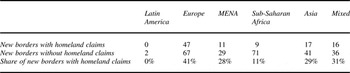
Tables 1 and 2 show that the share of territorial divisions that truncate homelands is distributed unevenly over time and across the world. There is considerable variation across decades, with especially notable spikes in the 1940s (as a result of the reordering of territorial borders after World War II) and the 1990s (largely driven by Serbian and Russian claims to the former territories of Yugoslavia and the Soviet Union, respectively). Europe also accounts for a disproportionate share of new borders that are characterized by homeland claims to land on the other side. It is possible that this is a product of the disproportionate attention FBIS paid to areas identified as strategically important for the United States. However, the results are robust to excluding all European cases from the analysis.Footnote 59 Since there are substantial differences between regions and decades, the following empirical analysis contains fixed effects for every possible combination of decade and region.Footnote 60
Homelands claims across new borders by decade

Homeland claims across new borders by region

In the analysis that follows, international conflict is operationalized in three ways, reflecting different levels of conflict: dyadic militarized interstate disputes (MIDs), violent dyadic MIDs, and dyadic wars. MIDs are disputes ranging in intensity from threats to use force to actual combat that falls short of the threshold for war.Footnote 61 Violent MIDs are those disputes in which military force was actually used rather than just displayed or threatened. This variable captures international conflict that is severe enough to be characterized by actual violence, but which still falls short of the standard for war. Wars are operationalized as conflict involving sustained combat and organized armed forces resulting in a minimum of 1,000 battle-related deaths within a twelve-month period.Footnote 62 Dyadic conflicts are appropriate in this context because we are interested in whether states that sit across a new border are more likely to engage in conflict with each other, not whether they are more likely to engage in conflict in general.Footnote 63
Homeland Status and International Conflict
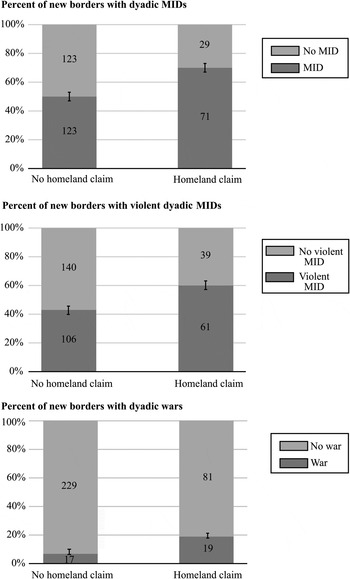
Figure 1 reveals significant variation in the presence of conflict across new borders. Generally speaking, dyadic MIDs across new international borders are common but far from universal, with 56 percent of all new territorial divisions experiencing a dyadic MID between the states on opposite sides of the new border. This pattern is consistent with the finding that many territorial conflicts do not escalate to militarized disputes.Footnote 64
Homeland status and international conflict

Figure 1 also shows that new borders that divide homelands are consistently related to conflict. States on opposite sides of a new border experienced a dyadic MID between them in 71 percent of the cases in which the new border divided the homeland of at least one of the states, compared with 50 percent of the time where this was not the case (t = −3.6248, d.f. = 344, p = 0.0003). Violent MIDs following the drawing of a new international border occur 43 percent of the time when homelands are not truncated, but 61 percent of the time when they are (t = −3.0541, d.f. = 344, p = 0.0024). The pattern persists for wars, with dyadic wars following the drawing of new international borders occurring 7 percent of the time when homelands are not truncated, but 19 percent of the time when they are (t = −3.3840, d.f. = 344, p = 0.0008).
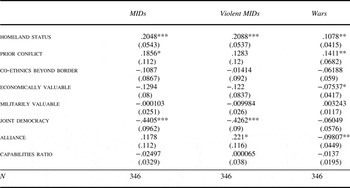
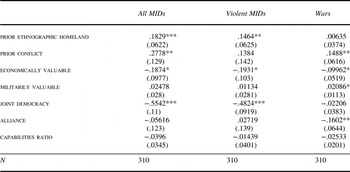
To test the hypothesis that the loss of homeland territory is more likely to be associated with international conflict than the loss of territory that is not categorized as part of the homeland, Table 3 reports the results of linear regressions with robust standard errors clustered for each dyad and fixed effects for every pair of region and decade for the three operationalizations of international conflict.Footnote 65 The table includes controls for those elements that could potentially account for the presence of homeland discourse about a territory and for conflict.Footnote 66 The finding that the same basic relationship holds regardless of the level of international conflict reinforces the connection between the homeland status of territory and international conflict.
Dyadic conflict between states on either side of a new international border

Notes: All models contain fixed effects for every pair of region and decade. Robust standard errors clustered by dyad in parentheses. * p < .10; ** p < .05; *** p < .01.
Since prior conflict is strongly associated with future conflict and because conflict can sanctify land, thereby leading to perceptions of the territory over which conflict took place as part of the homeland, the presence of prior conflict could theoretically account for the observed relationship between homeland discourse and conflict. To control for the impact of prior conflict, Table 3 includes a binary variable for the existence of any dyadic MID between the two states between 1816 and the year of the territorial division, inclusive.Footnote 67 Controlling for the existence of prior conflict also helps address the possibility that there is something about states making homeland claims where no new border has been drawn that is systematically different from those who do get new borders. Consistent with prior scholarship, the existence of prior conflict between states is related to subsequent conflict.
Given the widespread assumption that borders that cut through ethnic groups are more conflict prone than those that do not and the role played by co-ethnics abroad in generating support for challenging the territorial status quo, Table 3 also controls for the presence of co-ethnics on the other side of a new border.Footnote 68 Interestingly, the current presence of co-ethnics on the other side of the border is not consistently related to the presence of international conflict and does not substantively affect the impact of homeland claims on conflict.
This finding is consistent with prior research that found that having a majority of one ethnicity in one state and a minority in another is not systematically related to MID onset.Footnote 69 This result implies that whereas interstate conflict may often involve the presence of co-ethnics on the other side of the border, conflict does not necessarily follow from the presence of co-ethnics, per se. This also reinforces the theoretical weight that theories of nationalism grant to territory as a factor in constituting a nation's nationalism distinct from ethnicity. In other words, the violation of a nation's territorial aspirations are enough to trigger the “state-to-nation” incongruence identified by Miller as critical for international conflict, regardless of the actual presence or absence of co-ethnics on the other side of the border.Footnote 70
The desire for economically valuable territory could also trigger both the existence of homeland claims (as a cover for the desire for such territory) and conflict. Economically valuable territory is operationalized as a binary variable based on the presence of oil or natural gas reserves in a particular territory or border region.Footnote 71 Economically valuable territory is significantly, but negatively, related to conflict. This result is consistent with the argument that the existence of natural resources, rather than leading to conflict, expands the pie and thereby allows for the peaceful resolution (or preemption) of wars.
Like a territory's economic value, desire for militarily important territory could also lead to conflict and, potentially, to its designation as part of the homeland. The military value of territory is proxied by the (log) distance of the new international border from the capital city of the states in question.Footnote 72 This measure assumes that, other things being equal, the further away the international border, the less vulnerable a state feels if that border changes. For example, the fact that the 1949 border between Jordan and Israel divided Israel's capital made it strategically very important for Israel. In contrast, the fact that the border between China and Pakistan is more than 3,500 kilometers from Beijing makes it relatively less strategically important. This measure also captures the reality that the strategic value of territory may vary across the members of any particular dyad.Footnote 73
A large literature has tracked the relationship between democracies and peace. The relatively robust finding of this literature is that although democracies may not be inherently more peaceful than nondemocracies, democracies are less likely to fight one another.Footnote 74 Recent work has also argued that the findings of democratic peace are a function of the resolution of territorial conflict between states. From this perspective it is not that joint democracy leads to peace, but that the resolution of outstanding territorial claims leads to both peace and democracy.Footnote 75 Consistent with these arguments, dyads facing each other across a new border in which both states are democratic when the border is drawn are significantly less likely to engage in a dyadic MID (but not, necessarily, war) than dyads in which at least one of the states is nondemocratic.Footnote 76
Alliance ties might also be plausibly related to the categorization of land on the other side of the border as part of the homeland if homeland claims are less likely to be articulated against an ally. Alliances have also been found to modestly reduce the chances of a territorial dispute emerging in the first place.Footnote 77 As a result, Table 3 controls for the presence of any alliance between the members of the dyad facing each other across a new border.Footnote 78
Finally, Table 3 controls for the relative material capabilities of the members of the dyad because the relative material capability of the states on either side of the border is plausibly related to their willingness to engage in conflict and to the decision to categorize territory as part of the homeland.Footnote 79 This could be the case if actors are more likely to label territory as part of their homeland if they think they can actually get it.
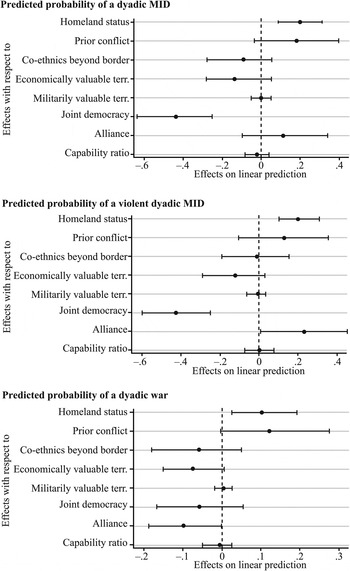
In sum, Table 3 shows that states that lost homeland territory are significantly more likely to engage in international conflict, including violence and even war, with the state on the other side of that border than states involved in territorial divisions that did not involve the loss of homeland territory. As Figure 2 shows, changing the character of a new border from one that does not divide homelands to one that does while holding all other variables at their mean is associated with a roughly 20 percent increase in the probability of a dyadic or violent MID and an 11 percent increase in the probability of a war between the states on either side of the border.
Predicted probability of international conflict

Alternative Explanations
The analysis thus far shows that homeland status remains linked to international conflict even after controlling for potentially confounding variables. The primary challenge to interpreting this link in causal terms is a concern about potential endogeneity and omitted variable bias. This concern stems from the possibility that the presence of homeland claims could be correlated with variables that are not adequately controlled for by the measures used in this study. There are also good reasons to be concerned that the homeland status of territory could be endogenous to prior conflict, to the act of drawing a border, or to the material value of territory. Bloodshed in particular locations and the sacrifices expended to defend them (for whatever reason) could sanctify those places, perhaps leading to their inclusion in the homeland and to the presence of homeland claims. It could also be the case that the act of territorial division itself could lead to the eruption of homeland claims; perhaps by making once-marginal claims salient or by undercutting dominant understandings of the homeland. The significant role elites play in shaping nationalism also raises the possibility that the definition of the extent of the homeland reflects their material calculations about territory. To the extent that any of these are the case, the discourse-based measure of the homeland status of territory might be picking up something else—such as contestation over the border or the land's economic or military value—rather than a socially grounded nationalist attachment to the territory in question. The lack of a temporal dimension to the data also means that we cannot rule out the possibility that it was the drawing of the new border that created the homeland claims themselves.
The observational statistical analysis based on the FBIS measure of the homeland status of territory is limited in its ability to empirically disentangle these questions of endogeneity. As a result, I created a second measure of the homeland status of territory based on the identification of the presence of members of ruling ethnic groups on the other side of (what would later become) the border before the border was drawn.Footnote 80 As I noted, the use of a co-ethnicity-based measure of the homeland status of territory is somewhat problematic because it is inconsistent with key aspects of the dominant theories of nationalism that lead us to expect that homelands matter. Nonetheless, because the identification of the presence of co-ethnics by this measure is temporally prior to the border and to the machinations of contemporary politicians, it mitigates the concerns about endogeneity.
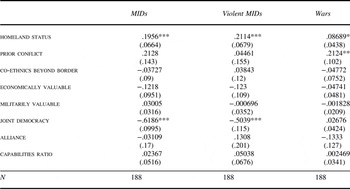
A territory was coded as part of the homeland if an ethnographic map based on data compiled before the border was drawn noted the presence of any members of a ruling ethnic group on the other side of what would eventually become the border.Footnote 81 The classification of ruling ethnic groups generally followed the Ethnic Power Relations (EPR-ETH) data set, with a ruling group defined as one that was in any government at the level of junior partner or higher.Footnote 82 As Table 4 shows, using this proxy for the homeland status of territory instead of the one based on homeland discourse yields substantively similar results for the presence of MIDs in general, as well as for violent MIDs. Although the results no longer hold for the presence of war, this is likely because there is so little variation that we would need many more cases to detect a relationship if one exists. Of the thirty-two wars in the data, only five take place where one side had no co-ethnics on the other side of the border before the border was drawn.
Dyadic conflict between states on either side of a new international border, alternative (ethnographic) measure of homeland status

Notes: All models contain fixed effects for every pair of region and decade. Robust standard errors clustered by dyad in parentheses. * p < .10; ** p < .05; *** p < .01.
The empirical record is also inconsistent with other observable expectations of the argument that homeland claims are endogenous to elite machinations, including the expectation that, at equilibrium, claims would be common and reciprocal.Footnote 83 The relationship between homeland status and conflict is also robust to recoding cases in which the articulated homeland claims are especially likely to be instrumental in nature (where claims are made only in a single calendar year and never again, or in which claims first appear more than five years after the territorial division) as not marking the homeland status of territory.Footnote 84
There are also theoretical reasons to believe that homeland claims may not be endogenous to the machinations of political leaders. First, this concern depends on the difficult-to-verify assumption that political leaders' nationalist commitments differ fundamentally from those of the populations that they lead.Footnote 85 Second, even if this assumption is accepted, the mere fact that leaders attempt to appropriate the discourse of homelands for ulterior motives suggests that the application of homeland territoriality to land on the other side of the border is deeply entrenched enough in a society to be ripe for instrumentalization. Understanding nationalism as intersubjectively defined means that a leader's ability to instrumentally use “homeland” territoriality to justify the incorporation of territory that is desirable for material reasons or, conversely, to contract the scope of the homeland to avoid costly conflict with a powerful neighbor over materially irrelevant real estate, is limited by the rest of the society's beliefs.
Overall, the results are substantially similar regardless of whether homeland status is proxied in a theoretically consistent but potentially endogenous way (homeland discourse) or in a way that reduces concerns about endogeneity, but is less consistent with the constructivist underpinnings of the theories of nationalism that flag homelands as a meaningful variable (prior existence of co-ethnics). This reduces the concern that the impact of a territory's homeland status on international conflict is endogenous to political machinations or to the drawing of the border, at least when it comes to MIDs and violent MIDs.
Although the measure of homeland status based on the past presence of co-ethnics addresses the possibility that contemporary conflict could lead to the definition of a territory as part of the homeland, it is still limited in its ability to ameliorate concern about endogeneity to prior conflict. Doing so would require detailed case studies of each new border that could establish the historical relationship between notions of homeland and conflict. Although these are beyond the scope of this article, the fact that homeland territoriality is a critical part of every nationalist enterprise but not every nationalism is born out of conflict means that there is at least a theoretical reason to believe that homeland territoriality is not necessarily endogenous to conflict. Although conflict over territory could certainly lead to the emergence of nationalism in some cases, most theories of nationalism point to other factors—such as industrialization, exclusion from power, or blocked economic mobility—as the main reasons nationalism emerges.Footnote 86 To the extent that these factors, and not territorial conflict, drove the emergence of nationalism, homeland territoriality would be exogenous to conflict over territory.
Empirically, the main analysis is robust to controlling for the presence of prior conflict in four different ways—MIDs between 1816 and 1945, a state's experience of any territorial change between 1816 and 1944, the existence of a violent territorial transfer between the states in the dyad between 1900 and 1944, and involvement in a civil war before 1945. Moreover, restricting the analysis to only those cases that never experienced conflict before the new border was drawn (according to any of these measures) and in which, therefore, endogeneity to prior conflict should not be a concern, does not affect the results.Footnote 87
Unfortunately, even the best measures of prior conflict are imperfect since observational data are always left censored. However, to qualify as an omitted variable, such prior conflict would have to influence the presence of homeland claims after 1945 without causing any international conflict between 1816 and 1944. Given the generally strong role of prior conflict in predicting future conflict, such a 130-year gap seems relatively unlikely. This logic, importantly, does not apply to states that enter the international system with a new international border drawn after 1945 since data on international conflict are gathered for existing states only. Prior conflict for these cases would be missed even if it existed. However, omitting these cases from the analysis does not change the results.Footnote 88 As a result, we can be relatively confident that any omitted variable bias caused by undetected prior conflict in these cases is not shaping the overall results.
Another concern is that the presence of homeland claims is functioning as a measure of the contestation over a border rather than of the homeland status of territory, per se. This could be the case because MIDs are much more likely between states that disagree about some aspect of where the border ought to be. To check this possibility, Table 5 reestimates the models in Table 3 but restricts the sample to states with new international borders that Huth and Allee identified as having a territorial dispute.Footnote 89 As Table 5 shows, the substantive relationship between homeland claims and international conflict remains the same. This lessens the possibility that the effect of homeland status on international conflict identified earlier is coming from disagreements about borders per se, rather than from disagreements about borders that involve claims to lost homeland territory.
Dyadic conflict between states on either side of a new international border only in cases of territorial disputes

Notes: All models contain fixed effects for every pair of region and decade. Robust standard errors clustered by dyad in parentheses. * p < .10; ** p < .05; *** p < .01.
Finally, we might also be concerned that a particular subsample of cases is driving the results. The most likely cases that could be doing so are those in which both sides of the dyad make reciprocal homeland claims to areas on the other side of the border. As we might expect, such cases are especially likely to be violence prone and to account for a disproportionate number of homeland claims. However, this subset of cases is not driving the results since the relationship between homeland status and international conflict remains substantively similar even when these cases are excluded.Footnote 90
Conclusion
Constructivist theories of nationalism argue that homelands are a special kind of territory because of their role in constituting nations. This article integrates this view of homelands into the scholarship on international conflict by presenting a systematic, cross-national, and replicable constructivist operationalization of the homeland status of territory. The present study thus contributes to the creation of data based on constructivist assumptions that, in turn, enable the cross-national quantitative testing of the empirically observable implications of constructivist theories of international relations.
Although the results of this study confirm the repeated finding that territory plays a significant role in international conflict, they suggest that not all territory is equally important. Rather, territory that is defined by a group's nationalism as part of the homeland is especially conflict prone. These results raise the possibility that the commonly observed relationship between territory and conflict may be driven by a subset of territorial disputes—those over homelands—rather than by territory, per se. The finding that dividing homelands tends to lead to additional conflict should, at the very least, be taken into account when territorial partitions are considered as potential policy solutions to international conflict.
Integrating the view of homelands as a particular nationalist form of territoriality into the study of territorial conflict has other implications that are relevant for the study of international conflict, but they lie beyond the scope of this article. First, because the definition of exactly what constitutes the homeland can change over time, homelands are not actually indivisible.Footnote 91 Although my analysis, like all prior investigations of homelands, treats them as static, future research could explore the conditions under which the homeland status of territory varies over time and the mechanisms that bring such changes about. Such an analysis would also be in a position to examine the role of politics relative to structural factors in driving variation in actors' pronouncement of claims and international conflict.
Second, although my analysis largely treated homelands as “social facts,” their constructed origins suggests that there is likely to be internal variation within the nation in the definition of the homeland and domestic contestation over its extent.Footnote 92 This internal variation might plausibly be related to the presence of international conflict if, for example, socially and politically powerful groups claim land on the other side of the border as part of the homeland whereas less powerful groups do not. Conversely, where claims are articulated by less powerful groups only, they may be less likely to lead to conflict. Empirically investigating the impact of such internal variation in the definition of the homeland on international conflict requires an analysis of homeland claims that takes the unit of analysis as the political movement rather than the state or the border, and systematically gathers data about the homeland claims made on that level. Such a study would also have to complement a source such as FBIS with sources better able to capture the full range of domestic variation in the definition of the homeland.
Supplementary material
Supplementary material for this article is available at http://dx.doi.org/10.1017/S0020818315000193.