Introduction
During World War II (WWII), more than 20 million people fled or were forced to migrate out of the eastern territories of Europe, because of the advancing of the Red Army that lasted until the capitulation of the Nazi regime in 1945. This forced migration is also called forced displacement or expulsion.
Forced displacement as a traumatic life event is associated with elevated psychosocial stress, long-term health consequences, and mortality rates (Kuwert et al., Reference Kuwert, Braehler, Glaesmer, Freyberger and Decker2009; Saarela and Finnäs, Reference Saarela and Finnäs2009). The population of former displaced people is under increased investigation due to the large number of traumatic events experienced in the past and its impact on mental health disorders such as post-traumatic stress disorder (PTSD) and depression (Kuwert et al., Reference Kuwert, Spitzer, Trader, Freyberger and Ermann2006; Strauss et al., Reference Strauss, Dapp, Anders, von Renteln-Kruse and Schmidt2011). PTSD was found in 9% and major depression in 5% of migrants, as well as a high comorbidity with other mental health disorders (Fazel et al., Reference Fazel, Wheeler and Danesh2005). People exposed to more than three traumas had a 4.7-fold increased risk of mental disorders more than 10 years after exposure (Steel et al., Reference Steel, Silove, Phan and Bauman2002). Trauma-related mental impairments declined over time, except for people who suffered multiple traumas (Steel et al., Reference Steel, Silove, Phan and Bauman2002). Former WWII children experienced more than one traumatic event throughout childhood and adolescence and are affected by depression, PTSD symptoms, and anxiety disorders in old age (Beutel et al., Reference Beutel, Decker and Brähler2007; Kuwert et al., Reference Kuwert, Spitzer, Rosenthal and Freyberger2008; Reference Kuwert, Braehler, Glaesmer, Freyberger and Decker2009; Glaesmer et al., Reference Glaesmer, Gunzelmann, Braehler, Forstmeier and Maercker2010).
According to Maercker (Reference Maercker1998), multiple factors affect the development and maintenance of PTSD symptoms. This biopsychosocial model of PTSD takes risk and protective factors into account in the development and maintenance of PTSD symptoms. Forced displacement in WWII is considered a risk factor that also has an impact on the mental health of these people even 60 years later (Kuwert et al., Reference Kuwert, Braehler, Glaesmer, Freyberger and Decker2009; Glaesmer et al., Reference Glaesmer, Gunzelmann, Braehler, Forstmeier and Maercker2010). Previous studies found multiple traumas to be associated with mental health disorders in terms of higher levels of PTSD, anxiety, and depression in former displaced people (Kuwert et al., Reference Kuwert, Braehler, Glaesmer, Freyberger and Decker2009; Strauss et al., Reference Strauss, Dapp, Anders, von Renteln-Kruse and Schmidt2011). As multiple factors are considered in Maerckers (Reference Maercker1998) model, the unique impact of displacement in WWII on PTSD and mental health in old age has to be explored. A study on older Germans found 31.5% of forced displaced people with a full PTSD diagnosis, 33.7% with a partial PTSD, and 34.9% with neither (Muhtz et al., Reference Muhtz2011b). Displaced people showed a higher amount of psychological burden and physical impairment. Physical diseases were positively associated with traumatic stress in older adults (Glaesmer et al., Reference Glaesmer, Braehler, Guendel and Riedel-Heller2011). As displacement is considered to be a traumatic event and traumatic experiences are associated with decreased health, the question arises whether displacement predicts the occurrence of mental disorders in aged adults? The occurrence of elevated mental health symptoms affects quality of life (QoL) and well-being (Beutel et al., Reference Beutel, Decker and Brähler2007). Hence, differences between displaced and non-displaced persons on health-related QoL are investigated. In addition, the impact of displacement on the prediction of health-related QoL is examined.
Associated with the increased body of research on the long-term effects of war-related events, this study aims to investigate in depth the factor of displacement and its unique contribution to mental health disorders in older adults. First, we investigate whether forcibly displaced and non-displaced people differ regarding mental health disorders and health-related QoL in this representative sample. The investigation of health-related QoL in displaced people is a novel aspect. Second, we examine the substantial contribution of displacement as a biographical variable to predict PTSD, depression, somatoform symptoms, and health-related QoL. The unique impact of forced displacement, as a predictor for mental disorders and QoL, is yet unknown. We also examine the odds for displaced people to report symptoms of mental health disorders and the likelihood of displacement to affect health-related QoL even 60 years later. A new approach is presented by using forced displacement as a biographical variable and predictor for the occurrence of mental health disorders and QoL in late life.
Methods
Subjects
A representative sample of the German general population was selected with the assistance of a demographic consulting company (USUMA, Berlin, Germany). The survey met the ethical guidelines of the International Code of Marketing and Social Research Practice by the International Chamber of Commerce and the European Society of Opinion and Marketing Research. The study was reviewed and approved by the institutional ethics review board. Germany was separated into 258 sample areas representing the different regions of the country. Households of the respective area and members of these households fulfilling the inclusion criteria (age >14 years, able to read and understand the German language) were selected randomly. The sample aimed to be representative in terms of age, gender, and education. A first attempt was made for 8,368 addresses, of which 8,116 were valid. If not at home, a maximum of three attempts were made to contact the selected person. All subjects were visited by a study assistant, informed about the investigation, and handed self-rating questionnaires. The assistant waited until the participants answered all questionnaires and offered help if the meaning of the questions was not clear. A total of 5,033 people agreed to participate and completed the self-rating questionnaires in May and June 2008 (participation rate, 62.1%). Participation was refused by 1,982 subjects (24.4%), 1,029 subjects (12.7%) were not reached after four attempts, and 67 subjects (0.8%) refused participation due to severe health issues. Five (0.06%) of the interviews were unusable because of incompleteness. This subsample includes 1,659 participants (32.9%) aged 60–85 years. To investigate the impact of forced displacement, participants who experienced forced displacement were identified by the question derived from the trauma list of the PTSD module of the Munich Composite International Diagnostic Interview (M-CIDI; Wittchen and Pfister, Reference Wittchen and Pfister1997).
Instruments
List of traumatic events
The PTSD module of the M-CIDI (Wittchen and Pfister, Reference Wittchen and Pfister1997) contains a trauma list of eight potentially traumatizing events, such as the experience of rape, injury, or war-related events. Forced displacement was assessed with the question “You were driven out of your homeland” (yes/no). Forced displaced and non-displaced people were divided by that question.
Post-traumatic stress disorder
Post-traumatic stress disorder was assessed with the third part of the Post-traumatic Diagnostic Scale (PDS; Foa et al., Reference Foa, Cashman, Jaycox and Perry1997; German adaptation by Griesel et al., Reference Griesel, Wessa and Flor2006). The scale assesses PTSD symptoms according to the Diagnostic and Statistical Manual of Mental Disorders, Fourth Edition (DSM-IV; APA, 2000). This self-report instrument consists of 17 PTSD symptoms that assess the three symptom clusters: intrusion, avoidance, and hyper-arousal. The items are rated on a 4-point severity/frequency scale from 0 (not at all) to 3 (several times per week/almost always). The instrument shows good internal consistency α = 0.92 (Foa et al., Reference Foa, Cashman, Jaycox and Perry1997). The German adaptation proved to be a valid and reliable instrument (Griesel et al., Reference Griesel, Wessa and Flor2006). A sum score of the items and a cut-off score for severity groups (mild, mild–moderate, moderate–severe, and severe) can be calculated. PTSD symptoms are also assigned to a partial and full PTSD syndrome (APA, 2000). A full PTSD syndrome includes at least one stressor (criterion A), at least one intrusive experience (criterion B), at least three symptoms of avoidance/numbing (criterion C), and two and more symptoms of hyper-arousal (criterion D). A partial PTSD syndrome included at least one stressor (criterion A) and one or more symptoms of one of the three criteria B, C, and D. A dichotomous PTSD symptom classification (yes/no) is yielded as well.
Depressive syndrome and somatoform symptom severity
The Patient Health Questionnaire (PHQ) is a screening instrument for the most frequent psychological disorders in primary care, for example depressive and somatoform symptoms (Kroenke et al., Reference Kroenke, Spitzer, Williams and Loewe2010). To assess depressive syndrome, the depressive module of PHQ (PHQ-9; Loewe et al., Reference Loewe, Kroenke, Herzog and Graefe2004) was applied. This self-report measurement screens for depressive symptoms based on the DSM-IV criteria (APA, 2000). Nine items are answered on a 4-point Likert scale from 0 (not at all) to 3 (almost every day), with a maximum sum score of 27. The PHQ-9 shows a good sensitivity (95%) and specificity (86%) (Graefe et al., Reference Graefe, Zipfel, Herzog and Loewe2004). The PHQ-9 shows a very good internal reliability with Cronbach's α = 0.88–0.89 (Kroenke et al., Reference Kroenke, Spitzer and Williams2001; Graefe et al., Reference Graefe, Zipfel, Herzog and Loewe2004). The PHQ-9 differentiates between two depressive syndromes: “major depressive” and “other depressive syndrome.” A dimensional evaluation can determine the severity of depressive symptoms. Cut-off scores lower than 5 indicate the absence of a depressive syndrome, scores of 5–10 indicate a mild depressive syndrome, and a score of greater than 10 indicates a major depressive syndrome (Loewe et al., Reference Loewe, Kroenke, Herzog and Graefe2004). Somatoform symptom severity was assessed through the PHQ-15 module on somatization (PHQ-15; Loewe et al., Reference Loewe, Kroenke, Herzog and Graefe2004). The module is based on 15 frequent physical conditions and on the DSM-IV criteria for somatoform symptom severity (APA, 2000) and has a good reliability of Cronbach's α = 0.80 (Kroenke et al., Reference Kroenke, Spitzer and Williams2002). Thirteen items are from the somatization module and two items (sleep disturbance and fatigue) are derived from the PHQ-9 module. Despite the two item overlap validation studies showed that somatoform symptoms are accurately assessed (Kroenke et al., Reference Kroenke, Spitzer, Williams and Loewe2010). All items are answered on a 3-point Likert scale from 0 (not affected) to 2 (strongly affected), with a maximum score of 30. If more than three somatoform symptoms strongly affect a person, a somatoform syndrome is assigned.
Health-related quality of life
To assess health-related QoL, the SF-12v2 was applied (Nuebling et al., Reference Nuebling, Stoessel, Hasselhorn, Michaelis and Hofmann2006). It is a short and economic version of the health survey SF-36v2 and consists of eight subscales (Kroenke et al., Reference Kroenke, Spitzer and Williams2001). The items can be summarized to two scales assessing physical and mental components of QoL. Both scales show a good reliability of Cronbach's α > 0.80 (Cheak-Zamora et al., Reference Cheak-Zamora, Wyrwich and McBride2009).
Statistical analyses
Statistical analyses were computed using SPSS 18.0. Socio-demographic variables are displayed in Table 1. Group differences between displaced and non-displaced people were calculated by χ2-test statistic. The differences in mental health disorders PTSD, depression and somatoform symptoms, and health-related QoL were calculated in two ways. First, a t-test statistic (α inflation Bonferroni-adjusted) was calculated for the sum scores of mental disorders and the scores of physical and mental components of health-related QoL to detect differences between displaced and non-displaced people. Second, the mental disorders (PTSD, depression, and somatization) are dichotomized (not assigned/assigned). Additional χ2-tests are performed to detect group differences and to investigate the prevalence of symptoms in the sample. A multiple regression analysis is performed to predict the two components of health-related QoL by socio-demographic variables (dummy coded) and displacement. To compare the impact of forced displacement on health-related QoL, the physical and mental components are also dichotomized by median split (high levels of QoL (0), low levels of QoL (1)). The dichotomization of mental health disorder and health-related QoL is needed to perform a logistic regression analysis that predicts a binary outcome and calculates odds ratios. This allows comparison of the odds ratios of both mental health disorders and health-related QoL predicted by forced displacement and the socio-demographic variables such as age, gender, income, and family status (procedure ENTER). Therewith the contribution of each predictor is investigated and odds ratios represent the likelihood of predictors.
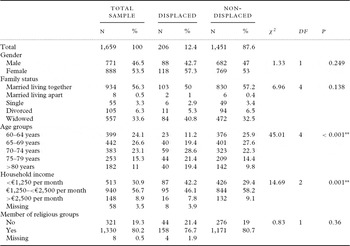
Socio-demographic characteristic of the total sample and the subsamples of displaced and non-displaced people

**p < 0.01.
Results
Sample characteristics
A total of 1,659 older people were contacted and applied to the survey. Two hundred and six subjects (12.4%) of the representative sample of older adults reported forced displacement in order to the item of the M-CIDI trauma list. Of the 206 displaced people, gender distribution is 88 males and 118 females, which equals 5.3% and 7.1% of the total sample. The highest number of displaced people (28.6%) was represented in the age group between 70 and 74 years. The least number of displaced people (11.2%) was found in the youngest age group 60–64 years. Further socio-demographic variables are displayed in Table 1. Displaced and non-displaced people differed statistically significant in age group (χ2(4) = 45.01, p < 0.001) and income (χ2(2) = 14.69, p = 0.001).
Psychological syndromes and health-related quality of life
Post-traumatic stress symptoms
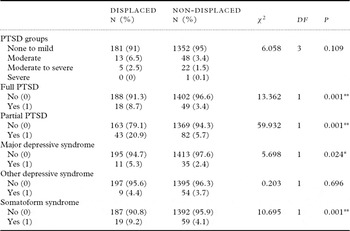
Hence, considering symptoms of PTSD, displaced people reported a higher PTSD score (M (SD) = 3.12 (5.77)) than non-displaced (M (SD) = 1.59 (4.38); t(231.05) = 3.64, p < 0.05, 95% CI [0.713, 2.389], d = 0.30). Additional variables were calculated for PTSD (see Table 2). Post-traumatic stress symptoms (total score of the PDS) were divided into four groups from none to severe burden due to PTSD symptoms. A χ2-test showed no differences between the groups of displaced and non-displaced people on PTSD severity. In both groups, over 90% of the participants did not report PTSD symptoms or had only mildly severe PTSD symptoms. Considering the criteria of full and partial PTSD, statistical significant differences between displaced and non-displaced people were recognized (Table 2). Displaced people reported symptoms of full PTSD (8.7%) and partial PTSD (20.9%) more frequently than non-displaced people. Prevalence rates were 3.4% for full PTSD and 5.7% for partial PTSD in the total sample.
Prevalence of PTSD (groups, full, partial), depressive syndromes, and somatoform symptom in displaced and non-displaced people

*p < 0.05; **p < 0.01.
Somatoform symptoms
Displaced adults reported higher somatoform symptom severity (M (SD) = 5.84 (4.11)) than non-displaced persons (M (SD) = 4.15 (3.81)). This is a statistically significant difference (t(257.83) = 5.578, p < 0.05, 95% CI [1.095, 2.289]) with a small to moderate effect size (d = 0.42). Regarding a dichotomized classification of somatoform syndrome, significantly more displaced persons reported symptoms than non-displaced (χ2(1) = 10.695, p < 0.05).
Depressive symptoms
Displaced people reported more depressive symptoms (M (SD) = 4.2 (4.054)) than non-displaced people (M (SD) = 3.16 (3.547)). This difference reached statistical significance (t(1650) = 3.84, p < 0.05, 95% CI [0.507, 1.564]) and amounted to a small effect of d = 0.27. Displaced people also showed a significantly higher frequency of symptoms of major depressive syndrome than non-displaced people (χ2(1) = 5.698, p < 0.05). No statistically significant difference between both groups in the prevalence of other depressive syndrome (χ2(1) = 0.203, p = 0.696) was found.
Health-related quality of life
On measures of health-related QoL, the two sum scores of physical and mental health components were calculated. Displaced older people (M (SD) = 43.66 (8.99)) scored significantly lower on the physical scale (t(256.92) = −4.16, p < 0.001, 95% CI [−4.12, −1.47], d = −0.32) than non-displaced participants (M (SD) = 46.47 (8.70). The same statistically significant difference was found for the mental component (t(256.44) = −2.78, p = 0.006, 95% CI [−3.44,−0.58], d = −0.21) with displaced reporting lower mental health scores (M (SD) = 52.33 (9.71)) than non-displaced people (M (SD) = 54.35 (9.36)).
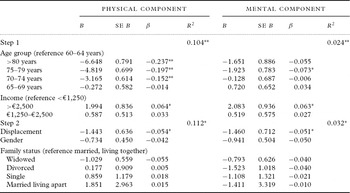
The multiple regression analysis (Table 3) for the physical component of QoL explained 11.2% of variance. Higher age groups and being displaced are negatively associated with physical QoL. Higher income is accompanied by better physical QoL. The mental component (explained variance 3.2%) is also negatively associated with the age group 75–79 years and displacement. It is positively related to higher income. Both analyses show a smaller contribution of displacement (β) than age groups and income.
Multiple regression analysis to predict the physical and mental components of health-related quality of life

*p < 0.05; **p < 0.01.
Logistic regression analysis
As displaced and non-displaced people differ in age groups and income, these predictors are introduced to the logistic regression in a first step as covariates. In a second step, displacement, gender, and family status are entered into the analyses.
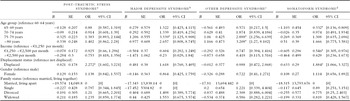
Four logistic regression analyses have been performed to investigate the influence of displacement on mental health disorders. As binary criteria (no disorder and disorder) post-traumatic stress syndrome, major depressive syndrome, other depressive syndrome, and somatoform syndrome are predicted by forced displacement and socio-demographic variables (Table 4).
Logistic regression predicting post-traumatic stress disorder, major depressive syndrome, other depressive syndrome, and somatoform syndrome

aHosmer–Lemeshow χ2(8) = 3.63, p = 0.88, Nagelkerkes R 2 = 0.049; bHosmer–Lemeshow χ2(8) = 4.57, p = 0.80, Nagelkerkes R 2 = 0.077; cHosmer–Lemeshow χ2(8) = 6.88, p = 0.54, Nagelkerkes R 2 = 0.059; dHosmer–Lemeshow χ2(8) = 3.88, p = 0.86, Nagelkerkes R 2 = 0.06.
*p < 0.05; CI = confidence interval for odds ratio (OR).
Forced displacement is the only predictor for PTSD (OR = 2.2, 95% CI [1.602, 3.221]). The other variables did not contribute to the prediction of post-traumatic stress syndrome. The inter-correlations between post-traumatic stress syndrome and forced displacement were small (r = 0.136, p < 0.01), so the assumption of multicollinearity is declined. Forced displacement was a significant predictor for somatoform syndrome. To be displaced increases the risk to suffer from somatoform syndrome (OR = 1.8, 95% CI [1.066, 3.327]) compared with non-displaced. Both major and other depressive syndromes are not significantly predicted by forced displacement. The risk for other depressive syndrome is increased for 75–79-year-old people by OR = 2.8 (95% CI [1.256, 6.639]) and is further elevated for adults older than 80 years (OR = 3.2, 95% CI [1.27, 8.102]). People aged 75–79 years have an increased risk of suffering from major depressive syndrome of OR = 3.3 (95% CI [1.125, 9.908]). Our results show that depression is more predicted by age than by displacement.
Complementary to the multiple regression analyses, two logistic regression analyses were performed for physical and mental components of QoL (dichotomized). Being displaced (OR = 1.4), female gender (OR = 1.3), and increased age (OR = 2.1–3.4) significantly contributed to predict lower physical health. A monthly income over 2,500€ per month decreased the risk for lower physical QoL (OR = 0.6). Lower mental health was significantly predicted by being displaced (OR = 1.3) and being 75 years and older (OR = 1.4–1.5). A moderate to high income lowers the risk for reduced mental QoL (OR = 0.5–0.7).
Discussion
This population-based representative study addressed the issue of the long-term impact of forced displacement in WWII on mental health disorders and health-related QoL in older adults. A novel approach was shown by using the biographical variable of forced displacement as predictor for mental health disorders in German older adults. Forced displacement is a traumatic event in people's lives and it is confirmed that this trauma during childhood still has a unique contribution to mental health disorders in aged adults. It is also shown that displacement has an impact on health-related QoL. These results have to be interpreted carefully as in light of other contributing variables the impact of displacement decreases.
Differences in mental health disorders and quality of life
The first aim of the study was to investigate differences between displaced and non-displaced persons. Displaced people showed significantly higher levels of PTSD, somatoform, and depressive symptoms. These findings complement previous results showing increased psychological burden of displaced people (Fischer et al., Reference Fischer, Struwe and Lemke2006; Beutel et al., Reference Beutel, Decker and Brähler2007; Strauss et al., Reference Strauss, Dapp, Anders, von Renteln-Kruse and Schmidt2011). Furthermore, differences in both components of health-related QoL were recognized. Displaced people reported worse physical and mental QoL than non-displaced people. In both groups of displaced and non-displaced people, higher levels of depressive symptoms and lower levels of mental health-related QoL were found. Looking at the effect sizes of these differences, only minor effects were revealed. The small effect sizes raise concern on the importance of displacement as a predictive factor for decreased QoL in older adults. The reasons for lower levels of health-related QoL can be manifold, considering the differences in socio-demographic variables, displaced people are of higher age and have less income per month. These factors are already known to decrease QoL in aged adults (Netuveli et al., Reference Netuveli, Wiggins, Hildon, Montgomery and Blane2006). It was also found that mental health disorders such as higher levels of depressive symptoms are also accompanied by lower health-related QoL (Solhaug et al., Reference Solhaug, Romuld, Romild and Stordal2012).
Displacement as a predictor
The analysis raised doubts about the importance of displacement in light of the effects of socio-demographic variables. The impact of displacement on mental health disorders and QoL was investigated by regression analyses. Displaced people have a twofold risk to report symptoms of PTSD, which is understandable as it is a traumatic event in life and shows the increased impact of that specific trauma even 60 years later. Displacement also contributed to somatoform symptoms, but its impact is limited as age and income also had a significant impact. The increased risks for PTSD and somatoform symptoms can be explained with long-term elevated stress levels of the displaced persons (Muhtz et al., Reference Muhtz2011a). Worse physical health may therefore primarily be influenced by older age and lower income. Hence, the contribution of displacement seems to be of relative importance. It was also found that displacement did not predict depressive symptoms despite the difference that was found between displaced and non-displaced people. Hence, older age was accompanied by a threefold increased risk for depressive syndromes.
Summarizing, displacement is a predictor of mental health and health-related QoL, but it does not account for much variance. Its contribution decreases in combination with other socio-demographic predictors. This raises the question whether the differences in QoL between displaced and non-displaced people are solely based on forced displacement. Several reasons may lead to the differences in mental health and QoL, for example current traumatic events such as loss of spouse, a diagnosis of a chronic condition, or a serious surgery. In Maerckers (Reference Maercker1998) model, multiple factors contribute to the development and maintenance of a mental disorder. By comparison, the contribution of displacement as a single factor is small. Traumatic events so long ago still have an effect on mental health in aged adults, but the associations have to be interpreted carefully. The long-term consequences of single war-related events are not easily investigated as traumatic events may cumulate over lifespan and each event is likely to be accompanied by health constraints. Therewith recent events are not taken into account, which may also have a meaningful impact on people's recent health and well-being. The investigation of multiple and recent traumas may account for more variance of a person's perceived stress and QoL.
Methodological limitations
There is still a debate whether mental health scales can be used as psychometrically sound screening measures of mental disorders or whether to use them as continuous measures of distress (Wheaton, Reference Wheaton2007). Distress is a continuum and disorder is supposed to be a category. Considering disorder as a function of distress (Wheaton, Reference Wheaton2007), a screening for mental disorders will not lead to diagnoses per se, but higher scores of symptoms equal an increased probability of a diagnosis. Although dichotomization of variables is accompanied by loss of information and smaller effect sizes (Streiner, Reference Streiner2002), we were able to show significant odds ratios for the prediction of mental health disorders and QoL. Calculating the odds allows comparison of the risks for mental disorders and QoL in displaced people. Another limiting aspect is that the considerable differences on the dependent variables are very common in population-based studies. Group differences are more likely to be significant in very large samples and have to be interpreted with caution as the effect sizes are rather small (small d < 0.30; Cohen, Reference Cohen1988) and are unequally distributed between displaced and non-displaced people in the sample. Furthermore, we were able to show associations of former traumas on concurrent mental health disorders and QoL. Real long-term effects can only be investigated with longitudinal studies. This purpose cannot be addressed with this representative data set.
Conclusion and future research
The impact of single traumatic events or cumulative critical events on mental disorders and QoL needs to be investigated more closely. Higher rates of mental disorders are naturally occurring in aged populations. In particular, older adults who grew up during WWII experienced multiple traumatic events (Strauss et al., Reference Strauss, Dapp, Anders, von Renteln-Kruse and Schmidt2011). Aside from the assessment of mental and physical health disorders, future directions should focus on positive aspects and resources in older adults. Most studies follow a clinical approach using measurements of health constraints. These will not depict positive aspects in terms of protective factors such as resilience and coping strategies and previous research has also neglected these factors. It is important to have a closer look at protective factors as WWII experiences in general or specific traumas as forced displacement may be reactivated in the process of aging. Certain cues such as documentaries on television or moving houses may trigger a re-traumatization in aged adults. The investigation of protective factors can address fears or problems that come along with changes and identified resources can be adopted to maintain well-being, for example social activities or disclosure of traumatic experiences. In geriatric and gerontological research, clinical as well as health-related approaches should be pursued. Hence, forced displacement and its long-term consequences have to be investigated in respect of protective variables and positive effects such as personal growth and coping strategies. These variables may also lead to valuable explanations of the increased age and better health of displaced older people. Protective factors can serve to support future aged adults with war-related traumas in the process of healthy aging.
Conflict of interest
None.
Description of authors’ roles
Simone Freitag wrote the paper and undertook the statistical analyses. Simone Freitag, Elmar Braehler, Silke Schmidt, and Heide Glaesmer designed the study. Elmar Braehler and Heide Glaesmer provided the data. Heide Glaesmer and Silke Schmidt assisted in writing of the paper.
Acknowledgments
This study was supported by a research grant from the Medical Faculty of the University of Leipzig to Heide Glaesmer.