Introduction
Bipolar disorders (BDs) are prevalent, comorbid, and impairing conditions burdened by relevant rates of disability and suicidal behaviors.Reference Schaffer, Isometsä and Tondo1
Differently from major depressive disorder and anxiety disorders, whose prevalence has been found consistently higher in female versus male gender (female-to-male ratio of prevalence rates for anxiety disorders, 1.5–2.3; female-to-male ratio of prevalence rates for major depression, 1.9–2.0),Reference Bandelow and Michaelis2, Reference Salk, Hyde and Abramson3 most epidemiologic investigation in bipolar patients has shown no gender differences in terms of prevalence rates.Reference Diflorio and Jones4 However, previous and more recent studies reported higher frequencies of hypomania or bipolar II disorder in women as well as other sociodemographic and clinical gender-related differences.Reference Diflorio and Jones4–Reference Fellinger, Waldhör and Blüml9
Beyond epidemiological aspects, female BD patients have shown specific clinical peculiarities that may be of relevance in relation to presentation and outcome, even though results in this field may be not always consistent because of limited sample size, enriched samples, and geographic and other methodological issues.Reference Karanti, Bobeck and Osterman10 In a Danish study, for instance, women with BD showed distinct patterns of in- versus outpatient treatment and prevalence of mixed depression and comorbidity with substance abuse, compared with male bipolar patients.Reference Kessing11 In a subsequent study,Reference Nivoli, Pacchiarotti and Rosa12 male gender was reported to be associated with mania at the onset of bipolar I disorder (BD-I). In addition, men were found to have higher rates of comorbid alcohol abuse/dependence, cannabis abuse/dependence, pathological gambling, and conduct disorder. On the other hand, female bipolar patients reported higher rates of comorbid eating disorders and weight change, appetite change, and central insomnia during depression. In a subsequent American study, female gender was associated with significantly higher risk of rapid cycling, cycle acceleration, and increased severity of mood episodes over time in a large sample of bipolar patients.Reference Erol, Winham and McElroy13 More recently, an European-American collaborative study found that severe mood episodes lead more often to hospitalizations in bipolar women.Reference Fellinger, Waldhör and Blüml9 Another recent British study reported that sleep loss triggering episodes of expanded mood was associated with female gender and BD-I subtype.Reference Lewis, Gordon-Smith and Forty14
Gender differences in BD may also be relevant in light of treatment.Reference McElroy15 For instance, a recent collaborative European study reported for the first time that the risk profiles for the development of an antidepressant treatment-emergent mania differ significantly according to gender.Reference Scott, Brichant-Petitjean and Etain16
As an increasing interest toward patient-oriented medicine and gender-related issues has been observed in many medical and psychiatric conditions, this study sought to assess gender differences and clinical correlates in the largest multicenter sample of Italian bipolar patients analyzed to date. We hypothesized that bipolar patients may exhibit specific differences in terms of sociodemographics and clinical features according to gender.
Methods
An overall sample of 1674 patients was enrolled from different Italian psychiatric clinics. This sample, in light of the size and the number of involved psychiatric units, may be considered satisfactory and representative of the entire national territory. The protocol was approved by the local Ethical Committees. Patients had a diagnosis of BD according to DSM-IV-TR (Diagnostic and Statistical Manual of Mental Disorders, Fourth Edition, Text Revision) criteria.17 Diagnoses were made by expert psychiatrists, who had regularly followed up with the selected patients and confirmed by the Mini-International Neuropsychiatric Interview.Reference Sheehan, Lecrubier and Sheehan18 Patients consecutively afferent to outpatient or inpatient services were included in the study. Clinical information was extrapolated through a review of the clinical charts and clinical interviews with patients and available relatives. Data were entered into an electronic central database (electronic Case Report Form: e-CRF). Collected data included the following sociodemographic and clinical variables divided into 3 clusters:
Cluster 1 (sociodemographic variables): age, gender, education (years), employment, marital status (at least 1 marriage or partnership), and living alone.
Cluster 2 (lifetime clinical variables): age at onset of BD, age at first pharmacological prescription (including benzodiazepines), age at first contact with psychiatric services, first psychiatric diagnosis, age at first psychiatric diagnosis, age at first diagnosis of BD, age at first mood stabilizer/atypical antipsychotic, polarity of first episode, lifetime number of manic episodes, lifetime number of depressive episodes, prevalent polarity, prevalent course, lifetime psychotic symptoms, and lifetime attempted suicide.
Cluster 3 (clinical variables—last year of observation): type of current episode, number of hypomanic/manic episodes, number of depressive episodes, presence of psychotic symptoms, presence and number of attempted suicides and the degree of lethality, comorbidity with substance misuse, presence of hospitalizations, presence of insight, attribution of symptoms to a psychiatric disorder, treatment adherence, number of visits, and administration of psychoeducational interventions (according to Colom’s model).Reference Vieta, Pacchiarotti and Valentí19
Prevalent polarity was calculated according to the Barcelona proposal, defined as at least two-thirds (2/3) of the total number of past episodes being from the same polarity.Reference Colom, Vieta and Suppes20
Lethality of suicide attempts was evaluated according to global impression of Scale for Assessment of Lethality of Suicide Attempt (score 1–2: low; score 3: medium; score 4–5: high).Reference Kar, Arun and Mohanty21
Exclusion criteria were the following: (1) patients who had not been examined in the last 12 months for the impossibility of collecting data on cluster 3 variables (last year of observation); (2) patients whose clinical information was incomplete; and (3) patients with a diagnosis of dementia, mental retardation, or other medical conditions (eg, untreated endocrine disorders) associated with an increased risk of psychotic symptoms or other clinical features (eg, suicidal attempts).
Descriptive analyses of the total sample were performed. Gender was compared by Student’s t test for quantitative variables and chi-square tests for qualitative variables. Owing to the large number of variables statistically related to the dependent variable (gender) at the univariate analyses, preliminary multiple logistic regression analyses (1 for each abovementioned cluster) were performed including only statistically significant variables. Finally, statistically significant variables from these final models were then inserted in a new global starting multivariable logistic regression model in order to obtain the variables independently associated with gender.
The selection of the variables has been done according to a backward procedure; in the last multivariable logistic model, the age (not statistically significant) has been kept in the model in order to obtain the estimates adjusted for this variable. The goodness of fit has been assessed by the Hosmer-Lemeshow test.
The level of statistical significance was set at P ≤ 0.05. Statistical analyses have been performed using SAS® 9.2.
Results
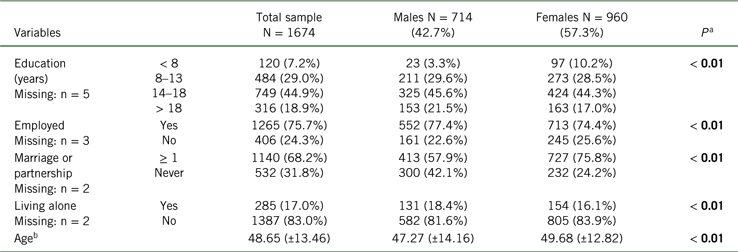
The case series included 1674 patients: 714 males (42.7%) and 960 females (57.3%). Patients had an age between 18 and 80 (mean: 48.65 ± 13.46). Descriptive analyses of the total sample and according to gender are reported in Tables 1–3.
Sociodemographic variables of the total sample and of the two gender groups

a In bold are statistically significant P values resulting from χ2 and from unpaired Student’s t test for the variable “age.”
b Standard deviations are reported in parentheses for the variable “age.”
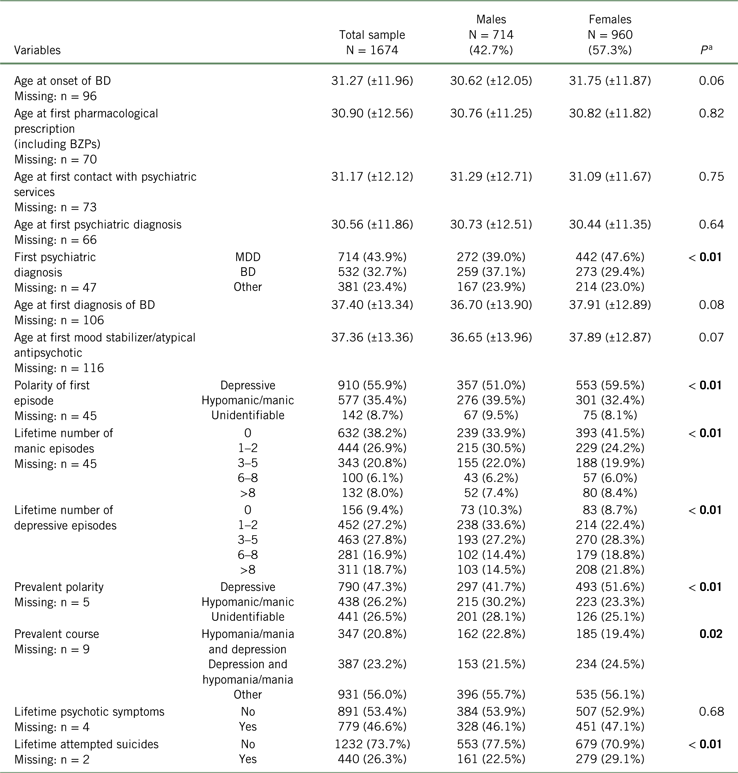
Clinical variables of the total sample and of the two gender groups

BD, bipolar disorder; BZP, benzodiazepine; MDD, major depressive disorder.
Standard deviations are reported in parentheses.
a In bold are statistically significant P values resulting from χ2 or unpaired Student’s t test.
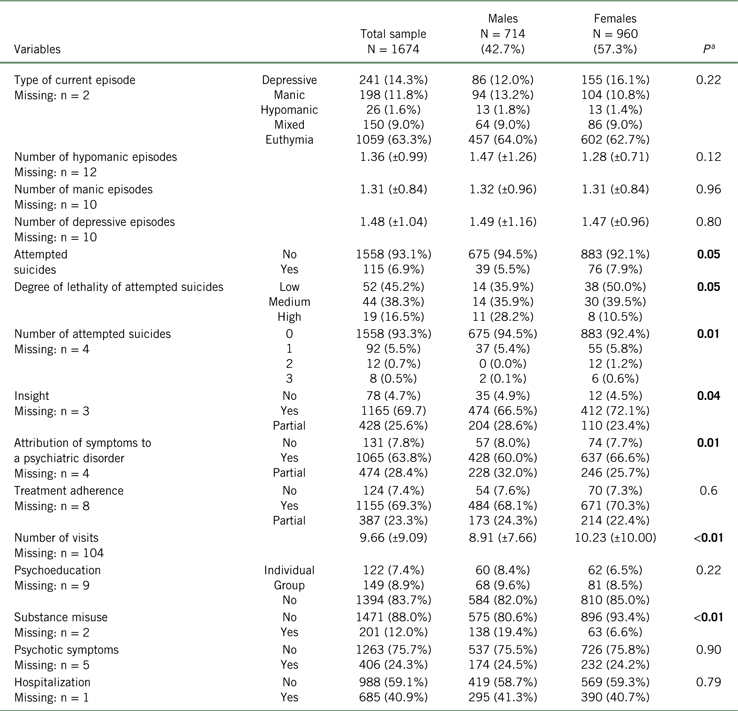
Clinical variables of the total sample and of the two gender groups (last year of observation)

Standard deviations are reported in parentheses.
a In bold are statistically significant P values resulting from χ2 or unpaired Student’s t test.
There were not significant differences between the 2 genders in the age at first pharmacological prescription, age at first contact with psychiatric services, age at first psychiatric diagnosis, presence of lifetime psychotic symptoms, type of current mood episode, number of depressive episodes in the last year, number of hypomanic episodes in the last year, number of manic episodes in the last year, presence of psychotic symptoms in the last year, presence of hospitalizations, treatment adherence, and administration of psychoeducational interventions. The 2 genders showed a statistically borderline difference for the age at onset of BD (P = 0.06), age at first diagnosis of BD (P = 0.08), and age at first mood stabilizer/atypical antipsychotic (P = 0.07).
Female versus male BD patients were older (P < 0.01), less educated (P < 0.01), and less often employed (P < 0.01), but more often married or in a civil partnership (P < 0.01) and less often living alone (P < 0.01). They more often had a first psychiatric diagnosis of major depressive disorder (P < 0.01), first episode of depressive polarity (P < 0.01), lifetime depressive predominant polarity (P < 0.01), more lifetime major depressive episodes (P < 0.01), fewer lifetime manic episodes (P < 0.01), more lifetime depression-mania-euthymia cycles (P = 0.02), and suicide attempts (P < 0.01), as well as more prior-year suicide attempts (P = 0.05) and prior-year psychiatric visits (P < 0.01), but lower prior-year suicide attempt lethality (P = 0.05), and less prior-year substance abuse (P < 0.01), better prior-year insight (P = 0.04), and more prior-year attributing symptoms to a psychiatric disorder (P = 0.01).
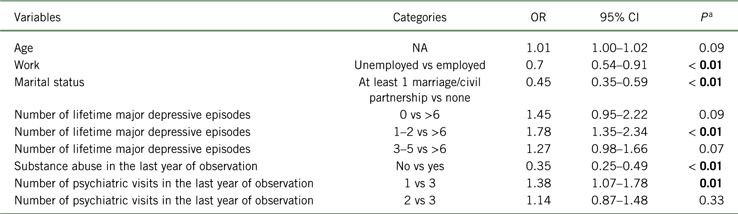
The results of the goodness-of-fit test (Hosmer-Lemeshow test: χ2 = 6.84, df = 8, P = 0.55) showed that the multivariable logistic regression model including previously significant sociodemographic/clinical variables as possible predictors of the type of gender was adequate. In particular, female gender was less frequently associated with employment (odds ratio [OR] = 0.7, P < 0.01), lifetime single marital status (OR = 0.45, P < 0.01), and substance abuse in the last year of observation (OR = 0.35, P < 0.01) (Figure 1), whereas it was more frequently associated with a major number of lifetime major depressive episodes (OR = 1.78, P < 0.01) and psychiatric visits in the last year of observation (OR = 1.38, P = 0.01) (Table 4). These were the only variables that remained significant in this final logistic regression model.
Presence of substance abuse in the last year of observation in the two gender groups. Asterisk (*) indicates P = <0.01 according to multivariable logistic regression.

Summary of the statistics for the best-fit multivariable logistic regression model applied

CI, confidence interval; NA, not applicable.
In this analysis, the dependent variable was gender (male versus female). With regard to age, the odds ratio (OR) means the increase of the relationship at each unity increase.
Hosmer-Lemeshow test: χ2 = 6.84, df = 8, P = 0.55.
a In bold are statistically significant P values.
Discussion
To date and to our knowledge, this study is the first national report about gender differences in BD.
The main results of this study (as shown by binary logistic regression) consist of an association of male gender with employment, lifetime single marital status, and substance abuse (in the last year of observation), and of female gender with a major number of lifetime major depressive episodes and with a major number of psychiatric visits in the last year of observation.
With regard to substance abuse, our result is concordant with what has been reported in the literature. Of note, several previous studies reported an association between male gender and currentReference Kawa, Carter and Joyce7, Reference Kessing11, Reference Nivoli, Pacchiarotti and Rosa12 or past substance abuse.Reference Hendrick, Altshuler and Gitlin5, Reference Arnold6 Furthermore a very recent meta-analysis of available studies reported an OR of 2.2 (confidence interval: 1.12–4.28) for the frequency of substance abuse in male bipolar patients versus female ones.Reference Messer, Lammers and Müller-Siecheneder22 The more frequent comorbidity with substance abuse in male bipolar patients represents an unfavorable predictor of long-term outcome; it is noteworthy that comorbid substance abuse in BD has been associated with a higher risk of recurrencesReference Strakowski, DelBello and Fleck23 and development of rapid cycles,Reference Carvalho, Dimellis and Gonda24, Reference Buoli, Dell’Osso and Caldiroli25 more psychotic symptoms,Reference Dell’Osso, Camuri and Cremaschi26 and more suicidality.Reference Messer, Lammers and Müller-Siecheneder22, Reference Dell’Osso, Vismara and Dobrea27 Therefore, male bipolar subjects should be carefully monitored to prevent the risk of substance abuse or limit eventual current substance misuse: few data have been published about the management of BD with concomitant substance misuse, but adjunctive psychosocial interventions including psychoeducation, augmentative naltrexone to pharmacotherapy, or the choice of valproate as mood stabilizer might be all useful strategies to improve long-term outcomes of male bipolar subjects.Reference Salloum and Brown28
With regard to sociodemographic factors, the finding of a higher rate of employment in bipolar males is hardly interpretable for the cultural bias linked to a lower occupational access of the female population in most of worldwide countries.Reference Boerma, Hosseinpoor and Verdes29 Even if cultural issues are excluded (eg in case of studies conducted in the same country), contrasting results have been found with regard to the association between gender and occupational status in BD; while a first study, conducted in Taiwan, reported male gender to be associated with long-term favorable psychosocial outcomes,Reference Tsai, Chen and Kuo30 a recent study in the same country found male gender to be associated with the risk of being unemployed.Reference Chang, Huang and Chiu31 A reasonable explanation is that, as well as cultural issues, other clinical factors (eg, a different distribution of gender in type I and II bipolar subtypes or in rapid cyclers) may contribute to the observation of different occupational status of male versus female bipolar subjects.Reference Erol, Winham and McElroy13, Reference Scott, Grunze and Meyer32 In this sense, a meta-analysis and a subsequent clinical study reported that female gender was more common in rapid cyclers compared with nonrapid cyclers.Reference Kupka, Luckenbaugh and Post33, Reference Kupka, Luckenbaugh and Post34
Similarly to what is reported in our study, previous research found male gender to be associated with single marital status.Reference Lieberman, Massey and Goodwin35, Reference Azorin, Belzeaux and Kaladjian36 This finding has been interpreted as the consequence of gender-related different presentations of the onset of illness. While bipolar women tend to have a depressive onsetReference Lieberman, Massey and Goodwin35 and are less likely to have comorbid substance abuse,Reference Messer, Lammers and Müller-Siecheneder22 male bipolar patients have a frequent onset of illness with a manic episodeReference Lieberman, Massey and Goodwin35 and concomitant substance abuse.Reference Messer, Lammers and Müller-Siecheneder22 Also of note, in our sample female bipolar patients presented more frequently a first depressive episode than male patients.
With regard to clinical features associated with female gender, previous studies found a predominant depressive polarityReference Nivoli, Pacchiarotti and Rosa12 and more frequent depressive onset,Reference Nivoli, Pacchiarotti and Rosa12, Reference Cremaschi, Dell’Osso and Vismara37 but not a higher number of past depressive episodesReference Hendrick, Altshuler and Gitlin5, Reference Kawa, Carter and Joyce7 in female bipolar patients than in male ones. Probably our finding of a higher number of depressive episodes in female patients is the result of the mediation of other clinical factors such as age, depressive polarity of first bipolar episode, and prevalent depressive polarity. Of note, in our sample female patients were older, had a more frequent depressive polarity, and had a more frequent depressive onset. From a clinical point of view, the number of previous depressive episodes has been associated with poor functional outcomesReference Bonnín, Reinares and Hidalgo-Mazzei38, Reference Soni, Singh and Shah39 and less probability of pharmacological response in case of a new depressive episode.Reference Solomon, Fiedorowicz and Leon40 In contrast, the result of more psychiatric visits in the last year of observation in female bipolar patients cannot be interpreted uniquely. On the one hand, it could be an indicator of greater insight by the female gender; on the other hand, it could be the result of greater severity of illness and poor clinical stabilization. The latter hypothesis is supported by recent data that show the female gender to be associated with poor insight especially during depressive phases of BD.Reference Güçlü, Karaca and Yıldırım41, Reference de Assis da Silva, Mograbi and Silveira42 We must also highlight the fact that the result of fewer prior-year psychiatric visits in male versus female patients is consistent with more prior-year substance abuse in male versus female subjects: men more often than women seek symptomatic relief via substance abuse rather than psychiatric help.Reference Messer, Lammers and Müller-Siecheneder22
Finally, previous research found suicidal attempts to be more probable in female bipolar patients. Also in our sample the female gender presented a higher probability of lifetime suicidal attempts and more suicidal attempts in the last year of observation. However, the statistical significance of these variables was not confirmed in the final multivariable logistic regression model. Probably, the association of more lifetime depressive episodes with the female gender contributes importantly to the higher risk of prior suicide attempt in bipolar women.Reference Benazzi43
Taken as a whole, with the exception of substance abuse and number of depressive episodes, our data confirm that there is not a substantial association between female or male gender and clinical markers of poor outcome in BD (eg, rapid cycling, psychotic symptoms, or number/lethality of suicide attempts). Gender would not seem, therefore, to represent a robust predictor of outcome in BD. This observation has also been outlined in another review of this topic.Reference Diflorio and Jones4 On the other hand, treatment should be personalized according to gender, and clinicians should take into account the fact that bipolar males tend to develop substance abuse and may have a manic predominant polarity, whereas bipolar women can present a more depressive profile. Bipolar men should be preferentially treated with a pharmacotherapy with more efficacy in the prevention of manic/hypomania episodes and craving, whereas treatment of bipolar women should be more tailored for the prevention of depressive episodes. In addition, as gender-related clinical features of BD are partly explained by the different hormonal profile, special attention should be dedicated to women during pregnancy, postpartum, or menopause, during which hormonal fluctuations represent a concrete risk of relapse of bipolar illnessReference Arnold6, Reference McElroy15, Reference Vega and Barbeito44 and the delay in treatment can have serious effects on the health of women and their offspring.Reference Serati, Buoli and Altamura45
The following limitations of the present research need to be mentioned:
1. Patients were treated with different drugs, which might have influenced some clinical features (eg, the use of tricyclic antidepressants and the development of rapid cycling).Reference Altamura and Goikolea46
2. The different settings of care (in several Italian regions) may have influenced the clinical and demographic features of the sample.
3. Some data were collected retrospectively (eg, number of mood episodes) so that they might not have been always as accurate as in controlled studies.
4. Transcultural studies are needed to disentangle the cultural-related variables from differences possibly due to the biological background.Reference Altamura, Mundo and Bassetti47
Conclusion
In bipolar patients, female gender is less frequently associated with employment, lifetime single marital status, and substance abuse in the last year of observation. On the other hand, female gender is more frequently associated with a greater number of lifetime major depressive episodes and psychiatric visits in the last year of observation. There is not a substantial association between female or male gender and clinical markers of poor outcome in BD (eg, rapid cycling, psychotic symptoms, or number/lethality of suicide attempts). Further large-sample prospective studies are needed to confirm the results of the present research.
Disclosures
Massimiliano Buoli, Bruno Mario Cesana, Andrea de Bartolomeis, Emi Bondi, Giuseppe Maina, and Antonello Bellomo have nothing to disclose. Bernardo Dell’Osso reports personal fees from Lundbeck and personal fees from Janssen Cilag, outside the submitted work; Andrea Fagiolini reports personal fees from Angelini, personal fees from Lundbeck, personal fees from Otsuka, and personal fees from Janssen Cilag, outside the submitted work; and A. Carlo Altamura reports personal fees from Lundbeck, outside the submitted work.