Introduction
Upon examining identified and type specimens from the Natural History Museum (NHM), London and the Moravian Museum, Brno, Czech Republic (MMBC), respectively, it became apparent that two new generic synonymies in Chiasmini are needed. These are provided along with additional notes on the taxa involved and new combinations that result from the generic synonymies.
Letter annotations of bibliographic references prior to 1956 follow Metcalf (1964a) and those from 1956 to 1985 follow Oman et al. (Reference Oman, Knight and Nielson1990). References are included for all listed taxa.
Results
Chiasmini
Stenogiffardia Evans, Reference Evans1977a: 116. Type: S. elongata Evans, Reference Evans1977a, by original designation, placement nov.
= Pratura Theron, Reference Theron1982b: 21. Type: P. graminea Theron, Reference Theron1982b, by original designation, syn. nov.
= Doraturella Emeljanov, Reference Emeljanov2002. Type: D. spica Emeljanov, Reference Emeljanov2002, by original designation, syn. nov.; synonymized with Pratura by Zahniser (Reference Zahniser2008).
Included species
Stenogiffardia acuminata (Naudé), comb. nov.
Aconura acuminata Naudé, Reference Naude1926a: 55; transferred to Pratura by Theron (Reference Theron1982b)
Stenogiffardia ceylona (Zahniser), comb. nov.
Pratura ceylona Zahniser, Reference Zahniser2008: 7
Stenogiffardia graminea (Theron), comb. nov.
P. graminea Theron, Reference Theron1982b: 21
Stenogiffardia parvula (Kirkaldy)
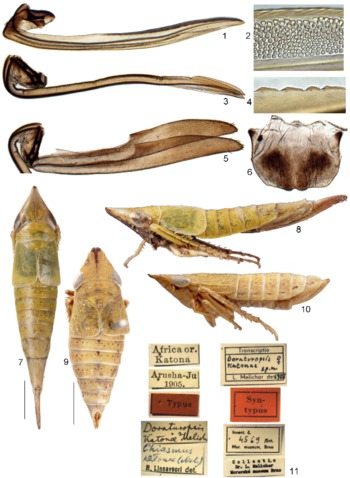
Stenogiffardia parvula (Evans): 1, first valvula; 2, detail of dorsal sculpturing of the first valvula; 3, second valvulae; 4, detail of the teeth of the second valvula; 5, third valvulae ( = gonoplac); 6, sternite VII; 7, female dorsal habitus; 8, female, lateral habitus. Chiasmus katonae (Melichar): 9, female, dorsal habitus; 10, female, lateral habitus. 11, labels associated with the specimen of C. katonae. Scale bars = 1.0 mm. (A colour version of this figure can be found online at: journals.cambridge.org/jti).

Phrynophyes parvula Kirkaldy, Reference Kirkaldy1906c: 328.
= S. elongata Evans, Reference Evans1977a: 116; synonymized with S. parvula (Kirk.) by Fletcher and Condello (Reference Fletcher and Condello1993)
Stenogiffardia spica (Emeljanov), comb. nov.
Doraturella spica Emeljanov, Reference Emeljanov2002: 663; transferred to Pratura by Zahniser (Reference Zahniser2008)
Remarks. Zahniser (Reference Zahniser2008) synonymized Doraturella with Pratura based on the similar shape of the head and the distinctive very long style apophysis with a sharp tooth near the base and a spiralling row of smaller teeth extending toward its apex. Other similarities include the green colour of the species, the sub-brachypterous forewings and the female ovipositor protruding very far beyond the pygofer apex. These characters are shared with S. parvula (Kirkaldy), and the genera are synonymized here based on these characters. This synonymy further extends the range of the genus to include Mali, South Africa, Sri Lanka and Australia. Evans (Reference Evans1977a) placed Stenogiffardia in Platymetopiini, and this was followed by Oman et al. (Reference Oman, Knight and Nielson1990). It is placed here in Chiasmini, which conforms to the previous placement of its synonym, Pratura, in the tribe (Zahniser, Reference Zahniser2008).
Images of the female ovipositor, sternite VII, and the habitus of S. parvula (Kirkaldy) are provided in Figs 1–8. The first valvula is similar to that of S. graminea (Theron) (see Zahniser, Reference Zahniser2008 for comparison). The second valvula is longer than that of S. graminea. Sternite VII of S. parvula is not as produced laterally as in S. graminea and has a different pattern of coloration or darkly sclerotized areas. The female illustrated in Figs 7 and 8 is 6.3 mm in length, which is 2.3 mm shorter than the brachypterous female reported by Evans (Reference Evans1977a). The specimens examined here do not have the head as strongly produced as those examined by Evans (Reference Evans1977a), which perhaps accounts for the discrepancy in length. Size variation in this species was also noted by Fletcher and Condello (Reference Fletcher and Condello1993) who also illustrated the male genitalia.
Material examined: 2♂, 2♀ (NHM). 1st label: AUSTRALIA: Queensland: Cairns: Botanic Garden; 4.vi.1987. 2nd label: M. Asche and H. Hoch, B.M. 1988-142.
Chiasmus Mulsant and Rey, Reference Mulsant and Rey1855a
Chiasmus Mulsant and Rey, Reference Mulsant and Rey1855a: 215. Type: C. translucidus Mulsant and Rey, Reference Mulsant and Rey1855a, by monotypy
= Atractotypus Fieber, Reference Fieber1866a: 501. Type: A. bifasciatus Fieber, Reference Fieber1866a, by monotypy; synonymized with Chiasmus by Signoret (Reference Signoret1877a)
= Kosmiopelex Kirkaldy, Reference Kirkaldy1906c: 334. Type: K. varicolor Kirkaldy, Reference Kirkaldy1906c, by monotypy; synonymized with Chiasmus by Evans (Reference Evans1974a)
= Duraturopsis Melichar, Reference Melichar1908b: 13. Type: D. katonae Melichar, Reference Melichar1908b, by monoytpy, syn. nov.
= Kartwa Distant, 1908 g: 394. Type: K. mustelina Distant, 1908 g, by original designation; synonymized with Chiasmus by Singh-Pruthi (Reference Singh-Pruthi1930a)
= Postumus Distant, 1918b: 84. Type: P. fascialis Distant, 1918b, by original designation; synonymized with Chiasmus by Evans (Reference Evans1974a).
Chiasmus katonae (Melichar) comb. nov.
Duraturopsis katonae Melichar, Reference Melichar1908b: 13
Remarks. A female syntype of D. katonae Melichar was borrowed from the MMBC. The monotypic genus is undoubtedly a synonym of Chiasmus based on the position of the ocelli on the crown and well behind anterior margin of head, crown produced, crown texture completely shagreen to base, anterior margin of head foliaceous, and metafemur apical macrosetae 2+1 (other Chiasmus spp. have 2+0 or 2+1 macrosetae). Chiasmus katonae (Melichar) is considered a valid species pending further taxonomic study of the species of Chiasmus. The crown is depressed medially, and the pro- and mesofemora have a pair of brown, vertical, wide, stripe-like markings, one apically and the other subapically. Other external characters are as shown in Figs 9 and 10. An identification label by Linnavuori (Fig. 11) also indicates his opinion that this species belongs in Chiasmus.
Material examined: 1♀ (MMBC). Labels are figured; topmost label on the pin is at the upper left in the figure, successively lower labels continue down the left column, and then continue to the right column, with the lowest label on the pin at the lower right. The specimen is from Arusha, Tanzania. Note that two of the identification labels have written the genus name as ‘Doraturopsis’. The published name associated with this series of specimens is Duraturopsis Melichar, not to be confused with the valid name Doraturopsis Lindberg, another genus of Chiasmini.
Acknowledgements
I thank M.J. Fletcher (Orange Agricultural Institute, New South Wales, Australia) for email discussions that led to the conclusion that Stenogiffardia is a synonym of Pratura and Doraturella, and for his suggestions regarding an earlier draft of the manuscript. I thank M.D. Webb (NHM) for informative discussions about C. katonae. I am grateful to M.D. Webb and I. Malenovsky (MMBC) for the loan of specimens. This work was supported in part by the National Science Foundation grant no. 08-41612.