1. INTRODUCTION
Understanding the interaction of fast charged particles with plasma targets is of crucial importance to several applications, including the inertial confinement fusion (ICF) driven by ion beams (Deutsch, Reference Deutsch1986; Deutsch et al., Reference Deutsch, Maynard, Bimbot, Gardes, Dellanegra, Dumail, Kubica, Richard, River, Servagean, Fleurier, Sanba, Hoffmann, Weyrich and Wahl1989; Hoffmann, Reference Hoffmann2008), high energy density physics (Tahir et al., Reference Tahir, Deutsch, Fortov, Gryaznov, Hoffmann, Kulish, Lomonosov, Mintsev, Ni, Nikolaev, Piriz, Shilkin, Spiller, Shutov, Temporal, Ternovoi, Udrea and Varentsov2005; Nellis, Reference Nellis2006), and related astrophysical processes (Nettelmann et al., Reference Nettelmann, Holst, Kietzmann, French, Redmer and Blaschke2008). In particular, there exists a promising ICF scheme (Stöckl et al., Reference Stöckl, Frankenheim, Roth, Suß, Wetzler, Seelig, Kulish, Dornik, Laux, Spiller, Stetter, Stöwe, Jacoby and Hoffmann1996; Roth et al., Reference Roth, Cowan, Key, Hatchett, Brown, Fountain, Johnson, Pennington, Snavely, Wilks, Yasuike, Ruhl, Pegoraro, Bulanov, Campbell, Perry and Powell2001), in which a plasma target is to be irradiated simultaneously by an intense laser beam and an intense ion beam. In that context, several experiments (Roth et al., Reference Roth, Stöckll, Suß, Iwase, Gericke, Bock, Hoffmann, Geissel and Seelig2000; Oguri et al., Reference Oguri, Tsubuku, Sakumi, Shibata, Sato, Nishigori, Hasegawa and Ogawa2000; Frank et al., Reference Frank, Grande, Harres, Heßling, Hoffmann, Knobloch-Maas, Kuznetsov, Nürnberg, Pelka, Schaumann, Schiwietz, Schökel, Schollmeier, Schumacher, Schütrumpf, Vatulin, Vinokurov and Roth2010; Hoffmann, Reference Hoffmann, Tahir, Udreal, Rosmej, Meister, Varentsov, Roth, Schaumann, Frank, Blažević, Ling, Hug, Menzel, Hessling, Harres, Günther, El-Moussatil, Schumacher and Imran2010) were conducted recently to investigate the beam-plasma and beam-matter interactions involving heavy ion and laser beams. Especially important for understanding these interactions are the energy loss measurements for ions penetrating a plasma target in a wide-range of plasma parameters. It is expected in such experiments that the ion propagation would be affected in a significant way by the modulation of the plasma target properties in the presence of laser beams.
Motivated by the experimental advancements, the need to comprehend complexity of the beam-matter interaction in the presence of strong laser fields has prompted a number of theoretical studies in recent years. Arista et al. (Reference Arista, Galvao and Miranda1989) developed a time-dependent Hamiltonian formulation to describe the effect of a strong laser field on energy losses of swift ions moving in a degenerate electron gas. It was shown that the energy loss is reduced for ions at intermediate speeds, but is increased for slow ions, due to a resonance process of plasmon excitation in the target assisted by a photon absorption. For plasma targets, on the other hand, it was found that the energy loss is reduced in the presence of a laser field when the projectile speed is smaller than the electron thermal speed (Arista et al., Reference Arista, Galvao and Miranda1990), and that projectiles may be even accelerated in the limit of a high intensity laser field (Nersisyan et al., Reference Nersisyan and Akopyan1999).
Recent experiments (Frank et al., Reference Frank, Grande, Harres, Heßling, Hoffmann, Knobloch-Maas, Kuznetsov, Nürnberg, Pelka, Schaumann, Schiwietz, Schökel, Schollmeier, Schumacher, Schütrumpf, Vatulin, Vinokurov and Roth2010; Hoffmann, Reference Hoffmann, Tahir, Udreal, Rosmej, Meister, Varentsov, Roth, Schaumann, Frank, Blažević, Ling, Hug, Menzel, Hessling, Harres, Günther, El-Moussatil, Schumacher and Imran2010) were devoted to measuring the energy loss and charge states in heavy ion beams penetrating the laser-generated plasma targets with unprecedentedly high densities and temperatures, achieved by irradiating a cold, solid carbon foil by a strong laser pulse. Specifically, local values of the energy loss per unit path length, or instantaneous stopping powers were measured for ions arriving to such a target at different time delays relative to the laser pulse. It was found in the experiment that, after the laser pulse ceased, the ion stopping power was clearly increased with respect to its value in the cold foil, prior to the onset of the laser pulse. This increase in stopping power was expected due to the plasma effect and increased ion charge states. However, surprisingly, the ion stopping power was found to decrease with respect to the value corresponding to the cold foil during the initial raise of the pulse intensity. While no conclusive explanation was offered for the observed initial reduction in stopping power (Frank et al., Reference Frank, Grande, Harres, Heßling, Hoffmann, Knobloch-Maas, Kuznetsov, Nürnberg, Pelka, Schaumann, Schiwietz, Schökel, Schollmeier, Schumacher, Schütrumpf, Vatulin, Vinokurov and Roth2010; Hoffmann, Reference Hoffmann, Tahir, Udreal, Rosmej, Meister, Varentsov, Roth, Schaumann, Frank, Blažević, Ling, Hug, Menzel, Hessling, Harres, Günther, El-Moussatil, Schumacher and Imran2010), we shall show in this paper that this phenomenon is closely related to interactions between the ion beam, laser beam and plasma.
2. PIC SIMULATION METHOD
We perform here a two-dimensional (2D) electrostatic particle-in-cell (PIC) simulation to investigate the time-dependent energy loss of an ion beam and dynamic polarization of a two-component plasma irradiated by a laser beam pulse. The electrostatic PIC method involves calculation of the classical motion of an ensemble of charged particles, as well as a self-consistent determination of the electrostatic field due to all charges, under the influence of a laser field (Hockney & Eastwood, Reference Hockney and Eastwood1981). The Coulomb collisions between charged particles are included explicitly in our code through a Monte Carlo method (Nanbu, Reference Nanbu1997). A hydrogen plasma is considered, along with a beam of Boron ions moving with an energy of 2.06 MeV/u in the direction of an x-axis. The Boron projectile is considered to be fully stripped with a charge state Z i = 5. The plasma parameters selected for the simulation are as follows: plasma density n 0 = 9 × 1018 cm−3, initial electron temperature T e = 100 eV, and ion temperature T i = 10 eV. The plasma electron temperature is selected to be relevant with the experiment carried by Frank et al. (Reference Frank, Grande, Harres, Heßling, Hoffmann, Knobloch-Maas, Kuznetsov, Nürnberg, Pelka, Schaumann, Schiwietz, Schökel, Schollmeier, Schumacher, Schütrumpf, Vatulin, Vinokurov and Roth2010), and the plasma ion is assumed to be cold initially. Simulations are carried on 128 × 64 rectangle meshes with the spacing of 0.85λDe, where 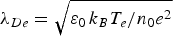 is the Debye length of plasma electrons. Initially, the plasma is assumed to be uniform in the center of the laser spot, in accordance with the experimental situation. A laser field of the form E = E 0 (t)sin ω0t is polarized in the direction with an angle α away from the x-axis, and it has a frequency ω0 and an amplitude E 0 (t) corresponding to a 10 ps full width at half maximum Gaussian pulse. The peak laser intensity is expressed in terms of I 0 = cE 0max2/(8π), where E 0max is the maximum value of the amplitude E 0(t). The electrostatic calculation is suitable for laser intensities below ~5 × 10¹⁷ W/cm2, whereas for higher intensities, when the Lorentz force becomes important, an electromagnetic simulation would be necessary. In our simulations, the initial plasma density and temperature are treated as given parameters, while the laser frequency and peak intensity are varied in order to examine the effects of laser pulse on ion energy loss.
3. STOPPING POWER
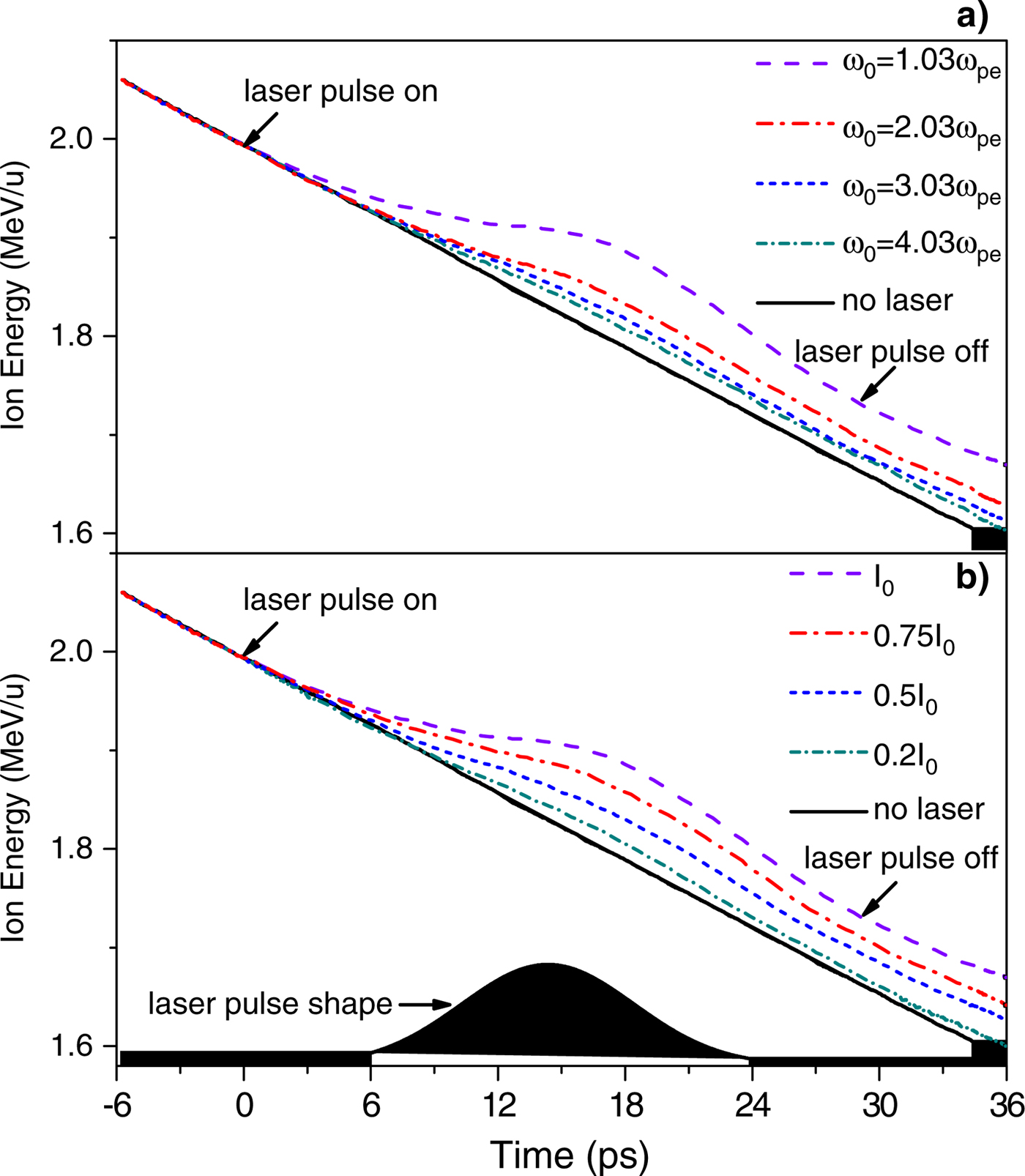
Figure 1 shows the influences of (1) different laser frequencies ω0 and (2) peak intensities I 0 on temporal evolution of the ion kinetic energy. Also shown is the laser intensity envelope, E 0(t). In addition, a situation with no laser is shown in both panels for the sake of comparison with the case of ion traversing the plasma unperturbed by the laser field. The origins of the abscissae in Figure 1 are set to be the time when the laser pulse hits the plasma target. The peak laser intensity I 0 in Figure 1a is set to be 5 × 10¹³ W/cm2, whereas the frequency ω0 in Figure 1b is set at 1.03ωpe, with 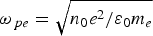 being the frequency of plasma electrons. We assume, without loss of generality, that the ion travels in the positive direction of the x axis and that the laser field is polarized in the direction with α = 45°. It is seen in both panels that the slopes of the ion energy curves are almost constant before the onset of the laser pulse, representing a steady ion energy loss rate in a laser-free plasma. As soon as the laser pulse hits the plasma, the slopes of the ion energy curves become gradually reduced, indicating that the ions lose less energy. In particular, this reduction in energy loss is more pronounced as the laser frequency gets closer to ωpe, or when the peak intensity increases. After the laser pulse is turned off, the ions only interact with heated plasma, and a constant slope is again observed.
(Color online) The effects of (a) different laser frequencies and (b) different peak intensities on the temporal evolution of the ion kinetic energy. The peak laser intensity I 0 in panel (a) is set to be 5 × 10¹³ W/cm2 and the laser frequency ω0 in panel (b) is set to be 1.03ωpe, with 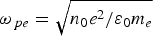 being the frequency of plasma electrons. Also the intensity I 0 in panel (b) represents 5 × 10¹³ W/cm2.
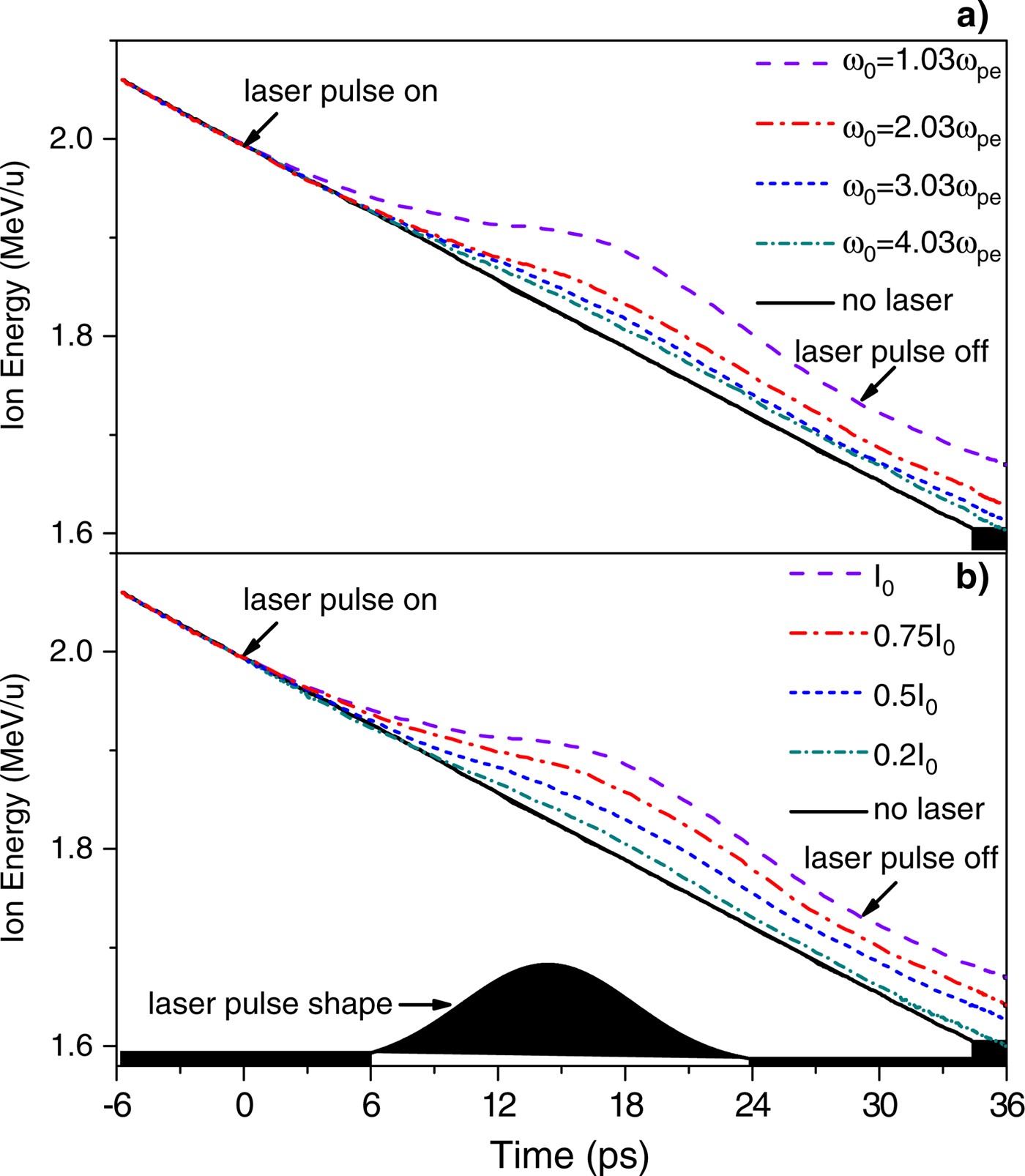
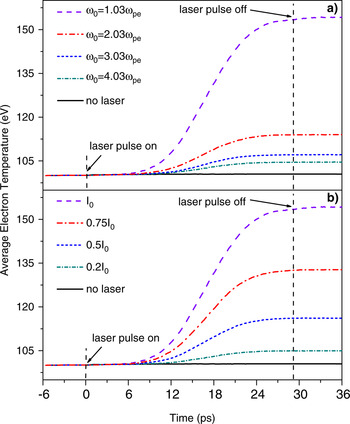
Analyzing the effect of different laser frequencies in Figure 1a, a significant reduction in ion energy loss is observed when laser frequency is near the plasma electron frequency, ω0 = 1.03ωpe. This laser frequency corresponds to laser-plasma interaction near the critical density surface, where parametric excitation of plasma waves occurs and the plasma can be effectively heated by the excited waves (Kruer, Reference Kruer1981). For the type of laser pulse adopted here, the time average of the force exerted by the laser field on the ion is zero. On the other hand, the temperatures of plasma electrons and ions increase due to the energy absorption in plasma from the laser field through the process of wave heating. This increase in plasma temperature is illustrated in Figure 2, where the influences of (1) laser frequency and (2) peak intensity on the temporal evolution of the average plasma electron temperature are shown with the same parameters as in Figure 1. In Figure 2a one observes a significant increase in the electron temperature as the laser frequency approaches the plasma electron frequency. The increase in plasma temperature leads to a large reduction of the ion energy loss, as was previously shown by the linear models (Arista et al., Reference Arista, Galvao and Miranda1990; Hu et al., Reference Hu, Song and Wang2009). As the laser frequency increases, the parametric excitation of plasma waves weakens, so that the plasma is less effectively heated and the ion energy loss is less affected by the laser pulse. The effect of increasing laser intensity, seen in Figure 1b for laser frequency ω0 = 1.03ωpe, may be similarly rationalized as occurring due to the increased amplitude of the excited plasma waves, and hence increased amount of energy transferred from the laser to the background plasma, so that the resulting higher plasma temperature, as shown in Figure 2b, gives rise to a more substantial ion energy loss reduction (Hu et al., Reference Hu, Song and Wang2009).
(Color online) The effects of (a) different laser frequencies and (b) different peak intensities on the temporal evolution of the average plasma electron temperature T e. The other parameters are the same as those used in Figure 1.

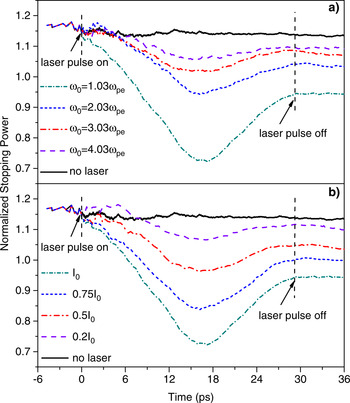
In our simulations, the energy loss ΔE and the traveled path Δs of ions are calculated at each time step, resulting in an instantaneous stopping power ΔE/Δs. The stopping power is finally obtained as a time average over the laser period, S = 〈ΔE/Δs〉, and its temporal evolution relative to the laser pulse is shown Figure 3 for the same set of laser frequencies and intensities as in Figures 1 and 2, and with the same definition of the origins of the abscissae. [Note that S is normalized in Figure 3 by S 0 = (Z pe)2/(4π2ɛ0λDe2).] As in Figures 1 and 2, the stopping power in a plasma without laser is also shown for the sake of comparisons. An initial decrease of the stopping power can be observed in both panels of Figure 3 after irradiation by the laser is turned on, and a minimum stopping power is found around the peak of the laser intensity (occurring at t ≈ 14.5 ps). The stopping power is subsequently seen to increase as the laser intensity decreases, and a steady value of stopping power is reached in the laser-free plasma, after the laser irradiation ceases. As explained in the preceding paragraph, the temperature of the laser-free plasma after the laser irradiation is turned off is elevated with respect to its initial value due to plasma heating that took place during the laser pulse. Hence the ion stopping power after the laser irradiation is smaller than it was before the laser irradiation, as seen in all data displayed in Figure 3. This reduction in stopping power at all times, during and after the laser irradiation, becomes more pronounced when the laser frequency approaches the plasma electron frequency and when the laser intensity increases, in accordance with the conclusions found from Figure 1. The effect of laser frequency is in agreement with conclusions from the linear model, presented by Arista et al. (Reference Arista, Galvao and Miranda1990), who pointed out that the largest decrease in stopping power occurs when ω0/ωpe → 1.
(Color online) The effects of (a) different laser frequencies and (b) different peak intensities on the temporal evolution of the ion stopping power S, normalized by S 0 = (Z pe)2/(4π2ɛ0λDe2), with Z p being the ion charge, ɛ0 the permittivity of free space, and 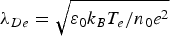 the Debye length of the plasma electrons. The other parameters are the same as those used in Figure 1.

4. PLASMA POLARIZATION
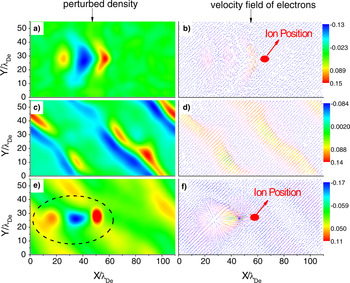
In order to analyze the dynamic polarization of plasma, we display the perturbed density (normalized by n 0) and the velocity field of the plasma electrons in Figure 4. Three different cases are illustrated in the figure for the sake of comparison: (1) plasma interacting with an ion only (Figs. 4a and 4b), (2) plasma interacting with the laser only (Figs. 4c and 4d), and (3) plasma interacting with both the ion and the laser field (Figs. 4e and 4f). The initial kinetic energy of the injected ion in the cases (1) and (3) is set to be 2.06 MeV/u. The laser frequency ω0 and the peak intensity in cases (2) and (3) are set to be 1.03ωpe and 5 × 10¹³ W/cm2, respectively. The plasma parameters used in the figure are the same as those used in Figures 1 and 2. Again, we assume that the ion travels in the positive direction of the x axis in cases (1) and (3), and that the laser field is polarized in the direction with α = 45°. For a plasma interacting with the ion only, as shown in Figures 4a and 4b, the typical V-shaped cone structures are seen lagging behind the ion, along with multiple oscillatory lateral wakes, and with the opening cone angle that decreases with increasing ion speed, as explained in greater detail elsewhere (Hu et al., Reference Hu, Song and Wang2010).
(Color online) The perturbed density (normalized by n 0) and the velocity fields of plasma electrons for three different cases: (1) plasma interacting with the ion only [panels (a) and (b)], (2) plasma interacting with the laser only [panels (c) and (d)], and (3) plasma interacting with both the ion and the laser field [panels (e) and (f)]. The initial ion energy in cases (1) and (3) is set to be 2.06 MeV/u, while the laser frequency ω0 and the laser peak intensity in the cases (2) and (3) are set to be 1.03ωpe and 5 × 10¹³ W/cm2, respectively.

Figures 4c and 4d show case (2) where the plasma interacts with the laser field at the time t = 16 ps after the laser pulse hit the plasma target. For a homogeneous plasma, the parametric excitation of plasma waves can play an important role near the critical surface (Kruer, Reference Kruer1981). In Figure 4d, where the velocity field of plasma electrons is plotted, a strong coupling of the laser field with the electron plasma waves is observed and the plasma waves are seen to be excited along the direction of the laser field polarization (Kruer et al., Reference Kruer, Kaw, Dawson and Oberman1970). At the initial stage of irradiation, plasma is heated mainly by collisional absorption, while the waves are starting to increase exponentially in amplitude. Finally, these waves saturate, concomitant with the onset of a rapid plasma heating due to the acceleration of plasma particles by the large amplitude plasma waves. At this stage, the plasma begins to heat very efficiently according to the anomalous resistivity (Kruer, Reference Kruer1981).
When plasma interacts with both the ion and laser, interference effects between the moving ion and the laser field can be observed in Figures 4e and 4f at the time t = 15.5 ps. A wakefield, as indicated in Figure 4e by the regions encircled by the dotted line, excited by the traveling ion is also seen to lag behind the ion, but the edge shape of the wake field is greatly distorted in comparison to the laser-free case, (1), due to modulation effects of the laser field on the electron motion. Owing to this modulation the response of plasma electrons to the incident ion is greatly hindered, as indicated by the limited development of the wake wave pattern in Figure 4f when compared to that seen in Figure 4b. Under such a destructive interference effect, the amount of energy lost in the wakefield by the moving ion due to collisions and collective excitations is reduced, resulting in a reduced stopping power. At the same time, in regions outside the dotted line, further away from the ion, the plasma waves excited by the laser field through parametric excitation are seen to exist uninhibited by the ion, giving rise to a significant increase of the plasma temperature.
5. CONCLUSIONS
The effects of laser frequency and peak intensity on the temporal evolution of the ion kinetic energy and the ion stopping power were studied in detail by the PIC/MC simulation method. Compared to the laser-free case, a pronounced reduction of the stopping power was found as the laser frequency approaches the plasma electron frequency and as the laser intensity increases. We attribute this reduction to increased plasma temperature due to the energy absorbed in plasma from the laser pulse through the process of wave heating. In addition, owing to the modulation of the ion wake by the laser field, the dynamic polarization of the plasma by moving ion is found to be strongly hindered in comparison to the laser-free case.
ACKNOWLEDGMENT
This work is supported by the National Basic Research Program of China (Grants No. 2010CB832901 and No. 2008CB717801), the Fundamental Research Funds for the Central Universities (Grant No. DUT10ZD111), and the Program for New Century Excellent Talents in University (NCET-08-0073). ZLM acknowledges support by the Natural Sciences and Engineering Research Council of Canada.